Local SEO is the key to ensuring your tree care business appears in local searches like "tree removal near me." Here’s a quick overview of how to boost visibility and attract more customers:
- Google Business Profile (GBP): Claim, verify, and optimize it with accurate details, photos, and regular updates.
- Website Optimization: Use location-specific keywords, create service and city pages, and ensure fast, mobile-friendly performance.
- Tracking Tools: Set up Google Analytics 4 (GA4), Google Search Console, and call tracking to monitor leads and conversions.
- Reviews: Actively request and respond to customer reviews to build trust and improve rankings.
- Citations & Backlinks: Ensure consistent business listings across directories and build local backlinks for authority.
- Content Creation: Publish locally relevant content, such as guides, FAQs, and seasonal tips, to engage your audience.
With 46% of Google searches having local intent and 80% of local searches converting into leads, these steps can make a measurable difference in your business growth. Start by auditing your current performance, and then focus on optimizing your online presence for local customers.
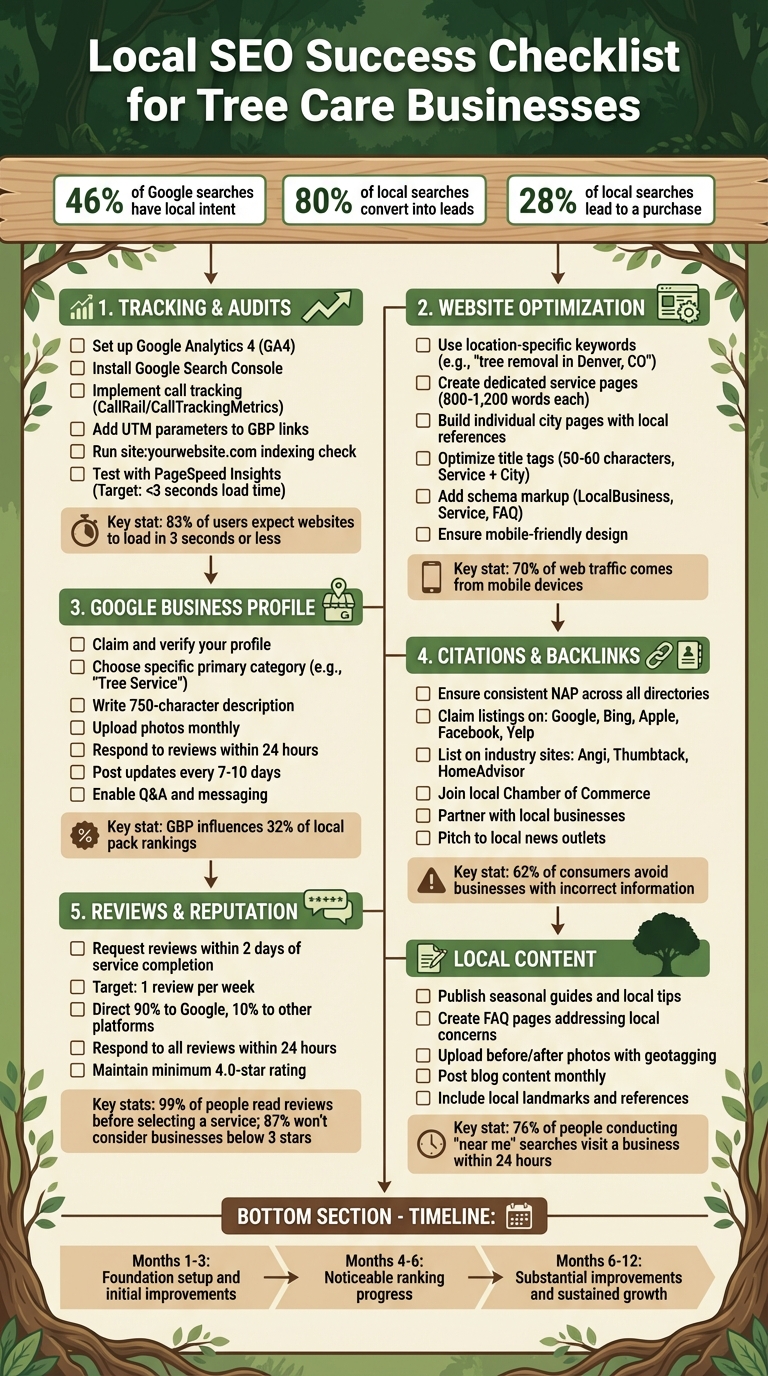
Local SEO Checklist for Tree Care Companies – Complete Implementation Guide
Mastering Tree Service SEO: Dominate Google & Grow Your Business!
Setting Up Tracking and Performance Audits
Before diving into strategies, it’s crucial to understand where you currently stand. Tracking tools not only give you a starting point but also help identify which efforts are bringing in paying customers.
Installing Analytics and Call Tracking
Start with Google Analytics 4 (GA4) to monitor website traffic and conversions. Set up the tracking code and define Goals for key actions like form submissions or emergency service calls. For example, a "Thank You" page after a form submission can act as a conversion trigger.
Integrate Google Search Console with GA4 to track keyword performance, fix crawl errors, and ensure proper indexing.
Since phone calls often lead to high-value customers, install a call tracking tool like CallRail or CallTrackingMetrics. These tools help identify whether calls come from organic search, your Google Business Profile, or paid ads. Dynamic Number Insertion (DNI) can display tracking numbers based on the source while keeping your primary business number intact.
"Proper tracking is the single most important element in your local business digital marketing stack." – Nick Pierno, Director of Custom Projects, Whitespark
Add UTM parameters to your Google Business Profile link (e.g., ?utm_source=google&utm_medium=organic&utm_campaign=gmb-listing) to distinguish profile clicks from regular organic traffic in GA4. This helps you see how many leads come from Google Maps versus standard search results.
Running a Local SEO Audit
Once tracking is in place, it’s time to audit your local SEO performance. Start by typing site:yourwebsite.com into Google to check if your pages are indexed correctly.
Next, review your Google Business Profile to ensure it’s claimed, verified, and set up with the right primary category (e.g., "Tree Service" or "Arborist"). Also, confirm that your business name, address, and phone number (NAP) match exactly across your website and directory listings.
Use Google PageSpeed Insights to test your site’s loading speed and mobile usability. Speed matters – 83% of users expect a website to load in 3 seconds or less. Slow-loading sites not only frustrate visitors but can also hurt your local rankings. Check for broken links, 404 errors, and ensure your NAP details are in text format, not embedded in images.
Search for your business on major directories like Yelp and Yellow Pages to identify duplicate or inconsistent listings that could harm your visibility. Look at your star ratings and total reviews. Negative feedback often reveals issues you might need to address.
Finally, compare your profile to top-ranking competitors in your area. How many reviews do they have? What categories are they using? What does their website offer? This analysis can highlight areas where you’re falling behind.
Creating a Reporting Schedule
After your audit, set up a schedule to review progress regularly. Monthly reviews should focus on metrics like website traffic, phone leads, and keyword rankings. Pay attention to signals of high-intent customers, such as direction requests from your Google Business Profile, clicks-to-call, and form submissions.
Plan quarterly audits to identify broader trends and seasonal patterns. For instance, you might notice an increase in storm damage inquiries during certain months. Regular reporting helps you see the bigger picture, avoiding overreactions to daily fluctuations, and ensures your SEO efforts are on track.
| Metric Category | Key Metrics to Track | Tool to Use |
|---|---|---|
| Conversions | Phone calls, form fills, quote requests | CallRail, GA4 |
| GBP Engagement | Direction requests, profile calls, photo views | GBP Insights |
| Visibility | Local Pack rankings, organic keyword position | Search Console, BrightLocal |
| Reputation | Star rating, review volume, response rate | GBP, Yelp |
| Technical | Page load speed, mobile usability, indexing errors | PageSpeed Insights, GSC |
Optimizing Your Website for Local Search
Using the data from your tracking and audits, it’s time to fine-tune your website to attract local tree care customers. By clearly emphasizing your location and services, you can turn local search traffic into paying customers.
Using Service and Location Keywords
To connect with local customers, incorporate specific keywords like "tree removal in Denver, CO" throughout your site. Add them to key areas such as homepage headlines, service page titles, meta descriptions, headings, image alt tags, and even your URL slugs. Make sure your title tags highlight the service and location upfront. For instance, "Tree Removal Denver, CO | Emergency Storm Cleanup" is more effective than "ABC Tree Company | Tree Removal Services in Denver".
Your URL structure should also reflect this approach. Use clean, descriptive paths like yourtreecompany.com/tree-removal-denver-co instead of vague URLs such as /services/page-12.
"If you want to rank well in each town, then yes [you need a separate page]. A page for each area helps Google understand where you operate." – Local Tree Service Marketing
Considering that 72.7% of users click organic or map results over paid ads, and 28% of local searches lead to a purchase, getting your keywords and structure right can have a direct impact on your business.
Building Service and City Pages
To capture more local traffic, create individual pages for each service and area you serve. Instead of cramming everything into a single "Services" page, build dedicated pages for offerings like tree removal, pruning, stump grinding, and emergency services. Then, add separate pages for each major city or town you cover, accessible via a footer link or an "Areas Served" menu.
Each page should feature 800–1,200 words of original content. Blend useful information – like the importance of tree trimming or common causes of storm damage – with details about your business. Avoid duplicating text across city pages. Instead, tailor each one with local references, such as landmarks, neighborhood names, weather challenges, and customer testimonials.
Add a Google Map to each city page to reinforce your geographic relevance. Make sure your NAP (Name, Address, Phone number) is in text format so search engines can read it. Since most local searches are done on mobile and 80% of smartphone users who search for local businesses make an offline purchase, include easy-to-use click-to-call buttons and quote request forms on every page.
| Page Element | Optimization Requirement |
|---|---|
| Title Tag | 50–60 characters; include "Service + City" at the start |
| Meta Description | 50–160 characters; include target keyword and a clear CTA |
| Word Count | 800–1,500 words for competitive markets |
| Schema Type | LocalBusiness, Service, and FAQ markup |
| Load Speed | Under 3 seconds |
Use high-quality, original photos of your team, equipment, and completed projects on your service pages. Avoid stock images – they don’t build trust. Instead, upload real visuals and add descriptive alt text with keywords, like "tree removal crew working in Denver backyard".
Fixing Technical SEO Issues
Even the best content won’t perform well if your site has technical problems. Start by ensuring your site is mobile-friendly. Google prioritizes mobile versions for ranking, and with 70% of all web traffic coming from mobile devices, your site must adapt seamlessly to different screen sizes.
Keep your site fast – 83% of users expect it to load in 3 seconds or less, and every extra second can reduce conversions by 7%. Tree care websites often feature large images, so compress them to avoid slowing down your site. Use tools like Google PageSpeed Insights or GTmetrix to identify other issues like slow server response times or unoptimized JavaScript.
Make sure your site is secure with HTTPS and an SSL certificate. Since 2014, Google has favored secure sites, and a "Not Secure" warning can drive visitors away. Check that all your pages are indexed by searching site:yourdomain.com on Google. If anything is missing, submit an XML sitemap through Google Search Console.
Add schema markup (like LocalBusiness, Service, and FAQ) to help search engines understand your site and improve your chances of earning rich snippets. If you remove any pages, set up 301 redirects to preserve link equity.
"Local and organic traffic makes up nearly 70% of all traffic to websites." – Stephanie Heitman, Associate Director of Content, LocaliQ
Finally, ensure your NAP details are in HTML text format, not embedded in images, so search engines can properly associate them with your location. By addressing these technical aspects, you’ll strengthen your local rankings and prepare for the next steps in managing reviews and creating local content.
Building Off-Site SEO for Local Rankings
Once your website is optimized, it’s time to strengthen your presence beyond your site. Tools like Google Business Profile, consistent citations, and local backlinks can help establish your business as a trusted part of the community.
Setting Up Google Business Profile
Your Google Business Profile (GBP) is one of the most powerful tools for improving local rankings. Start by searching for your business on Google Maps. If it’s already listed, click "Own this business?" to claim it. Verification in 2025 can be done through postcards, phone calls, texts, emails, or even video verification where you show your storefront and equipment.
Choose a specific primary category that reflects your main service, like "Tree Service", instead of a broad term like "Contractor." Add secondary categories such as "Stump Grinding" or "Arborist" to cover all your offerings. If you don’t have a physical storefront, hide your home address and define your service areas by listing specific cities, counties, or a radius.
Write a 750-character business description, focusing the first 250 characters on what sets you apart. Naturally include keywords like "tree removal" or "emergency tree service", but avoid stuffing them into your business name – this could lead to profile suspension. Upload high-quality photos of your projects, team, and branded equipment at least monthly. Businesses with active photo galleries tend to get more clicks and direction requests.
Respond to all reviews within 24 hours, whether they’re positive or negative, to build trust and show Google your business is active. Publish Google Posts every 7–10 days to keep your profile fresh. Use the Q&A section to post and answer common questions like "Do you offer free estimates?" Enable messaging for direct inquiries, but ensure you respond promptly, as response time can affect your ranking.
Creating Citations and Directory Listings
Citations – mentions of your business name, address, and phone number (NAP) – are essential for local SEO. Consistency is key. Even minor differences, like using "St." in one place and "Street" in another or listing a toll-free number instead of a local one, can confuse search engines and hurt your rankings.
Start by claiming your listings on major platforms like Bing Places, Apple Business Connect, Facebook, Yelp, YellowPages, and Foursquare. Then, focus on industry-specific directories such as Angi, Thumbtack, HomeAdvisor, and the Better Business Bureau. These directories are particularly effective for reaching customers actively searching for home services.
Use tools like BrightLocal’s Citation Tracker or Semrush to audit your listings, fix inconsistencies, and identify directories where your competitors appear. Duplicate listings can weaken your SEO, so remove or merge any duplicates.
| Directory Category | Examples for Tree Care | Purpose |
|---|---|---|
| Major Search/Maps | Google Business Profile, Bing Places | Visibility in search results and map packs |
| General Directories | Yelp, YellowPages, Facebook, Foursquare | Broad digital footprint and trust signals |
| Industry/Niche | Angi, Thumbtack, HomeAdvisor | Targeted reach for home service customers |
| Local/Community | Chamber of Commerce, local news sites | High-authority links and geographic relevance |
Incorrect information online can drive away 62% of consumers, so keep your listings accurate and up-to-date.
Once your citations are in order, shift your focus to building local backlinks to further enhance your online authority.
Getting Local Backlinks
After verifying your business listings and ensuring consistency, start building local backlinks to strengthen your rankings. Backlinks from local websites signal to Google that your business is trusted and well-established in the area.
Reach out to suppliers, distributors, and nearby businesses to request links on their "Partners" pages.
Join your local Chamber of Commerce or business associations for credible backlinks with consistent NAP details. You can also gain local authority by partnering with community organizations or contributing expert commentary to local news outlets.
"The main takeaway here is that the more involved you are in the communities you serve, the more reason you will be giving local people to talk about and link to your business." – Miriam Ellis, Local Search Scientist, Moz
Pitch seasonal tips or expert insights to local digital news sites. For example, offer advice on tree safety during storms or other local environmental issues to secure high-quality PR-based links. Additionally, create "best of" guides or community-focused blog posts that local organizations might link to as a resource.
SEO tools can also help you identify where competitors are getting backlinks. Target those same directories or organizations for your own business. Considering that local and organic traffic makes up nearly 70% of all website visits, and 76% of people conducting "near me" searches visit a business within 24 hours, building a strong local backlink profile can have a direct impact on your success.
sbb-itb-130a704
Managing Reviews and Creating Local Content
Online reviews and locally focused content are powerful tools for building trust and improving your search rankings. With 99% of people reading reviews before selecting a service provider and 85% trusting online reviews as much as personal recommendations, managing customer feedback is just as critical as website optimization.
Requesting and Responding to Reviews
Timing is everything when it comes to reviews. Ask for feedback right after completing a job – this is when customers are most likely to be happy with your service. Direct 90% of your review requests to Google and the remaining 10% to platforms like Yelp, BBB, or Angi. Make it easy for customers by sending review links through text, email, or even a QR code on the invoice within two days of service. Train your team to let customers know in person that they’ll receive a review link soon.
Consistency is key. Aim for one review per week to keep your feedback steady and relevant. With about 50% of customers choosing businesses with at least a 4.0-star rating, maintaining a solid reputation is more important than amassing a large number of reviews.
When responding to positive reviews, personalize your reply by thanking the customer by name and referencing the specific service provided: "We’re so glad we could assist with your emergency tree removal!". This not only shows appreciation but also helps with keyword relevance. For negative reviews, address concerns promptly, take responsibility, and offer a direct way to resolve the issue offline, like a phone number or email.
"In the customer’s mind the clock starts when he or she posts a negative review, and your reputation drops with every hour you delay providing a response. Bad reviews that remain unanswered signal to other customers you are disinterested." – Chip Bell, customer service expert
Here’s a quick guide on how to handle different types of reviews:
| Review Type | Response Goal | Key Element to Include |
|---|---|---|
| Positive | Build Loyalty & SEO | Thank the customer; mention the specific service provided. |
| Neutral | Clarification | Thank them for the feedback; ask for details on how to improve. |
| Negative | Damage Control | Apologize; take responsibility; provide direct contact info. |
While managing reviews is essential, creating relevant local content can further strengthen your connection with the community.
Writing Content for Local Customers
Pair your review strategy with content that resonates with your local audience. Write about seasonal topics, common issues, and local concerns. For instance, create posts like "5 Signs Your Oak Tree is Diseased" or seasonal guides such as "Prep Your Trees for a Winter Storm" and "Best Time for Tree Trimming in Ohio". FAQ pages are another great way to address local search queries, with topics like "How Much Does Stump Grinding Cost in Cleveland?" or "Local Regulations for Tree Removal in [Your City]".
Add a visual touch by uploading before-and-after photos of recent projects to your website and Google Business Profile, and use geotagging to emphasize your local presence. Keep your Google Business Profile active by posting updates every 7 to 10 days, sharing project highlights or seasonal tips. Since nearly 70% of all website visits come from local and organic traffic, content tailored to your community can lead to meaningful results.
How Tree Company Leads Can Support Your Local SEO
Managing local SEO can be a challenge, especially for tree care businesses that already have their hands full. That’s where Tree Company Leads steps in. They handle the technical side of things, letting you focus on running your business. Here’s how they simplify local SEO, from personalized ad strategies to smart review management.
Custom SEO and Marketing Services
Tree Company Leads offers a specialized Maps SEO system that takes care of everything – keyword targeting, local optimization, content creation, and ranking strategies. The result? Google Maps becomes a powerful tool for attracting leads. They also provide professional web design services, creating dedicated service pages and localized landing pages to boost your online presence.
When it comes to advertising, they manage Google Ads and Local Service Ads with budgets ranging from $600 to $2,000 and $1,000 to $2,000, respectively. Their strategy not only improves your immediate visibility through paid ads but also strengthens your long-term search rankings. On top of that, they offer an exclusive pay-per-lead model, ensuring a steady flow of high-quality prospects.
Implementing the Checklist for You
Tree Company Leads aligns their services with a detailed local SEO checklist to cover all the bases. They use tools like Google Analytics and Search Console to track keyword performance and monitor your local reach across neighborhoods . To optimize your Google Business Profile, they focus on accurate categorization and consistently upload geo-tagged photos.
Their efforts don’t stop there. They integrate your CRM with automated email and text systems to request customer reviews immediately after a job is done. Plus, they publish monthly blog posts and video content to position your business as a trusted local expert. While it may take 3 to 6 months to secure top-page rankings for competitive keywords like "tree removal", Tree Company Leads takes care of the entire process. That way, you can stay focused on what you do best – caring for trees.
Conclusion
Succeeding in local SEO for tree care comes down to four key areas: tracking, on-site optimization, off-site authority, and reputation management. These elements work together to ensure your business shows up when potential customers search for terms like "tree removal near me" or "emergency arborist in [City]." With about 80% of local searches turning into leads, having a well-thought-out strategy is essential .
Start with reliable tracking data and a polished Google Business Profile, which influences approximately 32% of local pack rankings. Pair that with a fast, mobile-friendly website (loading in under three seconds), consistent NAP (Name, Address, Phone) details across directories, and a steady flow of customer reviews, and you’re setting yourself up for success. Keep in mind, 87% of consumers won’t consider a business unless it has a rating of 3 to 5 stars, making review management a must.
While results take time, patience pays off. You can expect to see noticeable progress within 4–6 months, with more substantial improvements in 6–12 months. This process requires ongoing effort – monitoring keyword rankings, ensuring citations are accurate, and consistently producing quality content.
"Local SEO isn’t rocket science. But it does take consistency, clarity, and a little creativity." – Matt Sullivan, CEO of Torro Media
The foundation is clear, so the next step is action. Whether you take on these tasks yourself or work with specialists like Tree Company Leads, the key is to start now. Focus on the essentials: claim your Google Business Profile, fix technical issues, and actively collect customer reviews. Each step you take boosts your visibility and strengthens your position in the local market.
FAQs
What are the best ways to optimize my Google Business Profile for local SEO?
To get the most out of your Google Business Profile for local SEO, start by claiming and verifying your profile. Double-check that your business name, address, and phone number (NAP) are correct and match across all platforms. Choose the service categories that best describe your tree care business, and add high-quality photos and videos to highlight your work.
Keep your profile up to date by regularly reviewing your hours, services, and other details. Aim to post new content, like updates or promotions, at least twice a month to keep your profile active. Encourage happy customers to leave reviews, and make sure to respond to them – whether they’re positive or not – in a professional and timely manner. Following these steps can boost your local visibility and help you connect with more potential clients.
What should be included on service and city pages to improve local SEO for tree care businesses?
To improve service and city pages for local SEO, make sure to include the city-plus-service keyword in the title tag, H1, and meta description. Keep your Name, Address, and Phone number (NAP) consistent throughout the page, and embed a Google Map to boost local relevance. Incorporate local schema markup, like LocalBusiness, FAQ, or Reviews, to help search engines better understand your content.
Enhance the page with high-quality photos, customer testimonials, and a clear call-to-action to keep visitors engaged. Additionally, use internal links with location-specific anchor text to make navigation easier and strengthen your SEO efforts.
Why is it important to keep your business’s name, address, and phone number (NAP) consistent online?
Keeping your NAP information (Name, Address, Phone Number) consistent across all online platforms is a key factor in local SEO. Search engines rely on this information to confirm your business’s authenticity, and any inconsistencies can hurt your local rankings. Plus, errors or mismatched details might confuse potential customers, causing them to look elsewhere.
To avoid this, make sure your business name, address, and phone number are accurate and match across platforms like your Google Business Profile, online directories, and your website. This not only strengthens trust but also boosts visibility and ensures customers can easily reach you.