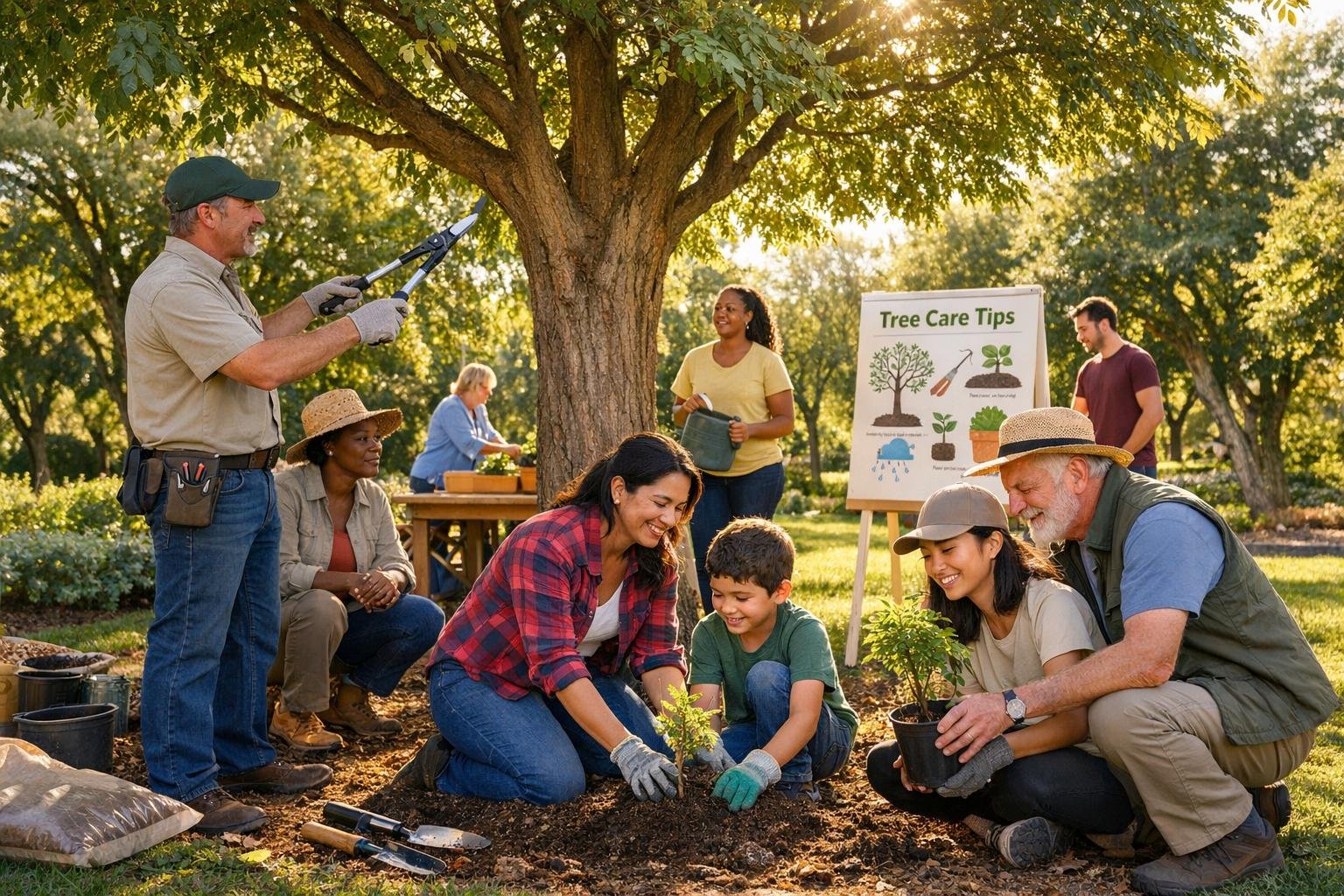
Engaging your community is key to success in tree service marketing. Why? It builds trust, creates loyal customers, and helps your business stand out. Here’s how:
- Workshops and Events: Host tree care workshops or partner with schools to educate and connect with locals.
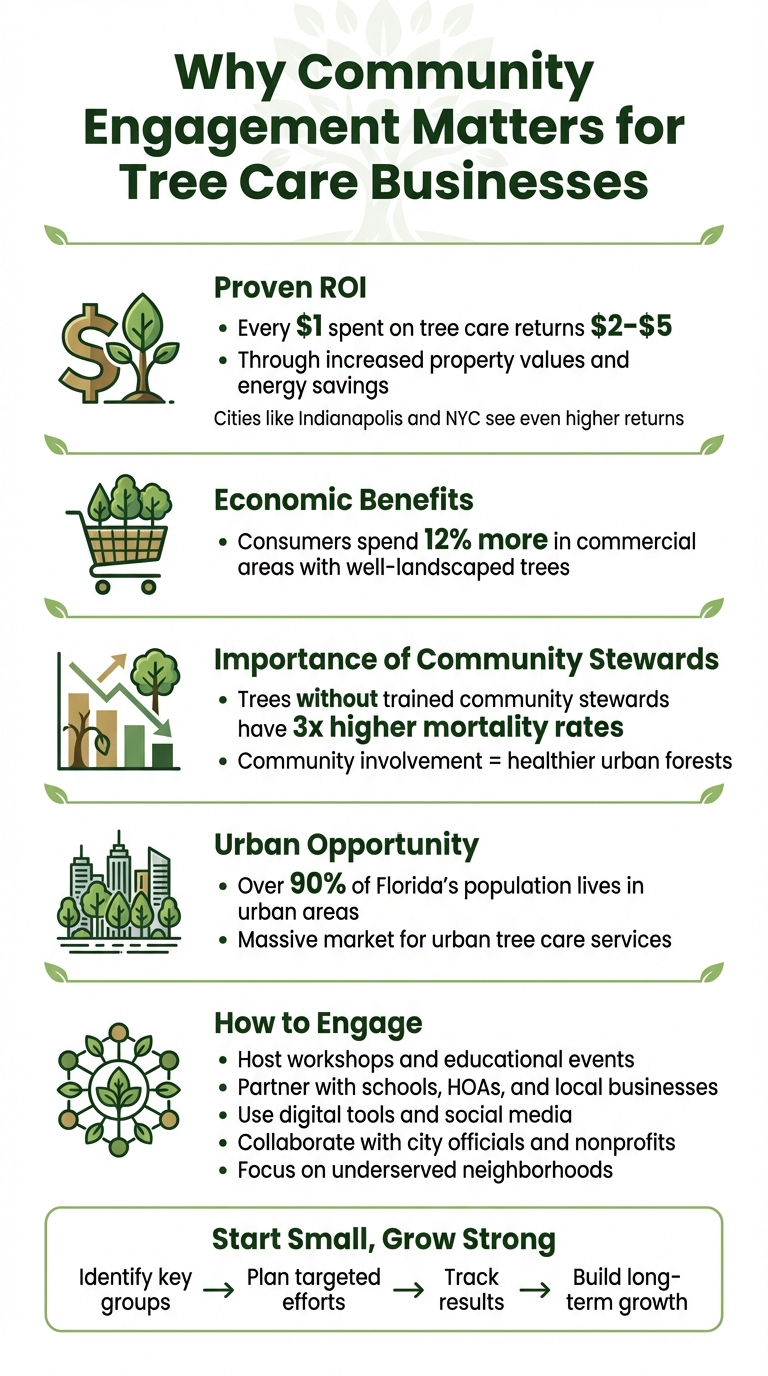
- Proven ROI: Every $1 spent on tree care can return $2–$5 through increased property values and energy savings. Cities like Indianapolis and NYC see even higher returns.
- Stronger Relationships: Collaborate with homeowners, HOAs, city officials, and nonprofits to secure contracts, reduce conflicts, and gain referrals.
- Tailored Outreach: Focus on local needs – offer free tree care in underserved areas or partner with businesses for landscaping projects.
- Digital Tools: Use social media and online workshops to expand your reach and share expertise.
Start small: Identify key groups, plan targeted efforts, and track results. Building strong community ties today ensures long-term growth for your business tomorrow.
ROI and Benefits of Community Engagement in Tree Care
What Community Engagement Means for Tree Care Businesses
Defining Community Engagement in Tree Care
Community engagement goes far beyond handing out flyers or posting sporadically on social media. The Centers for Disease Control and Prevention (CDC) defines it as "the process of working collaboratively with and through groups of people affiliated by geographic proximity, special interest, or similar situations to address issues affecting the well-being of those people".
For tree care businesses, this boils down to creating meaningful conversations – both to understand the community’s needs and to share your expertise in tree care. Walt Whitmer from Penn State Extension captures this well:
Effective community engagement is more than simply talking to, or informing our citizens or constituents about the things we want them to know about.
The benefits are clear. When your company is viewed as a trusted community partner, you’re likely to see more referrals, less pushback on tree removal projects, and stronger support for urban tree initiatives. For instance, research shows that consumers spend 12% more in commercial areas with well-landscaped trees. This underscores how tree care businesses can position themselves as essential contributors to their communities.
The next step? Identifying the key groups in your community that can help drive these efforts.
Who You’ll Work With in Your Community
Once you understand the essence of community engagement, it’s time to focus on the right collaborators. Different groups offer unique opportunities for partnership.
Homeowners and renters are often your primary audience – they’re the ones reaching out for help after a storm in Mobile or seeking advice on pruning. Homeowners Associations (HOAs) and neighborhood groups present opportunities for bulk contracts and word-of-mouth referrals.
City governments, including elected officials and municipal staff, play a crucial role. They manage public tree contracts and set local regulations. Building strong relationships here can open doors to larger projects and keep you informed about upcoming policy changes. Local businesses also benefit from well-maintained landscapes that draw in more customers, making them another valuable partner. Schools, on the other hand, offer opportunities for educational workshops that connect your expertise with families and younger generations.
Nonprofit organizations, like garden clubs, environmental groups, and conservancies, are natural allies for tree planting events and stewardship programs. A great example comes from Tampa, where the city collaborated with UF/IFAS Extension in 2013 to conduct focus groups that identified barriers to tree care. This led to the creation of a neighborhood tree steward initiative and an expanded tree species program, empowering residents with knowledge about tree selection and maintenance.
Core Principles for Successful Engagement
After identifying your key collaborators, it’s essential to follow some guiding principles for building meaningful relationships. Transparency is the foundation of trust. Clearly explaining your tree care recommendations – and being honest when you don’t have all the answers – can go a long way in fostering loyalty and credibility.
Consistency is just as critical. Whether it’s attending regular neighborhood meetings or actively sharing tips in local social media groups, consistent interaction helps establish your presence and reliability.
Michael Kuhns, Extension Forestry Specialist at Utah State University, emphasizes:
Community involvement must include residents who will be impacted by a project, involve them early and throughout the process, and ensure some citizen control over the process.
Lastly, cultural awareness is vital. Understanding the demographics, economic conditions, and resources available in your community allows you to tailor your approach. A suburban neighborhood with ample resources might support an extensive tree preservation program, while a working-class area may need affordable or free tree care options. Engaging stakeholders early ensures your efforts align with local priorities and create lasting value.
sbb-itb-130a704
Creating Your Community Engagement Plan
Identifying Local Needs and Setting Clear Goals
Before diving into any community engagement efforts, start with a needs assessment. Look into existing community forestry programs, municipal budgets, and the level of support from elected officials and local businesses. This groundwork helps identify where your tree care business can make the most impact.
A tree inventory is a great way to build a data-driven foundation for your plan. Survey neighborhoods to document tree locations, species, conditions (good, fair, or poor), and maintenance needs. For a quick overview, try a "windshield survey" – a simple drive-through to estimate tree numbers, spot planting gaps, and flag obvious issues like pest problems or improperly pruned trees.
Understanding the community’s concerns is just as critical. Use tools like surveys and focus groups to gather input. For example, similar methods have been used to successfully develop neighborhood tree steward programs and expand tree species options to address local knowledge gaps.
Bill Elmendorf, Professor and Ibberson Chair in Community and Urban Forestry at Penn State University, offers a great analogy:
Community tree plans are like road maps. They are not the destination, but they help get you there.
Once you’ve collected your data, conduct a SWOT analysis to uncover strengths, weaknesses, opportunities, and threats, much like evaluating local SEO vs paid ads for your marketing strategy. This analysis helps pinpoint the best starting points. For instance, if your community has active garden clubs (a strength) but struggles with limited municipal funding (a weakness), you could focus on collaborating with these clubs instead of relying on city contracts.
With a solid understanding of local needs, set clear and actionable goals. Start with a broad vision, narrow it down to achievable goals, and then outline specific objectives and strategies. For example, your vision might be "a thriving urban forest." A goal could be "planting diverse tree species annually", with an objective of "engaging the community through quarterly workshops." This structured approach ensures transparency and keeps stakeholders involved from the beginning.
Armed with this knowledge and a clear plan, you can now fine-tune your strategies for different segments of your community.
Choosing Your Target Audiences
Not everyone in your community will need the same approach. Segment your audience by considering factors like income levels, education, age, and how different neighborhoods view urban nature.
For example, higher-income areas might support tree preservation programs, while working-class neighborhoods may benefit more from free or low-cost tree care services. Schools can be great hubs for reaching families through educational workshops, and partnerships with local governments can lead to larger public tree care projects. Since over 90% of Florida’s population lives in urban areas, understanding urban demographics is crucial for effective engagement.
Get stakeholders involved early. Engage residents, business owners, and community leaders during the planning phase, not after decisions are made. Hosting workshops where key community members can review draft plans and provide feedback reduces potential conflicts and builds trust. For example, in Duval County, Florida, UF/IFAS Extension trained Master Gardener Volunteers in structural pruning and park tree maintenance. Surveys showed these volunteers felt they were making a real difference in the urban forest while also enjoying stronger community connections.
Planning Your Budget and Resources
Your engagement plan needs a realistic budget that accounts for staff time, materials, equipment, and potential community contributions. As William Elmendorf, Ph.D., Associate Professor at Penn State Extension, explains:
An annual budget is used to identify the resources needed to fulfill the annual work plan. Resources include not only money but also people, time, materials, equipment, and donations.
Start by creating an annual work plan that breaks your long-term goals into smaller, manageable focus areas for the year. Then, design a budget that supports these plans. For example, if you’re planning quarterly tree care workshops, your budget might include venue costs, educational materials, demo equipment, and staff hours for preparation and presentation.
Diversify your funding sources to stretch your budget further. Apply for state environmental grants, collaborate with civic organizations, or launch "Remembrance Tree Programs" where residents can donate trees in honor of loved ones. These creative funding options can help cover the costs of community projects.
| Resource Category | Examples for Engagement | Purpose |
|---|---|---|
| Personnel | Staff arborists, interns, volunteers, consultants | Data collection, workshops, and supervised planting |
| Equipment | GPS units, handheld computers, planting tools | Ensuring inventory accuracy and supporting outreach events |
| Materials | Mulch, saplings, educational brochures | Improving physical spaces and educating the community |
| Administrative | Insurance, permit fees, software licenses | Managing risks and maintaining data |
| Funding Sources | Grants, civic donations, corporate foundations | Reducing business costs for community projects |
Invest in training volunteers or junior staff to expand your reach. While professionals should handle complex tasks, trained volunteers can collect data on tree species and conditions. Using tools like GIS software or handheld computers can improve efficiency and make reporting faster, which helps justify your budget to stakeholders.
Face-to-Face Community Outreach Methods
Joining Local Events and Celebrations
Getting involved in local events like Arbor Day celebrations offers a natural way for tree care businesses to connect with their community. These gatherings often feature tree planting ceremonies and educational activities, providing the perfect platform to showcase your expertise. You can also set up booths at Earth Day festivals, neighborhood cleanups, and local fairs to share practical tree care tips.
Attending public forums or municipal meetings about urban forestry is another great way to engage. Participating in shade tree commission meetings helps build relationships with local officials and active community members. Schools offer additional opportunities – leading tree planting projects or giving educational talks can create lasting connections and even inspire young people to explore "green job" opportunities.
At community planting events, involve residents by letting them choose tree species from a pre-approved list. This not only increases their investment in the project but also boosts the likelihood of long-term care for the trees.
Running Tree Care Workshops and Demonstrations
Once you’ve established a presence at community events, hosting hands-on workshops can deepen your connection with local residents. These workshops can focus on practical skills like structural pruning, tree identification, species selection, and seasonal maintenance techniques. Partnering with local hardware stores or community centers can make these sessions more accessible and familiar.
For example, in 2013, Tampa and UF/IFAS Extension launched a neighborhood tree steward program that educated residents on tree selection and care, expanding options for right-of-way plantings. Similarly, in 2019, UF/IFAS Extension in Duval County, Florida, trained Master Gardener Volunteers in structural pruning and park tree maintenance, with participants reporting high satisfaction in their contributions to the urban forest.
To make these workshops more inclusive, offer flexible scheduling, simple registration processes, and multilingual materials. During demonstrations, teach practical techniques like the "donut" mulch method, which involves applying a 2–4 inch ring of organic mulch around the base of a tree. Highlight the importance of watering newly planted saplings – about 15–25 gallons per week during their first year – to help them establish strong root systems.
These sessions also provide a chance to recruit "Tree Stewards", volunteers who can take responsibility for local tree care. Since trees without trained community stewards have a mortality rate three times higher, these programs are critical for maintaining a healthy urban forest.
Reaching Out to Individual Neighborhoods
Neighborhood-focused outreach is key to building trust and visibility. Use tools like branded yard signs, door hangers, and flyers to highlight your work and engage with the community.
Identify a local "tree champion" to spearhead neighborhood initiatives. For instance, in April 2025, La Grande, Oregon, launched a three-year program with a Community Forestry Outreach Coordinator to plant 100 trees annually.
Focus on underserved neighborhoods with low canopy cover to address environmental equity. Organize activities like guided tree walks, cleanup events, and "meet the arborist" sessions in parks or schoolyards to foster trust and awareness. Writing articles for local newspapers or community newsletters is another effective way to share seasonal tree care tips and encourage requests for new plantings. These direct, neighborhood-level efforts often lead to stronger community partnerships and long-term collaboration.
Using Digital Tools for Community Engagement
Connecting Through Local Social Media
Social media offers tree care businesses a direct and affordable way to connect with local communities. Platforms like Facebook and Instagram are particularly effective for sharing photos and videos of tree work, which tend to resonate well with older audiences. The goal? Create posts that encourage likes, comments, and shares to expand your reach.
"A post that triggers engagement and gets you thousands of impressions and introduces your tree service business to a new audience is far more effective than a promo post that is seen by a half-dozen followers that already know you exist." – TreeCareSEO
For hyper-local outreach, platforms like Nextdoor shine. They’re perfect for sharing time-sensitive updates like winter storm warnings or fire prevention tips. Participating in neighborhood-specific Facebook groups can also help you answer tree care questions and establish yourself as a trusted local expert. Want to grow your audience quickly? Try running contests where participants tag local friends – it’s a proven way to boost visibility.
A balanced content strategy is crucial. Mix in entertaining posts, practical tree care tips, and special promotions instead of relying solely on ads. Tools like Hootsuite make it easier to plan a month’s worth of content in advance. Including videos of the business owner or team members adds a personal touch, making your brand feel approachable. And don’t stop at posts – digital workshops can take your engagement to the next level.
Running Online Workshops and Q&A Sessions
Virtual workshops are a great way to address local concerns while reaching a wider audience. Before hosting one, consider surveying your community to uncover their biggest challenges, like pest problems or storm damage prevention.
Organizations like the Alliance for Community Trees have shown how webinars can build local expertise. Their Environmental Justice Training Series, for instance, tackles issues like fostering dialogue between renters and property owners and building trust in urban forestry. Similarly, The Stewardship Network’s monthly webcasts and the Florida Tree Stewards program introduced by UF/IFAS in 2025 offer valuable models for engaging communities through hybrid and online initiatives.
Focus your sessions on practical skills, such as structural pruning, young tree care, or spotting hazardous conditions. Enhance presentations with visuals like satellite imagery, local planting photos, and video demonstrations. Promote your events through social media, newsletters, and city websites, and use text message reminders to boost attendance. Recording these workshops and creating an online resource library ensures residents can access the information anytime.
"Educational efforts should be considered as two way; urban natural resource professionals may have as much to learn and as great a need to change perspectives as the community impacted by a project." – Michael Kuhns, Extension Forestry Specialist, Utah State University
Sharing Your Community Work Online
Showcasing your involvement in the community builds trust and highlights your dedication beyond regular services. For example, sharing before-and-after photos of tree trimming, land clearing, or restoration projects demonstrates the impact of your work. Posting pictures from Arbor Day events, local festivals, or neighborhood planting projects underscores your active role in the community.
Collaborations with schools, businesses, and civic organizations can further emphasize your commitment. If you offer unique programs like a "Remembrance Tree" initiative to honor life events, share the stories and photos behind them to highlight their personal importance. Documenting volunteer efforts, tree inventories, or hands-on workshops reinforces your role as a community educator.
Prioritize content that encourages interaction over constant promotion. Behind-the-scenes videos of your team in action help build genuine connections, while showcasing projects that enhance green spaces or address local environmental issues demonstrates your alignment with community values. These efforts not only strengthen your online presence but also open doors for future collaborations. Tools like the Spreading Roots Community Action Toolkit can help you craft a professional yet heartfelt narrative that resonates with your audience.
Working with Partners in Your Community
Finding the Right Partners
Building strong partnerships begins with identifying organizations that share your passion for healthier urban forests. Traditional partners often include local tree boards, city foresters, and municipal tree commissions – groups already dedicated to tree care. But don’t stop there. Including nontraditional partners like nurseries, real estate agencies, schools, utilities, and local businesses can significantly broaden your impact. Neighborhood associations, social service groups, and environmental nonprofits also make excellent collaborators.
Reaching out early in the planning process helps cultivate genuine involvement and commitment. Before making contact, take the time to understand their cultural background, socio-economic makeup, and any recent developments in their area. This ensures your proposal resonates with their actual needs. Form a task force that includes civic leaders, business owners, and social groups to define shared goals and streamline collaboration.
"Synergy… is the interaction of two or more agents or forces so that their combined effort is greater than the sum of their individual efforts." – Arbor Day Foundation
Once you’ve identified your key partners, the next step is to plan collaborative events that maximize the benefits of these relationships.
Planning Joint Events and Programs
After securing partners, organizing coordinated events can amplify the community’s impact. Create a diverse planning committee that includes local leaders, activists, green industry professionals, business owners, and municipal representatives. Establish a clear framework with steps like setting a vision, defining goals, outlining strategies, creating work plans, budgeting, and evaluating outcomes. A SWOT analysis can help align your efforts with local realities.
One idea is a Remembrance Tree Program, where residents can donate trees to commemorate special events or loved ones. This not only raises funds but also creates an emotional connection to your tree-planting initiatives. Collaborate with schools and city officials to co-host Arbor Day celebrations, using these events to showcase proper planting techniques. You can also hold public workshops and make draft plans available in public spaces like libraries for community feedback. This proactive approach often reduces negative reactions later. To avoid unnecessary conflicts, establish clear decision-making rules from the outset.
"Community engagement is the process of ‘working collaboratively with and through groups of people affiliated by geographic proximity, special interest, or similar situations to address issues affecting the well-being of those people.’" – United States Centers for Disease Control and Prevention (CDC)
Connecting with City and Environmental Programs
Partnering with municipal programs can elevate your efforts from isolated projects to part of a larger vision for the urban canopy. Collaborations with state agencies or city boards can provide access to grants, equipment, and technical expertise that private organizations might not be able to secure on their own. Programs like Tree City USA or local Tree Commissions lend official credibility, which helps build trust with residents and property owners.
Consider serving on municipal Tree Commissions or Environmental Advisory Councils to have a direct say in local tree ordinances. Offer your expertise to help cities update or conduct street and park tree inventories – an essential step for data-driven management. Tools like i-Tree software can be used with city planners to calculate and showcase the economic and environmental value of the urban tree canopy. Additionally, you can assist nonprofits or municipal groups in applying for state forestry grants by contributing technical details and work plans. These partnerships can position tree care as a solution to pressing municipal challenges like stormwater management, improving watershed health, and reducing urban heat islands.
"If you don’t know where you’re going, any road will get you there. Getting to a place you want to go takes planning." – William Elmendorf, Ph.D., Associate Professor, Penn State University
Tracking Your Community Engagement Results
What to Measure in Community Engagement
Tracking your progress is essential to ensure that your efforts lead to meaningful outcomes for your community. Focus on measurable results like biological metrics (tree survival rates, annual growth, and maintaining species diversity below 15%), participation data (volunteer hours, workshop attendance, and partnerships), and financial performance (funds raised, grant approvals, and staying on budget).
Operational data is equally important. Keep track of the number of trees planted versus removed, completed hazard assessments, and processed permit applications. For awareness campaigns, monitor media mentions, press releases, and the reach of educational materials shared with residents. As the World Bank emphasizes:
Monitoring and evaluation are important management tools to track your progress and facilitate decision making… By closely examining your work, your organization can design programs and activities that are effective, efficient, and yield powerful results for the community.
These metrics provide a foundation for analyzing qualitative insights, which are just as crucial for refining your strategy.
Gathering Feedback from Participants
Feedback from participants offers invaluable insights that go beyond the numbers. Collect this feedback immediately after events through surveys and informal conversations. Post-event surveys are particularly effective when memories are fresh. Follow up with emails containing targeted questions about what worked well and what could be improved. Informal chats during events can also uncover honest opinions that structured surveys might miss.
To foster trust and engagement, involve the community early in the planning process. Create task forces with representatives from all corners of the community, including residents, business owners, and local organizations, to establish open communication before programs even begin. A creative approach like a "Tree Report Card" can help evaluate urban trees in a way that resonates with the public. Feedback should be viewed as a two-way street – learn as much from the community’s perspectives and experiences as they learn about tree care. Use these insights to identify areas for improvement and fine-tune your approach.
Improving Your Strategy Based on Results
Refining your strategy is an ongoing process. Regular SWOT analyses can help you identify areas for growth and address challenges head-on. For example, if workshop attendance drops, consider changes to timing, location, or content. If tree survival rates decline, focus on maintenance and irrigation, especially during the critical first three to five years after planting.
Align your metrics with a clear planning framework: Vision → Goals → Objectives → Strategies → Annual Work Plan → Evaluation. This structure ensures that your efforts remain focused and adaptable. Update your tree inventory annually to track progress and identify trends over time. Beyond the numbers, pay close attention to qualitative feedback about community needs and trust-building – these insights often reveal what data alone cannot. By continuously refining your approach, you’ll ensure that your engagement efforts remain impactful and responsive.
Rules of Effective Community Engagement in Urban Forestry – Dr. Asia Dowtin
Conclusion
Engaging with your community is a cornerstone for growth in the tree care industry. As the Arbor Day Foundation wisely states:
Collaboration and community engagement are as important as the trees themselves. They are the foundation for action and sustainability.
This spirit of collaboration doesn’t just grow trees – it grows trust. By building strong community ties, you create a network that fuels referrals, attracts volunteers, and positions your business as a go-to resource in your area.
Hosting workshops or educational events does more than generate immediate revenue; it establishes your credibility for the long haul. Partnering with local businesses like landscapers or real estate agents, as well as community organizations, lays the groundwork for consistent referrals . Involving residents early in tree-related projects encourages a sense of pride and shared responsibility, which leads to better long-term care for the trees you plant . This proactive approach can also give you an edge when competing for local funding or municipal support by showcasing your dedication to the community’s overall well-being.
To make these benefits a reality, start with a focused plan. Pick one or two strategies from this guide – whether that’s participating in a local event, launching tree service advertising campaigns, or collaborating with a neighborhood group – and take it step by step. Track your progress, listen to feedback, and fine-tune your efforts to achieve lasting success. If you notice low website traffic during this process, adjusting your digital strategy can help get your community outreach back on track.
FAQs
What are the best ways for tree care businesses to use digital tools to connect with their community?
Tree care businesses can connect with their community and grow their presence by making smart use of digital tools. Start with a well-optimized website and focus on local SEO to ensure your business shows up when people search for services like tree trimming or emergency tree removal in your area. Adding Google Ads to the mix can help you target homeowners who need immediate help. To build trust, share helpful content like blog posts offering seasonal tree care tips or advice on staying safe during storms – this positions your business as a go-to resource for the community.
Social media platforms such as Facebook, Instagram, and Nextdoor are excellent for showcasing your work, hosting Q&A sessions, or promoting local events. Get people involved by encouraging comments, tags, or participation in polls. Short videos or live-streamed workshops are another great way to make your brand feel approachable while showing off your expertise.
You can also use tools like online surveys or interactive maps to gather feedback from the community on tree planting or maintenance projects. These efforts not only strengthen trust but also turn online interactions into meaningful, real-world connections. By engaging in this way, your business can grow while making a positive impact on the local environment.
What are the benefits of collaborating with local organizations on tree care projects?
Collaborating with local organizations can bring a deeper connection and greater success to tree care projects. By teaming up with community groups, schools, or civic clubs, tree service businesses gain valuable insight into local priorities and can create initiatives that truly resonate with the people they serve. This kind of partnership not only encourages community involvement but also builds trust and inspires locals to take an active role in maintaining and supporting these projects.
These partnerships often come with added benefits, such as access to shared resources like grants, equipment, or volunteer networks, which can help lower costs and expand the project’s impact. Tree care companies bring their expertise to the table while gaining credibility and goodwill through these collaborations. Showcasing these efforts in marketing campaigns can further strengthen relationships with the community and open doors to new opportunities.
How can tree care businesses track the success of their community engagement efforts?
To gauge how well their community engagement efforts are working, tree care businesses should begin by setting specific goals. These might include boosting awareness, attracting more volunteers, or generating new leads. With clear objectives in place, tracking key performance indicators (KPIs) becomes much easier and more effective.
Here are some KPIs that can help measure progress:
- Event metrics: Track the number of attendees, total volunteer hours, or how many trees were planted during community events.
- Digital engagement: Monitor website traffic, social media interactions, and how often people click on ads.
- Lead generation: Measure how many service inquiries or quote requests come in after campaigns.
- Community feedback: Use surveys before and after events to assess awareness levels and satisfaction.
- Partnerships: Count the number of collaborations with local groups or businesses and evaluate their impact.
Tools like Google Analytics or other tracking platforms can simplify monitoring these metrics. Reviewing this data regularly – perhaps through quarterly updates showcasing growth in areas like volunteer participation or new leads – can help fine-tune strategies. Sharing these results with stakeholders also highlights progress and keeps everyone aligned on goals.