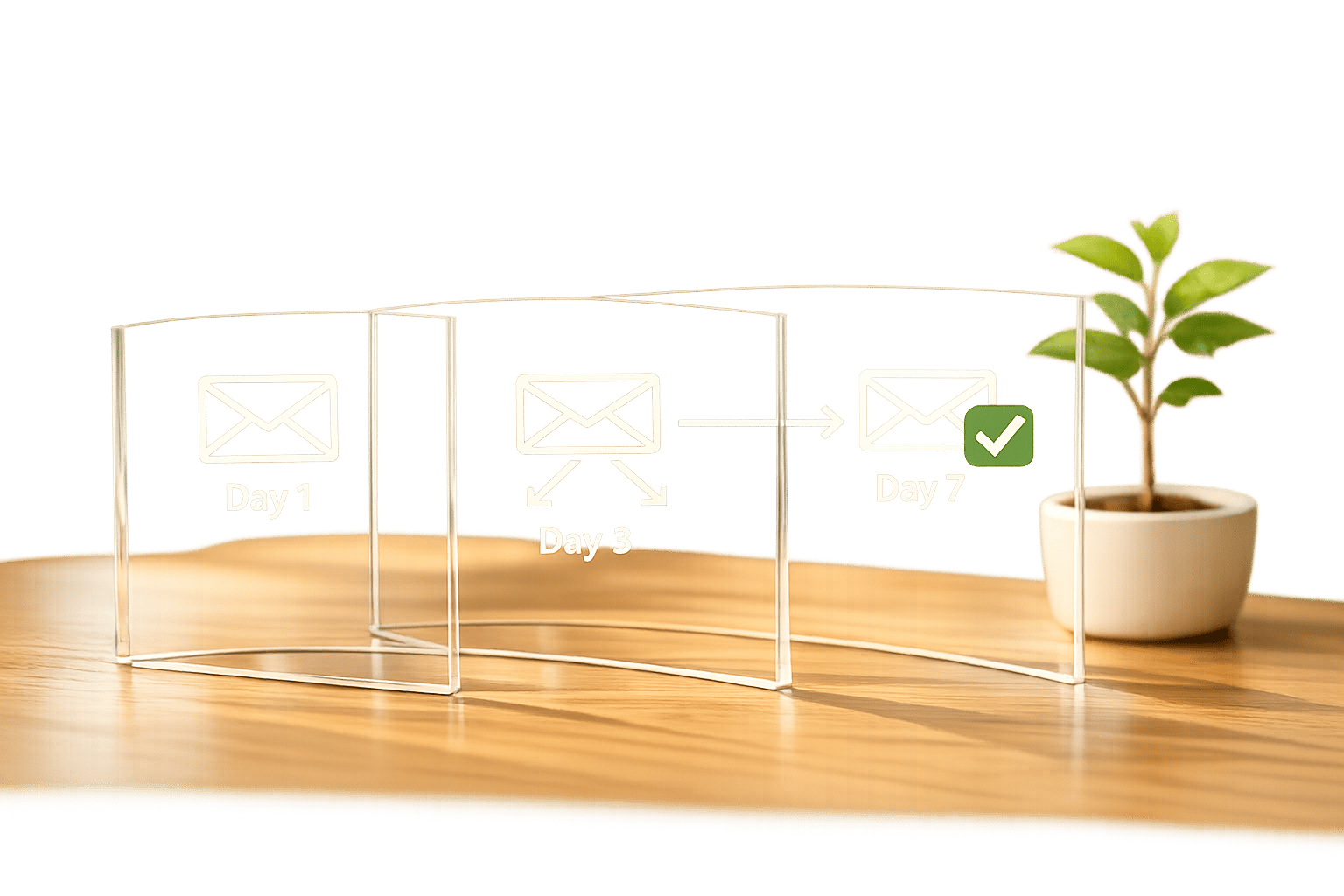
Email drip campaigns are a game-changer for tree service businesses. They automate communication, nurture leads, and keep your services top-of-mind for customers. Here’s why they matter:
- Automated Follow-Ups: Drip campaigns send pre-scheduled emails triggered by actions like quote requests or seasonal needs, saving you time.
- Higher Engagement: Automated emails can achieve open rates of 45-55% and drive 75% of email marketing revenue.
- Seasonal Relevance: Tailor your emails to seasonal services like spring pruning or storm prep.
- Lead Nurturing: It often takes 8 touchpoints to convert a lead – drip campaigns handle this effortlessly.
To get started:
- Build your email list through sign-up forms or offering free resources (e.g., "How to Spot a Dangerous Tree").
- Segment your list by customer type, location, or engagement level.
- Create a sequence of 4-10 emails, including welcome messages, tips, testimonials, and offers.
- Use automation tools like Mailchimp or ActiveCampaign to simplify the process.
- Track performance metrics like open rates (45-55%) and click-through rates (4-5%) to refine your campaigns.
Drip campaigns ensure consistent communication, boost bookings, and free up your time to focus on tree care.
What Email Drip Campaigns Are and How They Work
Definition of Email Drip Campaigns
An email drip campaign is an automated marketing strategy that sends a series of pre-scheduled messages based on specific triggers or timelines. The idea is simple: nurture leads by delivering relevant, bite-sized content over time – much like a steady drip of water helping a plant grow.
For tree service businesses, this approach can handle tasks like following up on customer inquiries, sharing helpful tips, or promoting seasonal deals – all automatically. It’s a hands-off way to ensure potential and existing clients receive timely, tailored messages, keeping your business top of mind.
The Mechanics of Drip Campaigns
Drip campaigns rely on three key components: triggers, conditions, and actions.
- Triggers are the events that set the process in motion. For example, a homeowner might trigger a campaign by submitting a "request a quote" form or downloading a storm preparation guide.
- Conditions determine the timing and flow of the campaign. These rules ensure emails are spaced out appropriately – for instance, sending a follow-up three days after the initial inquiry or scheduling the next email a week later.
- Actions are the emails themselves. These messages are sent automatically based on the triggers and conditions, ensuring a seamless experience for both you and your audience.
Drip campaigns shine when it comes to personalization. Instead of sending the same email to everyone, you can customize messages based on what your subscribers do or need. For a tree service business, someone requesting their first quote might receive educational content about your services, while a returning customer could get reminders for seasonal maintenance. Automation tools can even add personal touches, like including the recipient’s name or referencing the specific tree species they mentioned in their inquiry.
"An email drip campaign is a type of automated email marketing strategy that sends email sequences triggered by user actions or timelines. Think of it like a steady drip from a faucet… where each message builds on the previous one to guide prospects through the sales funnel." – Ryan Buckley, HubSpot
The results speak for themselves: businesses using drip campaigns report a 451% boost in qualified leads and click-through rates of 4–5%. For tree service companies, this means more jobs booked with far less effort spent on manual follow-ups.
How to Build and Grow Your Email List
Proper Email Collection Methods
Start by gathering contact information at every opportunity. Add a sign-up form to your website – whether it’s a simple newsletter subscription box or something like a "Request a Free Estimate" form. To encourage sign-ups, offer something valuable in return, like a free guide or resource.
Lead magnets are particularly effective for tree service businesses. For example, you could offer a free guide such as "How to Spot a Dangerous Tree" or "Best Trees for Privacy in Your Yard." Combine online strategies like these with in-person methods, such as hosting webinars or participating in local events, to expand your reach .
To ensure a high-quality list, use a double opt-in process. This requires new subscribers to confirm their interest via a verification email. While it adds an extra step, it helps reduce spam and keeps your list accurate. Plus, welcome emails sent after confirmation have an impressive average open rate of 83.63%, making them a great way to make a strong first impression.
Avoid shortcuts like purchasing email lists – these often lead to spam traps that could harm your domain’s reputation. Instead, focus on building your list organically. It may take more time, but you’ll attract people who are genuinely interested in your services. To stay compliant with the CAN-SPAM Act, always include an unsubscribe option and link to your privacy policy in every email .
Once you’ve built a solid list, take it a step further by segmenting your contacts based on how they signed up and how they engage with your emails.
How to Segment Your Email List
Segmentation allows you to send more personalized and relevant messages to your subscribers. Instead of blasting the same email to everyone, divide your list into smaller groups based on characteristics like behavior or interests. For tree service businesses, this might involve separating one-time emergency removal clients from those who book annual maintenance, or grouping subscribers by neighborhood to send tailored storm warnings.
Start by tracking where each lead came from. Did they sign up through a "Free Estimate" form, download a guide about emerald ash borer treatments, or meet you at a local event? These details provide valuable insight into their needs and where they are in the decision-making process. You can also segment by engagement level. For instance, identify subscribers who haven’t opened an email in 90 days and create re-engagement campaigns specifically for them.
"A divided list will make it easier to create more personalized content for your leads and clients." – Amy Wilder, Community Manager, vcita
The benefits of segmentation are clear: segmented emails achieve 30% higher open rates and 50% more click-throughs. For a tree service business, this could mean that a homeowner who inquired about stump grinding receives follow-ups focused on that service, while someone interested in tree health gets content about fertilization and pest management. Businesses that use automated, segmented email sequences can see conversion rates improve by as much as 50%.
How to setup drip email campaigns with real-world examples (step-by-step)
Creating Drip Campaigns for Tree Services
Once you’ve built a segmented, high-quality email list, the next step is creating a focused drip campaign that engages your audience and drives action.
Sample Email Sequence for Tree Services
A well-structured drip campaign for tree services usually includes 4–10 emails, spaced out to maintain interest and gradually build trust. Start with a welcome email that’s sent immediately after someone fills out a contact form or requests a quote. This email should acknowledge their interest and make the most of their peak engagement.
After 2–3 days, follow up with an educational email. Share seasonal tree care tips or advice on spotting common tree diseases. This positions your business as a knowledgeable and reliable resource. A few days later, send a social proof email – this could include before-and-after photos, customer testimonials, or case studies from local projects. Highlighting your expertise helps build credibility.
Next, deliver a promotional email with a time-sensitive offer, like a seasonal discount or a special service package. For instance, you could promote a spring storm prep service or a winter pruning deal. This creates urgency while addressing timely customer needs. Personalize these emails based on the preferences and needs of your segmented audience. Wrap up the sequence with a post-service appreciation email. Thank customers for their business, encourage them to leave a review, and subtly prompt referrals.
"Not every email has to be a sales pitch. Send out helpful tree care tips… This positions you as an expert and keeps your clients engaged." – Tree Services Marketing
Businesses using this type of email sequence often see conversion rates improve by as much as 50%. It typically takes around eight touchpoints to turn a prospect into a paying customer.
When and How Often to Send Emails
Timing is everything when it comes to email campaigns. Your first email should go out within 24 hours of a signup or inquiry to capture the recipient’s attention while their interest is fresh. For the initial welcome series, space emails about 2–3 days apart. This keeps the momentum going without overwhelming your audience. Once the welcome sequence wraps up, shift to a more consistent schedule – about one email every two weeks. Research shows this interval is ideal for staying connected without risking unsubscribes.
For the best results, send emails on weekdays – Tuesdays through Fridays – when open rates tend to be higher. Avoid sending key communications on Saturdays, as engagement typically drops. If you’re a smaller tree service business with a list of fewer than 2,000 subscribers, aim for 4–8 emails per month to prevent fatigue. During seasonal promotions, like storm prep in spring or dormant pruning in winter, you can temporarily increase frequency. Just make sure each email offers something fresh and valuable to your audience, rather than repeating the same message.
sbb-itb-130a704
Using Automation and Personalization
Once you’ve segmented your audience, automation and personalization step in to amplify engagement. Automation eliminates the need to individually write and send emails, giving you more time to focus on tree care rather than administrative tasks. By combining automation with personalization – like using a customer’s name, service history, or location – you can ensure every message feels relevant and timely.
Setting Up Automation Tools
Start by mapping out your customer journey – from the initial quote request to post-service follow-ups. This will help you determine the right moments to send emails and the purpose behind each one. For example, you can set up behavioral triggers for specific actions. If a customer clicks on a link about stump grinding in your newsletter, they can automatically be added to a drip sequence focused on that service.
Most automation platforms allow you to define triggers based on actions like form submissions, long periods of inactivity (e.g., 12 months without a tree inspection), or completed services. A useful feature is setting automation to remove customers from general campaigns once they’ve booked a service. Automated emails are incredibly effective, driving about 75% of revenue from email marketing campaigns. B2C companies using automation have seen conversion rates increase by up to 50%. Platforms like Mailchimp, ActiveCampaign, and Brevo are popular choices for setting up these workflows.
Once your automation is in place, focus on personalizing each message to create a connection with your audience.
How to Personalize Your Emails
Personalization starts with simple details like the recipient’s name, location, and service history. For example, sending reminders tied to a customer’s last service – like “It’s been 12 months since your last pruning” – feels much more relevant than a generic email.
Location-based promotions can also be highly effective for tree services. Let’s say a severe storm recently impacted your area. You could send targeted emails offering storm damage recovery tips or emergency tree removal services to affected customers. Using smart fields in your email platform, you can automatically insert personal details, making each email feel custom-made. Segmented emails have been shown to increase click-through rates by 50% and boost open rates by 30%.
"Personalization is key. Try to customize emails to your target audience’s industry and align your emails to provide the right information at the right time." – Robert Catalano, Digital Marketing Specialist, Toshiba
To increase engagement, keep your emails concise with short paragraphs and a single call-to-action. Since most subscribers only spend two to eight seconds skimming an email, every word needs to work hard. Test different personalized subject lines – like “John, your trees need this” or “Special offer for your Dallas home” – to find out which approach gets the best response.
Measuring and Improving Campaign Results
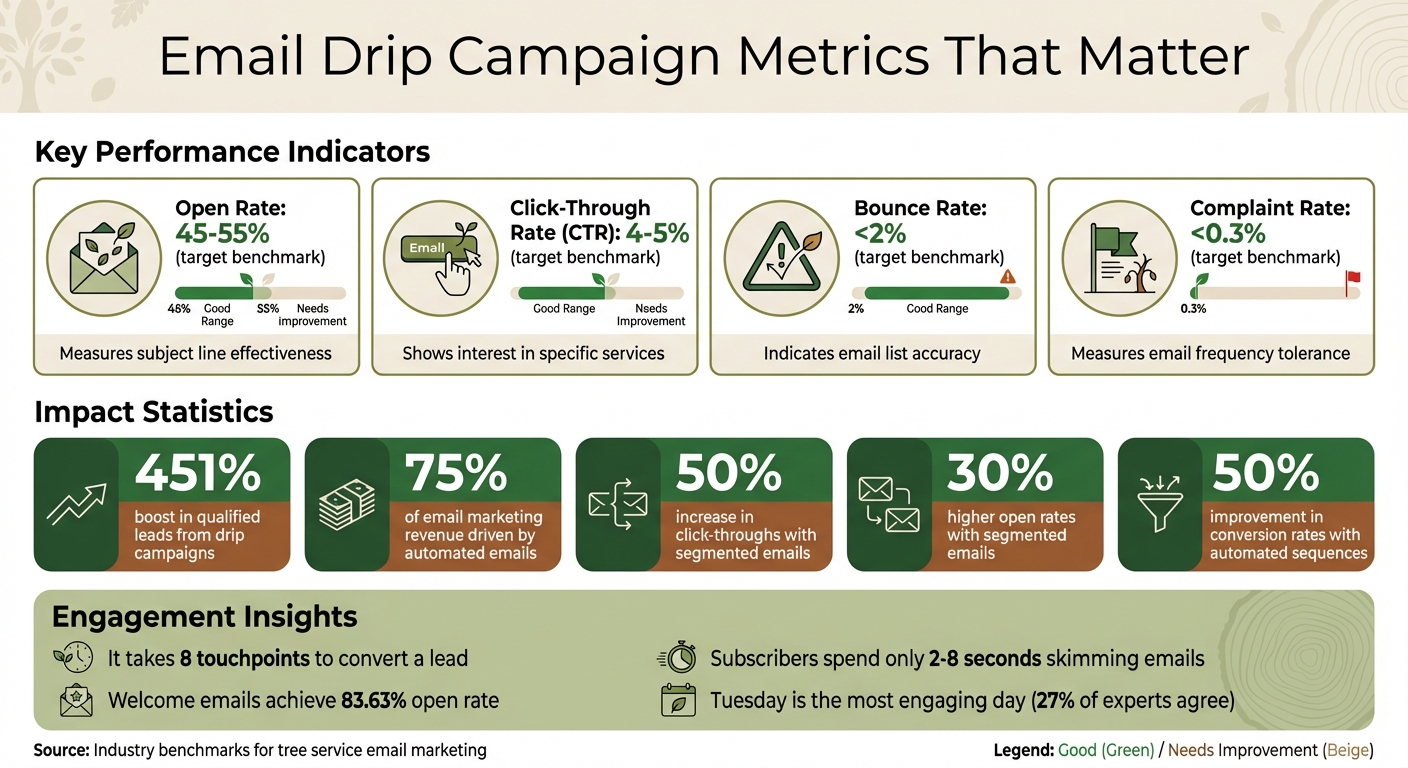
Email Drip Campaign Performance Metrics and Benchmarks for Tree Services
Tracking the right metrics is essential to gauge whether your email drip campaigns are driving new business. For example, the open rate – the percentage of recipients who open your email – offers insight into how compelling your subject lines are. A strong open rate for email campaigns typically falls between 45% and 55%. Meanwhile, the click-through rate (CTR) measures engagement by showing how many recipients clicked on links like "Schedule a Quote." For tree services, a healthy CTR hovers around 4% to 5%. Another key metric, the conversion rate, reflects the percentage of recipients who ultimately book a service.
It’s also crucial to keep an eye on bounce rates and complaint rates. A bounce rate exceeding 2% or a complaint rate above 0.3% suggests it’s time to fine-tune your email list or adjust your messaging. Additionally, higher unsubscribe rates may indicate issues with your timing or content. Greg Zakowicz, Senior Ecommerce Expert at Omnisend, highlights this point:
"If the unsubscribe rate for a drip campaign is significantly higher than scheduled campaigns, it is usually a good indication that something needs to be altered, such as the message timing or the content."
Metrics to Track
| Metric | Target Benchmark | What it Indicates for Tree Services |
|---|---|---|
| Open Rate | 45% – 55% | Effectiveness of subject lines (e.g., "Is your oak tree safe?") |
| Click-Through Rate | 4% – 5% | Interest in specific services (e.g., pruning vs. removal) |
| Bounce Rate | < 2% | Accuracy of your email list |
| Complaint Rate | < 0.3% | Whether email frequency feels intrusive to recipients |
| Conversion Rate | Varies | Success in turning digital leads into service bookings |
It’s worth noting that Apple Mail Privacy Protection may inflate open rates artificially, making CTR a more dependable measure of genuine engagement. Another valuable metric is revenue per campaign, which highlights which email sequences are actually driving income. For example, Island Olive Oil’s three-part welcome sequence in 2025 accounted for just 1.22% of their total emails but generated a staggering 39% of their email revenue.
These benchmarks serve as a guide for fine-tuning your campaigns to improve performance.
Using Data to Improve Your Campaigns
Once you’ve identified key metrics, use data-driven testing to enhance your campaigns. Start with A/B testing one variable at a time, such as experimenting with different subject lines, call-to-action (CTA) button colors, or send times, while keeping everything else consistent. Testing multiple variables at once can muddy the waters, making it unclear what’s driving the results. For instance, testing subject lines that mention seasonal tree care might directly impact service bookings. If you discover that emails sent on Tuesday mornings outperform those sent on Friday afternoons, you might want to adjust your schedule accordingly – especially since 27% of marketing experts report Tuesday as the most engaging day of the week.
If you notice a spike in unsubscribes after the third email in a five-email sequence, revisit its content to see what might be turning recipients away. Automation tools can also play a pivotal role in improving your campaigns. For example, removing contacts from your drip sequence after they’ve booked a service prevents redundant communication. In 2025, Amundsen Sports achieved a 32% conversion rate for their order confirmation emails by including targeted product recommendations and exclusive offers. For tree services, you could apply a similar strategy by suggesting seasonal pruning after a removal service or offering discounts on stump grinding to recent customers.
Conclusion
Email drip campaigns are a powerful way for tree service businesses to stay connected with both potential and existing clients, all while running on autopilot. By sending out automated emails that include helpful tips, showcase your services, and offer timely promotions, you can nurture leads and establish your business as a local authority. As we’ve seen, these campaigns can significantly boost revenue and improve conversion rates.
To get started, keep it simple. Set up a basic welcome sequence for new leads, divide your email list into residential and commercial clients, and use trigger-based emails to engage prospects at the peak of their interest. A steady, consistent approach with multiple touchpoints is key to seeing results.
Focus on delivering value first – whether it’s tree care tips, safety advice, or service highlights – before introducing promotional offers. This positions your business as a trusted resource rather than just another company pushing sales. Plus, this value-driven strategy often achieves better open rates than standard emails.
Once your campaigns are live, use the metrics we discussed earlier to fine-tune your approach. Test one element at a time – like subject lines, sending times, or content – to see what resonates most with your audience. By relying on data for these adjustments, your campaigns will only get better over time. Meanwhile, automation takes care of follow-ups and appointment reminders, freeing you to focus on day-to-day operations while ensuring no lead slips through the cracks.
With the right tools and strategy, email drip campaigns can revolutionize how you attract, engage, and retain clients. They turn one-time customers into loyal, long-term relationships, creating a reliable stream of revenue for your tree service business. When done right, email automation becomes a cornerstone of your marketing success.
FAQs
What’s the best way to start building an email list for my tree service business?
To grow an email list for your tree service business, start by gathering contact details from both current and potential customers. Offer incentives that are hard to resist – think free estimates, seasonal discounts, or expert tree care advice. You can collect email addresses through your website, social media platforms, or even in-person during service visits.
After collecting these emails, take the time to organize and segment your list. For example, you might group customers by type, such as homeowners or property managers. This allows you to send messages that feel more personal and relevant to their specific needs. Using tools like automated email campaigns or drip sequences, you can share timely, customized content that keeps your business top of mind and helps guide potential customers toward making a decision.
By combining smart incentives, thoughtful segmentation, and automation, you can steadily grow your email list, build stronger relationships, and turn leads into loyal customers who return to your tree service business time and time again.
How can I segment my email list to boost engagement for my tree service business?
To get better results from your email drip campaigns, break your email list into smaller, targeted groups based on things like customer behavior, preferences, or demographics. This way, you can send content that feels personal and relevant, making it more likely that your audience will engage and take action.
For tree service businesses, here are some ways you could segment your list:
- Customer type: Are they homeowners, property managers, or municipal clients? Each group has different needs.
- Location: Adjust your offers to fit regional demands or seasonal services.
- Engagement history: Look at their previous purchases, website activity, or how they’ve responded to past emails.
Keep your segments up-to-date by regularly reviewing your data. For instance, you could send homeowners seasonal tree care tips or offer specialized services tailored to property managers. Pairing smart segmentation with thoughtfully crafted content and well-timed emails helps you build stronger connections and motivates your audience to take action.
How can I track the success of my email drip campaigns for tree services?
To gauge how effective your email drip campaigns are, pay close attention to metrics like open rates, click-through rates, and conversion rates. These numbers reveal how successfully your emails are grabbing attention, encouraging interaction, and inspiring action.
It’s also important to keep an eye on unsubscribe rates and bounce rates. High numbers here could point to problems with your email content or the quality of your contact list. By routinely analyzing these stats, you can tweak your campaigns to boost engagement and strengthen your connection with recipients. Experimenting with different subject lines, email content, and sending schedules can further refine your results over time.