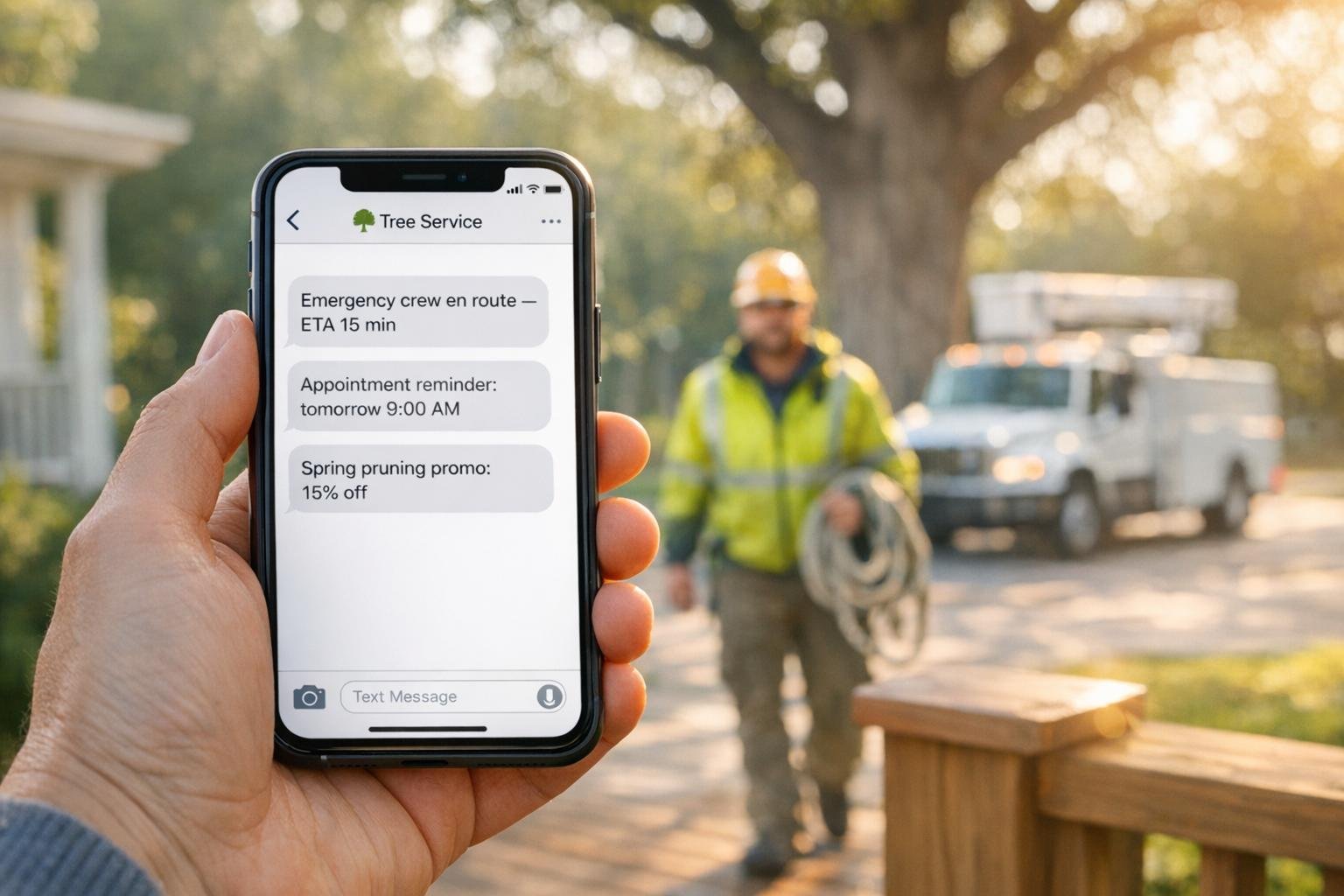
SMS marketing is the fastest and most effective way for tree service businesses to connect with customers through effective tree service marketing. Here’s why:
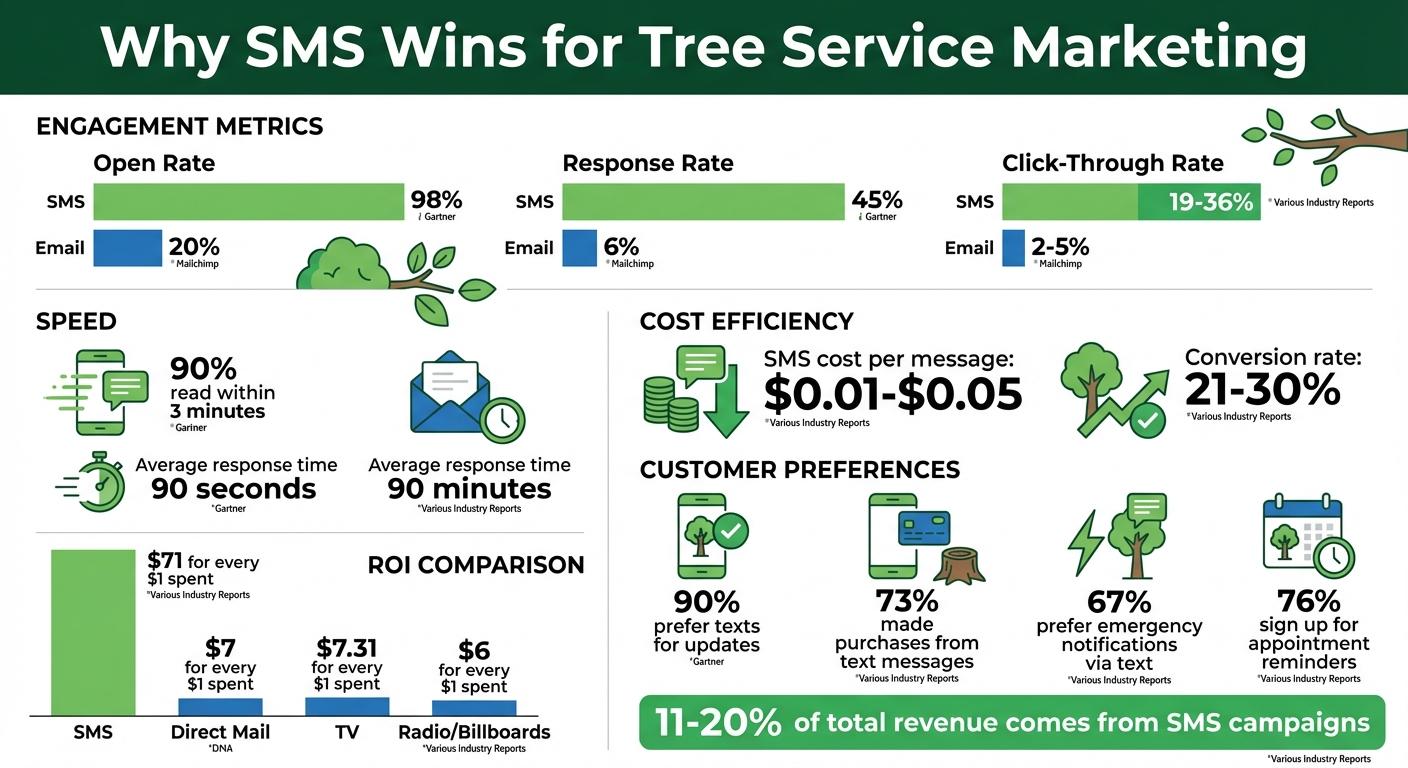
- 98% open rate: Almost every text gets read, compared to email’s 20%.
- Immediate engagement: 90% of texts are read within 3 minutes, perfect for emergencies like storm damage.
- Higher response rates: SMS achieves a 45% response rate, far surpassing email’s 6%.
- Cost-effective: Sending texts costs as little as $0.01 per message, with an ROI of $71 for every $1 spent.
- Customer preference: 90% of customers prefer texts for updates, and 73% have made purchases because of a text.
Whether it’s sending storm alerts, pruning reminders, or seasonal promotions, SMS ensures fast communication, better engagement, and measurable results. For tree service businesses, it’s a must-have tool to boost bookings and build customer loyalty.
SMS vs Email vs Traditional Marketing Performance Comparison for Tree Services
The Ultimate Guide to SMS Marketing (Everything You Need to Know in 2026)
sbb-itb-130a704
How SMS Compares to Email and Print Marketing
For tree service businesses, making every dollar count is crucial. When it comes to choosing the most effective marketing channel, SMS stands out as a clear winner over email and traditional advertising.
98% Open Rates vs. 20% for Email
SMS boasts an impressive 98% open rate and a 45% response rate, leaving email’s 20–32% open rate and 6–8% response rate far behind. This means almost every text you send gets read and often acted upon, making SMS an invaluable tool for time-sensitive communications like storm damage alerts.
Speed is another major advantage. Ninety percent of text messages are read within 3 minutes, and responses can come in as quickly as 90 seconds. Compare that to email, where responses typically take about 90 minutes. In emergencies – like a tree blocking a driveway – those saved minutes can make all the difference.
SMS also shines when it comes to click-through rates. Campaigns sent via text achieve click-through rates between 19% and 36%, while email lags with a modest 2% to 5%. Including a link to schedule estimates or showcase your portfolio in a text message drives more immediate action, which is crucial for converting urgent inquiries and seasonal promotions into confirmed jobs.
And it’s not just about engagement – SMS is also a far more cost-effective option.
Lower Costs Than Print and TV Advertising
SMS doesn’t just outperform traditional advertising; it does so at a fraction of the cost. Sending a text costs between $0.01 and $0.05 per message, yet delivers an average ROI of $71 for every $1 spent. Compare that to TV’s $7.31, direct mail’s $7, and radio or billboards’ $6 ROI. That’s nearly a 10x advantage over these older methods.
For small to medium-sized tree service businesses, this cost efficiency is a game-changer. With a modest $100 monthly SMS budget, you can reach thousands of clients with appointment reminders, seasonal deals, and emergency notifications – all while tracking results in real time.
Unlike billboards or radio ads, where success is often hard to measure, SMS gives you clear metrics. You’ll know exactly how many messages were delivered, opened, and acted upon, making it easier to calculate ROI and adjust your strategy as needed.
SMS for Emergency and Seasonal Tree Services
Tree services don’t stick to a 9-to-5 schedule. When a storm takes down a branch or a tree becomes a safety hazard, homeowners want help immediately – long before they’d think to check their email. That’s where SMS steps in as a game-changer.
Fast Response for Storm Damage and Emergencies
During severe weather, 67% of consumers prefer to receive emergency notifications via text message. For tree service providers, this preference means quicker bookings and safer resolutions. With SMS, an arborist can send out instant alerts about storm damage risks, offer emergency cleanup services, or share critical safety tips – all within minutes of a storm hitting.
"An arborist’s role is often time-sensitive, especially in emergency situations like storm damage or hazardous tree removal. SMS allows immediate communication with clients, advising them of potential risks, offering services, or providing critical advice." – Bitesms
Unlike email, which has an average response time of 90 minutes, SMS delivers and gets noticed almost immediately. Plus, it doesn’t rely on internet access, making it a dependable option even when storms disrupt broadband connections.
Two-way texting adds another layer of convenience. Homeowners can quickly ask about pricing, availability, or safety concerns and get real-time answers. This type of instant communication not only resolves emergencies faster but also builds trust and strengthens customer relationships.
Pruning Reminders and Seasonal Promotions
SMS isn’t just for emergencies – it’s just as effective for keeping customers engaged during routine tree care. A staggering 76% of consumers sign up for business texts specifically to receive appointment reminders, making automated seasonal messages a perfect fit for tree maintenance.
Imagine this: a quick text reminding homeowners about spring pruning or fall cleanup. You can even tailor messages to the season, like offering spring health checks, summer storm prevention tips, fall pruning, or winter stump grinding discounts. Adding a clear call to action – such as "Reply YES to schedule your fall pruning" or "Call (555) 123-4567 for a free assessment" – drives engagement and boosts bookings.
SMS also works wonders for reactivating dormant customers. Sending targeted discounts to users who signed up but never booked a service can successfully bring them back. This is especially effective since 58% of consumers opt in to receive promotional texts, and 60% admit they’ve made a purchase sooner than planned because of a text message. It’s a simple yet powerful way to keep your business top of mind while driving sales.
Building Customer Relationships Through SMS
SMS is more than just a messaging tool – it’s a direct, two-way channel that fosters trust through quick, personal interactions. When customers opt in to receive texts, they’re signaling a genuine interest in staying connected with your business. The immediacy that makes SMS ideal for emergency alerts also strengthens everyday communications, creating consistent touchpoints throughout the customer journey. In fact, 60% of consumers want the ability to text businesses back – a preference that saw a 12% increase between 2023 and 2024. This back-and-forth communication paves the way for seamless scheduling and better engagement at every service interaction.
Easier Appointment Scheduling and Customer Feedback
Two-way texting simplifies scheduling and makes gathering feedback a breeze. Instead of dealing with missed calls or waiting hours for email replies, customers can text questions, share photos of their trees, and schedule appointments in real time. With an average response time of just 90 seconds, SMS outpaces all other communication channels. This real-time scheduling eliminates delays and the back-and-forth hassle of traditional booking methods.
SMS also streamlines estimates. Customers can send photos of their trees or yard damage directly to arborists for quick preliminary quotes – no site visit required. After completing a job, a follow-up text with a direct link to Google or Yelp makes it easy for customers to leave reviews while the experience is still fresh. This simple step can significantly boost your review volume and improve local SEO and paid ad performance.
Special Offers and Customer Rewards
SMS isn’t just about logistics – it’s a powerful tool for building loyalty through timely, personalized offers. Over 70% of consumers make purchases after receiving SMS promotions, and 75% prefer texts for exclusive local deals. Personalized messages strengthen customer loyalty by making each interaction feel tailored.
For example, referencing past services in your texts can make a big impact. If a customer had a tree removed last year, you could send them a discount on stump grinding for the current season. For clients who haven’t booked in over a year, a personalized “welcome back” text with a small loyalty discount can help reactivate their account.
"People are more likely to act on a text when it looks like you wrote it just for them. This means more than just including basic details like a first name – provide value to your customers by speaking to their unique needs and interests."
– Jessica Schanzer, Senior Product Marketing Manager, Klaviyo
Exclusive SMS rewards can also increase customer value. Offer perks like early access to seasonal booking slots or insider discounts that aren’t available on other channels. Keep your messages concise – under 160 characters – and include a clear call to action, like "Reply YES to claim your 15% spring pruning discount". To avoid frustration, send texts only between 8 a.m. and 9 p.m. in your customer’s local time zone.
SMS Performance Metrics for Tree Service Businesses
SMS marketing has proven to be highly effective at engaging customers, but the real magic happens when you track its performance. Unlike Google Ads for tree services or other traditional advertising, SMS provides clear, actionable data for every message you send. The trick is to focus on the metrics that matter most to your tree service business and use them to fine-tune your marketing efforts.
Tracking Delivery, Open, and Response Rates
Delivery rate tells you the percentage of texts that successfully reach your customers’ phones. Aim for a delivery rate of 98–99%, which can be achieved by regularly updating your contact list to remove outdated numbers or landlines. If your delivery rate dips below this range, it’s time to clean up your list.
Open rate measures how many delivered messages are actually opened. SMS has an impressive 98% open rate, with 90% of texts read within three minutes of being received. This means your messages are not only reaching customers but are also being seen almost immediately.
Response rate tracks how many recipients reply to your messages. SMS typically delivers a 45% response rate, making it a powerful tool for confirming appointments, following up on estimates, or addressing urgent inquiries. If your response rate is low, it might be time to tweak your message or include a stronger call-to-action.
Measuring Conversion Rates and Return on Investment
Conversion rate measures the percentage of recipients who take the action you want – like booking a service – after receiving your text. For commercial services like tree care, SMS conversion rates typically range between 21% and 30%, much higher than the 18% average for email marketing. If your rate is falling short, experiment with different message formats, timing, or offers to see what resonates.
Click-through rate (CTR) shows how many people click on links in your texts, such as a seasonal promotion or booking page. For commercial services, CTRs generally fall between 21% and 35%, far outpacing email’s 2% to 5%. Adding UTM parameters to your links makes it easy to track how much website traffic and how many bookings each campaign generates.
Return on investment (ROI) compares the revenue generated from booked jobs to the cost of your SMS platform and labor. SMS marketing can deliver up to $71 in revenue for every $1 spent. In some industries, campaigns have achieved as much as a 35x ROI. While tree service businesses operate differently than retail, these figures highlight the income potential of a well-planned SMS strategy.
Keep an eye on your opt-out rate, which should stay between 1% and 2%. If too many customers reply with "STOP", it could be a sign that you’re sending messages too often or that the content isn’t hitting the mark. Remember, 73% of consumers will unsubscribe if they feel bombarded with texts. Striking the right balance between frequency and quality is key.
Conclusion
SMS marketing delivers immediate visibility, high engagement, and measurable results for tree service businesses. With a 98% open rate, 90% of messages read within three minutes, and a 45% engagement rate, text messages reach customers faster and more reliably than email or print advertising ever could.
On top of these impressive stats, SMS marketing is also cost-effective. Compared to the hefty price tags of billboards or radio ads, SMS campaigns are far more affordable. Yet, they pack a punch – businesses report that 11–20% of their total revenue comes directly from text campaigns. Features like automated reminders, emergency alerts, and review follow-ups not only streamline operations but also save time and money.
Bryan Clayton, founder of GreenPal, summed it up perfectly:
Without SMS, I don’t know that we’d be in business because we just couldn’t figure out another way to keep people in the loop.
If you’re not leveraging SMS yet, you’re leaving serious revenue on the table. Start small with appointment confirmations and seasonal updates, then expand to emergency alerts and review requests. The numbers don’t lie – businesses using SMS are 683% more likely to report success with their digital marketing efforts. For tree service companies looking to dominate their local markets, SMS marketing isn’t just an option – it’s a must-have tool for staying ahead in today’s competitive landscape.
FAQs
Why is SMS marketing so effective for tree service businesses?
SMS marketing stands out for its incredible 98% open rate, with most messages being read and acted on within minutes. This speed ensures your message reaches customers almost instantly, making it perfect for time-sensitive updates or promotions.
Compared to email, which often gets buried in cluttered inboxes, SMS provides a direct and personal line of communication. For tree service businesses, this means you can connect with clients in real time – whether it’s to share seasonal discounts, send appointment reminders, or promote emergency services. Its straightforward and immediate nature makes SMS an effective way to build trust and encourage customer engagement.
How does SMS marketing save money compared to traditional advertising for tree service businesses?
SMS marketing offers an affordable way to connect with your audience compared to traditional advertising methods like print or TV ads. Sending a text message usually costs just a few cents, making it a budget-friendly option for reaching customers without the hefty price tag of other channels.
What makes SMS even more appealing is its incredible open rate – an average of 98%. That means nearly every message you send is seen by your audience. This level of engagement ensures you get more bang for your buck, delivering impressive results without breaking the bank. For tree service businesses, this can mean more leads and conversions while keeping marketing costs under control.
How can tree service businesses use SMS for emergency notifications?
SMS is an incredibly effective way for tree service businesses to alert clients about emergencies like storm damage, fallen trees, or safety hazards. Thanks to its quick delivery and high open rates, SMS ensures urgent updates land directly in front of customers when they need them most.
To get the best results, keep your messages short and to the point. Clearly explain the emergency and include any immediate steps clients should take – like contacting your team or avoiding a dangerous area. Adding a personal touch, such as referencing the client’s location or previous services, can make the message feel more relevant and build trust.
Because SMS typically gets faster responses than email, it’s perfect for situations that require immediate attention. This direct approach not only helps businesses handle emergencies smoothly but also shows customers that their safety is a top priority.