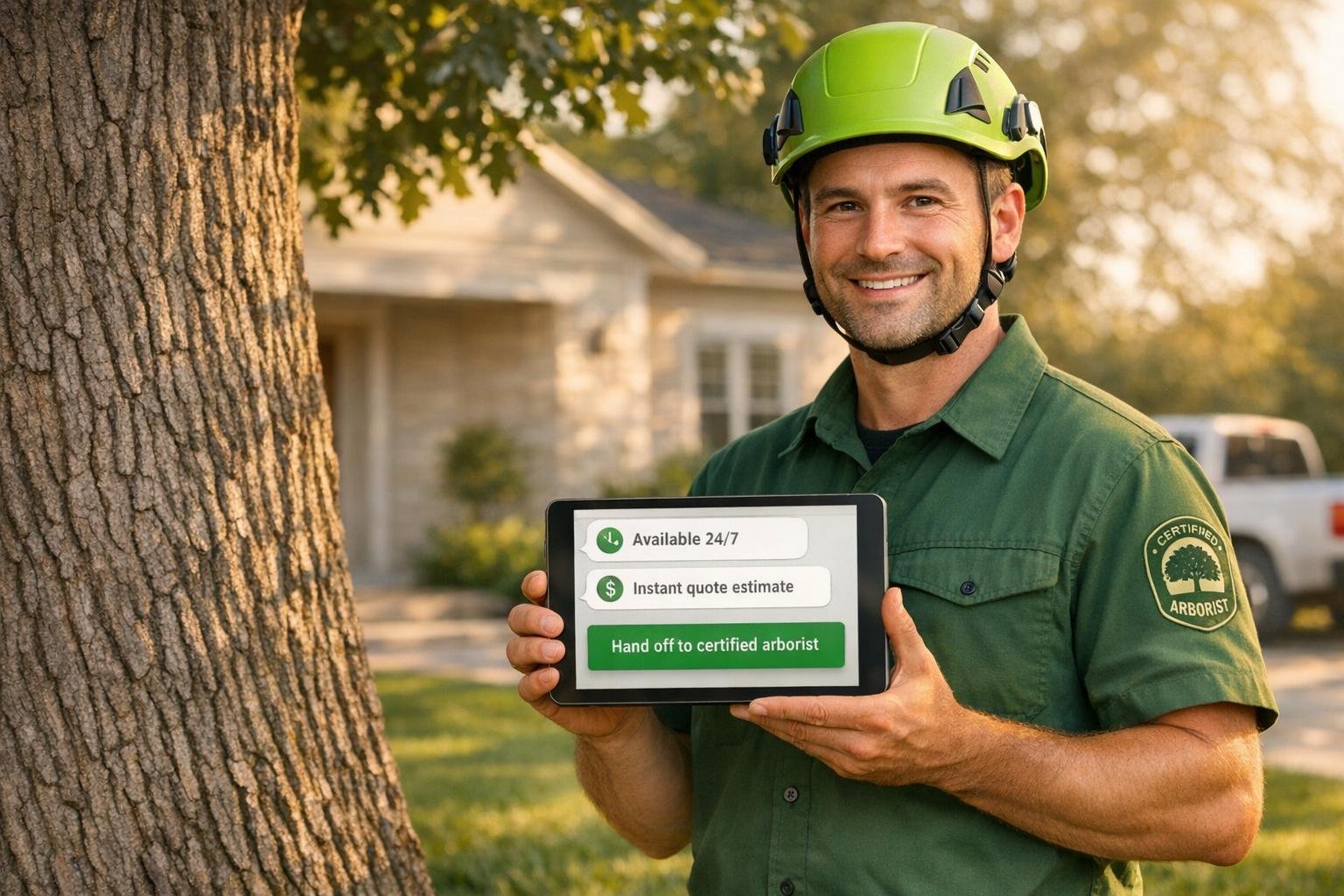
AI chatbots are transforming the tree service industry by providing instant, 24/7 customer support. They handle basic inquiries, schedule appointments, and qualify leads faster than traditional methods. Businesses using chatbots see increased lead conversions and reduced administrative workloads. However, chatbots lack the personal touch and problem-solving ability of human support, which remains essential for complex issues. The best approach? Combine chatbots for routine tasks with human expertise for nuanced customer needs.
Key Takeaways:
- Chatbots respond instantly, improving lead response rates and customer satisfaction.
- They reduce costs, with interactions costing around $0.50 compared to $6.00 for human support.
- Humans are better for complex issues and building trust but are limited by availability and higher costs.
- A hybrid approach balances efficiency and personalized service.
Quick Comparison:
| Feature | AI Chatbot | Human Support |
|---|---|---|
| Availability | 24/7 | Limited to business hours |
| Cost per Interaction | $0.50 | $6.00 |
| Response Time | Immediate | Minutes to days |
| Handling Complexity | Limited | Excellent |
| Customer Preference | 77% frustrated | 88% prefer human |
Chatbots are a cost-effective solution for routine tasks, while human support ensures quality for complex interactions. Together, they create a balanced customer service strategy.
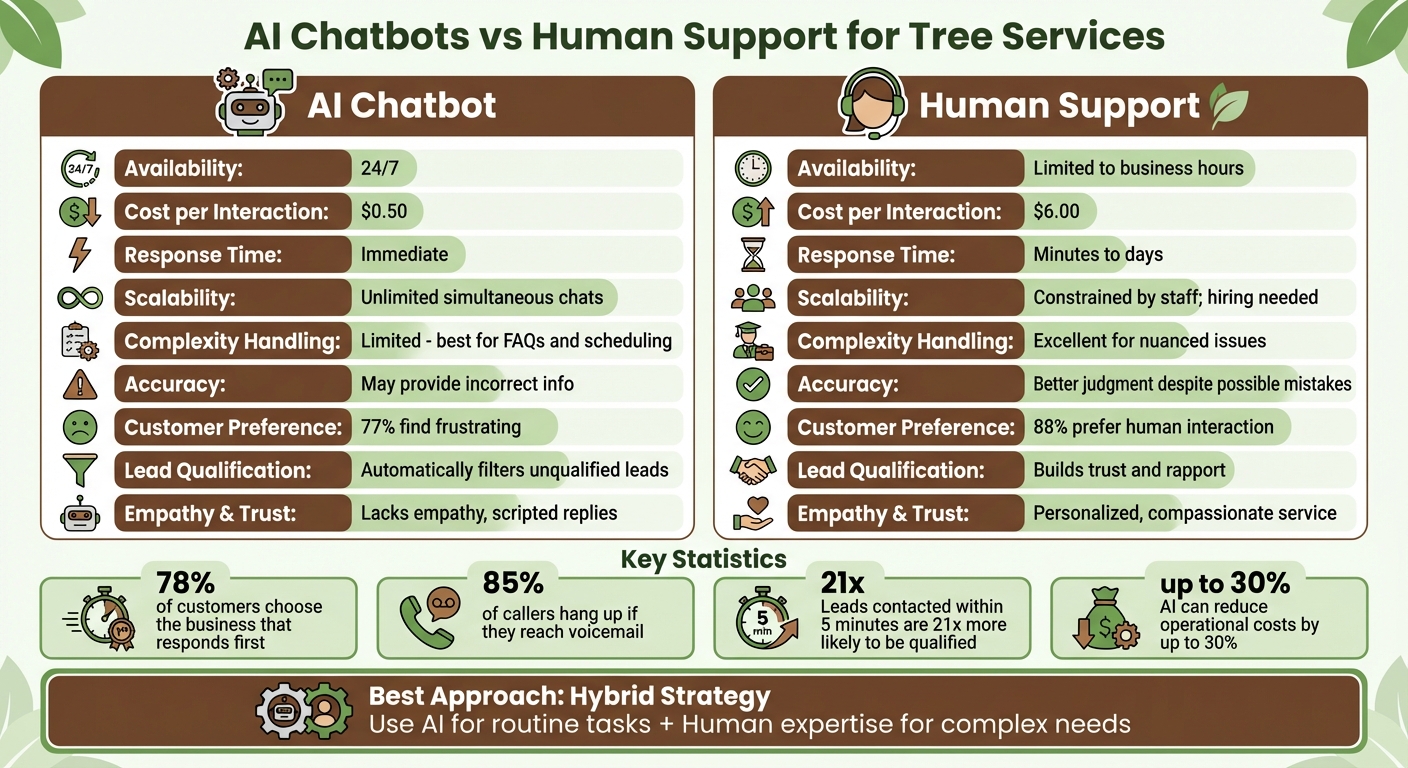
AI Chatbots vs Human Support for Tree Services Comparison
Supercharge Your Tree Care Leads & Sales With These AI Tools | Tree Care Marketing Solutions
sbb-itb-130a704
1. AI Chatbots for Tree Services
AI chatbots bring round-the-clock accessibility to tree service businesses, helping to capture leads and streamline customer support.
Lead Generation
AI chatbots work tirelessly, even during off-hours, to ensure no potential lead is missed. Imagine a homeowner needing emergency tree removal at 11:00 PM after a storm. Instead of facing a voicemail, they get an instant response from a chatbot. This matters because 85% of callers with storm damage will hang up and contact a competitor if their call goes unanswered.
The chatbot doesn’t just collect contact information – it qualifies leads by asking key questions about the service area, tree type, urgency, and property size. It can even request photos via SMS to assess the situation. For example, a tree care company in Washington state adopted this system in May 2025 and saw a 42% jump in lead conversions within just 60 days.
With multi-channel integration, the bot centralizes leads from platforms like Facebook Messenger, Instagram, Google Business Profile, WhatsApp, and your website. Speed is critical: leads contacted within 5 minutes are 21 times more likely to be qualified than those contacted after 30 minutes. Once the chatbot gathers leads, it seamlessly transitions to handling inquiries or escalating emergencies.
Customer Support
AI chatbots excel at managing routine questions while flagging urgent issues for immediate human intervention. If someone types, "A tree fell on my house", the system alerts your on-call team instantly. For simpler questions – like pruning schedules or service areas – the bot provides quick, accurate answers tailored to the industry.
Post-job follow-ups are automated, too. After a tree removal, the chatbot might send an SMS about stump grinding seven days later. A month after pruning, it could email details on plant health care plans. For more technical or diagnostic questions, the chatbot routes the customer to a human arborist without delay.
Operational Efficiency
By automating 40% of office tasks, AI significantly reduces administrative burdens. This includes scheduling estimates, sending follow-ups, and syncing client records. Integrating with tools like ArboStar and Jobber ensures schedules stay up-to-date, freeing your team to focus on crews and closing deals.
Photo submissions allow for remote estimates, cutting down on unnecessary site visits. The bot can even trigger workflows based on weather alerts, like high winds exceeding 40 mph, to encourage proactive inspections and removal jobs. Equipment maintenance checklists are generated in seconds, saving hours of manual work. These efficiencies translate into better cost management and a stronger return on investment.
Cost
AI chatbot solutions typically range from $297 to $499 per month, with setup fees between $497 and $3,000. Entry-level options start as low as $2.99 per month, but specialized bots for tree services offer more tailored features. Compared to hiring a full-time receptionist or paying for comparing local SEO vs. paid ads (which often cost around $3,000 monthly), AI proves to be a cost-effective alternative.
The financial benefits become clear quickly. Leads from third-party aggregators can cost up to $90 per call, and inconsistent follow-ups result in the loss of 60% of high-value plant health care jobs. AI prevents these losses by ensuring every lead gets prompt attention.
"Buying leads is like renting a house; building your own AI SEO platform is like owning the deed." – Allen Seavert, Founder, SetupBots
2. Human Customer Support for Tree Services
While AI chatbots offer consistent availability and speed, human support brings a level of expertise and personal touch that machines just can’t replicate.
Lead Generation
Humans excel at turning potential leads into loyal customers by offering tailored advice and building trust. For instance, when a homeowner needs guidance on a tricky tree health issue or wants to discuss a bundled service package, a skilled arborist can position themselves as a trusted local expert. This matters because 78% of customers choose the business that responds to them first, highlighting the need for effective ways to get more tree service leads.
Yet, here’s the catch: only 27% of local leads are contacted by small-to-mid-sized businesses, and fewer than 40% of calls to tree service companies are answered by a live person. During busy seasons, these missed connections add up quickly. While human interaction is critical for building relationships and handling high-value consultations, it often struggles to keep up with the demand for quick responses.
The real strength of human support lies in addressing complex and nuanced questions with a personalized approach.
Customer Support
When it comes to resolving complex issues, human expertise is irreplaceable. For example, a homeowner worried about oak wilt or debating whether a leaning tree poses a structural risk needs more than a chatbot – they need the insight and empathy of a certified arborist. Humans are also better equipped to handle negotiations, special requests, and unique situations that fall outside a bot’s programming.
However, availability remains a major hurdle. During emergencies, 85% of callers will hang up if they hit voicemail. Offering 24/7 human support isn’t feasible for most tree service companies, as it can increase labor costs by 30% to 50%.
"Human interaction remains crucial… chatbots support sales but human interaction remains crucial." – Dr. Vivian Atud, Business and Marketing Consultant
While human support offers unmatched depth and flexibility, it also comes with operational challenges that can impact efficiency.
Operational Efficiency
Relying on human support can slow things down. Arborists and managers often spend 40% of their time on administrative tasks like scheduling and follow-ups, which takes time away from their core responsibilities. This juggling act can lead to disorganization, especially when business owners are managing crews while answering phones. In fact, 60% of high-value Plant Health Care jobs are lost due to inconsistent follow-ups.
Scaling human teams also presents a challenge. Managing a higher volume of inquiries means hiring more staff, while automated systems can handle unlimited requests without additional costs. Traditional manual approaches to SEO and lead management are another bottleneck – they’re prone to errors and can take weeks to complete tasks that automation handles in seconds.
Cost
The financial trade-offs between human support and AI solutions highlight the need to balance expertise with efficiency.
A full-time customer service representative earns a median salary of $42,827 per year, not including benefits or turnover expenses. On average, human interactions cost around $6.00 each, compared to $0.50 per interaction for AI. Meanwhile, traditional agencies handling manual SEO and lead management charge between $1,500 and $3,500 per month.
AI-driven solutions can cut operational costs by up to 30%, but here’s the thing: 88% of customers still prefer speaking to a human. For complex issues like billing disputes, resolution rates are much higher with human support. The challenge lies in striking the right balance – using human expertise for high-value tasks while automating repetitive processes to save time and money.
Pros and Cons
Let’s break down the strengths and weaknesses of AI chatbots versus human customer support for your tree service business.
| Feature | AI Chatbot | Human Customer Support |
|---|---|---|
| Availability | Always on, 24/7 instant responses | Limited to standard business hours |
| Cost per Interaction | Around $0.50 | Around $6.00 |
| Response Time | Immediate, zero wait time | Can range from minutes to days |
| Scalability | Handles unlimited chats at once | Constrained by staff availability; hiring needed |
| Complexity Handling | Great for FAQs and scheduling tasks | Best for nuanced or emotionally charged issues |
| Accuracy | May provide incorrect or "hallucinated" info | Can make mistakes but offers better judgment |
| Customer Preference | 77% find chatbots frustrating | 88% prefer speaking with a human |
| Lead Qualification | Automatically filters unqualified leads | Builds trust and rapport with potential clients |
| Empathy & Trust | Lacks empathy, uses scripted replies | Offers personalized and compassionate service |
AI chatbots bring speed, affordability, and the ability to handle large volumes of inquiries. However, they struggle with complexity and lack the emotional touch that only humans can provide. On the other hand, human support excels in building trust and solving intricate problems but comes with higher costs and limited availability.
For tree service businesses, a hybrid approach often works best. Use AI chatbots to manage basic queries, schedule appointments, and filter leads. Then, transfer more complicated or sensitive cases to experienced human staff. This ensures efficiency without sacrificing customer satisfaction.
"You should not use AI as a one-size-fits-all solution in your business, even when you are thinking about a very specific context such as customer service." – Shunyuan Zhang, Harvard Business School
Cost is a key factor: AI chatbots cost roughly $0.50 per interaction compared to $6.00 for human support. However, chatbots often fall short when handling complex inquiries – 75% of customers report dissatisfaction in those cases. Additionally, over half of chatbot implementations (53%) fail within 15 months due to maintenance or escalation challenges. Balancing these trade-offs is essential for long-term success in your tree service marketing strategy.
Conclusion
AI chatbots shine when it comes to tasks like 24/7 lead capture and handling basic inquiries. Here’s why they matter: 78% of customers choose the business that responds first, and reaching out within five minutes makes prospects 21 times more likely to be qualified. This makes AI chatbots a game-changer for capturing leads outside business hours or during emergencies when your team is busy in the field.
That said, AI works best as a complement to human expertise – not a replacement. Quick responses are critical for conversions, which is why combining AI’s speed with human insight creates the perfect balance. AI can handle routine questions, while your staff focuses on more complex customer needs. This hybrid approach ensures a smooth, efficient customer experience.
By automating repetitive tasks and transferring qualified leads to your team for more detailed discussions, you can significantly cut costs – from about $6.00 per interaction to just $0.50. And while AI takes care of efficiency, your team maintains the personal touch that 88% of customers prefer. This cost-effective strategy highlights the value of blending AI with human support.
To get started, consider automating after-hours lead capture or appointment scheduling. Keep your chatbot’s knowledge base updated with accurate pricing and policies to avoid miscommunication. As Shunyuan Zhang from Harvard Business School wisely notes:
"You should not use AI as a one-size-fits-all solution in your business, even when you are thinking about a very specific context such as customer service".
Looking to take your strategy further? Tree Company Leads offers services like web design, Google Ads strategies, and lead generation, all tailored to fit seamlessly into your operations. Their expertise in local SEO ensures that your AI tools work in harmony with your overall marketing efforts.
With the tree care industry projected to grow from $1.3 billion in 2024 to $2.5 billion by 2031, combining AI efficiency with human expertise puts your business in the best position to thrive. Let AI handle the repetitive tasks, focus on delivering exceptional service, and be ready to capture the opportunities ahead.
FAQs
What should a tree service chatbot handle vs a human?
A tree service chatbot is perfect for handling everyday tasks like answering FAQs, sharing basic service information, scheduling appointments, and gathering contact details. These automated interactions provide instant, round-the-clock responses, making the process faster and more efficient for both businesses and customers.
However, when it comes to more complex or sensitive matters – like diagnosing tree health, addressing specific concerns, or giving tailored advice – human expertise is essential. These situations demand professional judgment, experience, and the kind of nuanced understanding that AI simply can’t match.
How do I prevent my chatbot from giving wrong answers?
To minimize errors, focus on training your chatbot with precise, industry-specific data and linking it to a reliable, up-to-date knowledge base. Keep an eye on its interactions, refine responses regularly, and establish clear fallback options for handling uncertain questions. Conduct thorough testing before launch to spot and address potential issues. These practices help boost accuracy and ensure your chatbot provides dependable answers.
What’s the best way to add a chatbot to my website and phone leads?
Adding a chatbot to your website is easiest when you use an AI-powered tool that integrates seamlessly with your site and communication channels. Prioritize tools that offer features like customizable branding, lead qualification, and appointment scheduling.
Most platforms simplify the process with options like embedding a widget, which requires minimal technical know-how. This allows you to ensure 24/7 engagement with your website visitors and phone leads, providing consistent follow-up without extra effort.