
If you’re in the tree care business, getting customers often depends on your online visibility. With 76% of homeowners searching online for services and emergencies like storm damage driving quick decisions, being easy to find on Google is essential. Here’s the key:
- Local SEO: Optimize your Google Business Profile (GBP) to rank in the Local 3-Pack, where 44% of search clicks go. Use accurate business info, strong reviews, and high-quality photos to build trust.
- Google Ads & LSAs: Pay-per-click (PPC) ads and Local Services Ads (LSAs) can generate immediate leads. LSAs, with the Google Guaranteed badge, build credibility and attract high-intent customers.
- Website Optimization: A fast, mobile-friendly site with clear calls-to-action (like "Call Now" or "Get a Free Quote") can turn visitors into paying customers. Add live chat and simple contact forms for better lead capture.
- Meta Ads (Facebook/Instagram): Reach homeowners who aren’t actively searching but may need services soon. Target high-income households with engaging visuals and retarget users who’ve shown interest.
Tree service marketing strategies that combine these elements can see ROI as high as 11x, with exclusive leads driving better results than shared ones. Fast response times (within 5 minutes) are critical to closing deals. By using these tools, you can consistently attract customers and grow your business.
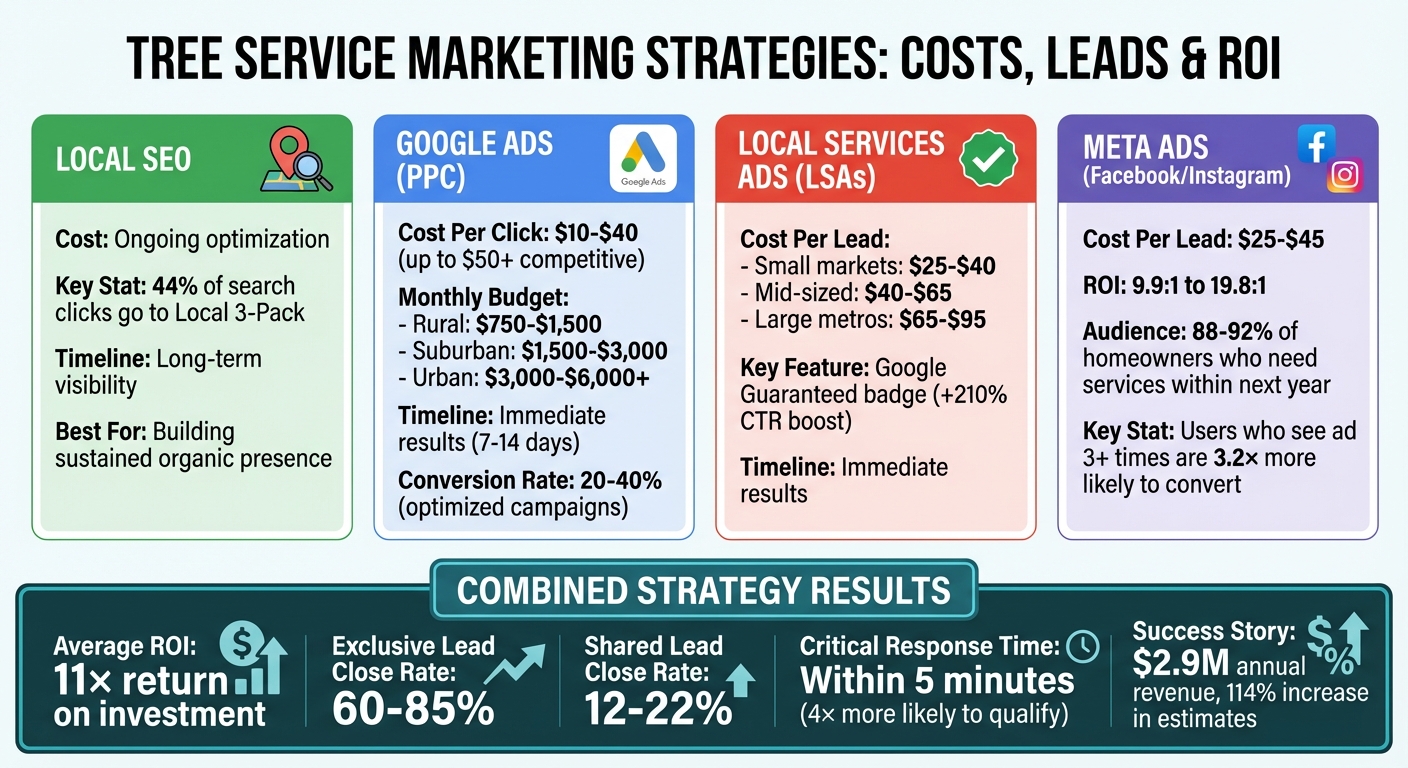
Tree Service Marketing Strategies ROI and Lead Costs Comparison
13 Ways To Market Your Tree Service Business in 2026
sbb-itb-130a704
Local SEO for Tree Service Businesses
Local SEO is a game-changer for tree service companies, helping them land in Google’s coveted Local 3-Pack. This visibility turns searches into calls and booked jobs. With 72% of consumers relying on Google to find local businesses and 76% visiting a business within 24 hours, ranking high in local searches directly impacts your bottom line.
"Tree service owners don’t lose to competitors online – they lose in Google Maps." – Tree Services Marketing
Google determines Map Pack rankings using three factors: relevance (how well your profile matches a search), distance (your proximity to the searcher), and prominence (your business’s reputation and visibility). Even if a competitor has better equipment, your optimized Google Business Profile (GBP) and consistent online presence can give you the edge.
When emergencies strike – like a tree falling on a driveway – homeowners often call the first credible business they find. Nearly 50% of local business interactions happen through Google Maps and the 3-Pack. To capitalize on this, optimizing your GBP is critical to boosting your local visibility.
Google Business Profile Setup
Think of your Google Business Profile as your digital storefront. Around 80% of U.S. consumers search online for local businesses weekly, and many call directly from the map listing without even visiting your website. Setting up your profile correctly from the start avoids ranking headaches later.
Start by ensuring NAP consistency (Name, Address, Phone number) across your GBP, website, and directories. Even small inconsistencies, like using "St." instead of "Street", can confuse Google.
Select "Tree Service" as your primary category rather than a broad term like "Landscaper". This choice directly affects which searches trigger your profile. You can also add up to nine secondary categories for related services like stump grinding or storm cleanup.
Use the "From the Business" description to include high-intent keywords, such as "emergency tree removal" or "ISA certified arborist", within the first 250 characters. Detail each service – tree pruning, storm cleanup, land clearing – with descriptions that align with search queries.
"A profile with 20+ photos of actual work – crews cutting trees, equipment, finished jobs – gets way more clicks than one with three blurry pictures." – Tree Service Marketing Solutions
Photos play a big role in engagement. Upload at least 20 high-quality images showcasing your team, equipment, and completed projects. Geo-tag these photos to enhance local relevance. Adding 1–2 new photos weekly signals activity to Google. Use the "Questions & Answers" section to address common concerns like "Are you insured?" or "Do you provide free estimates?" This builds trust before customers even call.
Reviews are another critical factor. Profiles often see a ranking boost after their first 10 reviews. For example, a business with a 4.7-star rating and 50 reviews can outperform one with a perfect 5.0-star rating but only 8 reviews because Google values review volume and recency. Encourage customers to leave detailed reviews mentioning the specific service and city. Always respond to reviews – positive or negative – to show you’re engaged.
| Optimization Element | Frequency | Impact on Ranking |
|---|---|---|
| NAP Consistency | Once (Audit regularly) | High (Foundational) |
| Primary Category | Once | Very High |
| Customer Reviews | Continuous | High (Prominence) |
| Photo Uploads | 1–2 per week | Medium (Engagement) |
| Google Posts/Updates | Weekly | Medium (Relevance) |
| Service Descriptions | Once (Update as needed) | Medium (Relevance) |
Use the "Add Update" feature weekly to post promotions, seasonal tips, or job highlights. This signals activity to Google. Track your GBP performance with UTM parameters in your website link (e.g., ?utm_source=google&utm_medium=organic&utm_campaign=gbp) to measure how many leads come directly from your map listing.
Once your GBP is optimized, focus on targeting local keywords that align with customer intent.
Local Keyword Targeting
Local keywords link your business to high-intent searches. For example, someone searching "tree removal Houston" is likely ready to hire. Since nearly 50% of Google searches are for local businesses, targeting these keywords ensures you’re visible when potential customers are ready to book.
While generic terms like "tree service" may attract traffic, they often convert poorly. Long-tail keywords, such as "affordable oak tree removal in west Denver", attract customers who know exactly what they need.
"The generic short keywords get searched more but convert worse. The longer specific ones bring in customers who are actually ready to book work." – Tree Service Marketing Solutions
Create dedicated landing pages (e.g., /tree-removal-kalamazoo-mi) with 500–800 words of content tailored to specific services and locations. Naturally integrate the service and city into H1 headlines, subheadings, meta descriptions, and image alt tags.
| Keyword Type | Example | Intent Level | Conversion Potential |
|---|---|---|---|
| Generic | Tree service | Low (Research) | Low |
| Localized | Tree removal Houston | High (Ready to book) | High |
| Service-Specific | Emergency storm cleanup | Very High (Immediate) | Very High |
| Long-tail Local | Affordable oak tree removal in west Denver | Very High (Specific) | Highest |
Incorporate these keywords into your GBP and on-site content to strengthen your local search signals. Ask customers to include the service and city in their reviews (e.g., "Excellent stump grinding in Charlotte") to further boost your relevance. Geo-tag photos of completed jobs to reinforce your service area.
Ranking in the Google Map Pack
The Google Map Pack captures 44% of all clicks from search results, with 33% of those clicks going to the top three listings. For tree service businesses, this spot is vital. Customers with urgent needs – like storm damage or fallen trees – often call the first reputable business they find.
To improve your Map Pack ranking, focus on consistent updates and strong local signals. While you can’t control your physical proximity to searchers, you can optimize relevance by refining your GBP categories, service descriptions, and keyword usage. Build prominence through reviews, citations, and a solid online presence.
Ensure NAP consistency across directories like Yelp and Facebook, as Google cross-references this information to verify your business. Adding LocalBusiness schema markup to your website can also help Google better understand your business.
Regularly post updates and job highlights to signal activity. Use the Q&A section to address common concerns, such as insurance, emergency availability, and pricing. This proactive approach can build trust and encourage engagement.
Businesses in Google Maps are 2.7 times more likely to be viewed as reputable. With nearly 70% of local searches happening on smartphones, your GBP often serves as the entire customer journey – from discovery to making the call.
Google Ads and Local Services Ads for Tree Companies
When it comes to generating immediate traffic, Google Ads and Local Services Ads (LSAs) are game-changers for tree service companies. While local SEO vs. paid ads is a common debate, these paid platforms deliver results right away – perfect for meeting urgent or seasonal demands. They’re especially effective for high-intent searches like "tree removal near me" or "emergency tree service".
Costs and Models
Google Ads operates on a pay-per-click model, with costs ranging from $10 to $40 per click for most tree service keywords. In competitive urban areas, prices can climb above $50. On the other hand, LSAs use a pay-per-lead system, meaning you only pay when someone calls or messages you directly. Lead costs vary based on location:
- Small markets: $25–$40 per lead
- Mid-sized areas: $40–$65 per lead
- Large metros: $65–$95 per lead
The Google Guaranteed Badge
One standout feature of LSAs is the Google Guaranteed badge. This green checkmark, earned after passing Google’s screening process (background checks, license verification, and proof of liability insurance), can boost click-through rates by a whopping 210%. Plus, Google offers up to $2,000 in coverage for the work, giving homeowners extra peace of mind during emergencies.
"What we’ve realized through working with you and your team is that you can quantify marketing returns. I can look and see I’m spending this dollar and I’m getting this in return for it." – Ryan Warner, Owner
To make the most of your budget, focus on high-intent searches like "emergency tree removal" and avoid wasting money on irrelevant clicks, such as "tree service jobs" or "DIY tree trimming". With a well-structured campaign, most tree service companies start seeing quality leads within 7 to 14 days.
Campaign Setup and Management
Launching a successful Google Ads campaign requires careful planning. Start by switching to Expert Mode instead of Smart Campaigns, which gives you full control over keywords and location targeting.
Geo-Targeting and Budgeting
Define your service area using geo-targeting. You can narrow your ads to a radius of 10 to 30 miles or target specific ZIP codes. Monthly budgets depend on your market:
- Rural areas: $750–$1,500
- Suburban markets: $1,500–$3,000
- Urban areas: $3,000–$6,000+
Keyword Strategy
Choosing the right keywords is critical. Use phrase match and exact match keywords to ensure your ads appear only for relevant searches. Examples of high-intent keywords include:
- "Tree removal near me"
- "Emergency arborist"
- "Stump grinding cost"
At the same time, build a negative keyword list to filter out low-value traffic. Exclude terms like "free", "cheap", "supplies", "equipment", "Christmas", and "jobs".
| Keyword Type | Examples | Intent Level |
|---|---|---|
| High Intent | "tree removal near me", "emergency arborist" | High (Ready to hire) |
| Low Intent | "how to trim a tree", "tree removal equipment" | Low (Researching/DIY) |
Split your campaigns into separate ad groups for each service, such as tree removal, trimming, or stump grinding. This way, your ad copy can directly address the searcher’s specific needs.
For LSAs, submit your local licenses and proof of $1M in liability insurance to get started. Once approved, you can select job types like "emergency tree removal" or "stump grinding" to ensure you only get leads relevant to your business.
Mobile Optimization
With over 70% of searches happening on mobile devices, optimizing for mobile is non-negotiable. Include prominent click-to-call buttons and ensure your landing pages load quickly. Directing traffic to service-specific landing pages – rather than a generic homepage – can double your conversion rates from 10% to 20% or higher.
Disable features like Auto-apply recommendations and the Display Network to keep tighter control over your budget. Once your campaign is live, shift your focus to tracking performance and refining your strategy.
Lead Tracking and Performance Measurement
Tracking your leads is essential for understanding which ads and keywords are driving revenue. Without it, you’re flying blind.
Call Tracking
Tools like CallRail assign unique phone numbers to each campaign, allowing you to monitor call duration. Calls lasting 60 seconds or more typically indicate genuine interest, while shorter calls may be accidental or irrelevant. Tracking these metrics lets you calculate your true cost per qualified lead.
Key Metrics to Monitor
Keep an eye on three primary metrics:
- Cost Per Lead (CPL)
- Conversion Rate
- Return on Ad Spend (ROAS)
For example, if your average tree removal job brings in $1,200 and your CPL is $50, converting just one in 24 leads can break even. Highly optimized campaigns often see conversion rates between 20% and 40%, meaning one in five leads becomes a paying customer.
"The lead that came in 3 minutes ago is 4x more likely to book than the one you call back after 2 hours." – Kevin Shea, Sales Manager, Home Service Direct
Speed Matters
Responding quickly to LSA leads can improve your ranking. Google tracks your response time, and delays can push your ad placement lower. Follow the 5-Minute Rule: respond to every lead within five minutes, even if it’s just to acknowledge their inquiry. Companies offering 24/7 availability – via an answering service or similar – often rank higher for evening and weekend searches.
Ongoing Optimization
Review your search terms report weekly to identify wasted spend. Add irrelevant terms to your negative keyword list and adjust location bids monthly based on performance. For example, if leads from one ZIP code convert better than another, increase your bid for that area.
For LSAs, check your dashboard daily to dispute invalid leads. If a lead comes from outside your service area or for a service you don’t offer, you can request a refund.
Finally, track form submissions using conversion pixels and set up UTM parameters in your ad URLs (e.g., ?utm_source=google&utm_medium=cpc&utm_campaign=tree-removal) to identify which campaigns are driving bookings. This level of detail helps you shift your budget toward higher-performing campaigns, ensuring every dollar works harder.
Meta Ads and PPC for Tree Service Companies
Google Ads are great for reaching homeowners who are actively searching for tree services, but Meta Ads on Facebook and Instagram let you connect with the 88–92% of homeowners who may need your services within the next year but aren’t searching yet. These platforms are perfect for building awareness and creating demand for the future. On average, well-managed Facebook ads for tree services deliver an ROI between 9.9:1 and 19.8:1, with leads costing around $25–$45.
"Facebook advertising isn’t about capturing intent – it’s about creating it." – Kevin Shea, Sales Manager, Home Service Direct
Considering that 76% of homeowners spend just 0–2 days researching before booking a service – and 68% of these quick decision-makers call the company they remember seeing advertised – consistent visibility is key. Plus, homeowners who see your ad three or more times before needing a service are 3.2× more likely to convert than those seeing it for the first time.
Blending Meta ads with PPC campaigns creates a complete marketing funnel that caters to both immediate and future customer needs.
Facebook and Instagram Advertising
To make the most of Meta Ads, target homeowners aged 35–65 within a 15-mile radius of your service area. Focus on households in the top 25–50% income bracket with homes valued at $400,000 or more. Higher home values often mean larger properties and mature trees – ideal for tree care services. Exclude renters to avoid wasting your budget on people who can’t authorize tree work.
Use a three-tier campaign structure that aligns with the customer journey:
- Cold traffic (40% of your budget): Introduce your company to a broad audience with educational content or eye-catching visuals, like dramatic crane removals.
- Warm traffic (30%): Target users who engaged with your previous ads or videos. Highlight social proof, like reviews or certifications (e.g., ISA Certified Arborist credentials).
- Hot traffic (30%): Focus on high-intent prospects who visited specific service pages. Use direct-response copy and urgency-based offers, such as “Book This Week and Save 10%”.
Upload your customer database to create lookalike audiences of 10,000–50,000 similar users. These audiences typically convert 2–3× better than cold traffic. Visuals matter – before-and-after images and 30-second videos outperform static visuals.
Leverage Facebook’s lead generation forms to collect contact details without requiring users to leave the platform. Since 80% of Facebook users access the site via mobile, make sure your “Call Now” or “Get Quote” buttons are easy to tap, and ensure landing pages load instantly. Plan a 30-day retargeting sequence:
- Days 1–7: Show reviews and social proof.
- Days 8–21: Feature special offers.
- Days 22–30: Use scarcity messaging to create urgency.
Adjust your campaigns seasonally. In spring, tighten your targeting to high-income households and increase your budget by 40–50%. During slower winter months, expand your radius and offer early bird discounts. To avoid wasting ad spend, exclude customers who hired you in the last 90 days.
With a monthly budget of $800–$1,200, you can expect 25–45 leads. Aim for a CPM under $15, a CPC between $1.50–$3.00, and a cost per lead of $25–$45.
PPC Campaign Optimization
To maximize your PPC campaigns, start by analyzing your search terms report weekly. Identify and exclude irrelevant keywords like “jobs,” “careers,” “DIY,” “how to,” “free,” “cheap,” and “Dollar Tree” by adding them to your negative keyword list.
Segment your campaigns by service type – tree removal, pruning, stump grinding, etc. – so your ad copy and landing pages match the searcher’s intent.
Run A/B tests on ad headlines, visuals, and landing pages. Test two variations at the same time and gather at least 50–100 clicks before deciding which performs better. For ad copy, use Headline 1 to highlight the service and location (e.g., “Tree Removal in Austin” or tree services in Georgia) and Headline 2 to emphasize trust factors (e.g., “Licensed & Fully Insured”). Add extensions like Call, Location, Sitelink, and Callout to increase visibility and provide direct contact options.
Keep an eye on your Quality Score in Google Ads. This score (ranging from 1 to 10) measures the relevance of your keywords, ads, and landing pages. A higher score lowers your cost per click, helping you get more value from your budget. Track metrics like conversion rate (aim for 5–12%, though optimized campaigns can hit 20–40%), cost per lead, and return on ad spend (target 300–500% for mature campaigns).
"The biggest budget killer? Paying for clicks that never become customers." – Alex Gambashidze, Marketing Associate, ResultCalls
Lastly, adjust location bids monthly. If leads from one ZIP code convert better than another, increase your bids for that area to capture more of the high-performing traffic.
Web Design and Lead Generation
Your website isn’t just a digital placeholder – it’s your most powerful sales tool. With over 60% of local service searches happening on smartphones, often during urgent situations like storm damage or a leaning tree, your site must perform flawlessly on mobile devices. A fast-loading, professional-looking website that’s easy to navigate can turn curious visitors into paying customers. By combining mobile-friendly design with effective lead capture tools, you can make a lasting impression that drives results.
Tree service comes with high stakes – heavy machinery, potential property damage, and substantial costs. Homeowners need to feel confident in your expertise before they even consider calling. A well-designed website builds that trust by showcasing proof of insurance, certifications, and real before-and-after photos of your work. Including authentic images of your team and projects adds credibility and helps establish a connection with potential clients. This blend of trust-building elements and smart design can transform visitors into high-quality leads.
Mobile-Friendly Website Design
Mobile optimization isn’t just a nice-to-have – it’s a must. Since Google prioritizes mobile-friendly sites in its rankings, your website should adjust seamlessly to any screen size and load in under 3 seconds to minimize bounce rates. Use modern image formats like WebP and compress files to maintain visual quality while ensuring fast load times.
Make it easy for users to take action. Prominently display "Call Now" or "Get a Free Quote" buttons above the fold on every page. For mobile users, a fixed contact bar with options like "Call", "Quote", or "Text Us" should remain visible as they scroll. Instead of funneling all traffic to your homepage, create service-specific landing pages. For instance, if someone searches for "stump grinding", direct them to a page with tailored content and a clear call to action. And don’t forget to feature your 24/7 emergency contact details prominently – tree service demand often spikes after storms.
"Your website shouldn’t just look nice, it should work hard to bring in customers. That means converting visitors into calls, quote requests, and scheduled jobs."
– Local Tree Service Marketing
Take this example: From June to October 2025, Serhii Halchuk, founder of Leads4Build, led a digital marketing campaign for a startup tree service provider in Greater Boston. By implementing service-specific landing pages, simplified quote forms, and live chat, the website’s conversion rate jumped from 5% to 13%. By the fifth month, the campaign generated over 280 monthly leads and resulted in 65+ completed jobs.
Once your site is optimized for mobile, the next step is to focus on converting traffic into leads with the right tools.
Lead Capture Tools and Systems
A mobile-friendly design sets the stage, but effective lead capture tools are what turn website traffic into real business opportunities. Keep contact forms simple – limit them to essential fields like name, phone number, and service type. Overly long forms can discourage users and lower conversion rates. Place trust signals, such as reviews, certifications, and insurance badges, near your lead capture tools to reassure homeowners that their information is in safe hands.
Instant communication is key. Integrate live chat and online scheduling tools to make booking as seamless as possible. Offer multiple contact options, including click-to-call buttons and traditional forms, to cater to different preferences. Use action-oriented phrases like "Get a Free Quote" or "Call Now for Fast Service" to encourage engagement.
Track performance with tools like Google Tag Manager and call tracking to identify which buttons and forms drive the most leads. Respond quickly using lead automation and centralized dashboards – speed is critical when securing new business.
Here’s a success story: Within just three to four weeks of launching a revamped lead generation strategy in 2025, one client saw 30–40 new leads, filled their calendar eight weeks in advance, and hit a record monthly revenue of $90,000.
Tree Company Leads Service Plans
Tree Company Leads provides customized service plans designed specifically for tree care businesses. Once your website and lead capture tools are set up, you can select a plan that aligns with your business goals. These plans focus on delivering 100% exclusive leads, meaning you won’t have to compete with others for the same opportunities. Unlike shared lead models, this approach ensures that every lead is exclusively yours to pursue.
Each plan combines multiple digital marketing channels like Google Ads, Facebook Ads, SEO, custom landing pages, and conversion tracking to bring in tree service leads. On average, businesses experience an ROI of 11x, with every $1 spent generating between $10.34 and $12.50 in revenue. Exclusive leads also have a much higher close rate – ranging from 60% to 85% – compared to the 12% to 22% typical of shared leads.
Here’s a breakdown of the available plans to help you choose the best match for your business:
Plan Comparison
| Plan | Monthly Price | Exclusive Leads | Best For | Key Benefits |
|---|---|---|---|---|
| Starter | $1,850 | 15 leads | Small businesses testing digital marketing or filling slower seasons | Quick launch, no competition, conversion-optimized landing pages |
| Growth | $2,900 | 25 leads | Established companies ready to scale operations | Higher volume, multi-channel approach, exclusive geographic targeting |
| Dominate | $5,400 | 50 leads | Market leaders aiming to dominate their service area | Maximum lead flow, priority support, comprehensive tracking |
Whether you’re looking for a low-risk way to build your customer base or aiming to dominate your market, there’s a plan for you. The Starter plan is ideal for businesses wanting to test digital marketing or fill slower seasons. The Growth plan offers scalability, providing a higher volume of leads to keep your teams busy. For companies ready to take over their local market, the Dominate plan delivers maximum lead flow and priority support.
It’s worth noting that your lead costs can vary based on your business’s qualifications. Meeting criteria like state licensing, liability insurance, and maintaining a Google Business Profile rating of 4.5+ stars can reduce costs and open up additional advertising opportunities.
"By the second month, Tree Leads had sent us over thirty new customers."
– Aaron F., Regional Marketing Lead
Timing is critical when handling exclusive leads. A delay of just five minutes in responding to a new inquiry can reduce your chances of qualifying the lead by 400%. To get the most out of your leads, have systems in place to respond – via call or text – within 15 minutes.
Conclusion
By combining strategies like Local SEO, PPC, and Meta Ads, your tree service business can effectively attract both immediate and consideration-phase leads. This guide covered how Local SEO, Google Ads, Local Services Ads, Meta Ads, and conversion-focused web design work together to support the customer journey.
Digital marketing systems have shown the ability to deliver impressive returns, often achieving 5–10x ROI on ad spend. For example, Ryan Warner’s company saw annual revenue grow to $2.9 million, with a 114% increase in estimates over two years, thanks to a measurable marketing system. Another business secured 30–40 qualified leads within weeks, filling their schedule eight weeks in advance.
The key to success lies in dependable systems. Partnering with Tree Company Leads means receiving exclusive leads generated directly from your website and campaigns. This approach ensures you’re targeting high-quality prospects without competing for the same leads.
An integrated digital strategy combines quick response times with efficient lead capture, so no opportunity slips through the cracks. Responding to leads within five minutes can significantly increase your chances of landing a job. With the best lead generation tools for lead capture, tracking, and ongoing support, you can focus on delivering outstanding tree care while your marketing efforts consistently bring in customers ready to book.
Tree Company Leads provides customized packages designed to turn your marketing budget into steady revenue growth, backed by industry expertise and proven strategies.
FAQs
Which channel should I start with first?
Building a strong presence in local search starts with local SEO and optimizing your Google My Business profile. These steps lay the groundwork for better visibility in local search results. Once you’ve established a solid organic presence, adding paid advertising like Google Ads (PPC) can help you attract leads and bookings quickly. Combining SEO for sustainable growth with PPC for instant results creates a balanced strategy that delivers both short-term and long-term benefits.
How quickly should I follow up on new leads?
You should respond to new leads as quickly as you can – ideally within 24 hours. Acting promptly demonstrates professionalism, helps establish trust, and significantly boosts your chances of turning those leads into paying customers.
What makes leads ‘exclusive’?
Leads are labeled as exclusive when they are provided to just one business within a designated area. This eliminates the risk of competitors accessing the same leads, giving you a better opportunity to turn them into paying customers.