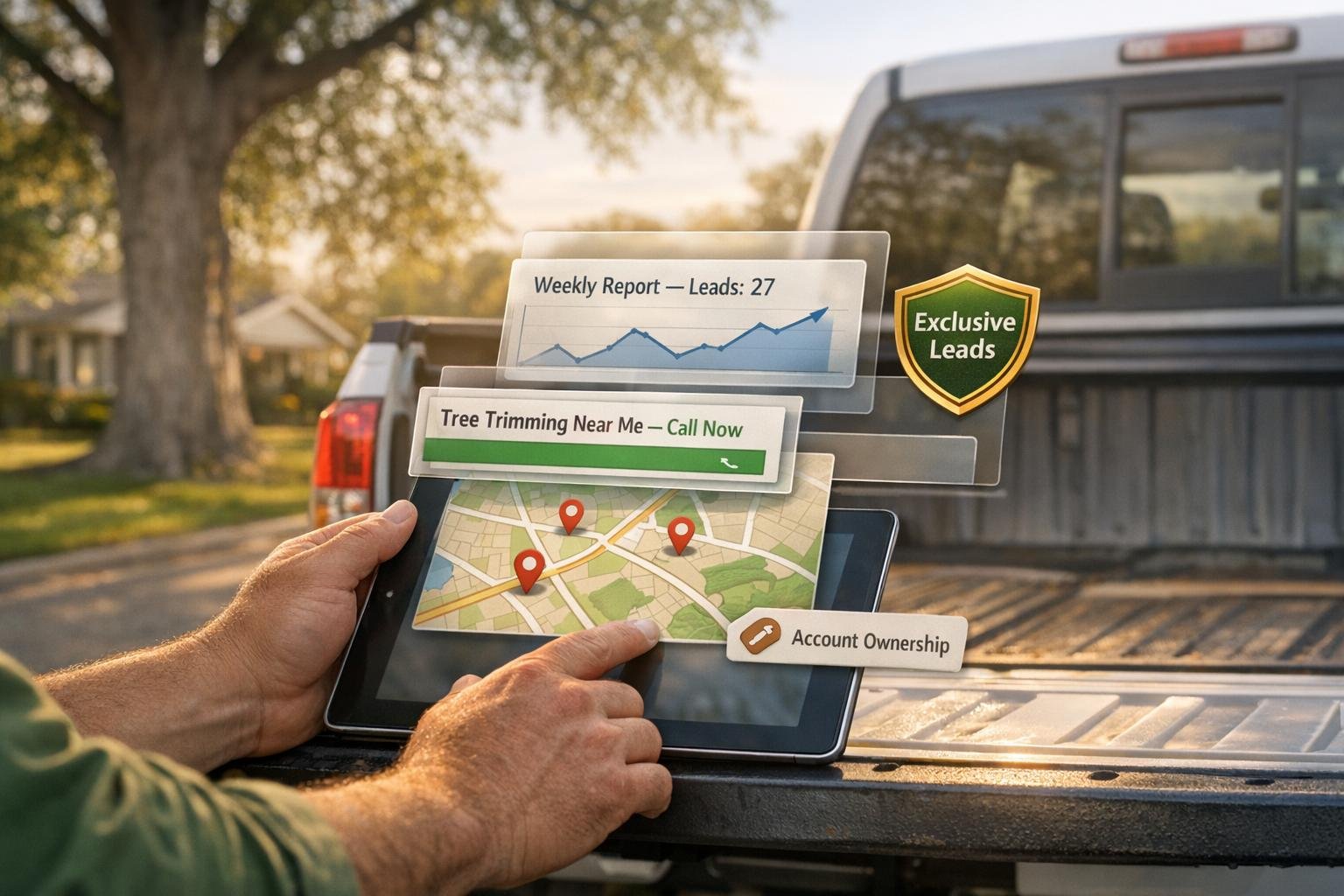
Finding the right marketing agency for your tree service business can be the key to growing your customer base and staying competitive. Here’s what you need to know upfront:
- Specialized agencies deliver better results: Tree service marketing requires unique strategies like seasonal campaigns for storm emergencies or pruning services. General agencies often miss these nuances.
- Focus on local SEO and exclusive leads: With 70% of customers researching online, optimizing your Google Business Profile and securing exclusive leads can boost conversions by 30%.
- Set clear goals: Whether you want fast leads through PPC or long-term growth via SEO, define your objectives and budget (5%-10% of revenue is typical).
- Evaluate expertise and case studies: Look for agencies with proven results in the tree care industry – like increasing lead volumes or tripling revenue for similar businesses.
- Ask the right questions: Ensure they offer transparent reporting, account ownership, and strategies tailored to your local market.
Partnering with a specialized agency can help you stand out in a $2.51 billion industry projected to grow 14% annually. Keep reading for a step-by-step guide to choosing the best fit for your business.
🌳💵 Tree Service PPC Strategy That Literally Prints Cash – See How We Do It!
sbb-itb-130a704
Define Your Marketing Goals and Needs
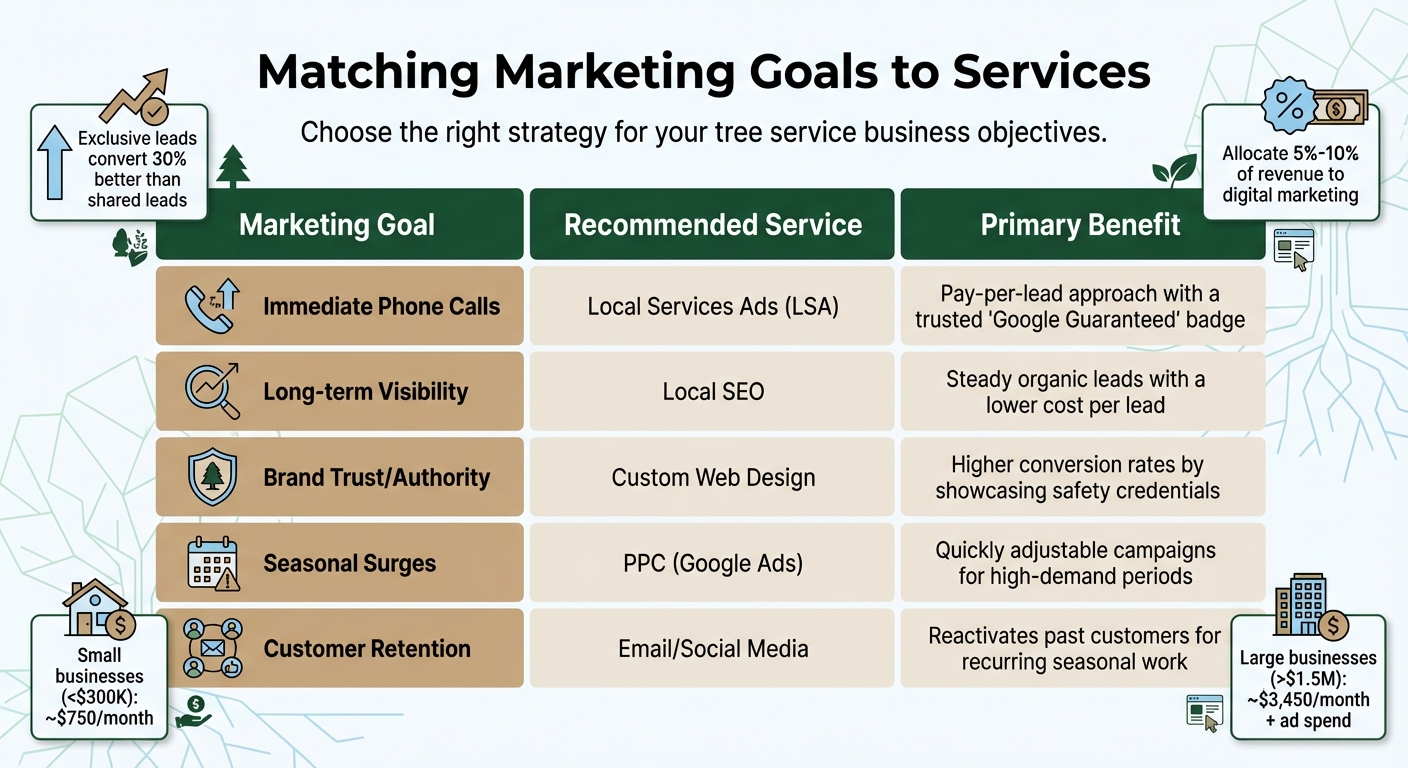
Tree Service Marketing Goals and Recommended Services Comparison
To create a successful marketing strategy, you need to start with clear, measurable goals. Vague objectives like "get more customers" won’t cut it. Instead, focus on revenue-driven targets that align with your business’s current stage and growth ambitions. For example, a tree service company earning under $300,000 annually will need a different approach than one generating $1.5 million or more. Smaller businesses often see great results by building a strong Google Business Profile and gathering reviews, while larger operations might prioritize regional expansion. On average, tree service businesses allocate 5% to 10% of their revenue to digital marketing to stay competitive.
Set Clear Objectives for Your Tree Service Business
Your first step is deciding whether your focus is immediate results or long-term growth. If you need leads fast – say, to fill gaps in your schedule next week – services like Google Ads for tree services or Local Services Ads (LSAs) are great options. On the other hand, Search Engine Optimization (SEO) builds organic authority, creating a steady stream of leads over time.
"A PPC campaign for emergency tree removal in storm season demands lightning-fast targeting… Meanwhile, a spring pruning campaign focuses on awareness, seasonal SEO, and nurturing leads over weeks."
- Tim Brown, Founder, Hook Agency
If exclusive leads are a priority, make that clear when choosing an agency. Exclusive leads often convert 30% better than shared ones. Another key objective should be focusing on conversion, not just website traffic. Thousands of visitors don’t mean much if they aren’t calling your business or filling out contact forms. Improving your website’s ability to turn visitors into paying customers should be a top priority.
Lastly, consider your business’s seasonality. During storm seasons, your marketing might focus on high-volume emergency leads, while quieter months could shift toward maintenance services.
Prioritize Services That Match Your Goals
Once your objectives are clear, choose services that align with them. For immediate results, look for agencies that specialize in PPC, LSAs, and lead automation. If you’re aiming for long-term growth, focus on strategies like SEO, content creation, and video marketing. High-ticket growth may require custom strategies, while businesses looking for all-in-one solutions often benefit from full-service agencies that handle everything from SEO to web design.
| Marketing Goal | Recommended Service | Primary Benefit |
|---|---|---|
| Immediate Phone Calls | Local Services Ads (LSA) | Pay-per-lead approach with a trusted "Google Guaranteed" badge |
| Long-term Visibility | Local SEO | Steady organic leads with a lower cost per lead |
| Brand Trust/Authority | Custom Web Design | Higher conversion rates by showcasing safety credentials |
| Seasonal Surges | PPC (Google Ads) | Quickly adjustable campaigns for high-demand periods |
| Customer Retention | Email/Social Media | Reactivates past customers for recurring seasonal work |
Budgeting is another important aspect. Smaller businesses (under $300K in revenue) may spend around $750/month, while larger companies (over $1.5M in revenue) might invest $3,450/month or more, plus ad spend. Before signing with any agency, track your current metrics – like lead volume, closing rates, and revenue – to establish a baseline. This will help you measure whether the agency is delivering a solid return on investment.
As Ryan Warner, a tree service business owner, put it:
"What we’ve realized through working with you and your team is that you can quantify marketing returns. I can look and see I’m spending this dollar and I’m getting this in return for it."
- Ryan Warner, Owner
Clear objectives not only help you choose the right agency but also set the foundation for measuring success.
Research and Shortlist Specialized Agencies
Once your objectives are set, it’s time to find agencies that genuinely understand the tree service industry.
Focus on Industry-Specific Experience
General marketing agencies often rely on broad strategies that overlook the unique needs of tree care businesses. But specialized agencies know the difference between promoting pruning services and hazardous tree removal. They also understand how critical it is to launch immediate-response campaigns for storm-related calls.
Consider agencies founded or staffed by licensed arborists. These teams already speak your language, cutting down on the time spent explaining industry specifics. As Monica Hemingway, Founder of Tree Care Marketing Solutions, says:
"Tired of wasting time and money explaining tree care to your marketing agency? Hire the agency staffed by arborists!"
This expertise allows these agencies to hit the ground running, using data-driven strategies tailored to the tree care market. They’re skilled at targeting seasonal demands, optimizing for high-value jobs like emergency removals, and incorporating industry-specific keywords for better results.
Evaluate Case Studies and Success Stories
Request case studies that highlight measurable outcomes like revenue growth, lead generation, and job bookings – not just metrics like website traffic or ad impressions. A solid agency will back their claims with numbers that matter.
Take Leads4Build, for example. Between June and October 2025, they partnered with a new tree service provider in Greater Boston that had no digital presence. By creating optimized landing pages and running Google and Facebook ads, the agency generated over 280 monthly leads at $40 per lead. This effort resulted in 65+ completed jobs and helped the solo arborist grow into a five-person crew. According to the business owner:
"I was genuinely worried we wouldn’t even get off the ground as a new business. Now my biggest challenge is hiring qualified arborists fast enough to keep up with demand."
Another example is Tree Service Digital, which worked with Eco Tree Experts in West Palm Beach, FL, over 32 months ending in January 2024. By combining SEO, Google Maps optimization, and Local Service Ads, they helped the client triple their annual revenue from $1 million to $3 million.
When reviewing case studies, ensure the agency provides exclusive leads to maintain strong conversion rates. Confirm that they allow you to own your advertising accounts and offer transparent, real-time dashboards to track ROI. These benchmarks can help you gauge whether an agency can deliver the results you’re aiming for.
Evaluate Agency Expertise and Capabilities
Once you’ve set clear goals and narrowed down your list of potential agencies, it’s time to dive into their expertise. Specifically, look at their skills in local SEO, paid advertising, and exclusive lead generation – three essential areas for driving tree service leads.
Examine Their Local SEO Strategies
For tree service businesses, local SEO is the foundation of steady growth. With 97% of consumers turning to online searches for local services, your agency must do more than just participate in local search – they need to dominate it.
Start by asking about their approach to optimizing your Google Business Profile. An experienced agency will prioritize selecting the right primary category (like "Tree Service" or "Arborist"), maintaining a steady flow of 3–5 new Google reviews each month, and publishing weekly posts with photos. Why photos? Posts with images see 42% more engagement than those without. The goal here is to secure a spot in Google’s "Local Pack", the map section that appears at the top of search results.
Next, check their strategy for NAP (Name, Address, Phone) consistency. Your business details should be accurate across 40–60 high-authority directories, including niche platforms like TreeBuzz or ISA’s "Find an Arborist" (common for a Virginia tree service marketing agency). Dedicated service area pages optimized for mobile are also critical – 73% of tree service searches happen on mobile devices. Make sure your website loads in under three seconds on 4G networks, as speed plays a big role in Google’s rankings.
A strong local SEO plan can yield 8–12% more organic leads each month, with conversion rates hovering between 12–18%. These aren’t just numbers – they directly translate to more booked jobs and revenue. Once local SEO is solid, it’s time to evaluate their PPC strategies.
Assess Their Google Ads and PPC Campaigns

Pay-per-click (PPC) advertising delivers instant visibility, but it requires precision to ensure your budget isn’t wasted. In the tree service industry, competition is fierce – clicks can cost over $40, and the average cost per lead often surpasses $100.
A specialized Florida tree service marketing agency will focus on high-intent keywords like "tree removal near me" or "emergency tree service", steering clear of broader terms such as "how to trim a tree". They should also segment campaigns by specific services – like stump grinding or pruning – to ensure ads are relevant. Ask how they use negative keyword lists to filter out irrelevant searches like "jobs", "equipment", or "DIY".
Robust call tracking and CRM integration are non-negotiable. These tools help connect your ad spend directly to booked jobs. On average, tree service PPC campaigns convert at around 5%.
Landing pages are another critical piece. While standard websites might convert about 10% of visitors, well-designed landing pages for tree services can achieve conversion rates of 20% or more. Chris Down from Downey Marketing puts it best:
"Every distraction on your website is another opportunity for someone to leave without converting into a lead."
Give PPC campaigns 2–3 months to fine-tune keywords and targeting. Insist on keyword-level tracking so you can pinpoint exactly which terms are driving calls and jobs.
Determine Their Lead Generation Approach
Once local SEO and PPC are in place, the focus shifts to converting visibility into exclusive leads. Quantity matters, but quality is just as important. Shared leads can reduce conversion rates by 30% or more, so confirm that the agency delivers exclusive leads – ones not sold to multiple contractors.
Look for agencies that combine Google Local Services Ads (LSAs) with traditional search ads. LSAs use a pay-per-lead model instead of pay-per-click, and they come with the "Google Guaranteed" badge, which helps build trust instantly. These ads appear at the very top of search results, capturing high-intent customers before they even consider competitors.
Exclusive, geo-targeted leads typically convert 30% better than shared ones. Make sure the agency offers real-time lead tracking and transparent dashboards so you can monitor your ROI at any time.
Finally, confirm account ownership. You should retain full ownership of your Google Ads, Analytics, and LSA accounts. This ensures that all your data and campaign history remain with you, even if you decide to switch agencies.
A well-executed lead generation system can completely transform your business pipeline. For example, generating 50 qualified leads a month could result in 15–25 booked jobs. That’s the kind of impact you want from the right agency.
Ask the Right Questions During Consultations
You’ve narrowed down your options, and now it’s time to dig deeper. The right questions can help uncover whether an agency truly understands your business and can deliver measurable results. This step ensures you’re partnering with a team that knows the tree service industry inside and out – and can account for every dollar spent.
Inquire About Customization for Local Markets
Kick things off by asking: "What specific strategies do you use to target local customers for tree service businesses in South Carolina, and how do you tailor these strategies to my market area?" This question helps you avoid cookie-cutter approaches and reveals the agency’s ability to craft campaigns that resonate with your specific audience.
A strong agency will dive into strategies like local optimization, emphasizing how they adapt campaigns to suit your service areas and account for seasonal changes. Tim Brown from Hook Agency puts it this way:
"A PPC campaign for emergency tree removal in storm season demands lightning-fast targeting, local ad tweaks, and urgency-driven copy. Meanwhile, a spring pruning campaign focuses on awareness, seasonal SEO, and nurturing leads."
If they can’t explain how they’d adjust campaigns for something like spring pruning versus fall storm prep, that’s a red flag. Additionally, confirm they create dedicated landing pages for each service and location. Sending paid traffic to a generic homepage is a major misstep.
Once you’ve covered local strategies, shift the conversation to how they measure and report campaign success.
Explore Their Performance Tracking Methods
To gauge how results-oriented an agency is, ask: "How do you track and report the performance of marketing campaigns, and what tools or metrics do you use to ensure transparency and accountability?" This will help you identify whether they focus on meaningful outcomes instead of vanity metrics like clicks or impressions.
The best agencies will mention tools like centralized dashboards that consolidate all leads – calls, contact forms, chats, texts, and messages – in one place. They should also use call tracking systems and keyword-level tracking to show which search terms are driving actual booked jobs.
Make sure they set baseline metrics at the beginning to measure progress accurately. Ask about their reporting schedule – monthly reports are a minimum, but real-time tracking is even better. Lastly, confirm that you own your accounts. This means retaining full ownership of your Google Ads, Analytics, and Local Services Ads accounts, which ensures transparency and control.
For example, Tree Company Leads offers real-time lead tracking with transparent dashboards, enabling you to monitor ROI and lead quality at any time. This kind of visibility empowers you to make smarter decisions about where to allocate your marketing budget.
Compare Agencies and Make an Informed Decision
You’ve done the research, asked the tough questions, and now it’s time to evaluate your options side-by-side. By comparing agencies thoroughly, you can identify the one that aligns best with your tree service business goals and budget. This step is key – 73% of businesses report dissatisfaction with their first marketing agency choice. A careful comparison now can save you from costly mistakes later.
Use a Comparison Table for Agency Evaluation
A comparison table is a simple yet effective way to organize and analyze your options. Focus on key factors that directly affect your business, such as industry expertise, lead quality, return on investment (ROI), and contract flexibility. This method ensures you’re weighing every detail, from pricing to performance, with clarity.
Here’s an example of how to structure your evaluation:
| Agency Name | Industry Focus | Lead Type | Core Services | Investment | Contract Terms | Reported ROI |
|---|---|---|---|---|---|---|
| Tree Company Leads | Tree service specialists | Exclusive leads | Local SEO, Google Ads, real-time tracking | Custom pricing | Flexible terms | High conversion rates |
| Agency B | General home services | Shared leads | SEO, PPC | $2,500–$5,000 | 12-month minimum | 2:1 average |
| Agency C | Multi-industry | Exclusive leads | Full marketing suite | $5,000–$10,000 | 6-month minimum | Varies by client |
This table gives you a clear snapshot of each agency’s strengths and weaknesses. Pay special attention to lead exclusivity – shared leads can reduce conversion rates by over 30%. Also, confirm you retain account ownership for assets like Google Ads, Analytics, and your website, ensuring control if you part ways. Agencies with a specialized focus often achieve 20–30% higher client retention and up to 60% faster lead growth, making this a critical factor to consider.
Budgeting and Trial Periods
As a general guideline, allocate 5%–10% of your revenue to digital marketing. For established tree service companies generating $2 million to $20 million annually, this translates to a marketing investment of $70,000 to $100,000 per year. If you’re hesitant to commit immediately, consider starting with a 3-month pilot project to test the agency’s performance and communication before signing a long-term agreement.
Check References and Performance Guarantees
Before finalizing your decision, ask for 2–3 client references. Focus on how the agency handles underperforming campaigns – this insight will give you a glimpse into how they’ll respond when challenges arise. By weighing these factors carefully, you’ll be well-positioned to choose an agency that delivers results and aligns with your business priorities.
Conclusion
Once you’ve set clear goals and completed a thorough evaluation, it’s time to make a well-informed decision. Select an agency that truly understands the specifics of tree care – whether it’s handling emergency storm leads or managing seasonal pruning schedules – and can deliver results in a highly competitive $2.51 billion industry. Specialized tree care marketing agencies can help businesses achieve up to 60% faster lead growth compared to working with generalist firms.
Make sure to verify the agency’s industry expertise, check references, and ensure you retain full ownership of your digital assets. Look for agencies that provide tools like real-time tracking dashboards and focus on driving booked jobs rather than vanity metrics like clicks or impressions. With nearly 90% of customers starting their search on Google, your agency must excel in areas like Google Business Profile optimization, Local Services Ads, and "near me" SEO.
The takeaway is clear: agencies specializing in tree care marketing deliver results through exclusive leads, accurate ROI tracking, and in-depth industry knowledge. These should be your guiding factors when making your final choice.
Want to take your Georgia tree service market by storm with exclusive, high-quality leads? Tree Company Leads offers the expertise and transparency you need to transform online searches into signed contracts. Contact us today to craft your personalized growth strategy!
FAQs
How long until a tree service marketing agency shows results?
A tree service marketing agency often produces noticeable results within 2 to 4 months. During this period, businesses can experience improvements such as higher Google rankings, more leads, and increased revenue. While some campaigns may yield quicker outcomes, the timeline largely depends on factors like the specific strategy employed, the level of competition, and the overall scope of the campaign. Typically, the first few months bring initial gains in visibility and lead generation.
What should I demand for lead tracking and ROI reporting?
When discussing lead tracking and ROI reporting, make sure to request tools and analytics that can clearly measure how your campaigns are performing. This includes tracking metrics like traffic, conversions, and leads. Insist on transparent reports that break down your ROI, highlighting key data such as cost per lead and conversion rates.
The agency should also utilize tools like Google Analytics or call tracking systems to monitor results accurately. Most importantly, these reports should align with your business objectives and showcase measurable outcomes that reflect your goals.
How do I know if the leads will be exclusive to my business?
To ensure exclusivity, find out if the marketing agency enforces a "one company per service area" rule. This policy guarantees they won’t represent multiple businesses in the same region, helping to avoid lead sharing and minimizing competition between clients.