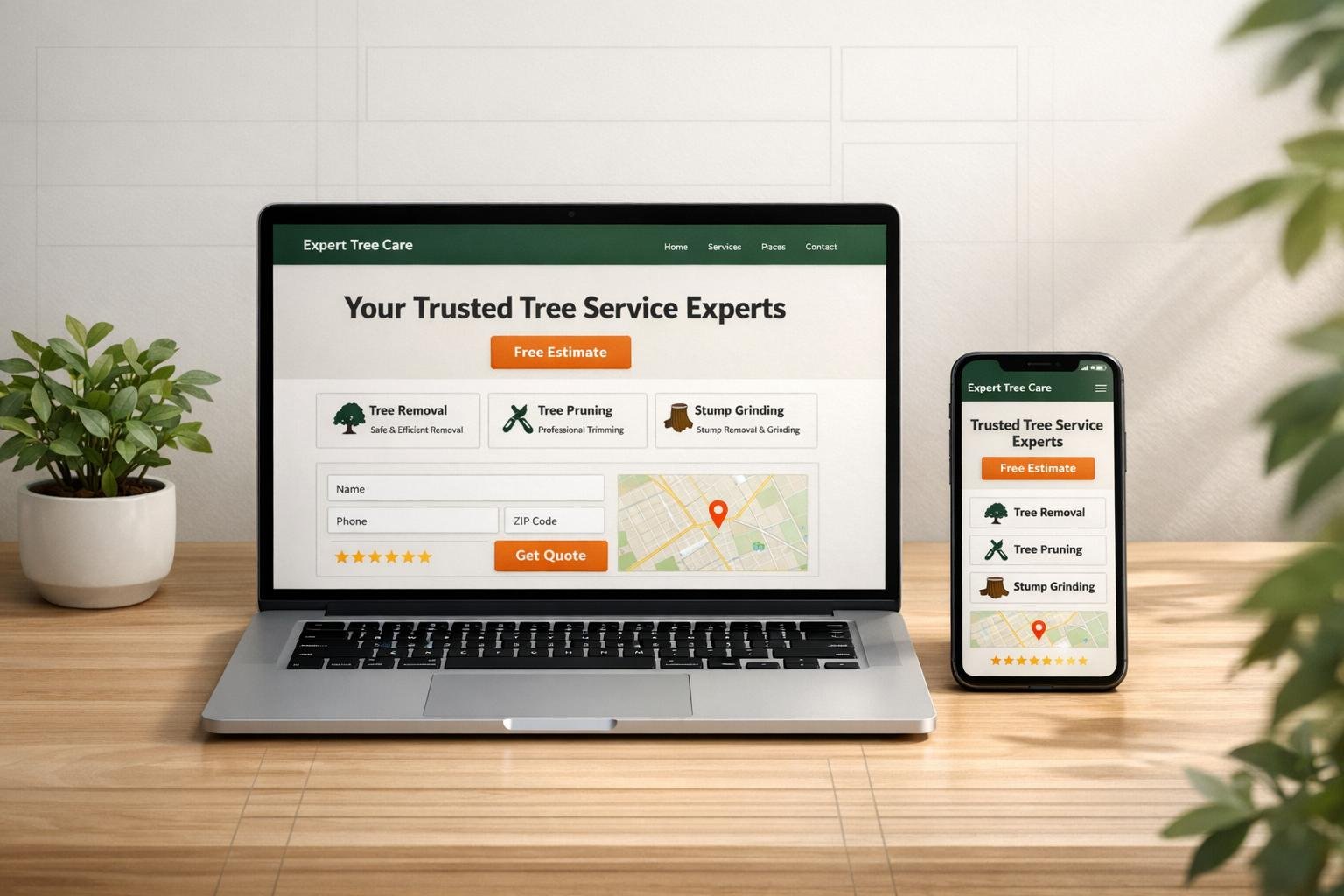
Want your tree service business to stand out online? Your website is more than just a digital business card – it’s your 24/7 salesperson. Homeowners are searching online for tree services, and a well-designed, fast, and mobile-friendly website can make all the difference. Here’s what you need to know:
- 89% of homeowners search online before hiring tree care services.
- 75% of users judge your credibility based on your website design.
- Mobile users dominate: 79% of searches for tree services happen on phones.
- A slow site hurts conversions – 53% leave if it takes more than 3 seconds to load.
To build a website that works for your business, focus on these key areas:
- Choose the right platform: Look for fast load times, mobile responsiveness, and lead tools.
- Design for mobile: Responsive layouts, click-to-call buttons, and easy navigation are essential.
- Create detailed service pages: Highlight your services, credentials, and local expertise.
- Optimize for local SEO: Ensure your business shows up in local searches with tools like Google Business Profile.
- Add lead capture tools: Use live chat, simple forms, and call tracking to turn visitors into customers.
- Keep it fast and secure: Compress images, enable SSL, and use reliable hosting to maintain trust and performance.
Your website should not only look professional but also drive leads and grow your business. Let’s dive into how to make it happen.
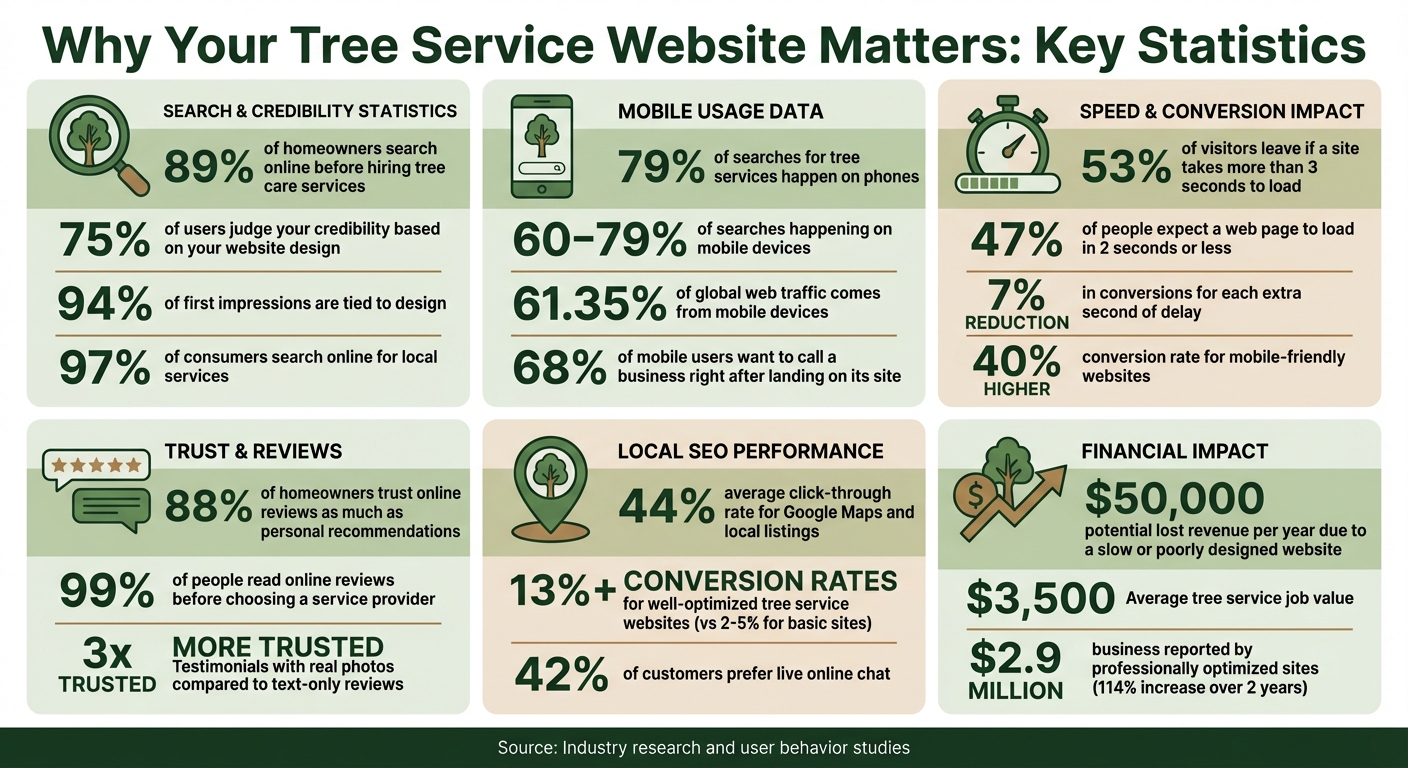
Tree Service Website Statistics: Mobile Usage, Conversion Rates & User Behavior
How to Build Your Tree Service Website for Maximum Conversion & Lead Flow
sbb-itb-130a704
Select Your Website Platform
The platform you choose for your website plays a huge role in how easily you can update content, attract leads, and rank well in local searches. It’s all about finding the right balance between user-friendliness and the technical features your tree service business needs to thrive online.
What to Look for in a Website Platform
Your platform should check several key boxes: mobile responsiveness, lead capture capabilities, fast load speeds, and strong security. With most searches happening on mobile devices, your site must adjust seamlessly to different screen sizes. Features like tap-to-call buttons that stay visible as users scroll are a must – 68% of mobile users want to call a business right after landing on its site.
Lead generation tools are just as critical. Look for platforms that integrate with chatbots, live chat, and easy-to-use contact forms. Short, straightforward forms can make a big difference in turning visitors into customers. Plus, make sure the platform supports dedicated service pages for offerings like stump grinding or emergency tree removal, as well as location-specific pages for each city you serve. These pages are essential for boosting your local SEO rankings.
Quick load times and strong security features are non-negotiable. An SSL certificate (HTTPS) is a must-have – browsers flag sites without one, which can hurt your credibility with potential customers researching your services.
Best Platforms for Tree Service Websites
Tree Company Leads custom web design is built specifically for the tree care industry. It offers layouts tailored to your business, complete with industry-specific SEO and lead generation tools designed to match how tree service customers search and make decisions. The platform also handles all the technical upkeep, letting you focus on your business while your site works to bring in leads 24/7.
"I am thrilled with the new website Tree Company Leads designed for my tree service business! The layout is clean and user-friendly, which has definitely increased my online inquiries."
- Mark Thompson, Tree Service Business Owner
Tree Company Leads takes the guesswork out of adapting generic platforms to fit your industry. It comes preloaded with mobile-responsive designs, built-in lead capture tools, fast page speeds, and strong security features. Everything is designed specifically with tree care businesses in mind, ensuring your website connects with homeowners searching for services and converts them into customers.
Once you’ve chosen your platform, the next step is designing a mobile-friendly site that leverages these built-in features.
Design a Mobile-Responsive Website
With 60%-79% of searches happening on mobile devices, your website needs to work seamlessly across all screen sizes. Mobile-friendly websites enjoy a 40% higher conversion rate compared to non-responsive ones. Plus, speed is critical – 53% of visitors will leave if a site takes longer than 3 seconds to load, and each extra second reduces conversions by 7%.
A responsive design ensures your site automatically adjusts to different devices. This means images resize, text flows properly, and buttons remain easy to tap. Visual appeal is just as important – 75% of users judge a company’s credibility based solely on its website design, and 94% of first impressions are tied to design.
"Your website isn’t competing against other tree service websites – it’s competing against Amazon, Netflix, and every modern website your customers use daily." – Home Service Direct
To keep visitors engaged, make navigation simple and guide them to the most important service information.
Navigation Structure and Core Pages
Your navigation should be straightforward and touch-friendly. The main menu should include key sections like Services (with a dropdown for specific offerings such as tree removal, stump grinding, and pruning), About, Gallery, and Contact. Each service should have its own dedicated page to make it easier for both customers and search engines to understand your expertise.
Showcase high-quality visuals, including before-and-after photos, branded trucks, and crew members in safety gear, to highlight the professionalism of your work. Add an FAQ section to address common concerns about pricing, insurance, and safety – this not only helps potential customers but also improves your search rankings for specific queries.
Once your navigation is set, focus on optimizing interactive features for mobile users.
Mobile Design Best Practices
Click-to-call functionality is a must – 68% of mobile visitors want to call a business immediately after visiting its site. Make your phone number large, clickable, and place it in a sticky header that stays visible as users scroll. For urgent needs, include a prominent "Emergency Service" button in a high-contrast color to capture leads during storms or emergencies.
Ensure all interactive elements are easy to use. Tap targets should be at least 44×44 pixels or a minimum height of 50px to make them finger-friendly. Use short contact forms (just name, phone, and service type), keep font sizes at least 16px, and limit paragraphs to 3-4 lines for better readability on small screens.
To keep your site fast and visually appealing, compress images with tools like TinyPNG or use modern formats like WebP. Aim for load times under 3 seconds. Adding a floating contact bar with options like "Call", "Quote", or "Text" keeps your contact details accessible as users browse. For those who prefer messaging, consider live chat or chatbots to capture leads 24/7.
Write Service-Focused Content
After ensuring your website is mobile-friendly, the next step is creating service-focused content that turns visitors into customers. Your content shouldn’t just list your services – it needs to showcase your expertise and answer the key questions homeowners might have. Well-written, optimized content not only builds trust but also attracts qualified leads through SEO or ads. The goal is to speak directly to your customers’ needs while demonstrating your technical knowledge of tree care.
Most homeowners don’t have a deep understanding of tree care and often value reliability over finding the lowest price. Your content should highlight your licensing, insurance, and years of experience. Use clear, straightforward language to explain the "why" and "how" of your services. For instance, describe the property protection measures you take during complex tree removals. This kind of transparency fosters trust even before they pick up the phone.
"My personal advice is to write about what you’re passionate about, trees! … Write about what your customers ask you frequently about. Your area of expertise isn’t represented enough online." – Gravity Web Designs
Tackle specific concerns like pricing, permits, and cleanup processes to answer questions before they’re even asked. This approach not only simplifies the sales process but also helps search engines connect your site with highly specific queries. Keep your tone authoritative yet approachable – you’re the expert, but you’re also someone who genuinely wants to help homeowners with their tree care challenges.
Write Detailed Service Pages
Create a dedicated page for each of your primary services – tree removal, stump grinding, pruning, and emergency cleanup. These pages should target location-based searches by incorporating city names into headlines, such as "Tree Removal in [City]", and referencing local landmarks or common tree species.
On each service page, prominently display your credentials. Mention your $2 million+ liability insurance and ISA (International Society of Arboriculture) certifications. Include high-resolution before-and-after photos to demonstrate your quality of work, along with images of your team in safety gear and operating professional equipment. These visuals reassure potential customers that you’re a legitimate, professional operation.
Define your service area clearly. Use interactive maps or list specific neighborhoods to avoid receiving inquiries from outside your coverage zone. Add bold, easy-to-spot "Get a Free Quote" or "Emergency Service" buttons at the top of the page and repeat them throughout. For emergency services, use high-contrast buttons like "24/7 Emergency Service" to capture urgent leads during storms or other crises. Enhance these pages further by incorporating authentic visuals and testimonials from satisfied clients.
Use Photos and Testimonials to Build Trust
Once your service pages are detailed and informative, strengthen them with real photos and testimonials to establish credibility. Authentic images of your crew and equipment perform far better than generic stock photos. In fact, 88% of homeowners trust online reviews as much as personal recommendations, and testimonials with real photos are trusted three times more than text-only reviews.
On your "About Us" page, include photos of the owner and team members, along with their names and specialties, to add a personal touch. Encourage your crews to take "before", "during", and "after" photos from the same angle to showcase transformations. These galleries help homeowners visualize how their own property could look after your services. Use modern image formats like WebP and enable "lazy loading" to ensure high-resolution photos don’t slow down your site.
Place testimonials on the relevant service pages. For example, a stump grinding review belongs on the stump grinding page, not buried on a general "Reviews" page. Video testimonials, even if they’re just 30 seconds long, can significantly boost credibility. Embed a live widget showing your current Google star rating (e.g., 4.9/5) to provide third-party validation.
To maintain a steady flow of reviews, send automated text or email requests within 24–48 hours of completing a job. Respond to all reviews promptly – within 24–48 hours. For negative reviews, reply with empathy and offer to resolve the issue privately. This shows potential clients that you’re accountable and committed to customer satisfaction.
Add Lead Generation and Local SEO Features
After perfecting your content and ensuring it builds trust, the next step is making sure local customers can actually find your website. Here’s the reality: 97% of consumers search online for local services. If your business doesn’t appear on the first page for searches like "tree removal [your city]", you’re essentially handing jobs over to your competitors. Local SEO ensures your business shows up when people in your area need help, while lead capture tools turn those visitors into calls and quote requests. Together, these strategies can turn local searches into actual business opportunities.
Local SEO doesn’t just increase visibility – it drives results. For instance, Google Maps and local listings boast a 44% average click-through rate, and well-optimized tree service websites can achieve conversion rates of 13% or higher, compared to the typical 2–5% for basic sites. But simply having a website isn’t enough. You need to signal to Google that your business is active and make it easy for potential customers to reach you.
"If you’re not on page one for ‘tree removal [your city],’ you’re losing money. Competitors who rank higher take those jobs." – Alex Gambashidze, ResultCalls
Here’s how to focus on two key areas: optimizing for local search and implementing lead capture tools that work even while you’re busy.
Local SEO Optimization Techniques
Start by claiming and verifying your Google Business Profile (GBP). Set "Tree Service" as your primary category and consider adding secondary ones like "Arborist" or "Stump Removal Service". Upload high-quality photos of your team, equipment, and completed projects – posts with photos get 42% more engagement. Before uploading, geotag your images to add location data, which boosts local relevance.
Use Google Posts to share updates like completed jobs, seasonal tips, or special offers. These posts expire after seven days, so posting weekly signals to Google that your business is active. Also, encourage customer reviews and respond promptly – preferably within 24–48 hours. Why? 99% of people read online reviews before choosing a service provider, and a thoughtful response to a negative review can sometimes win over more customers than a perfect five-star rating.
Keep your Name, Address, and Phone number (NAP) consistent across platforms like your website, GBP, Yelp, Facebook, Angi, and the Better Business Bureau. Use tools like BrightLocal or Whitespark to audit and fix any inconsistencies.
Create service area pages for every city or neighborhood you serve. These pages should include unique content, mention local landmarks, and address regional tree issues, such as storm damage in coastal towns or oak wilt in Texas. Incorporate long-tail keywords like "emergency tree removal in Dallas" into your title tags, headings, and image alt text to reinforce your local relevance.
Add Local Business Schema Markup using JSON-LD to help search engines understand your business type, service area, operating hours, and reviews. This can improve your local search visibility by up to 30%. Embedding a Google Map on your contact page also strengthens your local presence.
While GBP optimization can produce quick wins, consistent effort over three to six months is typically required to achieve top rankings. If managing SEO feels overwhelming, professional services tailored to tree companies – costing around $1,500 per month – can be a worthwhile investment, given the potential revenue from new customers.
Install Lead Capture Tools
Once your local SEO is in place, focus on capturing leads effectively. Make it simple for visitors to contact you, especially on mobile devices. Add large, clickable call-to-action buttons in your site’s header and as a sticky footer.
Integrate live chat or chatbots to collect lead details 24/7, even when you’re unavailable. With 42% of customers preferring live online chat, an automated greeting like “Need help with a tree service? Let me take your info for a free estimate” can encourage immediate engagement.
Use tools like online booking systems and call tracking to streamline scheduling and measure marketing ROI. For example, platforms like Jobber make appointment booking easier, while services like CallRail help track which pages or campaigns generate the most calls.
By combining local SEO with effective lead capture tools, you ensure that visitors not only find your website but also take action.
| Category | Recommended Software | Primary Benefit |
|---|---|---|
| Live Chat / Chatbots | Tidio, ManyChat, HubSpot Chat, LiveChat, Intercom | 24/7 engagement and instant response |
| Call Tracking | CallRail, CallTrackingMetrics | Tracks ROI and attributes calls to specific pages |
| Online Booking | Jobber | Simplifies scheduling and reduces booking friction |
| Contact Forms | WPForms, Gravity Forms | Makes mobile-friendly quote requests easy |
| Review Management | EmbedSocial, Elfsight, BrightLocal | Displays real-time reviews to build trust |
Ensure your site is secure with an SSL certificate (HTTPS), as browsers often flag non-secure websites, which can deter potential leads. Use tools like Google Analytics and Google Tag Manager to track clicks, form submissions, and conversions, so you can continuously refine your strategy.
"Your website isn’t competing against other tree service websites – it’s competing against Amazon, Netflix, and every modern website your customers use daily." – Home Service Direct
Optimize Website Performance and Security
Your website’s performance and security play a huge role in turning visitors into customers. Did you know that 47% of people expect a web page to load in 2 seconds or less? And every extra second of delay can decrease conversion rates by 7%. For tree service companies, this means a slow or insecure website could cost you potential clients – especially during emergencies when homeowners need help fast. A quick, secure site not only builds trust but also keeps visitors engaged.
Improve Website Speed
Speed matters. Start by compressing images using modern formats like WebP to reduce file sizes while maintaining quality. Tools like Google PageSpeed Insights can help pinpoint issues like oversized images or slow server response times.
Here are some ways to improve your site’s speed:
- Enable browser caching to make return visits faster.
- Use a Content Delivery Network (CDN) like Cloudflare to deliver content more quickly.
- Minify CSS and JavaScript files to simplify browser processing.
- If your site uses a heavy theme, consider rebuilding it with a lighter framework like Next.js or streamlined HTML/CSS.
Also, invest in reliable hosting. Cheap shared hosting often slows down your site. With mobile devices making up about 61.35% of global web traffic, ensure critical elements – like your phone number and call-to-action button – load first, so visitors can act without delay.
Once your site is running smoothly, it’s time to focus on security measures to protect both your business and your users.
Implement Security Measures
Speed is crucial, but so is security. Start by installing an SSL certificate to encrypt data between users and your server. Without SSL, browsers like Chrome display a "Not Secure" warning, which can erode trust instantly. Free SSL certificates are available through Let’s Encrypt, or you can opt for paid versions with added warranties, like Network Solutions’ $10,000 security warranty. Plus, switching to HTTPS can even improve your search rankings.
Other essential security steps include:
- Automated Backups: Use tools like UpdraftPlus or BlogVault to schedule daily backups to remote locations like Dropbox or Amazon S3. This is crucial because hiring professionals to fix a hacked site can cost over $250 per hour.
- Strong Passwords and 2FA: Use unique passwords managed by tools like LastPass, and enable Two-Factor Authentication (2FA) with apps like Authy or Google Authenticator.
- Web Application Firewall (WAF): Install a WAF like Sucuri or Cloudflare to block malicious traffic. Sucuri offers a full security package – including malware scanning and cleanup – for about $199 per year.
- CAPTCHA Protection: Add CAPTCHA to forms to block spam and bots.
- Regular Updates: Keep your site’s core software, themes, and plugins updated to fix vulnerabilities. Over 40% of websites have security flaws that hackers can exploit.
"Backups are your first defense against any WordPress attack. Remember, nothing is 100% secure." – Editorial Staff, WPBeginner
Conclusion
Creating a website that works as your 24/7 digital sales agent starts with a mobile-responsive design, service-focused content, local SEO, and effective lead capture tools. When these elements come together, your site transforms into a revenue-generating machine. Considering that many homeowners begin their search online, your website often serves as their first – and sometimes only – impression. Every aspect of your digital presence should be geared toward turning visitors into paying customers.
Effective SEO strategies ensure potential clients can find you by targeting searches like "tree removal near me." Once they land on your site, clear and concise content, along with authentic before-and-after photos, builds trust and keeps them engaged. From there, features like simple contact forms, tap-to-call buttons, and fast load times eliminate any barriers that might prevent them from reaching out. As one expert wisely noted: "Traffic means nothing if it doesn’t turn into leads. Conversion optimization ensures your website generates real business".
"A website shouldn’t just ‘look good’, it should work hard for your business. For tree service companies, that means being clear, fast, mobile-friendly, and built to turn clicks into calls." – Local Tree Service Marketing
The stakes are high. A slow or poorly designed website can cost a tree service company as much as $50,000 in lost revenue each year. On the other hand, businesses with professionally optimized sites and robust digital marketing strategies have reported closing $2.9 million in business, reflecting a 114% increase in estimates over two years. With the average tree service job valued at around $3,500, every visitor who leaves without converting represents a missed opportunity.
The key is to integrate all these elements into a seamless, conversion-focused experience. Start with a solid platform, prioritize mobile optimization, build out detailed service pages, and implement effective lead capture tools. Ensure your site is fast, secure, and answers the questions homeowners are asking. By doing so, you’ll position your business as the go-to option for tree services, no matter what device your potential customers are using.
FAQs
How much should a tree company website cost?
The price of a tree company website depends on factors like design, features, and the level of customization. A simple website typically starts at around $2,000, while a more advanced, fully tailored site focused on generating leads can cost anywhere from $10,000 to $15,000 or more. Additionally, ongoing maintenance fees often range between $500 and $2,000 per month. Overall, you should plan for a budget of $2,000 to $20,000, depending on what you’re looking for and how customized the site needs to be.
How long does local SEO take to get more calls?
Local SEO for tree service companies can start driving more calls in just a few weeks. That said, seeing noticeable improvements often takes 3 to 6 months of steady optimization. The key to sustained growth? Consistently updating your strategy and targeting the right local keywords.
What should I track to know my website is working?
To get the most out of your website, keep an eye on essential metrics like the number of visitors, bounce rate, and actions such as contact form submissions or bookings. Make sure your site loads fast – ideally within 2-3 seconds – and works well on mobile devices. These elements play a big role in user experience and lead generation, letting you gauge how effectively your site draws in visitors and turns them into potential customers.