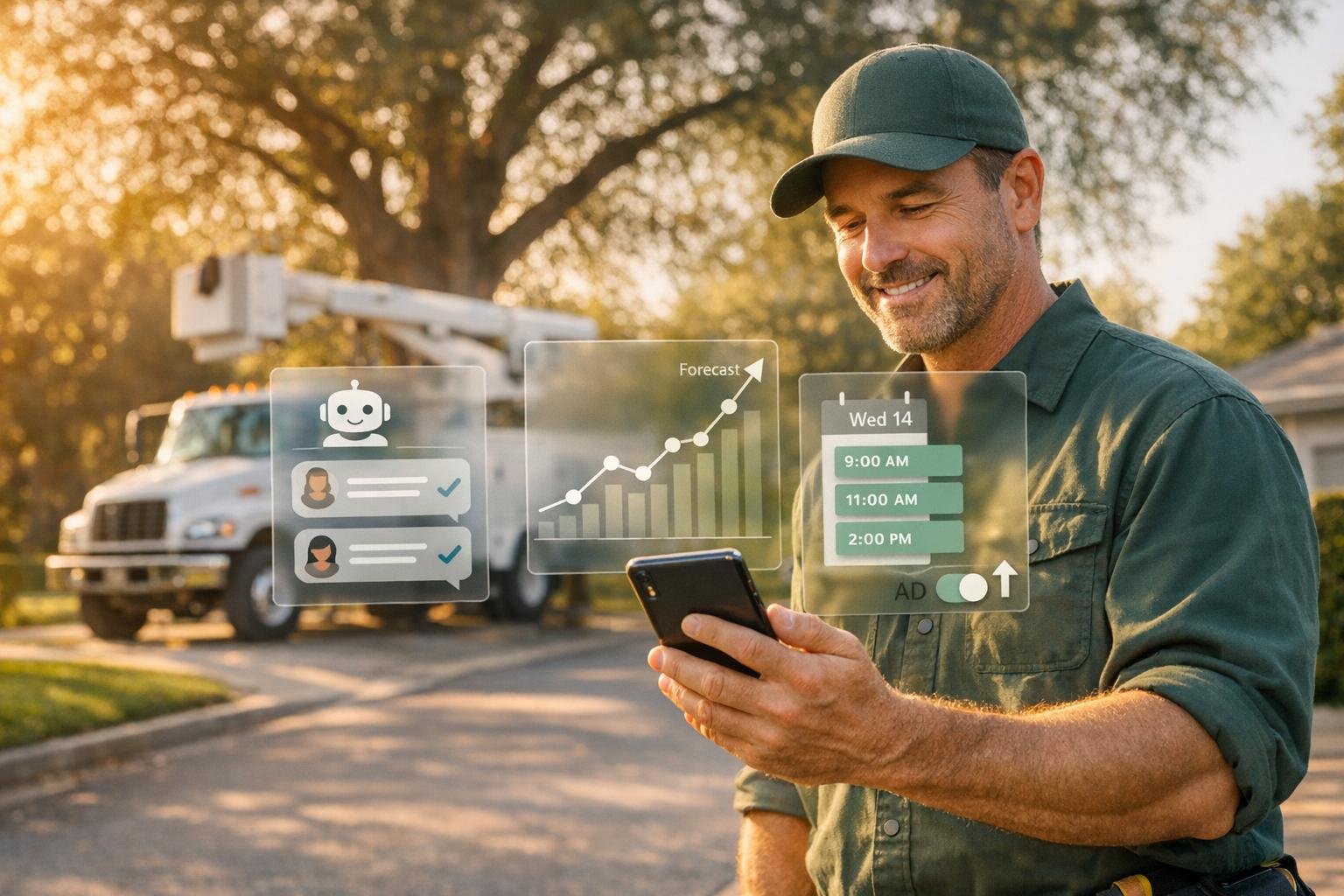
Want to grow your tree service business? AI can help you generate leads, respond faster, and increase revenue.
Here’s what you need to know:
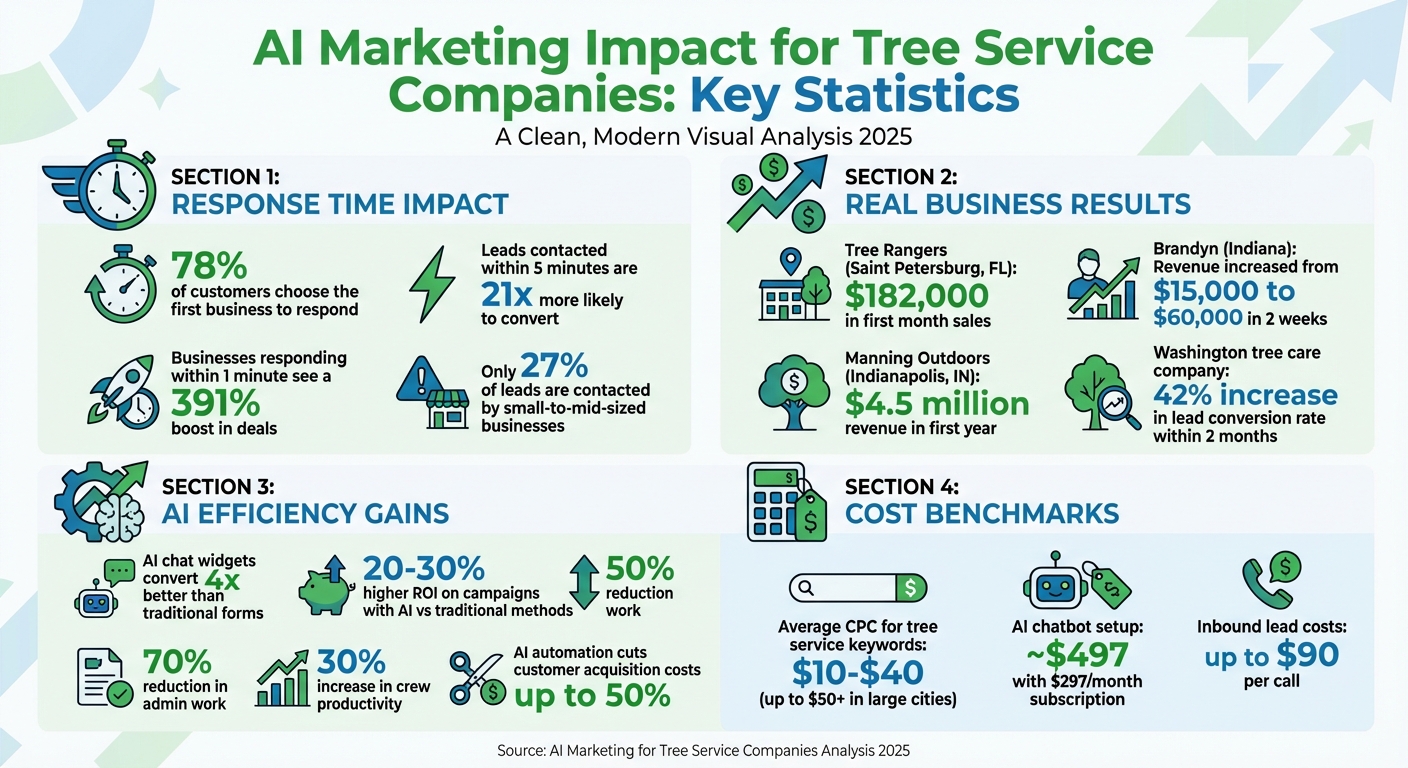
- 78% of customers choose the first business to respond. AI tools like chatbots and automated text-back systems ensure you never miss a lead, even after hours.
- Speed matters. Leads contacted within 5 minutes are 21x more likely to convert. AI-powered systems handle inquiries instantly, schedule appointments, and filter out low-quality leads.
- Real results: Ronnie from Tree Rangers boosted monthly sales to $182,000 using AI, while Brandyn in Indiana increased revenue from $15,000 to $60,000 in just two weeks.
AI doesn’t replace your expertise – it makes your marketing and customer service faster and more efficient. From predictive analytics to Google Ads optimization, these tools save time and money while targeting the right customers at the right time.
If you’re ready to stand out in the competitive tree care market, AI marketing is the way forward.
AI Marketing Impact Statistics for Tree Service Companies
Top 3 Ways to Use AI in Your Tree Service Business
sbb-itb-130a704
AI Chatbots for Lead Capture and Customer Support
Picture this: a homeowner notices a damaged oak tree late at night. They’re not waiting until morning to find help – they’re already online, submitting forms, and sending messages, expecting quick responses. If your tree service isn’t replying immediately, chances are they’ll move on to someone else. That’s where AI chatbots step in. These bots engage visitors instantly, whether they’re reaching out through your website, Facebook Messenger, Instagram, Google Business Profile, or even SMS.
How Chatbots Improve Lead Generation
Speed matters. Leads contacted within 5 minutes are 21 times more likely to be qualified compared to those contacted after 30 minutes. AI chatbots make this possible by responding instantly. They don’t just collect contact details – they also ask qualifying questions, like the type of service needed (removal, pruning, or emergency work) and whether the inquiry falls within your service area. Plus, they filter out irrelevant leads, saving you time.
Here’s a real-world example: in early 2024, a tree care company in Washington adopted an AI chatbot. Within two months, their lead conversion rate jumped by 42%. Advanced bots can even sync with tools like Google Calendar to suggest appointments and book estimates without endless back-and-forth. Once a qualified lead is identified, the system sends an alert straight to your phone so you can step in at the right moment. Miss a call? No problem – the AI can automatically send a text to keep the conversation going, making sure no lead slips through the cracks.
But chatbots aren’t just about capturing leads – they’re game-changers for ongoing customer support too.
Automating Customer Support with AI
AI chatbots go beyond lead generation by tackling routine customer inquiries 24/7. They can provide pricing ranges, confirm service areas, and even share advice tailored to specific tree species. This means you can focus on estimates and fieldwork instead of answering the same questions over and over.
"Today’s AI chatbots aren’t the clunky, frustrating ‘customer-service’ bots of just a few years ago. Instead, they provide genuine 24/7 customer support by having natural conversations via chat or text message." – Monica Hemingway, Ph.D., Licensed Arborist and Marketing Strategist
Customization is key. You can train your bot to reflect your company’s service offerings, working hours, and preferred communication style, ensuring every response feels on-brand. With multi-channel integration, messages from platforms like Facebook, Instagram, Google, and SMS are consolidated into a single dashboard. This makes it easy to monitor conversations and jump in when necessary. Setup costs are typically around $497, with monthly subscriptions running about $297.
Predictive Analytics for Targeted Marketing
You’ve got a database full of past customers, website visitors, and leads. But here’s the challenge: how do you figure out which ones are worth your time and effort? That’s where predictive analytics steps in. By analyzing your historical data, it helps pinpoint the prospects most likely to convert. This means you can focus your resources on the opportunities with the highest payoff.
Understanding Customer Behavior with Data Analysis
AI excels at uncovering patterns in customer data. For instance, it can analyze details like the types of trees on a property, local conditions, and previous service dates. Let’s say a homeowner had their oak tree trimmed 18 months ago, and oaks generally need pruning every two years. Predictive systems can flag this customer for a follow-up, ensuring you’re reaching out at the right time.
"Predictive analytics, an application of AI, allows marketers to predict future customer behavior based on past data. This can be particularly useful for tree service companies in identifying potential customers and forecasting market trends." – Chris Sams, Jemsu
Search intent data is another powerful tool. If someone searches for "emergency tree removal", they’re signaling urgency, while a search for "tree trimming estimate" might reflect a more budget-conscious mindset. AI tools can track these search patterns, enabling you to create targeted campaigns around high-value keywords. Considering that tree service jobs typically range from $1,200 to $4,500, knowing who’s searching for premium services like hazardous tree removal versus routine maintenance can have a huge impact on your bottom line.
These insights allow you to maximize your marketing spend by targeting the right audience at the right time.
Improving Campaign Performance with Data
By leveraging these behavioral insights, predictive analytics helps fine-tune your campaigns to get the best return on investment. It answers critical questions like: Which ZIP codes bring in the highest-paying jobs? When do emergency calls peak during the year? Which marketing channels attract leads that actually convert? Metrics like cost per lead, conversion rates, and customer lifetime value guide your decisions, so you can double down on what works and cut what doesn’t.
Here’s how it works in practice: AI can screen out "tire-kickers" or renters, ensuring your ads reach verified homeowners. During storm season, it can prioritize leads for emergency tree removal, while slower months can focus on routine maintenance. Tools like Looker, Akkio, or Polymer integrate with your customer database to spot trends you might otherwise miss. This strategy not only brings in better leads but can also push your close rate on qualified estimates from 25% to 45%.
With predictive analytics, you’re not just marketing smarter – you’re making every dollar count.
AI-Powered Google Ads Optimization
AI has transformed the way businesses approach Google Ads, allowing campaigns to be more efficient and effective. Without proper optimization, running Google Ads can quickly drain your budget. For example, the average cost per click for tree service keywords ranges from $10 to $40, and in larger cities, it can climb above $50. This makes AI-powered tools a necessity to ensure every dollar is spent wisely.
Google’s AI tools take over many time-consuming tasks, such as manual bid adjustments. Smart Bidding, for instance, uses machine learning to tweak bids in real-time, factoring in elements like the searcher’s device, location, time of day, and even competitor activity. Another example is Performance Max campaigns, which expand your reach across Search, Display, and YouTube by analyzing user intent beyond basic keyword matches.
"AI tools for Google Ads handle tasks like keyword optimization and bid adjustments, giving you more time to focus on growing your business." – Avram Gonzales, Chief Strategist, Digital Harvest
The results speak for themselves. In August 2025, a tree service company operating in a market of 250,000 people spent $2,300 on a well-structured Google Ads campaign. They generated 37 leads, booked 15 jobs, and earned $18,750 in revenue – an impressive 8x return on investment. These kinds of results are possible because AI continually learns which searches drive conversions and which ones don’t.
Automated Ad Targeting for Local Areas
AI shines when it comes to targeting the right audience at the right time. Instead of casting a wide net, AI ensures your ads reach homeowners actively searching for services like "tree removal near me" within a specific 10-mile radius of your business.
This level of precision is essential for tree services, which are inherently local. Paying for clicks from users who live 50 miles outside your service area is a waste. AI lets you narrow your targeting down to specific ZIP codes, improving lead quality. You can even apply bid modifiers to increase bids by 20–30% in high-value neighborhoods where jobs typically pay more.
Google’s AI also prioritizes intent-based targeting. For instance, someone searching for "emergency tree removal" at 2:00 AM after a storm likely has an urgent need, while someone browsing "tree trimming tips" on a Sunday afternoon does not. AI identifies these differences and adjusts bids to ensure your ads are competitive when it matters most.
One critical adjustment: set your location targeting to "Presence only" instead of "Presence or interest." The default setting can waste money by showing ads to people who are merely interested in your area but don’t actually live there. For tree services, where proximity is key, this simple change can make a big difference.
Reducing Wasted Ad Spend with AI
Once your targeting is dialed in, the next step is minimizing wasted ad spend. This is where AI truly excels. For example, without proper filtering, you could end up paying for clicks from searches like "tree service jobs", "DIY tree removal", or "tree trimming equipment" – none of which lead to paying customers. AI identifies and filters out these non-buyer searches automatically.
AI also monitors performance in real-time, reallocating your budget to campaigns that convert while pausing underperforming ads before they drain your funds. Additionally, AI-generated scripts can further enhance efficiency. For example, you can use tools like ChatGPT to create scripts that automatically add exact match keywords as negatives in broad match campaigns, preventing your own ad groups from competing with each other. Other scripts can track your Quality Score daily, a feature not natively available in Google Ads, helping you identify and address costly low-relevance keywords.
| Market Type | Average CPC | Recommended Monthly Budget |
|---|---|---|
| Rural / Low-Competition | $10 – $15 | $750 – $1,500 |
| Suburban / Mid-Sized | $20 – $30 | $1,500 – $3,000 |
| Urban / High-Competition | $30 – $50+ | $3,000 – $6,000+ |
(Source:)
While AI automation is powerful, it’s not perfect. Google often recommends "auto-apply" changes, such as adding broad match keywords or increasing budgets – adjustments that could hurt your ROI if applied without review. To avoid this, review AI suggestions manually every two weeks. This allows the system to learn effectively without making impulsive changes based on short-term trends.
"AI won’t write your strategy for you, but it can help turn good ideas into great outcomes – if you know your audience and guide it with the right inputs." – Avram Gonzales, Chief Strategist, Digital Harvest
AI tools like Jasper and Copy.ai can also help with creating multiple ad copy variations for A/B testing. This lets you identify which messaging resonates most with your audience. Pairing these ads with specialized landing pages – such as one for emergency tree removal and another for routine pruning – can boost conversion rates from the typical 10% to 20% or more.
Personalized Customer Experiences with AI
AI has gone beyond simply optimizing lead capture and campaigns – it’s now reshaping customer engagement by making interactions more personal. By analyzing customer data like the tree species on their property, previous service history, and even local environmental factors, AI turns generic messages into tailored conversations. These personalized interactions don’t just grab attention; they build trust and position your business as a reliable partner rather than just another contractor.
The numbers back this up: personalized AI-driven interactions significantly boost customer engagement, with tailored recommendations leading to higher conversion rates compared to generic approaches. And when 78% of customers choose the business that responds first to their inquiry, delivering personalized responses quickly gives you a major edge.
Customizing Marketing Campaigns with AI
AI-powered CRMs make it easier to tailor marketing efforts. They can automatically tag leads based on factors like service type, urgency, and how the lead was generated. For instance, someone requesting emergency storm damage help will receive a different follow-up than someone casually exploring pruning tips. AI ensures that each message is not only relevant but also delivered at the best possible time based on customer behavior and purchasing patterns.
"By using AI, you can easily analyze data already in your system to understand individuals’ preferences, behaviors, and purchase patterns. From this data, you can create experiences tailored directly to your consumers." – Katie Petersen, ArboRisk
Tools like ChatGPT and Claude can even help with content creation. By feeding these tools your brand voice and service details, you can quickly generate newsletters, social media updates, and blog posts that sound authentic and align with your messaging. This is especially useful for batching content – imagine creating a month’s worth of posts about seasonal tree care trends in one sitting.
AI also enhances lead capture. Multi-step quote forms powered by AI convert 35% better than basic forms. These forms ask targeted questions like “How many trees need service?” or “Is this an emergency?” and even allow photo uploads. This makes customers feel like their needs are understood while providing your team with the details needed to deliver accurate quotes.
By combining personalized messaging with smart automation, AI doesn’t just improve engagement – it builds lasting customer loyalty.
Improving Customer Engagement with AI Data
AI keeps customers engaged over time by automating reminders for seasonal maintenance, such as dormant pruning in winter or storm preparation in summer, based on their service history. These timely nudges encourage repeat business without requiring manual follow-up.
Using predictive analytics, AI can even anticipate customer needs. For example, if your data shows that a neighborhood faced pest problems last spring, AI can trigger content about preventive treatments before the issue arises again. Proactive efforts like this show customers you’re always one step ahead, strengthening their trust in your expertise.
AI also ensures customers stay connected through tools like voice assistants and chatbots. These can provide 24/7 support, handling routine questions or booking appointments directly into your calendar – even when your team is in the field. This kind of instant engagement is crucial, especially when leads are 10 times less likely to respond if they don’t hear back within 5 minutes. Quick responses can mean the difference between securing a job or losing it to a competitor.
| AI Personalization Feature | Benefit to Tree Service Company |
|---|---|
| Species-Specific Tips | Establishes your company as an expert in local tree care. |
| Seasonal Reminders | Drives repeat business and boosts customer lifetime value. |
| Automated Follow-ups | Ensures around-the-clock engagement, improving lead qualification rates. |
| Predictive Analytics | Anticipates service needs like pruning or pest control. |
Think of AI as an essential part of your team. The more context you provide – like your specific tools, service area, and company values – the more natural and effective its messaging will be.
Combining AI with Tree Company Leads Services
AI is transforming how businesses handle marketing, and when paired with Tree Company Leads, it creates a system that works tirelessly to generate leads and improve customer interactions. Instead of replacing your existing strategies, AI enhances them. By integrating AI-powered tools with Tree Company Leads’ services – like custom web design, Google Ads management, and lead tracking – you can achieve round-the-clock lead generation.
How AI Works with Tree Company Leads Features
Tree Company Leads designs custom websites that focus on driving conversions. Adding AI chat widgets to these sites can multiply visitor conversions by four compared to traditional long-form estimate requests. These chat widgets ask targeted questions like, "How many trees need service?" or "Is this an emergency?" They can even prompt homeowners to upload photos for quicker quotes.
Speed matters. When a homeowner submits a form on your Tree Company Leads website or clicks on a Google Ad, AI can send an SMS or email reply within 15 seconds. This is crucial since 78% of customers go with the first business to respond. Waiting even five minutes can reduce your chances of qualifying a lead by 400%.
AI also integrates seamlessly with industry-specific CRMs like ArborGold or Jobber, automatically syncing lead data and eliminating manual data entry. Since about 28% of calls go unanswered due to on-site work, an AI voice assistant can step in to handle missed calls. It can screen callers for service areas and urgency, and even schedule estimates directly into your Google Calendar – whether it’s during business hours or a midnight storm emergency.
| Feature | Without AI | With AI Integration |
|---|---|---|
| Response Time | Minutes to hours (manual) | 15 seconds (automated) |
| Lead Availability | Business hours only | 24/7 autopilot |
| Data Entry | Manual into CRM | Auto-sync to ArborGold/Jobber |
| Conversion Rate | Standard web forms | 4x higher with AI chat widgets |
AI doesn’t just improve lead capture – it streamlines your entire marketing process, as we’ll explore next.
Simplifying Marketing with AI Integration
AI simplifies your workflow by removing inefficiencies. Instead of managing multiple communication channels across various platforms, AI consolidates everything into one dashboard. Automated lead scoring filters out low-value inquiries by analyzing intent, saving your team from wasting time on unqualified leads. This allows your estimators to focus on high-priority leads, like emergency removal or storm cleanup requests, cutting admin work by 70% and increasing crew productivity by 30%.
With Tree Company Leads, AI reduces response times to just 15 seconds, a drastic improvement over manual processes. Google Ads campaigns managed by Tree Company Leads become even more effective when combined with AI targeting. AI analyzes search data to connect you with property owners in specific ZIP codes actively looking for your services. If you’re working on local SEO, AI can also generate thousands of hyperlocal landing pages to capture organic traffic without the need for ongoing ad expenses.
"AI chatbots do more than just provide 24/7 support – they help sort out leads instantly." – ArboStar
Implementing AI is straightforward. Replace your current website call-to-action with "Text an Arborist Now" to increase click-through rates. Update your Google Business Profile hours to 24/7 if you’re using an AI receptionist to handle after-hours storm calls. From there, let AI handle routine questions, allowing your team to concentrate on estimates and fieldwork. By combining Tree Company Leads’ expertise with AI automation, you’ll have a marketing system that operates around the clock – even when you’re not.
Measuring ROI of AI Marketing
Once you’ve implemented AI tools, the next critical step is figuring out if they’re actually boosting your revenue. Tracking the right metrics is what separates a successful AI investment from a wasted one. Companies leveraging AI in marketing report 20-30% higher ROI on campaigns compared to traditional methods. However, a staggering 74% of companies still struggle to demonstrate measurable ROI from these investments.
Key Metrics for AI Marketing Success
To determine the success of your AI marketing efforts, focus on metrics that directly tie back to your business goals.
1. Financial Metrics
Start with numbers that impact your bottom line. Compare pre- and post-AI implementation sales to measure incremental revenue. Calculate Cost Per Acquisition (CPA) by dividing total marketing costs by new customer acquisitions. Use Return on Ad Spend (ROAS) to see how much revenue you generate for every dollar spent on advertising.
2. Lead Conversion Metrics
These metrics help you understand how well AI converts leads into paying customers. For example, track the lead-to-customer conversion rate, which measures the percentage of initial inquiries that result in sales. In one case, a tree care company in Washington implemented an AI chatbot in 2025 and saw a 42% increase in lead conversion rates within just two months.
3. Operational Efficiency
AI often shines in reducing manual tasks and speeding up processes. Track hours saved on repetitive tasks like scheduling, data entry, and report generation. For instance, AI-powered automation can cut customer acquisition costs by up to 50%. It also significantly reduces campaign setup time, shrinking it from 5-7 days to just 1-2 days.
4. Customer Experience Metrics
Finally, assess how AI impacts customer interactions. Metrics like email open rates, click-through rates, and engagement levels across channels provide insights into how well your campaigns resonate with your audience.
| Metric Category | What to Track | Why It Matters |
|---|---|---|
| Financial | Revenue gains, CPA, ROAS | Measures direct profit impact |
| Lead Conversion | Lead-to-customer rate, SQLs | Evaluates sales effectiveness |
| Operational | Time saved, campaign speed | Highlights efficiency improvements |
| Customer Experience | Response time, engagement rates | Tracks service quality and resonance |
These metrics are the building blocks for aligning AI investments with your broader business objectives.
Aligning AI Investment with Business Goals
Armed with these metrics, set SMART goals to ensure your AI tools deliver measurable results. For example, instead of saying, "We want more leads", aim for something specific like: "Increase website conversions for emergency tree removals by 20% within four months". Specific goals like this provide clear benchmarks for success.
Before launching AI tools, document your baseline performance. Record your current sales figures, lead quality, response times, and efficiency levels. Without this data, it’s impossible to know whether improvements stem from AI implementation.
When calculating ROI, make sure to include all costs. This means factoring in software subscriptions, setup fees (which for tree-specific AI tools can range from $1,000 to $3,000), employee training, and ongoing maintenance. Use this formula to calculate ROI:
ROI = [(Revenue Gains + Cost Savings + Productivity Gains) – (AI Investment + Implementation Costs + Ongoing Costs)] / Total AI Investment × 100.
"Running a home service business without measuring AI marketing results is like driving blindfolded." – CI Web Group
Take a phased approach to measuring ROI. Track implementation metrics during the first 1-3 months. Focus on operational efficiency improvements from months 4-12. Finally, assess comprehensive financial ROI after 13-24 months. While AI-driven personalization can deliver 5-8 times the ROI on marketing spend, these benefits often take time to fully materialize. Companies that establish detailed ROI measurement frameworks are 2.5 times more likely to scale their AI initiatives successfully.
To maximize AI’s impact, consider running A/B tests. Compare AI-powered campaigns against traditional ones to isolate results. Also, evaluate the cost of your AI system against alternatives. For example, in the tree service industry, inbound lead costs can reach $90 per call. Investing in AI infrastructure may be more cost-effective than buying leads in the long run. Measuring ROI in these areas ensures your AI tools are driving profitable campaigns while improving lead conversion rates.
Conclusion
AI marketing is reshaping how tree service companies attract leads, streamline campaigns, and connect with customers. Did you know that businesses responding within the first minute see a 391% boost in deals, and 78% of customers choose the first company to respond?. Tools like missed call text-back systems and web chatbots make it possible to capture leads instantly, addressing a common issue: only 27% of leads are contacted by small-to-mid-sized businesses. From there, AI can take things further – predictive analytics help pinpoint high-intent prospects, AI-driven Google Ads reduce wasted spending, and personalized follow-ups encourage customer loyalty.
Consider these results: Tree Rangers in Saint Petersburg, FL, closed $182,000 in their first month using AI-powered marketing. Manning Outdoors in Indianapolis, IN, achieved $4.5 million in revenue within their first year. These success stories highlight the potential of integrating AI into your marketing strategy.
As Monica Hemingway, Ph.D., a licensed arborist and marketing strategist, puts it:
"AI won’t replace us, but will free us up to focus on what we do best – provide exceptional tree care services to our communities."
By pairing AI tools with Tree Company Leads services, tree care businesses can take advantage of a system that automates lead qualification and scheduling. This means every high-quality lead is nurtured and booked without the need for manual effort. AI-driven marketing ensures seamless integration of chatbots, predictive analytics, and ad optimization, simplifying every step of lead generation and customer engagement.
The key is to act quickly. Whether it’s a $20/month tool like ChatGPT for content creation or a $297/month chatbot system, the return on investment can be transformative. Focus on tools that deliver measurable results, align them with your business goals, and let AI elevate your marketing game.
FAQs
Which AI tool should I start with first?
An excellent starting point for incorporating AI into your tree service business is using an AI-powered chatbot or a lead qualification system. These tools are designed to streamline customer interactions, qualify leads, and even schedule appointments around the clock. By automating these tasks, you can ensure faster responses to customer inquiries, which can lead to higher conversion rates.
Chatbots stand out because they’re efficient, easy to scale, and operate tirelessly – no breaks, no downtime. This makes them a practical and effective way to begin integrating AI into your marketing strategy.
How do I set up AI to book estimates automatically?
Streamline your estimate booking process by using AI-powered chatbots and scheduling tools tailored for tree service businesses. These tools can manage inquiries, qualify potential customers, and schedule appointments around the clock.
By setting up your chatbot to identify urgent requests – like storm damage – you can ensure high-priority cases are addressed promptly. Integrating the system into your existing workflow is key to keeping operations smooth. Be sure to thoroughly test the setup to guarantee accurate bookings and provide a hassle-free experience for your customers. This approach not only reduces manual work but also helps you capture more leads efficiently.
How can I prove AI marketing is worth the money?
AI marketing proves its worth when it delivers measurable outcomes like more leads, boosted sales, better ROI, and streamlined operations. Take Ronnie’s Tree Rangers, for example – they brought in $182,000 in just one month with the help of AI systems. Real-world case studies like this showcase how AI tools can provide clear advantages for tree service companies.