
Generating leads for tree service businesses in 2026 requires a strong online presence, effective marketing strategies, and leveraging multiple platforms to attract homeowners. Here’s a quick breakdown of how to stand out in a competitive market:
- Optimize Your Google Business Profile (GBP): Claim and verify your profile, use local keywords, upload high-quality photos, and respond to reviews promptly. A polished GBP helps you rank higher and attract more customers.
- Focus on Local SEO: Create dedicated service and location pages on your website. Highlight certifications, ensure mobile-friendliness, and improve load times to convert visitors into customers.
- Run Google Ads and Local Services Ads (LSAs): Target high-intent keywords like “emergency tree removal.” LSAs, with their pay-per-lead model, can boost visibility while keeping costs manageable.
- Use Meta Ads: Advertise on Facebook and Instagram to reach local homeowners early. Showcase services with engaging visuals and use lead forms to simplify the booking process.
- Build Referral Programs: Offer cash or discounts for referrals. Partner with landscapers, roofers, and real estate agents to expand your network.
- Collect Reviews: Request reviews after every job. Positive reviews increase trust and improve rankings on Google.
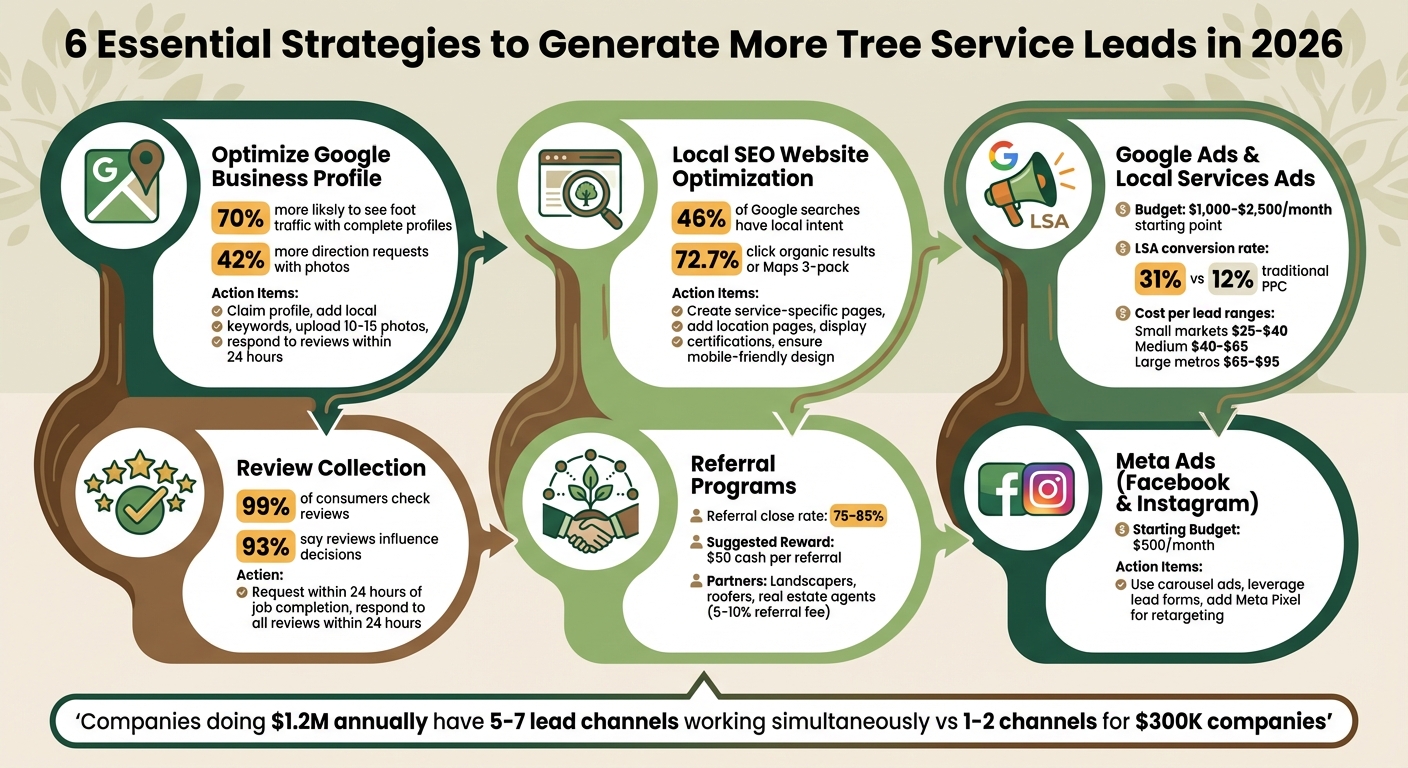
6 Essential Strategies to Generate More Tree Service Leads in 2026
Tree Service Lead Generation – How to Get More Leads Fast
sbb-itb-130a704
Set Up and Optimize Your Google Business Profile
A polished Google Business Profile is a game-changer for pulling in local leads, especially in the highly competitive tree service industry. Businesses with complete profiles are 70% more likely to see foot traffic, and profiles featuring photos can generate 42% more direction requests and 35% more website clicks. It’s a key tool for increasing visibility and engagement.
"Your Google Business Profile is the most important piece of digital real estate your local business owns." – ReviewScout AI
Claim and Verify Your Profile
To get started, claim your profile through business.google.com or Google Maps. Google offers several ways to verify your business:
- Phone or SMS Verification: Receive a code via phone or text for quick confirmation.
- Email Verification: A code is sent to your business-domain email address.
- Service-Area Business (SAB): If you operate without a physical storefront, set up a SAB profile. This allows you to list up to 20 service areas while keeping your home address private.
- Video Verification: Record a video showcasing your business exterior, interior, and official documents.
- Instant Verification: Available if your website is already verified in Google Search Console.
- Postcard Verification: A code is mailed to your physical address, typically arriving within 5–14 days.
Make sure your NAP (Name, Address, Phone number) is consistent across your profile, website, and any other online directories. Inconsistencies can hurt your ranking, and Google explicitly prohibits the use of PO boxes.
Once verified, take your profile to the next level by adding local keywords and engaging visuals.
Add Local Keywords and Professional Photos
Set "Tree Service" as your primary category to ensure accuracy and relevance. Add secondary categories like "Arborist", "Stump Removal Service", or "Emergency Tree Service" to expand your reach. Use your 750-character business description wisely – place important keywords like "emergency tree removal", "tree trimming", and "stump grinding" within the first 250 characters, and mention your city or service area to boost local relevance.
Visuals are another powerful driver of engagement. Upload 10–15 high-quality photos showcasing before-and-after projects, your team in action, and branded vehicles. Geo-tag these images and aim to add 1–2 new photos weekly. Short video clips of tree removals or other services can also grab attention and increase interaction.
"Think of verification as Google’s handshake. No handshake, no trust." – Aniruddha Chakraborty, Marketing for Tree Service
Request and Respond to Customer Reviews
Reviews are critical. Ninety-nine percent of consumers check reviews before choosing a local service, and 93% say reviews influence their decisions. Businesses that respond to reviews are 45% more likely to attract visits.
Ask for reviews within 24 hours of completing a job. Use the "Ask for Reviews" link from your Google Business Profile dashboard and include it in follow-up emails or invoices – QR codes work great for this. Encourage customers to mention the specific service they received and your city, as this boosts keyword relevance.
Responding to reviews is just as important. Reply to all reviews – positive, neutral, or negative – within 24 hours. Use the customer’s name and reference details about their project to make your responses personal. For negative feedback, remain professional, apologize for the experience, and offer to resolve the issue privately. Keep in mind, offering incentives for positive reviews is against Google’s guidelines.
"A tree company with two reviews loses every time to one with 50+ five-star reviews. Even if they’re better at the work." – Alex Gambashidze, ResultCalls
Finally, make use of the Q&A section. Post and answer common questions like "Do you offer free estimates?" or "Are you insured?" This not only provides helpful information but also creates more opportunities to include relevant keywords, building trust with potential customers.
Use Local SEO to Improve Your Website
Your Google Business Profile might grab people’s attention initially, but it’s your website that turns those visitors into customers. With 46% of all Google searches having local intent and 72.7% of searchers clicking on organic results or the Google Maps 3-pack, ignoring local SEO could mean missing out on valuable leads.
"A great GBP drives the traffic. A great website closes the deal." – Clicks Geek
Your website should highlight the services you provide, the areas you serve, and your credibility while being easy to navigate on mobile devices. Here’s how to make sure every page works to attract local customers.
Build Pages for Specific Services and Locations
Google rewards specificity. That means creating dedicated pages for each of your main services and the locations you cover. For instance, a page focused solely on "tree trimming" will rank higher than a general "services" page. So, if you offer services like tree removal, stump grinding, or emergency storm cleanup, each should have its own landing page. Use the service name as the H1 heading and write 500–800 words that explain the service, why it’s important, and what makes your approach stand out.
Similarly, create individual pages for each city or neighborhood you serve. Use a title tag formula like "Service + City + State | Company Name", keeping it under 60 characters. For example: "Tree Removal Austin TX | [Your Company Name]. In your meta descriptions, add your phone number and a call-to-action, such as "Call Now" or "Free Estimate".
Avoid duplicating content across city pages – Google penalizes "doorway pages" that don’t provide unique value. Instead, customize each page with details like local landmarks, tree species common to the area, or weather-specific concerns.
For images, name files using service and location keywords (e.g., oak-tree-trimming-austin.jpg). Also, include Local Business Schema markup to help search engines understand your business details, such as hours, location, and services. This can boost your local search visibility by up to 30% and rank higher on Google. Once these pages are optimized, focus on building trust and making it easy for visitors to reach you.
Display Certifications and Make Contact Easy
Trust is key. Highlight your ISA certifications, state licenses, and insurance details on every service page. Include before-and-after photos from real jobs in your area – avoid stock images. Customer testimonials that mention specific services and locations can also go a long way in building credibility.
Make contacting you as simple as possible. Add a click-to-call button above the fold and include your phone number in the header of every page. For mobile users, this makes reaching out instant. In your meta descriptions, include your phone number and a clear call-to-action.
A contact form should be user-friendly, asking for basic details like name, phone number, service needed, and zip code. Let visitors know what to expect next – for example, "We’ll call you within 15 minutes during business hours to schedule your free estimate." Lastly, ensure your NAP (Name, Address, Phone number) is consistent across your website, Google Business Profile, and any online directories.
Make Your Site Mobile-Friendly and Fast
Seventy-six percent of people who conduct a local search on their smartphone visit a related business within 24 hours. Many tree service searches happen on mobile devices, especially during emergencies. A slow or clunky site could cost you leads.
Run your site through Google PageSpeed Insights and aim for a load time of under three seconds. Compress images, enable browser caching, and use a mobile-responsive design that adapts to any screen size. Test your site on an actual phone – click buttons, fill out the contact form, and make sure everything works smoothly.
After severe weather, emergency searches spike. A fast, mobile-friendly site ensures you’re ready to capture those leads. By combining optimized service pages with a responsive design, you’ll position your business to thrive in local search results.
Run Google Ads Campaigns
While local SEO vs. paid ads is a common debate, using both helps you set the groundwork while reaching customers ready to hire immediately. Organic rankings take time to build, but a well-structured ad campaign can start delivering leads in just hours. This strategy complements your optimized online presence, ensuring you capture interest at the moment it matters most. To succeed, prioritize high-intent keywords, set a realistic budget, and track conversions carefully.
Find Keywords That Show Purchase Intent
Not all searches are created equal. For example, a search like "how to remove a tree" suggests someone looking for DIY advice, not professional help. On the other hand, terms like "emergency tree removal" or "tree service near me" show clear intent to hire. These high-intent keywords are the ones that drive real results.
"Someone typing ’emergency tree removal’ isn’t browsing – they’re buying, and they need you today." – Joel Casarez, SEO Consultant
To maximize your results, create tightly focused ad groups for specific services like Tree Removal, Tree Trimming, Stump Grinding, and Emergency Services. Within these groups, target long-tail keywords such as "dead tree removal cost" or "certified arborist tree pruning." While these phrases may attract fewer searches, they often lead to higher conversions at a lower cost. Adding location-based keywords – like "tree service Austin" – can further refine your audience and improve relevance.
Use Phrase Match and Exact Match settings to avoid irrelevant clicks from searches like "Christmas tree delivery" or "forest service jobs". Start building a negative keyword list early, filtering out terms like "DIY", "jobs", "equipment", "supplies", "free", and "how to". Regularly review your Search Terms Report to catch and block any irrelevant terms that trigger your ads. Also, make sure your landing pages align with the keywords you’re targeting. For example, if your ad focuses on "stump grinding", the corresponding landing page should highlight that specific service, not general tree care.
Start with $1,000-$2,500 per Month and Monitor Results
For most tree service businesses, a monthly budget of $1,000 to $2,500 is a good starting point to gather meaningful data and generate steady leads. If you’re in a rural or low-competition area, you might start with $750 to $1,500. Suburban markets often require $1,500 to $3,000, while urban areas with high competition may need $3,000 to $6,000 or more. A daily budget of $50 to $100 per campaign strikes a balance between gathering enough data and avoiding overspending during the initial phase.
"If you spend less than $50 per day, it will literally take you forever to start to get the data to make educated decisions." – Joel Casarez, SEO Consultant
Track key performance metrics like Click-Through Rate (CTR), Conversion Rate, Cost Per Lead (CPL), and Return on Ad Spend (ROAS). Since about 80% of tree service leads come from phone calls, tools like CallRail can help you identify which keywords are driving inquiries. Review your campaign every two weeks to pause underperforming keywords and adjust bids based on seasonal trends. For instance, during storm seasons, you might increase bids by 15% to 25% to capture the surge in emergency searches.
Here’s a quick guide to suggested max CPC and daily budget ranges:
| Service Type | Suggested Max CPC | Daily Budget Range |
|---|---|---|
| Emergency Tree Removal | $10–$12 | $75–$150 |
| Tree Trimming | $8–$11 | $50–$100 |
| Stump Grinding | $6–$9 | $40–$80 |
(Source: Kaanen Group)
Once your campaign is running smoothly, consider bringing in professionals to take it to the next level.
Work with Tree Company Leads for Google Ads Management
Running Google Ads effectively requires ongoing attention – constant keyword research, bid adjustments, and landing page updates. Tree Company Leads specializes in managing Google Ads campaigns specifically for tree service businesses. Their team understands the unique challenges of the industry, from seasonal demand spikes to local competition, and they focus on delivering high-quality, exclusive leads. By partnering with experts, you can concentrate on running your business while they ensure your ads are performing at their best.
Use Meta Ads and Google Local Services Ads
Google Ads for tree services are great for capturing people actively searching for help, but what about those who don’t realize they need help until a problem arises? That’s where Meta Ads on platforms like Facebook and Instagram come in. They allow you to build awareness and stay top-of-mind for homeowners, even before they start searching. Meanwhile, Google Local Services Ads (LSAs) use a pay-per-lead model to connect you with highly qualified prospects. By combining these tools, you can target potential customers at every stage of their decision-making process. Let’s take a closer look at how Meta Ads can expand your reach.
Target Local Customers with Facebook and Instagram Ads
Meta Ads are a powerful way for tree service businesses to connect with local homeowners early on. These ads let you target specific audiences based on location, interests, and online behavior. For example, carousel ads can showcase your services – like tree removal, trimming, or stump grinding – using compelling before-and-after photos.
Facebook’s built-in lead forms make it easy for potential clients to request quotes without leaving the app, reducing barriers and increasing conversions. Start small with a $500 monthly budget to test different audiences and creative ideas. Since most users browse on mobile, ensure your call-to-action buttons are easy to tap and that your landing pages load quickly. Adding the Meta Pixel to your website allows you to retarget visitors who didn’t immediately book, keeping your business fresh in their minds.
Using urgency-driven headlines, such as “Storm Damage? Get 24/7 Emergency Tree Service – Free Estimates!”, can grab attention. Including customer testimonials or 5-star reviews in your ads also helps establish trust and credibility.
Set Up Google Local Services Ads for Pay-Per-Lead
Google Local Services Ads (LSAs) are a game-changer for visibility. They appear at the very top of search results – above traditional Google Ads and organic listings – making them hard to miss. LSAs operate on a pay-per-lead basis, meaning you only pay when a customer directly calls or messages you, which can be a cost-effective option in competitive markets.
To get started, you’ll need to complete Google’s background check to earn the “Google Guaranteed” badge. This certification can increase click-through rates by up to 210%. LSAs also boast an impressive conversion rate of around 31%, compared to about 12% for standard pay-per-click ads.
"LSAs appear above regular Google Ads and organic search results, ensuring maximum visibility." – Dipa Gandhi, 99 Calls
Several factors influence your LSA ranking, including proximity to the searcher, the number of positive reviews (aim for 50–100+), and your responsiveness to inquiries. Quick responses are crucial – replying within three minutes can make a lead four times more likely to convert compared to waiting two hours. Be sure to dispute any out-of-area inquiries to avoid unnecessary charges.
Here’s a breakdown of what you might pay per lead, depending on your market size:
| Market Type | LSA Cost Per Lead |
|---|---|
| Small markets | $25–$40 |
| Medium markets | $40–$65 |
| Large metros | $65–$95 |
(Source: Home Service Direct)
Take Jake’s Tree Solutions in Florida, for example. In 2025, they started using LSAs to complement their word-of-mouth referrals. By targeting high-intent searches like “emergency tree removal near me” and leveraging the “Message Leads” feature, they saw a 40% increase in leads within three months, all while keeping their average cost per lead at $25.
Combine Ad Platforms with Tree Company Leads
Running campaigns on both Meta Ads and Google LSAs creates a unified strategy that keeps your business visible across multiple channels. This consistent presence builds trust and familiarity, crucial for landing high-value tree service jobs. When potential customers see your company on Google search results and their Facebook feed, it reinforces your credibility.
Tree Company Leads can manage the technical aspects for you, from installing the Meta Pixel to handling Google’s background checks for LSAs. Their integrated tracking tools ensure you’re investing in the platforms that deliver the best results, creating multiple touchpoints that guide customers toward booking your services.
Create Referral Programs and Get More Reviews
To round out your lead-generation strategy, a well-thought-out referral and review system is essential. Happy customers are your most effective advocates, and referrals tend to close at an impressive rate of 75–85%. By combining a smart referral program with regular review collection, you can create a system that keeps new leads coming in consistently. The trick? Make it simple and rewarding for customers to recommend your tree service to others. Let’s dive into how to set up effective referral incentives and gather reviews that build trust.
Give Customers Incentives to Refer Others
For a referral program to work, the reward has to feel worthwhile. Studies suggest that $50 cash is a sweet spot for motivating referrals in the tree service industry – enough to inspire action without eating into your profit margins on jobs that typically cost $400–$1,000. Alternatively, you could offer $50–$100 in account credits, which customers can use toward future services like trimming or maintenance. This approach not only rewards referrals but also encourages repeat business.
"Personally, I think $50 cash is a tipping point for a referral that leads to $400-$1,000 in business for your company." – Chad Diller, CEO, Landscape Leadership
For larger projects, consider tiered rewards. For example, offer $200 for the first referral, $500 for the second, and up to $1,500 for multiple referrals. Dual-sided incentives can also be effective – give both the referrer and the new customer a $25 discount. This approach makes participation appealing for everyone.
Don’t forget about partnerships. Collaborate with landscapers, roofers, and real estate agents who can spot when your services are needed. Landscapers may notice tree root issues during routine work, roofers often see overhanging branches causing damage, and real estate agents know when quick tree services are essential to close a sale. Offering these partners a 5–10% referral fee or priority service can ensure a steady flow of high-quality leads.
Promote your referral program everywhere: on invoices, email signatures, your website, and even through physical materials like door hangers at job sites. Track referrals in your CRM and pay rewards promptly after the job is completed to maintain trust and goodwill with your advocates.
While referrals bring in new leads, gathering positive reviews helps solidify your credibility.
Send Automated Review Requests After Each Job
Timing is everything when asking for reviews. Sending review requests 2–3 days after completing a job ensures you capture fresh, positive impressions. Automation tools can help streamline this process – personalize messages based on the service provided and schedule them for optimal timing.
A strong collection of positive reviews can significantly boost your visibility. For instance, businesses with complete Google Business Profiles see 70% more location visits compared to those with incomplete profiles. Use multiple channels for review requests; text messages often get quicker responses than emails.
Be sure to respond to every review within 24 hours. Thank customers for positive feedback and address any concerns professionally. This shows that you take customer satisfaction seriously and are committed to delivering quality service.
Get Involved in Your Local Community
Building trust within your community is another way to drive referrals. Sponsor local sports teams, set up booths at community events, or host free "Ask an Arborist" clinics. These efforts establish your business as a trusted local expert while keeping your name top-of-mind.
Placing professional yard signs at active job sites is another simple but effective tactic. These signs act like mini billboards, showcasing your work to the surrounding neighborhood. Joining your local Chamber of Commerce is also a smart move. It can connect you with property managers, developers, and architects who may provide steady commercial leads.
Engaging with your community not only generates referrals but also boosts your local search visibility, amplifying the impact of all your marketing efforts.
Conclusion
Growing a tree service business in 2026 requires tapping into multiple lead sources to stay competitive. With the tree care industry generating around $24.8 billion in 2025 and customer acquisition costs rising by 34% between 2023 and 2026, it’s clear that a well-rounded marketing strategy is no longer optional – it’s essential.
Start by focusing on Local SEO and your Google Business Profile. These tools are key for building trust and driving organic traffic without continuous ad spend. For immediate visibility, integrate Google Ads and Local Services Ads (LSAs) into your strategy – LSAs boast a conversion rate of 31%, nearly three times higher than traditional PPC. To maintain a strong presence on social media, consider running Meta Ads, and don’t underestimate the value of a referral program for attracting high-quality leads.
"The difference between a tree service doing $300K annually and one doing $1.2M isn’t capability – it’s customer flow. Companies stuck at lower revenue levels have 1-2 lead sources. Growing companies have 5-7 channels working simultaneously." – Kevin Shea, Sales Manager, Home Service Direct
This insight highlights the importance of a diversified approach. By leveraging multiple channels, you can reduce the impact of seasonal demand shifts while strengthening your visibility across platforms like Google Maps, search engines, and Facebook. When homeowners see your business consistently across these spaces, it builds trust and makes them more likely to reach out.
For those looking to streamline their efforts, companies like Tree Company Leads can help manage your Google Ads campaigns and optimize your overall lead generation strategy. This allows you to focus on what you do best – providing excellent tree care services.
Make it a priority to monitor your results monthly, respond to inquiries within five minutes, and fine-tune your approach as needed.
FAQs
Which lead source should I start with first?
One of the fastest ways to attract free, high-quality leads is by optimizing your Google My Business (GMB) profile. A well-maintained GMB profile ensures your business shows up in local map results, putting you directly in front of nearby customers.
Here’s how to make the most of it:
- Complete every section: Fill out all the details, like your business name, address, phone number, and hours of operation.
- Add quality photos: Upload clear, professional images of your business, products, or services to make a strong impression.
- Encourage reviews: Positive reviews can boost your credibility and improve your visibility in search results.
- Use location-specific keywords: Incorporate terms that highlight your local area to connect with nearby customers.
- Post regular updates: Share news, offers, or events to keep your profile active and engaging.
While methods like SEO and PPC are effective, focusing on your GMB profile can deliver faster results when it comes to attracting local customers.
How do I track calls and form leads by channel?
To figure out where your leads are coming from, consider using call tracking tools. Assign dedicated phone numbers to each marketing channel – like Google Ads or social media – so you can pinpoint which platforms are generating calls.
For form submissions, you can add tracking pixels or UTM parameters to your website and landing pages. These tools let you trace submissions back to specific campaigns.
By combining call tracking and form tracking, you’ll get a clear picture of which channels are driving the most leads, helping you refine your marketing efforts.
What should I do when ads bring low-quality leads?
If your ads are pulling in low-quality leads, it’s time to take a closer look at your strategy. Start by fine-tuning your keyword targeting. Focus on terms that reflect high intent, are specific to your service, and include location-based phrases. This helps attract people who are more likely to convert.
Next, conduct a campaign audit. Look for problems like overly broad targeting or offers that might be unclear or unappealing. Make adjustments where necessary.
Don’t forget about your ad copy and landing pages. They should align closely with what your audience is searching for. Make sure the messaging speaks directly to their needs and expectations.
Finally, keep an eye on your performance data. Regular reviews can help you weed out unqualified leads and zero in on prospects who are genuinely interested in what you offer.