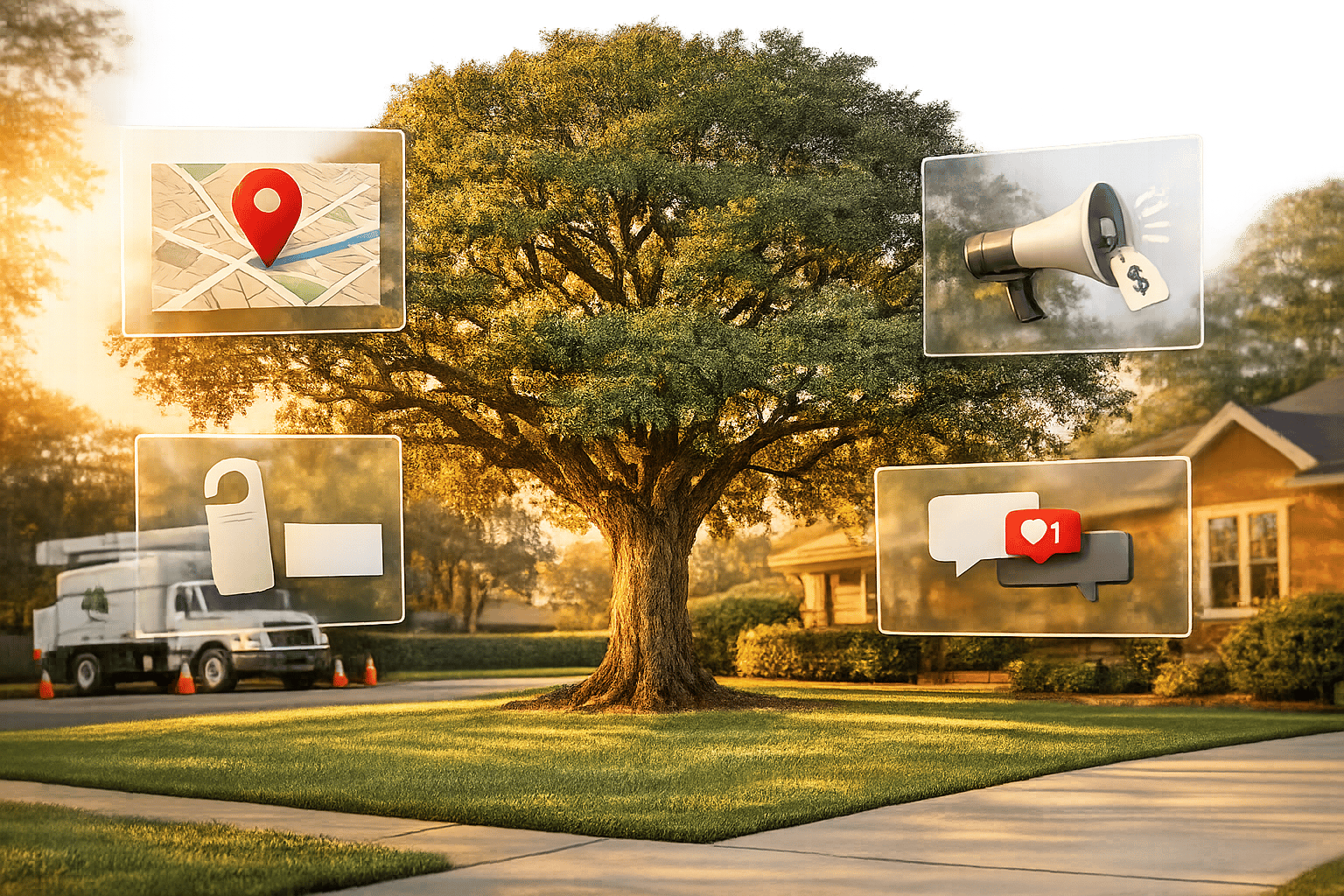
If you’re running a tree service business, standing out is no longer just about word-of-mouth or a logo on your truck. With 97% of consumers searching online for local services, your business needs a strong online and offline marketing strategy to thrive. Here’s how to grow your leads and revenue:
- Local SEO: Optimize your Google Business Profile, use location-specific keywords, and build local backlinks to rank higher in search results.
- Paid Ads: Use Google Local Service Ads and PPC campaigns for tree services to attract high-intent customers actively searching for tree services. If you’re just starting, follow a guide on how to set up Google Ads to ensure your budget is spent effectively.
- Social Media: Post time-lapse videos, before-and-after photos, and educational content to engage homeowners and build trust.
- Offline Tactics: Use vehicle wraps, yard signs, and sponsor local events to boost visibility in your community.
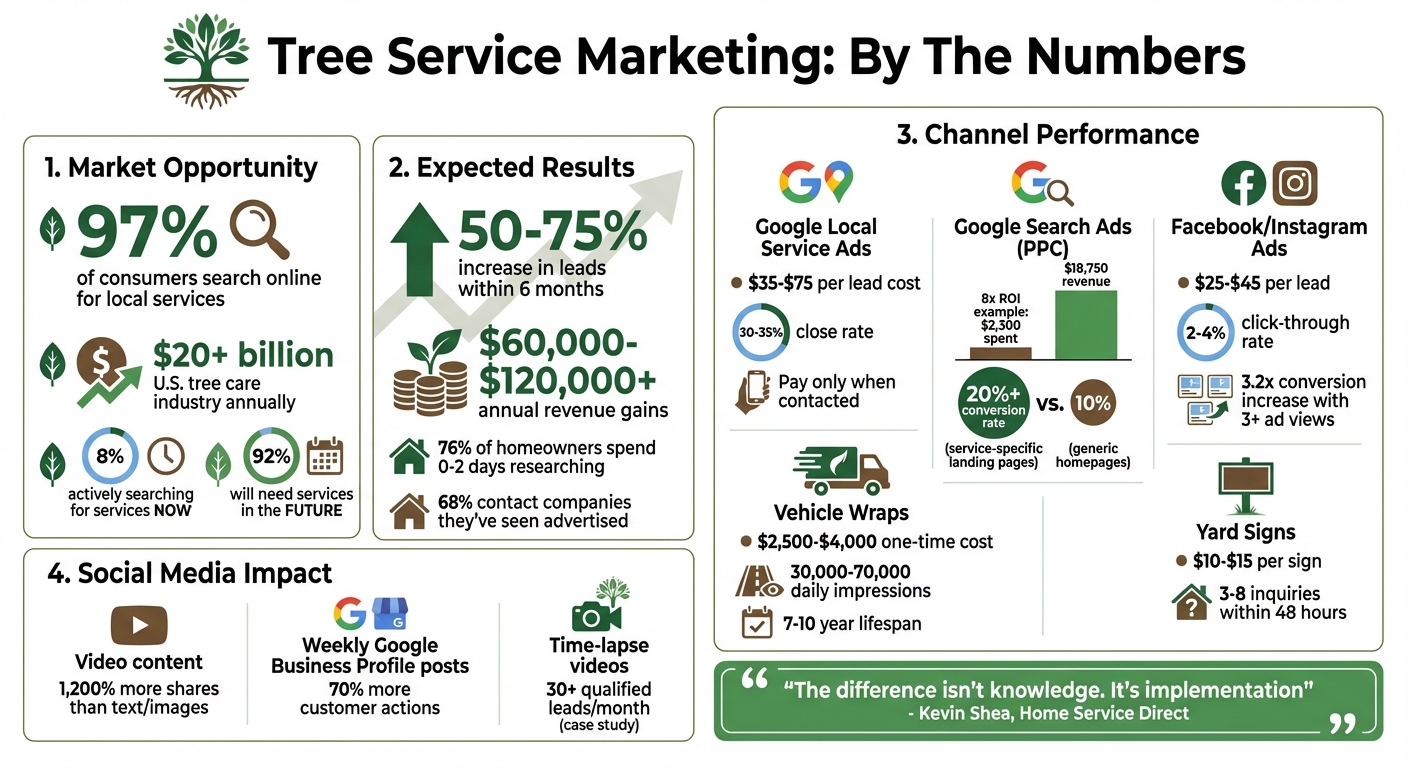
Businesses implementing these strategies often see a 50–75% increase in leads within six months, with annual revenue gains of $60,000 to $120,000 or more. Whether it’s dominating search results or leaving a lasting impression in your neighborhood, these methods help create steady growth for your tree service business.
Tree Service Marketing Strategy ROI and Lead Generation Statistics
1. Local SEO Optimization
Claim and Optimize Your Google Business Profile
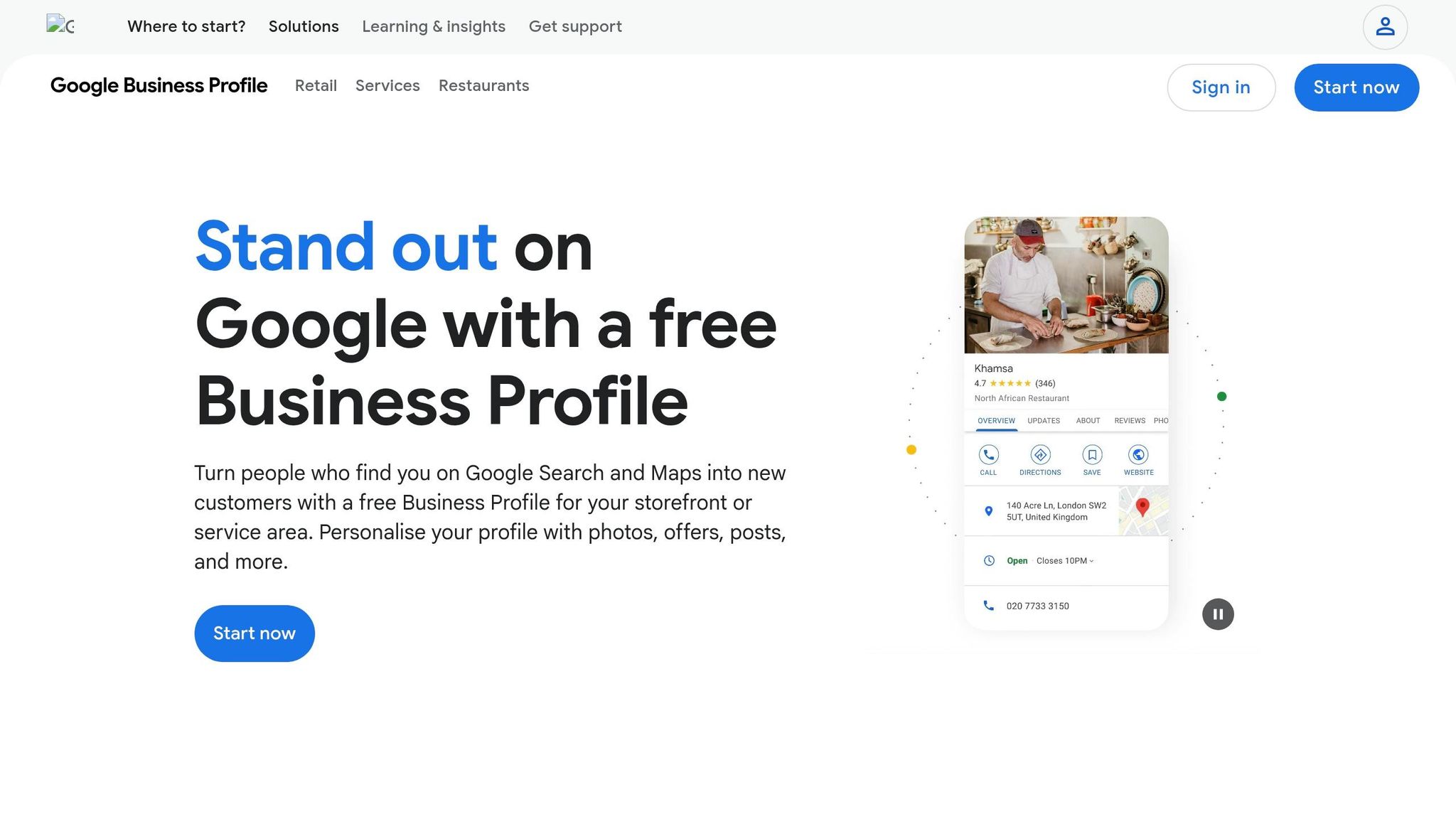
Your Google Business Profile (GBP) is often the first thing potential customers see when they search for tree services in your area. A well-maintained GBP is the cornerstone of your local SEO efforts. Start by ensuring your business Name, Address, and Phone number (NAP) are consistent across your GBP, website, and directory listings. Set "Tree Service" as your primary category, and add secondary ones like "Arborist" or "Stump Removal" to expand your visibility for different search terms.
Add geotagged photos of your branded trucks, work crews in action, and before-and-after shots of completed projects. These photos embed location data, making it clear to Google where you operate. Use the Services section to showcase offerings like emergency storm damage cleanup or tree pruning, and include standard pricing if applicable. In the Q&A section, address common questions, such as, "Do you offer 24/7 emergency storm service?" with clear, helpful answers.
"Businesses that post weekly on their Google Business Profile see 70% more customer actions (calls, website visits, direction requests) than those who don’t post regularly." – Tactical SEO Consulting
Stay active by posting weekly updates. Share special offers (e.g., "10% off stump grinding") or seasonal safety tips. Since posts expire after seven days, consistent updates keep your profile fresh. Encourage five-star reviews and respond promptly – ideally within 24 hours. For negative feedback, address concerns respectfully, take responsibility, and provide a direct contact number to resolve the issue.
These steps lay the groundwork for targeting hyper-local keywords and reaching customers ready to take action.
Target Location-Based Keywords
Instead of going after broad terms like "tree removal", focus on location-specific keywords such as "tree removal in Pensacola" or "emergency oak trimming in Oakwood District." These localized phrases face less competition and attract customers who are ready to hire. Create unique landing pages for each area you serve, incorporating local landmarks and targeted keywords into meta titles, H1 headings, and image alt text.
Once your pages are optimized, your next step is building trust and authority through local backlinks.
Build Local Backlinks
After optimizing your profiles and pages, strengthen your online presence with local backlinks. Links from local and industry-specific websites help improve your search rankings. Start by listing your business on major directories like Google Business Profile, Yelp, Angi, and the Better Business Bureau, along with niche platforms like TreeCareHQ and the International Society of Arboriculture (ISA).
Collaborate with non-competing local businesses – such as landscapers, realtors, or home improvement contractors – for reciprocal links or guest blog opportunities. Sponsoring community events, like youth sports teams or charity fundraisers, can also earn backlinks from organization websites and local news outlets. Keep in mind, websites that rank at the top of search results typically have 3.8 times more backlinks than lower-ranking ones.
sbb-itb-130a704
13 Ways To Market Your Tree Service Business in 2026
2. Paid Advertising
Paid advertising can supercharge your local SEO efforts by ensuring your business shows up when potential customers are ready to take action.
Google Local Service Ads (LSA)
Google Local Service Ads stand out in search results with their green "Google Guaranteed" badge. The best part? You only pay when a customer contacts you, with costs ranging from $35 to $75 per lead. These ads are highly effective, boasting close rates of 30–35%, compared to 12–15% for standard Google Search Ads.
Take HLI Tree Experts in Riverside, CA, for example. Between late 2025 and March 2026, they used LSAs to generate over 10 leads daily, adding approximately $50,000 in weekly jobs. This growth allowed them to expand from two to five trucks in just six months.
"Home Service Direct completely transformed our business. We’re getting 10+ leads daily and adding $50,000 worth of jobs to our pipeline every week." – Leonard A., owner
Pair LSAs with targeted Google Search Ads to maximize your reach and attract customers actively searching for your services.
Google Search Ads (PPC)
Google Search Ads are perfect for targeting homeowners who need services right away. These ads focus on urgent search terms like "emergency tree removal near me" or "tree removal emergency [City]". They target the 8–12% of the market actively looking to hire.
For the best results, create separate campaigns for each service – tree removal, pruning, stump grinding, and emergency work. This ensures your ad copy and landing pages align precisely with what potential customers are searching for.
Here’s a real-world example: In August 2025, a tree service client of Tree Service Digital in a market of 250,000 people spent $2,300 on Google Ads. The campaign generated 37 leads and 15 booked jobs, resulting in $18,750 in revenue – an 8x return on investment. To avoid wasting money, use negative keywords to filter out irrelevant searches like "jobs", "equipment", or "DIY". Always direct traffic to service-specific landing pages, which usually convert at 20% or higher, compared to just 10% for generic homepages.
Facebook & Instagram Ads (Meta Ads)
Facebook and Instagram Ads are fantastic for building brand awareness among the 88–92% of homeowners who might need tree services in the future. These platforms help generate demand before customers have an urgent need. To grab attention, use real before-and-after photos from actual jobs instead of stock images. High-quality visuals can deliver click-through rates of 2–4%, with leads typically costing $25 to $45.
There’s also a major advantage to repeated exposure. Ads seen three or more times can increase conversion rates by 3.2 times.
"Facebook advertising isn’t about capturing intent – it’s about creating it." – Kevin Shea, Sales Manager at Home Service Direct
To make the most of your efforts, set up retargeting campaigns using tracking pixels. This allows you to show ads to people who’ve already visited your website. A smart budget allocation could look like this: 40% for cold awareness, 30% for warm consideration, and 30% for hot conversion and retargeting.
3. Social Media Marketing
Post Time-Lapse Videos and Before-and-After Transformations
When it comes to social media, visual content is king – especially for tree service companies. Time-lapse videos are a fantastic way to condense hours of tree removal into a quick, eye-catching 30–60 second clip. These videos not only highlight your expertise but also demonstrate your commitment to safety. Similarly, before-and-after images taken from the same angle can showcase the dramatic improvements your services bring to a property.
Here’s a real-world example: In 2025, a tree service client of Tactical SEO Consulting started posting weekly time-lapse videos on Instagram and TikTok. Over just six months, they gained 15,000 followers and started generating more than 30 qualified leads each month. And it’s not surprising – video content drives engagement, generating 1,200% more shares than text and images combined. Even for ads, videos outperform static images by a 2:1 ratio.
"In a visually-driven industry like tree care, a smart social media marketing strategy is your most powerful tool for turning skeptical homeowners into confident clients." – Marketing 360
These videos don’t just grab attention – they build a sense of connection and trust with your local audience.
Build Trust Through Nextdoor and Local Community Engagement
Once you’ve captured attention with engaging visuals, platforms like Nextdoor can help you build trust within your community. Nextdoor is especially effective for tree services because it thrives on neighbor-to-neighbor recommendations [6,28]. Positive reviews from satisfied customers can go a long way in establishing credibility. Encourage your clients to share their experiences on their neighborhood feeds – it’s a simple yet impactful way to grow your reputation locally.
If you’re looking to go a step further, consider investing in promoted placements on Nextdoor. These typically cost between $300 and $600 per month, making it an affordable option for targeting homeowners in specific ZIP codes.
Create Educational Content That Builds Awareness
Not every homeowner is actively searching for tree services – 92% aren’t, in fact – but they will need them eventually. That’s where educational content comes in. By sharing tips on hazard signs, seasonal pruning, or when to call a professional, you can keep your business top-of-mind for future needs [8,4].
This strategy works because most homeowners – 76% – spend just 0–2 days researching before booking a service. Of these, 68% contact the company they’ve seen advertised or remember hearing about. Posting regular updates on platforms like your Google Business Profile can also make a big difference. Businesses that update weekly see 70% more customer actions, like calls or website visits, compared to those that don’t.
Educational content not only positions you as an expert but also ensures your business is the first one homeowners think of when the need arises.
4. Offline and Community Engagement
Sponsor Local Events and Use Your Trucks as Mobile Billboards
While digital marketing grabs attention online, offline efforts play a crucial role in establishing your company as a trusted name in the community. Sponsoring local activities, like youth sports teams, school events, or holiday festivals, not only boosts goodwill but also keeps your brand top-of-mind with residents. These sponsorships usually cost between $500 and $2,000 for banners and logo placement, making them a budget-friendly way to strengthen your local reputation.
Your service trucks are another powerful tool for offline marketing. A single vehicle wrap, priced between $2,500 and $4,000, can generate an impressive 30,000 to 70,000 impressions daily, with your branding visible from up to 50 feet away. Chad Diller, CEO of Landscape Leadership, highlights their value:
"Vehicle graphics are a very cost-effective means to advertise. They last for 7-10 years and you only pay once for them."
In addition to mobile advertising, on-site promotions can further amplify your visibility. For instance, placing yard signs at job sites is a simple but effective strategy. Bulk-ordered 18" x 24" signs cost just $10 to $15 each and can generate 3 to 8 inquiries within 48 hours. These signs act as proof of your quality work, sparking interest from neighbors who see your team in action. To take it a step further, distribute door hangers in a 2–3 block radius around completed projects. Adding a "neighbor discount" offer can encourage even more inquiries and build trust within the area.
When combined with your online efforts, these offline strategies create a strong foundation for local engagement and community trust.
Conclusion
Expanding a tree service business today goes beyond delivering exceptional work – it demands a mix of digital and offline strategies working together. The most successful companies use multiple channels to connect with homeowners at every stage of their decision-making process. For instance, Google Local Service Ads and PPC campaigns are great for reaching the 8% of homeowners actively searching for immediate help. On the other hand, tools like vehicle wraps, yard signs, and community sponsorships focus on the remaining 92%, building awareness long before they need your services.
This combination doesn’t just generate short-term results – it builds trust over time. The magic lies in how these channels support each other. Imagine a homeowner spotting your branded truck in their neighborhood, then later checking your glowing reviews on your Google Business Profile. That offline visibility reinforces your online credibility, making it easier to convert them into a customer. Companies that adopt this approach often see a noticeable boost in qualified leads within just six months. As Kevin Shea from Home Service Direct wisely says:
"The difference isn’t knowledge. It’s implementation".
Start with the basics: optimize your Google Business Profile, wrap at least one vehicle with your branding, and leave yard signs at every job site. These cost-effective steps create immediate visibility while laying the groundwork for long-term growth through strategies like SEO and referral partnerships. You can also find commercial contacts to diversify your revenue streams. Be diligent about tracking your leads – ask every customer, "How did you hear about us?". Then, review your results quarterly to drop any channels where the return on investment is less than three times the cost.
With the U.S. tree care industry pulling in over $20 billion annually, homeowners are actively looking for dependable providers. Following these strategies ensures a steady stream of leads, protecting your business from sudden changes in ad costs or search algorithms. Focus on perfecting a few key channels before spreading your efforts too thin, and you’ll create a resilient foundation for growth.
FAQs
Which marketing channel should I start with first?
If you’re looking to grow your tree service business, local SEO is the way to go. Specifically, focusing on your Google Business Profile can make a big difference. By optimizing this profile, your business becomes more visible in local search results – especially on Google Maps. This means nearby customers can find you more easily when searching for tree services.
Since most people start their hunt for tree services online, having a strong local SEO presence isn’t just helpful – it’s necessary.
How much should I budget for ads each month?
When running Google Ads campaigns for your tree service business, you should plan to allocate around $32–$50 per lead. To maintain a steady flow of leads, this generally translates to a monthly budget of $1,000–$2,000, though the exact amount may vary depending on factors like your target area and the level of competition.
How do I track which marketing is actually working?
To understand which marketing efforts are driving results, consider using marketing attribution tools. These tools help pinpoint the channels that lead to conversions, such as phone calls, form submissions, or scheduled jobs. With multi-touch attribution, you can get a clearer picture of the entire customer journey. It reveals which strategies are bringing in the most leads and sales, enabling you to allocate your budget wisely and concentrate on the channels that deliver real, measurable outcomes.