
If you’re running a tree service business, showing up in local search results is essential. Why? 96% of consumers search online for local services, and 76% of smartphone users visit a business within 24 hours of searching. If your company isn’t visible on Google – especially in the local Map Pack – you’re losing potential customers daily.
Here’s what you need to do:
- Target local keywords: Focus on terms like "tree removal [City]" or "stump grinding near me" to attract high-intent local searches.
- Optimize your Google Business Profile (GBP): Accurate info, photos, and reviews can boost visibility and drive leads.
- Build service-specific landing pages: Create pages for each service (e.g., tree removal, stump grinding) with location-based keywords.
- Ensure your website is mobile-friendly and fast: With 78% of emergency searches happening on mobile, a slow or hard-to-navigate site can cost you leads.
- Maintain NAP consistency: Your business name, address, and phone number must match across all directories to improve rankings.
SEO is a long-term effort, but the payoff is steady leads without the ongoing costs of ads. If you need immediate leads while your SEO builds, you can also set up Google Ads for tree companies to capture urgent calls. Start with GBP optimization and keyword research to get results faster.
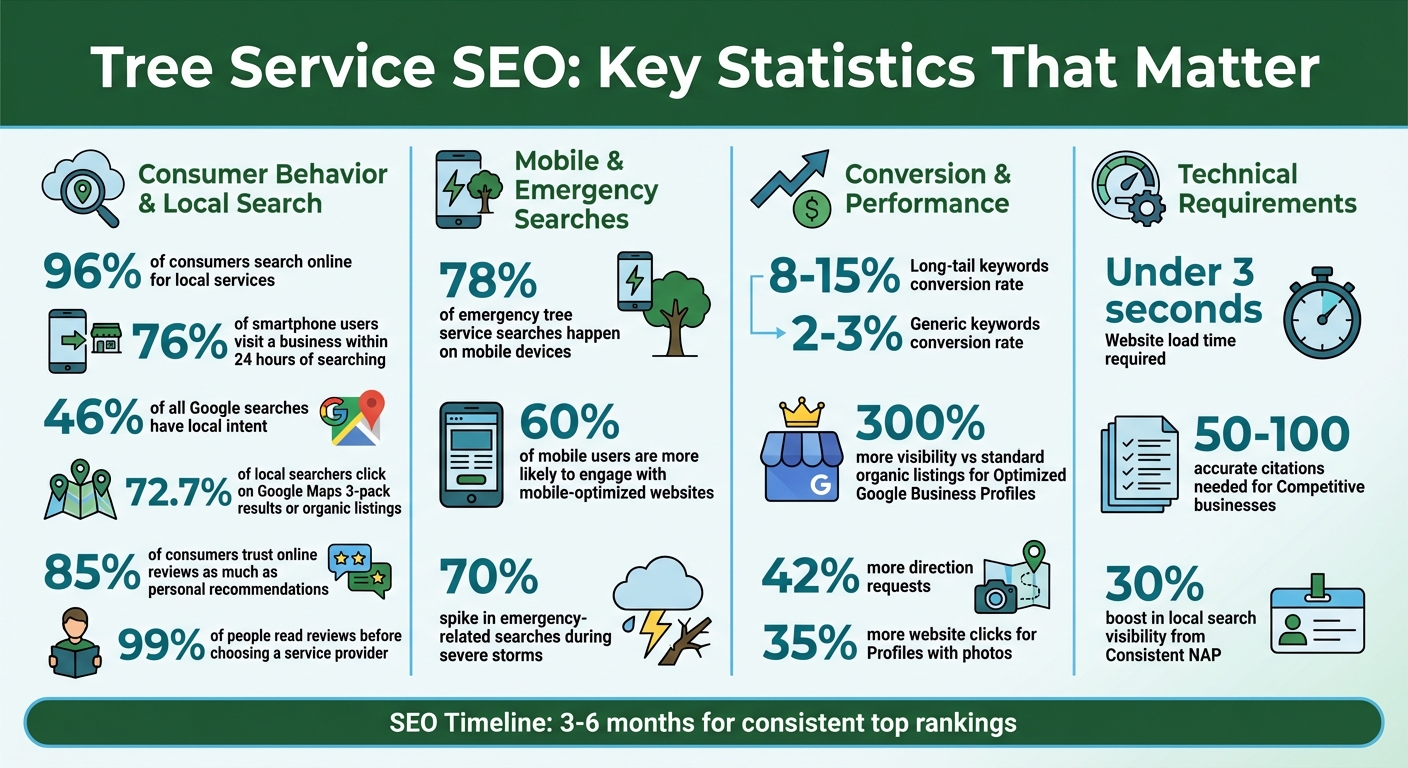
Tree Service SEO Statistics: Local Search, Mobile Usage, and Conversion Rates
Mastering Tree Service SEO: Dominate Google & Grow Your Business!
sbb-itb-130a704
Finding the Right Keywords for Tree Services
Targeting the right keywords connects you with local homeowners actively searching for tree services. Did you know that 46% of all Google searches have local intent? That means nearly half of your potential customers are using location-specific phrases to find services like yours. By identifying the exact search terms local customers use, you can ensure you rank higher on Google for tree services when they need help.
Start by focusing on your core services – tree removal, tree trimming, stump grinding, and emergency tree care – and pair them with your city or neighborhood name. For example, searches like "tree removal Denver" or "stump grinding near me" often signal someone ready to hire. These location-specific searches tend to convert well because they reflect both urgency and intent. Let’s dive into how local keywords can make all the difference.
Local Keywords That Drive Traffic
When it comes to tree service SEO, location is everything. Homeowners searching for help aren’t looking across the state – they want nearby providers. Keywords like "tree trimming near me" or "tree removal [City Name]" are magnets for local customers ready to book. In fact, 72.7% of local searchers click on Google Maps 3-pack results or organic listings. By combining your services with geographic terms – like your city, surrounding neighborhoods, or even local landmarks – you can capture these high-intent searches. For example:
- "Tree service in West Austin"
- "Emergency tree removal downtown Portland"
These types of phrases resonate with people searching for services in those specific areas.
Also, consider this: 78% of emergency tree service searches happen on mobile devices. Many of these searches occur when customers are onsite assessing damage, making "near me" keywords even more critical.
Keyword Research Tools
If you’re wondering how to find the right keywords for your business, tools like Google Keyword Planner and Ubersuggest are excellent starting points. Enter your main services as "seed" keywords, and these tools will suggest variations while showing you how often they’re searched in your area. Ubersuggest can even reveal which keywords drive traffic to your competitors’ websites.
Don’t overlook Google’s built-in tools like Autocomplete, "People Also Ask", and "Related Searches." They provide real-time keyword ideas such as "how much does tree removal cost in [City]" or "do I need a permit to remove a tree." These tools not only help you identify popular terms but also uncover precise long-tail phrases tailored to your services.
Long-Tail Keywords for Specific Services
Once you’ve nailed down your core and local keywords, refining your strategy with long-tail phrases can help you capture even more high-intent searches. Long-tail keywords are longer, highly specific phrases that attract customers who know exactly what they need. Instead of competing for a broad term like "tree service", you can target phrases such as:
- "Emergency oak tree removal in west Denver"
- "24/7 storm damage tree service [City Name]"
Why focus on these longer phrases? They tend to convert better because they match a customer’s precise needs. As Tree Service Marketing Solutions explains:
"The generic short keywords get searched more but convert worse. The longer specific ones bring in customers who are actually ready to book work."
The numbers back this up: long-tail keywords achieve conversion rates of 8-15%, compared to just 2-3% for generic terms. To make the most of this, create dedicated pages for niche services like "crane-assisted tree removal", "stump grinding", or "tree pruning for storm preparation." Each page should focus on its own long-tail keyword combination, helping you rank for multiple specific searches instead of competing for one broad term.
| Keyword Type | Example | Intent Level |
|---|---|---|
| Local Service | tree removal [City], tree trimming near me | High |
| Emergency | 24/7 tree service, storm damage removal | Very High |
| Service-Specific | stump grinding [City], deep root fertilization | Medium-High |
| Long-Tail | emergency oak tree removal in west Denver | High |
Emergency-related terms like "fallen tree removal" or "tree fell on house" see a 70% spike during severe storms. By optimizing for these urgent phrases, you can capture customers who need immediate assistance.
Setting Up Your Google Business Profile
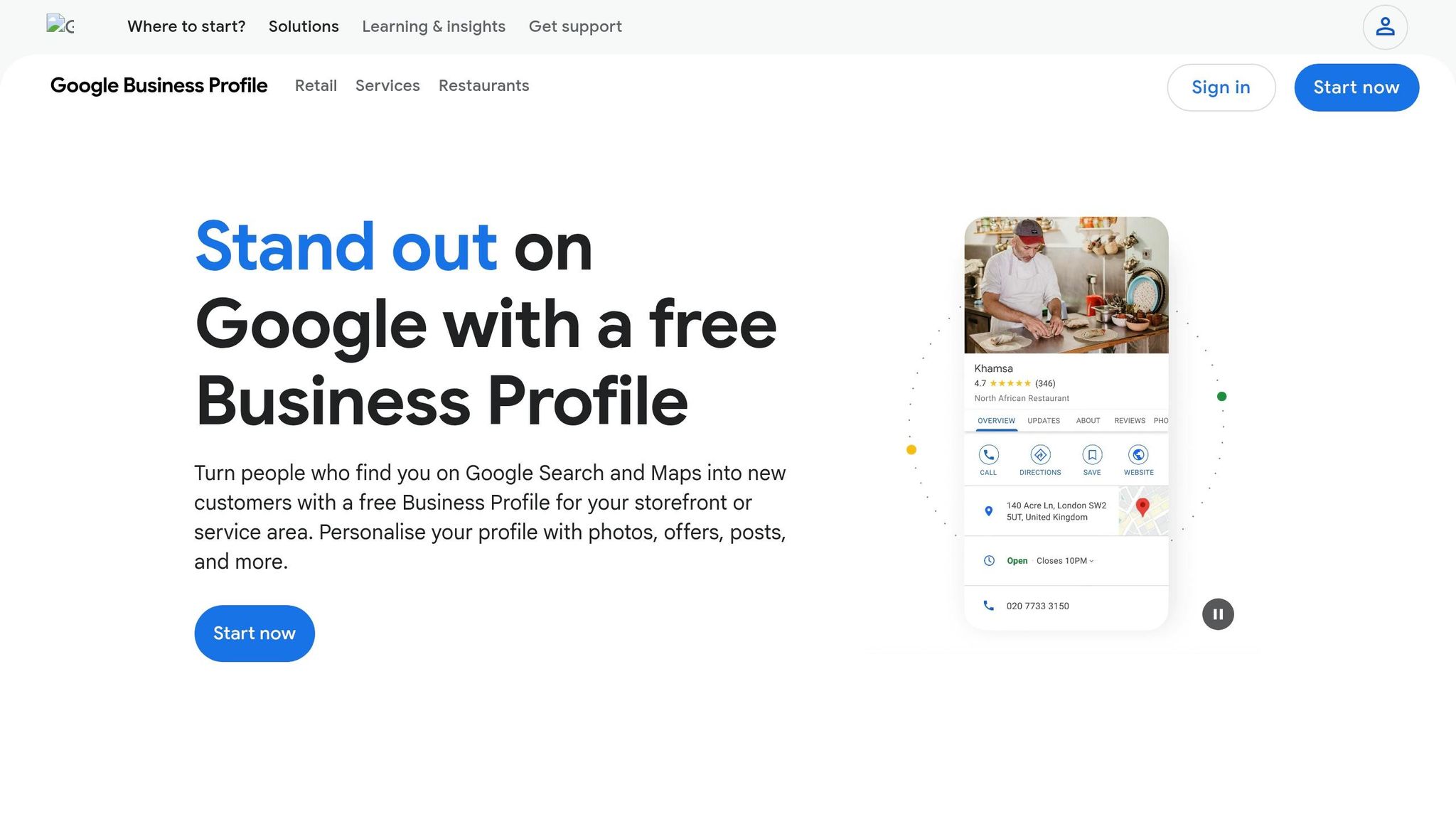
Your Google Business Profile (GBP) acts like a mini-website that can significantly boost your local tree service marketing visibility. It’s the key to landing in the coveted Google Map Pack – the top three local businesses that show up prominently in search results. In fact, optimized profiles can achieve 300% more visibility compared to standard organic listings.
Take HLI Tree Experts in Riverside, CA, as an example. Between 2022 and 2023, Leonard A. led the company through a local SEO overhaul, turning a modest 2-truck operation into a 5-truck fleet in just six months. This strategy brought in 10+ leads daily and added about $50,000 in weekly job revenue. Here’s how you can set up your GBP to become a high-performing local lead machine.
Keep Your Business Information Accurate
Your business name, address, and phone number (NAP) must match exactly across your GBP, website, and all online directories. Even small inconsistencies – like using "St." in one place and "Street" in another – can confuse Google.
Make sure to:
- Set "Tree Service" as your primary category to clearly define your business.
- Add secondary categories such as "Arborist", "Tree Removal Service", and "Stump Removal Service" to attract a broader range of search queries.
- Use the 750-character business description wisely – place your most important keywords in the first 250 characters to grab attention.
If you don’t have a physical office for customer visits, hide your address and specify your service areas instead. This helps Google identify the neighborhoods you cover. You can also add attributes like "On-site Services" or "Free Estimates" to provide quick, useful details to potential customers.
Accurate and consistent NAP details are the foundation of a strong local presence. Once that’s in place, it’s time to make your profile visually appealing.
Add Photos and Service Descriptions
Photos make a huge difference – profiles with images see 42% more direction requests and 35% more website clicks. Upload 3–5 new photos every week, showcasing your crew in action, your equipment, and before-and-after shots of completed jobs.
Here’s a pro tip: Rename your image files before uploading. Instead of generic names like IMG_123.jpg, use descriptive, localized names like oak-tree-trimming-west-chester-pa.jpg. Tools like GeoImgr can embed location data into your photos, helping Google associate your work with specific areas.
As Local Tree Service Marketing explains:
"Your tree care photos do more than show off your work. They help Google understand your business and where you serve."
In the "Services" section, list your offerings in detail. Include services like "Emergency Storm Damage Cleanup", "Stump Grinding", or "Cabling and Bracing", and add pricing where possible to stand out. Posting weekly updates – such as recent project photos, seasonal tips, or discounts like "10% off stump grinding" – signals activity to Google and keeps your profile fresh.
Finally, building trust through customer reviews can take your profile to the next level.
Collect and Reply to Customer Reviews
Reviews are essential – 85% of consumers trust online feedback as much as personal recommendations. After completing a job, ask customers for reviews through a short, text-based request.
Always respond to reviews, whether they’re glowing or critical, and aim to reply within 24 hours. For negative reviews, remain calm and professional. Acknowledge the customer’s concerns and provide a direct contact number to resolve the issue offline. As Clicks Geek points out:
"A professional, calm, and helpful response to a bad review can actually win you more business than a dozen five-star ratings. It proves you have integrity."
For example, in 2024, a tree service provider named Tucker optimized his GBP and saw 30 to 40 new leads in just 3 to 4 weeks, resulting in his best-ever revenue month of $90,000. By combining accurate information, engaging visuals, and active review management, you can create a profile that not only attracts attention but also converts searchers into loyal customers.
On-Page SEO for Your Tree Service Website
Your website needs to turn traffic from your Google Business Profile (GBP) into paying customers. On-page SEO helps optimize each page to rank higher in search results while giving visitors the information they need to take action. Let’s break down how to design effective service pages, write compelling meta tags, and structure internal links to maximize your website’s performance.
Create Landing Pages for Each Service
Build individual landing pages for each of your core services – like tree removal, pruning, stump grinding, and emergency storm cleanup. Aim for 500–800 words per page, detailing the process, safety practices, equipment used, and benefits for customers. These focused pages ensure that visitors from your GBP find the exact service they’re searching for right away.
Incorporate location-based keywords throughout the page. For example, if your business operates in Dallas, use phrases like "tree trimming in Dallas" in the H1 header, subheadings, and naturally within the content. This helps Google understand both your service offering and your service area. Adding an FAQ section is also a smart move – cover common queries about pricing, permits, or timelines.
Include trust-building elements to make your pages more effective. Highlight your insurance and licensing, show real photos of your team in action, and feature customer testimonials. These details transform a basic service page into what marketers call a "money page" – a page designed to generate revenue. Considering that 96% of consumers search online for local services, these pages are often the first impression potential customers get of your business.
Write Better Meta Tags
Your meta title and description are critical because they’re the first things users see in search results. Use this proven formula for meta titles: [Service] in [City, State] | [Company Name]. For example: "Tree Removal Services in Springfield, IL | Green Tree Experts."
For the meta description, include a secondary keyword and a clear call-to-action. A good example might be: "Licensed arborists serving Springfield. Fast response, free estimates. Call today for reliable tree removal". Keep it concise – around 150 to 160 characters – and prioritize the most important details, like your service and location, as mobile users might see a shortened version.
Highlight your unique selling points in the description. Phrases like "Certified Arborists", "Licensed & Insured", or "24/7 Emergency Service" can build trust and improve click-through rates. Tree Services Marketing emphasizes:
"Title tags and meta descriptions should include the city and service (e.g., ‘Tree Removal Services in Springfield – Fast, Reliable Help’)."
Each service page needs its own unique meta tags to avoid duplication and maintain consistency across your site.
Link Between Your Pages
Internal linking is key for both user navigation and SEO. Linking from your homepage to your main service pages helps direct authority and ensures that visitors (and Google) can easily find your most important content.
Use descriptive anchor text instead of generic phrases like "click here." For example, write "emergency tree removal" or "stump grinding services" to give both search engines and users a clear idea of the linked page’s content.
Consider using a hub-and-spoke structure: create a central "pillar" page, like a Tree Care Guide, that links to more specific "cluster" pages on topics like pruning techniques or tree disease identification. You can also link educational blog posts – like "How to Prepare for Storms" – to commercial pages such as "Emergency Services" to guide readers toward booking. As Google’s John Mueller puts it:
"It guides both Google and visitors to priority pages."
Keep your most important pages within a few clicks of the homepage, and make sure every page has at least one internal link pointing to it. This ensures no page gets overlooked.
Building Local Citations and NAP Consistency
Once your service pages are optimized, the next step is building your online authority through local citations. These citations – mentions of your business name, address, and phone number (NAP) – serve as a digital trail that helps Google confirm your business’s legitimacy and exact location. Keeping these listings consistent across platforms strengthens your credibility with search engines.
What Local Citations Are
Local citations refer to any online mention of your NAP on directories, websites, or social media platforms. They play a key role in what Google refers to as "Prominence", one of the three main factors (along with Relevance and Distance) that determine which businesses appear in the local Map Pack. Besides improving rankings, citations can also drive direct traffic from users searching for arborists on platforms like Yelp or Angi, rather than relying solely on Google. With 96% of consumers turning to the internet to find local services, these listings often provide their first impression of your business.
Where to List Your Tree Service Business
Start by listing your business on high-authority platforms like Google Business Profile, Yelp, Bing Places, Facebook, Apple Maps, and the Better Business Bureau. Then, target home service marketplaces such as Angi, HomeAdvisor, Thumbtack, and Nextdoor, where homeowners frequently search for contractors. Additionally, industry-specific directories like TreeCareHQ, the Tree Care Industry Association (TCIA), and the International Society of Arboriculture (ISA) can further establish your expertise with search engines. A competitive local business typically needs 50–100 accurate citations on trusted platforms to stand out.
Once your listings are live, maintaining consistency across all platforms is critical to improving your search engine rankings.
Keep Your NAP Information Consistent
Your business name, address, and phone number must match exactly across every listing. Even small discrepancies – like using "St." on one site and "Street" on another, or including "LLC" inconsistently – can confuse search engines and harm your rankings.
Tree Service Marketing Solutions explains:
"If your website says ‘Bob’s Tree Service LLC’ but your Google profile says ‘Bob’s Tree Service’… Google gets confused. Confused Google doesn’t rank you well."
To avoid these pitfalls, use tools like Moz Local, BrightLocal, or Whitespark to audit your listings and fix any inconsistencies. Regularly review your citations – ideally every 6–12 months – especially after changes like moving offices or updating phone numbers. When done correctly, consistent citations can boost your local search visibility by up to 30%.
Technical SEO: Mobile and Website Speed
After establishing consistent citations to build local credibility, the next step is ensuring your website runs efficiently – especially on mobile devices. Why? Because 78% of all emergency tree service searches are conducted on mobile devices. When homeowners are dealing with tree damage, they’re likely to contact the first company whose website is fast and easy to use on their phone.
Make Your Site Mobile-Friendly
Google now uses mobile-first indexing, which means it evaluates your site based on its performance on smartphones and tablets. If your site isn’t mobile-friendly, you’re losing out on potential customers. In fact, 60% of mobile users are more likely to engage with businesses that have mobile-optimized websites. On the flip side, users will quickly leave a site that’s hard to navigate on their device.
Test your website on a smartphone to ensure it’s easy to use. Key features to focus on include:
- Large, tap-friendly buttons (a click-to-call button is a must).
- Readable text that doesn’t require zooming.
- Simple, intuitive navigation.
A mobile-friendly design not only improves your search rankings but also converts emergency leads quickly.
Once your mobile setup is solid, the next priority is speeding up your site.
Speed Up Your Website
A fast website is critical for capturing leads during emergencies. Homeowners dealing with storm damage or fallen trees won’t wait for a slow-loading page – they’ll move on to the next company. Aim for your website to load in under 3 seconds, which is the standard for maintaining strong search rankings and keeping visitors engaged.
Use free tools like Google PageSpeed Insights or GTmetrix to identify performance issues. One common problem is oversized images, which can significantly slow down your site. To fix this:
- Compress and resize images before uploading them.
- Enable caching to reduce load times for repeat visitors.
- If your website runs on WordPress, consider using a caching plugin or a content delivery network (CDN) to deliver images more quickly.
As one tree service marketing expert explains:
"A slow and cumbersome website kills leads".
Secure Your Site with HTTPS
Enabling HTTPS by installing an SSL certificate is essential. This protocol encrypts data between a visitor’s browser and your server, protecting sensitive information like contact forms and quote requests. Google even uses HTTPS as a ranking factor, giving secure sites an edge over those still using HTTP.
Alex Gambashidze from ResultCalls highlights:
"Your site must use HTTPS, not HTTP. This encrypts data and builds trust with visitors and search engines".
Most web hosting providers now include SSL certificates for free, so there’s no reason to delay. Without HTTPS, your site may display “Not Secure” warnings, which can scare off potential customers before they’ve even learned about your services. For tree service businesses handling urgent and high-value jobs, building trust immediately is key to turning visitors into paying clients.
Key Takeaways
SEO for tree service companies doesn’t have to be complicated, but it does demand steady, focused effort. Your Google Business Profile is the backbone of your local SEO strategy and often drives the majority of calls. Make sure to fill out every section, post updates regularly, and keep your business details consistent across all platforms. As Alex Gambashidze aptly says:
"Not having a good Google Business Profile is like running a business without a sign".
This step sets the stage for all your other SEO efforts.
To boost your local relevance, create dedicated landing pages for each service you offer – like tree removal, stump grinding, or emergency storm cleanup – as well as for every city or neighborhood you serve, such as Charleston, South Carolina. These pages signal to search engines that you’re the go-to expert in your area. Pair them with ongoing customer reviews. With 99% of people reading reviews before choosing a service provider, these testimonials help build the trust you need to land those high-value jobs. Together, these efforts, alongside on-page and technical SEO, form a comprehensive local strategy.
Your website also needs to perform flawlessly. Make sure it loads in under 3 seconds, works seamlessly on mobile devices, and uses HTTPS for security and trustworthiness.
SEO is a long-term game. While optimizing your Google Business Profile can deliver quick results, consistently ranking at the top of search results usually takes 3 to 6 months of effort. Unlike paid ads that disappear when the budget runs dry, SEO creates a lasting foundation that attracts high-intent leads 24/7. By optimizing your Google Business Profile, ensuring NAP (Name, Address, Phone) consistency, and building service-specific pages, you’ll stand out in local searches and secure a steady stream of inquiries.
FAQs
How long does SEO take to bring in calls?
SEO typically requires 4 to 6 months to show results, as organic rankings improve gradually. If you’re looking for quicker outcomes, consider using strategies like Google Ads to generate immediate leads while your SEO efforts build momentum.
What should I do first on my Google Business Profile?
To start, make sure to fill out and fine-tune your business details. Double-check that your business name, address, phone number (NAP), and website link are correct and consistent across platforms. Select specific categories such as "Tree Service" or "Tree Removal Service" to help define your offerings. Also, upload clear, high-quality photos showcasing your team, equipment, and completed projects. Doing this boosts your profile’s visibility in local searches and on Google Maps, making it easier for potential customers to find you.
Do I need separate pages for each service area?
Creating separate pages for each service area is a smart move when it comes to local SEO. These dedicated pages allow you to focus on location-specific keywords, which can help improve your rankings in local search results. Plus, they let you offer tailored content that speaks directly to potential customers in specific areas. For instance, having pages optimized for searches like "tree removal near [city]" or "arborist in [neighborhood]" can make your business appear more relevant to those looking for services in those locations.