Author: cwfrankosky@gmail.com
Branding for tree services isn’t just about logos or taglines – it’s about building trust, attracting quality clients, and boosting revenue. In a market with over 175,000 businesses competing for a slice of a $1.49 billion industry, standing out is critical. Here’s why branding is a game-changer:
- Trust and Professionalism: A strong brand signals reliability. Clean trucks, matching uniforms, and consistent logos build confidence before customers even contact you.
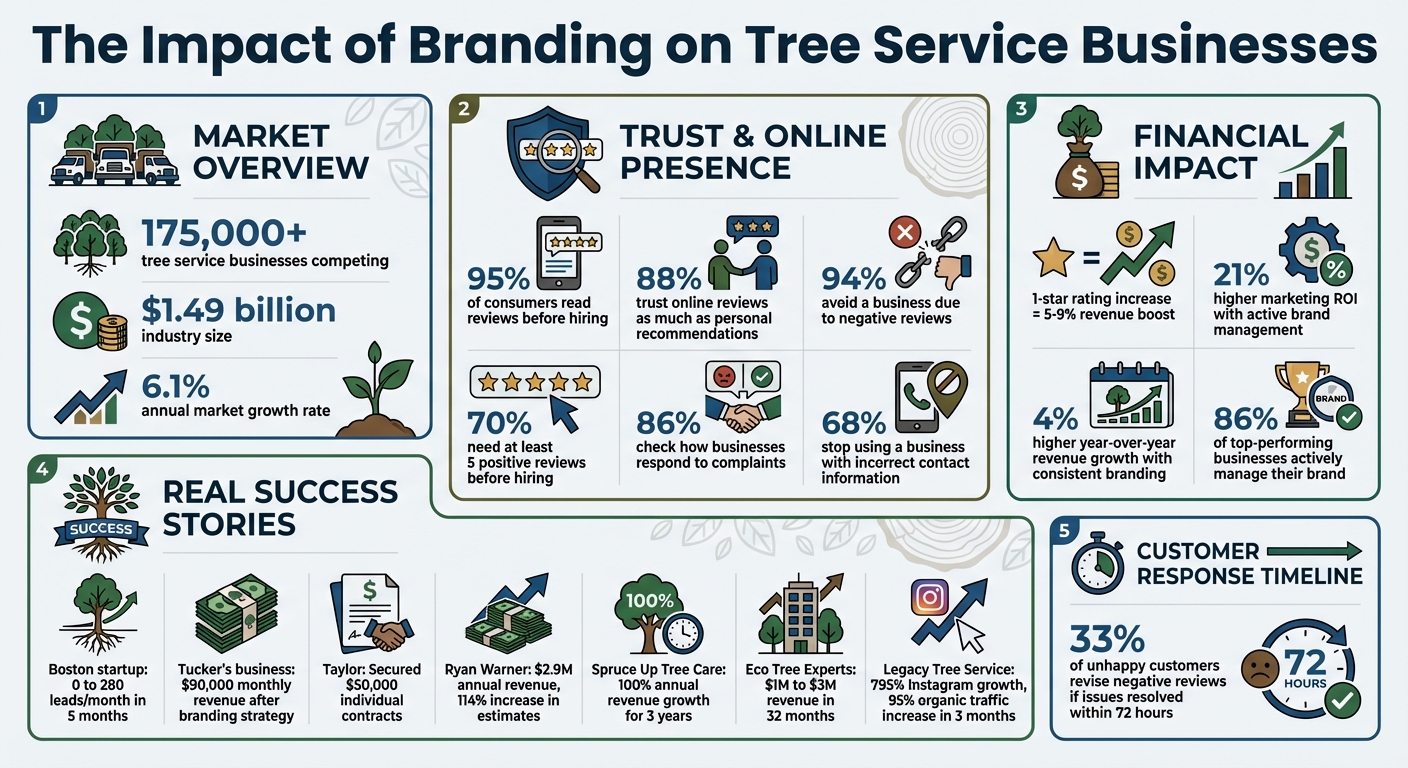
- Online Presence: A professional website and positive reviews are essential. With 95% of consumers reading reviews before hiring, even a one-star increase can boost revenue by 5–9%.
- Better Clients, Higher Revenue: A polished brand attracts clients who value expertise over price, leading to premium contracts and long-term growth.
For example, a Boston startup grew from zero to 280 leads per month in just five months by investing in branding. Another business hit $90,000 in monthly revenue after launching a targeted marketing strategy. Branding isn’t optional – it’s a direct path to trust, growth, and financial success.
Tree Service Branding Statistics: Impact on Revenue, Trust, and Customer Acquisition
Transform Your Tree Service Business with Sam Sadoff: Proven Strategies for Growth and Success
sbb-itb-130a704
How Branding Builds Customer Trust
Tree care is a high-stakes industry. Homeowners are inviting professionals to handle heavy equipment near their families and property, which means trust is non-negotiable. A strong brand acts as a trust shortcut, signaling professionalism and reliability before a single word is spoken.
"A trusted and recognised brand image gives customers the confidence to use what the brand offers." – ScienceDirect/Heliyon
People naturally gravitate toward brands they know and perceive as dependable. When your trucks are spotless, your crew wears matching uniforms, and your logo is consistently displayed across all touchpoints, you’re not just looking professional – you’re showing you take your business seriously. This kind of visual consistency prevents the unpolished image that can turn potential customers away before they even request a quote.
Falcon Digital Marketing sums it up perfectly: "Branding without trust just feels like marketing fluff. Trust without a brand makes it pretty hard to scale up and grow." The real key is delivering on your brand promise with tangible proof – licenses, insurance, certifications, and a history of happy customers.
Online Presence and Customer Reviews
Your website is essentially your digital headquarters. For many potential clients, it’s their first – and sometimes only – impression of your business. A professional, mobile-friendly site helps establish credibility. And with 95% of consumers reading online reviews before hiring service providers, your online presence can either seal the deal or drive them to competitors.
The numbers don’t lie: 88% of consumers trust online reviews as much as personal recommendations, and 94% say a negative review has caused them to avoid a business entirely. Even a small improvement in reviews can have a big impact – a one-star increase on Google Maps often leads to a 5–9% rise in yearly revenue for local businesses.
Take Tucker, for example. A tree service owner, he launched a targeted branding and digital strategy in 2025. Within just 3–4 weeks, his business generated 30–40 high-quality tree service leads, leaving him booked 8 weeks out and achieving a record monthly revenue of $90,000.
But it’s not just about having reviews – it’s about having enough of them. 70% of customers need to see at least 5 positive reviews before they feel confident hiring a service. And how you handle negative feedback matters: 86% of consumers look at how businesses respond to complaints before making a decision. The good news? 33% of unhappy customers will consider revising a negative review if their issue is resolved within 72 hours.
Consistency in online information is another trust factor. If your phone number differs across Google, Yelp, and Facebook, potential customers may question your reliability. As Marketing 360 puts it, "If they can’t trust you enough to have accurate information on your listings, how can they trust you with their tree care needs?". In fact, 68% of consumers will stop using a local business if they find incorrect or inconsistent contact information online.
A reliable digital presence lays the groundwork for a clear value proposition that sets you apart from competitors.
Creating a Clear Value Proposition
Building trust through consistent branding is just the beginning. A clear value proposition strengthens your position in the market. In a competitive industry where many tree services offer similar basics, your value proposition answers the critical question: "Why should I choose you?" It’s not about catchy slogans – it’s about clearly stating what makes your business stand out.
"The quality of your brand is going to impact the quality of your leads." – Amber Kurnik, Brand Specialist, ArborMark
Your value proposition could focus on eco-friendly approaches, like using biodegradable lubricants, recycling wood waste, or specializing in tree preservation. It might emphasize having certified arborists on staff, offering 24/7 storm response, or catering to commercial clients. Whatever your strength, make it clear at every customer interaction.
A strong brand attracts clients who value expertise and are willing to pay for it, while a weak or inconsistent one tends to draw price-focused shoppers. Ryan Warner saw this firsthand. By implementing a clear marketing strategy and sharpening his brand identity, his tree service business grew to $2.9 million in annual revenue, with a 114% increase in estimates over two years.
Clarity is key. Avoid confusing jargon – don’t say "Arboricultural Preservation Specialists" when "We help save healthy trees" is more straightforward. Highlight credentials like licenses, insurance, and certifications prominently. In tree care, safety is a top concern, and customers need to see proof of your professionalism.
The "Marketing Rule of 7" applies here: potential customers typically need to encounter your brand message at least seven times before making a decision. That’s why consistent branding across trucks, uniforms, websites, and yard signs isn’t just about appearances – it’s a strategy. Consistency builds recognition and trust, which are essential for long-term success.
The Financial Impact of Branding
Strong branding isn’t just about looking good – it directly impacts your bottom line. Research highlights that B2C companies with active brand management programs see a 21% higher marketing ROI compared to those without one. For tree service businesses, this means making every marketing dollar work harder, translating into more revenue.
Companies that prioritize consistent branding also experience 4% higher year-over-year revenue growth than their competitors. Over time, this growth compounds into a major advantage. In fact, 86% of top-performing businesses (those in the top 15% of their markets) actively manage their brand programs. These numbers underline how professional branding strategies can drive measurable financial success.
Revenue Growth Through Brand Recognition
Consistent branding helps your business become the go-to name customers think of when they need tree services. This kind of recognition simplifies the decision-making process for customers, making them more likely to call you instead of shopping around.
The financial benefits are clear. Branding acts as a tool for customers to identify and differentiate businesses, which directly influences financial performance. When customers recognize your brand, they’re less likely to haggle over price and more willing to pay for quality. Professor C. Whan Park from the University of Southern California explains:
"A good logo can be a synthesizer of a brand that is readily used by customers for identification, differentiation and positive associations."
Take Taylor, for example – a tree service client who adopted professional branding strategies. Taylor secured premium contracts, including individual jobs worth $50,000. This shows how a strong brand can attract high-value clients who prioritize expertise over cost.
The timeline for results varies depending on the branding approach. Choosing between Local SEO vs. paid ads involves understanding timelines; SEO might take 3–6 months to show results, while social media branding can build momentum in 1–3 months. Paid advertising generates immediate leads, and content marketing establishes authority over 6–12 months. Together, these efforts create both immediate and long-term growth, boosting lead flow and customer retention.
Improved Customer Retention Rates
Beyond attracting new clients, strong branding helps retain existing ones – an area where the financial payoff is undeniable. It’s far more cost-effective to keep a customer than to acquire a new one. When customers trust and recognize your brand, they’re more likely to return for services like annual pruning or storm cleanup, without shopping around. This "cognitive loyalty" means they instinctively stick with a brand they know and trust.
Brand loyalty also reduces marketing expenses. Happy customers generate referrals and leave positive reviews, which are much cheaper – and often more effective – than paid advertising. Studies show that a strong brand image combined with high customer satisfaction can significantly lower advertising costs. Essentially, your brand starts working for you, with word-of-mouth doing much of the heavy lifting.
Paul’s tree service is a great example. By focusing on building a strong brand presence through an accelerated marketing program, his business grew from a two-man crew to a four-man crew, pulling the company out of stagnation. This growth came not just from new customers but also from repeat business and referrals fueled by a recognizable and trusted brand.
The connection between brand image and customer satisfaction creates a powerful cycle. When your company delivers on the promises made by your branding – whether through your logo, messaging, or overall identity – it builds genuine loyalty. Satisfied customers are more likely to return, recommend your services to their neighbors, and stick with you even when competitors undercut your prices. This loyalty strengthens the trust you’ve built and reinforces your brand’s value in the marketplace.
Using Branding to Gain Competitive Advantage
With the tree service market expanding at a rate of 6.1% annually, competition is heating up. When most companies offer similar services – like tree removal, pruning, and stump grinding – branding often becomes the key factor that influences a customer’s decision. These advantages naturally build on the trust and financial benefits discussed earlier.
Differentiating Your Business from Competitors
Branding tells your story before a customer even picks up the phone. Picture this: a homeowner notices several tree service trucks in their neighborhood. The truck with consistent graphics, crew members in matching uniforms, and professional signage will likely stand out as more reliable. These consistent visuals stick in people’s minds, creating recognition.
A strong brand doesn’t just make your business memorable – it also improves the quality of leads you attract. Amber Kurnik, Brand Specialist at ArborMark, explains it best:
"The quality of your brand is going to impact the quality of your leads. You want to attract the right clientele to your business, and your brand will play a huge role in that".
By building a brand that emphasizes expertise and safety, you can appeal to customers who prioritize quality over simply finding the cheapest option.
Your brand voice also plays a critical role in setting you apart. Whether your tone is friendly and approachable or professional and authoritative, it should reflect your company’s personality and resonate with your target audience. For instance, some tree service companies focus their brand on eco-friendly practices, like using biodegradable lubricants and recycling wood waste into mulch, to attract environmentally conscious customers. Others highlight specialized services, such as emergency storm cleanup or handling large commercial contracts. The key is defining what makes your business unique and ensuring every customer interaction reinforces that message.
Brian LeDonne, Digital Marketing Specialist at PS Digital Marketing, emphasizes the power of a strong visual identity:
"In the tree care industry, your logo represents your expertise, reliability and dedication to environmental stewardship. A logo unique to your brand helps establish credibility and becomes a memorable symbol for clients".
When customers see a cohesive presentation – on trucks, uniforms, and yard signs – it signals that you run a professional operation. This attention to detail builds trust, which is critical for success.
Building Customer Loyalty for Repeat Business
While differentiation grabs attention, consistent branding keeps customers coming back. Delivering on your brand promises builds trust over time, making customers less likely to shop around.
Loyalty programs can also play a big role in retaining customers. For example, offering incentives like "Book 3 annual trims, get 1 free inspection" can turn one-time clients into loyal advocates. When customers feel connected to your brand, they’re more likely to recommend your services, leave glowing reviews, and call you first when they need help – bringing in high-quality leads while reducing the cost of acquiring new customers.
The connection between branding and repeat business is simple: retaining customers is far more cost-effective than acquiring new ones. By delivering consistent service, maintaining a professional appearance, and communicating reliably, your brand can create the emotional connection needed to stand out in a competitive market.
Branding Success in Tree Service Businesses
Real-world examples from tree service companies show how professional branding can fuel business growth. These stories highlight how consistent branding not only earns trust but also drives impressive financial results.
Consistent Branding and Return on Investment
Take Spruce Up Tree Care in Memphis, Tennessee, for instance. From 2022 to 2025, they achieved a staggering 100% annual revenue growth for three straight years. Their secret? A mobile-friendly website featuring team photos and customer review pop-ups, paired with a steady presence through Google Ads for tree companies and Local Service Ads. By maintaining consistent branding across every customer touchpoint, they turned their strategy into remarkable success.
In West Palm Beach, Florida, Eco Tree Experts experienced similar results. Over 32 months, ending in January 2024, they grew their revenue from $1 million to $3 million. Their winning formula included a professional website, multi-location SEO, and strategic email and text marketing campaigns. This combination helped them triple their revenue.
Then there’s Legacy Tree Service (formerly known as Legacy Tree Guard), which took branding to the next level by collaborating with a marketing agency for a complete rebrand. This included a new logo, a brand book, and a custom website featuring professional video content. Within just three months, they saw a 795% jump in Instagram profile visits and a 95% increase in organic website traffic. On top of that, their pay-per-click ads boasted a conversion rate of 27%.
These examples prove that consistent and well-executed branding strategies can deliver measurable returns, making them a key driver of business growth.
Marketing Strategies That Build Strong Brands
Beyond revenue growth, targeted marketing strategies amplify the power of a strong brand. By combining professional web design and local SEO, these campaigns create a brand presence that stands out and generates consistent leads. For example, Tree Company Leads employs strategies like custom web design, targeted Google Ads, and local SEO to transform a company’s online presence. Their approach ensures that the brand appears wherever potential customers are searching for tree services, turning a basic online profile into a lead-generating powerhouse that supports long-term business growth.
Conclusion
For tree service businesses, branding isn’t just an optional extra – it’s a key driver of growth. A strong, professional brand builds trust quickly and attracts clients who prioritize expertise over price, giving your business a crucial edge in a crowded local market.
The financial benefits are hard to ignore. Companies that focus on consistent branding – whether through truck wraps, uniforms, an optimized website, or local SEO – often see noticeable increases in revenue and customer loyalty. As Amber Kurnik, Brand Specialist at ArborMark, points out:
"The quality of your brand is going to impact the quality of your leads".
But branding goes beyond just dollars and cents. It’s about building trust. Your logo, website, and messaging make promises, while your reviews, certifications, and high-quality work back them up. As Falcon Digital Marketing explains:
"Branding without trust just feels like marketing fluff. Trust without a brand makes it pretty hard to scale up and grow".
Tree service professionals can move beyond relying solely on word-of-mouth by taking key steps: ensuring visual consistency, defining what sets their business apart, and leveraging digital tools to reach potential clients. Whether it’s creating a mobile-friendly website, optimizing a Google Business Profile, or running targeted ad campaigns, these efforts can turn a local operation into a trusted, recognizable brand.
In today’s competitive market, the tree service businesses that view branding as a strategic investment – not an afterthought – are the ones setting themselves up for long-term success and growth.
FAQs
What steps can tree service businesses take to build a strong online presence?
Tree service businesses can establish a strong online presence by developing a consistent and professional brand that highlights their values and expertise. Start by creating a unified visual identity – think logo, color scheme, and truck graphics – and ensure these elements are reflected across your website, employee uniforms, and social media profiles. Pair this with a clear message that showcases what makes your business stand out, whether it’s a commitment to safety, care for the environment, or top-notch customer service. This builds trust and credibility with potential clients.
To boost visibility in your local area, take advantage of digital marketing strategies like local SEO, optimizing your Google Business Profile, and running targeted ads. A well-designed, professional website with optimized content, active social media engagement, and a collection of positive online reviews can improve search rankings and establish your business as an authority. These efforts not only attract new clients but also encourage customer loyalty, helping your business grow and become a trusted name in the community.
How does investing in branding benefit tree service businesses financially?
Investing in branding can have a powerful impact on the financial performance of your tree service business. A well-developed brand creates trust and loyalty among customers, encouraging them to choose your services over others. This not only helps you stand out but also boosts customer retention, which translates to higher revenue over time.
On top of that, businesses that focus on branding often enjoy a stronger return on investment (ROI) in their marketing efforts. A polished and professional brand identity makes it easier to attract the right clients, set yourself apart in a crowded market, and generate more leads. In the long run, this can help ensure steady growth for your business.
How does branding help tree service businesses grow and attract loyal clients?
Branding plays a crucial role for tree service businesses by establishing trust, building credibility, and projecting a professional image that connects with clients. A strong brand emphasizes important qualities like safety, reliability, and expertise – exactly what homeowners and businesses seek when selecting a tree care provider. Consistent branding elements, such as a memorable logo, professional uniforms, and branded vehicle graphics, enhance recognition and reinforce a polished, trustworthy image.
Beyond recognition, effective branding sets you apart from competitors by highlighting what makes your services distinct. Whether it’s your dedication to eco-friendly practices, use of cutting-edge techniques, or focus on exceptional safety measures, a well-defined brand communicates these strengths clearly. It also strengthens your online presence, making it easier for potential clients to find and choose your business. In the end, thoughtful branding doesn’t just attract more clients – it draws in the kind of clients who appreciate professionalism and are ready to invest in reliable, high-quality service.
Related Blog Posts
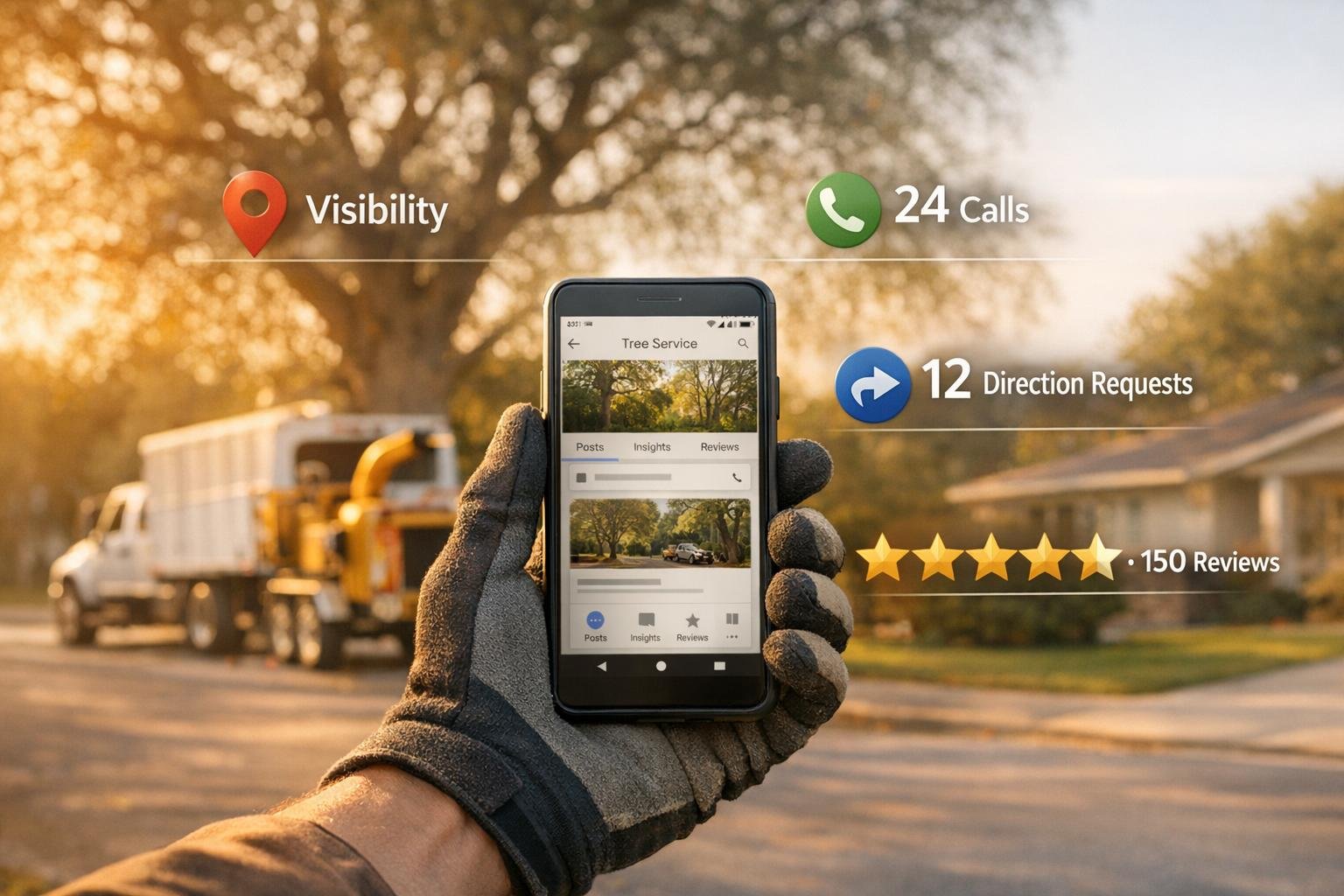
Your Google Business Profile (GBP) is a key tool for tree service businesses to attract and convert local customers. By optimizing your GBP, you can rank higher on Google, track customer actions, and build trust through reviews. Here’s what matters most:
- Visibility metrics: Track how often your profile appears in searches, the search terms used, and where customers are located.
- Customer actions: Monitor phone calls, website clicks, and direction requests to understand how people engage with your business.
- Reviews: Analyze star ratings, review volume, and customer feedback to maintain a strong reputation and improve rankings.
Success stories show how businesses have increased leads and revenue by fine-tuning their GBP. For example, targeted updates led one tree service provider to generate $90,000 in monthly revenue. Regularly reviewing these metrics and responding to customer feedback can directly impact your bookings and revenue.
Start by checking your GBP performance dashboard, using UTM tags for better tracking, and responding to reviews promptly. Staying consistent with these practices ensures your tree service stands out in your local market.
Google Business Profile Key Metrics and Impact Statistics for Tree Services
Visibility Metrics: Measuring Your Online Presence
Impressions and Profile Views
Views and impressions are key indicators of how often your business profile pops up in Google Search or Google Maps results. Google tracks unique visitors once per day, no matter the device or platform.
When it comes to Google Search, it’s a great tool for gauging overall brand awareness. For example, someone searching for "best tree pruning service" is likely exploring options. On the other hand, Google Maps tends to reflect stronger purchase intent – customers searching for directions are often ready to act immediately. Mobile users, in particular, show higher urgency and are more likely to convert, especially for time-sensitive services like emergency tree work. These metrics also reveal where customers are searching from, allowing you to pinpoint strong service areas or identify neighborhoods where your presence could improve.
"Maps traffic often indicates higher purchase intent – customers actively seeking directions typically need immediate service." – Robben Media
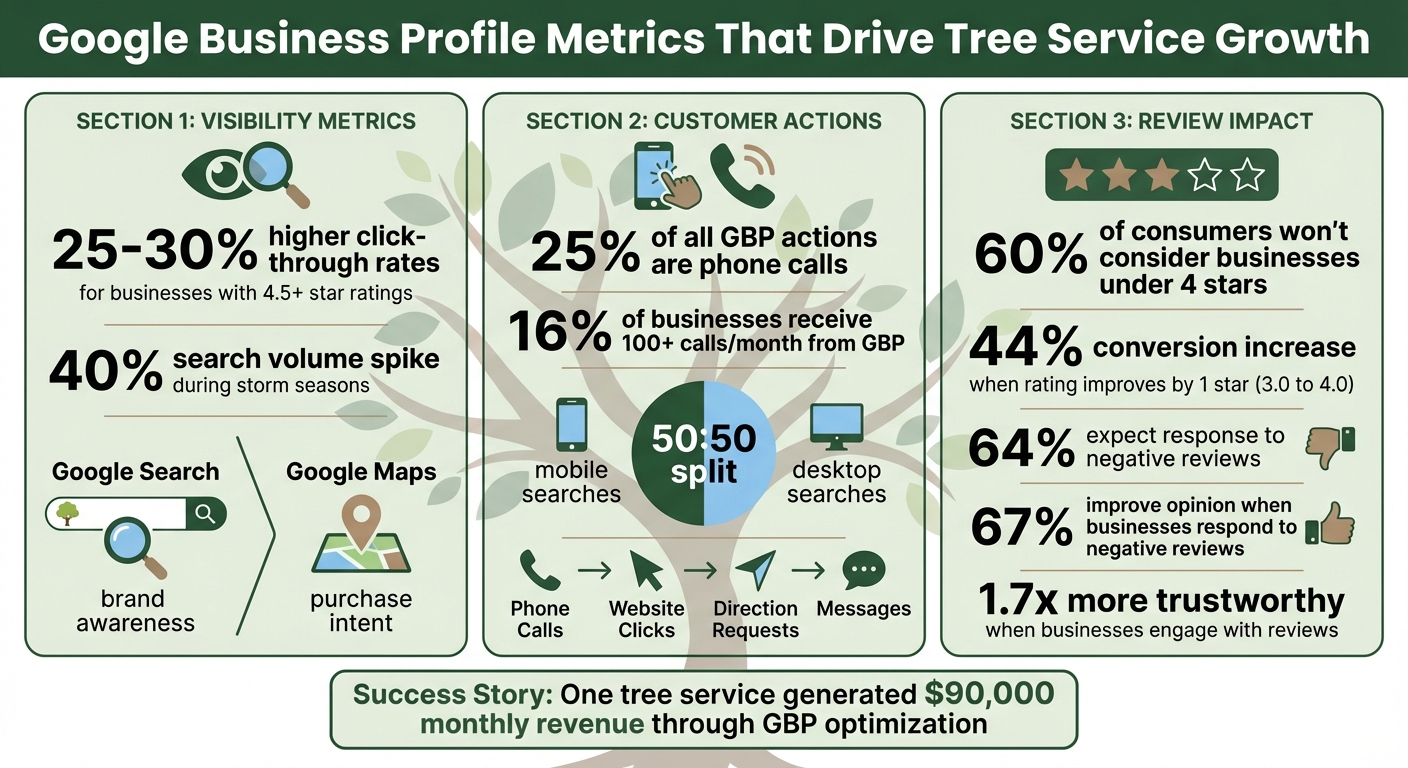
Performance data is updated every 1-2 days, though some metrics, like photo views, may take longer to refresh. Businesses with a 4.5+ star rating and consistent, fresh reviews often see 25-30% higher click-through rates compared to competitors with lower ratings.
From here, dive into search queries and seasonal trends to uncover more about your online reach.
Search Queries and Seasonal Trends
Your Google Business Profile (GBP) dashboard provides a "Searches" breakdown, showing exactly what terms people use to find you – things like "emergency tree removal" or "stump grinding near me." This serves as a handy form of keyword research. You’ll also see whether customers find you through Direct searches (your business name) or Discovery searches (categories or services). If most traffic comes from Discovery searches, it’s a sign to focus on Local SEO vs Paid Ads to determine the best strategy for your business.
Tree services often experience predictable demand spikes. For instance, search volume can jump by 40% during storm seasons or after extreme weather events. Lean into these patterns. Wesley Smith, Owner of Tree Service Digital, suggests:
"You can also benefit from free advertising by posting promotional offers and special events via Google Posts, perhaps highlighting different tree services as the seasons change".
Consider creating posts tailored to seasonal needs, like "Storm Prep" in the spring or "Winter Pruning" as colder months approach.
Google also uses bolded text, called "justifications", to highlight specific terms in your listing, such as "Provides: Tree pruning." These justifications can significantly boost click-through rates. To maximize their impact, review your search queries monthly and incorporate high-volume terms into your Services section and business description. Place these keywords in the first 250 characters of your description to ensure they’re visible before the text is truncated.
Comparing Your Performance to Local Competitors
Once you’ve analyzed your metrics, compare them with local competitors to uncover opportunities. Google’s Insights section includes benchmarking data, which lets you see how your photo engagement and views stack up against "similar businesses" in your area and category. This helps you gauge whether your visual content is as effective as other local tree services. Additionally, you can manually check how your profile appears in the Local 3-Pack – the top three businesses displayed with a map – across various devices and locations.
Pay close attention to rankings in different service areas to spot zones where competitors might be outperforming you. Study competitor profiles for highlighted keywords and review attributes to better understand what local customers prioritize.
"The difference between thriving and surviving often comes down to which businesses track what matters and optimize accordingly." – Robben Media
To dig deeper, use UTM codes on your GBP links to pinpoint which profile features are driving traffic compared to competitors’ broader organic presence. Regularly update your profile images to reflect each specific service you offer. Google may display a service photo over your cover photo if it aligns more closely with a user’s search query.
sbb-itb-130a704
Customer Action Metrics: Tracking Engagement
Phone Calls and Website Clicks
Your Google Business Profile (GBP) captures two key engagement actions: phone calls and website clicks. These metrics provide valuable insight into how customers prefer to connect with your business.
Google tracks click-to-call actions when mobile users tap the phone button on your profile. However, it doesn’t account for desktop users who manually dial your number after viewing it. Since mobile and desktop searches are roughly split 50:50, the actual number of calls you receive could be higher than reported. Phone calls are a major driver of engagement – about 25% of all GBP actions come from calls, making them an essential tool for turning searches into customers.
"A quarter of actions taken on GBP listings are phone calls." – Frances Miller, CallTrackingMetrics
Website clicks are tracked when users tap the "Website" button on your profile. However, without custom tracking, this traffic often appears as "direct" or "organic" in Google Analytics. To fix this, add a UTM tag to your website URL in the GBP dashboard (e.g., yourwebsite.com/?utm_source=google&utm_medium=organic&utm_campaign=gbp).
For tracking calls effectively, use a dedicated call tracking number as your primary contact and list your main business number under "Additional phone." This setup allows you to capture desktop calls, call durations, and even recordings – features Google removed from its native interface in July 2024. Interestingly, about 16% of businesses receive over 100 calls per month directly from their GBP listing. After phone and website clicks, direction requests offer another layer of insight into customer behavior.
Direction Requests and Customer Inquiries
Direction requests provide a window into where your customers are coming from and often signal strong purchase intent. These requests are particularly useful for identifying customers seeking same-day or next-day services, which can be critical in emergency situations.
This data highlights areas with high demand and potential growth opportunities. Similarly, customer inquiries via messages reveal common questions and specific service needs. For example, if you frequently get questions about stump grinding, consider adding more details about this service directly to your profile.
Google’s "Get Competitive Quotes" feature has shifted how homeowners reach out, allowing them to contact up to four tree service providers simultaneously. While this feature has impacted lead quality, as Panajota Gushkova, Paid Search Lead at Tree Care Marketing Solutions, notes:
"The competitive quotes feature changes the game for LSA lead quality. We’re seeing these leads behave more like cold inquiries than the warm leads traditional LSAs generate."
Responding quickly – ideally within 5–15 minutes – can make all the difference, as the fastest responder often wins the job. Since tree service pricing typically requires an on-site assessment, treat these inquiries as an opportunity to schedule free estimates promptly. Use the insights from inquiries to fine-tune your service offerings and strategy.
Using Engagement Data to Improve Your Services
By analyzing data from calls, clicks, and inquiries, you can adjust your operations to align with customer behavior. Review engagement metrics regularly to spot trends and refine your approach. For instance, check the peak calling times in the GBP Performance tab – if most calls happen in the early morning, ensure your team is ready to handle them during those hours.
Dive into search query data to see which services are most popular, and update your website content and GBP "Services" section accordingly. This ensures you’re highlighting the services that resonate most with your audience.
Compare the performance of different engagement actions to see which channels lead to better conversions. If one channel consistently outperforms others, focus your efforts there – whether it’s optimizing for mobile users or improving your website’s estimate request process.
| Metric Type | Measures | Action |
|---|---|---|
| Call Clicks | Taps on the "Call" button | Pair with call tracking to measure lead quality and conversion rates |
| Website Clicks | Clicks to your website | Use UTM tags to track which services drive site conversions |
| Direction Requests | Requests for directions | Identify high-demand neighborhoods for focused crew deployment |
| Messages | Direct inquiries via Search/Maps | Monitor response speed to improve lead capture |
To separate organic GBP performance from paid advertising, use different tracking numbers for Google Ads Location Extensions. This avoids inflated metrics and helps pinpoint which channel generates profitable leads. Keep in mind, GBP metrics typically capture only 30% to 50% of the actual calls your business receives. Combining Google’s data with third-party tools will give you a more complete picture.
Review Metrics and Reputation Management
Review Volume and Average Rating
The number of reviews your business has and your average star rating play a huge role in building trust with potential customers and improving your local search rankings. For tree service businesses, Google factors in "prominence" when ranking local companies, which is influenced by both review quantity and quality. Here’s a telling statistic: 60% of consumers won’t even consider a business unless it has at least a 4-star rating, and 28% lose trust if a business has far fewer reviews than its competitors.
Both the volume of reviews and your average rating matter. If you only have a handful of reviews, a single bad one can drag your score down significantly. But with more positive reviews, the impact of one negative comment is minimized, giving a clearer picture of your service quality.
Here’s why improving your rating is worth the effort: Boosting your average rating by just one star – say, from 3.0 to 4.0 – can increase conversions on your Google Business Profile by 44%. And keep in mind, most people (around 70%) read between 5 and 20 reviews before deciding whether to trust a business. Interestingly, a mix of both positive and negative reviews tends to feel more credible to potential customers.
"More reviews and positive ratings can help your business’s local ranking."
- Google Business Profile Help
When customers leave reviews, Google often prompts them to specify the type of service they received, like tree removal or pruning. This extra detail not only helps potential customers understand what you’re great at but also allows you to track satisfaction across different services. Just note that it can take up to two weeks for a new review to affect your overall rating.
Understanding how many reviews you have and their quality sets the foundation for analyzing their timing and sentiment.
Review Timing and Customer Sentiment
Fresh reviews carry more weight than older ones. A steady flow of recent feedback signals to Google – and potential customers – that your business is active and consistently delivering good results. Beyond just numbers, the tone of customer sentiment can reveal trends you might otherwise miss. For instance, if stump grinding reviews are consistently glowing, but emergency tree removal feedback is more mixed, you’ve identified both a strength and an area for improvement. Negative reviews, while tough to read, often highlight where customer expectations aren’t being met and give you a roadmap for better service.
Pay attention to the details customers mention – things like how professional your crew was, how quickly you responded, or how thorough the cleanup was. These specifics can highlight what’s working and what needs attention. For example, if several reviews in a single month mention delays, it might point to a scheduling issue you need to address.
"Negative reviews aren’t necessarily a sign of poor business practices. Customer feedback presents opportunities to learn what they expect and may help you find ways to improve future experiences."
- Google Help
The insights you gain from reviews should shape how you respond, which we’ll dive into next.
Using Review Feedback to Improve Your Business
Responding to reviews isn’t optional – it’s essential. 64% of customers expect a response to negative reviews, and 40% expect one for positive feedback. The upside? When businesses respond thoughtfully to negative reviews, 67% of customers improve their opinion of the brand, and 62% of unhappy customers are willing to give the business another shot. Plus, businesses that engage with reviews are seen as 1.7 times more trustworthy by potential clients.
Aim to respond within 24–72 hours, and make your replies personal and professional. Address the reviewer by name and sign off with your own name or initials to add a human touch. For positive reviews, thank the customer specifically and mention the service they received (e.g., "We’re so glad we could assist with your oak tree removal!"). For negative feedback, start with an apology, provide a brief explanation, and offer a way to resolve the issue privately.
"When you reply to customer reviews, it shows that you value their feedback. Positive reviews and helpful replies can help your business stand out."
- Google Help
Use negative reviews as learning opportunities. For instance, if 65% of complaints mention rude customer service, it might signal a need for better staff training. If comments frequently mention issues with cleanup, it could be time to revisit your post-job protocols. On the flip side, highlight and reinforce practices that earn praise in positive reviews. Using feedback effectively not only enhances your Google Business Profile but also attracts higher-quality leads.
Tools and Methods for Tracking GBP Metrics
Connecting Google Analytics with GBP

Your Google Business Profile (GBP) dashboard gives you insights into listing actions, but it doesn’t capture what happens once visitors land on your website. That’s where Google Analytics steps in. By using UTM parameters on your website URL in your GBP dashboard, you can track on-site behavior like contact form submissions, views of specific service pages, or even exits.
To get started, use Google’s Campaign URL Builder to create a tagged link. Include parameters like utm_source=google, utm_medium=organic, and utm_campaign=gbp. Once you’ve updated the "Primary website" field in your GBP with this UTM-tagged URL, you can track traffic in Google Analytics by navigating to Acquisition > All Traffic > Source/Medium. This method helps you pinpoint which actions on your site are coming directly from your GBP.
"Without UTM tagging, traffic from GBP will show in Google Analytics as either organic or direct. Even when it does get attributed to the organic channel, we have no idea which part of the Google Business Profile that visitor came from."
- Claire Carlile, Google Business Profile Silver Product Expert
For even deeper insights, consider using specialized lead generation tools.
Local SEO Tools for GBP Analysis
Although the built-in Performance dashboard in GBP provides a basic overview, specialized tools can offer more detailed insights and streamline management, especially for businesses with multiple locations:
- AgencyAnalytics: Combines data from GBP, Google Analytics, and call tracking into a single, comprehensive view.
- BrightLocal: Features tools like the "Local Search Grid", which shows your rankings across a geographic area and includes SERP screenshots.
- Birdeye: Uses AI-driven tools like Insights AI for sentiment analysis and Competitors AI for benchmarking against others in your industry.
Additionally, Google Search Console can help you identify non-branded keywords that contribute to your Local Pack rankings. Since Google removed detailed call history in July 2024, external call-tracking software is now essential for evaluating lead quality and tracking call duration.
"Google Business Profile will track the number of calls to your business from your profile. However, we find it valuable to also use a call tracking tool with a customized number to better identify qualified leads."
- Valerie Jennings, CEO, Jennings Social Media & MarTech
With these tools, you can analyze your GBP performance more effectively and identify areas for improvement.
Setting Up a Regular Metric Review Schedule
Once you’ve integrated analytics and specialized tools, it’s crucial to establish a routine for reviewing your GBP performance. Decide who will monitor your profile – whether it’s you, a team member, or a marketing partner. While customer reviews and messages often need daily attention, broader performance metrics can typically be reviewed monthly, or more frequently in highly competitive markets.
Enable notifications to stay on top of new reviews and messages. Create a monthly checklist that covers key metrics like search queries, website clicks, direction requests, photo engagement, and service interactions. Keep in mind that Google only retains six months of historical data, so exporting your data regularly is essential for tracking long-term trends. If you manage multiple locations, automated reporting tools can simplify this process.
"As local marketers, we need to be monitoring our Google Business Profiles so that we can check the progress or quality over a period of time. We also need to make sure we have a process for systematic review and optimization so that we can see what’s working and what isn’t."
- Claire Carlile, Google Business Profile Silver Product Expert
Conclusion
How GBP Metrics Support Business Growth
Your Google Business Profile (GBP) works around the clock to generate leads, offering insights into how customers discover you, interact with your business, and perceive your reputation in the local market. Every month, millions of people search for local services, and for tree service companies, this means a wealth of high-intent customers looking for emergency removals, routine trimming, or stump grinding.
Tracking the right metrics can directly influence your revenue. Businesses maintaining a 4.5+ star rating with consistent, positive reviews often see a direct boost in bookings. Metrics like direction requests and call clicks indicate customers ready to take action, while search query data provides valuable insight into the exact terms people use when searching for tree services. As Robert Messinger, Director of SEO at Dentalfone, explains:
"Next to a business’s website, the GMB profile is the next most valuable piece of digital real estate".
Next Steps for Tracking Your Metrics
Now that you understand how GBP metrics fuel growth, it’s time to take action. These metrics not only reflect your current performance but also highlight opportunities for improvement and expansion.
Start by accessing the Performance tab in your GBP manager to review the last six months of data. This will give you a baseline for searches, customer actions, and review trends. Add a UTM-tagged URL (e.g., utm_source=gbp&utm_medium=organic) to your website field to track visitor behavior in Google Analytics 4, helping you gain deeper insights into customer engagement.
Establish a monthly review routine to keep your profile fresh and relevant. Update photos with recent project images, respond to all customer reviews, and analyze which search queries are driving the most visibility. Since Google discontinued detailed call history in July 2024, consider using a dedicated tracking phone number to measure lead quality and call durations more effectively. If you’re managing multiple service areas or need help fine-tuning your local SEO strategy, working with specialists like Tree Company Leads can provide tailored marketing and lead generation solutions for tree service businesses.
Use this data to make informed decisions – adjust staffing, refine your services, and maximize your marketing ROI.
The Best Metrics to Use for Google My Business
While organic metrics are vital, many businesses also use Google Ads for tree services to capture immediate local demand.
FAQs
How can Google Business Profile metrics help me grow my tree service business?
Google Business Profile metrics offer crucial insights that can help expand your tree service business. By keeping an eye on data like profile views, searches, clicks, and customer actions (such as calls, direction requests, or messages), you can uncover trends in customer behavior and engagement. These patterns can guide you in refining your profile content and zeroing in on keywords that deliver the best results.
On top of that, tracking reviews and ratings gives you a window into customer satisfaction levels while also helping to establish trust with potential clients. When used wisely, these metrics can boost your online presence and bring in more tree service bookings.
What key Google Business Profile metrics should tree service companies track?
Tree service businesses aiming to boost their online presence should pay close attention to key metrics from their Google Business Profile. These metrics reveal how well your business connects with potential customers and can guide your marketing efforts. Here are some of the most important metrics to monitor:
- Search appearances: This shows how often your business shows up in local search results, giving you a sense of your visibility.
- Customer actions: Track actions like calls, requests for directions, website clicks, or messages initiated through your profile to gauge engagement.
- Profile views and clicks: See how many people are viewing and interacting with your profile to assess its effectiveness.
- Customer reviews: Keep an eye on both the number and quality of reviews to manage and improve your reputation.
By analyzing these metrics, you can better understand how customers find and interact with your business, allowing you to fine-tune your strategies and strengthen your online presence.
How do customer reviews affect my tree service business’s local search rankings?
Customer reviews are an essential part of boosting your tree service business’s local search rankings. Google takes several factors into account, such as the quantity of reviews, their overall quality, and how recent they are. Good reviews don’t just improve your rankings – they also help build trust and confidence with potential clients.
To improve your local SEO, make it a habit to encourage happy customers to share their experiences, respond quickly to feedback (whether positive or negative), and ensure a steady stream of fresh reviews. These actions show Google that your business is active and dependable, which can positively impact your visibility.
Related Blog Posts
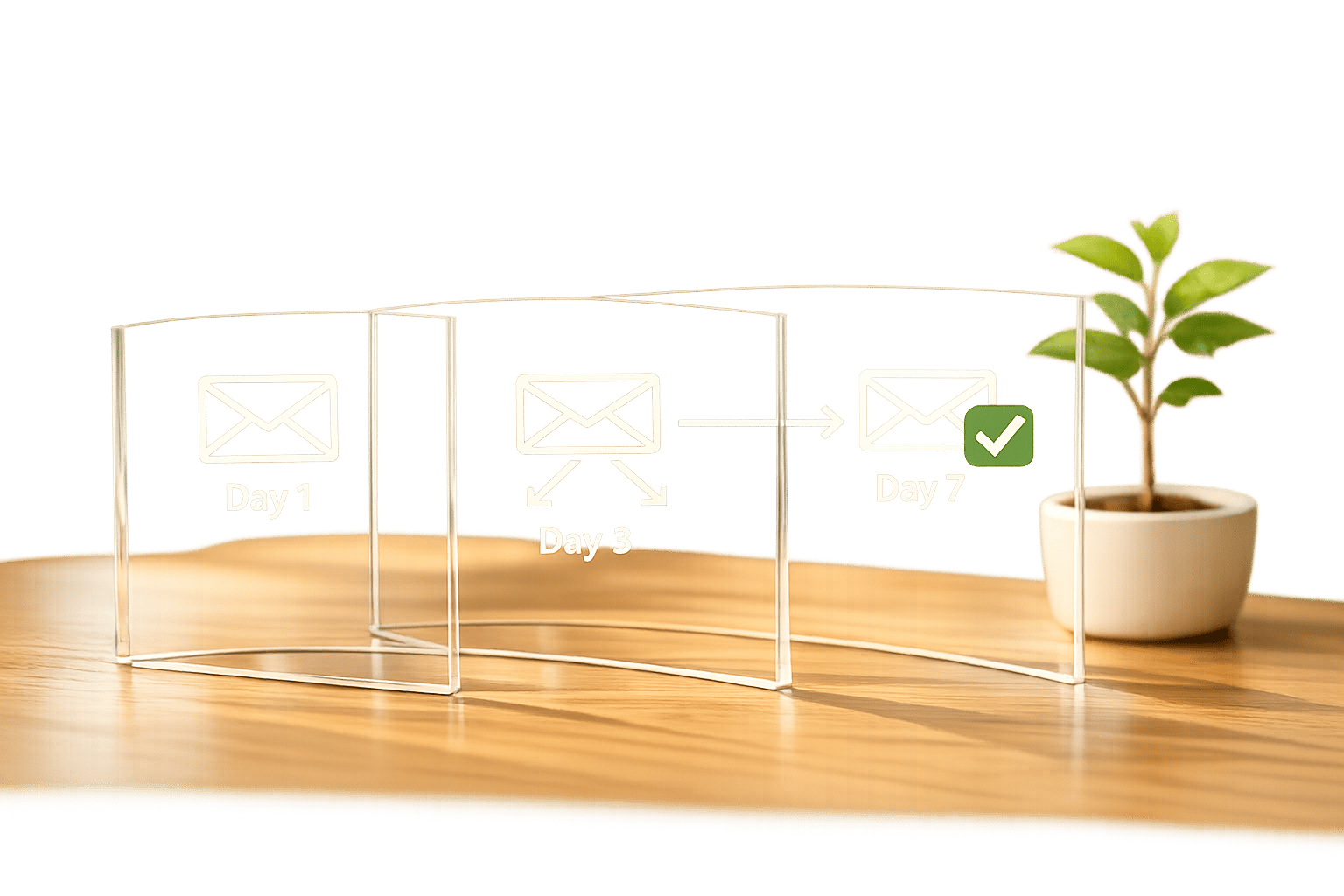
Email drip campaigns are a game-changer for tree service businesses. They automate communication, nurture leads, and keep your services top-of-mind for customers. Here’s why they matter:
- Automated Follow-Ups: Drip campaigns send pre-scheduled emails triggered by actions like quote requests or seasonal needs, saving you time.
- Higher Engagement: Automated emails can achieve open rates of 45-55% and drive 75% of email marketing revenue.
- Seasonal Relevance: Tailor your emails to seasonal services like spring pruning or storm prep.
- Lead Nurturing: It often takes 8 touchpoints to convert a lead – drip campaigns handle this effortlessly.
To get started:
- Build your email list through sign-up forms or offering free resources (e.g., "How to Spot a Dangerous Tree").
- Segment your list by customer type, location, or engagement level.
- Create a sequence of 4-10 emails, including welcome messages, tips, testimonials, and offers.
- Use automation tools like Mailchimp or ActiveCampaign to simplify the process.
- Track performance metrics like open rates (45-55%) and click-through rates (4-5%) to refine your campaigns.
Drip campaigns ensure consistent communication, boost bookings, and free up your time to focus on tree care.
What Email Drip Campaigns Are and How They Work
Definition of Email Drip Campaigns
An email drip campaign is an automated marketing strategy that sends a series of pre-scheduled messages based on specific triggers or timelines. The idea is simple: nurture leads by delivering relevant, bite-sized content over time – much like a steady drip of water helping a plant grow.
For tree service businesses, this approach can handle tasks like following up on customer inquiries, sharing helpful tips, or promoting seasonal deals – all automatically. It’s a hands-off way to ensure potential and existing clients receive timely, tailored messages, keeping your business top of mind.
The Mechanics of Drip Campaigns
Drip campaigns rely on three key components: triggers, conditions, and actions.
- Triggers are the events that set the process in motion. For example, a homeowner might trigger a campaign by submitting a "request a quote" form or downloading a storm preparation guide.
- Conditions determine the timing and flow of the campaign. These rules ensure emails are spaced out appropriately – for instance, sending a follow-up three days after the initial inquiry or scheduling the next email a week later.
- Actions are the emails themselves. These messages are sent automatically based on the triggers and conditions, ensuring a seamless experience for both you and your audience.
Drip campaigns shine when it comes to personalization. Instead of sending the same email to everyone, you can customize messages based on what your subscribers do or need. For a tree service business, someone requesting their first quote might receive educational content about your services, while a returning customer could get reminders for seasonal maintenance. Automation tools can even add personal touches, like including the recipient’s name or referencing the specific tree species they mentioned in their inquiry.
"An email drip campaign is a type of automated email marketing strategy that sends email sequences triggered by user actions or timelines. Think of it like a steady drip from a faucet… where each message builds on the previous one to guide prospects through the sales funnel." – Ryan Buckley, HubSpot
The results speak for themselves: businesses using drip campaigns report a 451% boost in qualified leads and click-through rates of 4–5%. For tree service companies, this means more jobs booked with far less effort spent on manual follow-ups.
How to Build and Grow Your Email List
Proper Email Collection Methods
Start by gathering contact information at every opportunity. Add a sign-up form to your website – whether it’s a simple newsletter subscription box or something like a "Request a Free Estimate" form. To encourage sign-ups, offer something valuable in return, like a free guide or resource.
Lead magnets are particularly effective for tree service businesses. For example, you could offer a free guide such as "How to Spot a Dangerous Tree" or "Best Trees for Privacy in Your Yard." Combine online strategies like these with in-person methods, such as hosting webinars or participating in local events, to expand your reach .
To ensure a high-quality list, use a double opt-in process. This requires new subscribers to confirm their interest via a verification email. While it adds an extra step, it helps reduce spam and keeps your list accurate. Plus, welcome emails sent after confirmation have an impressive average open rate of 83.63%, making them a great way to make a strong first impression.
Avoid shortcuts like purchasing email lists – these often lead to spam traps that could harm your domain’s reputation. Instead, focus on building your list organically. It may take more time, but you’ll attract people who are genuinely interested in your services. To stay compliant with the CAN-SPAM Act, always include an unsubscribe option and link to your privacy policy in every email .
Once you’ve built a solid list, take it a step further by segmenting your contacts based on how they signed up and how they engage with your emails.
How to Segment Your Email List
Segmentation allows you to send more personalized and relevant messages to your subscribers. Instead of blasting the same email to everyone, divide your list into smaller groups based on characteristics like behavior or interests. For tree service businesses, this might involve separating one-time emergency removal clients from those who book annual maintenance, or grouping subscribers by neighborhood to send tailored storm warnings.
Start by tracking where each lead came from. Did they sign up through a "Free Estimate" form, download a guide about emerald ash borer treatments, or meet you at a local event? These details provide valuable insight into their needs and where they are in the decision-making process. You can also segment by engagement level. For instance, identify subscribers who haven’t opened an email in 90 days and create re-engagement campaigns specifically for them.
"A divided list will make it easier to create more personalized content for your leads and clients." – Amy Wilder, Community Manager, vcita
The benefits of segmentation are clear: segmented emails achieve 30% higher open rates and 50% more click-throughs. For a tree service business, this could mean that a homeowner who inquired about stump grinding receives follow-ups focused on that service, while someone interested in tree health gets content about fertilization and pest management. Businesses that use automated, segmented email sequences can see conversion rates improve by as much as 50%.
How to setup drip email campaigns with real-world examples (step-by-step)
Creating Drip Campaigns for Tree Services
Once you’ve built a segmented, high-quality email list, the next step is creating a focused drip campaign that engages your audience and drives action.
Sample Email Sequence for Tree Services
A well-structured drip campaign for tree services usually includes 4–10 emails, spaced out to maintain interest and gradually build trust. Start with a welcome email that’s sent immediately after someone fills out a contact form or requests a quote. This email should acknowledge their interest and make the most of their peak engagement.
After 2–3 days, follow up with an educational email. Share seasonal tree care tips or advice on spotting common tree diseases. This positions your business as a knowledgeable and reliable resource. A few days later, send a social proof email – this could include before-and-after photos, customer testimonials, or case studies from local projects. Highlighting your expertise helps build credibility.
Next, deliver a promotional email with a time-sensitive offer, like a seasonal discount or a special service package. For instance, you could promote a spring storm prep service or a winter pruning deal. This creates urgency while addressing timely customer needs. Personalize these emails based on the preferences and needs of your segmented audience. Wrap up the sequence with a post-service appreciation email. Thank customers for their business, encourage them to leave a review, and subtly prompt referrals.
"Not every email has to be a sales pitch. Send out helpful tree care tips… This positions you as an expert and keeps your clients engaged." – Tree Services Marketing
Businesses using this type of email sequence often see conversion rates improve by as much as 50%. It typically takes around eight touchpoints to turn a prospect into a paying customer.
When and How Often to Send Emails
Timing is everything when it comes to email campaigns. Your first email should go out within 24 hours of a signup or inquiry to capture the recipient’s attention while their interest is fresh. For the initial welcome series, space emails about 2–3 days apart. This keeps the momentum going without overwhelming your audience. Once the welcome sequence wraps up, shift to a more consistent schedule – about one email every two weeks. Research shows this interval is ideal for staying connected without risking unsubscribes.
For the best results, send emails on weekdays – Tuesdays through Fridays – when open rates tend to be higher. Avoid sending key communications on Saturdays, as engagement typically drops. If you’re a smaller tree service business with a list of fewer than 2,000 subscribers, aim for 4–8 emails per month to prevent fatigue. During seasonal promotions, like storm prep in spring or dormant pruning in winter, you can temporarily increase frequency. Just make sure each email offers something fresh and valuable to your audience, rather than repeating the same message.
sbb-itb-130a704
Using Automation and Personalization
Once you’ve segmented your audience, automation and personalization step in to amplify engagement. Automation eliminates the need to individually write and send emails, giving you more time to focus on tree care rather than administrative tasks. By combining automation with personalization – like using a customer’s name, service history, or location – you can ensure every message feels relevant and timely.
Setting Up Automation Tools
Start by mapping out your customer journey – from the initial quote request to post-service follow-ups. This will help you determine the right moments to send emails and the purpose behind each one. For example, you can set up behavioral triggers for specific actions. If a customer clicks on a link about stump grinding in your newsletter, they can automatically be added to a drip sequence focused on that service.
Most automation platforms allow you to define triggers based on actions like form submissions, long periods of inactivity (e.g., 12 months without a tree inspection), or completed services. A useful feature is setting automation to remove customers from general campaigns once they’ve booked a service. Automated emails are incredibly effective, driving about 75% of revenue from email marketing campaigns. B2C companies using automation have seen conversion rates increase by up to 50%. Platforms like Mailchimp, ActiveCampaign, and Brevo are popular choices for setting up these workflows.
Once your automation is in place, focus on personalizing each message to create a connection with your audience.
How to Personalize Your Emails
Personalization starts with simple details like the recipient’s name, location, and service history. For example, sending reminders tied to a customer’s last service – like “It’s been 12 months since your last pruning” – feels much more relevant than a generic email.
Location-based promotions can also be highly effective for tree services. Let’s say a severe storm recently impacted your area. You could send targeted emails offering storm damage recovery tips or emergency tree removal services to affected customers. Using smart fields in your email platform, you can automatically insert personal details, making each email feel custom-made. Segmented emails have been shown to increase click-through rates by 50% and boost open rates by 30%.
"Personalization is key. Try to customize emails to your target audience’s industry and align your emails to provide the right information at the right time." – Robert Catalano, Digital Marketing Specialist, Toshiba
To increase engagement, keep your emails concise with short paragraphs and a single call-to-action. Since most subscribers only spend two to eight seconds skimming an email, every word needs to work hard. Test different personalized subject lines – like “John, your trees need this” or “Special offer for your Dallas home” – to find out which approach gets the best response.
Measuring and Improving Campaign Results
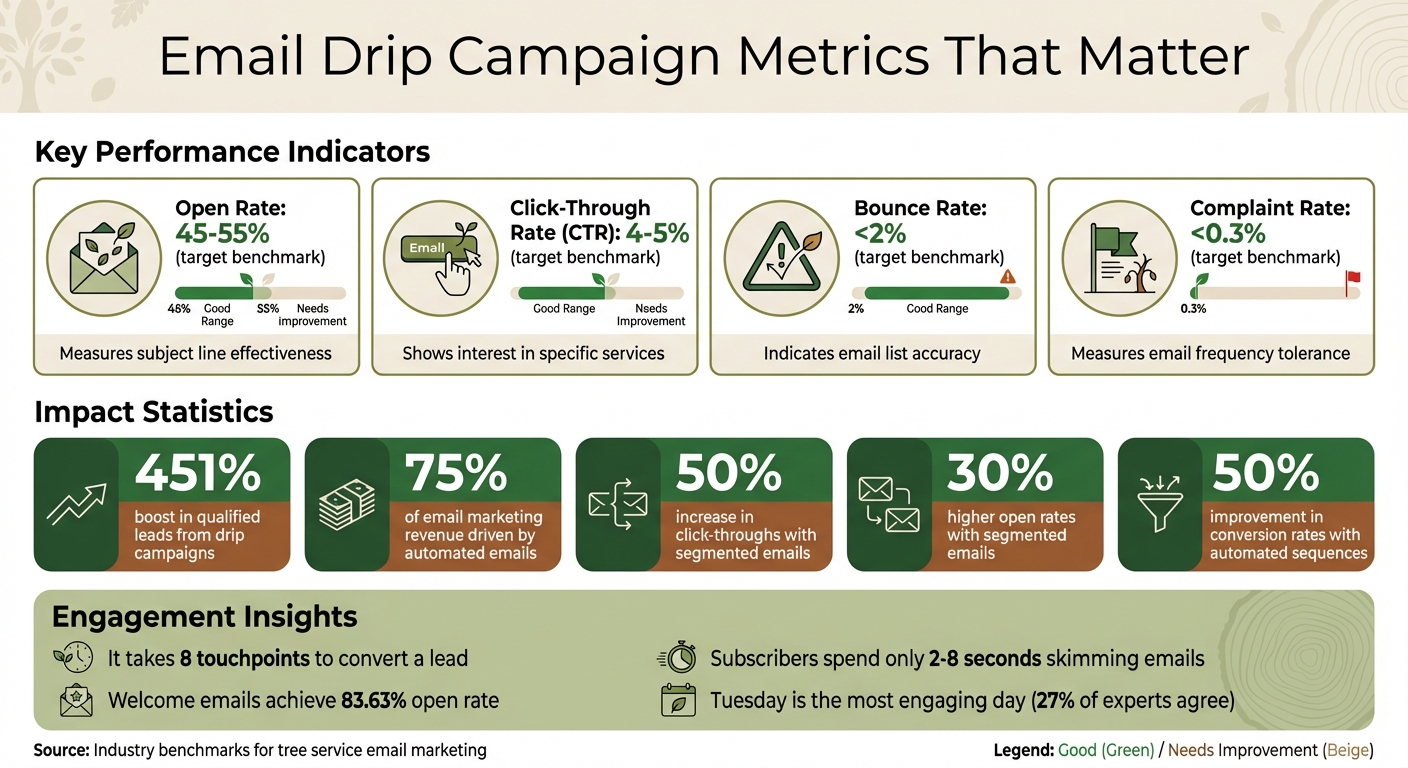
Email Drip Campaign Performance Metrics and Benchmarks for Tree Services
Tracking the right metrics is essential to gauge whether your email drip campaigns are driving new business. For example, the open rate – the percentage of recipients who open your email – offers insight into how compelling your subject lines are. A strong open rate for email campaigns typically falls between 45% and 55%. Meanwhile, the click-through rate (CTR) measures engagement by showing how many recipients clicked on links like "Schedule a Quote." For tree services, a healthy CTR hovers around 4% to 5%. Another key metric, the conversion rate, reflects the percentage of recipients who ultimately book a service.
It’s also crucial to keep an eye on bounce rates and complaint rates. A bounce rate exceeding 2% or a complaint rate above 0.3% suggests it’s time to fine-tune your email list or adjust your messaging. Additionally, higher unsubscribe rates may indicate issues with your timing or content. Greg Zakowicz, Senior Ecommerce Expert at Omnisend, highlights this point:
"If the unsubscribe rate for a drip campaign is significantly higher than scheduled campaigns, it is usually a good indication that something needs to be altered, such as the message timing or the content."
Metrics to Track
| Metric | Target Benchmark | What it Indicates for Tree Services |
|---|---|---|
| Open Rate | 45% – 55% | Effectiveness of subject lines (e.g., "Is your oak tree safe?") |
| Click-Through Rate | 4% – 5% | Interest in specific services (e.g., pruning vs. removal) |
| Bounce Rate | < 2% | Accuracy of your email list |
| Complaint Rate | < 0.3% | Whether email frequency feels intrusive to recipients |
| Conversion Rate | Varies | Success in turning digital leads into service bookings |
It’s worth noting that Apple Mail Privacy Protection may inflate open rates artificially, making CTR a more dependable measure of genuine engagement. Another valuable metric is revenue per campaign, which highlights which email sequences are actually driving income. For example, Island Olive Oil’s three-part welcome sequence in 2025 accounted for just 1.22% of their total emails but generated a staggering 39% of their email revenue.
These benchmarks serve as a guide for fine-tuning your campaigns to improve performance.
Using Data to Improve Your Campaigns
Once you’ve identified key metrics, use data-driven testing to enhance your campaigns. Start with A/B testing one variable at a time, such as experimenting with different subject lines, call-to-action (CTA) button colors, or send times, while keeping everything else consistent. Testing multiple variables at once can muddy the waters, making it unclear what’s driving the results. For instance, testing subject lines that mention seasonal tree care might directly impact service bookings. If you discover that emails sent on Tuesday mornings outperform those sent on Friday afternoons, you might want to adjust your schedule accordingly – especially since 27% of marketing experts report Tuesday as the most engaging day of the week.
If you notice a spike in unsubscribes after the third email in a five-email sequence, revisit its content to see what might be turning recipients away. Automation tools can also play a pivotal role in improving your campaigns. For example, removing contacts from your drip sequence after they’ve booked a service prevents redundant communication. In 2025, Amundsen Sports achieved a 32% conversion rate for their order confirmation emails by including targeted product recommendations and exclusive offers. For tree services, you could apply a similar strategy by suggesting seasonal pruning after a removal service or offering discounts on stump grinding to recent customers.
Conclusion
Email drip campaigns are a powerful way for tree service businesses to stay connected with both potential and existing clients, all while running on autopilot. By sending out automated emails that include helpful tips, showcase your services, and offer timely promotions, you can nurture leads and establish your business as a local authority. As we’ve seen, these campaigns can significantly boost revenue and improve conversion rates.
To get started, keep it simple. Set up a basic welcome sequence for new leads, divide your email list into residential and commercial clients, and use trigger-based emails to engage prospects at the peak of their interest. A steady, consistent approach with multiple touchpoints is key to seeing results.
Focus on delivering value first – whether it’s tree care tips, safety advice, or service highlights – before introducing promotional offers. This positions your business as a trusted resource rather than just another company pushing sales. Plus, this value-driven strategy often achieves better open rates than standard emails.
Once your campaigns are live, use the metrics we discussed earlier to fine-tune your approach. Test one element at a time – like subject lines, sending times, or content – to see what resonates most with your audience. By relying on data for these adjustments, your campaigns will only get better over time. Meanwhile, automation takes care of follow-ups and appointment reminders, freeing you to focus on day-to-day operations while ensuring no lead slips through the cracks.
With the right tools and strategy, email drip campaigns can revolutionize how you attract, engage, and retain clients. They turn one-time customers into loyal, long-term relationships, creating a reliable stream of revenue for your tree service business. When done right, email automation becomes a cornerstone of your marketing success.
FAQs
What’s the best way to start building an email list for my tree service business?
To grow an email list for your tree service business, start by gathering contact details from both current and potential customers. Offer incentives that are hard to resist – think free estimates, seasonal discounts, or expert tree care advice. You can collect email addresses through your website, social media platforms, or even in-person during service visits.
After collecting these emails, take the time to organize and segment your list. For example, you might group customers by type, such as homeowners or property managers. This allows you to send messages that feel more personal and relevant to their specific needs. Using tools like automated email campaigns or drip sequences, you can share timely, customized content that keeps your business top of mind and helps guide potential customers toward making a decision.
By combining smart incentives, thoughtful segmentation, and automation, you can steadily grow your email list, build stronger relationships, and turn leads into loyal customers who return to your tree service business time and time again.
How can I segment my email list to boost engagement for my tree service business?
To get better results from your email drip campaigns, break your email list into smaller, targeted groups based on things like customer behavior, preferences, or demographics. This way, you can send content that feels personal and relevant, making it more likely that your audience will engage and take action.
For tree service businesses, here are some ways you could segment your list:
- Customer type: Are they homeowners, property managers, or municipal clients? Each group has different needs.
- Location: Adjust your offers to fit regional demands or seasonal services.
- Engagement history: Look at their previous purchases, website activity, or how they’ve responded to past emails.
Keep your segments up-to-date by regularly reviewing your data. For instance, you could send homeowners seasonal tree care tips or offer specialized services tailored to property managers. Pairing smart segmentation with thoughtfully crafted content and well-timed emails helps you build stronger connections and motivates your audience to take action.
How can I track the success of my email drip campaigns for tree services?
To gauge how effective your email drip campaigns are, pay close attention to metrics like open rates, click-through rates, and conversion rates. These numbers reveal how successfully your emails are grabbing attention, encouraging interaction, and inspiring action.
It’s also important to keep an eye on unsubscribe rates and bounce rates. High numbers here could point to problems with your email content or the quality of your contact list. By routinely analyzing these stats, you can tweak your campaigns to boost engagement and strengthen your connection with recipients. Experimenting with different subject lines, email content, and sending schedules can further refine your results over time.
Related Blog Posts
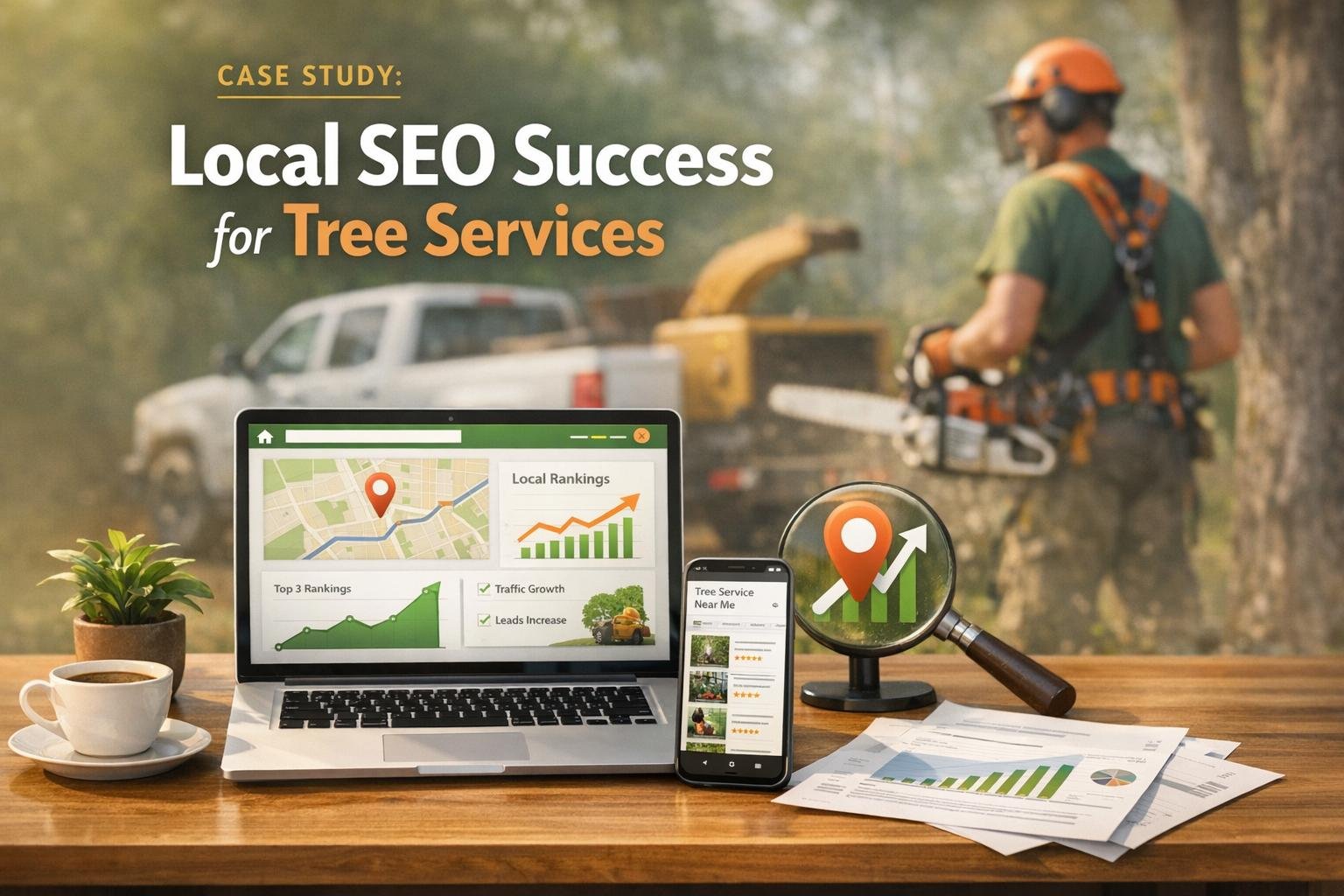
Key takeaway: Local SEO can transform a tree service business by increasing visibility in local searches, generating more leads, and improving customer engagement. This case study highlights how a Milwaukee-based tree service, Trees No More, achieved a 166% lead increase in just three months through targeted strategies.
What Worked:
- Website Optimization: Migrated from Shopify to WordPress, improved speed, and added service-specific pages.
- Google Business Profile Updates: Accurate details, geotagged photos, and keyword-rich descriptions.
- Local SEO Tactics: Built local citations, targeted high-intent keywords, and addressed customer FAQs.
Results:
- Monthly leads grew to over 55.
- Rank higher on Google to achieve Top-3 rankings for key local search terms.
- Fully booked schedules with consistent inquiries.
Local SEO isn’t just about being found – it’s about appearing in front of the right people at the right time. Whether you’re a tree service owner or in another local industry, focusing on location-specific strategies can drive measurable growth.
Local SEO Case Study: 3X More Calls for Tree Service Company 🌲 | POP Advertising Partners
Client Background: Problems Before Starting
Before diving into a focused SEO strategy, Trees No More was grappling with several digital challenges that were limiting its growth.
About the Business
Trees No More is a residential tree removal and trimming service located in South Milwaukee, Wisconsin. The company caters to homeowners across the greater Milwaukee area, offering services like emergency storm cleanup, stump grinding, and routine tree maintenance. Until recently, they relied heavily on word-of-mouth referrals to fill their schedule.
Problems They Faced
When Trees No More sought assistance, their online presence was more of a hindrance than a help. Their Shopify-based website came with high costs and was poorly optimized for a service-based business. A large homepage video significantly slowed down loading times, and the site’s content lacked focus on high-intent local keywords. Furthermore, there were no dedicated service pages for nearby areas like Franklin, and the website’s outdated design made navigation frustrating for potential customers. These issues combined to create a poor user experience and limited conversions.
Starting Performance Numbers
At the outset, Trees No More’s online visibility was nearly non-existent. Slow page speeds and weak local search rankings meant potential customers often abandoned the site before it even loaded. Worse yet, the company was losing out on jobs because it simply didn’t show up in Google search results – while their competitors did. These challenges made it clear that a local SEO vs. paid ads strategy was urgently needed.
Strategies Used to Improve Local SEO
Once the team identified the challenges faced by Trees No More, they devised a focused plan targeting three key areas: the website, the Google Business Profile, and broader local search strategies.
Website Improvements
The team transitioned the site from Shopify to WordPress to improve both speed and SEO capabilities. They created dedicated service pages for tree removal, stump grinding, emergency storm cleanup, and pruning, each tailored with location-specific keywords. To strengthen local relevance, they also developed landing pages for nearby areas.
A heavy video on the site was replaced with an optimized image to enhance load times. They implemented Local Business schema markup, which can boost local search visibility by approximately 30%. Additional performance upgrades included image compression, lazy loading, and minified CSS/JavaScript. The redesigned website featured clear call-to-action buttons and "Quick Quote" forms – an essential feature considering that 64% of users search for arborist services on mobile devices.
With the website optimized, the team then focused on improving the Google Business Profile to further increase local search visibility.
Google Business Profile Updates
The Google Business Profile was updated with consistent NAP (Name, Address, Phone) details, relevant categories (using "Tree Service" as the primary category, and "Arborist" and "Stump Removal Service" as secondary ones), and geotagged photos. The business description was revised to include local keywords within the 750-character limit. The Services section was populated with specific offerings like "Emergency Storm Damage Cleanup" and "Cabling and Bracing".
To boost online credibility, the team implemented a system to request customer reviews immediately after job completion. Since 85% of consumers trust online reviews as much as personal recommendations – and reviews contribute roughly 10% to Google’s local ranking factors – this step was critical. They also ensured every review received a professional response.
Additional Local SEO Tactics
To strengthen local SEO further, the team built citations across high-authority directories, ensuring consistent NAP details. They developed content addressing common queries like "Do I need a permit to take down a tree?" and "How much does it cost to remove a tree?". An internal linking strategy was implemented, connecting service pages, city-specific pages, and blog posts to help search engines navigate the site more effectively. Additionally, they optimized for high-intent keywords such as "tree removal near me".
"We wasted 6 months targeting the wrong keywords for our local area. Ranking #1 for tree trimming keywords nobody is searching for doesn’t make the phone ring." – Tim, C.A.T.
This well-rounded strategy led to measurable and impactful improvements for Trees No More.
sbb-itb-130a704
Results: What the Campaign Achieved
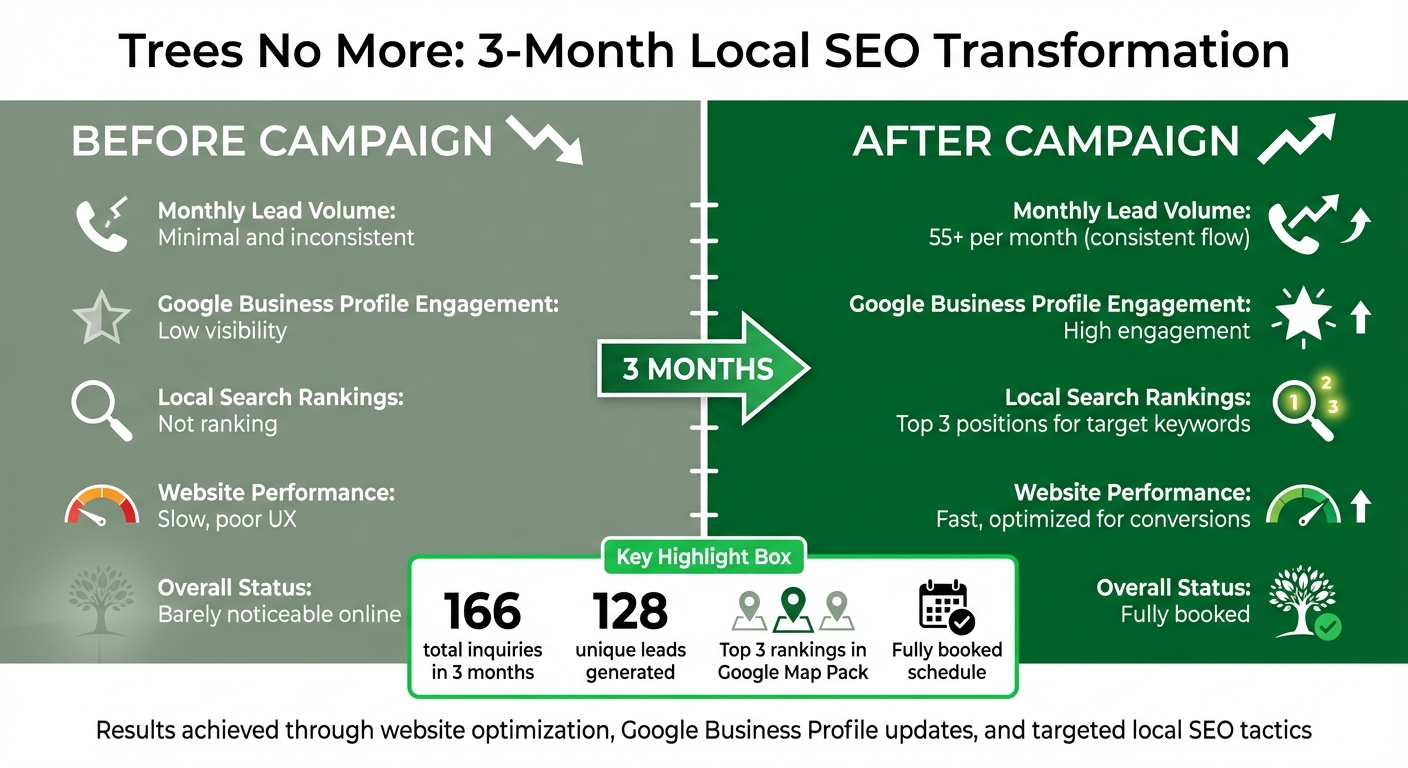
Trees No More Local SEO Results: Before vs After 3-Month Campaign
Before and After Comparison
In just three months, Trees No More completely revamped its online presence. The results? A whopping 166 inquiries, with 128 unique leads generated. The transformation took them from barely noticeable online to being fully booked.
| Metric | Before Campaign | After Campaign | Improvement |
|---|---|---|---|
| Monthly Lead Volume | Minimal and inconsistent | 55+ per month (avg.) | Consistent flow |
| Google Business Profile Engagement | Low visibility | High engagement | Noticeable growth |
| Local Search Rankings | Not ranking | Top positions for target keywords | Strong local presence |
| Website Performance | Slow, poor UX | Fast, optimized | Built for conversions |
Main Achievements
These numbers translated into real-world improvements in search visibility. Trees No More achieved top‑3 rankings in the Google Map Pack for high-intent keywords like "tree removal near me" and location-specific searches in South Milwaukee, Franklin, and nearby areas. Their Google Business Profile became a hub of activity, with a surge in clicks, calls, and direction requests – exactly the kind of engagement that turns online searchers into paying customers.
The business went from struggling to attract clients to being fully booked. A faster, conversion-focused website paired with enhanced local search visibility generated a steady stream of qualified leads ready to hire tree services. This success story highlights how targeted local SEO can transform a tree service business.
Ongoing Benefits
Even after the campaign, the benefits continue to roll in. The SEO groundwork laid for Trees No More keeps delivering results. Their location-specific landing pages and optimized service content hold strong rankings, ensuring a consistent flow of inquiries without relying on constant paid ads. The improved website infrastructure and Google Business Profile optimization provide lasting visibility, cementing their reputation as the area’s top tree service provider.
What Other Tree Services Can Learn
Why Targeted Optimization Works
Trees No More’s success highlights the power of focusing on precise, location-driven strategies over generic approaches. By zeroing in on high-intent, location-specific keywords like "tree removal near me", the business managed to generate 166 inquiries in just three months.
For example, targeting keywords such as "tree removal in Franklin" connects directly with customers ready to hire. Combine that with an optimized Google Business Profile that includes geotagged photos and regular updates, and you’ve got a setup that turns online searches into actual phone calls. The key to maintaining these results lies in consistent monitoring and timely adjustments.
Regular Updates and Vigilant Tracking
Local SEO isn’t a one-time effort – it’s an ongoing process. Search algorithms evolve, competitors step up, and rankings can shift if you’re not actively managing them. One tree service in Los Angeles saw a 95.24% increase in phone calls over 12 months by regularly tracking performance and refining their strategy based on data insights. Similarly, McAbee Tree Care boosted profile actions – like calls and direction requests – by 80% by keeping their Google listing updated and engaging.
Using tools like call tracking can help pinpoint which marketing efforts are driving leads, allowing you to double down on strategies that work. Staying on top of these metrics keeps your SEO strategy flexible and effective.
Getting Professional Help
Balancing local SEO with the day-to-day demands of running a tree service can be tough. Eco Tree Experts in West Palm Beach addressed this by partnering with a marketing agency, which helped them triple their revenue from $1M to $3M over 32 months. Their strategy combined SEO, Google Maps optimization, and paid advertising.
"I was genuinely worried we wouldn’t even get off the ground as a new business. Now my biggest challenge is hiring qualified arborists fast enough to keep up with demand".
This success story reinforces the importance of working with professionals who understand local SEO. Companies like Tree Company Leads specialize in building conversion-focused websites, managing Google Ads, and executing local SEO strategies tailored to tree service businesses. Partnering with experts can help simplify the process and significantly boost lead generation.
Conclusion
Local SEO has shown itself to be a game-changer for tree service businesses, driving substantial increases in inquiries, engagement, and revenue through well-executed strategies.
What’s the key to this success? These businesses honed in on high-intent keywords, ensured NAP consistency (Name, Address, Phone) across directories, and treated their Google Business Profile as a living, breathing sales tool rather than a static listing. Because algorithms and competition are always shifting, maintaining strong rankings demands regular updates, performance tracking, and strategic tweaks.
For many tree service owners, juggling these tasks alongside daily operations can feel like too much. That’s where expert help comes in. Tree Company Leads offers tailored solutions like conversion-focused websites, Google Ads management, and local SEO strategies specifically designed for tree care businesses, such as our Birmingham tree service marketing solutions. Their expertise allows business owners to focus on what they do best while still capturing high-quality leads.
Whether you choose to tackle these strategies on your own or bring in professional support, the results can be transformative. Your website becomes more than just an online presence – it becomes a lead-generating asset that works for you month after month, independent of third-party platforms or fluctuating ad budgets.
Ready to take the first step? Start by optimizing your Google Business Profile, creating location-specific landing pages, keeping citations consistent, and closely tracking your performance. Stick to the basics, monitor your progress, and refine your approach as needed. The success stories shared here prove that local SEO works – and the results are well worth the effort.
FAQs
How did switching from Shopify to WordPress boost SEO for Trees No More?
Switching from Shopify to WordPress made a big difference for Trees No More’s SEO. The shift provided more flexibility in managing content, faster page load times, and better tools for fine-tuning keyword optimization. As a result, the business started ranking higher in local search results and drawing in more targeted leads.
With WordPress, they could also customize their SEO strategies to better connect with their local audience. This tailored approach boosted their online visibility and drove a noticeable increase in customer inquiries.
How do geotagged photos and customer reviews help improve local SEO for tree service businesses?
Geotagged photos and customer reviews play a key role in strengthening local SEO efforts. Geotagged photos add location-specific details to your content, which helps search engines pinpoint where your business operates. This can boost your visibility in local search results while also making your online presence more relatable and trustworthy to potential customers.
Customer reviews, on the other hand, are essential for building trust. They show both search engines and potential clients that your business is active and dependable. Positive reviews not only enhance your reputation but can also improve your rankings on platforms like Google Maps and local search results. When combined, geotagged photos and customer reviews create a compelling online presence, making it easier for tree service businesses to connect with local customers.
Why is it important for local businesses to focus on high-intent, location-specific keywords?
Focusing on high-intent, location-specific keywords is a game-changer for local businesses. Why? It connects them directly with customers who are actively searching for services in their area. By zeroing in on these targeted keywords, businesses can improve their local search rankings, attract more relevant leads, and stand out in their specific service regions.
This strategy ensures marketing efforts reach an audience that’s ready to act – whether it’s booking a service, making a purchase, or visiting a location. The result? Better outcomes and a boost in business growth.
Related Blog Posts
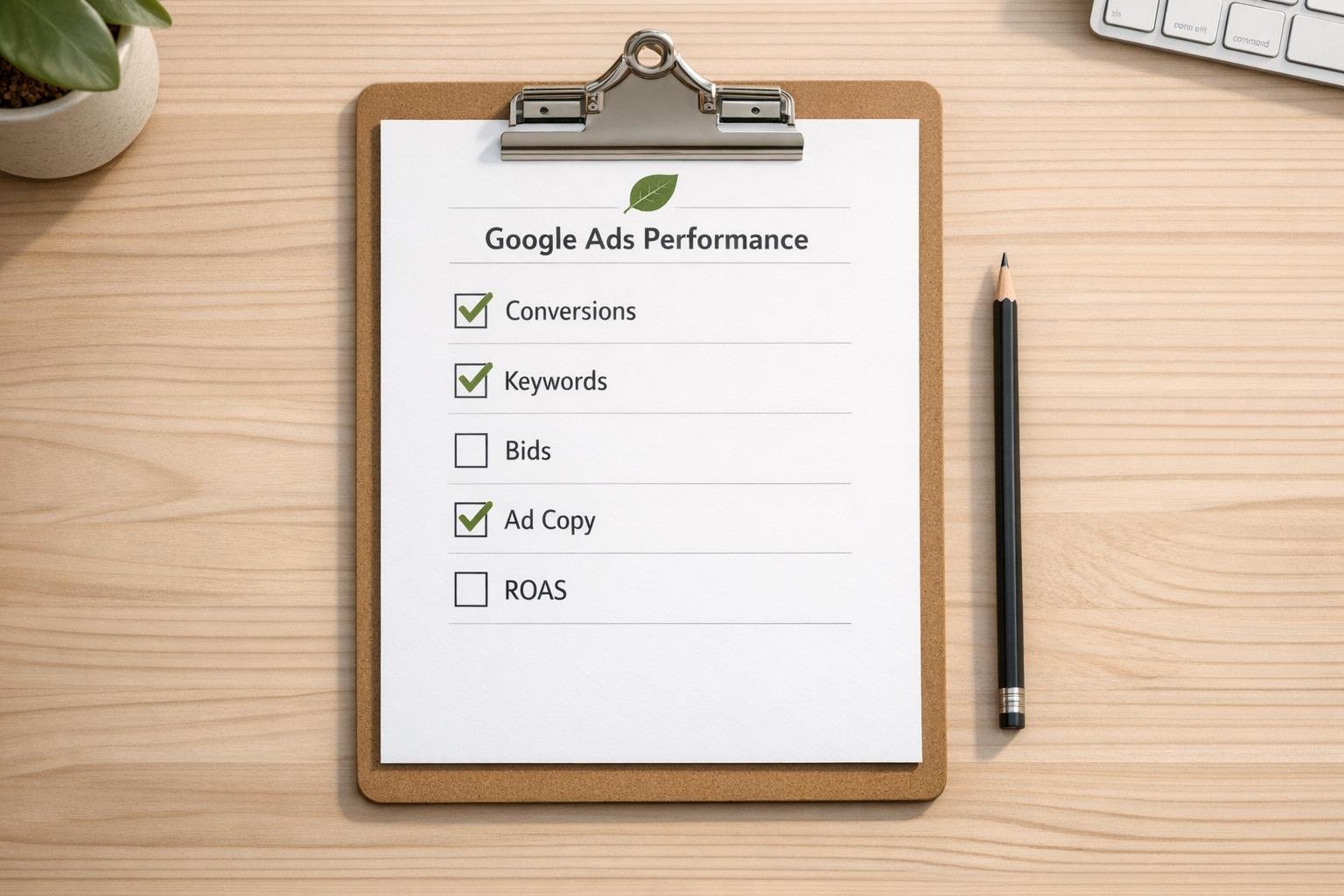
Managing Google Ads effectively isn’t just about setting up campaigns – it’s about constant monitoring to ensure your budget drives real results, not wasted clicks. For tree service businesses, this means tracking the right metrics, refining keywords, and adjusting strategies to convert clicks into actual jobs like tree removal or trimming. Here’s a quick breakdown of how to stay on top of your campaigns:
- Track Conversions: Use tools like Google Tag Manager to monitor calls, form submissions, and map requests. Ensure conversion tracking is active and accurate.
- Daily Metrics Check: Focus on click-through rate (CTR), cost-per-click (CPC), and conversions to catch issues early.
- Keyword Refinement: Review search terms weekly, add high-intent keywords, and block irrelevant ones with negative keywords.
- Device Performance: Evaluate mobile vs. desktop results bi-weekly and adjust bids accordingly.
- Ad Extensions & Quality Score: Update extensions monthly and optimize for relevance, CTR, and landing page experience.
- ROAS Analysis: Calculate Return on Ad Spend quarterly to identify which campaigns drive revenue and reallocate budgets effectively.
- Competitor & Seasonal Trends: Use tools like Auction Insights to monitor competitors and adjust bids during storm seasons or peak demand.
- Pause Underperformers: Stop running ads or keywords with low CTRs, poor Quality Scores, or high costs without conversions.
- Test Ad Copy: Experiment with responsive search ads to find the messaging that resonates best with your audience.
By following this checklist, you can cut waste, maximize ROI, and turn Google Ads into a reliable lead-generation tool for your business.
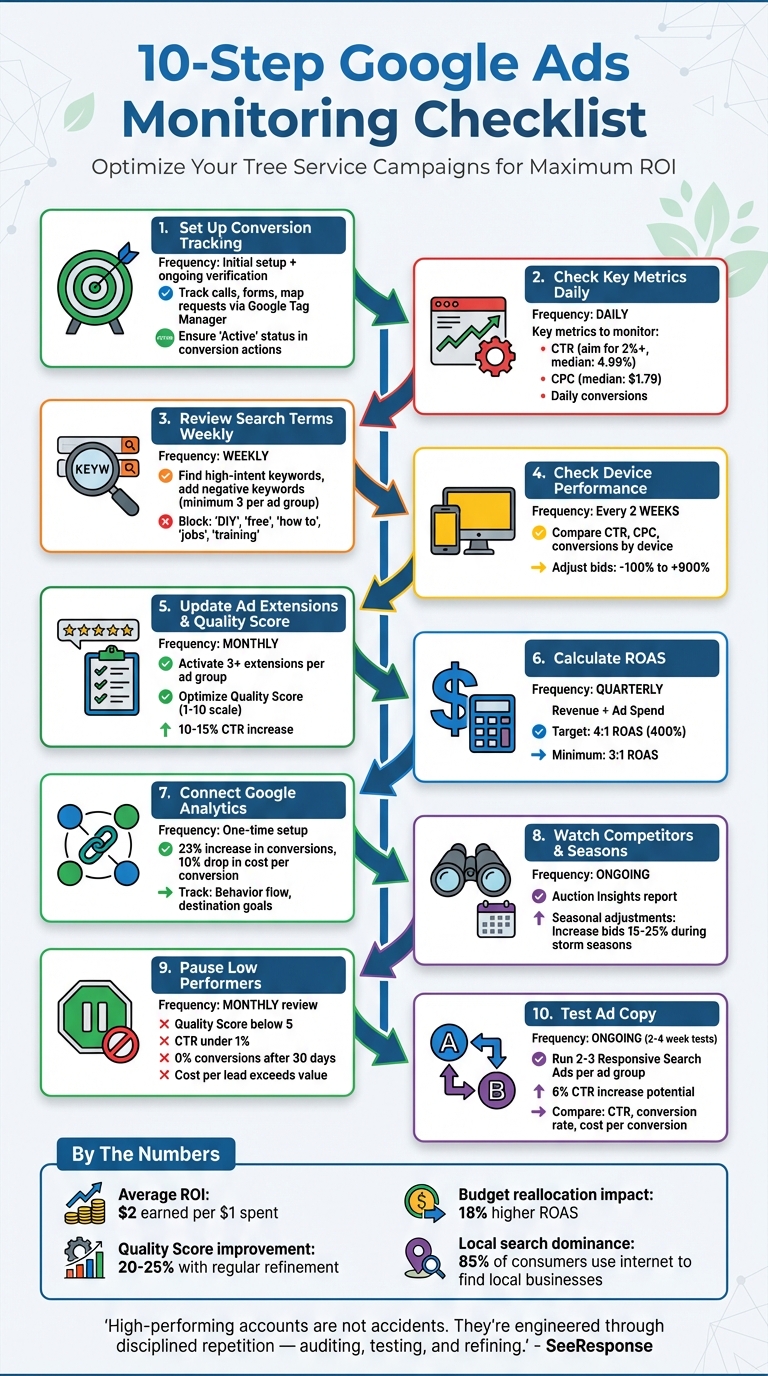
10-Step Google Ads Monitoring Checklist for Tree Service Businesses
How to Optimise Google Ads – My Simple $73M Checklist
Step 1: Set Up Conversion Tracking
Conversion tracking helps you figure out which ads are bringing in tree service jobs and which ones are just draining your budget. Without it, you’re left guessing whether a $500 spend brought in emergency tree removal calls or just a handful of inquiries.
Here’s how to verify and implement effective tracking setups.
Google Ads offers three ways to track call conversions: calls made directly from ads using forwarding numbers, calls to a phone number displayed on your website, and clicks on a phone number from mobile devices. By tracking all three, you get a clearer picture of how customers interact with your business.
"Conversion tracking is the only way to measure the effectiveness of a particular ad or advertisement campaign." – Tymofii Sankov, Author, Stape
Verify Conversion Actions
To check if your conversion tracking is working, go to the "Goals" menu in your Google Ads account and look at the "Status" column in the conversion actions table. If it says "Active", your conversions are being tracked. However, if you see "No recent conversions", it could mean that your tags aren’t firing correctly or your ads haven’t reached the right audience yet.
For phone call tracking, make sure call reporting is enabled in your account settings. Set a minimum call duration of 60 seconds to filter out short, irrelevant calls. To track form submissions, use a "URL contains" condition (e.g., "URL contains /thank-you") to log a conversion when someone lands on your confirmation page. This method is straightforward and doesn’t require extra coding.
You can use Google Tag Assistant to confirm that your tracking tags are installed and working properly. Keep in mind, conversion data might take up to 24 hours to show up in your reports.
Use Google Tag Manager
Google Tag Manager (GTM) is a one-stop solution for managing all your tracking tags. It simplifies updates, so you don’t have to rely on developers for every little change.
"The best thing about this is that marketers or analysts can control the process of Google Ads conversion tracking via Google Tag Manager and not bother the developers when they need to change or add something." – Tymofii Sankov, Author, Stape.io
Once your conversion actions are active, streamline their management with GTM. Deploy the Conversion Linker tag in GTM to fire on all pages. This tag ensures that marketing cookies are stored properly, so conversions are accurately tied to the right ad clicks. Without it, you risk losing critical attribution data. Use GTM’s Preview Mode to test your tags before making them live.
Step 2: Check Key Metrics Daily
Keeping a close eye on your metrics every day can help you catch problems early – before they drain your budget. For tree service businesses, daily monitoring can uncover trends like an increase in emergency calls after a storm or a sudden dip in keyword performance.
Three metrics deserve your attention: click-through rate (CTR), cost-per-click (CPC), and daily conversions. These numbers provide insight into whether your ads are reaching the right audience and converting clicks into actual jobs. By reviewing these metrics, you can fine-tune your strategy and make sure every dollar spent on ads works toward your goals.
Review Click-Through Rate (CTR)
CTR shows how often people click your ad after seeing it. For instance, if your "Emergency Tree Removal" ad gets 100 impressions and 1 click, the CTR is 1%. A higher CTR means your ad copy aligns well with what users are searching for, while a low CTR might signal the need for better targeting or messaging.
"A high CTR indicates that customers find your ads helpful." – Google Ads Support
Aim for a CTR of at least 2%; anything below 1% suggests your targeting may be off. With the median CTR across industries sitting at 4.99%, keeping a daily check on this metric is crucial. If you notice a drop, dive into your Search Terms Report to spot irrelevant queries like "tree identification." Adding these terms as negative keywords can help prevent wasted impressions.
CTR also affects your Quality Score, which influences both ad placement and cost-per-click. Improving your CTR can lead to better ad positions and lower CPCs, making it a key factor in your campaign’s success.
Analyze Cost-Per-Click (CPC)
CPC reflects how much you pay each time someone clicks on your ad. To calculate it, divide your total ad spend by the number of clicks (e.g., $100 ÷ 50 clicks = $2.00 per click). The median CPC across industries is around $1.79, but for tree service keywords, rates can vary depending on your local market.
If your CPC starts climbing, it might mean your ad relevance or bidding strategy needs adjustment. While CTR can show how well your ad grabs attention, CPC tells you whether those clicks are cost-effective. Even better, focus on metrics like cost per acquisition to understand the real value of those clicks.
To keep CPC in check, work on improving your Quality Score. This involves ensuring your ad copy matches search intent and optimizing your landing page for mobile users. Mobile performance is especially important for tree services since many leads come from high-value click-to-call actions. Segmenting your data by device can reveal performance differences and help you allocate your budget more effectively.
Track Daily Conversions
Conversions – whether they’re phone calls, form submissions, or mobile click-to-call actions – are the ultimate measure of your campaign’s effectiveness. Tracking these daily helps you understand how well your ads are turning clicks into leads.
Pay attention to both your conversion rate and cost per conversion. If you have a high CTR but few conversions, it could mean your landing page isn’t delivering on the promise of your ad. For example, an ad highlighting "stump grinding" should take users directly to a page dedicated to that service, not a generic homepage. Otherwise, potential customers might leave without taking action.
Use your Search Terms Report to weed out irrelevant queries by adding them as negative keywords. Also, analyze what times of day conversions are happening. If most calls come in between 8:00 AM and 5:00 PM, consider boosting your bids during those hours to capitalize on your team’s availability to respond quickly.
Step 3: Review Search Terms and Add Negative Keywords Weekly
Keywords determine when your ads appear, but the Search Terms Report shows the exact queries users enter. These two lists often don’t align perfectly, especially if you’re relying on broad match keywords. By reviewing this report weekly, you can maintain consistency between daily performance metrics and your broader monthly campaign goals.
To find the report, log into your Google Ads account, click on the Campaigns icon, then go to Audiences, keywords, and content. From there, select Search keywords and click on Search terms at the top of the page. This report is a goldmine for spotting queries that drive conversions.
"The search terms report tells you how closely the search terms that triggered your ads on Google are related to the actual keywords in your account… making your budget go further." – Google Business
By analyzing this report weekly, you can catch irrelevant queries that might drain your budget. This is especially important during high-activity periods, like after storms or during peak pruning seasons, when search behaviors shift rapidly.
Find High-Intent Keywords
High-intent keywords are those that show users are ready to take action, not just browsing. Look for concise phrases – typically two or three words – that indicate a strong intent to hire. Examples include "emergency tree removal" or "stump grinding service". Add these high-performing search terms to your keyword list and consider increasing bids to capture more of this valuable traffic.
Check the "Match type" column in your report to evaluate how closely the search terms align with your keywords. If broad match terms are generating too many irrelevant clicks, switch to phrase match (enclosed in quotation marks) or exact match (enclosed in square brackets). This adjustment can improve your budget efficiency by narrowing your audience to more relevant searches.
Add Negative Keywords
Negative keywords help you avoid paying for clicks from queries that won’t convert. For example, searches containing words like "DIY", "free", "how to", "jobs", "training", "pictures," or "classes" are often from users seeking information or employment, not professional services.
"By filtering out searches that aren’t relevant or specific enough, you ensure that you’re only paying for clicks that bring in business for you." – Google Ads Support
Google suggests including at least three negative keywords in every ad group to block irrelevant searches. For broader terms like "free" or "DIY," apply them at the campaign level. For more specific terms, like "planting" (if you don’t offer tree planting services), use them at the ad group level. This ensures that ads promoting removal or trimming services don’t appear in searches for unrelated services.
Use phrase match for negative keywords (e.g., "how to") to filter out specific ideas without restricting too much. If you notice recurring themes – like multiple searches involving "rental" – add that as a negative keyword to block all related queries. These weekly reviews allow you to identify and address patterns before they waste your ad spend.
With a well-refined keyword strategy in place, you’re set to move on to evaluating device performance in the next step.
Step 4: Check Device Performance and Adjust Bids Every 2 Weeks
Device performance can vary significantly – mobile users often behave differently from desktop users in terms of intent and conversion rates. Reviewing device performance every two weeks strikes a balance: it gives you enough data to spot meaningful trends without letting underperforming devices drain your ad budget.
This step builds on your daily metric reviews by helping you identify which platforms are driving the most valuable leads.
To analyze performance, click the "Segment" icon in your ad account and select "Device." This will show you data for computers, mobile devices, and tablets. Compare key metrics like click-through rate (CTR), conversion rate, and cost-per-conversion to see which devices are delivering the best results.
Compare Device Metrics
Focus on devices that combine high conversion rates with low costs per click (CPC). For instance, if mobile devices have a CTR of 0.45%, compared to 0.25% for desktops and 0.34% for tablets, you might consider increasing your mobile bid adjustment by +30% to capitalize on that stronger performance. This kind of analysis ensures your budget is directed toward traffic that not only clicks but also converts.
Adjust Device Bids
Fine-tune your bids to prioritize devices that deliver conversions. Bid adjustments can range from –100% (opting out entirely) to +900% (boosting bids up to 10x).
"Bid adjustments allow you to show your ads more or less frequently based on where, when, and how people search." – Google Ads Help
If a device shows high CPCs but rarely converts, lower the bid by 20–30% to reallocate your budget to better-performing segments. Make these changes gradually and monitor their impact over several days. If you’re using Smart Bidding strategies like Target CPA or Maximize Conversions, keep in mind that manual device bid adjustments aren’t supported, except for a -100% opt-out. In such cases, focus on analyzing device data to refine your overall campaign strategy rather than making direct bid changes.
Step 5: Update Ad Extensions and Quality Score Monthly
Once you’ve adjusted bids based on device performance, it’s time to shift your attention to monthly updates for ad extensions and Quality Score. These updates are crucial for maintaining long-term campaign success, especially as market trends and customer behaviors evolve.
Ad extensions, also called assets, are a powerful way to make your ads stand out and improve click-through rates (CTR). In fact, ads with extensions often see a 10-15% increase in CTR compared to those without. Meanwhile, a higher Quality Score can lower your cost-per-click, helping you get more value out of your advertising budget. Think of the Quality Score as a health check for your ads, keywords, and landing pages, showing you where improvements are needed to keep performance on track.
Review Ad Extensions
To maximize performance, make sure you’ve activated at least three ad assets for each ad group. Regularly update call extensions with your latest phone number, add service-specific sitelinks (like "Emergency Tree Removal"), and use location extensions to connect with local customers. These extensions not only increase relevance but also improve engagement.
Use the "Click type" segment in your account to analyze which extensions are driving the most interaction. For example, tree service businesses often find that call extensions are especially effective since customers frequently need urgent help with storm damage or hazardous trees.
Improve Quality Score
The Quality Score, rated on a scale from 1 to 10, measures three key factors: ad relevance, expected CTR, and landing page experience. If any of these elements are rated below average, take action immediately. For instance:
- Ensure your ad text aligns closely with search terms. If someone searches for "tree trimming near me", your ad should specifically mention "tree trimming", not just general "tree services".
- Break up larger ad groups into smaller, more focused groups based on specific services. This approach makes your ads more relevant to users.
- Optimize your landing pages to deliver on the promises made in your ads. Pages should load quickly, especially on mobile devices, since even a one-second delay can reduce conversion rates by up to 20%.
sbb-itb-130a704
Step 6: Calculate ROAS and Adjust Budgets Quarterly
After fine-tuning ad extensions and improving your Quality Score each month, it’s time to take a broader look at your campaigns every quarter. This quarterly review helps you account for seasonal trends and daily traffic fluctuations that might skew short-term results. The main focus here? Calculating your Return on Ad Spend (ROAS) to identify which campaigns are driving revenue and which ones are draining resources. This step ensures every advertising dollar is working toward generating profit.
Calculate Campaign ROAS
ROAS is a simple but powerful metric that shows how much revenue your ads generate for every dollar spent. The formula? Take your total revenue and divide it by your total ad spend. For example, if you spend $2,000 on ads and bring in $4,000 in revenue, your ROAS would be 2:1 (or 200%). To get an accurate calculation, assign conversion values based on your average service pricing.
For mature campaigns, a 4:1 ROAS (400%) is a solid benchmark, meaning you’re earning $4 for every $1 spent. Campaigns with a ROAS below 3:1 might need a closer look – whether it’s your targeting, ad copy, or keywords, something likely needs adjustment. Keep in mind, new campaigns might show lower ROAS initially. Be sure to factor in additional costs like vendor fees or transaction charges for a more precise evaluation.
"I can look and see I’m spending this dollar and I’m getting this in return for it. So again… you take that guesswork out of doing marketing!" – Ryan Warner, Owner, Local Tree Service Marketing
Reallocate Budgets
Once you’ve calculated ROAS, it’s time to put that data to work. Compare all your campaigns side by side to identify outliers. A campaign might generate impressive revenue, but if the costs are disproportionately high, it could still be inefficient. Focus on the revenue-to-spend ratio rather than just the total revenue.
For tree service companies, campaigns targeting high-intent keywords like "tree removal near me" often lead to booked jobs and deserve increased budgets. On the flip side, campaigns with ROAS below your acceptable threshold should either have their budgets reduced or be paused altogether. By reallocating your spending strategically, you can maximize returns and ensure your ad dollars are spent where they matter most.
Step 7: Connect Google Analytics for More Data

Google Ads gives you a clear picture of what happens before and during a click – like keywords, impressions, and conversions. But it doesn’t tell you what happens after someone lands on your site. That’s where Google Analytics comes in. By linking Google Ads with Google Analytics, you can track the entire customer journey and measure critical actions, such as quote requests or phone calls.
This connection isn’t just about data – it’s about results. Businesses that link these accounts see a 23% increase in conversions and a 10% drop in cost per conversion. To set it up, you’ll need Admin access in Google Ads and Editor or Administrator access in Google Analytics. During the setup, make sure to enable auto-tagging so campaign data flows seamlessly into Analytics. Keep in mind, it may take up to 48 hours for the data to appear in Analytics. Once connected, you’ll gain deeper insights into how users interact with your site.
Analyze Behavior Flow
The Behavior Flow report in Google Analytics is a powerful tool to see how visitors navigate your site after clicking on an ad. For tree service businesses, this insight can be game-changing. For example, if users clicking on an "Emergency Tree Removal" ad leave the pricing page almost immediately, it’s a sign you might need to make improvements. Consider speeding up load times, clarifying your calls-to-action, or ensuring the landing page matches the ad’s message.
Track Goals in Google Analytics
To track key actions, set up destination goals in Google Analytics. These goals let you monitor when users land on specific pages, like a "/thank-you" page after submitting a quote request or a "/contact-us" confirmation page. Destination goals go beyond Google Ads by capturing actions from all traffic sources – whether it’s organic, social, or paid.
Once your goals are set, import them into Google Ads by navigating to "Goals" > "Summary" > "Create conversion action". This dual tracking system ensures you don’t miss any valuable interactions, giving you the insights you need to fine-tune your campaigns and get the most out of your ad spend.
Step 8: Watch Competitor Ads and Seasonal Patterns
To truly optimize your ad campaigns, it’s not enough to just monitor your own performance. You also need to keep an eye on external factors like what your competitors are doing and how seasonal trends impact demand. This step expands your focus beyond internal metrics, helping you make smarter decisions by factoring in the broader market landscape.
Use Auction Insights
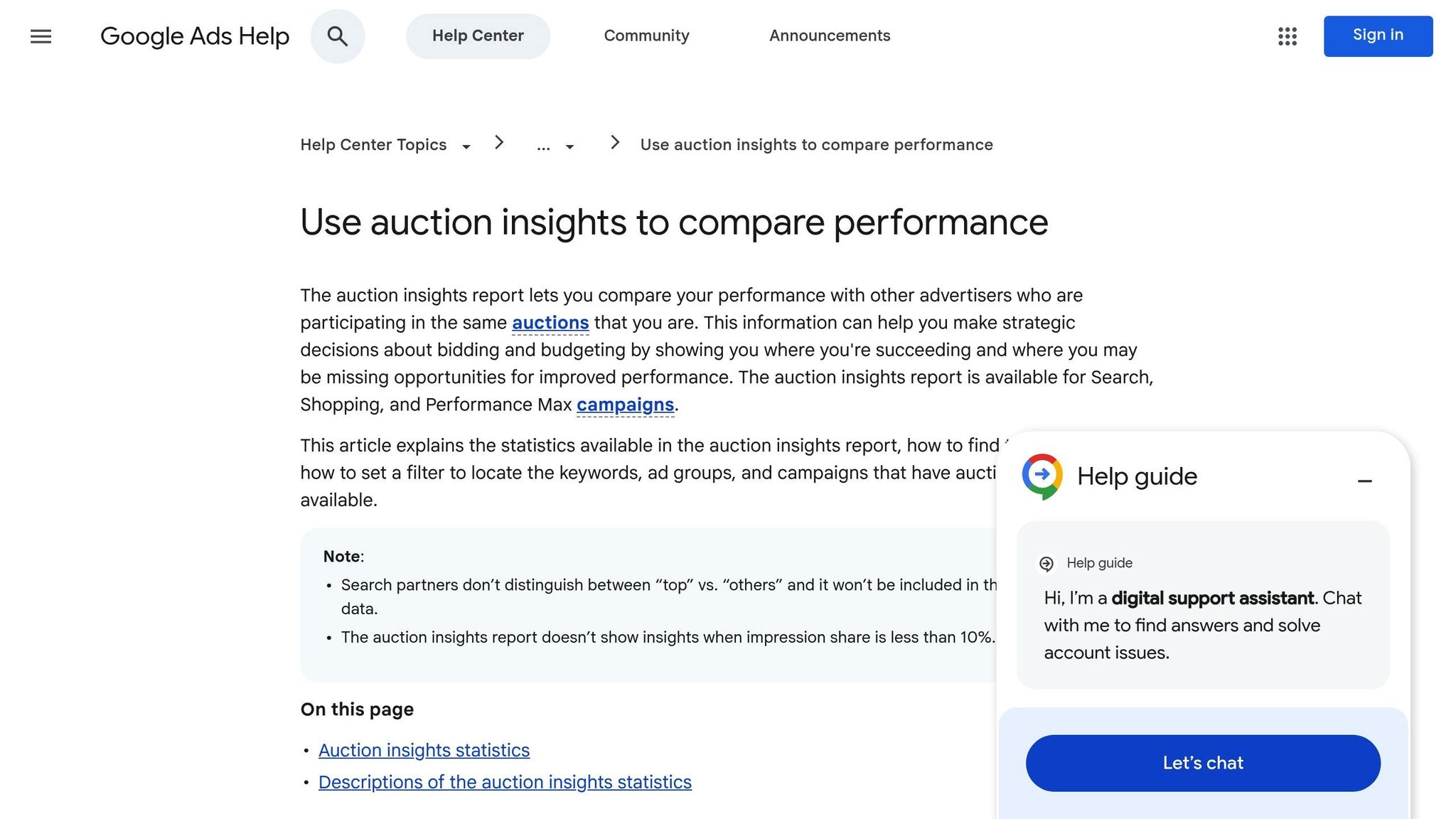
Google Ads’ Auction Insights report, found under "Insights and reports" in your dashboard for Search, Shopping, and Performance Max campaigns, is a goldmine for understanding how your ads stack up against competitors. It provides data on key metrics like:
- Impression Share: How often your competitors appear in the same auctions as you.
- Overlap Rate: How frequently their ads show alongside yours.
- Outranking Share: How often your ad ranks higher than theirs.
- Position Above Rate: How often their ad appears above yours when both are shown.
By applying filters to focus on high-intent keywords, you can pinpoint your most aggressive competitors. Break down the data by time – day of the week or month – to uncover trends. For instance, a competitor might consistently outbid you on weekends or during storm seasons. You can also analyze by device type to see if rivals dominate mobile searches, which is especially important for emergency calls.
Adapt to Seasonal Demand
While Auction Insights help you track competitor behavior, understanding and responding to seasonal trends ensures your campaigns stay effective year-round.
Demand for tree services tends to follow predictable patterns. Storm seasons often bring a surge in searches for terms like "emergency tree removal" and "storm tree cleanup". On the other hand, spring and summer lead to increased interest in trimming and shaping services as homeowners focus on maintaining their yards. By planning for these peaks and valleys, you can keep generating leads no matter the time of year.
"Seasonal strategy is important as well. Increase your bids 15-25% during storm seasons. When bad weather hits your area, emergency tree removal searches absolutely explode." – Joel Casarez, SEO Consultant
To prepare for short-term events like major storms (lasting 1–7 days), use Google Ads’ Seasonality Adjustments tool to help Smart Bidding adapt to expected changes in conversion rates. Adjust your ad scheduling to align with peak search times, which often occur around 7–9 AM, 12–1 PM, and 5–7 PM. During storm seasons, increase your daily budget and maximum CPC by 15% to 25% to capture high-value emergency searches. Additionally, review your search terms every 72 hours during these high-demand periods to uncover new high-intent keywords and refine your negative keyword list.
Step 9: Pause Low-Performing Keywords and Ads
Keeping your campaigns profitable means knowing when to pause keywords and ads that aren’t delivering results. Here’s how to identify and handle these underperformers.
Spotting Low-Performing Keywords
Start by filtering your keyword list to find the ones dragging down your campaign. Look for keywords with a Quality Score below 5 or a CTR (click-through rate) under 1% on the Search Network. A low Quality Score means Google sees your ad as irrelevant, which increases your cost-per-click. Meanwhile, a CTR under 1% signals that users aren’t engaging with your ad.
Pay close attention to keywords that rack up high impressions but generate few clicks – this is known as "impression waste." These keywords show your ad is visible but not connecting with potential customers. Similarly, keywords that get clicks but no conversions should be paused. For instance, if you’re paying $6.40 per click (the average CPC for consumer services) and a keyword hasn’t converted in 30 days, it’s time to consider pausing it.
"Pausing your keywords is easy. But it’s not always smart." – Karina Montenegro, Search Nurture
Before pausing any keyword, check your Search Terms report. Sometimes, the issue isn’t the keyword itself but the irrelevant searches it’s matching to. Adding negative keywords like "free", "jobs", or "rentals" can help cut budget waste without eliminating a potentially valuable keyword. If a keyword has a good CTR but no conversions, it might be worth auditing your landing page instead.
For newer campaigns, allow two to three weeks to collect enough data before making decisions. Keep in mind that demand for services like tree trimming can vary by season – a keyword that underperforms in January might thrive in spring when demand spikes.
Once you’ve handled underperforming keywords, shift your focus to your ad variations for similar issues.
Addressing Ineffective Ads
Ads need just as much scrutiny. Run at least three variations per ad group and pause any ad with a CTR below 1% or a high cost-per-lead.
Also, analyze performance by device. If mobile or tablet ads have a much higher cost-per-conversion compared to desktop, consider adjusting bids or pausing those ads altogether. Any budget freed up from pausing keywords or ads can be redirected to campaigns that are performing well.
One key tip: never delete keywords or ads – always pause them. This way, you preserve historical data and avoid repeating past mistakes.
For a quick reference, use the table below to guide your decisions:
| Metric | Metric Threshold | Action to Take |
|---|---|---|
| Quality Score | Below 5/10 | Improve ad relevance or pause keyword |
| CTR | Below 1% | Rewrite ad copy or refine targeting |
| Conversions | 0% after 30 days of spend | Pause keyword or audit landing page |
| Cost Per Lead | Exceeds the lead’s value | Lower bid or pause keyword |
Step 10: Test Different Ad Copy Versions
Just like monitoring and adjusting bids, testing different ad copy regularly is key to keeping your campaigns performing at their best. By experimenting with multiple ad variations, you can find out which messages truly connect with your audience and drive the most clicks and leads.
Responsive Search Ads (RSAs) make this process easier by automatically mixing and matching headlines and descriptions. This approach can increase CTR by around 6%. Running 2–3 RSAs per ad group gives the algorithm enough data to figure out which combinations work best.
Create Multiple Ad Variations
Try out messaging themes that cater to different customer needs. For instance, one ad might emphasize urgency with "Emergency Tree Removal – Available 24/7," while another focuses on cost with "Affordable Tree Trimming Services." You can also test ads that highlight benefits, like "Prevent Storm Damage," against ones that focus on features, such as "Certified Arborists on Staff".
Make sure to use all 15 headlines and 4 descriptions to maximize your testing efforts. Keep headlines under 30 characters to ensure they display well on mobile devices. You can also test different calls-to-action, like "Get a Free Estimate" versus "Call for 24/7 Service," depending on whether your audience is comparing options or needs immediate help.
"Understanding your competitor’s ‘offer’ and how they write their ads allows you to create a better offer and ad that will outperform the competition." – Brian Ferritto, Digital Marketing Strategist, 42connect, Inc.
Once you’ve developed your ad variations, evaluate their performance using A/B testing.
Analyze A/B Test Results
Run your tests for 2–4 weeks to collect enough data. Use benchmarks like a 4.99% CTR and a 4.61% conversion rate for comparison.
When reviewing results, focus on three key metrics:
- CTR (Click-Through Rate): This reveals which message grabs attention. A higher CTR means the ad’s messaging resonates well with your audience.
- Conversion Rate: This shows whether your ad attracts users who take the next step, like submitting a service inquiry.
- Cost Per Conversion: This helps identify which ad delivers leads at the lowest cost, regardless of the number of clicks.
Google Ads’ "Experiments" tool can help you compare your control ad against new variations. Look for a blue asterisk in the scorecard – it means the result is statistically significant and not just random. Once you’ve identified the best-performing ad, set your ad rotation to "Optimize" so Google prioritizes the winning version.
| Metric | What It Measures | Why It Matters |
|---|---|---|
| CTR | Percentage of users who click on the ad | Indicates whether an "Emergency" or "Affordable" message is more engaging |
| Conversion Rate | Percentage of clicks that result in a lead | Shows if the ad aligns with the landing page and drives inquiries |
| Cost Per Conversion | Average cost to acquire one lead | Helps identify the most cost-effective ad, regardless of click volume |
Conclusion
Running successful Google Ads campaigns isn’t a "set it and forget it" process – it demands consistent monitoring and fine-tuning. By sticking to this checklist, you can cut down on wasted ad spend, make every dollar count, and spot areas for improvement before they drain your budget.
Google Ads offer an impressive return, with businesses earning an average of $2 for every $1 spent. Regularly refining your keywords can improve your Quality Score by 20–25%, which lowers your cost-per-click (CPC) and boosts your ad rank. Plus, reallocating just 20% of your monthly budget based on performance data can result in an 18% higher return on ad spend.
"High-performing accounts are not accidents. They’re engineered through disciplined repetition – auditing, testing, and refining." – SeeResponse
This quote highlights the importance of staying disciplined with your campaign management. Develop a routine: check daily metrics, review search terms weekly, adjust device bids every two weeks, and conduct a full account audit each month. These habits can turn Google Ads from a risky expense into a dependable tool for bringing in quality leads. With about 85% of consumers relying on the internet to find local businesses, consistent monitoring ensures you’re reaching high-intent customers – whether they need emergency tree removal or regular tree care services.
FAQs
How can I boost my Google Ads Quality Score for better results?
To boost your Google Ads Quality Score, focus on three main components: expected click-through rate (CTR), ad relevance, and landing page experience.
Start by writing ad copy that aligns closely with your target keywords. Incorporate the primary keyword into your headline and description, and use a clear, persuasive call-to-action – something that resonates with homeowners searching for tree services. Adding ad extensions like sitelinks, callouts, and location extensions can also help increase your CTR by making your ad more engaging and informative.
Next, structure your campaigns with tightly themed ad groups. This approach ensures your ads stay highly relevant to the specific search terms they target. Don’t forget to regularly review and update your negative keywords to block irrelevant traffic, which could otherwise drag down your performance.
Lastly, pay attention to your landing page. It should load quickly, work seamlessly on mobile devices, and deliver exactly what your ad promises. Use straightforward headlines, easy navigation, and a simple contact form or phone number to create a smooth and hassle-free experience for visitors.
For tree service businesses, partnering with specialists like Tree Company Leads can make these steps much easier. They offer custom ad copy, targeted keyword strategies, and optimized landing pages to help you achieve better Quality Scores and attract more potential clients.
What are the best practices for tracking conversions in Google Ads campaigns?
To track conversions effectively in Google Ads, the first step is setting up a conversion tag (also called a global site tag). This tag helps you monitor key actions that matter to your business – like form submissions or phone calls. It’s crucial to ensure the tag is properly installed and functioning as intended.
For more detailed insights, connect your Google Ads account with Google Analytics. This integration provides access to richer data and allows you to tweak settings like conversion windows and attribution models to better align with your customer journey. It’s also a good idea to regularly check and fine-tune your tracking setup to maintain accuracy across website actions, phone calls, app engagements, and even offline conversions.
By keeping a close eye on your tracking and making adjustments as needed, you’ll be better equipped to make smarter decisions that boost campaign performance and drive a stronger return on investment (ROI).
How can I use negative keywords to make my Google Ads campaigns more cost-effective?
Negative keywords are a powerful tool to ensure your ads don’t show up for irrelevant searches. This not only saves money but also boosts your ROI. You can add these terms at either the campaign or ad group level, using phrase or exact match options.
Make it a habit to check the Search Terms report regularly. This helps you spot low-performing or unrelated queries so you can block them from triggering your ads.
By fine-tuning your keyword list, you can direct your budget toward high-quality traffic that’s more likely to turn into conversions.
Related Blog Posts

If you’re deciding between referral programs and paid ads to grow your tree service business, here’s the quick breakdown:
- Referral Programs: Leverage your happy customers to bring in new ones through rewards. They generate high-quality leads with a 75–85% closing rate, cost less (you only pay when deals close), and create long-term growth. However, they take time to scale and need consistent promotion.
- Paid Ads: Use platforms like Google or Facebook to target potential customers instantly. They offer fast results and scalability, but costs can be high ($10–$50 per click), and the leads often need more effort to convert.
Quick Comparison
| Metric | Referral Programs | Paid Ads |
|---|---|---|
| Cost Structure | Pay only for closed deals ($25–$75) | Pay-per-click ($10–$50 per click) |
| Lead Quality | High (75–85% closing rates) | Variable, often requires nurturing |
| Scalability | Limited by current customer base | Highly scalable with budget |
| Speed | Slower, builds over time | Immediate lead flow |
| Sustainability | Long-term growth loop | Stops when spending stops |
Key Takeaway: Referral programs are cost-effective and bring in loyal customers, while paid ads are better for quick visibility and scaling. The best approach? Combine both. Use paid ads to attract new customers and referral programs to turn them into long-term advocates.
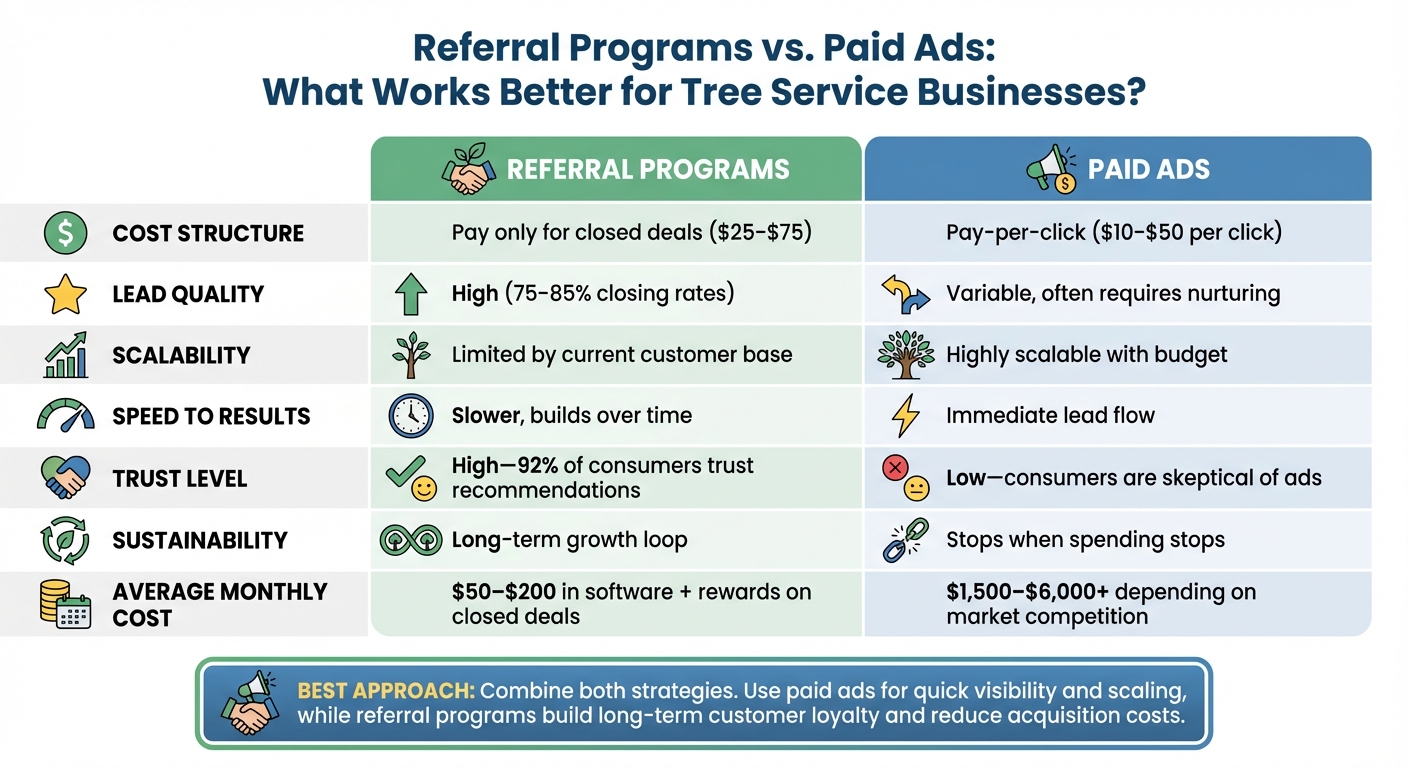
Referral Programs vs Paid Ads Comparison for Tree Service Businesses
Referral Programs: Pros and Cons
Benefits of Referral Programs
Referral programs can be a game-changer in tree service marketing. The trust factor is a standout benefit – 92% of consumers trust recommendations from people they know more than any other type of advertising. Think about it: when a happy customer tells their neighbor about your tree removal services, that personal endorsement carries a weight no ad campaign can replicate.
Here’s another impressive stat: referrals in the green industry close at rates between 75% and 85%. That’s a huge leap compared to most other lead sources. Chad Diller, CEO of Landscape Leadership, puts it plainly:
"Referrals close at a higher rate than most other marketing mediums and the customers that result also are more easy to retain."
Cost is another big plus. Traditional marketing efforts can cost tree service companies anywhere from $100 to $150 per new customer. Referral programs, on the other hand, only cost you when they convert.
Referred customers also tend to be more valuable. They bring in 16% to 25% higher lifetime value and boast a 37% higher retention rate compared to customers acquired through other channels. In home services, referred customers even spend 18% more on average, showing they’re more likely to invest in quality care from the start.
And here’s where verbal referrals shine: they convert into sales 32% of the time. Compare that to social media referrals, which only convert at 1%, and it’s clear that personal conversations still drive real business.
But, like any strategy, referral programs have their challenges.
Drawbacks of Referral Programs
While referral programs offer plenty of benefits, they’re not without their limitations. The biggest hurdle? Speed and scale. Unlike paid ads that can generate a flood of leads almost instantly, referral programs take time to gain momentum. Their reach depends heavily on the size and engagement of your current customer base.
Interestingly, fewer than half of green industry companies even have a formal referral program in place. Why? Many find the administrative work overwhelming. Relying on spreadsheets to track referrals can lead to missed payouts, which frustrates customers and damages trust. As Chad Diller warns:
"Nothing will suck the wind out of your brand evangelists’ sails more quickly, than crappy follow-up and lousy tracking."
Another challenge is maintaining a satisfied customer base. One bad experience – like a poorly handled tree removal – can stop your referral chain in its tracks. And these programs aren’t “set it and forget it.” They require constant effort. You need to actively promote them through invoices, emails, and conversations with happy customers. Without this, participation rates can remain disappointingly low.
The reward structure also plays a critical role. Diller urges tree service owners to carefully evaluate their incentives. Even what seems like a generous offer might not be enough to motivate customers. Whether it’s $50 cash, account credits, or tiered rewards for bigger projects, the key is to make the reward enticing enough for customers to take action.
Here’s a reality check: 61% of customers will make only one referral, while just 5% become “super-referrers” who make 11 or more. Finding and nurturing these high-value advocates requires a clear, deliberate strategy. Without it, you risk leaving untapped potential on the table.
Paid Ads: Pros and Cons
Benefits of Paid Ads
Paid advertising delivers immediate visibility, making it an attractive option for businesses looking to get results fast. SEO consultant Joel Casarez puts it succinctly:
"Google Ads is your shortcut to the top of search results (like, in hours, not months)."
This speed is crucial when homeowners search for urgent services like "emergency tree removal near me." With 62% of tree service searches happening on mobile devices, being visible at the right moment can make all the difference.
Another major advantage is precise targeting. Paid ads let businesses focus their budget on specific areas, such as certain zip codes or high-value neighborhoods. They can even target specific timeframes – for instance, running ads only from Tuesday through Saturday, 7 AM to 8 PM, when potential customers are most likely to act. This approach ensures ad spend is concentrated on high-intent leads. For example, ad bids for emergency tree removal typically range between $10 and $12 per click, while stump grinding costs hover around $6 to $9.
Local Services Ads (LSAs) add an extra layer of trust by displaying the "Google Guaranteed" badge, which gives homeowners confidence in the business. Unlike traditional Google Ads, LSAs charge on a pay-per-lead basis, meaning you only pay when someone calls or texts.
The numbers back up the effectiveness of paid ads: pay-per-click advertising delivers an average 200% return on investment for home service businesses. On top of that, 90% of consumers say paid ads influence their purchasing decisions. This makes paid advertising a powerful tool, especially during high-demand times like post-storm cleanups or the spring trimming season.
But while the benefits are clear, paid ads come with their own set of challenges.
Drawbacks of Paid Ads
The biggest downside to paid ads is cost. In competitive metropolitan markets, businesses may pay $50 or more per click, and there’s no guarantee those clicks will convert into paying customers. Monica Hemingway, founder of Tree Care Marketing Solutions, warns:
"Google Ads costs seem to be going through the roof in the tree service industry."
For smaller tree service businesses, monthly ad budgets typically range from $1,000 to $2,500 just to stay competitive. Larger companies often spend as much as $10,000. And here’s the catch: once you stop spending, the leads stop coming in. Aya Musallam of Viral Loops describes it as:
"The moment you turn off the tap, the leads dry up. It’s a relentless, expensive treadmill."
Another issue is the inconsistency in lead quality. Without careful targeting, businesses risk attracting irrelevant clicks. For example, failing to exclude keywords like "DIY", "jobs", or "free" can lead to wasted ad spend on users who have no intention of hiring a professional.
Running a successful paid ad campaign requires more than just money – it demands expertise. Businesses need to continuously refine keywords, optimize landing pages, and monitor performance. Unlike referral programs, where costs are tied to results, paid ads require ongoing investment and skilled management to see returns.
Lastly, paid ad leads often come with a trust gap. These are cold contacts, so converting them into paying customers requires extra effort and nurturing. With search volume for tree services dropping by as much as 60% in some areas, competition for high-quality leads has become tougher than ever.
Paid ads can be a powerful tool, but they’re not without their challenges. Balancing cost, quality, and expertise is key to making them work effectively.
Referrals Over Paid Ads: The Strategy That Actually Works (With Mike Garrison)
Referral Programs vs. Paid Ads: Direct Comparison
Choosing where to allocate your marketing budget often comes down to how referral programs and paid ads stack up against each other. Both approaches offer distinct benefits, but they differ in terms of cost, lead quality, speed, and scalability.
Cost structure is a key distinction. Paid ads follow a pay-per-click model, meaning you pay for every click, whether it converts or not. For tree service-related keywords, this cost can range from $10 to $40 per click, depending on your market, with an average lead cost of about $50. On the other hand, referral programs only incur costs when a deal is successfully closed, typically between $25 and $75. Aya Musallam from Viral Loops highlights this contrast:
"Paid ads start with a trust deficit. You must spend money to get a potential customer to consider your message. A referral begins with a trust surplus."
Lead quality is another area where these two methods differ significantly. Referral leads tend to be much stronger, with closing rates in the green industry ranging from 75% to 85%. These leads are often warmer and require less effort to convert. Additionally, referred customers tend to stick around longer and have a 16% higher lifetime value compared to other leads. Referred leads also convert 30% better and close 69% faster than leads from other sources. In contrast, paid ad leads are usually cold and need more nurturing to turn into paying customers.
Speed and scalability offer a trade-off between the two approaches. Paid ads provide instant visibility and a steady flow of leads as soon as your campaign launches. They’re especially useful for quickly entering new markets or filling gaps during slower periods. Scaling is as simple as increasing your budget. Referral programs, however, take time to gain traction since they rely on your existing customer base. But while they may start slower, referrals offer long-term sustainability. Unlike paid ads, which stop generating leads once you stop spending, referrals create a "viral loop", where each happy customer can bring in more business without additional advertising costs.
Here’s a quick summary of how these two methods compare:
Comparison Table
| Metric | Referral Programs | Paid Ads |
|---|---|---|
| Cost Structure | Pay-per-result (only when deals close) | Pay-per-click or impression (regardless of conversion) |
| Lead Quality | High – warm leads closing at 75–85% | Variable – cold leads requiring nurturing |
| Scalability | Limited by existing customer base size | Highly scalable with increased budget |
| Speed to Results | Slower build; grows naturally over time | Immediate visibility and lead flow |
| Trust Level | High – 92% of consumers trust recommendations | Low – consumers are often skeptical of ads |
| Sustainability | Self-sustaining growth loop | Stops immediately when spending stops |
| Average Monthly Cost | $50–$200 in software + rewards on closed deals | $1,500–$6,000+ depending on market competition |
Both strategies have their strengths, and the right choice depends on your specific goals, budget, and timeline.
sbb-itb-130a704
When to Use Referral Programs vs. Paid Ads
Paid ads are your go-to option when you need quick results, like during peak demand or when you’re expanding your reach. On the other hand, referral programs shine when you already have a happy, loyal customer base ready to advocate for your services.
Referral programs are particularly effective because they generate warm, prequalified leads through customer recommendations. As Chad Diller, CEO of Landscape Leadership, notes:
"Customer referrals close at a higher rate than most other marketing mediums and the customers that result also are more easy to retain."
If budget constraints are a concern, referrals are a smart choice. They’re performance-based, meaning you typically pay only after a successful conversion – usually between $25 and $50 per referral. Compare this to paid ads, which often require upfront investment for testing and can be less effective during slower seasons when search volumes drop by as much as 60%.
When it comes to lead quality, referrals take the lead. They boast closing rates of 75–85% and deliver customers with 16% higher lifetime profits. Paid ads, while useful for reaching a broader audience, tend to generate colder leads, which convert at a much lower rate of 1–5%.
The most successful tree service businesses know the power of combining both strategies. Use paid ads to quickly scale or dominate your market during busy seasons. At the same time, build a strong referral program to ensure a steady flow of low-cost, high-quality leads. Companies like Tree Company Leads can help you manage Google Ads campaigns while setting up the infrastructure for a balanced approach. By blending these methods strategically, you can enhance your overall marketing results.
Using Referral Programs and Paid Ads Together
Smart tree service businesses know they don’t have to pick between referral programs and paid ads – they can use both to their advantage. Paid ads bring in new customers quickly, while referral programs turn happy customers into a steady source of new leads, often at little to no cost. By combining these methods, you can create a seamless strategy that connects the customer acquisition phase with the referral stage, amplifying the strengths of both approaches.
Here’s the challenge: referral programs don’t work without an existing customer base, and relying solely on paid ads can get expensive over time. But when you use both together, every customer you gain through Google Ads becomes a potential referrer, which helps lower your blended customer acquisition cost. Even a modest referral rate – say, 2 new customers for every 10 you acquire – can significantly reduce your overall marketing spend.
To make this strategy work, it’s essential to transition new customers into your referral program right after they book a service. Add referral invitations to your "Thank You" page or include them in confirmation emails. Incentives like "Give $50, Get $50" are especially effective at motivating referrals. Aya Musallam captures the difference between these two methods perfectly:
"Paid advertising is like shouting at a crowd through a megaphone, hoping someone listens. Referral marketing is like having a trusted friend walk someone over to you and say, ‘You two should meet.’"
Tracking the combined results is key. Use unique referral codes to measure how your efforts impact the LTV:CAC ratio (aim for 3:1 or better). Tools like Tree Company Leads can help you run Google Ads campaigns with built-in tracking that links paid customers to the referrals they bring in, giving you a clear picture of your return on investment.
Don’t forget the power of timing: field crews should ask for referrals immediately after completing a job, when customer satisfaction is at its peak. While 83% of customers are willing to refer after a positive experience, only 29% actually do unless prompted or incentivized. This is why combining referral programs with paid ads – and implementing them systematically – can make such a big difference.
Conclusion
When deciding between referral programs and paid advertising, it all boils down to three key factors: cost structure, lead quality, and speed. Referral programs are a fantastic way to generate steady growth, offering warm leads that close 75–85% of the time and bringing in customers with a 16% higher lifetime value. On the other hand, paid advertising delivers quick lead volume, making it ideal for expanding into new markets or filling gaps during slower periods.
The most successful tree service companies don’t rely on just one approach – they mix both. Referrals provide consistent, low-cost growth, while paid ads help ramp up lead volume when needed. This combination strategy not only lowers your overall customer acquisition costs but also creates a ripple effect: every customer gained through Google Ads could turn into a referrer, amplifying your growth over time.
To put this into action, take a close look at your business. If you already have a strong customer base, consider launching a referral program with clear incentives (like $50 rewards). If your brand is still building recognition, prioritize paid advertising to quickly boost awareness. The key is to track both channels closely and adjust your spending for maximum efficiency.
FAQs
What’s the best way to combine referral programs and paid ads to grow my tree service business?
Referral programs are a great way to bring in high-quality leads because they’re built on trust. When someone is referred by a friend or neighbor, they’re more likely to not only sign up but also stick around. To make your program work, offer straightforward rewards – think discounts, gift cards, or service credits – and ensure it’s simple for customers to share referral links or codes.
Want to take it up a notch? Pair your referral program with paid advertising. For instance, you could use Google Ads to drive traffic to a referral page that highlights the rewards and benefits. On social media, target your existing customers and audiences with similar interests by showcasing real-world success stories and the incentives you’re offering. And don’t forget retargeting – serve reminder ads to people who started the referral process but didn’t finish. Dedicate part of your budget to these ads and the rest to funding rewards, creating a growth strategy that’s both scalable and fueled by trust.
How do I choose between referral programs and paid ads for my tree service business?
Deciding whether to focus on referral programs or paid ads depends on what you’re aiming to achieve, how much you’re willing to spend, and how quickly you need results. Referral programs are a budget-friendly way to grow your business while building trust. Since these customers often come through personal recommendations, they’re more likely to convert and stick around. However, building a strong referral network takes time and patience.
Paid ads, on the other hand, are all about speed. They can deliver results fast and allow you to target specific audiences based on factors like location and interests. While they can bring in a high volume of leads quickly, the costs can climb, and converting those leads into loyal customers often requires extra effort.
If your goal is rapid growth or you’re running a seasonal promotion, paid ads might be the way to go. But if you’re aiming for steady, long-term growth with high-quality leads, referral programs are worth considering. Many tree service businesses find success by combining both strategies, striking a balance between quick wins and trust-driven growth.
Why do referral programs often generate higher-quality leads than paid ads?
Referral programs often generate better-quality leads because they’re built on personal recommendations from happy customers. When someone recommends your tree service business to a friend or family member, it carries a layer of trust and credibility that paid advertising simply can’t match.
These referrals tend to convert into loyal customers more easily since they already have a favorable view of your business. Plus, referral customers often look for higher-value services and are more likely to stick around, making them a dependable way to grow your business over time.
Related Blog Posts

In 2025, social media is reshaping how tree service businesses connect with customers. Key trends include short-form videos, AI tools, carousel posts, local Facebook ads, and customer-generated content. Here’s why these matter:
- Short-Form Videos: Platforms like TikTok and Instagram Reels are perfect for showcasing tree services visually. Videos of tree removals or property transformations grab attention and build trust.
- AI Tools: Tools like ChatGPT and Hootsuite simplify content creation and scheduling, saving time for busy professionals.
- Carousel Posts: Before-and-after photo carousels highlight your work effectively and drive higher engagement.
- Local Facebook Ads: Target homeowners in your area with tailored ads for better visibility and conversions.
- Customer Content: Sharing reviews and client photos boosts credibility and attracts new leads. This is a proven way to generate tree service leads organically.
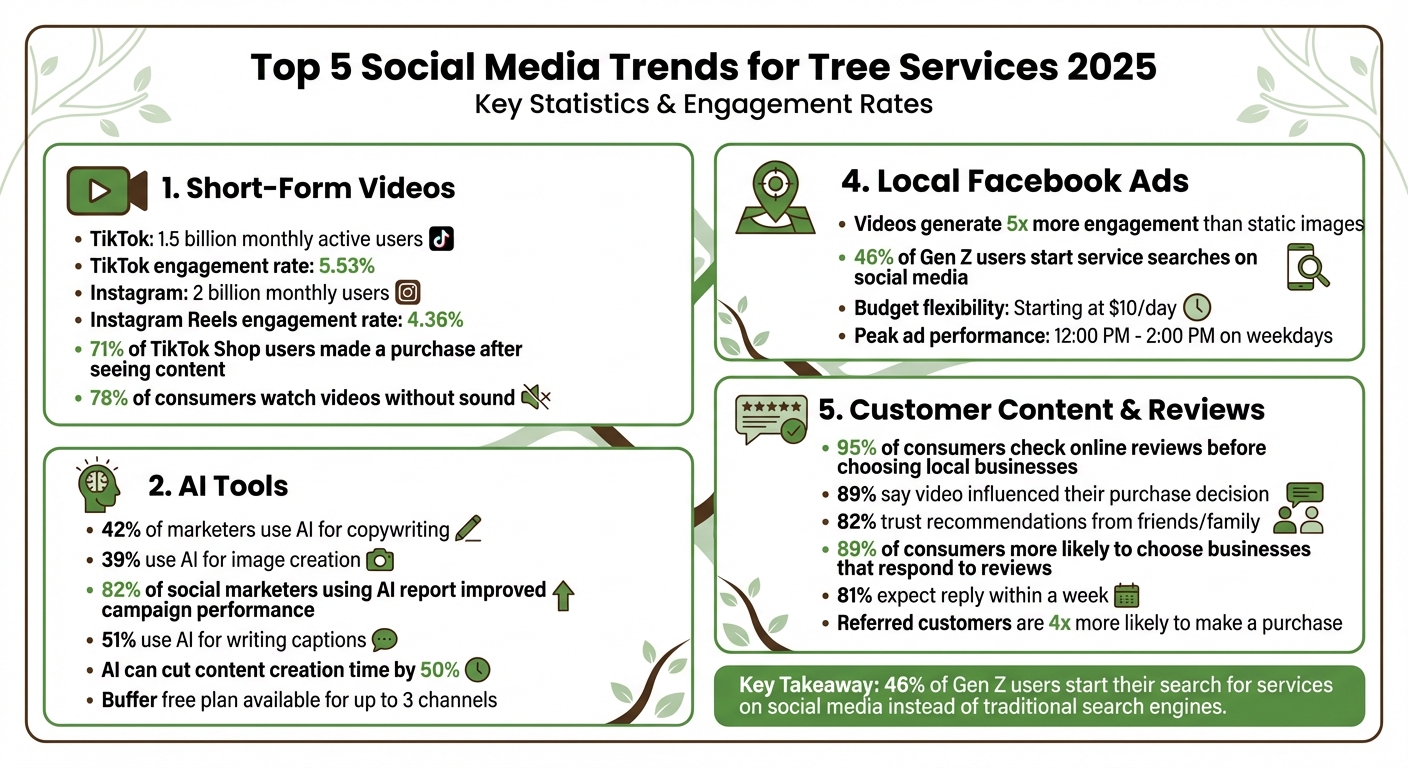
Top 5 Social Media Trends for Tree Services 2025: Key Statistics and Engagement Rates
1. Short-Form Videos on TikTok and Instagram Reels
Why They Work for Tree Service Businesses
Tree work is inherently visual, making it an ideal fit for short-form video content. Imagine a 30-second clip showing your crew carefully lowering a massive oak branch or a time-lapse capturing a property’s dramatic transformation. These videos tell compelling stories that Local SEO and paid ads simply can’t match. With TikTok reaching over 1.5 billion monthly active users and an impressive 3.85% engagement rate per view, along with Instagram’s 2 billion monthly users, these platforms offer a huge opportunity to connect with local audiences.
When homeowners watch your team skillfully handle storm-damaged trees or demonstrate proper pruning techniques, they’re not just seeing a service – they’re witnessing your expertise. This kind of visibility builds trust and encourages potential customers to engage with your business.
How Short-Form Videos Drive Engagement
Short-form videos dominate engagement metrics across social platforms. TikTok leads with a 5.53% engagement rate, while Instagram Reels follow at 4.36%, far outpacing traditional social media posts. Why? Authenticity. As Kara Redman, CEO of Backroom, puts it:
"As AI content goes up, our desire for content that feels human will become more in demand. Relatability will be key, so less polish and more real-world".
For tree service businesses, this means embracing raw, real content. Show behind-the-scenes moments of your crew at work, share educational snippets about spotting tree diseases, or capture drone footage of complex tree removals. These types of videos resonate with viewers. In fact, 71% of TikTok Shop users have made a purchase after seeing something in their feed, proving these platforms can directly drive business results.
Simple and Affordable for Small Businesses
You don’t need fancy equipment to get started – a smartphone is all it takes. Equip your crew with phones or GoPros to capture point-of-view shots during climbs or rigging jobs. Authentic, unpolished footage often performs better because it feels more relatable and trustworthy than overly polished ads.
Editing doesn’t have to be complicated either. Tools like Canva make it easy to create and schedule videos with captions, catering to the 78% of consumers who watch videos without sound. As Jim Lin, Director of Enterprise Social Media at Caterpillar, explains:
"AI allows the average person to simply imagine content and publish. Without the need for equipment, editing skills or people, content will only require a great concept or idea to become a reality".
Start small – create one video per week showcasing your team’s skills. Add bold captions for silent viewers, and use local hashtags to boost visibility in neighborhood searches. This simple approach makes short-form videos a practical and powerful tool for connecting with your community and growing your business in 2025.
2. AI Tools for Content Creation and Scheduling
Relevance to Tree Service Businesses
Running a tree service often means spending your day out in the field, not sitting at a desk brainstorming social media posts. That’s where AI and other lead generation tools for tree companies step in to save time. Platforms like ChatGPT, Jasper, and OwlyWriter can handle tasks like generating captions, drafting posts, and creating multiple message variations. These tools are already widely used – 42% of marketers rely on them for copywriting, and 39% use them for image creation. Beyond content generation, they can also help you find trending local hashtags and come up with fresh campaign ideas.
As Hootsuite Labs puts it:
"AI isn’t something to be wary of; it’s a critical tool to master if you want to stay competitive".
These tools don’t just stop at making content – they also help you schedule posts at the best times for engagement, so your audience sees them when they’re most active.
Potential for Audience Engagement
Scheduling tools like Buffer, Later, and Hootsuite take things a step further by analyzing audience behavior. They can increase engagement rates by up to 60%. For tree service businesses, this means your emergency storm tips, seasonal reminders, or other time-sensitive updates can reach homeowners exactly when they need them most.
AI can also boost how responsive your business feels. Chatbots integrated into platforms like Facebook or Instagram can instantly answer common questions about pricing, service hours, or availability – even at 2 a.m. when someone’s dealing with a fallen tree after a storm. This kind of 24/7 availability adds a layer of professionalism and accessibility to your business. It’s no surprise that 82% of social marketers using AI report improved campaign performance.
Ease of Implementation for Small to Medium-Sized Businesses
One of the great things about AI tools is how simple they are to use, even for small businesses without big budgets or technical expertise. For example, Buffer offers a free plan for up to three social channels, and Canva Pro, which includes AI-powered graphic design features, costs just $12.99 a month. These tools are built with busy entrepreneurs in mind, making it possible to create a full month’s worth of Instagram posts in just minutes.
The time savings are impressive. Marketers using AI report cutting content creation time by as much as 50%, and 51% specifically use AI for writing captions. For tree service professionals juggling fieldwork and business management, that kind of efficiency is a game-changer. Start small – use AI to draft captions for daily photos of your job sites. As you get the hang of it, you can add automated scheduling and even chatbot features to streamline your social media game even further.
3. Carousel Posts for Before-and-After Photos
Relevance to Tree Service Businesses
Carousel posts are a perfect match for tree service businesses because they allow you to showcase the full scope of a job in a way a single image just can’t. For example, you can use multiple slides to display the overgrown tree, the removal process, and the clean, polished result. This format is especially useful for jobs like hazardous tree removals, extensive pruning, or land clearing – projects where a single snapshot wouldn’t do justice to the work involved.
Another advantage? Instagram’s algorithm often gives these posts a "second chance." If someone skips the first slide, the platform may show them a later slide, giving your content more opportunities to grab attention. This step-by-step storytelling approach naturally encourages higher engagement.
Potential for Audience Engagement
Carousel posts don’t just look great – they also drive results. On average, they achieve an engagement rate of 1.92%, outperforming single images (1.74%) and videos (1.45%). Use all 10 slides, and you might even push beyond 2%. Plus, carousels can generate up to 3.1x more engagement than single-image posts. Every swipe signals value to Instagram’s algorithm, boosting your chances of being seen.
Educational content is particularly effective. Posts that break down processes or transformations step-by-step are 114% more likely to be saved than static images. For tree services, consider creating carousels like "How to Identify a Diseased Tree" or "The Steps of Stump Grinding." Even a simple "swipe left" prompt can bump engagement rates from 1.83% to 2%.
Ease of Implementation for Small to Medium-Sized Businesses
For small and medium-sized tree service businesses, carousel posts are a straightforward yet powerful way to tell a story and highlight your expertise. You don’t need fancy video equipment – just a series of photos, which you’re likely already taking during jobs. Start with your most eye-catching "after" photo to grab attention, then use the middle slides to show the "before" and work-in-progress shots. Wrap it all up with a call-to-action like "Click the link in our bio for a free quote".
To make the process even easier, try tools like PostNitro or OwlyWriter for AI-generated captions and layout ideas. Want to keep viewers swiping? Design your slides so a small portion of the next image is visible – this "peek preview" sparks curiosity. Despite their effectiveness, carousels only account for about 19% of Instagram content, giving you plenty of room to stand out.
4. Local Targeting with Facebook Ads
Relevance to Tree Service Businesses
Facebook Ads can give tree service companies a much-needed visibility boost, especially when competing for top spots in search results with Google Ads for tree services. By using precise geographical filters, you can ensure your ads reach local homeowners – your core audience – without wasting your budget on people outside your service area.
But it doesn’t stop at location. You can also target specific demographics, like homeowners aged 30–65, while avoiding renters who are less likely to need your services. Tailor your message to hit home with local concerns, such as removing hazardous trees before storm season or addressing pest infestations common in your area. Even small touches, like including local landmarks or neighborhood names in your ad copy, can make your ads feel more relevant and relatable, boosting engagement. And when paired with strategies like video ads, this targeted approach can deliver measurable results.
"The narrower your targeting and the more relevant your ad is to that defined audience, the higher your conversion rates will typically be".
Potential for Audience Engagement
When it comes to engagement, video content is king on Facebook. In fact, videos generate 5 times more engagement than static images. A quick 15-second clip showcasing your team expertly removing a dangerous tree or grinding a stump can grab attention as users scroll through their feeds. Pairing these videos with before-and-after photos can also help build trust and credibility fast.
Facebook’s Lead Generation Ads simplify the process for homeowners to reach you. Instead of navigating to your website, potential customers can submit their contact details directly within Facebook to request a free estimate. This seamless experience often results in higher conversion rates. And with over half of businesses planning to increase their investment in social media ads by 2025, there’s a growing focus on delivering real results – like leads and revenue – over superficial metrics like "likes". These tools and strategies make Facebook Ads a powerful option for small businesses looking to connect with their local community.
Ease of Implementation for Small to Medium-Sized Businesses
Facebook Ads are accessible for businesses of all sizes, offering flexible budgets that range from as little as $10 a day to more substantial monthly campaigns. If you’re new to ads, a great starting point is "boosting" a well-performing organic post, such as one featuring a recent tree removal job. It’s an easy way to expand your reach without diving into complex ad setups.
For those ready to take it further, Facebook Ads Manager unlocks advanced tools like retargeting people who’ve interacted with your page or ads in the past. Meta’s AI also works in your favor, automatically optimizing ad delivery to reach homeowners most likely to need tree services. Features like automated Messenger responses can keep potential customers engaged 24/7. To maximize impact, schedule your ads during peak browsing times – like lunchtime on weekdays between 12:00 PM and 2:00 PM. And don’t forget about A/B testing, which can help fine-tune your ads for even better results.
sbb-itb-130a704
5. Customer Content and Review Sharing
Relevance to Tree Service Businesses
In today’s digital world, where platforms like TikTok and Instagram thrive on visual content, customer reviews and photos can significantly boost your online presence. For tree service businesses, this is especially vital. Think about it – 95% of consumers check online reviews before choosing a local business, while only 4% skip this step when searching for services. For jobs involving potential hazards, like tree removal or trimming, this kind of social proof is invaluable. A simple screenshot of a glowing five-star review can often outperform Google Ads for tree companies because people trust real experiences.
"Reviews are always very important to have. That is usually one of the first things clients are looking for is a good reputation online".
Sharing customer photos of completed projects – like a perfectly trimmed oak or a safely removed hazardous tree – provides visual proof of your skills. This kind of user-generated content connects with people far better than traditional advertising.
Potential for Audience Engagement
Customer-generated content doesn’t just build trust – it drives engagement. Did you know that 89% of people say watching a video influenced their decision to buy a product or service? Now imagine the impact if that video features a real customer sharing their experience. Encouraging clients to tag your business or post before-and-after photos can lead to organic reach that goes beyond your immediate followers. This kind of organic exposure pairs perfectly with your overall social media strategy.
To sweeten the deal, offer incentives like a $50 discount on future services or $50 cash for every referral that turns into a booking. Research shows that 82% of people trust recommendations from friends or family, and referred customers are four times more likely to make a purchase. Train your crews to ask for reviews in person right after completing a job – this personal touch can work wonders. You can also use automated tools to send text or email review requests immediately after an invoice is paid. Include a direct link to your Google Business Profile or Facebook page to make the process seamless.
Ease of Implementation for Small to Medium-Sized Businesses
You don’t need a big budget or fancy equipment to get started with customer-generated content. A smartphone and a simple process are all it takes. Automate review requests through your CRM, and make sure your business information – like your name, address, and phone number (NAP) – is consistent across platforms like Google, Yelp, and Facebook to boost your local SEO. You can also create a unique hashtag, such as #MyBrandStory, to encourage customers to tag your business in their posts. This not only strengthens your local SEO but also builds trust with your audience.
Engaging with reviews is equally important. A whopping 89% of consumers are more likely to choose businesses that respond to reviews, and 81% expect a reply within a week. Make it a habit to respond to every review – whether it’s positive or negative. This shows customers that you value their feedback and helps turn happy clients into loyal advocates who naturally share their experiences with others.
Tree Services: From Zero to $130,900 in 120 Days Using THIS Facebook Ads Strategy
Using These Trends with Lead Generation Services
Many tree service owners struggle to turn social media buzz into actual customers due to limited time or expertise. That’s where Tree Company Leads steps in, turning engaging content into paying leads using tools like Google Ads, local SEO, and exclusive lead-generation strategies.
When you’re actively posting short-form videos on platforms like TikTok or Instagram Reels, you’re not just building engagement – you’re opening doors to new customers. Through a practice called Social SEO, these videos can even show up in Google search results, giving your content a broader reach. For example, showcasing drone footage of tricky tree removals can grab attention on social media and also attract homeowners actively searching for tree services online. Managed through platforms like Meta Ads Manager and TikTok Ads Manager, these video campaigns are designed to make a lasting impression.
The magic happens when social media efforts are combined with local SEO. Imagine a homeowner sees your Facebook ad featuring a dramatic before-and-after transformation. Statistics suggest that 72% of people will immediately head to Google to learn more about your business. That’s where an optimized Google Business Profile becomes critical. By ensuring your Name, Address, and Phone (NAP) information is consistent across platforms like Google, Yelp, and Bing, you can increase website clicks by 23%. Adding quality photos, fresh reviews, and even automating review requests after job completion builds the trust that 95% of consumers rely on before hiring a service. This seamless connection between engaging content and local SEO creates a strong foundation for hyper-local ad targeting.
To take it a step further, pairing local SEO with hyper-local Google Ads ensures your marketing dollars are spent wisely. By focusing on specific ZIP codes, you can capture high-intent searches like "tree service near me" and turn them into service calls. Professional ad management bridges the gap between social media brand awareness and direct inquiries. This multichannel strategy – where social media, paid ads, and local SEO work together – turns views into leads and clicks into signed contracts.
Conclusion
The five social media trends – short-form video, AI-powered tools, carousel posts, local Facebook ads, and customer-generated content – are game-changers for tree service businesses in 2025. With 46% of Gen Z users starting their search for services on social media instead of traditional search engines, treating these platforms as optional is no longer an option.
By weaving these trends into a well-rounded marketing strategy, tree service companies can turn online engagement into real-world action. The key lies in blending organic content with a solid marketing framework. Personal connections build trust, while professional tools – like local SEO, Google Ads management, and CRM integration – convert that trust into measurable growth. Considering that 89% of consumers say watching a video influenced their decision to purchase a service, having systems in place to capture and convert this interest is essential.
Tree Company Leads bridges the gap between your social media presence and effective lead generation. While you focus on showcasing before-and-after transformations or behind-the-scenes crew moments, expert marketing services ensure your Google Business Profile is polished, your contact details are consistent, and your paid ads target the right neighborhoods. This approach transforms social media from a vanity project into a results-driven channel – where every like, comment, and share can lead to a signed contract.
Tree service companies that combine authentic storytelling with data-backed marketing strategies are the ones turning clicks into appointments. This balance of relatable content and performance-driven tactics lays the foundation for long-term growth. Start applying these trends now, and consider teaming up with experts who can turn your social media engagement into tangible business success.
FAQs
How can tree service businesses use short videos to attract more customers?
Short videos are proving to be a powerful tool for tree service businesses to grab attention on platforms like TikTok, Instagram Reels, and YouTube Shorts. With algorithms prioritizing snappy, engaging content, a 15- to 30-second video showcasing your expertise can outshine static images or lengthy posts.
Here are a few ideas to make your videos stand out:
- Before-and-after transformations: Show a dramatic shift from an overgrown tree to a perfectly trimmed masterpiece. These quick cuts not only highlight your skills but also create visually satisfying content.
- Behind-the-scenes glimpses: Capture moments like safety checks, equipment prep, or a day in the life of your team. These clips help build trust and make your brand relatable.
- Quick tips for viewers: Share bite-sized advice, such as "3 signs your tree needs pruning." This positions your business as knowledgeable while encouraging viewers to share your content.
To maximize visibility, include captions, use trending audio, and add local hashtags like #DallasTreeCare. For an even smoother process, teaming up with experts such as Tree Company Leads can help you craft custom videos, optimize them for social media, and turn those views into quality leads for your business.
How can AI tools improve social media content creation for tree service businesses?
AI-powered tools can be a game-changer for tree service businesses, streamlining tasks like generating captions, picking the right images, and even creating videos. By automating these processes, teams can devote more energy to fieldwork while still keeping their social media accounts active and engaging. Plus, AI can analyze past performance and audience behavior to recommend optimal posting times, effective hashtags, and tailored messaging – making it easier to connect with local homeowners.
Beyond saving time, AI helps maintain a consistent brand voice across all platforms. It can also repurpose content effortlessly. For example, a single before-and-after photo can be transformed into multiple formats, such as carousels, Reels, or stories, increasing visibility and engagement. This approach not only strengthens online presence but also generates more leads for services like tree pruning, removal, and storm damage response.
On top of that, AI offers real-time, data-driven insights to fine-tune marketing strategies. By spotting trending topics and understanding audience preferences, tree service businesses can create content that truly resonates. It also helps allocate ad budgets more effectively, leading to a better return on investment – both in terms of revenue and securing new contracts.
Why is customer-generated content important for building trust in tree service businesses?
Customer-generated content – like reviews, photos, videos, and testimonials – plays a crucial role in building trust for tree service businesses. Why? Because most people check online reviews before hiring local services. Honest feedback from real clients can ease doubts and reassure potential customers. Sharing before-and-after photos or client-submitted videos is a great way to showcase your skills, dependability, and focus on safety – key factors in an industry where errors can be expensive.
This kind of content also taps into the increasing demand for authenticity on social media. Real stories and experiences from customers tend to connect with audiences better than traditional ads. By highlighting genuine interactions and results, tree service companies can boost engagement, attract referrals, and stand out in a crowded market. Experts like Tree Company Leads can help weave these trust-building elements into your website and social media profiles, making it easier for potential clients to see your value and confidently choose your services.
Related Blog Posts

Engaging your community is key to success in tree service marketing. Why? It builds trust, creates loyal customers, and helps your business stand out. Here’s how:
- Workshops and Events: Host tree care workshops or partner with schools to educate and connect with locals.
- Proven ROI: Every $1 spent on tree care can return $2–$5 through increased property values and energy savings. Cities like Indianapolis and NYC see even higher returns.
- Stronger Relationships: Collaborate with homeowners, HOAs, city officials, and nonprofits to secure contracts, reduce conflicts, and gain referrals.
- Tailored Outreach: Focus on local needs – offer free tree care in underserved areas or partner with businesses for landscaping projects.
- Digital Tools: Use social media and online workshops to expand your reach and share expertise.
Start small: Identify key groups, plan targeted efforts, and track results. Building strong community ties today ensures long-term growth for your business tomorrow.
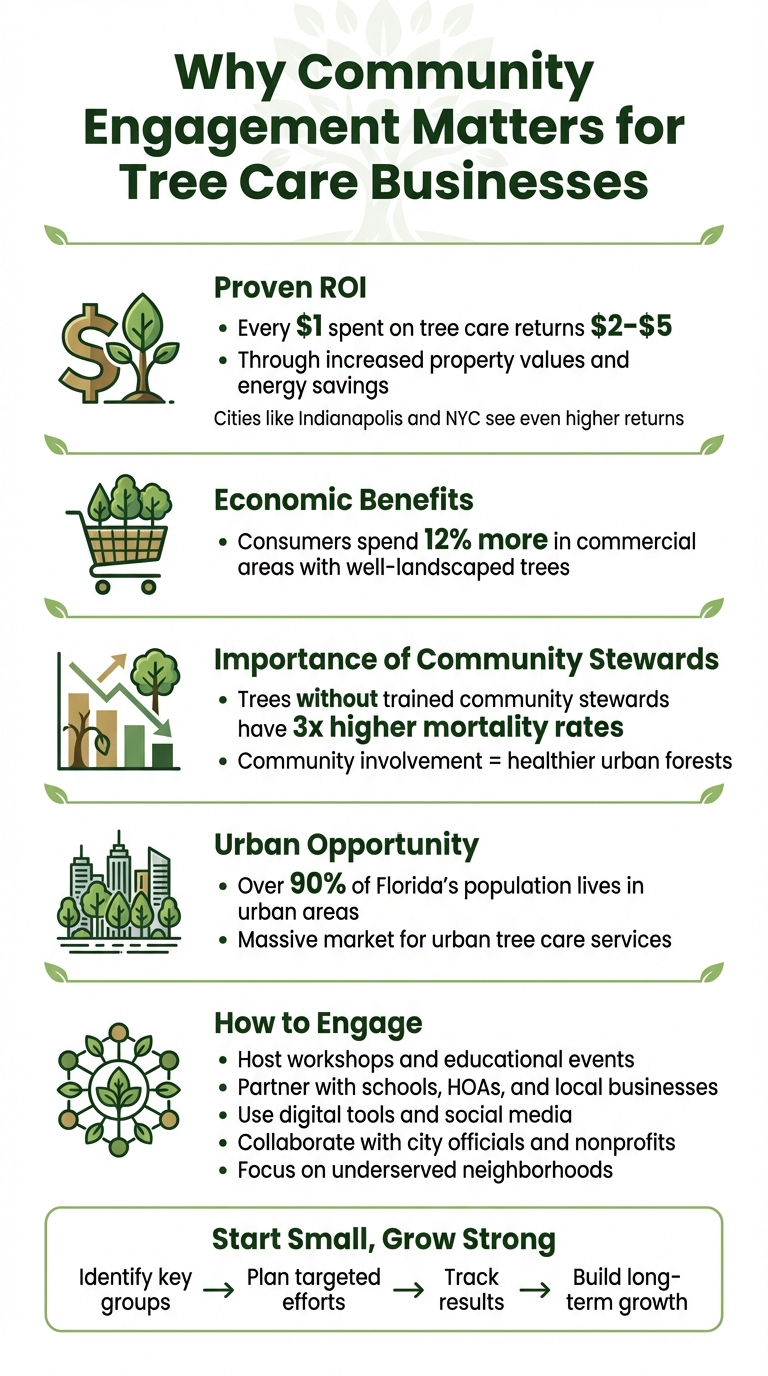
ROI and Benefits of Community Engagement in Tree Care
What Community Engagement Means for Tree Care Businesses
Defining Community Engagement in Tree Care
Community engagement goes far beyond handing out flyers or posting sporadically on social media. The Centers for Disease Control and Prevention (CDC) defines it as "the process of working collaboratively with and through groups of people affiliated by geographic proximity, special interest, or similar situations to address issues affecting the well-being of those people".
For tree care businesses, this boils down to creating meaningful conversations – both to understand the community’s needs and to share your expertise in tree care. Walt Whitmer from Penn State Extension captures this well:
Effective community engagement is more than simply talking to, or informing our citizens or constituents about the things we want them to know about.
The benefits are clear. When your company is viewed as a trusted community partner, you’re likely to see more referrals, less pushback on tree removal projects, and stronger support for urban tree initiatives. For instance, research shows that consumers spend 12% more in commercial areas with well-landscaped trees. This underscores how tree care businesses can position themselves as essential contributors to their communities.
The next step? Identifying the key groups in your community that can help drive these efforts.
Who You’ll Work With in Your Community
Once you understand the essence of community engagement, it’s time to focus on the right collaborators. Different groups offer unique opportunities for partnership.
Homeowners and renters are often your primary audience – they’re the ones reaching out for help after a storm in Mobile or seeking advice on pruning. Homeowners Associations (HOAs) and neighborhood groups present opportunities for bulk contracts and word-of-mouth referrals.
City governments, including elected officials and municipal staff, play a crucial role. They manage public tree contracts and set local regulations. Building strong relationships here can open doors to larger projects and keep you informed about upcoming policy changes. Local businesses also benefit from well-maintained landscapes that draw in more customers, making them another valuable partner. Schools, on the other hand, offer opportunities for educational workshops that connect your expertise with families and younger generations.
Nonprofit organizations, like garden clubs, environmental groups, and conservancies, are natural allies for tree planting events and stewardship programs. A great example comes from Tampa, where the city collaborated with UF/IFAS Extension in 2013 to conduct focus groups that identified barriers to tree care. This led to the creation of a neighborhood tree steward initiative and an expanded tree species program, empowering residents with knowledge about tree selection and maintenance.
Core Principles for Successful Engagement
After identifying your key collaborators, it’s essential to follow some guiding principles for building meaningful relationships. Transparency is the foundation of trust. Clearly explaining your tree care recommendations – and being honest when you don’t have all the answers – can go a long way in fostering loyalty and credibility.
Consistency is just as critical. Whether it’s attending regular neighborhood meetings or actively sharing tips in local social media groups, consistent interaction helps establish your presence and reliability.
Michael Kuhns, Extension Forestry Specialist at Utah State University, emphasizes:
Community involvement must include residents who will be impacted by a project, involve them early and throughout the process, and ensure some citizen control over the process.
Lastly, cultural awareness is vital. Understanding the demographics, economic conditions, and resources available in your community allows you to tailor your approach. A suburban neighborhood with ample resources might support an extensive tree preservation program, while a working-class area may need affordable or free tree care options. Engaging stakeholders early ensures your efforts align with local priorities and create lasting value.
sbb-itb-130a704
Creating Your Community Engagement Plan
Identifying Local Needs and Setting Clear Goals
Before diving into any community engagement efforts, start with a needs assessment. Look into existing community forestry programs, municipal budgets, and the level of support from elected officials and local businesses. This groundwork helps identify where your tree care business can make the most impact.
A tree inventory is a great way to build a data-driven foundation for your plan. Survey neighborhoods to document tree locations, species, conditions (good, fair, or poor), and maintenance needs. For a quick overview, try a "windshield survey" – a simple drive-through to estimate tree numbers, spot planting gaps, and flag obvious issues like pest problems or improperly pruned trees.
Understanding the community’s concerns is just as critical. Use tools like surveys and focus groups to gather input. For example, similar methods have been used to successfully develop neighborhood tree steward programs and expand tree species options to address local knowledge gaps.
Bill Elmendorf, Professor and Ibberson Chair in Community and Urban Forestry at Penn State University, offers a great analogy:
Community tree plans are like road maps. They are not the destination, but they help get you there.
Once you’ve collected your data, conduct a SWOT analysis to uncover strengths, weaknesses, opportunities, and threats, much like evaluating local SEO vs paid ads for your marketing strategy. This analysis helps pinpoint the best starting points. For instance, if your community has active garden clubs (a strength) but struggles with limited municipal funding (a weakness), you could focus on collaborating with these clubs instead of relying on city contracts.
With a solid understanding of local needs, set clear and actionable goals. Start with a broad vision, narrow it down to achievable goals, and then outline specific objectives and strategies. For example, your vision might be "a thriving urban forest." A goal could be "planting diverse tree species annually", with an objective of "engaging the community through quarterly workshops." This structured approach ensures transparency and keeps stakeholders involved from the beginning.
Armed with this knowledge and a clear plan, you can now fine-tune your strategies for different segments of your community.
Choosing Your Target Audiences
Not everyone in your community will need the same approach. Segment your audience by considering factors like income levels, education, age, and how different neighborhoods view urban nature.
For example, higher-income areas might support tree preservation programs, while working-class neighborhoods may benefit more from free or low-cost tree care services. Schools can be great hubs for reaching families through educational workshops, and partnerships with local governments can lead to larger public tree care projects. Since over 90% of Florida’s population lives in urban areas, understanding urban demographics is crucial for effective engagement.
Get stakeholders involved early. Engage residents, business owners, and community leaders during the planning phase, not after decisions are made. Hosting workshops where key community members can review draft plans and provide feedback reduces potential conflicts and builds trust. For example, in Duval County, Florida, UF/IFAS Extension trained Master Gardener Volunteers in structural pruning and park tree maintenance. Surveys showed these volunteers felt they were making a real difference in the urban forest while also enjoying stronger community connections.
Planning Your Budget and Resources
Your engagement plan needs a realistic budget that accounts for staff time, materials, equipment, and potential community contributions. As William Elmendorf, Ph.D., Associate Professor at Penn State Extension, explains:
An annual budget is used to identify the resources needed to fulfill the annual work plan. Resources include not only money but also people, time, materials, equipment, and donations.
Start by creating an annual work plan that breaks your long-term goals into smaller, manageable focus areas for the year. Then, design a budget that supports these plans. For example, if you’re planning quarterly tree care workshops, your budget might include venue costs, educational materials, demo equipment, and staff hours for preparation and presentation.
Diversify your funding sources to stretch your budget further. Apply for state environmental grants, collaborate with civic organizations, or launch "Remembrance Tree Programs" where residents can donate trees in honor of loved ones. These creative funding options can help cover the costs of community projects.
| Resource Category | Examples for Engagement | Purpose |
|---|---|---|
| Personnel | Staff arborists, interns, volunteers, consultants | Data collection, workshops, and supervised planting |
| Equipment | GPS units, handheld computers, planting tools | Ensuring inventory accuracy and supporting outreach events |
| Materials | Mulch, saplings, educational brochures | Improving physical spaces and educating the community |
| Administrative | Insurance, permit fees, software licenses | Managing risks and maintaining data |
| Funding Sources | Grants, civic donations, corporate foundations | Reducing business costs for community projects |
Invest in training volunteers or junior staff to expand your reach. While professionals should handle complex tasks, trained volunteers can collect data on tree species and conditions. Using tools like GIS software or handheld computers can improve efficiency and make reporting faster, which helps justify your budget to stakeholders.
Face-to-Face Community Outreach Methods
Joining Local Events and Celebrations
Getting involved in local events like Arbor Day celebrations offers a natural way for tree care businesses to connect with their community. These gatherings often feature tree planting ceremonies and educational activities, providing the perfect platform to showcase your expertise. You can also set up booths at Earth Day festivals, neighborhood cleanups, and local fairs to share practical tree care tips.
Attending public forums or municipal meetings about urban forestry is another great way to engage. Participating in shade tree commission meetings helps build relationships with local officials and active community members. Schools offer additional opportunities – leading tree planting projects or giving educational talks can create lasting connections and even inspire young people to explore "green job" opportunities.
At community planting events, involve residents by letting them choose tree species from a pre-approved list. This not only increases their investment in the project but also boosts the likelihood of long-term care for the trees.
Running Tree Care Workshops and Demonstrations
Once you’ve established a presence at community events, hosting hands-on workshops can deepen your connection with local residents. These workshops can focus on practical skills like structural pruning, tree identification, species selection, and seasonal maintenance techniques. Partnering with local hardware stores or community centers can make these sessions more accessible and familiar.
For example, in 2013, Tampa and UF/IFAS Extension launched a neighborhood tree steward program that educated residents on tree selection and care, expanding options for right-of-way plantings. Similarly, in 2019, UF/IFAS Extension in Duval County, Florida, trained Master Gardener Volunteers in structural pruning and park tree maintenance, with participants reporting high satisfaction in their contributions to the urban forest.
To make these workshops more inclusive, offer flexible scheduling, simple registration processes, and multilingual materials. During demonstrations, teach practical techniques like the "donut" mulch method, which involves applying a 2–4 inch ring of organic mulch around the base of a tree. Highlight the importance of watering newly planted saplings – about 15–25 gallons per week during their first year – to help them establish strong root systems.
These sessions also provide a chance to recruit "Tree Stewards", volunteers who can take responsibility for local tree care. Since trees without trained community stewards have a mortality rate three times higher, these programs are critical for maintaining a healthy urban forest.
Reaching Out to Individual Neighborhoods
Neighborhood-focused outreach is key to building trust and visibility. Use tools like branded yard signs, door hangers, and flyers to highlight your work and engage with the community.
Identify a local "tree champion" to spearhead neighborhood initiatives. For instance, in April 2025, La Grande, Oregon, launched a three-year program with a Community Forestry Outreach Coordinator to plant 100 trees annually.
Focus on underserved neighborhoods with low canopy cover to address environmental equity. Organize activities like guided tree walks, cleanup events, and "meet the arborist" sessions in parks or schoolyards to foster trust and awareness. Writing articles for local newspapers or community newsletters is another effective way to share seasonal tree care tips and encourage requests for new plantings. These direct, neighborhood-level efforts often lead to stronger community partnerships and long-term collaboration.
Using Digital Tools for Community Engagement
Connecting Through Local Social Media
Social media offers tree care businesses a direct and affordable way to connect with local communities. Platforms like Facebook and Instagram are particularly effective for sharing photos and videos of tree work, which tend to resonate well with older audiences. The goal? Create posts that encourage likes, comments, and shares to expand your reach.
"A post that triggers engagement and gets you thousands of impressions and introduces your tree service business to a new audience is far more effective than a promo post that is seen by a half-dozen followers that already know you exist." – TreeCareSEO
For hyper-local outreach, platforms like Nextdoor shine. They’re perfect for sharing time-sensitive updates like winter storm warnings or fire prevention tips. Participating in neighborhood-specific Facebook groups can also help you answer tree care questions and establish yourself as a trusted local expert. Want to grow your audience quickly? Try running contests where participants tag local friends – it’s a proven way to boost visibility.
A balanced content strategy is crucial. Mix in entertaining posts, practical tree care tips, and special promotions instead of relying solely on ads. Tools like Hootsuite make it easier to plan a month’s worth of content in advance. Including videos of the business owner or team members adds a personal touch, making your brand feel approachable. And don’t stop at posts – digital workshops can take your engagement to the next level.
Running Online Workshops and Q&A Sessions
Virtual workshops are a great way to address local concerns while reaching a wider audience. Before hosting one, consider surveying your community to uncover their biggest challenges, like pest problems or storm damage prevention.
Organizations like the Alliance for Community Trees have shown how webinars can build local expertise. Their Environmental Justice Training Series, for instance, tackles issues like fostering dialogue between renters and property owners and building trust in urban forestry. Similarly, The Stewardship Network’s monthly webcasts and the Florida Tree Stewards program introduced by UF/IFAS in 2025 offer valuable models for engaging communities through hybrid and online initiatives.
Focus your sessions on practical skills, such as structural pruning, young tree care, or spotting hazardous conditions. Enhance presentations with visuals like satellite imagery, local planting photos, and video demonstrations. Promote your events through social media, newsletters, and city websites, and use text message reminders to boost attendance. Recording these workshops and creating an online resource library ensures residents can access the information anytime.
"Educational efforts should be considered as two way; urban natural resource professionals may have as much to learn and as great a need to change perspectives as the community impacted by a project." – Michael Kuhns, Extension Forestry Specialist, Utah State University
Sharing Your Community Work Online
Showcasing your involvement in the community builds trust and highlights your dedication beyond regular services. For example, sharing before-and-after photos of tree trimming, land clearing, or restoration projects demonstrates the impact of your work. Posting pictures from Arbor Day events, local festivals, or neighborhood planting projects underscores your active role in the community.
Collaborations with schools, businesses, and civic organizations can further emphasize your commitment. If you offer unique programs like a "Remembrance Tree" initiative to honor life events, share the stories and photos behind them to highlight their personal importance. Documenting volunteer efforts, tree inventories, or hands-on workshops reinforces your role as a community educator.
Prioritize content that encourages interaction over constant promotion. Behind-the-scenes videos of your team in action help build genuine connections, while showcasing projects that enhance green spaces or address local environmental issues demonstrates your alignment with community values. These efforts not only strengthen your online presence but also open doors for future collaborations. Tools like the Spreading Roots Community Action Toolkit can help you craft a professional yet heartfelt narrative that resonates with your audience.
Working with Partners in Your Community
Finding the Right Partners
Building strong partnerships begins with identifying organizations that share your passion for healthier urban forests. Traditional partners often include local tree boards, city foresters, and municipal tree commissions – groups already dedicated to tree care. But don’t stop there. Including nontraditional partners like nurseries, real estate agencies, schools, utilities, and local businesses can significantly broaden your impact. Neighborhood associations, social service groups, and environmental nonprofits also make excellent collaborators.
Reaching out early in the planning process helps cultivate genuine involvement and commitment. Before making contact, take the time to understand their cultural background, socio-economic makeup, and any recent developments in their area. This ensures your proposal resonates with their actual needs. Form a task force that includes civic leaders, business owners, and social groups to define shared goals and streamline collaboration.
"Synergy… is the interaction of two or more agents or forces so that their combined effort is greater than the sum of their individual efforts." – Arbor Day Foundation
Once you’ve identified your key partners, the next step is to plan collaborative events that maximize the benefits of these relationships.
Planning Joint Events and Programs
After securing partners, organizing coordinated events can amplify the community’s impact. Create a diverse planning committee that includes local leaders, activists, green industry professionals, business owners, and municipal representatives. Establish a clear framework with steps like setting a vision, defining goals, outlining strategies, creating work plans, budgeting, and evaluating outcomes. A SWOT analysis can help align your efforts with local realities.
One idea is a Remembrance Tree Program, where residents can donate trees to commemorate special events or loved ones. This not only raises funds but also creates an emotional connection to your tree-planting initiatives. Collaborate with schools and city officials to co-host Arbor Day celebrations, using these events to showcase proper planting techniques. You can also hold public workshops and make draft plans available in public spaces like libraries for community feedback. This proactive approach often reduces negative reactions later. To avoid unnecessary conflicts, establish clear decision-making rules from the outset.
"Community engagement is the process of ‘working collaboratively with and through groups of people affiliated by geographic proximity, special interest, or similar situations to address issues affecting the well-being of those people.’" – United States Centers for Disease Control and Prevention (CDC)
Connecting with City and Environmental Programs
Partnering with municipal programs can elevate your efforts from isolated projects to part of a larger vision for the urban canopy. Collaborations with state agencies or city boards can provide access to grants, equipment, and technical expertise that private organizations might not be able to secure on their own. Programs like Tree City USA or local Tree Commissions lend official credibility, which helps build trust with residents and property owners.
Consider serving on municipal Tree Commissions or Environmental Advisory Councils to have a direct say in local tree ordinances. Offer your expertise to help cities update or conduct street and park tree inventories – an essential step for data-driven management. Tools like i-Tree software can be used with city planners to calculate and showcase the economic and environmental value of the urban tree canopy. Additionally, you can assist nonprofits or municipal groups in applying for state forestry grants by contributing technical details and work plans. These partnerships can position tree care as a solution to pressing municipal challenges like stormwater management, improving watershed health, and reducing urban heat islands.
"If you don’t know where you’re going, any road will get you there. Getting to a place you want to go takes planning." – William Elmendorf, Ph.D., Associate Professor, Penn State University
Tracking Your Community Engagement Results
What to Measure in Community Engagement
Tracking your progress is essential to ensure that your efforts lead to meaningful outcomes for your community. Focus on measurable results like biological metrics (tree survival rates, annual growth, and maintaining species diversity below 15%), participation data (volunteer hours, workshop attendance, and partnerships), and financial performance (funds raised, grant approvals, and staying on budget).
Operational data is equally important. Keep track of the number of trees planted versus removed, completed hazard assessments, and processed permit applications. For awareness campaigns, monitor media mentions, press releases, and the reach of educational materials shared with residents. As the World Bank emphasizes:
Monitoring and evaluation are important management tools to track your progress and facilitate decision making… By closely examining your work, your organization can design programs and activities that are effective, efficient, and yield powerful results for the community.
These metrics provide a foundation for analyzing qualitative insights, which are just as crucial for refining your strategy.
Gathering Feedback from Participants
Feedback from participants offers invaluable insights that go beyond the numbers. Collect this feedback immediately after events through surveys and informal conversations. Post-event surveys are particularly effective when memories are fresh. Follow up with emails containing targeted questions about what worked well and what could be improved. Informal chats during events can also uncover honest opinions that structured surveys might miss.
To foster trust and engagement, involve the community early in the planning process. Create task forces with representatives from all corners of the community, including residents, business owners, and local organizations, to establish open communication before programs even begin. A creative approach like a "Tree Report Card" can help evaluate urban trees in a way that resonates with the public. Feedback should be viewed as a two-way street – learn as much from the community’s perspectives and experiences as they learn about tree care. Use these insights to identify areas for improvement and fine-tune your approach.
Improving Your Strategy Based on Results
Refining your strategy is an ongoing process. Regular SWOT analyses can help you identify areas for growth and address challenges head-on. For example, if workshop attendance drops, consider changes to timing, location, or content. If tree survival rates decline, focus on maintenance and irrigation, especially during the critical first three to five years after planting.
Align your metrics with a clear planning framework: Vision → Goals → Objectives → Strategies → Annual Work Plan → Evaluation. This structure ensures that your efforts remain focused and adaptable. Update your tree inventory annually to track progress and identify trends over time. Beyond the numbers, pay close attention to qualitative feedback about community needs and trust-building – these insights often reveal what data alone cannot. By continuously refining your approach, you’ll ensure that your engagement efforts remain impactful and responsive.
Rules of Effective Community Engagement in Urban Forestry – Dr. Asia Dowtin
Conclusion
Engaging with your community is a cornerstone for growth in the tree care industry. As the Arbor Day Foundation wisely states:
Collaboration and community engagement are as important as the trees themselves. They are the foundation for action and sustainability.
This spirit of collaboration doesn’t just grow trees – it grows trust. By building strong community ties, you create a network that fuels referrals, attracts volunteers, and positions your business as a go-to resource in your area.
Hosting workshops or educational events does more than generate immediate revenue; it establishes your credibility for the long haul. Partnering with local businesses like landscapers or real estate agents, as well as community organizations, lays the groundwork for consistent referrals . Involving residents early in tree-related projects encourages a sense of pride and shared responsibility, which leads to better long-term care for the trees you plant . This proactive approach can also give you an edge when competing for local funding or municipal support by showcasing your dedication to the community’s overall well-being.
To make these benefits a reality, start with a focused plan. Pick one or two strategies from this guide – whether that’s participating in a local event, launching tree service advertising campaigns, or collaborating with a neighborhood group – and take it step by step. Track your progress, listen to feedback, and fine-tune your efforts to achieve lasting success. If you notice low website traffic during this process, adjusting your digital strategy can help get your community outreach back on track.
FAQs
What are the best ways for tree care businesses to use digital tools to connect with their community?
Tree care businesses can connect with their community and grow their presence by making smart use of digital tools. Start with a well-optimized website and focus on local SEO to ensure your business shows up when people search for services like tree trimming or emergency tree removal in your area. Adding Google Ads to the mix can help you target homeowners who need immediate help. To build trust, share helpful content like blog posts offering seasonal tree care tips or advice on staying safe during storms – this positions your business as a go-to resource for the community.
Social media platforms such as Facebook, Instagram, and Nextdoor are excellent for showcasing your work, hosting Q&A sessions, or promoting local events. Get people involved by encouraging comments, tags, or participation in polls. Short videos or live-streamed workshops are another great way to make your brand feel approachable while showing off your expertise.
You can also use tools like online surveys or interactive maps to gather feedback from the community on tree planting or maintenance projects. These efforts not only strengthen trust but also turn online interactions into meaningful, real-world connections. By engaging in this way, your business can grow while making a positive impact on the local environment.
What are the benefits of collaborating with local organizations on tree care projects?
Collaborating with local organizations can bring a deeper connection and greater success to tree care projects. By teaming up with community groups, schools, or civic clubs, tree service businesses gain valuable insight into local priorities and can create initiatives that truly resonate with the people they serve. This kind of partnership not only encourages community involvement but also builds trust and inspires locals to take an active role in maintaining and supporting these projects.
These partnerships often come with added benefits, such as access to shared resources like grants, equipment, or volunteer networks, which can help lower costs and expand the project’s impact. Tree care companies bring their expertise to the table while gaining credibility and goodwill through these collaborations. Showcasing these efforts in marketing campaigns can further strengthen relationships with the community and open doors to new opportunities.
How can tree care businesses track the success of their community engagement efforts?
To gauge how well their community engagement efforts are working, tree care businesses should begin by setting specific goals. These might include boosting awareness, attracting more volunteers, or generating new leads. With clear objectives in place, tracking key performance indicators (KPIs) becomes much easier and more effective.
Here are some KPIs that can help measure progress:
- Event metrics: Track the number of attendees, total volunteer hours, or how many trees were planted during community events.
- Digital engagement: Monitor website traffic, social media interactions, and how often people click on ads.
- Lead generation: Measure how many service inquiries or quote requests come in after campaigns.
- Community feedback: Use surveys before and after events to assess awareness levels and satisfaction.
- Partnerships: Count the number of collaborations with local groups or businesses and evaluate their impact.
Tools like Google Analytics or other tracking platforms can simplify monitoring these metrics. Reviewing this data regularly – perhaps through quarterly updates showcasing growth in areas like volunteer participation or new leads – can help fine-tune strategies. Sharing these results with stakeholders also highlights progress and keeps everyone aligned on goals.
Related Blog Posts

Competitor content analysis helps you understand what works for your competitors and how to improve your own strategy. For tree service businesses, this means studying local rivals to identify their strengths, weaknesses, and missed opportunities. Use this knowledge to refine your SEO, content, and advertising efforts.
Key takeaways:
- Identify competitors: Use Google searches, directories like Yelp, and tools like Semrush or Ahrefs to find direct and indirect competitors in your area.
- Analyze their content: Study blogs, social media, and ads to see what topics, formats, and strategies drive engagement.
- Spot gaps: Look for keywords or topics your competitors miss, like niche services or local-specific searches.
- Refine SEO and Google Ads strategies: Use tools to track rankings, backlinks, and ad strategies, then optimize your own campaigns.
How To Do Marketing Competitor Analysis (& What To AVOID)
sbb-itb-130a704
Finding Your Main Competitors
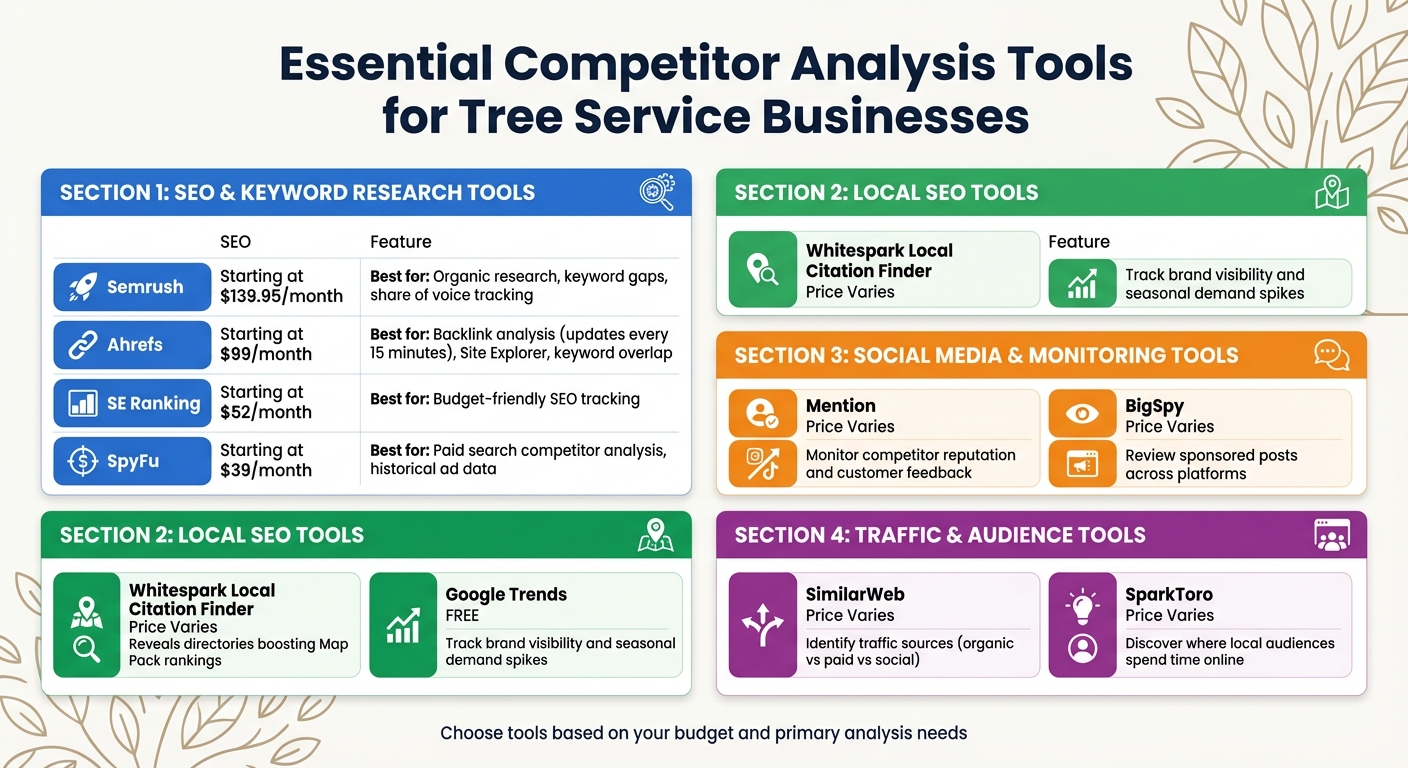
SEO and Social Media Competitor Analysis Tools Comparison for Tree Service Businesses
Before diving into content analysis, it’s crucial to identify your competitors. For tree service businesses, this means considering both direct competitors (local tree care companies targeting the same customers) and indirect competitors (landscapers or lawn care services offering basic tree trimming). While direct competitors aim for the same clientele, indirect competitors highlight alternative ways homeowners might handle tree care needs.
With over 33 million small businesses in the United States, your local market might be more crowded than you think. A structured approach can help uncover competitors you may not have noticed.
Local Competitor Research
Start by performing targeted Google searches with keywords like "tree removal near me," "emergency tree service," or "arborist in [your city]." Pay attention to companies that consistently show up in the top three Map Pack results – these are likely your most visible local competitors. Dive into their Google Business Profiles to examine their review counts, highlighted services, and how they interact with customers.
Local business directories such as Yelp, Angi (formerly Angie’s List), and HomeAdvisor are also valuable resources. These platforms can reveal which companies have the most reviews, the highest ratings, and detailed descriptions of their services. Reading customer reviews provides insight into what homeowners prioritize – whether it’s quick response times, competitive pricing, or specialized services like tree preservation.
Using Digital Tools for Competitor Discovery
Once you’ve compiled a basic competitor list through searches and directories, digital tools can help you uncover additional rivals. SEO and keyword research tools are particularly useful for spotting competitors you might otherwise miss. Platforms like Semrush (starting at $139.95/month), Ahrefs (starting at $99/month), and SE Ranking (starting at $52/month) can identify websites ranking for the same tree service keywords as your business. Simply enter your domain into tools like Ahrefs’ Site Explorer or Semrush’s Organic Research to generate a list of domains with overlapping keywords.
For more localized insights, tools like Whitespark‘s Local Citation Finder can reveal directories and citations that boost your competitors’ visibility and rank higher on Google for tree services. Additionally, paid search tools like SpyFu (starting at $39/month) can show which competitors are bidding on high-value keywords like "emergency tree removal" and even display their ad copy. Reviewing historical ad data can also help you spot successful seasonal campaigns, such as promotions for post-storm cleanup services.
Platforms like SparkToro and Similarweb offer another angle by identifying where your local audience spends time online, which can help you spot indirect competitors.
"Competitive analysis isn’t just about knowing your rivals. It’s about staying one step ahead of them." – Carlos Silva, Semrush
Google Trends is a free and insightful tool for tracking your brand’s visibility compared to competitors over time. It can also reveal seasonal demand spikes for services like "tree trimming" versus "stump grinding." Meanwhile, Ahrefs’ backlink index updates every 15 minutes, giving you near real-time insights into where competitors are building their online authority. Tools like Brand24 (starting at $149/month) and Mention can monitor online mentions of your competitors, allowing you to track their reputation and customer feedback in real time.
Reviewing Competitor Content Across Platforms
After pinpointing your main competitors, the next step is to dig deep into their content across various platforms. This means taking a close look at their websites, social media, and paid ads to figure out what’s working for them and where they’re missing the mark. The goal here isn’t to mimic their strategy but to uncover patterns, gaps, and opportunities you can use to strengthen your tree service business. Let’s start by diving into competitor blogs and website content.
Analyzing Blogs and Website Content
Start by exploring competitor websites to understand their content mix. Are they publishing how-to guides, case studies, or seasonal advice? Check their blog archives to see how often they post. Some businesses churn out weekly posts, while others focus on refreshing older content instead of creating new material.
Look closely at their topic clusters and site navigation. For instance, if a competitor has sections like "Storm Damage Cleanup" or "Tree Health Diagnostics", it’s a clear sign those topics are driving leads. Use tools like Google’s "People Also Ask" to find questions related to keywords such as "tree removal cost" that their content doesn’t address. These gaps are golden opportunities to create more detailed resources. This is a proven way to generate quality tree service leads and grow your business.
Examine the quality and depth of their articles. Are they brief 500-word posts or in-depth pieces exceeding 2,000 words? Do they use original photos from real jobs, or rely on generic stock images? Pay attention to their conversion elements, such as where they place calls-to-action for free estimates or emergency services.
"Quality content is time-consuming to produce… If a competitor is producing lots of high-quality content around certain topics, it’s because these topics are valuable to them." – Alex Walton, Competitive Intelligence Alliance
Don’t overlook technical aspects like page load speed and mobile responsiveness. Pages that take more than 3 seconds to load can drive away both visitors and search engines. With many homeowners searching for tree services on their phones during emergencies, a mobile-friendly site is crucial. Create a spreadsheet to track competitor subtopics, word counts, content formats, and technical performance. This will help you identify trends and plan your content strategy.
"Don’t just go after who ranks #1. Sometimes your most valuable insights come from competitors one tier below – that’s where real opportunity lives." – Kristavja Caci, SEO Content Marketer, Surfer
These observations can guide your marketing efforts by highlighting content gaps and untapped opportunities in your local market.
Evaluating Social Media Presence
Go beyond websites and analyze how competitors connect with their audience on social media. With 85% of businesses using social data for insights, this step is essential. Start by identifying their preferred platforms – whether it’s Facebook, Instagram, TikTok, or LinkedIn – and track their posting frequency.
Measure engagement by calculating follower ratios and categorizing their last 20–30 posts. For example, tally likes, comments, and shares, then divide by their total followers. A competitor with 2,000 followers and over 100 likes per post likely has a more engaged audience than one with 10,000 followers but minimal interaction. Note whether they focus on educational content (like tree care tips), project showcases (before-and-after photos), or promotions (seasonal discounts).
Check which content formats spark the most interaction. Posts with images tend to get 30% more shares and 25% more backlinks than text-only posts. Track their use of videos, testimonials, and live sessions. Don’t forget to analyze hashtags – both general ones like #TreeCare and location-specific ones like #DallasArborist.
Engagement quality matters too. Are customers asking questions in the comments? How quickly does the company respond? Tools like Not Just Analytics can help track Instagram or TikTok growth, while BigSpy is useful for reviewing sponsored posts. Also, pay attention to posting times; you might find that weekends are peak periods when homeowners plan outdoor projects.
These insights offer a clear view of how competitors build relationships with their audience, helping you refine your own strategy.
Reviewing Paid Advertising Strategies
Competitors’ paid advertising efforts can reveal a lot about their priorities and profitability. Start by searching high-intent keywords like "emergency tree removal" or "stump grinding near me" on Google to see which companies consistently show up in the "Sponsored" results.
Study their ad copy closely. What pain points are they addressing? Do they highlight 24/7 availability, licensed arborists, or free estimates? Click through to their landing pages to see how they guide visitors toward taking action. Look for calls-to-action, gated content like free tree care guides, and prominently displayed contact details.
For social media ads, Facebook’s Ad Library is a great resource to check out active campaigns. Tools like BigSpy can also help you analyze ad designs across multiple platforms. Document the types of visuals they use – are they running videos of tree removal jobs or static images with promotional text?
Add this data to your tracking spreadsheet, including columns for platform, ad themes, target keywords, CTA styles, and landing page URLs. Notice if competitors tailor their ads for different services. For example, storm damage ads might stress speed and emergency response, while routine trimming ads could focus on affordability and convenience.
Tools like SimilarWeb can show whether a competitor’s traffic comes mostly from organic search, social media, or paid ads. If they’re heavily investing in ads for certain services, it’s a strong indicator those services are profitable.
"When your competitors have impressive metrics, it’s essential to understand what they are doing well to build a better social media strategy." – Meagan Williamson, Pinterest Marketing Expert
These insights can help you refine your advertising strategy by pinpointing high-value services and crafting effective messaging for your campaigns.
Measuring Content Performance and SEO
To outshine your competitors in local search rankings, it’s crucial to evaluate how their content performs. By analyzing their strengths and identifying traffic-driving pages, you can refine your strategy and gain an edge. These insights will guide adjustments to your local SEO vs. paid ads strategy, helping you stay ahead in the game.
Using SEO Tools for Content Insights
Tools like Semrush, Ahrefs, and Moz are invaluable for diving into competitor SEO performance. Start by examining their monthly organic search traffic to gauge how much attention their content attracts from Google. For instance, if a competitor’s blog post on tree pruning techniques draws significant traffic, it suggests the topic resonates strongly with searchers.
Check keyword rankings using Semrush’s Organic Research or Ahrefs’ Site Explorer. A high number of top-10 keyword rankings is a clear indicator of a solid strategy. Look for keyword gaps – places where competitors rank but you don’t. These gaps represent opportunities to create fresh, targeted content.
Metrics like Domain Authority (DA) or Authority Score reveal a site’s overall strength. While a higher DA can indicate an advantage, don’t underestimate the power of backlinks. Research shows that top-ranking pages tend to have 3.8× more backlinks than those ranked lower. Use Moz’s Link Explorer or Ahrefs to identify competitor pages with strong backlink profiles and analyze why they attract so many links.
Another valuable metric is organic share of voice (SOV), which measures how visible competitors are for your target keywords compared to others in the market. Tools like Semrush can help you track SOV shifts over time, allowing you to spot trends and adjust your strategy accordingly. For example, a sudden spike in backlinks might indicate the launch of a high-performing content asset.
"An SEO competitor analysis is the process of evaluating your competitors’ SEO strategies – including their keywords, content, backlinks, and technical performance – to identify opportunities to outrank them." – Georgina D’Souza, Marketing Manager, Frase
Identifying Top-Performing Topics and Formats
Beyond technical SEO, understanding which topics and formats resonate most with audiences is key. Use tools like BuzzSumo to pinpoint competitor articles with the highest social shares and engagement. For example, if video content consistently outperforms text-only posts, it’s a sign that incorporating video could drive better results for your audience.
Content length matters too. Research indicates that long-form articles – especially those over 7,000 words – tend to attract significantly more traffic than shorter pieces. Tools like Semrush’s SEO Writing Assistant can help you determine the ideal word count by analyzing top-ranking pages for your target keywords.
Don’t overlook structural elements that enhance readability. Posts with at least one image tend to receive twice as much traffic and up to 30% more shares than text-only content. Similarly, breaking up text with lists and clear headings (H2 and H3 tags) makes content easier to digest and keeps readers engaged.
Tools like Clearscope or Frase can help you identify question-based topics competitors are targeting, often found in "People Also Ask" sections of search results. If competitors rank for broader queries like "How much does tree removal cost?" but skip more specific questions, you have a chance to capture that untapped audience.
"Top performers don’t just accept their competition. They know how to use the competition to better themselves." – Bernard Huang, Clearscope
Lastly, keep an eye on which competitors secure featured snippets (Position Zero) for high-value keywords. These snippets, often concise 40- to 60-word answers, can dramatically boost visibility. By studying how competitors structure their snippets – like one on tree disease symptoms – you can craft even better, more comprehensive answers to win that spot.
| Tool | Best For | Key Insight Provided |
|---|---|---|
| Semrush | Keyword & traffic analysis | Identifying keyword gaps and organic traffic volume |
| Ahrefs | Backlink research | Monitoring referring domains and link velocity |
| BuzzSumo | Content engagement | Revealing social shares and viral topics |
| Moz | Authority benchmarking | Assessing Domain Authority and top-linked pages |
| Clearscope | Content optimization | Pinpointing semantic keywords and content depth |
Turning Analysis into Action for Your Content
Turn competitor insights into tools for improving your content strategy. Instead of mimicking their approach, look for patterns that lead to success and create something better that caters to your audience’s needs. Below are practical tips for refining content formats, local SEO strategies, and paid campaigns based on competitor analysis.
Improving High-Performing Content Formats
When you notice content formats working well for competitors, don’t just replicate them – step it up. Research shows that 83% of B2B content marketers stand out by producing higher-quality content than their competitors, while 72% focus on topics their competitors overlook.
For example, if a competitor’s blog about tree disease identification is getting traffic, take it further. Add extra subtopics, custom visuals, video demonstrations, and expert perspectives. The goal? Make your version the go-to resource that answers questions their content doesn’t address.
"Surpassing your competitors in the SERPs is not just about researching and analyzing data. We also have to build, build, build!" – Moz
To boost engagement, mix in visuals and lists. Diversifying formats can also give you an edge. If competitors rely solely on blog posts, turn similar content into videos, podcasts, or downloadable guides. In fact, 38% of marketers differentiate by using formats their competitors skip.
Keep your brand’s voice consistent. Whether competitors lean toward casual, formal, or technical tones, pick a style that resonates with your audience. Add branded touches like customer success stories, before-and-after photos, or unique insights from your team to make your content stand out.
"The question isn’t ‘What are they doing?’ but ‘How can we solve this problem better for our audience?’" – Moz
Now, let’s apply these insights to local SEO strategies.
Refining Local SEO Strategies
Use competitor research to fine-tune your local SEO game. For tree service companies, local search rankings are critical. Start by identifying your real local competitors. Search for priority keywords with geographic terms like "best tree care services in Austin" or "emergency tree removal Dallas" to see who dominates the local pack and organic results.
Study their Google Business Profiles. Check their business categories and whether they use the city and state in meta titles, H1 tags, and body content – these details signal local relevance to Google.
Run a citation gap analysis to uncover opportunities. Search for a competitor’s Name, Address, and Phone (NAP) to find high-authority directories and local sites where they’re listed but you’re not. Prioritize getting listed on those same sites, especially those with "dofollow" links that pass authority to your pages.
"While it’s important to mention that correlation does not mean causation, we can learn a lot by seeing what the competition has done." – Casey Meraz, Founder, Juris Digital
Test local SEO elements systematically. If competitors use the city name in their H1 tags and you don’t, update yours and monitor results. Check for technical optimizations like Local Business Schema, embedded Google Maps, or GPS coordinates to help search engines verify your location.
Don’t just match their topics – find the gaps they’re missing. For instance, if competitors rank for broad queries like "tree trimming cost" but skip specific ones like "How much does oak tree trimming cost in winter?" you can target those untapped searches. Tools like Semrush can help identify keyword gaps where competitors rank but you don’t.
Optimizing Paid Campaigns with Competitor Insights
Take what you’ve learned from content and SEO improvements and apply it to your paid campaigns. Competitor analysis can guide you in refining your Google Ads strategy and maximizing ROI.
Use tools like SpyFu or Semrush to uncover the keywords competitors are bidding on, such as "emergency tree removal" or "stump grinding near me". Study their ad copy to see what messaging works – whether it’s urgency ("24/7 Emergency Service"), value ("Free Estimates"), or trust ("Fully Insured"). Then, craft ads that address similar customer needs but with a fresh perspective.
Watch for seasonal promotions and offers competitors highlight. If they’re pushing winter pruning deals or service bundles, make sure your offers are just as appealing. Check forums and review sites for complaints about competitors – if customers mention issues like "never showed up on time", address that directly in your ads with promises like "We show up on time".
Landing pages often make or break campaigns. Analyze where competitors drive their ad traffic – whether it’s to a lead magnet, service page, or contact form. If they use direct-response pages with pricing and a clear call-to-action, test a similar layout. Alternatively, if they send traffic to educational content first, consider creating a resource like a tree care guide to nurture leads before asking for their contact info.
Tree Company Leads specializes in helping tree service businesses optimize Google Ads with competitor-driven strategies. Their process combines keyword research, ad copy testing, and tailored landing page design to ensure your campaigns attract high-quality leads without wasting budget.
Set realistic benchmarks for key metrics like Click-Through Rate (CTR), Cost Per Click (CPC), and Quality Score based on competitor performance. If your Quality Score lags, focus on improving landing page relevance and ad alignment to secure better placements at lower costs. Test creative formats like video or user-generated content if competitors are using these successfully.
| Paid Campaign Element | What to Analyze | How to Apply It |
|---|---|---|
| Keywords | Terms competitors bid on | Add high-volume, low-competition keywords to your campaigns |
| Ad Copy | Headlines, hooks, CTAs | Create messaging that addresses similar needs with a unique spin |
| Offers | Seasonal promotions, discounts | Keep your offers competitive and timely |
| Landing Pages | Conversion paths, page structure | Optimize based on successful competitor designs |
| Creative Formats | Video, UGC-style content | Experiment with formats competitors use effectively |
Conclusion
Drawing from the strategies and insights explored earlier, keeping up with competitor content analysis is not just helpful – it’s essential. Markets shift, trends emerge, and what worked last year might not cut it today. By conducting regular reviews – whether quarterly check-ins or detailed annual assessments – you can ensure your approach remains sharp and grounded in what’s proven to work.
This practice allows you to spot content gaps, refine successful formats, improve local SEO in Norfolk, and fine-tune conversion paths. These steps directly impact search traffic, rankings, and customer conversions.
"Instead of guessing which keywords to target, which content to create, or which links to build, you can research your competitors, analyze what’s already working for them, and build upon that success." – Moz
Metrics consistently show that well-crafted content, smart topic selection, and the strategic use of visuals drive both traffic and engagement. These numbers don’t just validate your efforts – they provide benchmarks to measure and refine your strategy.
FAQs
How can I identify indirect competitors for my tree service business?
To identify indirect competitors, think beyond other tree service businesses. Consider companies that tackle similar customer needs, such as clearing space for outdoor projects, boosting curb appeal, or dealing with storm damage. These might include landscaping companies, lawn care providers, pest control services, or even utility crews focused on vegetation management.
Start by listing common customer concerns, like "I need a tree removed" or "my yard looks overgrown." Then, pinpoint services that could address those issues. Use tools like Google Maps, industry directories, and review platforms to research local businesses. Pay attention to their offerings, strengths, and weaknesses. For instance, a landscaping company may shine in design but lack the heavy equipment needed for large-scale tree removals.
This kind of analysis can reveal opportunities, such as providing 24/7 emergency tree removal, and help you emphasize what sets your tree service business apart from the rest.
What are the best tools for analyzing competitor content?
The most effective tools for analyzing competitor content bring together SEO data, performance metrics, and easy-to-use interfaces. Platforms like Semrush and Ahrefs are excellent for pinpointing keyword rankings, analyzing backlink profiles, and identifying top-performing content. They’re also great for spotting content gaps and finding ways to refine your strategy.
When it comes to content optimization, Clearscope stands out with its AI-powered keyword suggestions and relevance scores. It helps you create content that aligns more closely with search intent. These tools give tree service businesses the ability to measure up against competitors, uncover content opportunities, and develop high-ranking content designed to attract local customers and generate leads.
How can competitor analysis help improve my local SEO for tree services?
Competitor analysis is a smart way to sharpen your local SEO efforts. Start by pinpointing businesses that rank for the same service and location keywords you’re targeting (like tree trimming in Dallas). Dive into their Google Business Profiles to evaluate key elements such as categories, photos, reviews, and response rates – these factors play a big role in local search rankings.
Take it a step further by analyzing their website content. Look closely at how they use keywords, structure title tags, and write meta descriptions. Identify gaps or missed opportunities, such as the absence of location-specific keywords. Check where they’re listed online – platforms like Yelp or Facebook – and make sure your business is listed there too. Additionally, review their top-performing pages and backlinks to uncover ways to create stronger, locally-focused content that draws similar links.
Using these insights – like refining your profiles, improving your citations, and publishing targeted content – you can enhance your local search visibility and bring in more leads. If you need help navigating these steps, Tree Company Leads offers solutions to help your tree service business thrive with effective local SEO strategies.
Related Blog Posts

Click-to-call is a simple yet powerful tool that allows customers to connect with businesses instantly, especially on mobile devices. For tree care businesses, this feature is crucial since phone calls are 10 times more likely to convert than digital clicks. Adding a click-to-call button to your tree service website can increase call-to-conversion rates by 200%, with 88% of visitors more likely to reach out when this feature is available.
Here’s a quick rundown of tools that make implementing click-to-call easy and effective:
- Tree Company Leads: A specialized platform for tree service businesses with built-in click-to-call buttons, lead tracking, and templates designed to drive calls.
- CallRail: Offers call tracking, keyword insights, and AI tools to analyze and qualify leads.
- Google Call-Only Ads: Targets high-intent mobile users with ads that directly trigger calls.
- DialogTech: Advanced AI for call routing and transcription, ideal for businesses handling large call volumes.
- RingCentral: Embeddable widgets and VoIP integration for seamless call management.
- Twilio Programmable Voice API: A developer-friendly solution for custom click-to-call setups.
To maximize results, ensure your click-to-call button is prominent, action-driven (e.g., "Call Now for Emergency Service"), and optimized for mobile users. Test functionality across devices, track conversions, and refine placement to boost customer engagement and drive more business.
How to Set Up Website Pools and Mobile Click-to-Call Numbers in CallRail | Google Ads

Tree Company Leads Click-to-Call Integration
Tree Company Leads makes it easy for tree service businesses to connect with potential customers by embedding click-to-call functionality on every page they design. With mobile-optimized buttons, homeowners can reach out with just a tap, instantly dialing your number. This seamless integration also lays the groundwork for best lead generation tools for tracking and conversions.
Their real-time lead tracking system identifies which channels – be it local SEO vs paid ads – are driving calls and helping measure ROI. This system works hand-in-hand with the built-in phone system, ensuring every call is logged and neatly organized for easy follow-up.
Busy on-site and can’t answer a call? No problem. An automatic missed call text back feature keeps the conversation going, ensuring no potential customer is left hanging during hectic periods or emergencies.
The 1-Click Buildout feature is another game-changer. It provides ready-to-go templates with a drag-and-drop editor, allowing you to quickly embed lead capture forms and click-to-call buttons. These templates are designed specifically for tree service businesses, focusing on driving calls rather than leading visitors through multiple pages. This approach has been shown to boost conversion rates by up to 125%. Paired with smart SEO tactics, these templates create a well-rounded mobile marketing solution.
Tree Company Leads also integrates click-to-call with local SEO strategies and Google Business Profile management. This ensures high-intent leads can connect with your business the moment they search for tree services, making it a truly mobile-first solution to turn browsers into callers.
Top Tools for Click-to-Call Setup
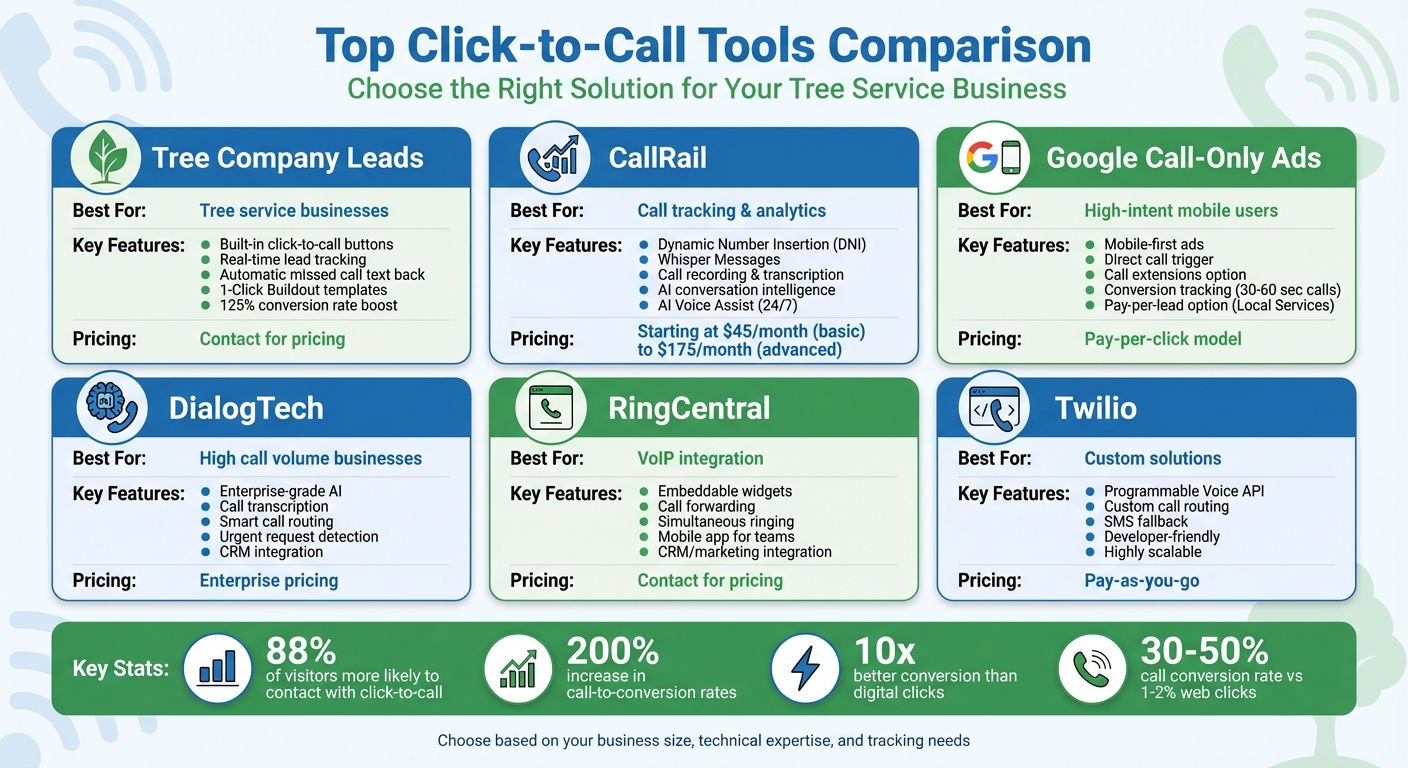
Click-to-Call Tools Comparison for Tree Service Businesses
While Tree Company Leads includes effective click-to-call features, there are platforms offering specialized tools to take your call conversions to the next level. These tools range from simple widgets to advanced systems that can track, route, and qualify leads. Here’s a look at some standout options for enhancing click-to-call functionality on tree service websites.
CallRail for Call Tracking and Analytics
CallRail stands out as a top choice for call tracking. Its Dynamic Number Insertion (DNI) feature automatically swaps out phone numbers on your site depending on how visitors found you – whether through a "tree trimming near me" ad or organic search. This makes it easy to pinpoint which marketing channels are driving calls.
Another handy feature is Whisper Messages, which plays a brief audio clip (e.g., "Call from Google Emergency Tree Ad") to the person answering the call, helping them tailor their response. Additional tools like call recording, automated transcription, and AI conversation intelligence can identify keywords such as "emergency tree removal" or "stump grinding" to help qualify leads. For businesses needing extra support, the AI Voice Assist feature (starting at $95/month) acts as a 24/7 virtual assistant to answer, capture, and qualify calls.
Plans start at $45/month for basic call tracking, including five local numbers and 250 minutes, with more advanced options available for $175/month, offering premium AI insights and full tracking capabilities.
Google Call-Only Ads and Call Extensions
Google’s call-only ads are designed for mobile users, displaying your phone number as the main call-to-action. This is perfect for capturing high-intent searches like "emergency tree removal." When users tap the ad, their phone dials your number immediately, bypassing the need for a website visit.
Call extensions, on the other hand, add your phone number to standard search ads, giving users the option to visit your site or call directly. Google tracks these calls as conversions if they last longer than a set duration (typically 30–60 seconds). For businesses using Google Local Services Ads, the pay-per-lead model ensures you’re only charged for qualified calls that meet specific criteria. Additionally, keyword-level tracking allows you to see which search terms are driving calls, helping refine your ad strategy.
DialogTech for Advanced Call Intelligence
For businesses handling a high volume of calls, DialogTech offers enterprise-grade call intelligence. This platform uses AI to transcribe calls, highlight urgent requests (like emergency tree services), and route calls based on location, agent expertise, or caller intent. It also integrates seamlessly with home service platforms, syncing call data with your customer management system for a streamlined workflow.
RingCentral Click-to-Call Widgets
RingCentral makes it easy to add click-to-call functionality to your website with embeddable phone widgets. These widgets connect to RingCentral’s VoIP system, ensuring calls are routed through your existing business phone setup while providing insights into which web pages or campaigns are generating calls.
The mobile app is especially useful for teams, allowing staff to answer business calls on personal phones while showing your company’s caller ID. Features like call forwarding and simultaneous ringing ensure that no emergency calls go unanswered, even if the main office line is busy or after hours. Plus, RingCentral’s integration with CRM and marketing platforms gives you a complete view of customer interactions across calls, texts, and emails.
Twilio Programmable Voice API

For businesses looking to build custom solutions, Twilio offers a developer-friendly platform with its Programmable Voice API. This tool enables you to create custom click-to-call buttons, set up automated call routing, and even implement SMS fallback for missed calls.
While Twilio requires more technical expertise compared to plug-and-play solutions, it’s highly scalable and operates on a pay-as-you-go pricing model. This makes it a great option for businesses with in-house technical teams or those working with web developers to create tailored systems.
sbb-itb-130a704
Implementation Best Practices for Tree Service Websites
Making click-to-call functionality work effectively starts with the basics. Use the tel: protocol in an anchor tag (e.g., <a href="tel:1234567890">Call Now</a>) to ensure mobile users can dial directly from your site. Be careful not to include spaces between "tel:" and the phone number. These simple steps lay the groundwork for maximizing the performance of more advanced tools.
Keep your phone number front and center by adding a sticky header on every page. This ensures it stays visible as users scroll through your website. On critical service pages, like "Emergency Tree Removal", place a call button prominently right after the service description. For your contact page, list separate numbers for each location if applicable, but maintain a consistent primary number across your website and Google Business Profile.
Once your button placement is set, thorough testing is a must. Test the functionality on various mobile devices, as around 70% of mobile users rely on click-to-call features to reach businesses. Ensure the dialer opens with the correct pre-filled number. For desktop users, confirm that the link triggers calling apps like Skype or FaceTime, as desktops lack native dialers. Use strong, action-driven phrases like "Speak to a Tree Expert in 60 Seconds" or "Call for a Free Estimate" to encourage clicks.
To measure success, track conversions by firing a GA4 event via Google Tag Manager whenever a "tel:" link is clicked. Define a "qualified lead" as a call lasting between 30–60 seconds. This is especially important since phone calls tend to convert at rates of 30–50%, far outpacing the 1–2% conversion rate typical of standard web clicks.
Timing also matters. Schedule click-to-call buttons to appear during business hours when staff is available to answer. For after-hours inquiries, consider using an answering service to capture potential leads. Lastly, A/B test button placement, design, and color. These tweaks can boost conversion rates by as much as 200%.
Summary and Key Takeaways
Click-to-call is a game-changer for tree service businesses, directly boosting revenue by making it easier for customers to connect. Research shows that 88% of website visitors are more likely to contact a company when a click-to-call button is available, and phone calls convert up to 10 times better than standard digital clicks. This instant connection can be especially valuable for securing high-value emergency jobs.
Tree Company Leads takes this a step further with an integrated approach, and there are several tools you can use to refine your click-to-call strategy. Each tool plays a unique role:
- CallRail helps track and attribute call sources.
- Google Call-Only Ads and extensions target high-intent searches.
- DialogTech, Twilio, and RingCentral provide advanced features like lead qualification, custom integrations, and reliable call routing.
"We’re able to track, analyze and improve on a call-by-call basis. And we’re able to understand, on a campaign level, which lead source is really working for us."
- Adam Leech, General Manager, Elmar Services
Success, however, comes down to more than just the tools – it’s about implementation. For the best results, ensure your click-to-call button is prominently displayed, uses action-driven CTAs like "Call for Emergency Service", and is paired with conversion tracking to measure campaign performance. Testing across devices is essential since mobile users make up a large share of searches, and a seamless experience is key to capturing those leads.
Tree Company Leads also offers tailored services for businesses looking to maximize their marketing ROI. Their expertise combines click-to-call functionality with custom web design, Google Ads management, and local SEO strategies. This ensures your phone is ringing with high-quality leads ready to book services like tree removal, pruning, or emergency assistance.
FAQs
How can click-to-call increase conversions for tree service businesses?
Click-to-call makes it incredibly easy for potential customers to contact your tree service business. With just one tap, they can connect with you directly, removing obstacles and speeding up communication. This feature is all about making the experience smoother and more convenient for users.
What’s the payoff? Click-to-call can lead to a noticeable jump in website conversion rates – sometimes by as much as 125%. For tree service businesses, this translates into more high-quality leads, better chances to engage with customers, and a boost in ROI. Plus, it enhances customer satisfaction by providing quick, hassle-free access to your services.
What features does Tree Company Leads offer for click-to-call integration?
Currently, there’s no detailed information about whether Tree Company Leads offers click-to-call integration. However, their services are designed to simplify customer interactions and help tree service businesses attract quality leads. To get a clearer picture of their offerings, it’s a good idea to contact their team directly and explore how their solutions might work for your business.
What are the best ways to test and improve click-to-call buttons on a website?
To make your click-to-call button a reliable driver for phone leads, approach it like any other conversion tool – test it, track its performance, and fine-tune it regularly. Start by embedding a correctly formatted tel: link, such as <a href="tel:18001234567">Call Us</a>, and ensure it functions smoothly on both desktop and mobile browsers. This step is crucial to provide users with a seamless experience.
Next, use unique tracking numbers for each variation of the button. For example, you might test different colors, placements, or text to see which version generates the most calls. This data will help you identify what works best for your audience.
Take it a step further with A/B testing. Experiment with different button designs – think about colors, sizes, or wording like “Call Now” versus “Speak to an Expert.” Track metrics such as call-through rates or the percentage of answered calls to evaluate performance. Tools like heatmaps or session recordings can also provide insights into whether users are interacting with the button or running into issues on the page. Regularly testing and tweaking these elements can make a big difference.
If you’re in the tree service business and want a hands-off approach, Tree Company Leads offers a complete solution. They take care of everything – from building a mobile-friendly website to embedding click-to-call buttons with tracking features. This allows you to focus on answering calls while they handle optimization and reporting.
By consistently analyzing and refining your click-to-call button, you can transform it from a simple feature into a powerful tool for generating leads.