In 2026, the tree service industry is highly competitive, with over 150,000 companies in the U.S. – a significant increase from 91,949 in 2015. To stand out, you need to analyze your competitors effectively. This guide outlines 10 practical steps to help you identify opportunities, improve your strategies, and gain an edge in your local market. Key insights include:
- 68% of jobs go to the first business that responds to tree service leads. Speed and responsiveness are critical.
- Google’s "Get Competitive Quotes" feature allows customers to compare up to four providers, but these leads convert 15–25% less than standard ones.
- Tools like SEMrush, Ahrefs, and BrightLocal can help you track competitors’ SEO, keywords, and local rankings.
Here’s a quick summary of the steps:
- Find local competitors using search terms and tools like BrightLocal.
- Analyze their Google Business Profiles for categories, reviews, and engagement.
- Review their websites for speed, mobile usability, and lead generation features.
- Compare their SEO rankings and keyword strategies.
- Study their service offerings and pricing to identify gaps.
- Examine online reviews for patterns in strengths and weaknesses.
- Evaluate their lead generation methods, including ads and response times.
- Monitor their advertising campaigns using tools like Google Ads Transparency.
- Set up a tracking system to monitor changes and trends.
- Turn data into actionable improvements for your business.
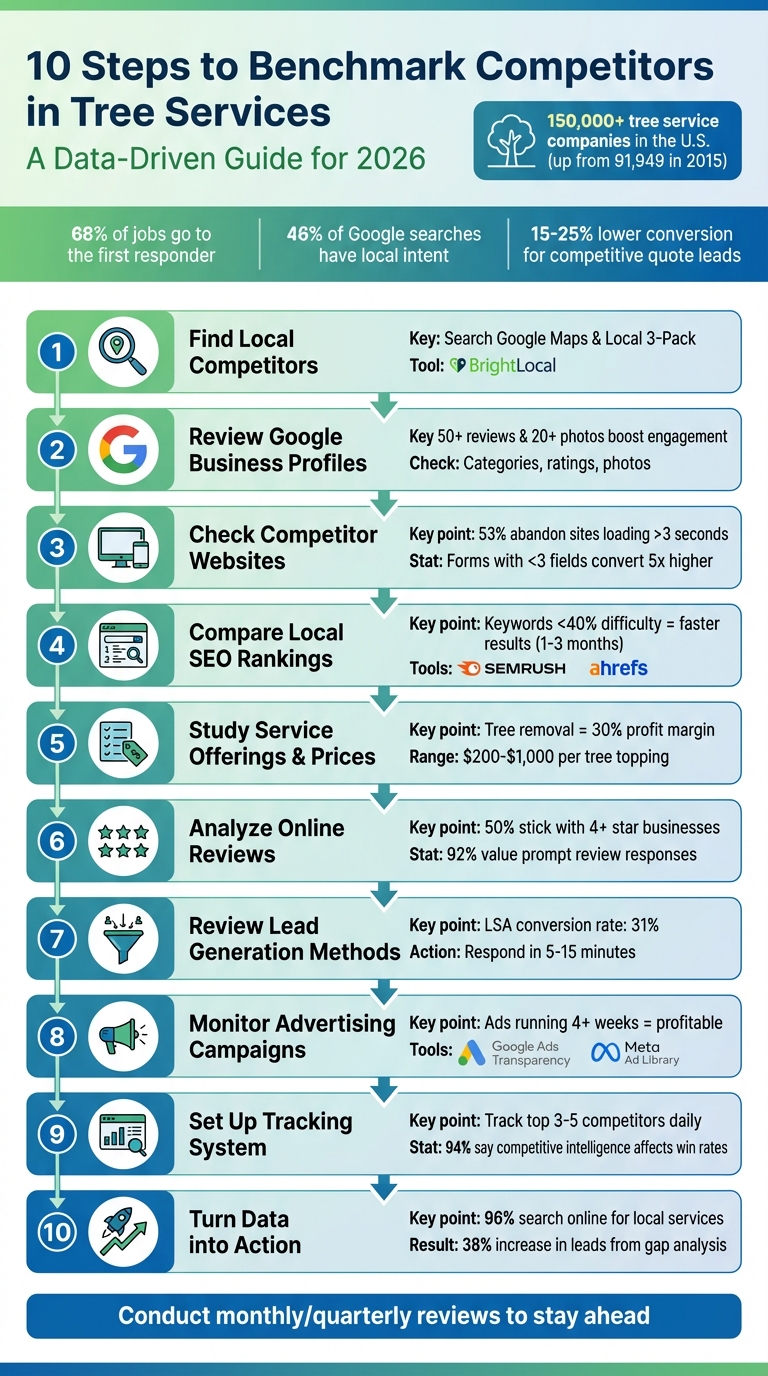
10-Step Competitor Benchmarking Process for Tree Service Companies
SEO Competitive Analysis: Steal Your Competitor’s SEO Keywords (DIY SEO)
sbb-itb-130a704
Step 1: Find Your Local Competitors
Your real competition isn’t just the local trucks you see driving around – it’s the companies showing up in Google search results.
Start by searching for your core services along with your city (e.g., "tree removal in Birmingham" or "stump grinding in Nashville"). Pay close attention to the Google Maps listings, the Local 3-Pack, and the organic results. The businesses appearing here are your main competitors in the digital space.
"If you’re not one of those three [in the Map Pack], you basically don’t exist." – Tree Service Marketing Solutions
Keep in mind that platforms like Yelp, Angi, and Houzz aren’t direct competitors – they’re additional marketing channels you can leverage. Instead, focus on tree service companies that consistently appear across multiple searches. If the same business shows up for terms like "tree trimming," "arborist services," and "tree removal," they’re a significant player you’ll want to keep an eye on.
Since proximity plays a big role in rankings, tools like BrightLocal’s Local Search Results Checker can help you see search results from different locations. Create a spreadsheet to track competitor names, URLs, Local Pack positions, and the keywords they’re ranking for. Once you’ve collected this data, you’ll be ready to analyze their Google Business Profile setups in Step 2.
Step 2: Review Google Business Profile Setup
Once you’ve identified your main competitors, it’s time to dive into their Google Business Profiles. Considering that nearly 46% of all Google searches have local intent, analyzing these profiles can reveal useful insights and guide you in refining your own, much like choosing between local SEO and paid ads for your growth strategy. This step lays the groundwork for improving specific profile elements.
Start by examining their business name and categories. Check if competitors are using their actual business names rather than stuffing them with keywords. Take note of their primary category – often "Tree Service" – and any additional ones, such as "Arborist", "Stump Removal Service", or "Emergency Tree Service". If a competitor sticks to just one category, you may have an edge by including relevant secondary categories on your profile.
Next, shift your focus to customer engagement and visual appeal. Look at the number of reviews they’ve received, their average ratings, and highlighted attributes like "professionalism" or "responsiveness." For example, a business with 50 reviews and a 4.7-star rating generally holds more weight than one with only 8 perfect reviews. Check how many photos they’ve uploaded – 20 or more high-quality images can significantly boost engagement. If a competitor has fewer than 10 photos, consider exceeding that number to stand out.
Also, review their service areas, business hours, and how often they post updates on Google. Pay attention to the towns or counties they list. Posting weekly can demonstrate activity and relevance. Finally, take a look at their Q&A section. This can highlight common customer concerns or areas where information might be lacking.
To stay organized, create a comparison table for your top three competitors. This will give you a clear benchmark and make it easier to spot opportunities to improve your own Google Business Profile.
Step 3: Check Competitor Websites
After reviewing Google Business Profiles, the next step is to dive into competitor websites. These sites can offer valuable insights into their conversion strategies and overall digital approach. A sleek, modern design often reflects a strong focus on marketing, while an outdated site might signal an opportunity for you to shine.
Start by assessing their load speed and mobile compatibility. Use tools like Google PageSpeed Insights to test your competitor’s URLs and compare performance scores. Remember, 53% of users abandon a website if it takes more than three seconds to load. If their site is slow or clunky on mobile, prioritize making your own site faster and more responsive. Test their website on multiple devices to see how user-friendly it is and ensure that important elements, like navigation and calls-to-action, remain accessible across platforms.
Next, take a closer look at their conversion pathways. Check for essential website features like "Click to Call" buttons that are easy to use on mobile. Evaluate their contact forms – how many fields do they require? Research shows that forms with fewer than three fields can convert up to five times higher than longer ones. If their forms or quote request process feel cumbersome, it’s a chance for you to simplify and improve your own.
Credibility is another critical factor. Look for trust signals on their site, such as ISA Certified Arborist badges, insurance information, customer testimonials, or professional memberships. These elements help build confidence with potential customers. Also, review their content strategy. Are they targeting high-value keywords like "Emergency Tree Removal" or "Stump Grinding"? Do they regularly publish blogs or guides that could drive organic traffic? These clues can reveal how they’re positioning themselves in the market.
Lastly, analyze their lead generation process. Fill out their contact form or sign up for their newsletter to experience their funnel firsthand. Do they send an automated email right away? How polished and professional is their follow-up? These details can highlight areas where you can refine your own approach, ensuring you turn more visitors into loyal customers.
Step 4: Compare Local SEO Rankings
Once you’ve reviewed competitor websites, the next step is to dive into local SEO rankings. This analysis uncovers which keywords are driving traffic to your competitors and highlights areas where you might be falling short. It’s a natural extension of the insights you gathered during your competitor website review.
Tools like SEMrush and Ahrefs are essential for this step. Start with SEMrush’s "Keyword Gap" tool to compare your website against up to five competitors. Focus on the "Missing" filter to pinpoint high-value keywords you’re not yet targeting. For example, phrases like "emergency tree removal [City]" or "stump grinding near [Landmark]" can bring in highly targeted, local traffic. Ahrefs offers a similar feature with its "Content Gap" tool, which also highlights keywords where competitors rank in the top 10 search positions.
"Competitor keywords represent terms that are already working for other businesses in your space." – Ana Camarena, Organic Content Lead, Semrush
Next, review competitors’ top-performing pages to identify what’s working for them. SEMrush and Ahrefs both provide "Top Pages" reports, showing which pages generate the most organic traffic. For instance, if a competitor’s "emergency tree removal" page is pulling in thousands of visits monthly, it’s a clear signal to optimize your content in that area. Additionally, explore their paid keywords using the "Advertising Research" tab in SEMrush or the "Paid Search" section in Ahrefs. High CPC keywords often indicate terms that convert well, making them worth your attention.
Pay close attention to keyword difficulty scores. Keywords with difficulty ratings above 70% are harder to rank for and may take six months or more to show results. On the other hand, low-competition keywords – those with difficulty scores under 40% – can deliver results faster, often within one to three months. For instance, if "tree removal" feels too competitive, use SEMrush’s Keyword Magic Tool to uncover long-tail alternatives like "affordable stump grinding near [Landmark]."
Finally, check whether competitors dominate Local 3-Pack results or Featured Snippets for terms like "tree trimming near me." These prominent search features capture a large share of clicks, providing a significant advantage in local SEO. By analyzing these elements, you can refine your strategy and improve your visibility in local search results.
Step 5: Study Service Offerings and Prices
Take a close look at your competitors’ service offerings and pricing. This step helps you pinpoint service gaps and evaluate whether your pricing is in line with the market or needs adjustment.
Start by listing the main services featured on competitors’ websites and Google Business Profiles. Most tree service companies highlight offerings like tree removal, trimming, pruning, stump grinding, and emergency storm response. Pay attention to what they don’t provide – if competitors in your area lack specialized arborist services or 24/7 emergency response, this could be your chance to stand out. Also, check their profile categories for niche services they might be overlooking. This analysis can uncover opportunities for you to fill unmet needs.
Next, focus on pricing. While exact prices are rarely listed, you can gather insights through mystery shopping. Call competitors for quotes and request brochures to understand their pricing strategies and sales process. Another option is to reach out to tree services in similarly sized cities in other states – they’re often more open about pricing since you’re not a direct competitor. For instance, tree topping typically costs between $200 and $1,000 per tree, while tree removal often generates a 30% profit margin.
"Pricing too low can hurt your credibility as being a business that provides high-quality service, but pricing too high may result in more business for your competition." – Lauren Spiers
Consider offering tiered service packages, such as Basic, Intermediate, and Premium. If your competitors stick to single-option pricing, tiered packages can attract both budget-conscious customers and those willing to pay for premium service. Also, check if competitors provide resources like pricing guides or FAQs. These tools not only build trust but can also help justify higher rates. Lastly, pay attention to how quickly competitors respond to quote requests – responding within 5–15 minutes can set you apart, especially when competing for urgent, high-intent leads.
Step 6: Analyze Online Reviews and Ratings
Online reviews are a goldmine when it comes to understanding your competition and refining your strategy. Start by examining the volume and recency of reviews for your top competitors. Did you know that 50% of customers stick with businesses that have at least a four-star rating? On top of that, 67% of people prioritize recent reviews when making decisions. For example, a competitor boasting 100 reviews from 2020 might not seem as appealing as one with 30 fresh reviews from just the past three months.
Pay attention to both the total number of reviews and what’s called review velocity – the number of reviews a business gets in the last 90 days. A steady flow of recent reviews signals an active and engaged business. But be cautious if you notice a sudden spike in reviews; it could hint at questionable tactics like review gating.
Next, dive into the sentiments and recurring themes in these reviews. Look for patterns in complaints or praise. Keywords like "left debris", "slow response", or "rude crew" can tell you a lot about where competitors fall short. In the tree service industry, for instance, customers often zero in on safety, crew professionalism, and whether the company provides proof of insurance. If you notice frequent complaints about missed estimates or messy job sites, this is your chance to highlight your own strengths in reliability and attention to detail. These insights naturally lead to evaluating how competitors handle customer feedback.
Don’t overlook response rates and reply times, either. A whopping 92% of customers say that businesses that respond promptly to reviews demonstrate good customer service. Even more, 82% of people are more likely to choose a company that actively engages with reviewers. Interestingly, nearly half (46%) of customers aged 45–60 expect a response within 24 hours.
"A 4.6‑star rating with 20 recent reviews and thoughtful responses will outperform a 5.0‑star rating with only five reviews from last year" – Monica Hemingway, Founder of Tree Care Marketing Solutions
Finally, widen your scope by assessing reviews across multiple platforms. While Google hosted 64% of professionally managed reviews in 2020, don’t ignore sites like Yelp, Facebook, and the Better Business Bureau. For instance, if your competitors dominate on Google but have little presence on Yelp, this could be an opportunity for you to carve out a niche and attract those customers.
Step 7: Review Lead Generation Methods
Take a close look at how competitors generate leads and respond to inquiries. This analysis complements the earlier website evaluation, helping you pinpoint gaps in your strategy. Start by checking if local competitors display the "Google Guaranteed" badge in their Local Services Ads (LSAs). These ads appear at the very top of search results and have a conversion rate of about 31%, nearly triple that of traditional Google Ads.
Another feature to examine is the "Get Competitive Quotes" option, which allows homeowners to contact up to four tree service providers with a single click. While this is convenient for potential customers, these shared leads tend to convert 15–25% lower than standard LSA leads because users are often shopping around for the best price. Factors like proximity, review quality, response speed, and profile completeness influence how these leads are distributed. Test this feature by submitting a quote and timing how quickly competitors respond.
Expand your evaluation to include additional lead generation channels. Beyond digital methods, traditional offline strategies still hold value. For instance, vehicle wraps, yard signs at active job sites, and direct mail campaigns remain effective. Direct mail postcards, which cost between $0.50 and $1.00 each, can generate consistent leads, especially in neighborhoods where your trucks are already visible. On the digital side, platforms like Facebook and Instagram are ideal for targeting homeowners in specific zip codes with before-and-after photos, helping to build brand recognition.
Competitors also rely on third-party platforms like Thumbtack and Angi, where leads cost between $15 and $60 and are shared among multiple companies. On Thumbtack, quick responses are crucial – 68% of jobs go to the first responder. Top-performing businesses aim to reply within 5–15 minutes, as delays significantly reduce conversion rates.
"The competitive quotes feature changes the game for LSA lead quality. We’re seeing these leads behave more like cold inquiries than the warm leads traditional LSAs generate." – Panajota Gushkova, Paid Search Lead
Finally, assess how efficiently leads are followed up. Monitor the entire process, from initial contact to scheduling, to ensure quick conversions. Focus on providing clear scheduling options rather than vague calls to action. This approach can raise exclusive lead closures to 60–75%, compared to the industry average of 25–30%.
Step 8: Monitor Advertising Campaigns
Once you’ve gathered insights from lead generation, the next step is to keep a close eye on your competitors’ advertising campaigns. This can sharpen your market strategy and help you stay ahead.
By analyzing where and how competitors advertise, you can uncover which channels are delivering the best results for them. Tools like the Google Ads Transparency Center (adstransparency.google.com) and Auction Insights allow you to see active competitor ads, evaluate their impression share, and determine whether their top ad placements are driven by quality or just higher bids. Similarly, the Meta Ad Library provides a clear view of all current Facebook and Instagram ads, making it easier to identify trending messages and strategies.
The duration of an ad can also be a strong indicator of its effectiveness. Ads that run for more than four weeks are often profitable, as businesses tend to sustain campaigns that deliver solid returns. If a competitor’s ad has been live for several months, it’s likely been tested and optimized for success.
You can also use manual search techniques to gather insights into competitor targeting. For example, opening an incognito browser and searching for high-intent keywords like "emergency tree removal near me" can reveal which competitors consistently appear in top ad spots. Additionally, visiting a competitor’s website and exploring their service or pricing pages can trigger retargeting ads. These ads can give you a glimpse into the display networks and offers they are using.
"When you analyze competitor ads, you’re essentially getting a free education on what’s working in your industry." – Austin LeClear, Grow My Ads
Tracking competitor ad patterns monthly can also help you spot seasonal trends. For example, competitors might increase bids on terms like "storm damage cleanup" in the spring or promote "tree pruning" services in late autumn. Automating competitive intelligence can save significant research time – up to 85–95% – while delivering results like a 31% boost in click-through rates and a 6:1 return on investment within just three months. These insights can help you fine-tune your ad spend and outperform the competition, paving the way for effective tracking in the next step.
Step 9: Set Up a Tracking System
To keep tabs on competitor performance without drowning in data, it’s essential to establish a focused tracking system that prioritizes what truly impacts your tree service business.
Start by categorizing competitors into tiers: monitor your top 3–5 competitors daily, the next 5–10 weekly, and broader industry players monthly. For daily tracking, zero in on high-value areas like emergency tree removal pricing, stump grinding rates, and updates to Google Business Profiles rather than attempting to monitor entire websites. This method builds on insights from website, SEO, and ad monitoring, creating a well-rounded view of your competitive landscape.
Leverage competitor campaigns to shape your tracking system. Tools like Ahrefs or Semrush can help you monitor keyword rankings for terms such as "tree removal near me". For local visibility, BrightLocal tracks citations and Google Business Profile metrics, while Local Falcon provides detailed map-ranking insights down to the block level. Additionally, Visualping can notify you when competitors update pricing or service pages. Setting keyword alerts for terms like "pricing", "emergency", and "discount" can further highlight strategic shifts.
Once you’ve gathered your data, centralize everything into a single dashboard, such as Google Sheets or Notion. This dashboard should log details like the date of the change, the type of signal, a brief summary, and an impact score. This streamlined view allows your team to quickly determine whether a competitor’s move warrants immediate action or continued observation. According to Klue’s 2024 State of Competitive Intelligence Report, 94% of businesses believe competitive intelligence directly influences their win rates.
"The goal is to surface the 5% of competitor activity that directly affects your business decisions and filter out everything else." – Visualping Team
Implement a "Detect, Score, Act, Log" workflow. High-impact changes should trigger immediate responses and automated alerts to your sales and marketing teams. By turning raw data into actionable insights, this system positions your business to make smarter decisions and stay ahead of the competition.
Step 10: Turn Data into Action
Once you’ve gathered all your competitor data, the next step is to turn those insights into meaningful actions that drive results. Data is only useful when it leads to strategies that improve key metrics – like increasing calls and conversions.
Start by optimizing your Google Business Profile. Considering that 96% of consumers search online for local services, this is a critical area. If competitors are dominating the Map Pack, ensure your profile is fully completed. Add 1–2 geotagged photos each week and regularly update it with job posts. Also, double-check that your primary category is set to "Tree Service" instead of "Landscaper", as this simple tweak can significantly improve your local visibility. Enable Google Messaging and aim for response times between 5–15 minutes. Why? Because quick responses are the top factor for winning competitive quote leads.
Address keyword gaps by creating focused service pages. Instead of cramming everything onto your homepage, write 500–800 word pages for high-intent keywords like "emergency tree service" or "stump grinding". For better local reach, build city- or neighborhood-specific landing pages, rather than just adding a list of locations in your footer.
When it comes to lead generation, use this formula to evaluate your efforts: Average Job Value × Close Rate = Lead Worth. For example, if you’re buying shared leads at $15–$45 each with a 12–22% close rate, compare that to exclusive leads priced at $50–$120 but with 60–85% close rates. The latter may offer a better return on investment. Keep in mind that competitive quote leads often convert 15–25% lower than standard leads due to price shopping, so track these separately.
"The ‘cost per lead’ number is meaningless without context. A $25 shared lead that closes at 15% is more expensive than a $75 exclusive lead that closes at 70%." – Kevin Shea, Sales Manager, Home Service Direct
Finally, create a 12-month roadmap to guide your efforts. Focus on lead generation during the first three months. From months 4–9, balance paid ads with SEO strategies. By month 10, shift toward organic growth and referrals. This phased approach ensures you’re not just reacting to competitors but building long-term advantages that grow over time. By following these steps, you can transform the insights from this guide into real, measurable results.
Conclusion
Competitor benchmarking goes beyond just keeping tabs on what others are doing – it’s about creating a focused, data-backed strategy that directs your efforts toward what truly works. As Ryan Warner, a tree service business owner, explains: "I can look and see I’m spending this dollar and I’m getting this in return for it. So again… you take that guesswork out of doing marketing!" In today’s crowded marketplace, success hinges on understanding where your competitors excel and where they fall short.
By following these steps, you can uncover market gaps, refine your online presence, and attract more customers. The proof is in the results: one dealer who increased visibility in areas where competitors were absent saw a 38% increase in leads. This shows how informed positioning, based on competitor analysis, can lead to tangible growth.
Keep in mind, benchmarking isn’t a one-time task. The local SEO landscape is always evolving, and strategies that work now might need tweaking in just a few months. Think of competitor analysis as a regular check-up – conduct monthly or quarterly reviews to stay ahead of shifts in the market and new trends. This approach allows you to move from reactive decisions to a forward-thinking, strategic game plan.
Take these insights and consider partnering with Tree Company Leads (https://treecompanyleads.com) to set the foundation for long-term growth.
FAQs
Which competitors should I track first?
Start by actively monitoring competitors who are leveraging digital marketing tools like local SEO, website design, and advertising. Pay close attention to local tree service businesses that stand out in your area, especially those utilizing Google My Business, running paid ads, or maintaining a strong presence on social media.
Focus on businesses that rank well in local search results or are clearly investing in marketing optimization tools. By analyzing their efforts, you can uncover gaps and find opportunities to improve your own marketing strategy.
What metrics matter most in local competitor benchmarking?
When evaluating how your tree service business stacks up against local competitors, focus on these key metrics:
- Google Business Profile performance: Check how complete their profiles are, the number and quality of reviews they have, and how well they’ve optimized for relevant keywords.
- Website engagement: Look at their website design, how mobile-friendly it is, and how quickly it loads. These factors directly impact user experience.
- Local SEO rankings: Pay attention to how they rank for local search terms that matter most to your audience.
- Advertising ROI: Consider metrics like cost per lead and the volume of leads they generate through paid campaigns.
- Customer reviews: Take note of the feedback they receive – both positive and negative – as it reflects customer satisfaction and areas where they excel (or fall short).
By keeping an eye on these areas, you can better understand your own position in the market and discover ways to grow.
How do I turn competitor data into a 90-day plan?
Start by diving into your competitors’ strategies. Identify the key players in your industry, explore their services, and study their marketing efforts. Tools like a SWOT analysis (Strengths, Weaknesses, Opportunities, and Threats) can help you break down what they’re doing well and where they might be falling short.
Once you’ve gathered this data, set specific, measurable goals based on your insights. For example, you might aim to increase your brand’s visibility or tap into a new customer segment. From there, outline actionable strategies to achieve these goals.
Make sure to check your progress every 30 days. Use these reviews to see what’s working, what’s not, and make any necessary adjustments to keep your plan on track and ahead of the competition.