Want more leads for your tree service business? Start with digital marketing.
Tree services are booming, with the industry projected to reach $35.6 billion by 2025. But if your business isn’t visible online, you’re losing customers to competitors. Over 87% of people research tree services online before calling. That means showing up in search results, Google Maps, and ads is non-negotiable.
Here’s what works:
- Local SEO: Get your business listed in the "Local Pack" on Google Maps for high-intent searches like "tree removal near me."
- Google Ads: Capture urgent leads with targeted campaigns for keywords like "emergency tree removal."
- Social Media Ads: Use platforms like Facebook to connect with local homeowners using before-and-after photos and seasonal campaigns.
- Mobile-Friendly Websites: Make it easy for customers to contact you with fast-loading pages, click-to-call buttons, and service-specific landing pages.
Digital marketing works for businesses of all sizes. Whether you’re spending $750 in a rural area or $6,000+ in a competitive city, these strategies can keep your schedule full year-round.
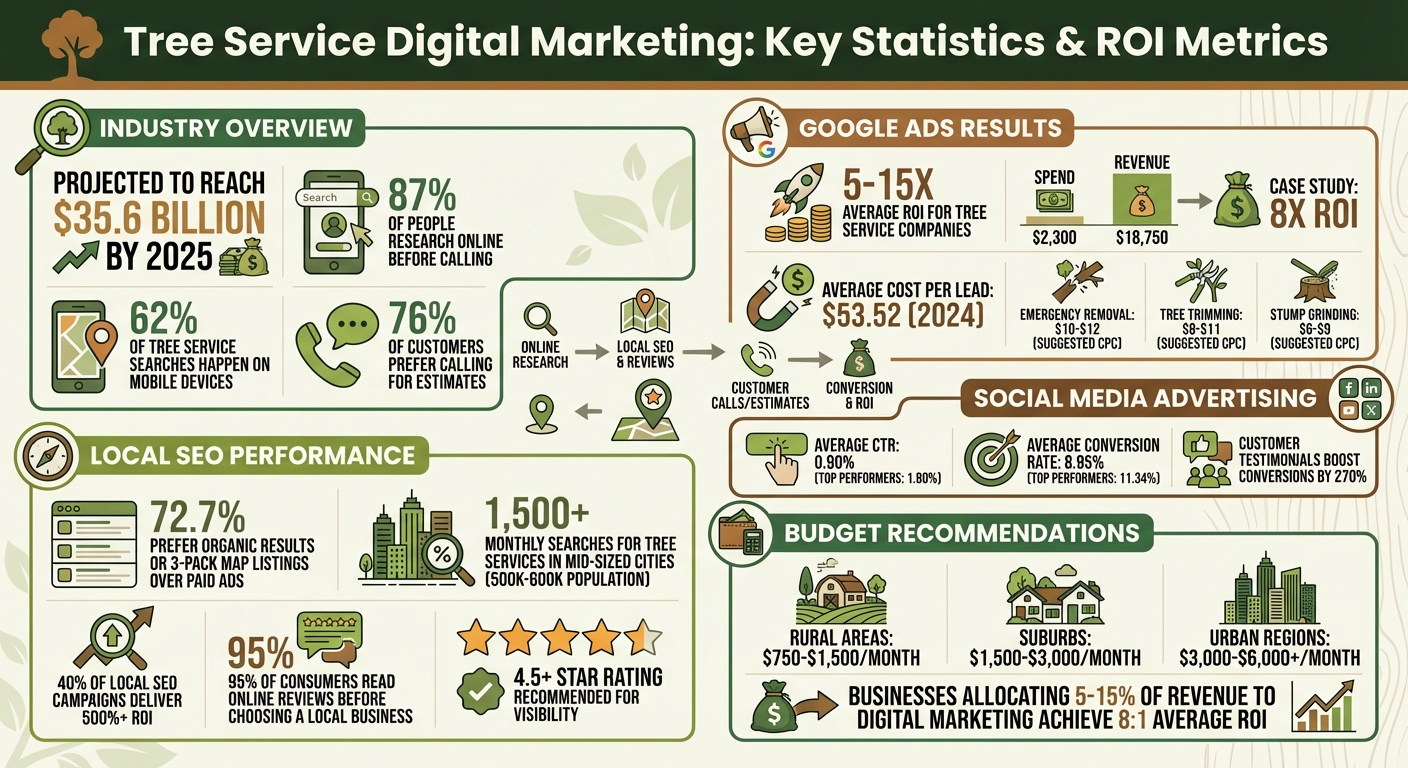
Tree Service Digital Marketing ROI Statistics and Key Metrics
The 10 Best Tree Service Marketing Ideas
Local SEO for Tree Service Businesses
Nearly half of all Google searches are local in nature. When someone searches for "tree removal near me" or "arborist in [City]", they’re often ready to hire. Local SEO ensures your tree service appears in front of these high-intent customers at just the right moment. Unlike paid ads that stop generating leads as soon as the budget runs out, local SEO builds long-term visibility, driving consistent calls month after month.
Here’s the kicker: 72.7% of searchers prefer clicking on organic results or the 3-pack map listing over paid ads. In mid-sized cities with populations of 500,000 to 600,000, there are typically over 1,500 monthly searches for tree services. And with 40% of local SEO campaigns delivering an ROI of 500% or more, it’s one of the most cost-efficient marketing strategies for tree service companies. While professional SEO management can cost between $2,000 and $5,000 per month, the steady stream of leads often makes it well worth the investment.
Google Business Profile Setup
Your Google Business Profile (GBP) is the backbone of your local SEO strategy. When people search for tree services in your area, your GBP determines whether you appear in the "Local Pack" – the top three businesses displayed alongside a map in search results. Securing this spot can dramatically increase your lead flow.
Start by claiming and verifying your profile as soon as possible. The verification process can take 2–4 weeks, so don’t wait until you’re desperate for leads. Once verified, you’ll have full control over your business details and can respond directly to customer reviews.
NAP consistency – your Name, Address, and Phone number – must match exactly across your GBP, website, and other online directories. Even small inconsistencies can confuse search engines and hurt your rankings.
Selecting the right categories is another crucial step. Set "Tree Service" as your primary category, and add secondary categories like "Arborist" or "Stump Grinding Service" to reflect your offerings. If you’re a service-area business without a physical storefront, clearly define your service area by listing all the cities and neighborhoods you cover.
Your business description is a prime spot for integrating keywords. Use terms like "tree removal", "stump grinding", and "emergency tree service" naturally. Write for people first, but make sure to include the phrases potential customers are searching for.
Photos are surprisingly impactful. Businesses with 10 or more high-quality photos tend to see higher engagement and improved rankings. Include images of your team at work, branded trucks, before-and-after shots, and your equipment. Regularly updating these photos – ideally weekly – signals to Google that your business is active.
Reviews can make or break your local rankings. With 95% of consumers reading online reviews before choosing a local business, it’s vital to request feedback from happy customers and respond to all reviews professionally. Aim for a 4.5+ star rating with recent reviews to boost your visibility.
Don’t overlook Google Posts. Posting weekly updates about completed projects, seasonal tips, special offers, or storm alerts keeps your profile fresh and engaging.
| Feature | Optimization Action | Impact on Ranking |
|---|---|---|
| Business Name | Use exact legal name; avoid keyword stuffing | High (Trust/Compliance) |
| Categories | Select "Tree Service" as primary | Critical (Relevance) |
| Photos | Upload 10+ high-quality project photos | Medium (Engagement) |
| Reviews | Maintain 4.5+ star rating with recent entries | High (Authority) |
| Posts | Update weekly with offers or tips | Medium (Activity Signal) |
Use GBP insights to track how many customers call directly from your map listing versus visiting your website. This data can help you fine-tune your strategy for even better results.
Once your GBP is optimized, shift your focus to identifying high-intent keywords your local customers are using.
Keyword Research for Tree Services
To connect with local customers, you need to target the keywords they’re searching for. Effective keyword research ensures you show up at every stage of their decision-making process.
Commercial intent keywords are essential. Focus on high-volume phrases like "tree services + [city]", "tree removal + [city]", and "arborist in [city]". For example, if you’re based in Austin, target "tree removal Austin" or "arborist in Austin."
Service-specific keywords let you reach customers with more specific needs. Terms like "stump grinding", "tree trimming", "land clearing", and "emergency tree removal" are great examples. Creating individual pages for each service not only improves rankings but also enhances the user experience.
Emergency keywords are key for capturing urgent leads. After storms or accidents, people often search for terms like "emergency tree removal", "storm damage cleanup", or "24/7 tree service". These searches tend to convert quickly due to their urgency.
With mobile usage accounting for over 60% of web traffic, optimizing for "near me" searches is a must. Queries like "tree removal near me" or "arborist near me" are common. Ensure your GBP and website content are tailored to these location-based searches.
Voice search is also on the rise. Customers using Siri, Alexa, or Google Assistant might ask, "Who offers the best tree removal near me?" or "Where can I find a certified arborist?". To capture these queries, use conversational, long-tail keywords in your FAQ sections and blog posts.
Don’t forget informational keywords to attract customers in the research phase. Queries like "when to prune apple trees", "how to tell if a tree is dying", or "best time of year for tree trimming" may not convert immediately, but they establish your expertise and keep your business top-of-mind.
"Tree Service SEO… is typically trying to show up higher for the main keywords and search intent that drive the most volume, which include ‘tree services + city’ and ‘tree removal + city’." – SEO Brothers
Use tools like Google Keyword Planner or Semrush to uncover search volumes specific to your area. In mid-sized cities, tree-related searches can exceed 1,500 per month, offering plenty of opportunities to capture traffic.
| Keyword Category | Examples | Intent Level |
|---|---|---|
| Core Services | Tree removal, tree trimming, arborist | High (Commercial) |
| Location-Based | Tree service [City], tree removal near me | High (Local) |
| Urgent/Emergency | Emergency tree removal, storm damage | Critical (Immediate) |
| Specialized | Stump grinding, land clearing, cabling | Medium (Niche) |
| Informational | When to prune trees, signs of tree disease | Low (Educational) |
Make sure to optimize your website with these keywords, especially on dedicated service pages, to strengthen your local SEO efforts.
On-Page SEO and Content
Once you’ve nailed down your keywords, it’s time to optimize your website. On-page SEO ensures search engines understand what each page is about and why it deserves to rank for specific searches.
Instead of grouping everything on one "Services" page, create separate pages for each offering – like "Tree Removal", "Stump Grinding", "Tree Trimming", and "Emergency Services". This approach improves rankings and makes it easier for visitors to find exactly what they need.
Location-based content is just as important. Develop landing pages for each city or neighborhood you serve. For example, if you cover multiple areas, create pages like "Tree Removal in [City A]" and "Tree Removal in [City B]" with localized content and meta descriptions.
Incorporate location modifiers naturally throughout your site by mentioning specific cities and neighborhoods. This helps boost your relevance for local searches and improves your visibility.
Google Ads for Tree Services
While local SEO helps build your long-term online presence, Google Ads offers immediate visibility. Launch a campaign, and your tree service can appear at the top of search results almost instantly. As SEO consultant Joel Casarez puts it, "Google Ads is your shortcut to the top of search results (like, in hours, not months)".
The numbers back this up. Tree service companies running Google Ads often report a 5–15X return on investment (ROI). For instance, in August 2025, a tree service operating in a market of 250,000 people spent $2,300 on Google Ads in one month. This generated 37 leads, resulting in 15 booked jobs and $18,750 in revenue – an impressive 8X ROI.
When someone searches for "emergency tree removal", they’re not just browsing – they’re ready to act. With 62% of tree service searches happening on mobile devices and 76% of customers preferring to call for estimates, your ads need to make it easy for potential clients to contact you.
Campaign Setup and Keyword Targeting
Setting up a Google Ads campaign correctly is critical to getting quality leads without wasting money. First, use Expert Mode instead of Smart Campaigns. Expert Mode gives you full control over keywords, bidding strategies, and location targeting.
Focus on high-intent keywords that reflect what potential customers are searching for. Examples include:
- "Emergency tree removal"
- "Tree cutting service near me"
- "Stump grinding cost"
- "Licensed arborist near me"
Organize these keywords into specific ad groups, such as Tree Removal, Emergency Services, Tree Trimming, and Stump Services. This structure improves your campaign’s Quality Score, which can lower costs over time.
To avoid wasting money on irrelevant clicks, use negative keywords. Add terms like "DIY", "jobs", "free", "how to", and "Dollar Tree" to your negative keyword list.
Start with a manual bidding strategy and set an initial daily budget of $50–$100 per campaign. This allows you to gather enough data without overspending. Spending less than $50 daily can slow down data collection. Once you’ve logged 30 or more conversions, switch to "Target CPA" bidding to let Google optimize for your preferred cost per lead.
| Service Type | Suggested Max CPC | Daily Budget Range |
|---|---|---|
| Emergency Tree Removal | $10–$12 | $75–$150 |
| Tree Trimming | $8–$11 | $50–$100 |
| Stump Grinding | $6–$9 | $40–$80 |
Ad scheduling can further boost results. Run your ads during peak search times – typically 7–9 AM, 12–1 PM, and 5–7 PM. During storm seasons, when emergency searches spike, increase your bids by 15–25% to capture the surge.
Your ads should direct users to dedicated landing pages that match the ad copy. For example, an ad about "Storm Damage" should link to a page focused on storm cleanup services. Include trust-building elements like your business license number, insurance details, and before-and-after photos to establish credibility.
Enhance your ads with extensions such as:
- Call extensions: Allow users to call directly from the ad.
- Location extensions: Showcase your service area.
- Sitelinks: Highlight specific services, like "Stump Grinding" or "Emergency Services".
Once your campaign is up and running, fine-tune your targeting to focus on local customers.
Geo-Targeting for Local Customers
Geo-targeting lets you zero in on the local audience most likely to need your services. One of Google Ads’ biggest strengths is its ability to target customers across your entire service area, not just those near your office. As Wesley Smith, founder of Tree Service Digital, explains, "Google Ads break those boundaries – you can appear across your entire service area, no matter where you’re based".
Set your location targeting to cover a 25–50 mile radius around your business or focus on specific high-value ZIP codes. This approach minimizes wasted clicks from users outside your service area. You can also use the "location in search" option to reach users searching for services in your area, even if they’re physically elsewhere. For example, someone in another city searching for "tree removal Atlanta" will still see your ad if you serve that area.
Optimize your ads for different devices. Mobile ads should include click-to-call features, while desktop ads can provide more detailed descriptions of your services. Make sure your landing pages are mobile-friendly and include prominent call buttons for easy contact.
Adjust your monthly budget based on your location’s competition:
- Rural areas: $750–$1,500 (CPC $10–$15)
- Suburbs: $1,500–$3,000 (CPC $20–$30)
- Urban regions: $3,000–$6,000+ (CPC $30–$50+)
To dominate search results, consider combining Google Ads with Local Services Ads (LSAs).
Combining Google Ads with Local Services Ads
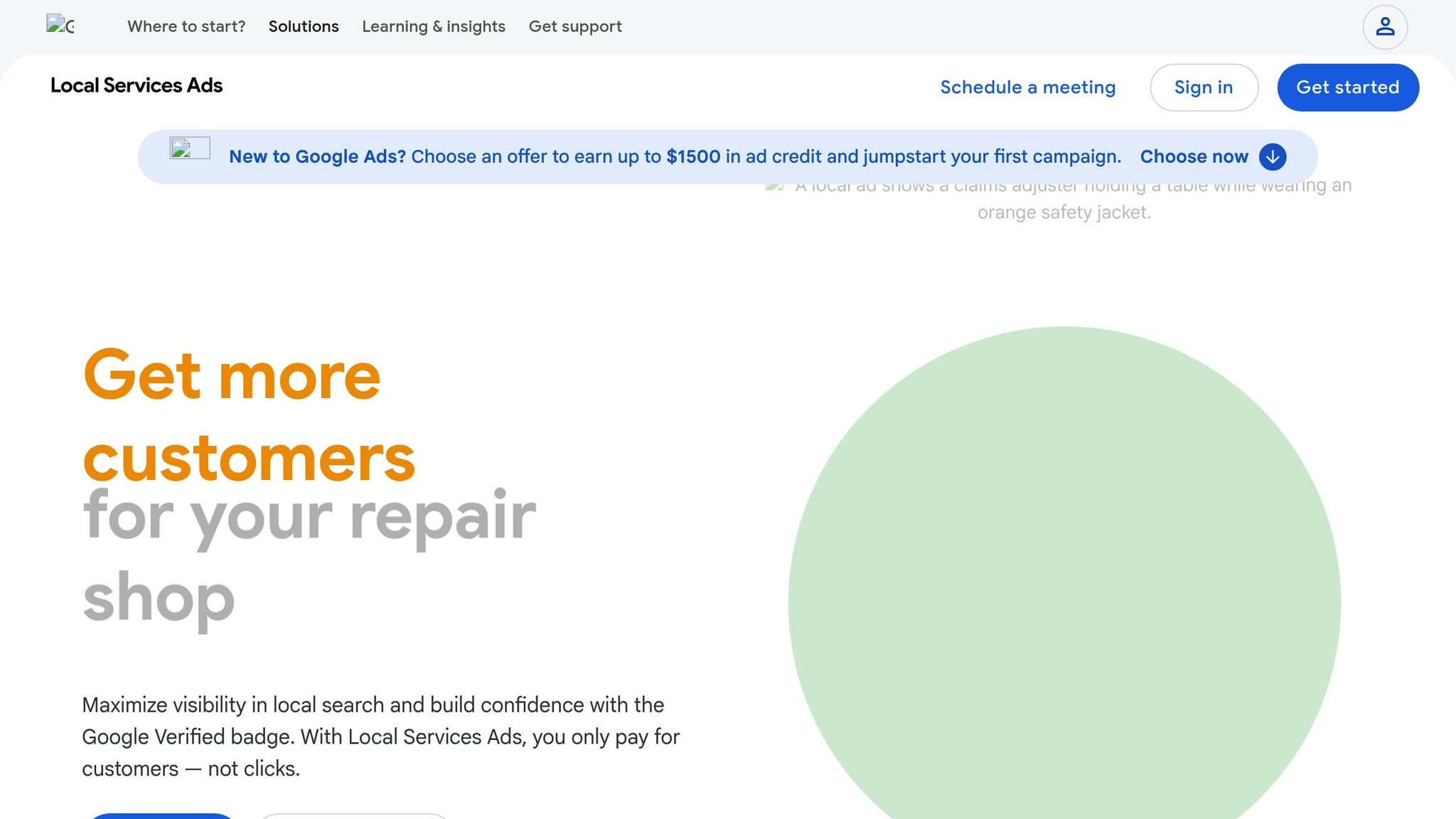
Running both traditional Google Ads and Local Services Ads (LSAs) can maximize your visibility. LSAs appear at the very top of search results and operate on a pay-per-lead model – you only pay when a potential customer contacts you directly.
One major advantage of LSAs is the Google Guaranteed badge, which you earn after passing a background check. This badge builds trust with potential customers and often increases click-through rates. As Digital Drew SEM founder Drew Blumenthal explains, "LSAs operate on a pay-per-lead model, not pay-per-click. That means you’re only charged when a potential customer contacts you directly through the ad".
Using both ad types together ensures you dominate the top of the search results. For example, when someone searches for "tree removal near me", your LSA might appear first, followed by your traditional Google Ad and then your organic listing. This layered approach increases your chances of getting contacted.
Speed matters with LSAs. Use the Google LSA mobile app to respond to leads quickly – ideally within minutes. Slow responses can hurt your ranking. And since 76% of customers prefer calling for estimates, make sure someone is available to answer calls during business hours.
Finally, track your campaign performance. Monitor phone calls (using tracking numbers), form submissions, and your Cost Per Lead (CPL). In 2024, the average CPL for tree services was about $53.52, though this can vary by market. Use this data to refine your strategy and focus on the keywords and ad types delivering the best ROI.
Social Media Advertising for Tree Services
When it comes to reaching local property owners and building brand awareness, social media advertising is a powerful tool. Unlike Google Ads, which target people actively searching for tree services, platforms like Facebook and Instagram allow you to connect with potential customers based on location, interests, and demographics. This proactive approach helps establish trust with homeowners even before they face an emergency.
The stats back it up: tree service ads on Facebook average a click-through rate (CTR) of 0.90%, with top campaigns hitting 1.80%. Conversion rates are equally impressive, averaging 8.95% and climbing as high as 11.34% for the best-performing ads. For visually oriented businesses like tree services, these platforms are a natural fit. Showcasing before-and-after photos or videos of your work can highlight your expertise and drive engagement. These metrics underline the potential return on investment when social media campaigns are executed effectively.
Meta Ads for Homeowners
Facebook and Instagram ads now rely heavily on interest-based targeting to connect with homeowners. To reach this audience, focus on interests such as Home Improvement, Gardening, DIY projects, or even Home Insurance. Targeting shoppers at major home improvement stores is another effective strategy since these interests often align with homeownership.
Hyperlocal targeting is key to narrowing your audience. Use ZIP codes or set a 15–25 mile radius around specific neighborhoods. Including the neighborhood name in your ad copy – like "Serving homeowners in [Neighborhood Name] with expert tree care" – can make your ads feel more relevant and personal. For demographics, aim for users aged 35–65, as this group is most likely to own homes. Start with a daily budget of $20–$30 to gather enough data for optimization.
Next, let’s talk about how visual content can take your social media strategy to the next level.
Using Photos and Videos
Visual content is the backbone of social media success. Before-and-after photos showcasing tree removals or trimming transformations consistently outperform other types of posts [30, 35, 37]. Videos are equally effective at building trust. Whether you’re featuring your team using professional safety equipment, sharing drone footage of complex projects, or posting "day in the life" clips, video content humanizes your business and builds credibility.
Customer testimonials are another game-changer, boosting conversions by up to 270%. You can also connect with your audience by sharing "Meet the Crew" posts or introducing the business owner, which adds a personal touch to your brand.
For the best results, use high-resolution images (at least 1080×1080 pixels) and limit text overlays. While Facebook no longer bans ads with too much text, overly text-heavy visuals tend to have reduced reach. As Afsheen Ali, Product Marketing Manager at Facebook, explains:
"Our research has shown that people demonstrate a preference for ads with less text".
| Performance Metric | Industry Average | Top Performers |
|---|---|---|
| Click-Through Rate (CTR) | 0.90% | 1.80% |
| Conversion Rate | 8.95% | 11.34% |
| Engagement Rate | 1.57% | 3.14% |
Seasonal Campaigns and Retargeting
Once you’ve nailed your visuals and budget, it’s time to explore seasonal campaigns and retargeting to drive bookings. Seasonal ads create urgency and position your business as an expert. For example, you can promote spring pruning services in late February or early March, storm preparation in the summer and fall, and winter damage prevention in November and December. Launching these campaigns 2–3 weeks before the season begins ensures you’re ahead of the curve.
Here’s an example: in October 2025, a tree service company ran a Facebook campaign targeting homeowners in storm-prone areas, promoting emergency tree removal services. The result? A 25% boost in service bookings during storm season. For emergency-focused ads, use "Click-to-Call" buttons and highlight 24/7 availability to encourage immediate action.
Retargeting ads are another effective tactic. One tree service business used them to reconnect with website visitors, achieving a 30% increase in conversions over two months. You can also offer educational resources like a "Seasonal Tree Care Calendar" or "Emergency Prep Guide." These lead magnets capture contact information from potential customers who aren’t ready to book yet while positioning your business as a trusted resource.
sbb-itb-130a704
Building a Tree Service Website That Converts
Your website is your strongest tool for generating leads. With the tree care industry pulling in over $20 billion annually in the U.S., businesses with complete digital profiles see 70% more location visits than those with incomplete ones. Every aspect of your website should be geared toward turning visitors into customers.
Website Features That Generate Leads
If your phone number isn’t easy to find, you’re missing out on potential clients. Make sure click-to-call buttons are clearly visible on every page.
Create dedicated pages for each service – tree removal, pruning, stump grinding, and emergency services. Use location-specific keywords like "tree removal in [City Name]" to attract local search traffic. These pages should highlight trust signals like insurance certificates, ISA certifications, and professional association logos to establish credibility.
Visual proof of your work, like before-and-after photos or videos, can make a big difference. A service area map or location-specific pages helps reassure visitors that you operate in their neighborhood. Adding educational content, such as seasonal tree care tips, positions you as a trusted local expert.
Modern lead forms should go beyond collecting basic information. Include fields for urgency, tree details, and even photo uploads to streamline remote quoting and prequalify leads. Guillaume Heintz, a Lead Generation Strategist, emphasizes:
"Don’t just collect names – qualify for intent, location, and urgency. Your estimators’ close rate will climb instantly."
Quick responses matter: contacting a lead within five minutes can double your chances of closing the deal compared to slower follow-ups. Many tree service companies now use live chat to provide instant support. Monica Hemingway from Tree Care Marketing Solutions explains:
"The fastest responder often wins the job, even if they’re not the cheapest."
Mobile-Friendly Design
Most tree service searches happen on mobile devices. In fact, 72% of consumers turn to Google Search first when looking for local businesses, with most searches coming from smartphones. During emergencies like storm damage, homeowners need quick help. If your site is slow to load or hard to navigate on a phone, they’ll move on to the next option.
To optimize for mobile, focus on fast loading times with compressed images, simple navigation, and prominently placed click-to-call buttons. Include clear CTAs like "Request a Free Estimate" tailored for mobile users. As Jobber explains:
"Many people search for help while on their phone, so your site should be easy to use on those devices. They might even be standing in their yard, looking at a fallen tree, when they land on your site."
A mobile-friendly design is also critical for local SEO, directly affecting how your site ranks in search results. Arul Selvan, a digital marketing specialist at TechAffinity, points out:
"Technical SEO is usually carried out to provide a great user experience. It is generally done by focusing on your site speed, mobile-friendliness, crawlability, site structure, and indexation."
Customizing your website design takes these features to the next level, making it a true lead-generation powerhouse.
Custom Web Design with Tree Company Leads
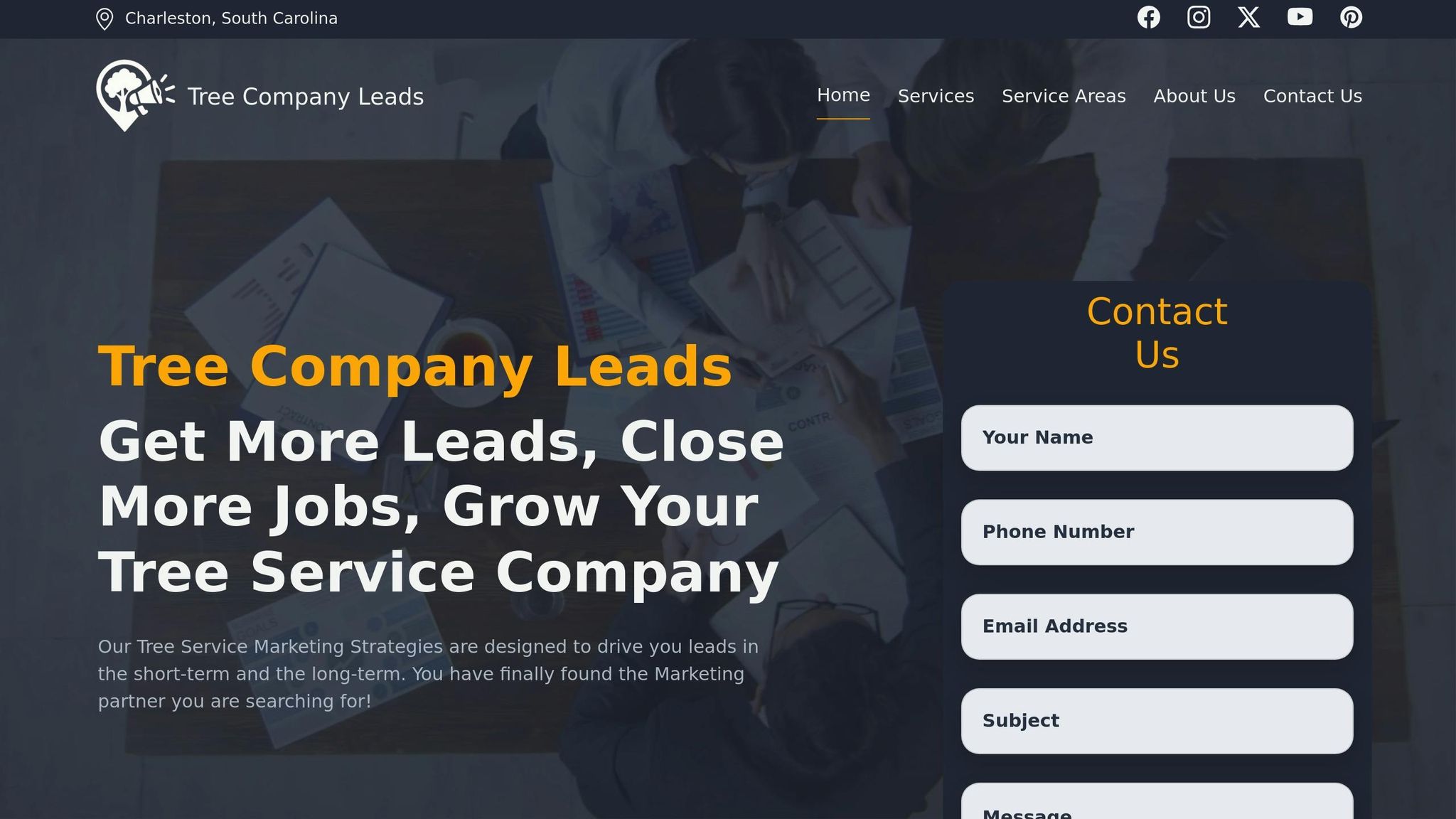
While generic website templates might save you money upfront, they rarely deliver the results you need to grow your business. Custom web design combines technical expertise with elements specifically designed to convert visitors into leads.
Tree Company Leads offers custom web design services tailored to tree service businesses. Their designs include features like seasonal messaging, fast-loading forms, and branding that reflects your company’s voice. These designs also focus on essentials like showcasing certifications, integrating service area maps, and ensuring a mobile-first experience.
Tom Sudik of Oasis Tree Care saw $17,000 in revenue from five jobs within six weeks of launching a specialized digital marketing program with Tree Company Leads. Similarly, Jack Leake of Affordable Tree & Landscape received 20 estimate requests in just two days after revamping his online presence, keeping his business busy even during slower times.
Justin Williamson from East Coast Arbor Pro sums it up:
"What it boils down to is that our phones haven’t stopped ringing since we switched to Tree Company Leads."
Custom web design isn’t just about making your site look good – it’s about creating a lead-generating system that works 24/7.
Tracking and Improving Marketing Results
Once your digital strategies are in motion, the next step is tracking their performance and fine-tuning them to get the most bang for your buck. Monitoring your efforts helps you pinpoint which channels are bringing in customers and which ones might just be draining your budget.
Measuring Performance Metrics
After launching local SEO, paid ads, and social media campaigns, keeping an eye on their performance is crucial. Focus on key metrics like website traffic, conversion rate, and cost per lead (CPL). For instance, a conversion rate above 3% is considered strong, while CPL is calculated by dividing your total spend by the number of leads generated.
Another key indicator is Return on Ad Spend (ROAS), which measures campaign profitability. For example, if you invest $2,000 in Google Ads and generate $8,000 in revenue, your ROAS is 4x. Ryan Warner, who runs a tree service business, highlights the importance of tracking:
"What we’ve realized through working with you and your team is that you can quantify marketing returns. I can look and see I’m spending this dollar and I’m getting this in return for it".
To dig deeper, use tools like call tracking. Platforms such as CallRail assign unique phone numbers to your campaigns, so you can tell whether a lead came from Google Ads, your website, or social media. Also, calculate your Customer Acquisition Cost (CAC) by dividing all marketing and sales expenses by the number of new customers acquired.
Here’s a quick overview of key metrics:
| Metric | Calculation Method | Why It Matters |
|---|---|---|
| Cost Per Lead (CPL) | Total Spend ÷ Total Leads | Measures ad efficiency |
| Conversion Rate | (Actions ÷ Total Visitors) × 100 | Shows how well your website converts traffic |
| ROAS | Total Revenue ÷ Total Ad Spend | Tracks campaign profitability |
| CAC | Total Marketing + Sales Costs ÷ New Customers | Reveals the cost of acquiring each customer |
Additionally, tools like Google Search Console can help you monitor your organic rankings and visibility over time.
Testing and Optimization
Before making any adjustments, gather performance data for at least 2–3 weeks. Regular reviews allow you to identify which keywords are driving results and which are just wasting money. Pause keywords that aren’t converting, and consider increasing bids on high-performing ones like “emergency tree removal”. Experiment with different ad elements – headlines, visuals (like before-and-after photos), and call-to-action buttons – to see what resonates most with your audience.
Fine-tune your geo-targeting by analyzing performance trends across ZIP codes. Shift your budget toward areas with high conversion rates and scale back in regions with lower-quality leads. For more control over campaigns, use Google Ads’ "Expert Mode" instead of automated Smart Campaigns. This gives you the flexibility to manage keyword bidding and location targeting.
Don’t overlook the technical side. Regular audits can ensure your website loads in under three seconds and is free of broken links . Encourage happy customers to leave reviews that include specific keywords, such as “stump grinding” and the name of their city. These reviews can boost your Local Map Pack visibility.
Combining Multiple Marketing Channels
To tie it all together, consider using a unified dashboard that tracks SEO, paid ads, and social media performance. Combining these channels creates a well-rounded marketing strategy. SEO works to build long-term visibility, while Google Ads deliver immediate leads. Running both Google Search Ads and Local Services Ads ensures you dominate the top of search results.
Each channel serves a unique purpose. Google Ads target high-intent customers actively searching for tree services, while social media ads on platforms like Meta help build awareness among homeowners who may not have an immediate need. Meanwhile, email and SMS marketing keep you on their radar for seasonal services like pruning or storm preparation.
Tools like Google Analytics and call tracking can help you follow the entire customer journey. A unified dashboard that captures calls, forms, chats, and texts ensures no leads are missed and allows for quicker follow-ups. Keep in mind that about 70% of tree service customers do their research before ever reaching out to a company.
Digital marketing is like a puzzle – every piece needs to fit together to get the best results. Businesses that use multiple channels often experience a steady flow of leads, even if one channel sees a dip.
Conclusion
If you want your tree service business to thrive in 2025, it’s essential to connect with customers across all digital platforms. The strategies outlined here work hand-in-hand to create a reliable stream of leads. Investing in local SEO helps build trust and organic visibility over time, while Google Ads and Local Services Ads provide quick results for urgent needs like emergency tree removal. Social media ads keep your services in front of potential customers during key seasons, and a fast, mobile-friendly website ensures those visitors turn into paying clients.
Businesses that allocate 5% to 15% of their revenue to digital marketing often achieve an average ROI of 8:1. Take T&T Tree Service as an example – effective digital marketing completely transformed their lead generation and revenue growth.
"Partnering with [an agency] has been a total game-changer for our tree service. We went from receiving 1-2 leads a day to consistently getting 15+ leads daily! Their expertise in website management, Google Ads, and SEO has driven a 200% revenue growth year over year." – Steve Tatalovich, Owner, T&T Tree Service
Consistency is key to staying visible online. Keep your Google Business Profile accurate and up-to-date, ensure your website is fast and optimized for conversions, and focus your ads on high-intent keywords like "emergency tree removal." Don’t forget to ask for reviews after each job – they’re invaluable for building trust and credibility.
Tree Company Leads takes the guesswork out of digital marketing by offering custom web design, targeted Google Ads, and SEO services. With these tools in place, you can focus on what you do best – running your business.
FAQs
What are the best ways to increase my tree service business’s online visibility?
To improve your tree service business’s online visibility, start by focusing on local SEO. Make sure to claim and optimize your Google Business Profile by providing accurate details like service areas, business hours, and contact information. Add high-quality photos and craft a detailed description that includes location-specific keywords such as "tree trimming in [city]" or "stump removal near [zip code]." On your website, create separate pages for each service you offer, using geo-targeted keywords in titles and meta descriptions. Don’t underestimate the power of positive customer reviews – most people rely on them before making hiring decisions. Encourage happy clients to share their feedback online.
If you’re looking for faster results, consider investing in paid advertising. Google Ads can help you target high-intent searches like "tree service near me", while allowing you to set a geographic radius to focus on local customers. Meta platforms like Facebook and Instagram are excellent for running ads that showcase before-and-after photos or seasonal tips, helping you connect with your audience. Additionally, Google Local Services Ads, if available in your area, can give your business an edge with the "Google Guaranteed" badge, which builds trust and attracts more clicks.
Don’t forget to stay active on social media and list your business in well-known directories like Yelp and Angi. Regularly post updates about recent projects, certifications, or seasonal advice to engage your audience and keep your brand visible. By combining local SEO, paid ads, and consistent social media activity, you can drive more leads and grow your tree service business effectively.
What are the best digital marketing strategies for tree service businesses?
The best digital marketing strategies for tree service businesses focus on increasing local visibility, running targeted ads, and building a website that turns visitors into paying customers.
Start with local SEO by claiming and optimizing your Google Business Profile. Make sure to use location-specific keywords like "tree trimming in Austin" and build local citations to improve your online presence. Creating helpful, service-focused content can also improve your chances of appearing in top Google Maps results, which is where many homeowners begin their search for tree services.
Next, invest in pay-per-click (PPC) advertising through platforms like Google Ads and Meta (Facebook/Instagram). PPC ads can target high-intent searches such as "tree removal near me", helping you connect with homeowners ready to book services. These ads can also be tailored by location, interests, and seasonal needs, driving immediate inquiries and bookings.
Lastly, make sure your website is built to convert visitors into leads. Your site should load quickly, be mobile-friendly, and include trust-building elements like customer reviews, certifications, and project photos. Keep your audience engaged by sharing tree care tips, before-and-after photos, and videos on your blog and social media. This not only attracts new leads but also encourages reviews, helping you grow your business while keeping marketing costs under control.
How can I optimize my Google Business Profile to improve local SEO for my tree service business?
To get the most out of your Google Business Profile (GBP) and boost your local SEO, start by making sure all your business details are accurate and up-to-date. This includes your business name, address, phone number (NAP), website, and hours of operation. Select a primary category that best represents your business, like Tree Service or Tree Removal Service, and add secondary categories for specific offerings, such as pruning or stump grinding. Make sure to list the cities or neighborhoods you serve so Google can better connect you with local searchers. Craft a short, keyword-focused description that highlights your expertise and what makes your services stand out.
Keep your profile fresh by regularly uploading high-quality photos and videos of your team, equipment, and completed projects. Ask your customers for reviews, and make it a habit to respond to all feedback – whether it’s glowing praise or constructive criticism – with professionalism and promptness. Take advantage of Google Posts to share updates like seasonal advice, special promotions, or recent projects. Don’t forget to keep an eye on the Q&A section, addressing common inquiries and fixing any incorrect information. Following these steps can help your tree service business gain more visibility in local search results and attract new customers.