
When homeowners need tree services, they act fast – 76% of local smartphone searches lead to a business visit within 24 hours. If your tree service company isn’t visible in these moments, you’re losing potential customers. Geographic Optimization (GEO) ensures your business ranks for searches like “emergency tree removal near me” and appears in Google’s Local Pack, which captures 44% of local search clicks.
Here’s how GEO helps tree service companies grow:
- Google Business Profile (GBP): Optimize your profile with accurate details, geotagged images, and regular updates to rank higher on Google locally.
- Local Keywords: Use location-based phrases like “tree trimming in Springfield” across your website and create dedicated pages for each service area.
- Citations: Ensure consistent business listings on directories like Google, Yelp, and industry-specific platforms to strengthen your local presence.
- Schema Markup: Add structured data to your website to help search engines display your business in rich search results.
With 78% of location-based mobile searches leading to offline purchases, a strong GEO strategy positions your company as the go-to local expert. By combining these tactics with tools like call tracking and review management, you can attract high-intent leads and grow your business effectively.
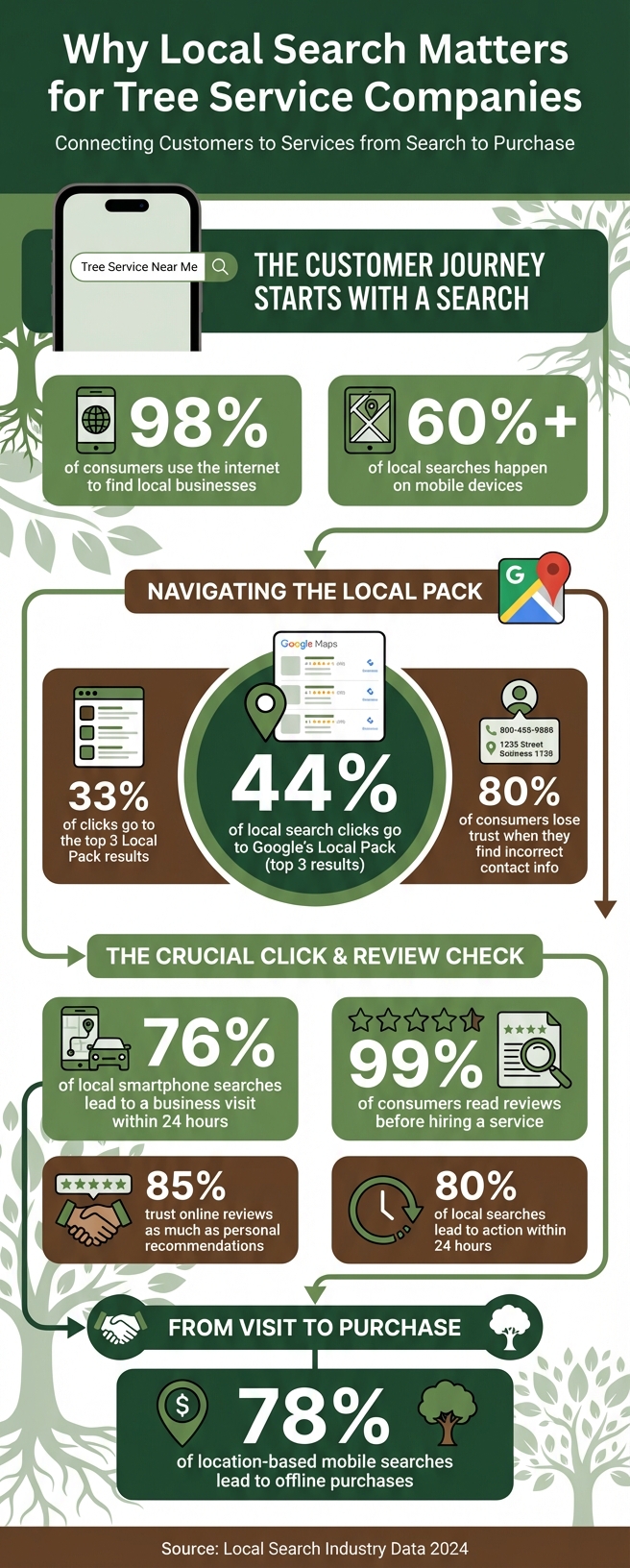
Local Search Statistics for Tree Service Companies
What is Geographic Optimization (GEO)?
GEO Basics
Geographic Optimization, or GEO, is all about making sure your tree service business shows up when people search for help in specific neighborhoods, towns, or areas within your service zone. Essentially, it focuses on the 15 to 30 miles where you actually operate.
When someone searches for terms like "tree removal near me" or "arborist in Pensacola", search engines rely on key tools like your Google Business Profile, localized web pages, and consistent business listings to confirm your service area. GEO works by aligning your online presence with your physical operating zone, using tools like structured data, local keywords, and verified listings.
Unlike traditional SEO, which casts a wider net, GEO zeroes in on the Map Pack – the top three local listings that grab 44% of local search clicks. With AI-driven local search features becoming more prominent by 2026, this strategy will only grow in importance. For businesses tied to a specific location, like tree service companies, this localized approach is a game-changer.
Why Tree Service Companies Need GEO
Once you understand how GEO works, it becomes clear why it’s essential for tree service providers. Tree services are inherently local – you can’t realistically serve customers far outside your area. This makes being visible in local searches absolutely critical. In fact, over 98% of consumers use the internet to find local businesses. When someone searches for emergency tree removal or routine tree trimming, they’re likely to call the first professional that pops up on their phone.
These aren’t casual browsers – they’re homeowners with immediate needs, ready to act fast.
"GEO ensures your business shows up in those high-intent searches… When someone’s air conditioner breaks in July or a pipe bursts in January, they’re not scrolling through page five of Google." – Optic Marketing Group
Without a solid GEO strategy, you risk losing potential customers to competitors who may not even provide better service but simply rank higher locally. For example, a newer company with 50 reviews and a 4.7-star rating can easily outrank a long-established business with only 8 reviews and a perfect 5.0-star rating. GEO helps level the playing field, positioning your company as the go-to expert in specific cities, neighborhoods, and even near local landmarks in your service area.
sbb-itb-130a704
Core GEO Strategies for Tree Service Companies
How to Optimize Your Google My Business Profile
Optimizing your Google Business Profile (GBP) is a critical first step in building a strong local presence. Start by ensuring your Business Name, Address, and Phone number (NAP) are consistent across your website and all directories. This consistency helps Google – and potential customers – trust your business. Use a local phone number with your area code instead of a toll-free number to emphasize your connection to the community.
Selecting the right primary category for your business is also key. Wesley Smith from Tree Service Digital advises:
"Your primary category on your Google Business Profile (GBP) should be hyper‑specific. For example, if you’re a tree service business, don’t just choose ‘Landscaper’ or ‘Contractor.’ Choose ‘Tree Service’".
This specificity ensures Google knows exactly what services you offer, which helps you show up in the right searches.
In the Services section, list detailed offerings like "Emergency Storm Damage Cleanup", "Stump Grinding", and "Cabling and Bracing". For your business description, focus on the first 250 characters, as this snippet appears before users click "read more".
To reinforce your local presence, upload 1–2 geotagged images every week. These could include before-and-after shots or equipment photos, embedding location data that signals your service area to Google. Keep your profile active with weekly updates – Google Posts expire after seven days, so regular posting shows you’re engaged.
Reviews are another powerful tool. With 99% of consumers reading reviews before hiring a service and 85% trusting them as much as personal recommendations, they can make or break your business. Encourage customers to mention specific services and their city in reviews (e.g., "Great tree removal in Charlotte"). Always respond to reviews, even negative ones:
"A professional, calm, and helpful response to a bad review can actually win you more business than a dozen five‑star ratings. It proves you have integrity".
These steps not only enhance your GBP but also strengthen your overall local SEO strategy.
Finding and Using Location‑Based Keywords
Once your GBP is optimized, the next step is to focus on location-based keywords. Combine your core services – like tree removal, trimming, and stump grinding – with geographic markers such as city names, neighborhoods, counties, or "near me" phrases. For example, targeting long-tail phrases like "affordable oak tree removal in West Denver" can help you attract customers who are ready to hire.
Strategically place these keywords throughout your website. Use them in headlines, H1 and H2 tags, meta descriptions, image alt tags, and URL slugs (e.g., /tree-removal-charlotte-nc). Rename image files with descriptive, location-specific names like oak-tree-removal-charlotte-before.jpg and add matching alt text. Aim for a keyword density of 1–2% to keep your content natural while still signaling relevance.
Creating unique landing pages for each major city or area you serve is another effective tactic. Avoid simply swapping out city names in the same template, as Google penalizes this "doorway page" approach. Instead, write original content that reflects local landmarks, regional tree species, or area-specific challenges like weather patterns or pests. Use your blog to answer local questions, such as "How much does stump grinding cost in Florida?" or "Do I need a permit to remove a tree in Raleigh?". Since 76% of local searches on smartphones result in a business visit within 24 hours, this targeted content can directly drive new leads.
Building Local Citations and Directory Listings
To further solidify your local presence, ensure your business details are listed consistently across reputable directories. Citations – mentions of your NAP on other websites – play a big role in Google’s local ranking algorithm. Consistency is key, as 80% of consumers lose trust in businesses when they find incorrect contact info online.
Start with the "Big Five" directories: Google Business Profile, Yelp, Facebook, Apple Maps, and Bing Places. Expand to industry-specific directories like the Tree Care Industry Association (TCIA), International Society of Arboriculture (ISA), and TreeCareHQ. Don’t forget local organizations like your Chamber of Commerce or community websites, which provide strong geographic signals.
Consistency matters. As Clicks Geek explains:
"If your business name is ‘Joe’s Tree Service LLC’ on one site and ‘Joe’s Tree Service’ on another, it creates confusion for search engines".
Stick to one format for your business name and address across all platforms. Audit your listings every six months using tools like BrightLocal, Whitespark, or Moz Local to catch and fix inconsistencies. Consider using data aggregators like Yext or BrightLocal to distribute your information across smaller directories efficiently. These efforts complement your GBP and location-based keywords, reinforcing your geographic accuracy.
| Directory Type | Examples | Primary Benefit |
|---|---|---|
| Major Search/Maps | Google Business Profile, Apple Maps, Bing Places | Direct visibility in Map Packs and navigation apps |
| General Directories | Yelp, Yellow Pages, BBB, Nextdoor | High domain authority and secondary lead generation |
| Home Service Sites | Angi, HomeAdvisor, Thumbtack | Connects with users specifically looking for contractors |
| Industry-Specific | ISA, TCIA, TreeCareHQ | Builds authority within the tree care industry |
| Local/Community | Chamber of Commerce, Local News, Sponsorships | Provides strong geographic relevance signals |
How to Structure Local Service Area Pages for Stronger SEO Performance
Advanced GEO Techniques for Tree Services
These advanced strategies build on basic GEO methods to help tree service companies dominate their local markets.
Creating Service Area Pages for Each Location
After optimizing your Google Business Profile (GBP) and building citations, the next step is to create Service Area Pages (SAPs) for each location you serve. Unlike location pages for physical businesses, SAPs focus on "service in city" keywords and don’t require a physical office in every area. To avoid penalties, steer clear of generic templates. Instead, make each page unique by incorporating local details like common tree species, neighborhood characteristics, weather challenges, and local permit requirements.
For instance:
- A page for Raleigh could highlight concerns like oak wilt and local tree ordinances.
- A page for Charleston might focus on storm damage from summer thunderstorms.
Use a clean, descriptive URL structure such as: yoursite.com/tree-removal-springfield. Your H1 header should include the city name and a clear benefit (e.g., "Fast Emergency Tree Removal in Springfield – 24/7 Response"). Adding a Google Map showing your service radius or specific neighborhoods reinforces your local presence. A localized FAQ section can answer questions like, "Do I need a permit for tree removal in Springfield?" or "How quickly can you respond to downtown storm damage?"
Boost trust by featuring customer reviews and photos of your team working at recognizable local landmarks. As Arborgold explains:
"Service area pages give search engines (and potential customers) a clear signal that you’re not only active in the area, but that you’re the trusted local expert for every type of tree care need."
Interlink your core service pages (e.g., "Tree Removal") with the relevant SAPs to improve authority and site crawlability. Since many searches for emergency tree services happen on mobile, ensure these pages load quickly and include prominent click-to-call buttons.
Once your SAPs are set, take your local SEO a step further with structured data.
Using Schema Markup for Local SEO
Schema markup helps search engines understand your business details – such as location, services, hours, and reputation. The most common format is JSON-LD, which can be added to your website’s header or footer. For tree service businesses, start with the LocalBusiness schema. Include basics like your name, address, phone number (matching your Google Business Profile), opening hours, and logo.
To go further, add:
- Service schema for offerings like "stump grinding", "tree pruning", or "emergency tree removal."
- GeoCoordinates to define your service area with latitude and longitude.
Using AggregateRating schema can display star ratings in search results, which builds trust and encourages clicks. Adding FAQ schema can help your page appear in "People Also Ask" sections, especially in voice search results. As Clicks Geek notes:
"When you spoon-feed Google this information, you make its job easy. In return, Google is more likely to feature your business in rich search results."
Before publishing, validate your schema markup using tools like Google’s Rich Results Test or the Schema.org Structured Data Validator to ensure accuracy.
| Schema Type | Purpose | Key Properties |
|---|---|---|
| LocalBusiness | Identifies your business and contact info | name, address, telephone, openingHours, logo |
| Service | Highlights specific services | serviceType, description, areaServed, provider |
| AggregateRating | Displays star ratings in search results | ratingValue, reviewCount, bestRating |
| FAQPage | Shows questions and answers in results | mainEntity (Question and Answer) |
| GeoCoordinates | Pinpoints exact location for map results | latitude, longitude, postalCode |
How Tree Company Leads Supports Your GEO Strategy
Creating a solid GEO strategy requires both time and specialized knowledge. Tree Company Leads streamlines this process by blending technical SEO with a steady stream of exclusive leads. Designed specifically for tree service companies, their approach ensures geo-targeted leads flow to your business 24/7, with you as the only responder to each inquiry. Here’s how their tailored plans complement your GEO strategy.
Tree Company Leads Plans and Features
Tree Company Leads provides two main plans, each tailored to different growth stages.
- Professional Plan: This plan focuses on local SEO and exclusive lead generation, perfect for businesses looking to maintain a steady customer base while improving their organic search visibility.
- Enterprise Plan: This option offers a more comprehensive package, including advanced web design, multi-channel campaigns across platforms like Google Ads, Meta, and YouTube, and AI chatbots to capture leads around the clock.
Since organic SEO can take 3–6 months to deliver results, these plans ensure your cash flow remains steady by leveraging paid channels while your GEO strategy gains traction.
Take it from Sarah R., a tree service owner:
"I’ve seen fantastic growth in my business since using their tree service marketing and lead generation. Their strategies are effective and tailored for the North Carolina market!"
The platform also features a lead management dashboard that provides real-time updates, call tracking, and a centralized system for managing contacts from forms, texts, and calls. These tools work seamlessly with your ongoing GEO efforts.
Combining Tree Company Leads with GEO Methods
The best results come from combining your GEO strategy with Tree Company Leads’ multi-channel approach. While you focus on building service area pages and adding schema markup, Tree Company Leads enhances your efforts through Google Local Service Ads, PPC campaigns, and conversion-focused web design. This ensures your business appears in the Map Pack, organic search results, and sponsored sections all at once.
Mike D., another satisfied customer, shared:
"Thanks to their Google Ads for tree services, my call volume has doubled in just a few weeks! The team really knows how to reach the right audience."
Additionally, the platform’s AI chatbots ensure no lead slips through the cracks, even after business hours. This integration allows your service area pages and schema markup to work hand-in-hand with paid advertising, giving your business a stronghold in local search results. By aligning these strategies, you can effectively dominate your target market.
Tracking and Improving Your GEO Results
Focus on tracking the metrics that influence your business outcomes. Nearly half of all local business interactions occur through Google Maps and the Local Pack, making visibility in these areas essential. The challenge lies in distinguishing between tactics that yield quick wins and those that drive ongoing growth.
Key Metrics to Track for GEO
Start with Google Business Profile (GBP) Insights. This tool helps you monitor customer actions like views, clicks, and calls – key indicators of high-intent leads, especially for time-sensitive services. Additionally, keep an eye on your Local Pack rankings for targeted keywords such as "tree removal [city]." Why? Because the top three results in the Local Pack attract about 33% of all clicks.
To get a broader view of your GEO success, connect local performance metrics to your website data. Use Google Search Console to identify location-specific keywords driving traffic. In Google Analytics 4 (GA4), set up conversion tracking to measure actions like phone calls, form submissions, and quote requests from particular service areas. Also, don’t overlook your review performance – the number of reviews and your average rating significantly impact your local rankings.
Here’s a quick breakdown of essential metrics and tools:
| Metric Category | What to Track | Tool to Use |
|---|---|---|
| Visibility | Local Pack ranking (top 3 spots) | BrightLocal, Google Search Console |
| Engagement | Direction requests, profile clicks | Google Business Profile Insights |
| Conversion | Phone calls, form submissions | GA4, call tracking software |
| Reputation | Review count, average rating | Google Business Profile |
Once you’ve gathered your data, the next step is to use it to make meaningful adjustments.
Adjusting Your GEO Strategy Based on Data
Using your optimized GBP and the insights you’ve collected, refine your GEO strategies regularly. Conduct weekly reviews of your GBP engagement and Local Pack rankings to spot any sudden changes or market trends. For instance, tree service demand often fluctuates with the seasons, so adjust your keywords accordingly. Experiment monthly with updates like new GBP categories, refreshed photos, or tweaks to your review request timing to see what boosts engagement.
To maintain local visibility, ensure your foundational tactics – like schema markup and service area pages – stay effective by making timely updates. Audit your citations every 6–12 months using tools like BrightLocal or Whitespark to ensure consistent NAP (Name, Address, Phone) data. Even small discrepancies, like "St." versus "Street", can confuse search engines and hurt your rankings. And remember, 80% of local searches lead to action within 24 hours, so addressing any data issues quickly is critical.
Kevin Fincel from Geol.ai emphasizes this point:
"If you only fix three things, fix data accuracy, reviews, and measurement. Everything else compounds after that".
Conclusion
For tree service companies, geographic optimization has become a necessity, not a choice. As Tree Service Marketing Agency puts it, "If your tree service does not practice local optimization, then you are losing a customer to those who do."
Local search behavior highlights the importance of this approach. Over 60% of local searches happen on mobile devices, making mobile-friendly design – complete with click-to-call buttons – essential for capturing leads. Online reviews also play a pivotal role, heavily influencing consumer decisions.
To stay ahead, ensure your Google Business Profile is claimed and verified, audit your citations for accuracy, and create city-specific landing pages. Adding schema markup can increase your local search visibility by up to 30%. Don’t overlook the value of managing your online reputation – responding to reviews professionally shows accountability and can set you apart from competitors. For an added edge, focus on generating exclusive, geo-targeted leads.
Partnering with services like Tree Company Leads can take these efforts further by delivering geo-targeted leads straight to your service areas. They also provide centralized tracking for calls, forms, and messages, helping you monitor and refine your strategy.
The tree care market is projected to hit $1.49 billion by 2025, with an annual growth rate of 7.5% through 2031. These numbers highlight the immense potential in this industry. By implementing and refining your GEO strategies, you can position your business not just to compete locally but to dominate your market.
FAQs
How long does GEO take to get my tree service ranking locally?
GEO efforts usually require 3 to 6 months of consistent work to boost your tree service’s local rankings. The exact timeline can vary based on factors like the level of competition in your area and the effort invested in tactics such as refining your Google My Business profile and incorporating location-specific keywords. Success takes time, so staying patient and committed is essential for meaningful results.
What’s the best way to pick the right cities for service area pages?
To create effective service area pages, start by targeting cities with a high search volume for keywords such as "tree removal" or "emergency tree services." Dig into your customer data and service requests to pinpoint locations where demand is strongest.
It’s also smart to look at areas where competitors are active or where the local SEO landscape is less competitive – this can help you carve out opportunities. Finally, make sure your team is equipped to provide services in the chosen areas to ensure you can meet customer needs efficiently.
Which GEO metrics actually predict more calls and booked jobs?
To attract more calls and secure more booked jobs, focus on key GEO metrics. Start by optimizing your Google Business Profile – ensure your business information is complete and accurate, including your address, phone number, and hours of operation.
Incorporate location-based keywords into your website and content. For example, if you offer tree services in Austin, Texas, use phrases like "tree trimming in Austin" or "Austin tree removal services" to capture local searches.
Encourage satisfied customers to leave positive reviews on platforms like Google. These reviews not only build trust but also boost your visibility in local search results.
Finally, aim to rank higher in the local map pack. This is the group of businesses that appear at the top of Google search results under a map. By focusing on these strategies, you’ll make it easier for potential customers to find and contact your tree service business.