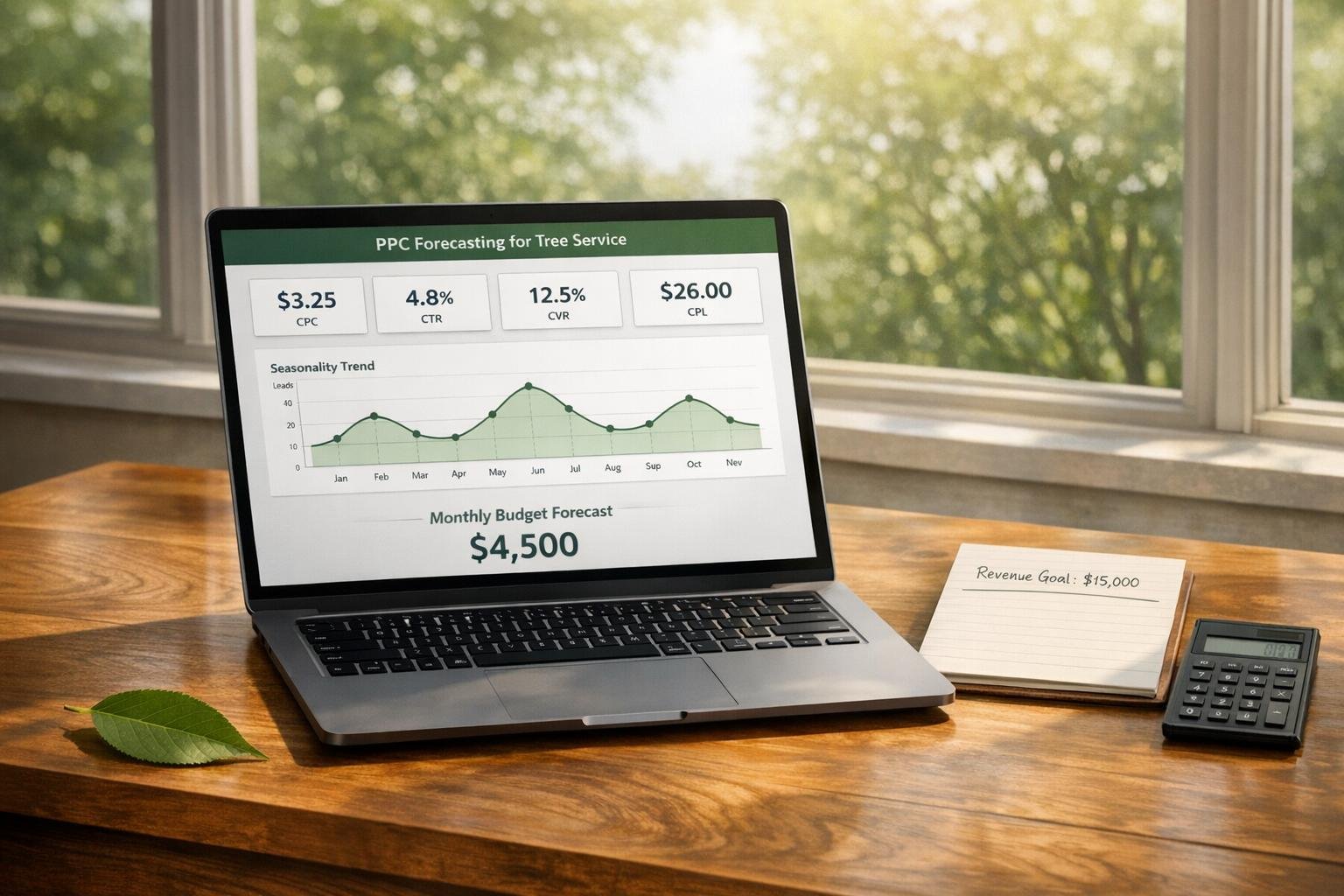
PPC advertising for tree services can drive leads quickly, but predicting costs is key to maximizing returns. Here’s how you can estimate your PPC budget and align it with your revenue goals:
- Start with your data: Use metrics like cost-per-click (CPC), click-through rate (CTR), conversion rate (CVR), and cost-per-lead (CPL) to understand ad performance.
- Compare benchmarks: Tree service CPCs average $8.57, with a CPL around $120. Adjust based on your location and service type.
- Set goals: Define revenue targets, calculate the leads needed, and estimate ad spend accordingly.
- Account for seasonality: Increase budgets during peak demand (spring/summer) and scale back in slower months.
- Refine as you go: Regularly review campaign data, adjust bids, and optimize your Google Ads setup to improve performance.
Forecasting PPC costs isn’t a one-time task. It’s about using data, adjusting for trends, and consistently aligning ad spend with business goals.
Tree Service Marketing | PPC Strategies for Tree Service Google Ads Campaign
sbb-itb-130a704
Step 1: Analyze Your Historical PPC Data
Your past Google Ads for tree services performance is the best place to start when predicting future costs. Use a full year’s worth of data, but give more weight to recent trends since cost-per-click (CPC) rates tend to increase over time.
Identify Key Metrics to Track
Not all metrics are equally helpful for forecasting. Focus on those that directly connect ad spend to revenue:
| Metric | Why It Matters |
|---|---|
| Cost Per Click (CPC) | Establishes your baseline spending per visitor. |
| Click-Through Rate (CTR) | Measures how effectively your ads grab attention. |
| Conversion Rate (CVR) | Tracks how often clicks turn into leads. |
| Cost Per Lead (CPL) | Shows the actual cost of each inquiry. |
| Close Rate | Reflects how many leads convert into paying customers. |
In addition to these, keep an eye on your average job value for different services. This adds vital context to your CPL. For example, the average value of a basic trimming job might hover around $500, while a full tree removal could exceed $5,000. Without this context, your CPL figures won’t tell the full story.
"Regardless of what your cost-per-click is, make sure you’re happy with how much the conversion costs you." – Andrew Peluso, Bananas Marketing Agency
Once you’ve gathered your key metrics, dive deeper by breaking your data into meaningful segments.
Segment Data for Clearer Insights
Divide your data by service type and location to uncover more specific trends. For instance, emergency tree removal services attract a different audience – and cost structure – than routine trimming jobs. Similarly, geographic segmentation helps pinpoint which areas generate the most profitable leads. These insights allow you to fine-tune your forecasts when adjusting your data.
Clean and Normalize Your Data
Raw data can be messy, and relying on it as-is might lead to skewed forecasts. Factors like a competitor driving up bids for a week or a seasonal slowdown can distort averages. Use the median to filter out extreme outliers, giving you a more balanced view of your campaign performance.
Another essential step is reviewing your Search Terms report to weed out irrelevant queries. Searches like "DIY tree cutting", "tree removal jobs", or "free tree service" can inflate your click numbers without adding real value. Exclude these terms from your analysis and add them as negative keywords to improve the accuracy of your historical data.
"Without conversion tracking for calls and forms, you’re gambling your budget." – Alex Gambashidze, Marketing Associate, ResultCalls
Lastly, include both phone call and form conversion data in your analysis. Ensuring your site is optimized to capture these leads is critical, as outlined in our tree service website checklist. Many tree service leads come through phone calls. If you only track form submissions, you risk underestimating your actual conversion rate and overestimating your cost per lead (CPL). By combining both data sources, you’ll get a clearer picture of your campaign’s true performance.
Step 2: Use Industry Benchmarks as a Reference
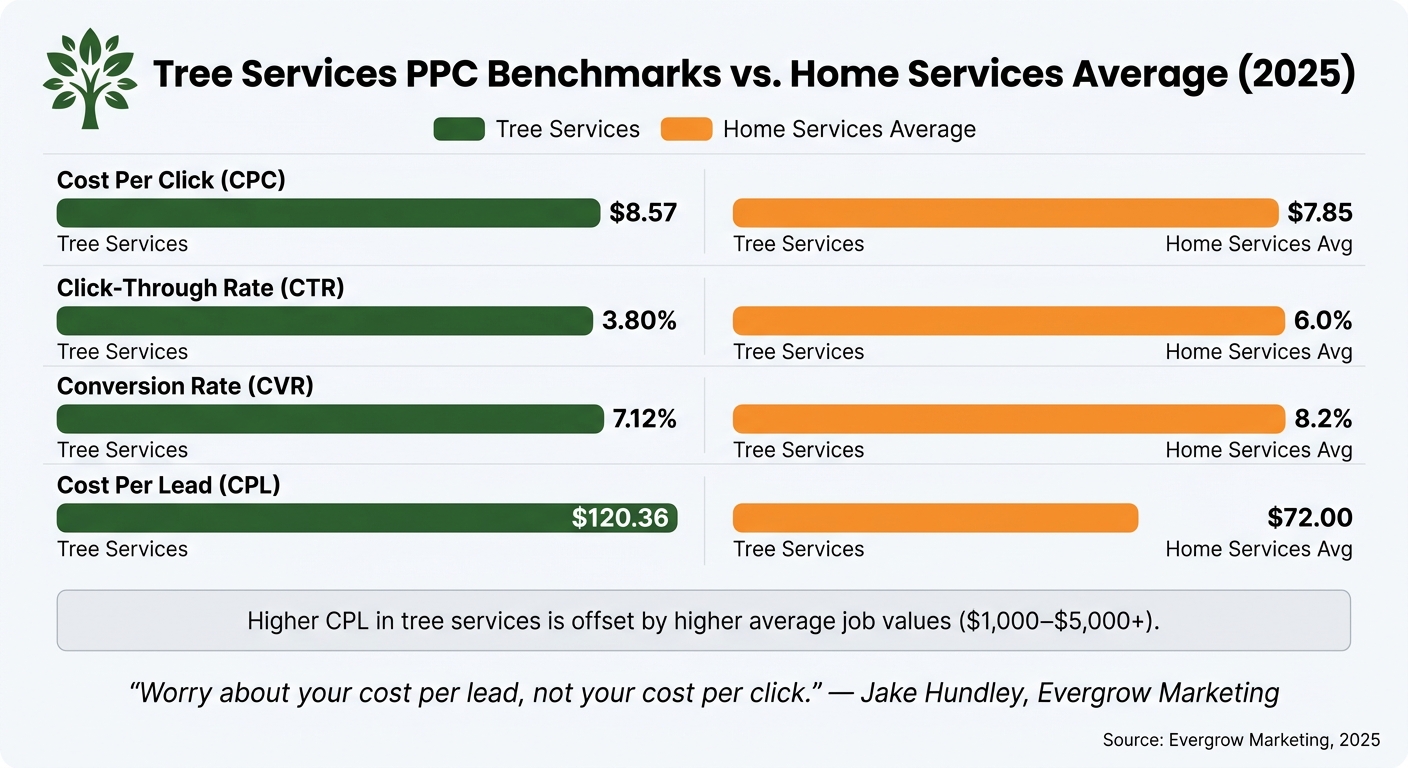
Tree Services PPC Benchmarks vs. Home Services Average (2025)
With your historical data cleaned up and organized, the next step is to compare it against industry benchmarks. While benchmarks won’t give you an exact prediction of your campaign costs, they serve as a helpful guide. They let you see if your numbers are in the ballpark or if certain areas need closer examination.
Typical PPC Benchmark Ranges for Tree Services
Tree services fall into a highly competitive niche within the home services industry. Based on Evergrow Marketing‘s 2025 data, here are some key benchmarks for tree services:
- Average Cost Per Click (CPC): $8.57
- Click-Through Rate (CTR): 3.80%
- Conversion Rate (CVR): 7.12%
- Cost Per Lead (CPL): $120.36
However, these numbers can vary widely depending on your location in Georgia. For example, CPCs might range from $10–$15 in smaller towns, but in major cities, they can climb to $30–$50 or more.
| Metric | Tree Services Benchmark | Home Services Average |
|---|---|---|
| Cost Per Click (CPC) | ~$8.57 | $7.85 |
| Click-Through Rate (CTR) | 3.80% | 6.0% |
| Conversion Rate (CVR) | 7.12% | 8.2% |
| Cost Per Lead (CPL) | $120.36 | $72.00 |
One thing to note: tree services often see lower conversion rates compared to the broader home services category. This isn’t necessarily a problem – it’s just the nature of the industry. Homeowners tend to shop around and get multiple quotes for tree removal jobs. The higher value of these jobs also means a higher CPL can still be worthwhile.
Compare Your Metrics to Industry Benchmarks
The goal isn’t to match these benchmarks perfectly but to spot any major discrepancies. For instance, if your CPC is 50% higher than the industry average, it might point to issues like low Quality Scores or overly broad keyword targeting. Similarly, if your conversion rate is lagging far behind the 7% benchmark, it could be a sign that your landing page needs improvement.
"The CPC is identical. The conversion rate is the difference between a profitable campaign and a money pit." – Tom Zhang, AdsPreview.us
A practical way to use benchmarks is to compare each key metric – CPC, CTR, CVR, and CPL – against your own data. Let’s say your CPL is $280 while the benchmark is $120. That gap could indicate problems with your bid strategy, audience targeting, or landing page. As Jake Hundley, CEO of Evergrow Marketing, explains:
"The trick is to combat [rising CPCs] with higher CTRs and CVRs in order to get lower cost leads. That’s the name of the game and why I tell clients not to worry about CPC so much. Worry about your cost per lead."
Step 3: Build a PPC Cost Forecast Model
Use your metrics to create a forecast that connects your revenue goals to a monthly ad budget.
Set Revenue Goals and Calculate Lead Needs
Start by defining your revenue target and working backward to determine how many leads you’ll need. As Kerrie Luginbill, Chief Strategy Officer at OTM, explains:
"Goal setting is critical for establishing agency-client alignment. When we set goals in collaboration with our clients, not only are we saying, ‘This is what we are trying to accomplish,’ but we’re also creating the structure for how to determine if our efforts are successful or not."
Here’s a quick example: If your average tree removal job earns $1,500 and you’re aiming for $30,000 in monthly revenue, you’ll need to book 20 jobs. With a 50% close rate, that translates to 40 leads. Assuming a 7% conversion rate from PPC, you’ll need approximately 572 clicks. Multiply those clicks by your average cost-per-click (CPC) to estimate your monthly ad budget. This process helps you calculate how much to allocate for ads each month.
Once you’ve established the total spend, break it down by service type to refine your forecast further.
Estimate Clicks and Ad Spend by Service Type
After setting revenue goals, divide your ad budget across different service categories. Costs per click can vary significantly depending on the type of tree service. For instance, emergency removal keywords might cost $40–$65 per click in competitive areas, while stump grinding keywords could be as low as $10–$20. A good starting point is to allocate:
- 40% for emergency removal
- 30% for standard removal
- 20% for trimming
- 10% for stump grinding
Here’s a breakdown of service types, estimated CPC ranges, and potential job values:
| Service Type | Estimated CPC Range | Estimated Job Value |
|---|---|---|
| Emergency Tree Removal | $40 – $65+ | $2,000 – $5,000 |
| Standard Tree Removal | $20 – $40 | $1,000+ |
| Tree Trimming/Pruning | $10 – $25 | $200 – $800 |
| Stump Grinding | $10 – $20 | Varies |
Your total monthly budget will also depend on your location. Suburban markets might require $1,500–$3,000 per month, while larger metro areas could demand $3,000–$6,000 or more.
Adjust for Seasonal Demand Changes
Once you’ve nailed down your base budget, account for seasonal demand shifts. A static budget won’t capture the fluctuations in search volume throughout the year. Spring and summer, especially after storms, tend to see higher search volumes and CPCs, while winter is usually slower.
Adjust your spending accordingly: increase your budget by 50–100% during peak seasons and reduce it by 30–50% in winter. Tools like Google Trends can help you identify when searches for terms like "tree removal" or "storm damage cleanup" are at their highest in your area. For an extra edge, consider setting automated bidding rules to raise bids during severe weather events, ensuring your ads stay visible when homeowners are actively looking for help.
"Building seasonality into your forecast tells you when your client needs to scale up, when to ease off, and how to align messaging with their target audience’s search behavior throughout the year." – Anya Leibovitch, Contributor, AgencyAnalytics
Keep in mind that increasing your budget during peak times doesn’t guarantee a proportional increase in leads. In smaller local markets, search volume has limits, and spending beyond a certain point could lead to diminishing returns. To prepare for variability, create a forecast with three scenarios: optimistic, expected, and conservative.
A solid forecast model does more than guide your budget – it lays out a plan for long-term growth. If you’d like expert help in fine-tuning your PPC cost forecast, Tree Company Leads offers custom Google Ads management and digital marketing solutions designed specifically for tree service businesses.
Step 4: Monitor and Refine Your Forecasts Over Time
Once your forecast model is set up, the work doesn’t stop there. To make your strategy effective, you need to monitor your campaign performance regularly and fine-tune your approach. A forecast only becomes valuable when you actively compare it to actual campaign outcomes and adjust as needed.
Track Actual Performance Against Your Forecast
Keep a close eye on your campaign metrics – ideally twice a week. Focus on key metrics like CTR (click-through rate), CPC (cost per click), CVR (conversion rate), and CPL (cost per lead). If these numbers stray from the 2025 benchmarks, dig deeper to find out why. For example, use call tracking tools like CallRail to verify conversions, counting calls over 60 seconds as legitimate inquiries. Additionally, maintaining a strong negative keyword list can save you from wasting 30% to 40% of your ad budget.
"Forecasts aren’t one-and-done. Regular updates help you stay aligned with real-time conditions, spot problems early, and make smarter decisions for future budget planning." – Anya Leibovitch, Contributor, AgencyAnalytics
If you notice significant differences between your forecast and actual performance, it’s time to make adjustments.
Adjust Campaigns Based on Performance Data
When performance falls short of expectations, take action. Pause keywords that are eating up your budget without delivering tree service leads. On the flip side, increase bids for high-performing terms – like "emergency tree removal near me" – that are driving real results. If certain ZIP codes are proving to be costly with little return, consider narrowing your radius targeting or excluding those areas altogether.
"Google Ads isn’t ‘set it and forget it.’ It’s ‘launch, learn, and optimize.’" – Local Tree Service Marketing
Give new campaigns about 2–3 weeks to gather sufficient data before making changes. Acting too soon might lead you to chase temporary fluctuations instead of meaningful trends. To keep improving, update your forecast model every month using the real data you’ve collected. Over time, this process will turn your forecast from a rough estimate into a dependable tool for planning and decision-making.
Conclusion: Using PPC Forecasting to Grow Your Tree Service Business
Forecasting PPC costs isn’t about guessing – it’s a structured, repeatable process. It starts with analyzing your historical data, comparing it to industry benchmarks, and building a forecast model that aligns with your revenue goals. From there, it’s all about refining the model as new performance data rolls in. This approach – anchored in data and constant adjustments – ensures your PPC campaigns contribute meaningfully to your business growth.
Ryan Warner, Owner of Local Tree Service Marketing, summed it up perfectly: "I can look and see I’m spending this dollar and I’m getting this in return for it… you take that guesswork out of doing marketing!" For example, one campaign invested $2,300 and delivered 37 leads, 15 booked jobs, and $18,750 in revenue – an impressive 8x return on investment. That kind of success doesn’t happen by chance. It’s the result of targeting the right keywords, optimizing bids, and timing campaigns strategically. These results highlight the power of a data-driven approach when shaping your PPC strategy.
When you have a strong forecast in place, your PPC campaigns are set up for consistent growth. Ready to move from guesswork to a data-focused strategy? Tree Company Leads specializes in managing Google Ads and lead generation for tree service businesses. They take care of everything – from campaign setup and keyword targeting to conversion tracking and ongoing optimization.
Your forecast isn’t static – it evolves every month. Monitor key metrics, make adjustments, and watch your business grow.
FAQs
How much should I budget per month for tree service PPC?
When planning a PPC campaign for a small to medium-sized tree service business, industry standards recommend allocating $1,000 to $2,500 per month. The specific budget will vary based on factors like the size of your market and your advertising objectives. This range is often a solid starting point to attract leads and support business growth.
What numbers do I need to forecast PPC costs accurately?
To figure out PPC costs for your tree service business, start by collecting some essential numbers: your monthly ad budget (anywhere from $2,000 to $13,000 is common), the average cost per click (CPC) in your industry, your expected conversion rate (about 10.22% for home services), and how many leads you want each month. By breaking down these details, you can match your budget to your growth targets and get a clearer picture of your potential expenses.
How do I adjust my PPC budget for tree service seasonality?
Seasonal shifts can have a big impact on your PPC campaigns, so it’s important to plan your budget accordingly. Start by analyzing demand fluctuations and comparing them to industry benchmarks. During peak seasons, it’s smart to increase your ad spend to take advantage of higher conversion rates. For services or products that are relevant all year, keeping a consistent budget can help maintain steady performance.
Make it a habit to track your campaign performance closely. During high-demand periods, adjusting your bids can help you stay visible when competition ramps up. Use insights from your data to align your ad spend with seasonal trends – this approach ensures you’re getting the most out of your budget while staying competitive.