If you’re deciding between referral programs and paid ads to grow your tree service business, here’s the quick breakdown:
- Referral Programs: Leverage your happy customers to bring in new ones through rewards. They generate high-quality leads with a 75–85% closing rate, cost less (you only pay when deals close), and create long-term growth. However, they take time to scale and need consistent promotion.
- Paid Ads: Use platforms like Google or Facebook to target potential customers instantly. They offer fast results and scalability, but costs can be high ($10–$50 per click), and the leads often need more effort to convert.
Quick Comparison
| Metric | Referral Programs | Paid Ads |
|---|---|---|
| Cost Structure | Pay only for closed deals ($25–$75) | Pay-per-click ($10–$50 per click) |
| Lead Quality | High (75–85% closing rates) | Variable, often requires nurturing |
| Scalability | Limited by current customer base | Highly scalable with budget |
| Speed | Slower, builds over time | Immediate lead flow |
| Sustainability | Long-term growth loop | Stops when spending stops |
Key Takeaway: Referral programs are cost-effective and bring in loyal customers, while paid ads are better for quick visibility and scaling. The best approach? Combine both. Use paid ads to attract new customers and referral programs to turn them into long-term advocates.
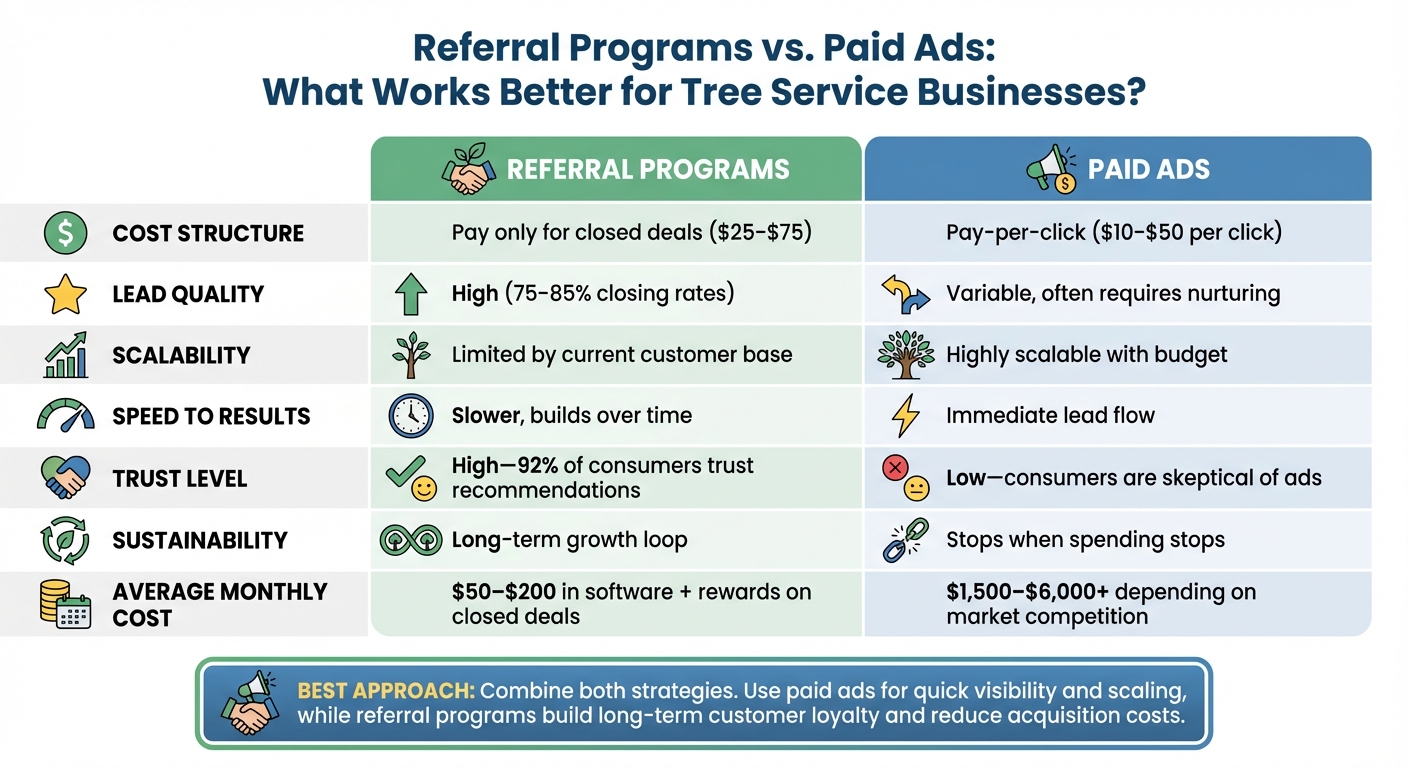
Referral Programs vs Paid Ads Comparison for Tree Service Businesses
Referral Programs: Pros and Cons
Benefits of Referral Programs
Referral programs can be a game-changer in tree service marketing. The trust factor is a standout benefit – 92% of consumers trust recommendations from people they know more than any other type of advertising. Think about it: when a happy customer tells their neighbor about your tree removal services, that personal endorsement carries a weight no ad campaign can replicate.
Here’s another impressive stat: referrals in the green industry close at rates between 75% and 85%. That’s a huge leap compared to most other lead sources. Chad Diller, CEO of Landscape Leadership, puts it plainly:
"Referrals close at a higher rate than most other marketing mediums and the customers that result also are more easy to retain."
Cost is another big plus. Traditional marketing efforts can cost tree service companies anywhere from $100 to $150 per new customer. Referral programs, on the other hand, only cost you when they convert.
Referred customers also tend to be more valuable. They bring in 16% to 25% higher lifetime value and boast a 37% higher retention rate compared to customers acquired through other channels. In home services, referred customers even spend 18% more on average, showing they’re more likely to invest in quality care from the start.
And here’s where verbal referrals shine: they convert into sales 32% of the time. Compare that to social media referrals, which only convert at 1%, and it’s clear that personal conversations still drive real business.
But, like any strategy, referral programs have their challenges.
Drawbacks of Referral Programs
While referral programs offer plenty of benefits, they’re not without their limitations. The biggest hurdle? Speed and scale. Unlike paid ads that can generate a flood of leads almost instantly, referral programs take time to gain momentum. Their reach depends heavily on the size and engagement of your current customer base.
Interestingly, fewer than half of green industry companies even have a formal referral program in place. Why? Many find the administrative work overwhelming. Relying on spreadsheets to track referrals can lead to missed payouts, which frustrates customers and damages trust. As Chad Diller warns:
"Nothing will suck the wind out of your brand evangelists’ sails more quickly, than crappy follow-up and lousy tracking."
Another challenge is maintaining a satisfied customer base. One bad experience – like a poorly handled tree removal – can stop your referral chain in its tracks. And these programs aren’t “set it and forget it.” They require constant effort. You need to actively promote them through invoices, emails, and conversations with happy customers. Without this, participation rates can remain disappointingly low.
The reward structure also plays a critical role. Diller urges tree service owners to carefully evaluate their incentives. Even what seems like a generous offer might not be enough to motivate customers. Whether it’s $50 cash, account credits, or tiered rewards for bigger projects, the key is to make the reward enticing enough for customers to take action.
Here’s a reality check: 61% of customers will make only one referral, while just 5% become “super-referrers” who make 11 or more. Finding and nurturing these high-value advocates requires a clear, deliberate strategy. Without it, you risk leaving untapped potential on the table.
Paid Ads: Pros and Cons
Benefits of Paid Ads
Paid advertising delivers immediate visibility, making it an attractive option for businesses looking to get results fast. SEO consultant Joel Casarez puts it succinctly:
"Google Ads is your shortcut to the top of search results (like, in hours, not months)."
This speed is crucial when homeowners search for urgent services like "emergency tree removal near me." With 62% of tree service searches happening on mobile devices, being visible at the right moment can make all the difference.
Another major advantage is precise targeting. Paid ads let businesses focus their budget on specific areas, such as certain zip codes or high-value neighborhoods. They can even target specific timeframes – for instance, running ads only from Tuesday through Saturday, 7 AM to 8 PM, when potential customers are most likely to act. This approach ensures ad spend is concentrated on high-intent leads. For example, ad bids for emergency tree removal typically range between $10 and $12 per click, while stump grinding costs hover around $6 to $9.
Local Services Ads (LSAs) add an extra layer of trust by displaying the "Google Guaranteed" badge, which gives homeowners confidence in the business. Unlike traditional Google Ads, LSAs charge on a pay-per-lead basis, meaning you only pay when someone calls or texts.
The numbers back up the effectiveness of paid ads: pay-per-click advertising delivers an average 200% return on investment for home service businesses. On top of that, 90% of consumers say paid ads influence their purchasing decisions. This makes paid advertising a powerful tool, especially during high-demand times like post-storm cleanups or the spring trimming season.
But while the benefits are clear, paid ads come with their own set of challenges.
Drawbacks of Paid Ads
The biggest downside to paid ads is cost. In competitive metropolitan markets, businesses may pay $50 or more per click, and there’s no guarantee those clicks will convert into paying customers. Monica Hemingway, founder of Tree Care Marketing Solutions, warns:
"Google Ads costs seem to be going through the roof in the tree service industry."
For smaller tree service businesses, monthly ad budgets typically range from $1,000 to $2,500 just to stay competitive. Larger companies often spend as much as $10,000. And here’s the catch: once you stop spending, the leads stop coming in. Aya Musallam of Viral Loops describes it as:
"The moment you turn off the tap, the leads dry up. It’s a relentless, expensive treadmill."
Another issue is the inconsistency in lead quality. Without careful targeting, businesses risk attracting irrelevant clicks. For example, failing to exclude keywords like "DIY", "jobs", or "free" can lead to wasted ad spend on users who have no intention of hiring a professional.
Running a successful paid ad campaign requires more than just money – it demands expertise. Businesses need to continuously refine keywords, optimize landing pages, and monitor performance. Unlike referral programs, where costs are tied to results, paid ads require ongoing investment and skilled management to see returns.
Lastly, paid ad leads often come with a trust gap. These are cold contacts, so converting them into paying customers requires extra effort and nurturing. With search volume for tree services dropping by as much as 60% in some areas, competition for high-quality leads has become tougher than ever.
Paid ads can be a powerful tool, but they’re not without their challenges. Balancing cost, quality, and expertise is key to making them work effectively.
Referrals Over Paid Ads: The Strategy That Actually Works (With Mike Garrison)
Referral Programs vs. Paid Ads: Direct Comparison
Choosing where to allocate your marketing budget often comes down to how referral programs and paid ads stack up against each other. Both approaches offer distinct benefits, but they differ in terms of cost, lead quality, speed, and scalability.
Cost structure is a key distinction. Paid ads follow a pay-per-click model, meaning you pay for every click, whether it converts or not. For tree service-related keywords, this cost can range from $10 to $40 per click, depending on your market, with an average lead cost of about $50. On the other hand, referral programs only incur costs when a deal is successfully closed, typically between $25 and $75. Aya Musallam from Viral Loops highlights this contrast:
"Paid ads start with a trust deficit. You must spend money to get a potential customer to consider your message. A referral begins with a trust surplus."
Lead quality is another area where these two methods differ significantly. Referral leads tend to be much stronger, with closing rates in the green industry ranging from 75% to 85%. These leads are often warmer and require less effort to convert. Additionally, referred customers tend to stick around longer and have a 16% higher lifetime value compared to other leads. Referred leads also convert 30% better and close 69% faster than leads from other sources. In contrast, paid ad leads are usually cold and need more nurturing to turn into paying customers.
Speed and scalability offer a trade-off between the two approaches. Paid ads provide instant visibility and a steady flow of leads as soon as your campaign launches. They’re especially useful for quickly entering new markets or filling gaps during slower periods. Scaling is as simple as increasing your budget. Referral programs, however, take time to gain traction since they rely on your existing customer base. But while they may start slower, referrals offer long-term sustainability. Unlike paid ads, which stop generating leads once you stop spending, referrals create a "viral loop", where each happy customer can bring in more business without additional advertising costs.
Here’s a quick summary of how these two methods compare:
Comparison Table
| Metric | Referral Programs | Paid Ads |
|---|---|---|
| Cost Structure | Pay-per-result (only when deals close) | Pay-per-click or impression (regardless of conversion) |
| Lead Quality | High – warm leads closing at 75–85% | Variable – cold leads requiring nurturing |
| Scalability | Limited by existing customer base size | Highly scalable with increased budget |
| Speed to Results | Slower build; grows naturally over time | Immediate visibility and lead flow |
| Trust Level | High – 92% of consumers trust recommendations | Low – consumers are often skeptical of ads |
| Sustainability | Self-sustaining growth loop | Stops immediately when spending stops |
| Average Monthly Cost | $50–$200 in software + rewards on closed deals | $1,500–$6,000+ depending on market competition |
Both strategies have their strengths, and the right choice depends on your specific goals, budget, and timeline.
sbb-itb-130a704
When to Use Referral Programs vs. Paid Ads
Paid ads are your go-to option when you need quick results, like during peak demand or when you’re expanding your reach. On the other hand, referral programs shine when you already have a happy, loyal customer base ready to advocate for your services.
Referral programs are particularly effective because they generate warm, prequalified leads through customer recommendations. As Chad Diller, CEO of Landscape Leadership, notes:
"Customer referrals close at a higher rate than most other marketing mediums and the customers that result also are more easy to retain."
If budget constraints are a concern, referrals are a smart choice. They’re performance-based, meaning you typically pay only after a successful conversion – usually between $25 and $50 per referral. Compare this to paid ads, which often require upfront investment for testing and can be less effective during slower seasons when search volumes drop by as much as 60%.
When it comes to lead quality, referrals take the lead. They boast closing rates of 75–85% and deliver customers with 16% higher lifetime profits. Paid ads, while useful for reaching a broader audience, tend to generate colder leads, which convert at a much lower rate of 1–5%.
The most successful tree service businesses know the power of combining both strategies. Use paid ads to quickly scale or dominate your market during busy seasons. At the same time, build a strong referral program to ensure a steady flow of low-cost, high-quality leads. Companies like Tree Company Leads can help you manage Google Ads campaigns while setting up the infrastructure for a balanced approach. By blending these methods strategically, you can enhance your overall marketing results.
Using Referral Programs and Paid Ads Together
Smart tree service businesses know they don’t have to pick between referral programs and paid ads – they can use both to their advantage. Paid ads bring in new customers quickly, while referral programs turn happy customers into a steady source of new leads, often at little to no cost. By combining these methods, you can create a seamless strategy that connects the customer acquisition phase with the referral stage, amplifying the strengths of both approaches.
Here’s the challenge: referral programs don’t work without an existing customer base, and relying solely on paid ads can get expensive over time. But when you use both together, every customer you gain through Google Ads becomes a potential referrer, which helps lower your blended customer acquisition cost. Even a modest referral rate – say, 2 new customers for every 10 you acquire – can significantly reduce your overall marketing spend.
To make this strategy work, it’s essential to transition new customers into your referral program right after they book a service. Add referral invitations to your "Thank You" page or include them in confirmation emails. Incentives like "Give $50, Get $50" are especially effective at motivating referrals. Aya Musallam captures the difference between these two methods perfectly:
"Paid advertising is like shouting at a crowd through a megaphone, hoping someone listens. Referral marketing is like having a trusted friend walk someone over to you and say, ‘You two should meet.’"
Tracking the combined results is key. Use unique referral codes to measure how your efforts impact the LTV:CAC ratio (aim for 3:1 or better). Tools like Tree Company Leads can help you run Google Ads campaigns with built-in tracking that links paid customers to the referrals they bring in, giving you a clear picture of your return on investment.
Don’t forget the power of timing: field crews should ask for referrals immediately after completing a job, when customer satisfaction is at its peak. While 83% of customers are willing to refer after a positive experience, only 29% actually do unless prompted or incentivized. This is why combining referral programs with paid ads – and implementing them systematically – can make such a big difference.
Conclusion
When deciding between referral programs and paid advertising, it all boils down to three key factors: cost structure, lead quality, and speed. Referral programs are a fantastic way to generate steady growth, offering warm leads that close 75–85% of the time and bringing in customers with a 16% higher lifetime value. On the other hand, paid advertising delivers quick lead volume, making it ideal for expanding into new markets or filling gaps during slower periods.
The most successful tree service companies don’t rely on just one approach – they mix both. Referrals provide consistent, low-cost growth, while paid ads help ramp up lead volume when needed. This combination strategy not only lowers your overall customer acquisition costs but also creates a ripple effect: every customer gained through Google Ads could turn into a referrer, amplifying your growth over time.
To put this into action, take a close look at your business. If you already have a strong customer base, consider launching a referral program with clear incentives (like $50 rewards). If your brand is still building recognition, prioritize paid advertising to quickly boost awareness. The key is to track both channels closely and adjust your spending for maximum efficiency.
FAQs
What’s the best way to combine referral programs and paid ads to grow my tree service business?
Referral programs are a great way to bring in high-quality leads because they’re built on trust. When someone is referred by a friend or neighbor, they’re more likely to not only sign up but also stick around. To make your program work, offer straightforward rewards – think discounts, gift cards, or service credits – and ensure it’s simple for customers to share referral links or codes.
Want to take it up a notch? Pair your referral program with paid advertising. For instance, you could use Google Ads to drive traffic to a referral page that highlights the rewards and benefits. On social media, target your existing customers and audiences with similar interests by showcasing real-world success stories and the incentives you’re offering. And don’t forget retargeting – serve reminder ads to people who started the referral process but didn’t finish. Dedicate part of your budget to these ads and the rest to funding rewards, creating a growth strategy that’s both scalable and fueled by trust.
How do I choose between referral programs and paid ads for my tree service business?
Deciding whether to focus on referral programs or paid ads depends on what you’re aiming to achieve, how much you’re willing to spend, and how quickly you need results. Referral programs are a budget-friendly way to grow your business while building trust. Since these customers often come through personal recommendations, they’re more likely to convert and stick around. However, building a strong referral network takes time and patience.
Paid ads, on the other hand, are all about speed. They can deliver results fast and allow you to target specific audiences based on factors like location and interests. While they can bring in a high volume of leads quickly, the costs can climb, and converting those leads into loyal customers often requires extra effort.
If your goal is rapid growth or you’re running a seasonal promotion, paid ads might be the way to go. But if you’re aiming for steady, long-term growth with high-quality leads, referral programs are worth considering. Many tree service businesses find success by combining both strategies, striking a balance between quick wins and trust-driven growth.
Why do referral programs often generate higher-quality leads than paid ads?
Referral programs often generate better-quality leads because they’re built on personal recommendations from happy customers. When someone recommends your tree service business to a friend or family member, it carries a layer of trust and credibility that paid advertising simply can’t match.
These referrals tend to convert into loyal customers more easily since they already have a favorable view of your business. Plus, referral customers often look for higher-value services and are more likely to stick around, making them a dependable way to grow your business over time.