
Tracking the right metrics can transform your tree service business. It’s not just about advertising – it’s about knowing exactly where your leads come from, how much they cost, and how they impact your revenue. Here’s the bottom line:
- Why it matters: Businesses that track lead sources and close rates see a 31% revenue increase. Meanwhile, customer acquisition costs have risen 34% since 2023.
- Key metrics: Focus on cost per lead (CPL), return on ad spend (ROAS), and close rates by channel. For example, referral leads close at 72%, while paid ad leads close at 35%.
- Tools you need: Use platforms like CallRail, Jobber, and Google Analytics to track leads, revenue, and website performance.
- Local SEO is vital: Optimize your Google Business Profile (GBP) to appear in the Google Map Pack, which captures 44% of clicks in local searches.
- Customer satisfaction drives growth: Companies with 50+ reviews get 3.4x more organic inquiries. Aim for 3–5 new reviews/month and respond to all feedback quickly.
Tracking metrics isn’t optional anymore. It’s the difference between guessing and growing. Start small, focus on the basics, and scale up as your business grows.
Core Metrics for Revenue and Lead Generation
Key Metrics to Track
To connect your marketing efforts directly to revenue, it’s crucial to monitor specific metrics. For tree services, focus on lead sources, qualified leads, and close rates by channel. For example, track whether inquiries come from Google Ads, organic search, referrals, or direct channels. Then, assess how many of these inquiries turn into qualified leads – homeowners ready to book – and evaluate close rates. As a reference point, referral leads often close at around 72%, while paid ad leads typically close at 35%.
Additionally, keep an eye on cost per lead (CPL) and average job value. CPL highlights how efficiently your ad spend generates inquiries, while average job value shows whether your marketing attracts high-revenue tree removal jobs or lower-margin trimming calls.
Finally, measure your overall investment efficiency using ROI and ad spend metrics.
How to Calculate ROI and Ad Spend Effectiveness
Here are four key formulas to assess your marketing performance:
| Metric | Formula | Target Benchmark |
|---|---|---|
| Cost Per Lead (CPL) | Total Ad Spend ÷ Total Leads | $30–$75 |
| Return on Ad Spend (ROAS) | Total Revenue ÷ Total Ad Spend | 3:1 minimum |
| Cost Per Acquisition (CPA) | Total Spend ÷ Booked Jobs | ~$150 |
| Marketing ROI | (Revenue − Marketing Cost) ÷ Marketing Cost | 5:1 good / 10:1 exceptional |
These formulas provide a clear picture of how well your ad dollars are working.
A 5:1 marketing ROI – meaning $5 earned for every $1 spent – is considered solid. Achieving a 10:1 ratio is outstanding, while anything below 2:1 is usually unprofitable once you factor in overhead and job delivery costs. For Google Ads specifically, tree service keywords generally cost between $10 and $40 per click.
"Base your budget on clear goals." – Local Tree Service Marketing
Tools for Tracking Revenue Metrics
To ensure accurate tracking, you need the best lead generation tools. Call tracking software – like CallRail or CallTrackingMetrics – assigns unique phone numbers to each campaign, helping you identify which ad generated a specific call. For better accuracy, count calls lasting over 60 seconds as genuine inquiries.
On the CRM side, platforms such as Jobber, Arborgold, and SingleOps are specifically designed for field service businesses. These tools connect lead source data with completed jobs and invoices, allowing you to calculate ROI effectively. Pair them with Google Analytics to track web form submissions, and use Google Ads in Expert Mode (rather than Smart Campaigns) to access detailed keyword-level cost data.
If setting up and managing these systems feels overwhelming, Tree Company Leads offers a comprehensive solution. They handle real-time lead tracking, Google Ads management, and custom web design, ensuring your revenue metrics stay accessible without the hassle of juggling multiple tools.
sbb-itb-130a704
Website and Search Performance Metrics
Website and SEO Metrics Explained
Your website often serves as your first impression, so keeping an eye on metrics like organic traffic, keyword rankings, and CTR (click-through rate) is essential.
Organic traffic measures how many visitors land on your site via search engines without clicking on ads. This figure reflects the overall health of your SEO efforts. Meanwhile, keyword rankings show where your site appears in search results for specific searches, such as "tree removal [city]" or "emergency tree service near me". Why does this matter? Websites ranking in the top three positions typically see 40 to 80 leads per month. Clearly, learning how to rank higher on Google can make a big difference.
CTR is another critical metric – it reveals how often people click on your site after seeing it in search results. If a high-ranking page has a low CTR, it’s a sign that your titles or meta descriptions might need improvement. Don’t overlook technical performance, either. A mobile load time of under 3 seconds should be your goal.
"If you’re not on page one for ‘tree removal [your city],’ you’re losing money." – Alex Gambashidze
Once you’ve nailed these basics, you can shift focus to local SEO metrics, which are key for converting nearby searches into leads.
Local SEO Metrics for Tree Services
For tree service businesses, local SEO metrics are crucial. Start by optimizing your Google Business Profile (GBP). Ensure your NAP (Name, Address, Phone number) details are accurate, and track profile views, direction requests, and direct calls to measure how well your profile attracts local leads.
Visibility in the Google Map Pack – those top three local search results – is a game-changer. The Google Map Pack commands an average CTR of 44%. Success here depends on optimizing your GBP, managing reviews consistently, and maintaining accurate NAP details across all directories. Why is this so important? A whopping 80% of consumers lose trust in a business when they find inconsistent contact information online.
With these insights, you can move on to setting up tracking systems to monitor and improve your performance.
How to Set Up Tracking Systems
Tracking tools help you turn your website and local SEO data into actionable insights, making it easier to improve your results across the board.
Start with Google Analytics (GA4) and Google Search Console (GSC). GA4 tracks user behavior on your site, including metrics like organic sessions, time spent on pages, and form submissions. On the other hand, GSC focuses on search performance, showing which queries lead users to your site, how many impressions your pages get, and where crawl errors might be holding you back.
One practical GSC strategy is to filter for "high-impression, low-CTR" queries. These are keywords where your site appears in search results but doesn’t get many clicks. Fixing this often involves tweaking your page titles and meta descriptions. For local SEO, your GBP dashboard is invaluable – it provides monthly data on calls, direction requests, and photo views directly from your profile.
Here’s a quick breakdown of the tools and their uses:
| Tool | Metrics Tracked | Used For |
|---|---|---|
| Google Search Console | Impressions, clicks, keyword positions, crawl errors | Organic search health |
| Google Analytics (GA4) | Organic traffic, user behavior, conversions | Website performance |
| Google Business Profile | Map views, calls, direction requests | Local visibility |
| PageSpeed Insights | Load time, Core Web Vitals | Site speed & mobile UX |
If this feels overwhelming, services like Tree Company Leads can help. They combine local SEO strategies with custom web design and performance tracking, so you can focus on running your business while staying on top of the metrics that matter most.
Customer and Job Quality Metrics
Metrics That Reflect Customer Satisfaction
When it comes to measuring marketing success, numbers like Local SEO vs Paid Ads performance only tell part of the story. The real proof lies in positive reviews and referrals. For instance, tree service companies with over 50 Google reviews receive 3.4 times more organic search inquiries than those with fewer than 10.
Another important metric is review velocity, or how many new reviews you collect each month. To keep your Google Business Profile active and appealing, aim for 3 to 5 fresh reviews per month. Recent feedback carries far more weight with potential customers than reviews from months ago.
Then there’s the referral rate – a clear indicator of satisfied customers. When past clients recommend your services to others, it shows trust and satisfaction. Plus, referrals often convert into paying jobs at a much higher rate than cold leads.
"A company that appears in search, has 50+ credible reviews, and responds to inquiries within an hour wins more than a company that does better work but takes 48 hours to send a quote." – StumpIQ
Customer feedback offers valuable insights into satisfaction levels, but it’s equally important to ensure that every job contributes to your business’s profitability.
Job Value and Profitability Metrics
Once you’ve gauged customer satisfaction, the next step is to focus on how each job impacts your bottom line. Customer happiness is crucial, but so is profitability. Here are some metrics to keep an eye on:
- Gross Margin Percentage (GM%): Subtract direct variable costs (like fuel or disposal fees) from your revenue to calculate this. For tree service businesses, a healthy range is 70% to 80%. If your margins consistently fall short, it’s time to dig into where resources are being wasted.
- Average Revenue Per Billable Hour (ARPBH): This metric typically ranges between $150 and $220 for tree service work. Breaking it down by service type – like emergency removals versus routine pruning – can help you identify which jobs are the most profitable. For example, by 2026, the average revenue for tree removal is projected to hit $1,920, compared to $262.50 for standard pruning jobs.
- LTV to CAC Ratio (Customer Lifetime Value to Customer Acquisition Cost): This metric shows how sustainable your marketing budget is. A ratio of 3:1 or higher is healthy. For instance, spending $300 to acquire a one-time customer is a concern, but repeat bookings or referrals can significantly improve this balance.
How to Track Customer Reviews
Tracking and managing customer reviews is a critical part of maintaining a strong online reputation. To maximize review collection, use automated SMS tools to request feedback within 30 minutes of job completion. These timely requests convert at 3 to 4 times the rate of those sent later. When the experience is fresh, customers are more likely to leave a review.
Platforms like Jobber, ServiceTitan, and ArboStar can automate review requests and help you monitor feedback in one place. Responding to reviews – especially negative ones – within 24 to 48 hours shows professionalism and signals to Google that your profile is actively managed.
"A good response to a negative review often does more for your reputation than the negative review costs." – StumpIQ
Don’t forget to upload high-quality photos of your completed jobs to your Google Business Profile. Profiles with 40+ photos tend to perform better than those with similar review scores but fewer images. These visuals not only enhance your profile but also help potential clients see the quality of your work.
Tree Service Marketing (How We Use Google + AI to Pull Local Leads)
Systems and Strategies for Tracking Metrics
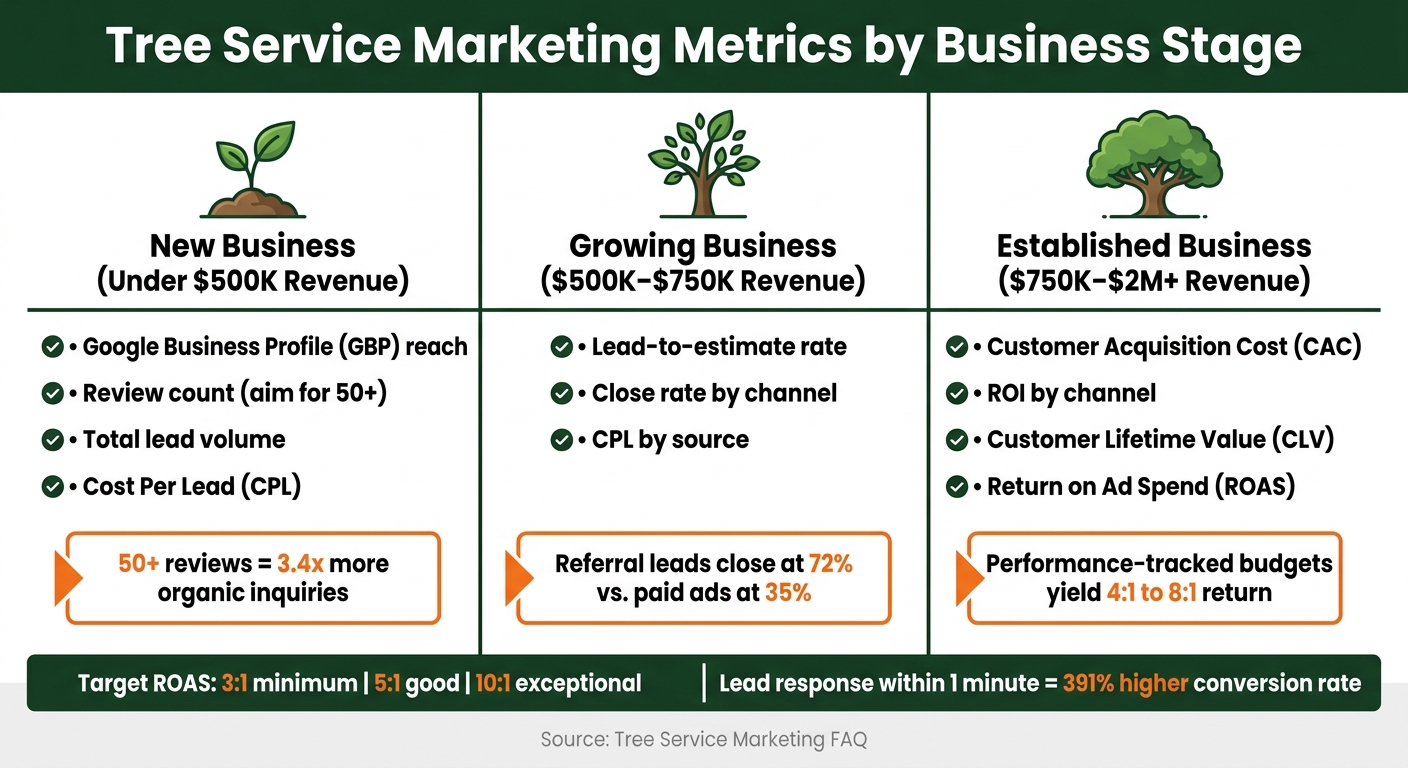
Tree Service Marketing Metrics by Business Stage
How to Set Key Performance Indicators (KPIs)
A KPI only matters if it ties directly to a business goal. For tree service businesses, KPIs can be grouped into three main categories: lead volume (like total leads and cost per lead – CPL), conversion (such as lead-to-estimate rate and close rate), and revenue (including customer acquisition cost – CAC and return on ad spend – ROAS). To keep your data meaningful, set clear definitions. For instance, count a "lead" as a phone call lasting over 60 seconds rather than any incoming call. A strong lead-to-paying-customer conversion rate to aim for is typically 25% to 35%.
Start small with two channels – Google Local Services Ads (LSAs), setting up Google Ads, and your Google Business Profile. Gather data over 30 to 90 days before expanding your efforts. Once your KPIs are set, integrate them into your tracking system for smoother analysis and decision-making.
Connecting Your Tracking Tools and Data
For most tree service businesses, the issue isn’t a lack of tools – it’s that the tools don’t work together. To bridge this gap, tag every lead at intake with its source – whether it’s from Google Search, Google Ads, referrals, direct traffic, or even door hangers. Tools like CallRail or Google Call Forwarding can help attribute phone calls to specific ads or keywords. From there, your CRM (such as Jobber, ServiceTitan, Housecall Pro, or ArboStar) consolidates this lead source data into one place.
After 90 days of tracking, you’ll have enough data to evaluate channels based on CPL, close rate, and average job value. This clarity allows you to pinpoint where to reinvest your marketing dollars . Once your tools are connected, you can adjust your focus on metrics that align with your business’s current growth phase.
Which Metrics to Focus on at Each Business Stage
As your business grows, the metrics you prioritize should shift. Trying to maximize profitability before you have a steady flow of leads is like fine-tuning a car engine before filling it with gas – it’s premature.
| Business Stage | Revenue Range | Metrics to Prioritize |
|---|---|---|
| New | Under $500K | Google Business Profile (GBP) reach, review count (aim for 50+), total lead volume, CPL |
| Growing | $500K–$750K | Lead-to-estimate rate, close rate by channel, CPL by source |
| Established | $750K–$2M+ | CAC, ROI by channel, Customer Lifetime Value (CLV), ROAS |
For businesses just starting out, visibility is everything. Optimizing your Google Business Profile and working toward 50+ reviews should be your first priority. Companies with at least 50 reviews get 3.4 times more organic search inquiries compared to those with fewer than 10. Once your lead flow stabilizes, focus on improving efficiency. Identify which channels deliver the highest close rates at the lowest cost. For established businesses, the goal shifts to scaling successful strategies and cutting underperforming ones, all guided by profitability data .
"The difference between a tree service doing $300K annually and one doing $1.2M isn’t capability – it’s customer flow." – Kevin Shea, Founder, Home Service Direct
Platforms like Tree Company Leads are designed for this structured approach. They combine Google Ads management, local SEO, and real-time lead tracking to help tree service businesses see exactly which strategies are driving revenue, no matter their growth stage.
Key Takeaways for Tree Service Marketing Metrics
The main idea here is straightforward: tracking metrics is essential for better results in tree service marketing. Companies that keep tabs on lead sources and close rates by channel can generate 31% more revenue with the same marketing budget because they know exactly which channels are delivering results.
Speed also plays a huge role in conversions. Tree removal leads are 391% more likely to convert when contacted within the first minute, and 88% of leads convert within 24 hours. Without proper tracking, businesses risk missing these critical opportunities. This highlights the importance of using tracking tools that are both effective and easy to use.
"If you can’t tell what it’s producing, you can’t improve it." – Brayden Fielding, CEO, Tree Traction
The good news? Effective tools don’t have to break the bank. CRM platforms like Jobber (starting at $49/month) or ArboStar, combined with reliable tracking tools, can connect every marketing dollar to completed jobs.
When tree service companies allocate their marketing budgets based on performance data, they typically see a 4:1 to 8:1 return. Achieving this kind of result involves 90 days of focused tracking, analyzing, and shifting budgets toward channels that work. Services like Tree Company Leads are designed to help businesses implement this strategy, ensuring every dollar spent contributes to measurable business outcomes.