Running a tree service business is challenging, especially when it comes to generating leads in a competitive market. Specialized advertising agencies for tree services focus on solving this problem by leveraging tailored strategies like local SEO vs. paid ads, and social media marketing. Here’s a quick breakdown of how they help:
- Local SEO: Optimizes your Google Business Profile, uses location-based keywords, and manages online reviews to improve visibility in search results.
- Paid Advertising: Google Ads and Local Services Ads deliver immediate leads. These campaigns are structured by service type, targeting high-intent customers with optimized landing pages.
- Social Media Marketing: Platforms like Facebook and Instagram target affluent homeowners with engaging visuals, videos, and seasonal campaigns.
- Performance Tracking: Tools like call tracking and conversion monitoring ensure ad spend delivers measurable results.
With competition rising – 150,000+ tree service companies expected in the U.S. by 2026 – partnering with an agency ensures a steady flow of exclusive leads, helping businesses grow efficiently. These agencies handle the marketing so you can focus on operations and scaling your business.
Tree Service Leads ➡️ Tree Service Marketing (Peak Inside a LIVE Campaign)
sbb-itb-130a704
Local SEO Strategies for Tree Service Companies
For tree service companies, local SEO is a game-changer. It’s all about connecting with customers who are ready to act. Think about it: when someone searches for "tree removal near me" or "emergency tree service in [city]", they’re not just browsing – they’re looking to hire right away. That’s why focusing on how to rank higher on Google is critical. It ensures your business appears in front of these high-intent customers exactly when they need you. The stats don’t lie: 97% of people search online for local services, and 73% of tree service-related searches happen on mobile devices. So, if your Google Business Profile and local keyword strategy aren’t on point, you’re missing out.
Setting Up and Optimizing Google Business Profiles
Your Google Business Profile is the backbone of your local SEO efforts. The first step is claiming and verifying your profile through Google’s postcard or video verification process. Once that’s done, make sure your business’s NAP (name, address, phone number) is consistent across all online directories – no mismatches allowed.
Choosing the right categories is just as important. Setting "Tree Service" as the primary category and adding secondary ones like "Arborist" or "Tree Removal Service" can make a big difference in search visibility. Agencies often craft a 750-character business description that naturally includes high-intent keywords like "emergency tree removal" and mentions the cities or zip codes you serve.
Photos also play a key role. Upload at least 20 high-quality, geo-tagged images showcasing your team, equipment, and before-and-after shots of completed jobs. Why? Because Google Business Posts with photos get 42% more engagement than those without. Regular updates – posted 2–3 times a week – about seasonal tips, promotions, or recent projects keep your profile active and relevant.
Once your profile is optimized, it’s time to drive organic traffic with location-specific keywords.
Using Location-Based Keywords to Increase Organic Traffic
Location-based keywords are the driving force behind local SEO success. The most effective ones combine your services with geographic terms, like "tree removal in [City]" or "stump grinding near me". High-intent phrases such as "emergency tree removal" or "tree removal cost" are especially valuable because they target customers ready to book immediately. Nearly half of all Google searches are for local businesses, and the Local Map Pack (the top three map results) captures 44% of clicks.
To make the most of these keywords, agencies strategically place them in website title tags, meta descriptions, headings, and body text. They also create dedicated landing pages for each service area, featuring 500–800 words of content that include local landmarks, unique tree issues in the area, and testimonials from nearby customers. Optimizing images with descriptive file names (e.g., "oak-tree-removal-dallas.jpg") and alt text further boosts local rankings. Adding schema markup (LocalBusiness) gives search engines structured data about your business, like address, hours, and services, enhancing your local visibility.
Managing Online Reviews and Business Reputation
Online reviews aren’t just nice to have – they’re a key ranking factor for local SEO. Google considers the volume, recency, and overall ratings of your reviews when determining your spot in the Local Map Pack.
"Google uses reviews to figure out if you’re trustworthy. A tree company with 50 reviews and a 4.7 rating beats one with 8 reviews and a perfect 5.0 every time. Volume matters. Recency matters." – Tree Service Marketing Solutions
To stay competitive, aim to generate 3–5 new reviews each month by sending customers a review link right after the job is done. Responding to reviews within 24–48 hours – whether they’re positive or negative – shows that you’re engaged and care about customer feedback. Handling negative reviews professionally can even turn a bad situation into an opportunity to build trust. With 93% of consumers saying online reviews influence their buying decisions and 76% visiting a business within 24 hours of a local search, managing your online reputation is non-negotiable.
Using Paid Advertising for Fast Results
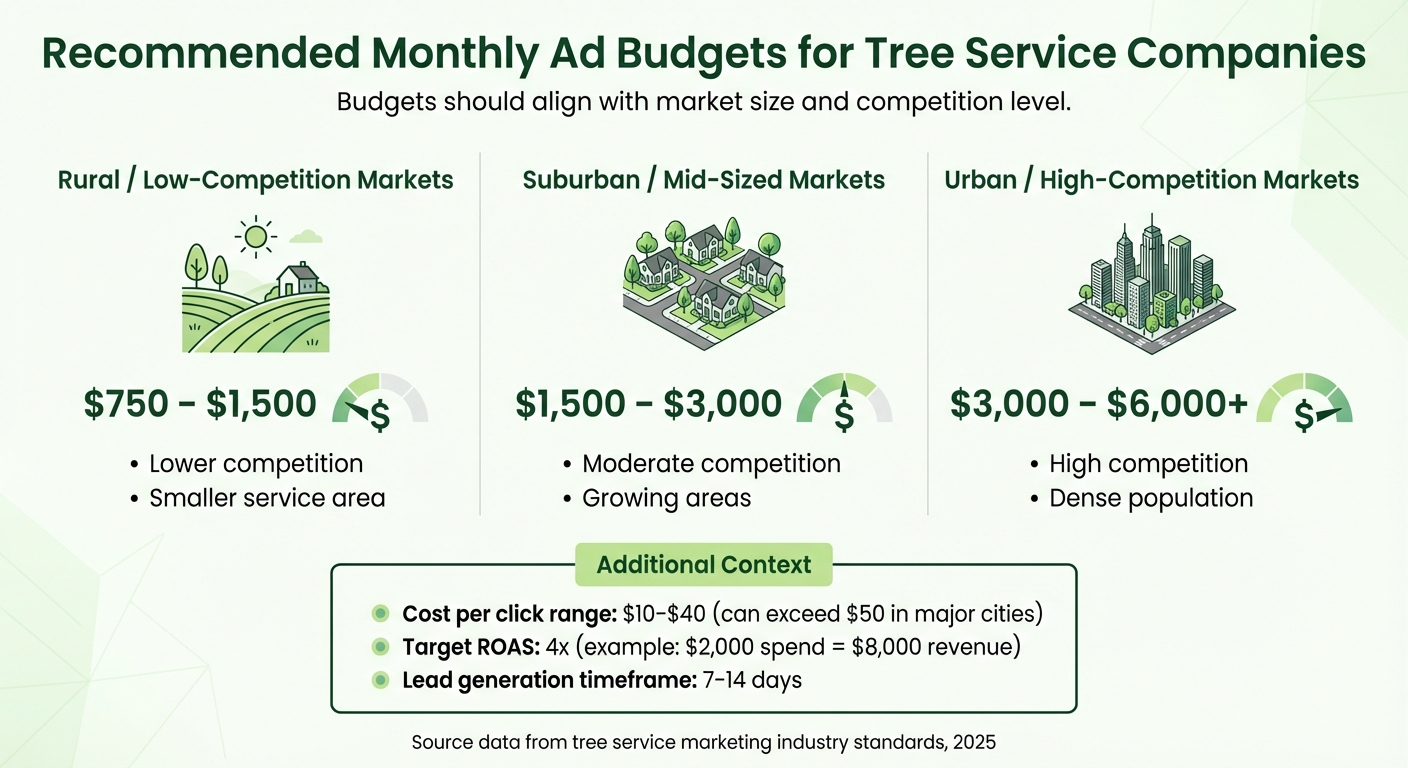
Tree Service Advertising Budget Guide by Market Type
Local SEO is great for building momentum, but if you’re looking for immediate visibility, paid advertising is the way to go. The moment your Google Ads campaign is live, your tree service business can show up at the top of search results, right when homeowners are searching for terms like "emergency tree removal" or "tree trimming near me". With 97% of consumers using search engines to research local businesses, this strategy can deliver quality leads in as little as 7 to 14 days. It’s a perfect complement to your local SEO efforts, quickly filling your pipeline with potential customers.
Optimized landing pages can increase conversion rates by as much as 40%. Agencies often use geographic targeting to focus on specific neighborhoods while excluding areas that are too far to service profitably. Additionally, negative keywords help filter out irrelevant searches, improving lead quality.
Building Effective Google Ads Campaigns
A well-structured Google Ads campaign starts with organizing ads by service type. This ensures the ad copy matches the user’s intent. For example, someone searching for "stump grinding Dallas" will see an ad highlighting stump grinding services in Dallas.
Keyword selection plays a huge role here. High-intent keywords attract customers who are ready to act. Agencies often use "phrase match" and "exact match" keywords to avoid wasting ad spend on unrelated searches like "forest service jobs" or "Christmas tree delivery". Expect the cost per click for tree service keywords to range from $10 to $40, with prices climbing above $50 in major cities.
Ad copy needs to grab attention immediately. Short, targeted headlines that mention the exact service are most effective. Chris Down of Downey Marketing highlights the importance of keeping users focused:
"Every distraction on your website is another opportunity for someone to leave without converting into a lead".
To maximize results, agencies often create dedicated landing pages with no navigation menus, a clear call-to-action, and trust signals like insurance badges and customer reviews. This approach can double conversion rates, moving from 10% to 20% or more.
From here, it’s all about aligning your budget with your performance goals.
Setting Budgets and Tracking ROI
Your ad budget should match your market size and competition. For example:
| Market Type | Recommended Monthly Ad Budget |
|---|---|
| Rural / Low-Competition | $750 – $1,500 |
| Suburban / Mid-Sized | $1,500 – $3,000 |
| Urban / High-Competition | $3,000 – $6,000+ |
Tracking key metrics like Cost Per Lead (CPL) and Return on Ad Spend (ROAS) is essential. A successful campaign might achieve a 4x ROAS, turning a $2,000 ad spend into $8,000 in revenue.
Ryan Warner, a tree service business owner, worked with a marketing agency to implement detailed tracking over two years, ending in late 2025. The results? A 114% increase in estimates and $2.9 million in revenue. Warner shared:
"What we’ve realized through working with you and your team is that you can quantify marketing returns. I can look and see I’m spending this dollar and I’m getting this in return for it".
To maintain profitability, optimization is key. Weekly reviews of search term reports help identify underperforming keywords – those with 10+ clicks but no conversions – and adjust bids based on geographic performance. Chris Down emphasizes this point:
"The reality is that optimization is where you actually make your campaign profitable. A campaign that’s been running for 6 months with consistent optimization will always outperform a brand new campaign".
Avoid using Smart Campaigns. Expert mode gives you full control over bidding and location targeting, which leads to better cost efficiency. As Chris Down warns:
"Google’s automated recommendations are designed to make the platform easier to use, but they’re also designed to get you to spend more money".
For businesses looking to save even more, Google Local Services Ads offer an alternative to traditional PPC.
How Google Local Services Ads Work for Tree Companies
Google Local Services Ads (LSAs) are a pay-per-lead model, meaning you only pay for qualified leads like phone calls or messages. These ads appear at the very top of search results and feature the "Google Guaranteed" badge, which instantly builds trust with potential customers.
To qualify for LSAs, your business must pass Google’s screening process, including background checks and verification of licenses and insurance. Once approved, your business profile will appear in the Local Services section when homeowners search for tree services in your area. This model is especially budget-friendly for companies just starting out.
However, LSAs provide less control over customer interactions since they direct users to a Google-hosted profile page instead of your website. For businesses with optimized websites, standard PPC campaigns may offer better long-term value.
In 2025, a tree service company run by Tucker launched a managed PPC campaign, generating 30 to 40 leads within three to four weeks. By focusing on high-intent leads, the business filled its schedule for eight weeks and achieved a record $90,000 in monthly revenue. This example shows why paid advertising is one of the quickest ways to grow a tree service business. Adding LSAs to the mix creates a strong multi-channel strategy for immediate and sustained growth.
Social Media Marketing for Tree Service Businesses
Social media marketing is a powerful addition to SEO and paid search strategies, offering the chance to connect with a dynamic and engaged audience. While platforms like Google Ads capture about 8% of active searchers, Facebook and Instagram reach the rest of the market. This approach isn’t about waiting for potential customers to search – it’s about sparking their interest. As Kevin Shea, Sales Manager at Home Service Direct, explains:
"Facebook advertising isn’t about capturing intent – it’s about creating it."
Tree service businesses typically allocate $800–$1,200 per month to social media marketing, which can yield 30–50 qualified tree service leads at $28–$45 per lead. These leads are exclusive, converting at rates of 60% to 75%, compared to just 20% to 35% for shared leads.
Targeting the Right Customers on Social Media
One common misstep is casting too wide a net by targeting everyone within a large radius. Effective campaigns focus on affluent homeowners aged 35 to 65 in specific zip codes, prioritizing properties with mature trees while excluding renters and apartment complexes. A layered three-tier campaign structure works well:
- Cold Traffic (40% of the budget): Introduces your brand to homeowners in the top half of the income bracket.
- Warm Traffic (30% of the budget): Retargets users who’ve interacted with your videos or page, using testimonials and social proof.
- Hot Traffic (30% of the budget): Targets website visitors and those who abandoned forms with direct offers to convert.
Since 76% of homeowners spend just 0–2 days researching before booking, and 68% call the first company they see advertised, retargeting plays a crucial role. Ads shown three or more times to homeowners before they need the service are 3.2 times more likely to convert than cold ads.
Once the audience is identified, the next step is creating visuals that grab attention and drive engagement.
Using Photos and Videos to Increase Engagement
Visual content dominates social media, being over 40 times more likely to be shared than text-only posts. Split-screen before-and-after images are particularly effective, helping homeowners visualize the potential transformation of their own trees and property. For best results, take both shots from the same angle.
Video ads are even more impactful, converting at twice the rate of static images. Popular formats include time-lapse footage of tree removals, introductory videos featuring the business owner, and educational clips like "safety assessment" tips. These formats build trust and outperform generic stock images. In fact, 89% of people say watching a video influenced their decision to purchase a service, which is why drone footage and time-lapse reels are becoming industry staples.
Authenticity is key – real photos from job sites resonate more than polished stock images. As Marketing 360 puts it:
"Social media management is no longer a luxury, it’s the virtual front yard where you build the confidence that earns the call."
Always watermark your photos and videos with your logo, and pair customer testimonials with images of completed jobs to further build trust and authenticity.
Running Seasonal Campaigns and Promotions
Seasonal adjustments to your campaigns can maximize results. In spring and summer, focus on a 10-mile radius and increase your budget by 40–50%, using time-sensitive calls to action like "Book now" or "Book by March 15 to save 15%". During fall, emphasize services like preventive trimming with messages such as "Prepare for winter storms". In winter, expand your reach to a 20-mile radius and offer early-bird discounts for spring services to keep leads coming in during slower months.
Kevin Shea underscores the importance of consistency:
"Consistency beats novelty every single time."
When storms hit, act fast by doubling or even tripling your ad spend and posting frequently – every 2 to 4 hours – with messages like "Crews standing by" or "Same-day emergency response" to capture urgent leads. Using Facebook Lead Ads can simplify the process by collecting contact information directly on the platform, reducing friction and boosting conversions. Quick responses matter – reaching out within five minutes significantly increases your chances of securing the job. Also, install the Facebook Pixel on your website to track conversions and build retargeting lists for visitors who didn’t call initially.
Measuring Performance and Improving Campaigns
Tracking is the backbone of any successful campaign. For tree service businesses, it’s essential to pinpoint which ads, keywords, and platforms are driving revenue. Key metrics to monitor include Click-Through Rate (CTR), Cost Per Lead (CPL), Conversion Rate, and Return on Ad Spend (ROAS). Ideally, campaigns should target a CTR between 3% and 5%, conversion rates of 5% to 12% (with well-optimized efforts reaching 20% to 40%), and a CPL ranging from $150 to $300.
Tracking Performance Metrics Across Marketing Channels
Accurate tracking is the first step toward improving campaigns. Tools like CallRail can assign unique phone numbers to ads, making it easier to count valid conversions (e.g., calls lasting over 60 seconds). For web-based leads, it’s important to separately track contact form submissions and online quote requests to distinguish them from general inquiries.
For example, in December 2025, a tree service client working with TreeServiceDigital invested $2,300 in Google Ads. This resulted in 37 leads, with 15 converting into booked jobs worth approximately $18,750 in revenue, delivering an 8x ROI. This kind of detailed tracking highlights exactly where returns are coming from.
Additionally, reviewing your Search Terms report weekly can help refine targeting. Adding negative keywords like "jobs", "DIY", and "free" can significantly reduce wasted ad spend. A case in point: Brent’s Tree Service collaborated with The Kaanen Group to refine their strategy, achieving a 126% increase in qualified leads while cutting their CPL by 63%. Applying these practices across channels can amplify results even further.
Integrating Multiple Marketing Channels
Relying on a single channel for leads can be risky. Instead, combining SEO, PPC, and social media ensures a steady and predictable flow of potential clients. For instance, linking Google Ads with Google Analytics lets you track how paid traffic engages with your website. Industry-specific CRMs like Arborgold or Jobber can also be integrated to track leads from their source all the way to the final invoice, providing a clear view of ROI.
A great example of this approach is Brown’s Tree Service in Fort Worth. In 2019, they partnered with Home Service Direct to launch a comprehensive digital marketing campaign. The results? A 225% increase in web traffic, along with 10+ online quotes and calls daily. Owner Lance Brown shared:
"I had the best summer of my career with leads flooding in. The higher lead volume allowed me to double my crew size and have consistent business year-round."
Strategic budget allocation also plays a big role. For tree services, consider splitting your budget like this: 40% for emergency removal, 30% for standard removal, 20% for trimming, and 10% for stump grinding. Adjust spending seasonally – boosting budgets by 50% to 100% during spring and summer, and scaling back by 30% to 50% in winter. These adjustments ensure you’re maximizing opportunities during peak seasons.
Common Marketing Mistakes to Avoid
Even with diligent tracking and integration, avoiding common errors is just as important. One major misstep is driving paid traffic to a generic homepage instead of tailored, service-specific landing pages. These dedicated pages can double conversion rates from around 10% to 20% or more.
Another frequent mistake is relying on Google’s "Auto-apply" recommendations. These automated suggestions often limit control over keyword targeting and budget allocation. Similarly, setting daily budgets too low – like $10 per day – can hinder your ability to gather enough data for informed decision-making. Lastly, when tracking phone leads, focus on call duration. Calls under 30 seconds rarely indicate a qualified prospect.
Conclusion: Working with a Tree Services Advertising Agency
Collaborating with a tree services advertising agency can save you time, cut costs, and ensure a steady flow of leads. These agencies combine strategies like local SEO, PPC, and social media to create reliable lead-generation systems. Their expertise in the tree care industry means they understand the nuances of your business – whether it’s responding to storm damage or scheduling routine maintenance. They design campaigns that align with your seasonal needs, ensuring your business stays on track. Instead of relying on unpredictable referrals, these professionals build multi-channel strategies to provide you with consistent, exclusive leads every month.
Specialized agencies have delivered impressive results, generating over $9.8 million in estimated job value for their clients through targeted marketing efforts. Their landing pages often perform better than industry norms, helping you convert more visitors into customers. With their support, you can focus on managing your crews and scaling your operations.
Key Takeaways
- Local SEO: Optimizes your Google Business Profile, drives organic traffic with location-based keywords, and builds credibility through authentic reviews.
- Paid Advertising: Google Local Services Ads and PPC campaigns can produce leads quickly, often within 48 to 72 hours.
- Visual Content: Using real job photos and videos boosts engagement and conversions – up to four times more than stock images.
- Performance Tracking: Tools like call tracking and conversion monitoring help identify which ads are driving your most profitable jobs. Professional Google Ads services for tree care can further refine these results.
To maximize your advertising dollars, avoid common mistakes like sending traffic to generic homepages instead of service-specific landing pages. Also, be sure to use negative keyword lists to prevent wasting up to $1,000 per month on irrelevant clicks. With these strategies, you can secure a competitive edge in your market.
Next Steps for Tree Service Business Owners
If you’re ready to move beyond inconsistent referrals and take control of your lead generation, it’s time to find the right agency. Look for one with experience in tree care marketing, guarantees on lead exclusivity, and transparent reporting through performance dashboards. Make sure you retain ownership of all advertising accounts to safeguard your data in case the partnership ends.
As Ryan Warner, Owner of Local Tree Service Marketing, explains:
"What we’ve realized through working with you and your team is that you can quantify marketing returns. I can look and see I’m spending this dollar and I’m getting this in return for it."
The tree services industry is expected to grow from $1.3 billion in 2024 to $2.51 billion by 2029. By aligning with a specialized agency, you can position your business to capture more of this growth – spending less time chasing leads and more time focusing on the work you’re passionate about.
FAQs
How do I choose the right service area to target?
To find the ideal service area for your tree service business, start by examining local demand and search patterns. Tools like Google Keyword Planner can help you pinpoint regions with a high search volume for tree-related services. Once you’ve identified these areas, make sure your Google My Business profile is tailored for local visibility.
It’s also smart to aim for locations where competition is lighter. By focusing on areas with strong demand and ensuring you can efficiently serve customers there, you’ll position your business to achieve the best return on investment (ROI).
Should I run Google Ads, Local Services Ads, or both?
Running Google Ads alongside Local Services Ads is a smart way to boost lead generation for your tree service business. Local Services Ads sit right at the top of search results and use a pay-per-lead model, offering high visibility while keeping costs manageable. On the other hand, Google Ads provide broader targeting options, allowing you to reach potential clients through a variety of keywords and ad formats. Together, they help you cover a wide range of search intents and connect with more potential customers.
What tracking setup do I need to prove ROI?
To show the return on investment (ROI) from your tree service advertising, start by setting up conversion tracking. This allows you to monitor actions like calls, form submissions, and leads generated from your campaigns. Use unique call tracking numbers for each campaign so you can pinpoint exactly where inquiries are coming from.
Keep an eye on important metrics such as cost per lead and conversion rates. Tools like Google Analytics can give you a comprehensive picture of your advertising performance. Make it a habit to review and fine-tune your campaigns regularly to drive measurable growth for your business.