
Competitor content analysis helps you understand what works for your competitors and how to improve your own strategy. For tree service businesses, this means studying local rivals to identify their strengths, weaknesses, and missed opportunities. Use this knowledge to refine your SEO, content, and advertising efforts.
Key takeaways:
- Identify competitors: Use Google searches, directories like Yelp, and tools like Semrush or Ahrefs to find direct and indirect competitors in your area.
- Analyze their content: Study blogs, social media, and ads to see what topics, formats, and strategies drive engagement.
- Spot gaps: Look for keywords or topics your competitors miss, like niche services or local-specific searches.
- Refine SEO and Google Ads strategies: Use tools to track rankings, backlinks, and ad strategies, then optimize your own campaigns.
How To Do Marketing Competitor Analysis (& What To AVOID)
sbb-itb-130a704
Finding Your Main Competitors
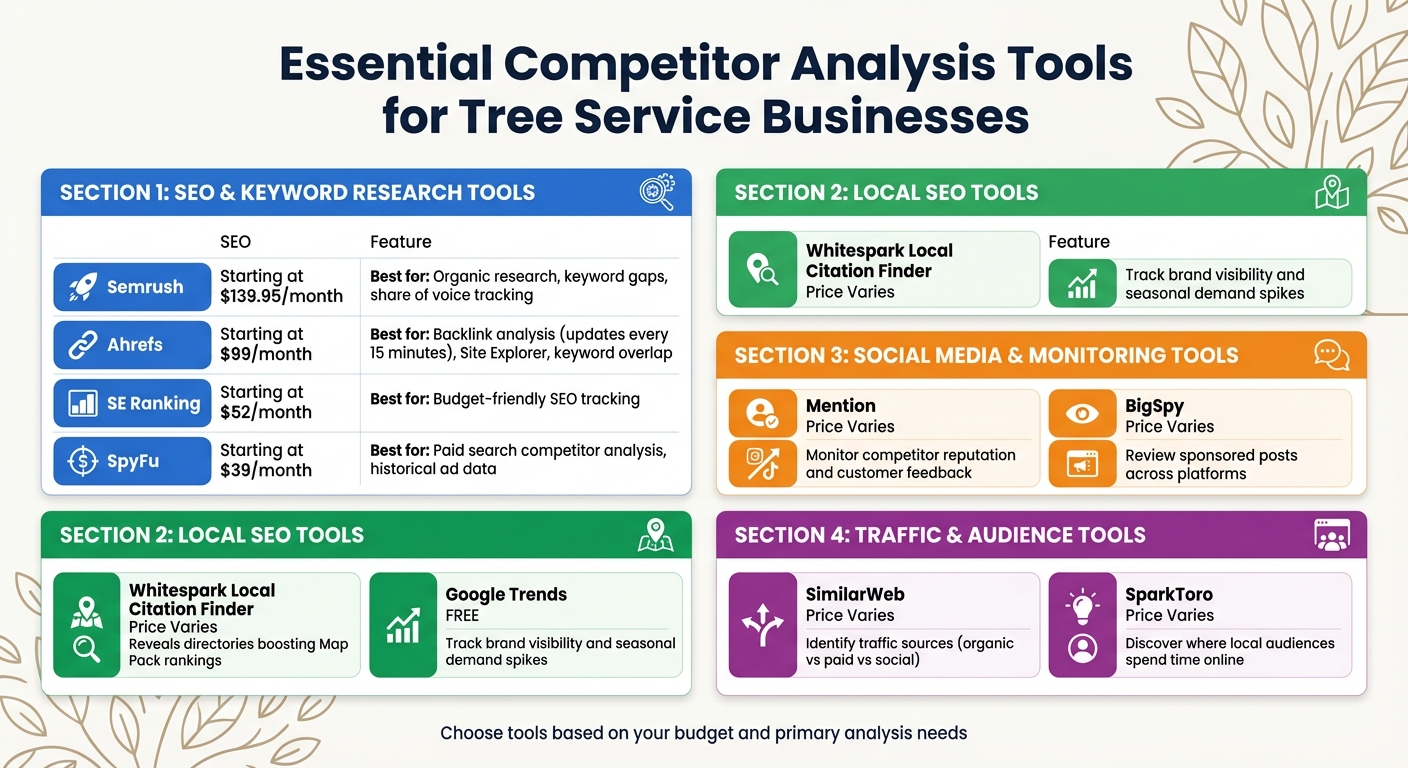
SEO and Social Media Competitor Analysis Tools Comparison for Tree Service Businesses
Before diving into content analysis, it’s crucial to identify your competitors. For tree service businesses, this means considering both direct competitors (local tree care companies targeting the same customers) and indirect competitors (landscapers or lawn care services offering basic tree trimming). While direct competitors aim for the same clientele, indirect competitors highlight alternative ways homeowners might handle tree care needs.
With over 33 million small businesses in the United States, your local market might be more crowded than you think. A structured approach can help uncover competitors you may not have noticed.
Local Competitor Research
Start by performing targeted Google searches with keywords like "tree removal near me," "emergency tree service," or "arborist in [your city]." Pay attention to companies that consistently show up in the top three Map Pack results – these are likely your most visible local competitors. Dive into their Google Business Profiles to examine their review counts, highlighted services, and how they interact with customers.
Local business directories such as Yelp, Angi (formerly Angie’s List), and HomeAdvisor are also valuable resources. These platforms can reveal which companies have the most reviews, the highest ratings, and detailed descriptions of their services. Reading customer reviews provides insight into what homeowners prioritize – whether it’s quick response times, competitive pricing, or specialized services like tree preservation.
Using Digital Tools for Competitor Discovery
Once you’ve compiled a basic competitor list through searches and directories, digital tools can help you uncover additional rivals. SEO and keyword research tools are particularly useful for spotting competitors you might otherwise miss. Platforms like Semrush (starting at $139.95/month), Ahrefs (starting at $99/month), and SE Ranking (starting at $52/month) can identify websites ranking for the same tree service keywords as your business. Simply enter your domain into tools like Ahrefs’ Site Explorer or Semrush’s Organic Research to generate a list of domains with overlapping keywords.
For more localized insights, tools like Whitespark‘s Local Citation Finder can reveal directories and citations that boost your competitors’ visibility and rank higher on Google for tree services. Additionally, paid search tools like SpyFu (starting at $39/month) can show which competitors are bidding on high-value keywords like "emergency tree removal" and even display their ad copy. Reviewing historical ad data can also help you spot successful seasonal campaigns, such as promotions for post-storm cleanup services.
Platforms like SparkToro and Similarweb offer another angle by identifying where your local audience spends time online, which can help you spot indirect competitors.
"Competitive analysis isn’t just about knowing your rivals. It’s about staying one step ahead of them." – Carlos Silva, Semrush
Google Trends is a free and insightful tool for tracking your brand’s visibility compared to competitors over time. It can also reveal seasonal demand spikes for services like "tree trimming" versus "stump grinding." Meanwhile, Ahrefs’ backlink index updates every 15 minutes, giving you near real-time insights into where competitors are building their online authority. Tools like Brand24 (starting at $149/month) and Mention can monitor online mentions of your competitors, allowing you to track their reputation and customer feedback in real time.
Reviewing Competitor Content Across Platforms
After pinpointing your main competitors, the next step is to dig deep into their content across various platforms. This means taking a close look at their websites, social media, and paid ads to figure out what’s working for them and where they’re missing the mark. The goal here isn’t to mimic their strategy but to uncover patterns, gaps, and opportunities you can use to strengthen your tree service business. Let’s start by diving into competitor blogs and website content.
Analyzing Blogs and Website Content
Start by exploring competitor websites to understand their content mix. Are they publishing how-to guides, case studies, or seasonal advice? Check their blog archives to see how often they post. Some businesses churn out weekly posts, while others focus on refreshing older content instead of creating new material.
Look closely at their topic clusters and site navigation. For instance, if a competitor has sections like "Storm Damage Cleanup" or "Tree Health Diagnostics", it’s a clear sign those topics are driving leads. Use tools like Google’s "People Also Ask" to find questions related to keywords such as "tree removal cost" that their content doesn’t address. These gaps are golden opportunities to create more detailed resources. This is a proven way to generate quality tree service leads and grow your business.
Examine the quality and depth of their articles. Are they brief 500-word posts or in-depth pieces exceeding 2,000 words? Do they use original photos from real jobs, or rely on generic stock images? Pay attention to their conversion elements, such as where they place calls-to-action for free estimates or emergency services.
"Quality content is time-consuming to produce… If a competitor is producing lots of high-quality content around certain topics, it’s because these topics are valuable to them." – Alex Walton, Competitive Intelligence Alliance
Don’t overlook technical aspects like page load speed and mobile responsiveness. Pages that take more than 3 seconds to load can drive away both visitors and search engines. With many homeowners searching for tree services on their phones during emergencies, a mobile-friendly site is crucial. Create a spreadsheet to track competitor subtopics, word counts, content formats, and technical performance. This will help you identify trends and plan your content strategy.
"Don’t just go after who ranks #1. Sometimes your most valuable insights come from competitors one tier below – that’s where real opportunity lives." – Kristavja Caci, SEO Content Marketer, Surfer
These observations can guide your marketing efforts by highlighting content gaps and untapped opportunities in your local market.
Evaluating Social Media Presence
Go beyond websites and analyze how competitors connect with their audience on social media. With 85% of businesses using social data for insights, this step is essential. Start by identifying their preferred platforms – whether it’s Facebook, Instagram, TikTok, or LinkedIn – and track their posting frequency.
Measure engagement by calculating follower ratios and categorizing their last 20–30 posts. For example, tally likes, comments, and shares, then divide by their total followers. A competitor with 2,000 followers and over 100 likes per post likely has a more engaged audience than one with 10,000 followers but minimal interaction. Note whether they focus on educational content (like tree care tips), project showcases (before-and-after photos), or promotions (seasonal discounts).
Check which content formats spark the most interaction. Posts with images tend to get 30% more shares and 25% more backlinks than text-only posts. Track their use of videos, testimonials, and live sessions. Don’t forget to analyze hashtags – both general ones like #TreeCare and location-specific ones like #DallasArborist.
Engagement quality matters too. Are customers asking questions in the comments? How quickly does the company respond? Tools like Not Just Analytics can help track Instagram or TikTok growth, while BigSpy is useful for reviewing sponsored posts. Also, pay attention to posting times; you might find that weekends are peak periods when homeowners plan outdoor projects.
These insights offer a clear view of how competitors build relationships with their audience, helping you refine your own strategy.
Reviewing Paid Advertising Strategies
Competitors’ paid advertising efforts can reveal a lot about their priorities and profitability. Start by searching high-intent keywords like "emergency tree removal" or "stump grinding near me" on Google to see which companies consistently show up in the "Sponsored" results.
Study their ad copy closely. What pain points are they addressing? Do they highlight 24/7 availability, licensed arborists, or free estimates? Click through to their landing pages to see how they guide visitors toward taking action. Look for calls-to-action, gated content like free tree care guides, and prominently displayed contact details.
For social media ads, Facebook’s Ad Library is a great resource to check out active campaigns. Tools like BigSpy can also help you analyze ad designs across multiple platforms. Document the types of visuals they use – are they running videos of tree removal jobs or static images with promotional text?
Add this data to your tracking spreadsheet, including columns for platform, ad themes, target keywords, CTA styles, and landing page URLs. Notice if competitors tailor their ads for different services. For example, storm damage ads might stress speed and emergency response, while routine trimming ads could focus on affordability and convenience.
Tools like SimilarWeb can show whether a competitor’s traffic comes mostly from organic search, social media, or paid ads. If they’re heavily investing in ads for certain services, it’s a strong indicator those services are profitable.
"When your competitors have impressive metrics, it’s essential to understand what they are doing well to build a better social media strategy." – Meagan Williamson, Pinterest Marketing Expert
These insights can help you refine your advertising strategy by pinpointing high-value services and crafting effective messaging for your campaigns.
Measuring Content Performance and SEO
To outshine your competitors in local search rankings, it’s crucial to evaluate how their content performs. By analyzing their strengths and identifying traffic-driving pages, you can refine your strategy and gain an edge. These insights will guide adjustments to your local SEO vs. paid ads strategy, helping you stay ahead in the game.
Using SEO Tools for Content Insights
Tools like Semrush, Ahrefs, and Moz are invaluable for diving into competitor SEO performance. Start by examining their monthly organic search traffic to gauge how much attention their content attracts from Google. For instance, if a competitor’s blog post on tree pruning techniques draws significant traffic, it suggests the topic resonates strongly with searchers.
Check keyword rankings using Semrush’s Organic Research or Ahrefs’ Site Explorer. A high number of top-10 keyword rankings is a clear indicator of a solid strategy. Look for keyword gaps – places where competitors rank but you don’t. These gaps represent opportunities to create fresh, targeted content.
Metrics like Domain Authority (DA) or Authority Score reveal a site’s overall strength. While a higher DA can indicate an advantage, don’t underestimate the power of backlinks. Research shows that top-ranking pages tend to have 3.8× more backlinks than those ranked lower. Use Moz’s Link Explorer or Ahrefs to identify competitor pages with strong backlink profiles and analyze why they attract so many links.
Another valuable metric is organic share of voice (SOV), which measures how visible competitors are for your target keywords compared to others in the market. Tools like Semrush can help you track SOV shifts over time, allowing you to spot trends and adjust your strategy accordingly. For example, a sudden spike in backlinks might indicate the launch of a high-performing content asset.
"An SEO competitor analysis is the process of evaluating your competitors’ SEO strategies – including their keywords, content, backlinks, and technical performance – to identify opportunities to outrank them." – Georgina D’Souza, Marketing Manager, Frase
Identifying Top-Performing Topics and Formats
Beyond technical SEO, understanding which topics and formats resonate most with audiences is key. Use tools like BuzzSumo to pinpoint competitor articles with the highest social shares and engagement. For example, if video content consistently outperforms text-only posts, it’s a sign that incorporating video could drive better results for your audience.
Content length matters too. Research indicates that long-form articles – especially those over 7,000 words – tend to attract significantly more traffic than shorter pieces. Tools like Semrush’s SEO Writing Assistant can help you determine the ideal word count by analyzing top-ranking pages for your target keywords.
Don’t overlook structural elements that enhance readability. Posts with at least one image tend to receive twice as much traffic and up to 30% more shares than text-only content. Similarly, breaking up text with lists and clear headings (H2 and H3 tags) makes content easier to digest and keeps readers engaged.
Tools like Clearscope or Frase can help you identify question-based topics competitors are targeting, often found in "People Also Ask" sections of search results. If competitors rank for broader queries like "How much does tree removal cost?" but skip more specific questions, you have a chance to capture that untapped audience.
"Top performers don’t just accept their competition. They know how to use the competition to better themselves." – Bernard Huang, Clearscope
Lastly, keep an eye on which competitors secure featured snippets (Position Zero) for high-value keywords. These snippets, often concise 40- to 60-word answers, can dramatically boost visibility. By studying how competitors structure their snippets – like one on tree disease symptoms – you can craft even better, more comprehensive answers to win that spot.
| Tool | Best For | Key Insight Provided |
|---|---|---|
| Semrush | Keyword & traffic analysis | Identifying keyword gaps and organic traffic volume |
| Ahrefs | Backlink research | Monitoring referring domains and link velocity |
| BuzzSumo | Content engagement | Revealing social shares and viral topics |
| Moz | Authority benchmarking | Assessing Domain Authority and top-linked pages |
| Clearscope | Content optimization | Pinpointing semantic keywords and content depth |
Turning Analysis into Action for Your Content
Turn competitor insights into tools for improving your content strategy. Instead of mimicking their approach, look for patterns that lead to success and create something better that caters to your audience’s needs. Below are practical tips for refining content formats, local SEO strategies, and paid campaigns based on competitor analysis.
Improving High-Performing Content Formats
When you notice content formats working well for competitors, don’t just replicate them – step it up. Research shows that 83% of B2B content marketers stand out by producing higher-quality content than their competitors, while 72% focus on topics their competitors overlook.
For example, if a competitor’s blog about tree disease identification is getting traffic, take it further. Add extra subtopics, custom visuals, video demonstrations, and expert perspectives. The goal? Make your version the go-to resource that answers questions their content doesn’t address.
"Surpassing your competitors in the SERPs is not just about researching and analyzing data. We also have to build, build, build!" – Moz
To boost engagement, mix in visuals and lists. Diversifying formats can also give you an edge. If competitors rely solely on blog posts, turn similar content into videos, podcasts, or downloadable guides. In fact, 38% of marketers differentiate by using formats their competitors skip.
Keep your brand’s voice consistent. Whether competitors lean toward casual, formal, or technical tones, pick a style that resonates with your audience. Add branded touches like customer success stories, before-and-after photos, or unique insights from your team to make your content stand out.
"The question isn’t ‘What are they doing?’ but ‘How can we solve this problem better for our audience?’" – Moz
Now, let’s apply these insights to local SEO strategies.
Refining Local SEO Strategies
Use competitor research to fine-tune your local SEO game. For tree service companies, local search rankings are critical. Start by identifying your real local competitors. Search for priority keywords with geographic terms like "best tree care services in Austin" or "emergency tree removal Dallas" to see who dominates the local pack and organic results.
Study their Google Business Profiles. Check their business categories and whether they use the city and state in meta titles, H1 tags, and body content – these details signal local relevance to Google.
Run a citation gap analysis to uncover opportunities. Search for a competitor’s Name, Address, and Phone (NAP) to find high-authority directories and local sites where they’re listed but you’re not. Prioritize getting listed on those same sites, especially those with "dofollow" links that pass authority to your pages.
"While it’s important to mention that correlation does not mean causation, we can learn a lot by seeing what the competition has done." – Casey Meraz, Founder, Juris Digital
Test local SEO elements systematically. If competitors use the city name in their H1 tags and you don’t, update yours and monitor results. Check for technical optimizations like Local Business Schema, embedded Google Maps, or GPS coordinates to help search engines verify your location.
Don’t just match their topics – find the gaps they’re missing. For instance, if competitors rank for broad queries like "tree trimming cost" but skip specific ones like "How much does oak tree trimming cost in winter?" you can target those untapped searches. Tools like Semrush can help identify keyword gaps where competitors rank but you don’t.
Optimizing Paid Campaigns with Competitor Insights
Take what you’ve learned from content and SEO improvements and apply it to your paid campaigns. Competitor analysis can guide you in refining your Google Ads strategy and maximizing ROI.
Use tools like SpyFu or Semrush to uncover the keywords competitors are bidding on, such as "emergency tree removal" or "stump grinding near me". Study their ad copy to see what messaging works – whether it’s urgency ("24/7 Emergency Service"), value ("Free Estimates"), or trust ("Fully Insured"). Then, craft ads that address similar customer needs but with a fresh perspective.
Watch for seasonal promotions and offers competitors highlight. If they’re pushing winter pruning deals or service bundles, make sure your offers are just as appealing. Check forums and review sites for complaints about competitors – if customers mention issues like "never showed up on time", address that directly in your ads with promises like "We show up on time".
Landing pages often make or break campaigns. Analyze where competitors drive their ad traffic – whether it’s to a lead magnet, service page, or contact form. If they use direct-response pages with pricing and a clear call-to-action, test a similar layout. Alternatively, if they send traffic to educational content first, consider creating a resource like a tree care guide to nurture leads before asking for their contact info.
Tree Company Leads specializes in helping tree service businesses optimize Google Ads with competitor-driven strategies. Their process combines keyword research, ad copy testing, and tailored landing page design to ensure your campaigns attract high-quality leads without wasting budget.
Set realistic benchmarks for key metrics like Click-Through Rate (CTR), Cost Per Click (CPC), and Quality Score based on competitor performance. If your Quality Score lags, focus on improving landing page relevance and ad alignment to secure better placements at lower costs. Test creative formats like video or user-generated content if competitors are using these successfully.
| Paid Campaign Element | What to Analyze | How to Apply It |
|---|---|---|
| Keywords | Terms competitors bid on | Add high-volume, low-competition keywords to your campaigns |
| Ad Copy | Headlines, hooks, CTAs | Create messaging that addresses similar needs with a unique spin |
| Offers | Seasonal promotions, discounts | Keep your offers competitive and timely |
| Landing Pages | Conversion paths, page structure | Optimize based on successful competitor designs |
| Creative Formats | Video, UGC-style content | Experiment with formats competitors use effectively |
Conclusion
Drawing from the strategies and insights explored earlier, keeping up with competitor content analysis is not just helpful – it’s essential. Markets shift, trends emerge, and what worked last year might not cut it today. By conducting regular reviews – whether quarterly check-ins or detailed annual assessments – you can ensure your approach remains sharp and grounded in what’s proven to work.
This practice allows you to spot content gaps, refine successful formats, improve local SEO in Norfolk, and fine-tune conversion paths. These steps directly impact search traffic, rankings, and customer conversions.
"Instead of guessing which keywords to target, which content to create, or which links to build, you can research your competitors, analyze what’s already working for them, and build upon that success." – Moz
Metrics consistently show that well-crafted content, smart topic selection, and the strategic use of visuals drive both traffic and engagement. These numbers don’t just validate your efforts – they provide benchmarks to measure and refine your strategy.
FAQs
How can I identify indirect competitors for my tree service business?
To identify indirect competitors, think beyond other tree service businesses. Consider companies that tackle similar customer needs, such as clearing space for outdoor projects, boosting curb appeal, or dealing with storm damage. These might include landscaping companies, lawn care providers, pest control services, or even utility crews focused on vegetation management.
Start by listing common customer concerns, like "I need a tree removed" or "my yard looks overgrown." Then, pinpoint services that could address those issues. Use tools like Google Maps, industry directories, and review platforms to research local businesses. Pay attention to their offerings, strengths, and weaknesses. For instance, a landscaping company may shine in design but lack the heavy equipment needed for large-scale tree removals.
This kind of analysis can reveal opportunities, such as providing 24/7 emergency tree removal, and help you emphasize what sets your tree service business apart from the rest.
What are the best tools for analyzing competitor content?
The most effective tools for analyzing competitor content bring together SEO data, performance metrics, and easy-to-use interfaces. Platforms like Semrush and Ahrefs are excellent for pinpointing keyword rankings, analyzing backlink profiles, and identifying top-performing content. They’re also great for spotting content gaps and finding ways to refine your strategy.
When it comes to content optimization, Clearscope stands out with its AI-powered keyword suggestions and relevance scores. It helps you create content that aligns more closely with search intent. These tools give tree service businesses the ability to measure up against competitors, uncover content opportunities, and develop high-ranking content designed to attract local customers and generate leads.
How can competitor analysis help improve my local SEO for tree services?
Competitor analysis is a smart way to sharpen your local SEO efforts. Start by pinpointing businesses that rank for the same service and location keywords you’re targeting (like tree trimming in Dallas). Dive into their Google Business Profiles to evaluate key elements such as categories, photos, reviews, and response rates – these factors play a big role in local search rankings.
Take it a step further by analyzing their website content. Look closely at how they use keywords, structure title tags, and write meta descriptions. Identify gaps or missed opportunities, such as the absence of location-specific keywords. Check where they’re listed online – platforms like Yelp or Facebook – and make sure your business is listed there too. Additionally, review their top-performing pages and backlinks to uncover ways to create stronger, locally-focused content that draws similar links.
Using these insights – like refining your profiles, improving your citations, and publishing targeted content – you can enhance your local search visibility and bring in more leads. If you need help navigating these steps, Tree Company Leads offers solutions to help your tree service business thrive with effective local SEO strategies.