Author: cwfrankosky@gmail.com
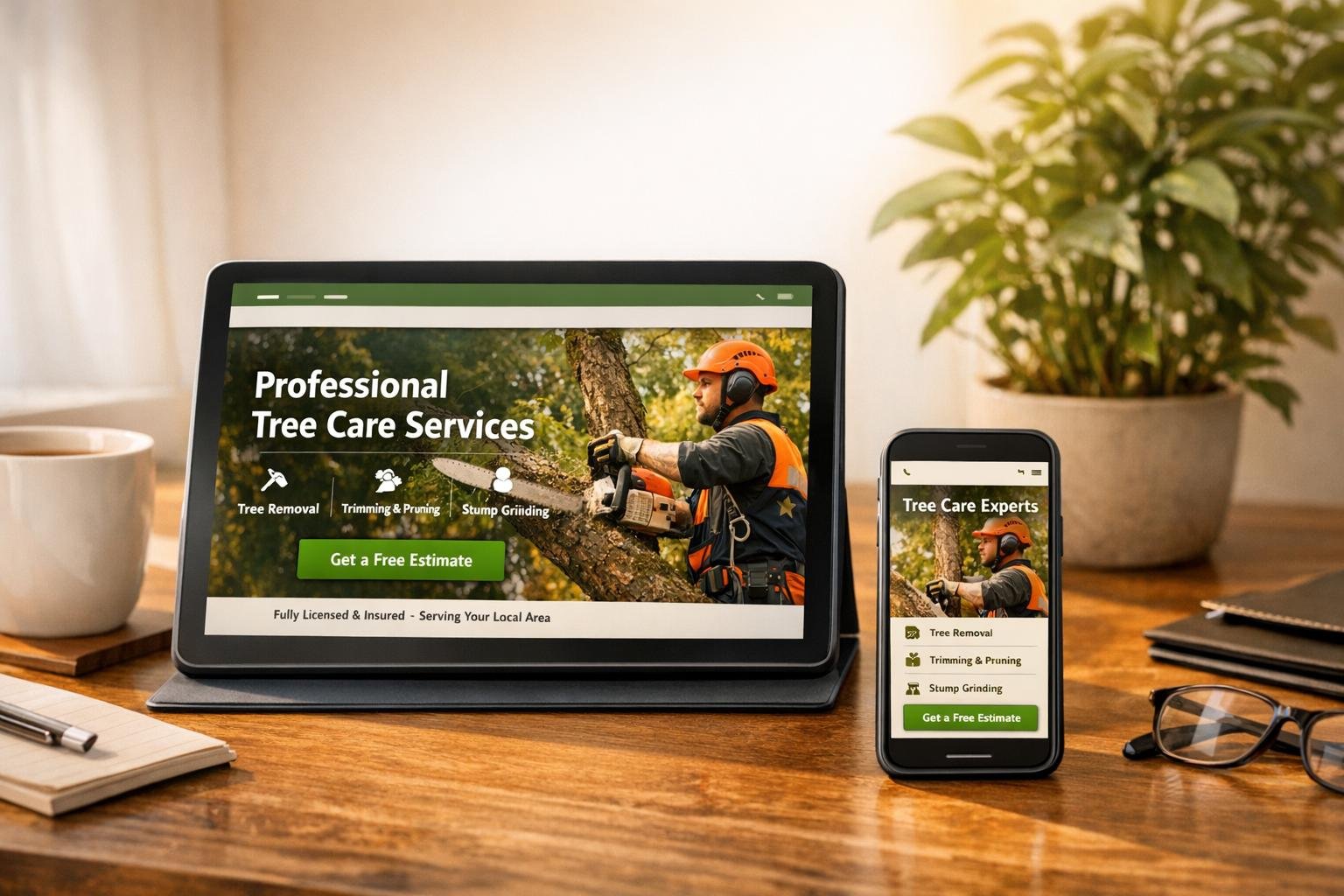
Your tree service website must work well on any device. Why? Mobile traffic accounts for nearly 60% of all web visits, and 89% of users leave websites with poor usability. Plus, Google prioritizes mobile-friendly sites in search rankings. If your site isn’t responsive, you could lose customers and visibility.
Here’s what you need to focus on:
- Key Pages: Test your homepage, service pages, contact forms, and testimonials to ensure they display correctly on all screen sizes.
- Testing Tools: Use free tools like Chrome DevTools or Google’s Mobile-Friendly Test for quick checks. For deeper insights, consider paid tools like BrowserStack.
- Common Issues: Fix problems like horizontal scrolling, unreadable text, or buttons that are too small to tap.
- Real Devices: Simulators are helpful, but testing on actual smartphones, tablets, and desktops ensures accurate results.
Responsive design isn’t just about looks – it’s about creating a smooth experience for visitors. A mobile-friendly site helps you retain customers and rank higher in local searches.
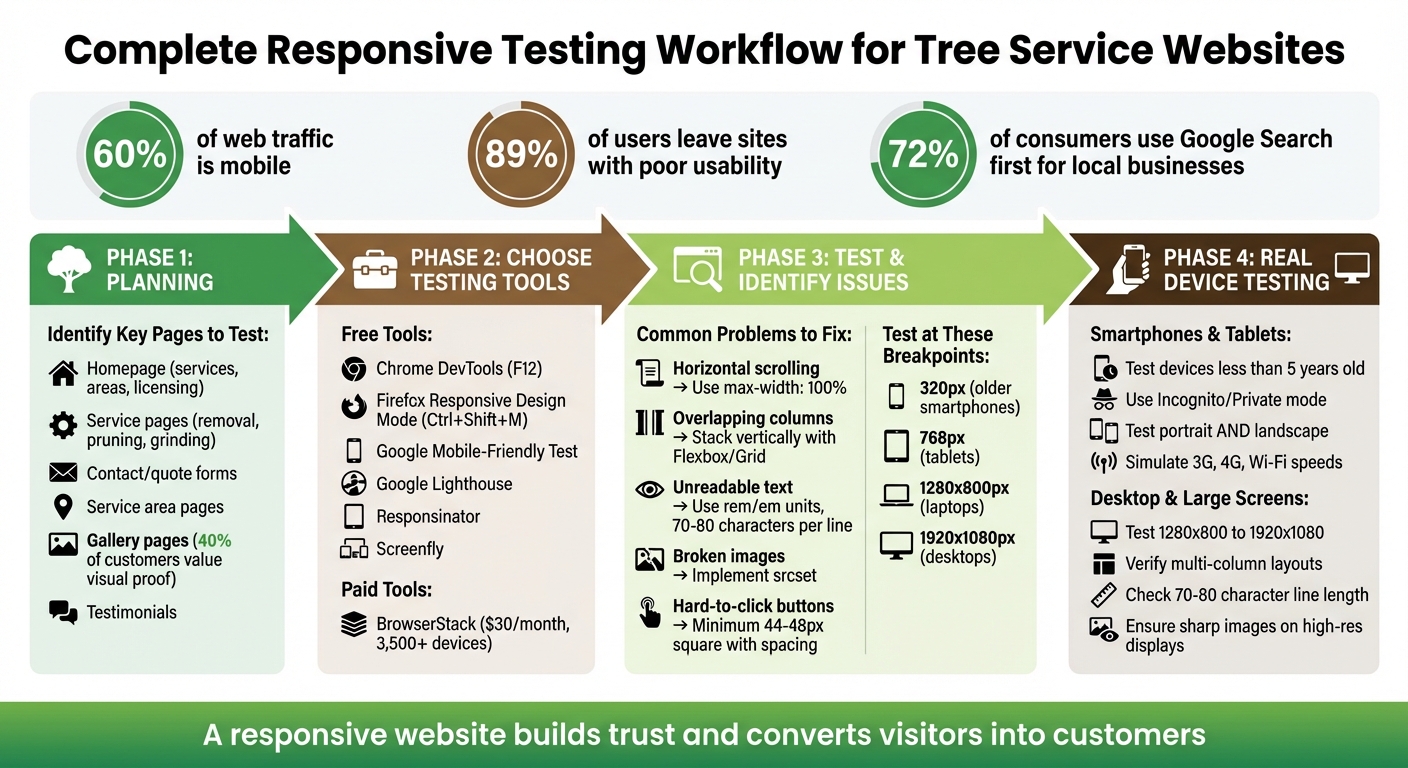
Complete Responsive Testing Workflow for Tree Service Websites
How to Test if a Website is Responsive and Mobile Friendly – Quick and Easy
Planning Your Responsiveness Testing
To ensure a smooth user experience, start with a well-thought-out plan. Focus your testing efforts on pages that directly impact leads and revenue.
Identify Key Pages to Test
Your homepage is often the first impression visitors get. It needs to clearly showcase your services, service areas, and trust-building elements like licensing and insurance details – across all screen sizes. Visitors should instantly understand what you offer and where you operate.
Take a close look at your service pages, whether they cover tree removal, pruning, stump grinding, or emergency assistance. These pages must be easy to read and navigate on mobile devices. Don’t forget to test contact and quote request pages – these are your conversion hubs. If a call button isn’t functional on a smartphone or a form is tricky to fill out on a tablet, you’re likely losing potential customers.
Service area pages play a key role in local SEO. These pages should display maps and local contact details correctly on any device. For gallery pages, make sure before-and-after photos are clear and scale properly without slowing down the mobile experience. Remember, 40% of customers value visual proof like this. Lastly, check your testimonials and reviews pages to ensure they remain visually appealing and accessible on different screen sizes.
Once you’ve identified the critical pages, it’s time to select the right tools for testing their responsiveness.
Gather Your Testing Tools
With your priority pages outlined, choose tools that help you evaluate performance across a variety of devices.
Start with free options like Chrome DevTools and Firefox Responsive Design Mode, which let you simulate different device resolutions and orientations right in your browser. For more extensive testing, consider BrowserStack, which offers access to over 3,500 real devices and browsers, with plans starting at about $30 per month. Use Google’s Mobile-Friendly Test and Google Lighthouse (available in Chrome) to assess technical responsiveness, SEO, and accessibility. Tools like Responsinator and Screenfly can also resize your viewport to match popular device dimensions.
"The best way to test your website and its responsiveness to screen size on different devices is to use the actual devices." – Tom Homer, Software Developer, eSilverStrike
While browser tools provide a quick way to check layouts, testing on real devices ensures touch functionality and performance are up to par.
Using Browser Developer Tools to Test Responsiveness
Browser developer tools make it easy to simulate how your tree service website will look on different devices – without needing physical hardware. Both Chrome and Firefox have built-in features that allow you to check how your site appears on smartphones, tablets, and desktops, all from the comfort of your computer.
How to Test with Chrome DevTools
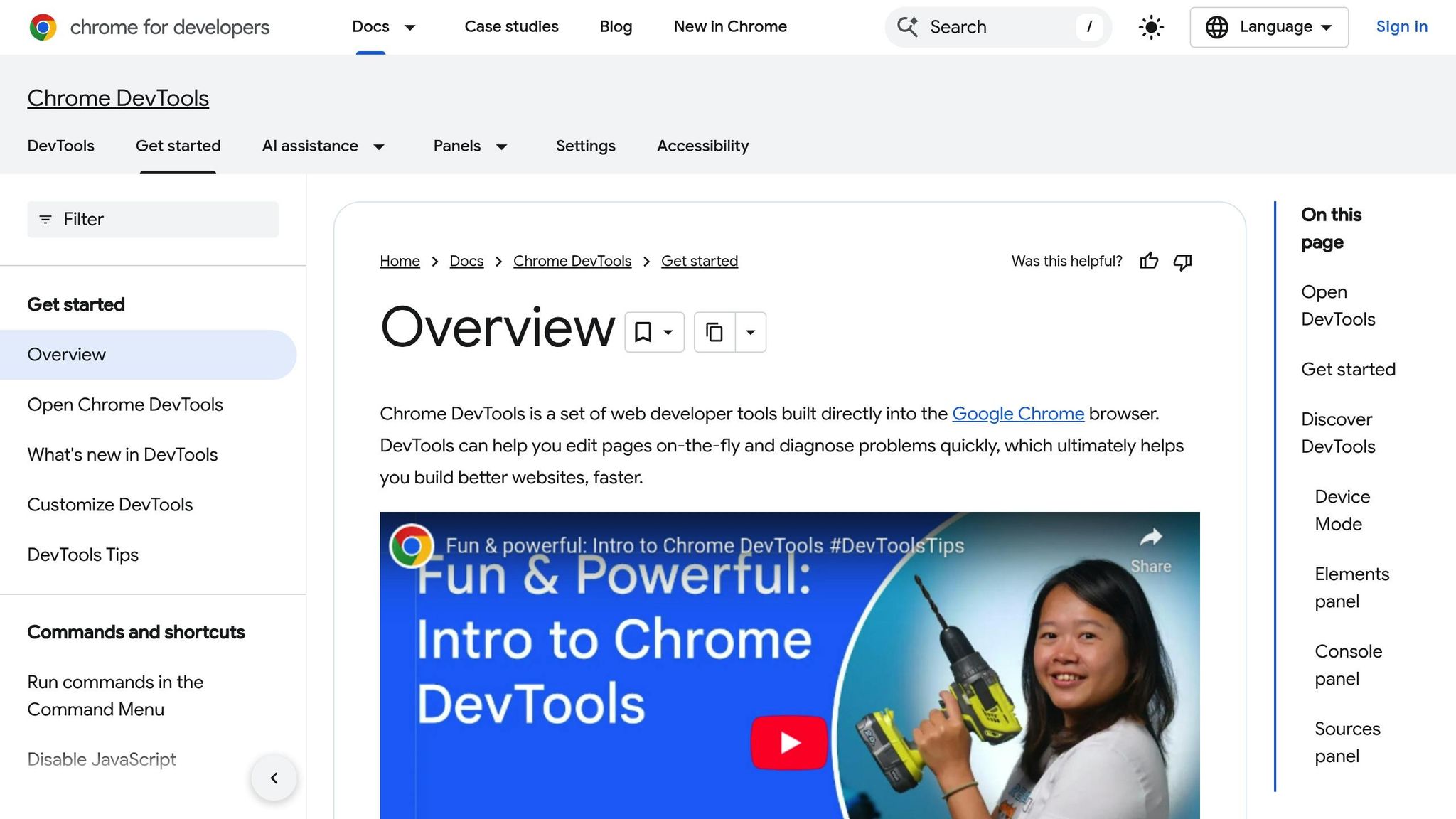
To open Chrome DevTools, press F12 on Windows/Linux or Cmd+Option+I on Mac. Alternatively, right-click anywhere on your webpage and select "Inspect." Once DevTools is open, click the Device Toolbar icon (it looks like a smartphone stacked on a tablet) to enable simulation mode.
From here, you’ll notice a "Dimensions" dropdown menu. Set it to Responsive to manually adjust the viewport size by dragging its edges or entering specific pixel dimensions. You can also select preset devices like iPhone, Samsung Galaxy, or Pixel, or input custom dimensions. Need to test orientation? Toggle between portrait and landscape modes as needed.
Make sure to test your site at 320px wide, as some older mobile devices still use this resolution. For performance testing, use the Throttle dropdown to simulate slower network speeds like "Mid-tier mobile" or "Low-end mobile." This feature is especially useful for checking how quickly your tree service photos or contact forms load on slower connections. Keep an eye on the Console tab for any JavaScript errors or unexpected layout shifts at different screen sizes.
Firefox also offers similar tools for responsive testing.
How to Use Firefox Responsive Design Mode

Firefox provides its own user-friendly tools to test responsiveness. To activate Firefox Responsive Design Mode, press Ctrl+Shift+M on Windows/Linux or Cmd+Opt+M on Mac. You can also access it through the Firefox menu under Tools > Browser Tools > Responsive Design Mode.
The default viewport starts at 320 x 480 pixels, but you can resize it by dragging the bottom-right corner or entering exact dimensions. For precise adjustments, use the arrow keys to change the size by 1px at a time, or hold Shift to adjust in 10px increments. You can also select specific devices from the dropdown menu to mimic their screen size and pixel density.
Click the touch simulation icon (a hand with a pointing finger) to turn mouse clicks into touch events. This lets you verify that your buttons and forms are fully functional for mobile users. Firefox also allows you to simulate different connection speeds, such as 2G, 3G, or LTE, giving you a clear picture of how your site performs under varying conditions.
"As we build new sections or layouts, it’s often quickest and more sustainable to check those as you go rather than wait until the entire site is built." – FreshySites
After enabling touch simulation or changing the user agent, make sure to reload your page. Many websites only detect touch support during the initial load, so reloading ensures accurate testing. Regularly refreshing the page also helps maintain consistent conditions across all device simulations.
Using Online Tools to Test Mobile-Friendliness
While browser developer tools are great for quick checks, online tools dig deeper, uncovering issues that might otherwise go unnoticed. These automated tools evaluate your tree service website’s mobile usability and flag technical problems that could impact user experience and search engine rankings. They work hand-in-hand with manual checks, ensuring no mobile issue slips through the cracks.
Google Mobile-Friendly Test
Google’s Mobile-Friendly Test is a free and straightforward tool for assessing your website’s mobile usability. Just drop your URL into the tool, and in seconds, you’ll get a pass/fail result along with a preview of how your page looks on mobile devices. It evaluates key factors like viewport settings, text readability, spacing of touch elements, and whether content fits the screen without horizontal scrolling.
The tool scores your site on a scale of 0 to 100, with a minimum score of 80 required to pass. However, aiming for a perfect 100 can significantly enhance the user experience. A study of over 4,000 pages revealed that nearly 83% of sites faced issues with "Size and Proximity of Links." Font readability problems were found to lower scores by up to 40 points, while inadequate spacing for tap targets could cost up to 30 points. To avoid these pitfalls, ensure critical buttons like "Call Now" or "Get a Quote" are at least 48 pixels square. Don’t forget to review footer links and pagination, as they’re often overlooked. When testing updates, use Incognito or Private browsing mode to make sure you’re viewing the latest version of your site rather than a cached one.
Using Responsinator
Responsinator is another handy tool that shows how your site looks on popular devices in both portrait and landscape orientations. Simply enter your URL, and you’ll instantly see how your site appears on iPhones, Android phones, and tablets. It highlights design layout issues that might affect usability.
This tool is particularly helpful for checking whether visual elements like service galleries, before-and-after photos, or contact forms retain their intended layout across devices. With mobile devices accounting for 51.53% of global website traffic in the second quarter of 2020, ensuring your site performs well in all orientations is crucial. Key interactive elements must remain functional and accessible, regardless of the device being used.
sbb-itb-130a704
Common Responsiveness Problems and How to Fix Them
When you use tools to identify responsiveness issues, you’ll likely encounter several common challenges. These tools often highlight layout and usability problems that can frustrate users and hurt your website’s search rankings. For example, horizontal scrolling is a frequent issue on tree service sites, making navigation clunky and discouraging visitors. Considering mobile devices are projected to account for over 60% of web traffic by 2025, addressing these problems is crucial for attracting new customers.
One issue is navigation menus that don’t adapt well on tablets, leading to awkward wrapping before the mobile menu kicks in. Similarly, service galleries showcasing before-and-after photos may display unevenly, with gaps or overlapping images caused by poorly configured grid layouts. Another common headache is image overflow – high-resolution photos of tree equipment or job sites can extend beyond their containers, pushing other content off-screen. To fix this, include the viewport meta tag in your HTML and use CSS to make images scale properly:
<meta name="viewport" content="width=device-width, initial-scale=1.0"> And in your CSS:
img { max-width: 100%; height: auto; } Let’s break down some of these common issues and their fixes.
Setting Viewport Breakpoints and Adjusting Layouts
Configuring breakpoints for different devices is essential for responsive design. Breakpoints are specific screen widths where your layout adjusts to fit various devices. A mobile-first approach works best: start with styles for smartphones, then use @media queries to tweak layouts for screens wider than 768 pixels. For scalable layouts, rely on relative units like percentages or rem instead of fixed pixel values.
"Responsive web design isn’t a single technology – it’s a set of techniques and principles that work together to make websites adapt to different screen sizes, resolutions, and devices." – Laura Coronel, Treehouse
Always test your design at widths as narrow as 320 pixels, as some older smartphones still use this screen size. Multi-column layouts that look great on desktops should stack vertically on smaller screens to keep text readable and user-friendly.
Improving Touch Targets and Button Usability
Interactive elements like buttons need to work well on touchscreens. Ensure buttons such as "Call Now" or "Request a Quote" are large enough – ideally 44-48 pixels square – with sufficient spacing to prevent accidental taps. Use CSS media queries to adjust button dimensions and spacing for mobile while maintaining a consistent appearance on desktops.
"Interactive elements are touch-friendly, with properly spaced and sized buttons." – BrowserStack
Chrome DevTools’ Device Mode can help you simulate touch interactions by displaying your cursor as a fingertip-sized circle, making it easier to evaluate button usability. Testing on actual devices is also vital for ensuring accuracy.
Making Fonts Easier to Read
Fixed font sizes can hurt readability, especially on smaller screens. Instead, use rem or em units so fonts can scale fluidly with screen sizes. Without the right viewport meta tag, mobile browsers may inconsistently enlarge font sizes, creating a cluttered look.
Aim for text columns with 70 to 80 characters per line for better readability. On larger screens, limit content width to prevent lines from stretching too far. Additionally, use minor breakpoints to slightly increase font sizes for viewports over 360 pixels, ensuring text remains legible even on smaller devices. Don’t forget to add enough padding around your text to avoid words being cut off at the edges.
| Layout Issue | Solution |
|---|---|
| Horizontal Scrolling | Use max-width: 100% and avoid fixed pixel widths |
| Overlapping Columns | Use Flexbox or CSS Grid to stack columns vertically on smaller screens |
| Unreadable Text | Use relative units (rem/em) and adjust line heights for mobile |
| Broken Images | Implement srcset to serve optimized image sizes for different devices |
| Hard-to-Click Buttons | Increase padding and spacing for touch targets to at least 44×44 pixels |
Testing Responsiveness on Actual Devices
While browser tools and online simulators can offer some insights, nothing beats testing your tree service website on actual devices. Real-world testing reveals how your site performs under authentic conditions, such as varying network speeds and real touch interactions. With 59% of all web traffic now coming from mobile devices, ensuring your site works seamlessly on these devices is essential for attracting and retaining potential customers.
Different browsers, like Safari (WebKit) and Chrome (Blink), can render pages differently, leading to unique challenges. By testing on physical devices, you can catch these discrepancies and refine your site further. As Software Developer Tom Homer explains:
"The best way to test your website and its responsiveness to screen size on different devices is to use the actual devices. This allows you to not only test the actual sized screen, but how the internet browser itself that comes installed on the device, displays the page".
Real-device testing builds on simulated tests, confirming that your website adjustments hold up under everyday conditions.
Testing on Smartphones and Tablets
Start by testing on popular devices like the latest iPhones and Samsung Galaxy models. Focus on devices that are less than five years old, as they represent most active users. To ensure you’re seeing the most up-to-date version of your site, always use Incognito or Private mode during testing.
Check that key interactive elements, such as "Call Now" buttons, are easy to tap and that your layout adjusts smoothly in both portrait and landscape orientations without requiring horizontal scrolling. These small details play a big role in capturing local leads by providing a smooth user experience.
Test your site under different network conditions, such as 3G, 4G, and Wi-Fi, to evaluate how quickly images load and whether forms function properly. If your site is still in development, tools like BrowserStack’s Local Testing feature (starting at about $30 USD per month) let you test your site on mobile devices even if it’s hosted locally on your computer.
Testing on Desktop and Large Screens
While mobile testing is crucial, don’t overlook desktop and larger screen users. Many homeowners and commercial clients still research tree services on office computers or home desktops. Test your site across a range of screen sizes, from 1280 x 800 pixels (common on 13-inch laptops) to 1920 x 1080 pixels (standard for 23-inch monitors).
Ensure your multi-column layouts remain visually balanced and functional without stretching content too wide. Text columns should stick to 70 to 80 characters per line for easy readability, even on large displays. Check that service galleries look organized, navigation menus are accessible, and call-to-action buttons stand out without getting lost in excessive white space. Finally, make sure your tree service photos appear sharp and professional on high-resolution displays, avoiding any pixelation or distortion.
Conclusion
Responsive testing plays a key role in driving local leads and helping your business grow. By leveraging tools like Chrome DevTools, Firefox Responsive Design Mode, online platforms such as the Google Mobile-Friendly Test, and real devices ranging from smartphones to desktop monitors, you can make sure your website performs seamlessly for every visitor.
Why does this matter? The numbers speak for themselves: 72% of consumers turn to Google Search first when looking for local business information, and 89% of users leave websites after a poor experience. A responsive website that loads quickly, looks great on any screen, and allows users to easily interact – like tapping a "Call Now" button – builds trust and turns casual visitors into paying customers.
To get it right, focus on the details: ensure layouts work at 320px, touch targets are mobile-friendly, test both portrait and landscape orientations, and simulate different network conditions. As BrowserStack highlights:
"Inconsistent user experiences across devices can harm a brand’s reputation. Users expect smooth & reliable performance, no matter the device. Failure to meet these expectations can lead to dissatisfaction and lost customers."
By following these practices, you’re not just optimizing for usability – you’re building a reputation for reliability. When someone searches for emergency tree removal on their phone, your website’s seamless experience can make all the difference. It’s this level of care that positions your business as trustworthy and approachable, turning visitors into loyal customers.
Need more tips on improving your tree service website and capturing local leads? Check out the expert guidance from Tree Company Leads.
FAQs
What tools can I use to check if my tree service website is mobile-friendly?
Testing how well your tree service website performs across different devices is essential. A responsive site ensures a smooth user experience, whether visitors are browsing on a phone, tablet, or desktop. Here are some tools to help you evaluate your site’s responsiveness:
- Chrome DevTools: This browser tool lets you simulate various screen sizes and devices. You can test phones, tablets, and desktops, tweak screen dimensions, and even assess load times on slower network speeds – all without leaving your browser.
- BrowserStack: With this platform, you can check your site on a wide range of real devices and operating systems, giving you insight into how it performs on the same hardware your customers use.
- Free Simulators: Tools like Screenfly and Responsinator provide quick previews of your site’s appearance on different screen resolutions, and they don’t require any downloads or installations.
For the most reliable results, pair these tools with testing on actual devices or use native emulators like the iOS Simulator or Android Emulator. This combination helps ensure your website not only looks good but also works flawlessly for every visitor, regardless of their device.
Why is it important to test your website on real devices for responsiveness?
Testing your website on actual devices is crucial for gaining a true understanding of how it functions across different screens, browsers, and hardware setups. While simulators and emulators can be helpful, they often overlook important aspects like touch gestures, unique browser behaviors, or variations in rendering engines.
Real device testing allows you to ensure your site works smoothly for users, whether they’re on a smartphone, tablet, or desktop. It also helps uncover potential problems that might affect usability and the overall user experience.
How can I fix responsiveness issues on my tree service website?
To address common responsiveness issues on your tree service website, start by testing its performance across different devices. One handy tool for this is Chrome DevTools. Open your site in Chrome, right-click and select Inspect (or use Ctrl + Shift + I on Windows or ⌘ + Option + I on macOS). Once there, enable responsive mode by clicking the device toolbar icon or pressing Ctrl + Shift + M (Windows) or ⌘ + Shift + M (macOS). This feature lets you preview how your site looks on various screen sizes and orientations.
Pay attention to problems like horizontal scrolling, overlapping elements, or text that’s difficult to read. Fixing these issues often involves a few key steps:
- Use a viewport meta tag: This ensures your site scales properly on different devices.
- Switch to flexible layouts: Replace fixed dimensions with percentages or
vwunits for a more adaptable design. - Make images and videos responsive: Apply CSS rules like this:
img, video { max-width: 100%; height: auto; } - Implement media queries: Adjust styles for specific screen sizes. For example:
@media (max-width: 768px) { /* Styles for tablets */ } @media (max-width: 480px) { /* Styles for mobile devices */ }
After making these adjustments, retest your site to confirm everything works smoothly across devices. If tackling this feels overwhelming, consider reaching out to experts like Tree Company Leads, who specialize in creating mobile-friendly, lead-generating websites tailored to tree service businesses.
Related Blog Posts
If you’re running Google Ads for a tree service business, keyword research is the key to connecting with customers actively searching for help. Without it, you risk wasting money on irrelevant clicks or missing out on high-intent leads. Here’s what you need to know:
- Tree service keywords are expensive: Costs range from $10 to $40 per click, with some exceeding $50 in competitive areas.
- Focus on high-intent keywords: Terms like "emergency tree removal near me" or "licensed arborist" attract customers ready to hire.
- Use tools like Google Keyword Planner: Analyze search volumes, costs, and competition to find the best keywords for your campaigns.
- Target local and specific queries: Include city names, zip codes, and long-tail keywords like "stump grinding cost [city]" to reach nearby customers.
- Organize campaigns by service type: Group keywords into categories (e.g., Tree Removal, Stump Grinding) and use negative keywords to block irrelevant traffic.
Pro Tip: Regularly review performance metrics like Click-Through Rate (CTR) and Cost Per Lead (CPL) to refine your strategy and avoid wasted ad spend.
This guide breaks down how to find the right keywords, structure campaigns, and optimize for better results. Let’s dive in.
Tree Service Marketing | PPC Strategies for Tree Service Google Ads Campaign
Know Your Services and Customers
Before diving into keyword research, it’s crucial to understand two things: the services you offer and the problems your customers are trying to solve. This means clearly defining your offerings and pinpointing the situations that lead clients to seek your help.
List Your Core Tree Services
Start by outlining the tree services you provide. These might include tree removal, tree trimming, stump grinding, emergency cleanup, tree health assessments, wood chipping, or tree transplanting. These service names will act as your foundation – or "seed keywords" – for building targeted campaigns.
To keep things organized, group these services into broader categories, such as Tree Removal, Emergency Services, Tree Trimming, or Stump Services. This structure not only makes your services easier to understand but also helps create focused ad groups that can boost your ad performance and conversion rates.
Additionally, consider using professional terms like "Certified Arborist", "Tree Surgeon", or "Licensed Tree Service" in your messaging. These descriptors appeal to customers who value expertise and safety, often more than simply finding the cheapest option.
Once you’ve listed your services, think about how they align with the specific problems your customers are trying to solve.
Identify Customer Problems
Put yourself in your customer’s shoes. What challenges are they facing? For example, someone searching for "emergency tree removal after storm" likely has an urgent safety concern, while someone typing "tree trimming estimates" is probably planning ahead and comparing options.
"A person searching for ’emergency tree removal after storm’ has completely different needs than someone poking around and looking for ‘tree trimming estimates.’" – Tree Leads On Demand
Focus on problem-specific keywords like "dead tree removal", "leaning oak tree help", "branches touching power lines", or "tree fell on house." These phrases attract customers who are ready to hire a professional immediately. At the same time, use negative keywords like "DIY tree removal" or "free tree cutting" to filter out searchers who aren’t looking for professional help.
Given that 87% of customers research tree services online before making a call, your keywords should address both urgent concerns (like safety) and routine inquiries (like pricing, insurance, and credentials). Aligning your keywords with these needs ensures you’re reaching high-intent searchers who are ready to act.
Tools for Keyword Research
Once you’ve got a clear list of services and a solid understanding of customer challenges, it’s time to dive into keyword research. Using the right tools can help you uncover what your prospects are searching for, giving you insights into search volumes, competition levels, and even cost-per-click (CPC) estimates. This information is key to optimizing your marketing budget.
Use Google Keyword Planner
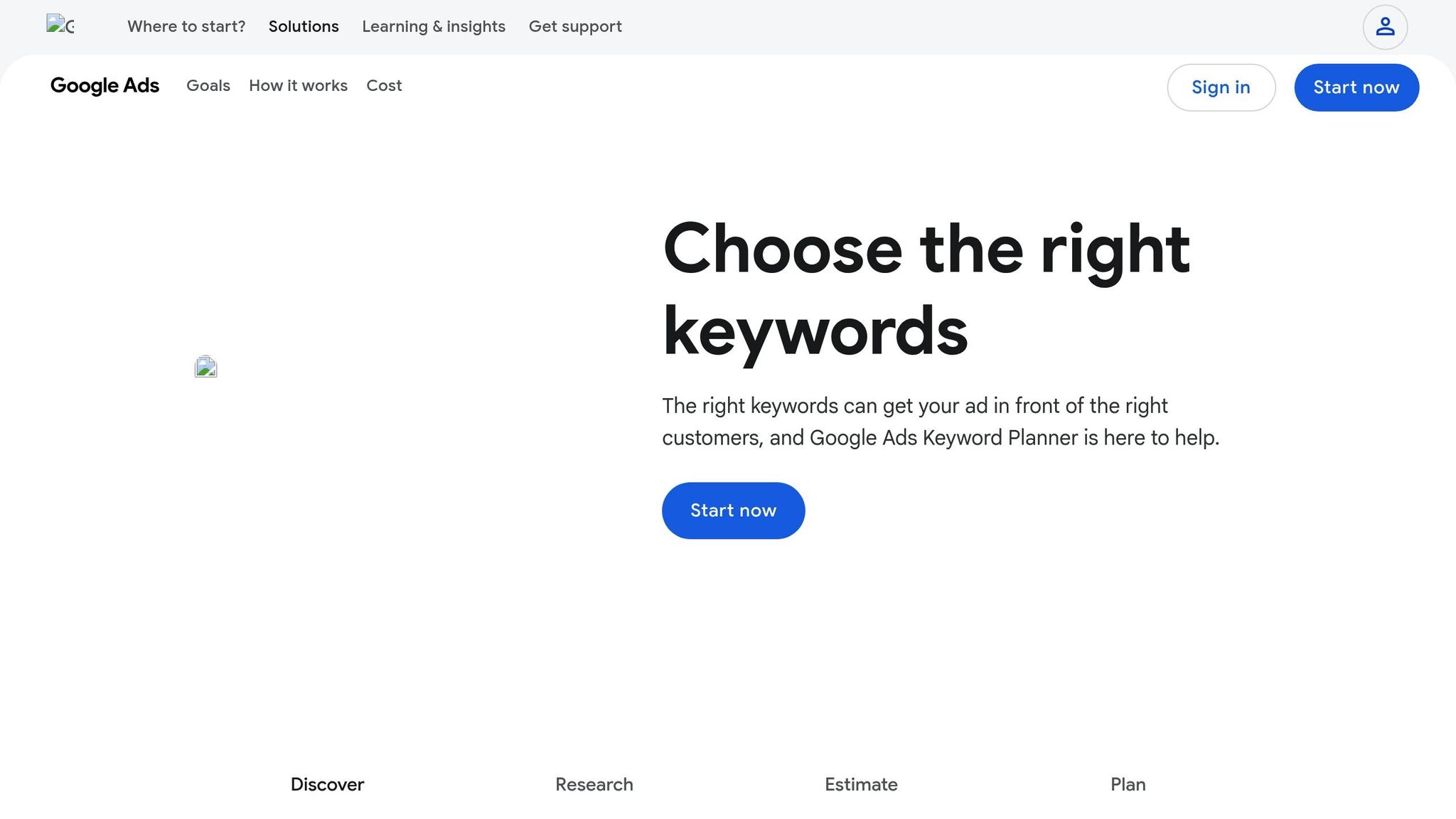
Google Keyword Planner (GKP) is a great starting point – it’s free and pulls data straight from Google’s search engine. To access it, you’ll need a Google Ads account.
Once inside, switch to Expert Mode. From there, you can choose your starting point – either by entering specific keywords or using a website as a reference. Narrow down your search by filtering results to focus on your service area, which will help you avoid misleading national averages. The "Refine keywords" panel is especially useful for organizing ideas by category. If you’re new to this, look for keywords labeled as having "Low" or "Medium" competition. These are generally easier to rank for and come with lower bid costs.
Another helpful feature is the "Forecast" tab, which lets you estimate potential clicks and conversions based on your budget before spending a dime.
It’s worth noting that GKP shows search volume in broad ranges (e.g., 100–1,000 or 10,000–100,000 searches) instead of exact numbers. Also, its "Competition" metric reflects the level of competition for paid ads, not organic rankings.
Try Additional Research Tools
While Google Keyword Planner is a solid starting point, other tools can provide deeper insights – especially when it comes to local targeting or analyzing competitors. Platforms like SEMrush, Ahrefs, and Moz offer advanced features like hyperlocal filters and keyword difficulty scores, helping you refine your research.
For inspiration, tools like AnswerThePublic and AlsoAsked are fantastic for uncovering common questions people search for – like "how much does tree removal cost?" or "when is the best time to prune oak trees?" These can spark ideas for blog topics or informational ad campaigns.
If you’re curious about what keywords your local competitors are using, SpyFu can be a game-changer. It lets you dig into up to 10 years of their PPC keyword history. As Rambod Yadegar, President of HawkSEM, explains:
"When conducting keyword research, it is prudent to use multiple tools and not rely on a single source".
Using a mix of tools can help you expand your keyword list and make more informed decisions before finalizing your strategy.
Check Google Search Features
Don’t overlook the free insights Google itself provides. Start typing a service like "tree removal near" into Google’s search bar, and Autocomplete will suggest popular queries based on real user searches in your area.
Pay attention to the "People Also Ask" section, which often highlights customer concerns. For instance, searching for "tree trimming" might reveal questions like "How often should I trim my trees?" These insights can guide your content strategy and help you address what your audience cares about.
Google Trends is another useful tool, especially for spotting seasonal patterns. For example, searches for "emergency tree service" tend to spike after storms, while "tree pruning" sees increased interest during late winter. Understanding these trends can help you plan ad spending and promotions to align with seasonal demand.
Target High-Intent and Local Keywords
Once you’ve gathered keyword ideas using research tools, it’s time to narrow your focus on queries that drive immediate customer action. Why? Because almost half of all Google searches have a local intent, and 28% of those searches lead to a purchase within just 24 hours. For tree service businesses, targeting high-intent local keywords can connect you with customers ready to take action.
Focus on Local Keywords
Local keywords are your gateway to reaching customers in your service area who are actively searching for help. These keywords fall into two main categories: implicit and explicit.
- Implicit keywords, such as "tree trimming", don’t include a location but rely on Google’s location data to match users with nearby services.
- Explicit keywords, like "tree removal in Miami" or "arborist [zip code]", include a specific location, signaling even stronger local intent.
To capture hyper-local demand, include neighborhoods, zip codes, and even local landmarks in your keyword strategy. For instance, instead of only targeting "tree service Austin", try adding phrases like "tree service Hyde Park Austin" or "78704 tree removal." As Stephanie Heitman, Associate Director of Content at LocaliQ, explains:
"Local keywords are keywords modified for a specific location… they’re targeting a smaller subset of the global population, meaning they’re less competitive than non-local keywords".
Once you’ve established a solid local keyword foundation, expand your efforts by targeting more specific customer queries.
Add Long-Tail Keywords for Specific Services
Long-tail keywords, which are phrases containing three or more words, are excellent for capturing specific customer needs. Examples include "emergency tree removal cost [city]" or "stump grinding [neighborhood]." While these terms might have lower search volumes, they tend to deliver higher conversion rates because they attract users who are closer to making a decision.
For additional inspiration, check Google’s "People Also Ask" section. A search for "tree removal" might reveal questions like "how much does tree removal cost in [city]?" or "what is the best time to remove a tree?" These types of queries are particularly valuable as voice search continues to grow in popularity.
Add Seasonal and Event-Based Keywords
Demand for tree services often fluctuates throughout the year, so your keywords should adjust accordingly. For example, terms like "storm tree cleanup", "ice storm tree damage repair", or "24-hour tree removal" see spikes after severe weather events. Similarly, searches for "tree pruning" often increase in late winter, while "emergency tree service" becomes more common after storms.
If you operate in an area prone to hurricanes in September, prioritize emergency-related keywords during that time. For urgent services, using Call-Only Ads with keywords like "emergency tree removal" can help you connect with mobile users who need immediate assistance.
| Keyword Category | Examples | Intent Level |
|---|---|---|
| Service-Based | tree removal service, stump grinding, tree trimming | High (Commercial) |
| Emergency | emergency tree removal, storm damage tree service | Very High (Transactional) |
| Location-Based | tree service [city], local tree care, best tree company near me | High (Transactional) |
sbb-itb-130a704
Organize Keywords for Your Campaigns
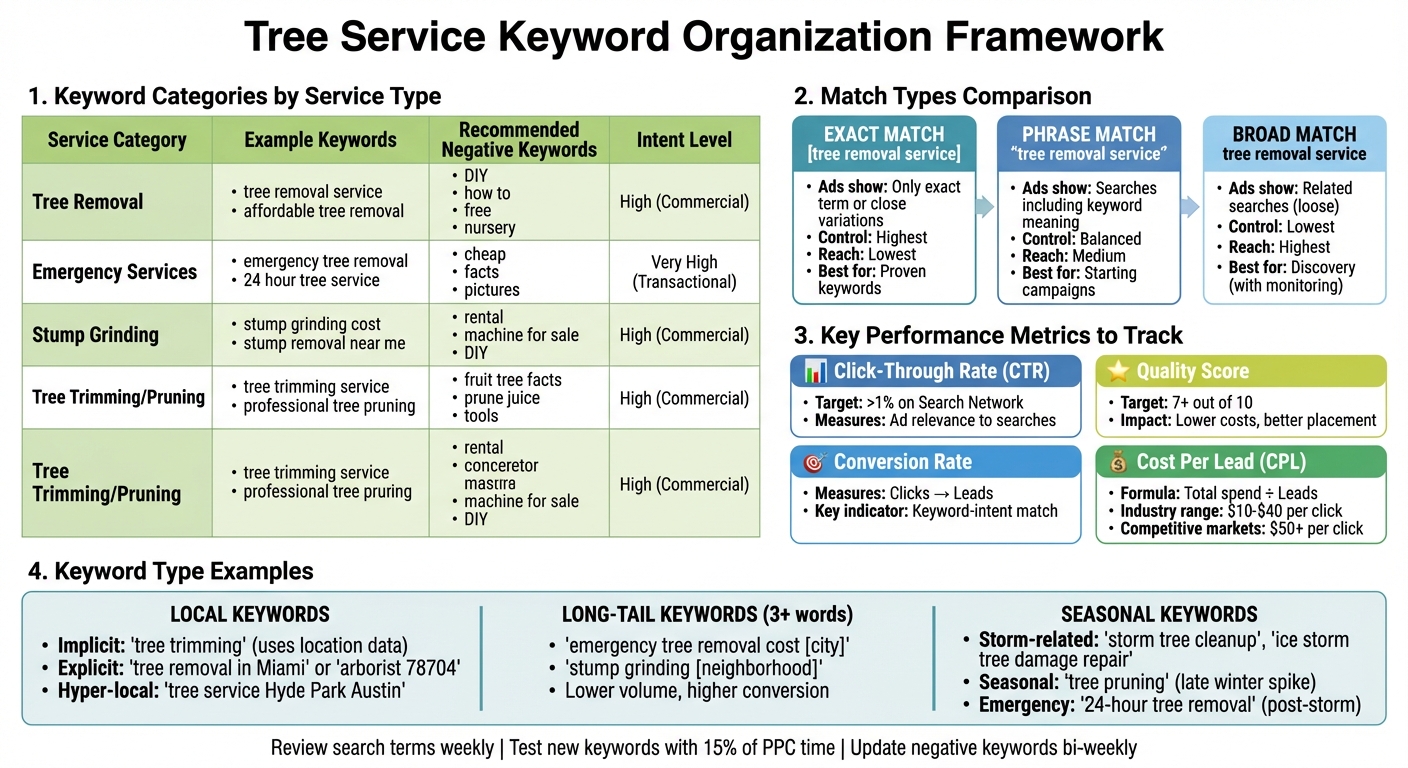
Tree Service Keyword Categories and Performance Metrics Guide
Now that you’ve identified your target keywords, it’s time to organize them in a way that ensures your ads align perfectly with search queries. This approach not only improves your Quality Score but also minimizes wasted ad spend. As Google Ads Help explains:
"If all your keywords and ads are in one ad group, users searching for ‘formal shoes’ may be shown your ad about ‘running shoes’. Instead, you can create ad groups for each keyword to show users either ‘formal shoes’ or ‘running shoes’."
Group Keywords by Service Type
Start by creating distinct ad groups for each service you offer, such as Tree Removal, Tree Pruning, Stump Grinding, and Emergency Services. This ensures that someone searching for "stump grinding cost" won’t end up seeing an ad about tree trimming. Pair each ad group with a dedicated landing page to increase conversions.
To refine your keywords further, add modifiers like "hire", "best", "service", or "company" to your base terms. For example, instead of just "tree removal", use phrases like "hire tree removal company" or "best tree removal service." These additions indicate that the searcher is ready to take action, not just browsing.
Choose the Right Match Types
Once you’ve grouped your keywords, you’ll need to decide how broadly or narrowly your ads should reach potential customers. Google Ads offers three match types to help you control this:
- Exact match: Ads appear only when someone searches for your exact term or a close variation (formatted as
[tree removal service]). This gives you tight control but limits your reach. - Phrase match: Ads show for searches that include the meaning of your keyword (formatted as
"tree removal service"), offering a balance between control and reach. - Broad match: Ads display for searches that relate to your keyword, even loosely (no special formatting). While this reaches the widest audience, it requires careful monitoring.
For starters, stick with phrase or exact match to avoid wasting your budget on irrelevant clicks. Arnold, The Digital Marketing Professor, shares:
"With Phrase and Exact match keywords I keep very specific control over the queries that trigger my ads."
After identifying high-performing keywords, consider expanding to broader match types to capture more traffic. Assess performance after 100–200 clicks to make informed adjustments.
Create a Negative Keyword List
Negative keywords are your shield against irrelevant traffic. By excluding terms like "DIY", "how to", "free", "jobs", "training", "rental", "bonsai", and "tools", you can ensure your ads only reach people actively looking to hire a professional.
Sean MacDonald, Founder of Tree Leads On Demand, highlights the importance of this step:
"Negative keywords help filter out irrelevant traffic, saving ad spend for high-intent searches."
Review your Search Terms Report every two weeks to identify new negative keywords and refine your list. For example, if you’re not hiring, exclude employment-related terms like "careers", "hiring", and "salary" to avoid paying for clicks from job seekers.
| Service Category | Example Keywords | Recommended Negative Keywords |
|---|---|---|
| Tree Removal | tree removal service, affordable tree removal | DIY, how to, free, nursery |
| Emergency Services | emergency tree removal, 24 hour tree service | cheap, facts, pictures |
| Stump Grinding | stump grinding cost, stump removal near me | rental, machine for sale, DIY |
| Tree Trimming/Pruning | tree trimming service, professional tree pruning | fruit tree facts, prune juice, tools |
Track and Improve Keyword Performance
After organizing your keyword groups and implementing negative keyword strategies, the next step is to focus on ongoing optimization. Initial campaigns are just the beginning – regular monitoring and adjustments are critical to ensure your advertising dollars are well spent.
Review Search Term Reports
The search terms report is a goldmine of information, showing the exact phrases people type into Google that trigger your ads. While keywords are what you bid on, search terms reflect the actual user queries. Checking this report weekly can help you spot irrelevant phrases and add them as negative keywords right away.
To dig deeper, enable the "Keyword" column in the report. This lets you see which of your bid keywords matched specific search terms, helping you identify if broad match keywords are attracting low-quality traffic. Google Ads Help sums it up well:
"By adding irrelevant search terms as negative keywords, you can prevent your ad from showing to people who are looking for something you don’t sell."
Keep in mind that search term data for a specific day typically becomes available after 3 p.m. PT the following day. Use this information to fine-tune your campaigns and focus on metrics that reveal how well your ads are performing.
Monitor Key Performance Metrics
To evaluate the effectiveness of your keywords, track these four critical metrics:
- Click-Through Rate (CTR): This measures how often people click on your ad after seeing it. A CTR below 1% on the Search Network usually indicates issues with your keywords or ad targeting.
- Quality Score: Google rates your keywords from 1 to 10 based on expected CTR, ad relevance, and landing page experience. Aiming for a score of 7 or higher can reduce costs and improve ad placement.
- Conversion Rate: This shows the percentage of clicks that turn into leads, such as phone calls or form submissions. It’s a key indicator of whether your keywords match user intent.
- Cost Per Lead (CPL): This metric divides your total ad spend by the number of leads generated, helping you assess if your keyword bids are financially sustainable.
For industries like tree services, where customers often prefer calling over filling out forms, using call tracking software can help you attribute phone leads to specific keywords. With these insights, you can refine your strategy to focus on keywords that deliver the best results.
Test New Keywords
Reserve about 15% of your PPC management time for testing new keywords and experimenting with match types. As WordStream advises:
"Ideally, you’ll do a little bit of keyword research (adding new keywords, setting new negatives, or experimenting with new match types) every week. Over time, your account will get stronger and more relevant because of it."
Use your search terms report to identify high-performing queries that aren’t already in your keyword list. Add these as new exact or phrase match keywords to capture more targeted traffic. If your budget allows, test broad match modifiers to uncover emerging trends, but keep a close eye on your negative keyword list to filter out irrelevant traffic.
Let new keywords run for 2–3 weeks to gather enough data before making adjustments. Before adding any terms, use Google Keyword Planner’s "Review Forecasts" feature to estimate clicks, impressions, and costs. This ensures your new keywords align with your budget and campaign goals.
Conclusion
Keyword research for tree service businesses isn’t a one-and-done task – it requires consistent effort and fine-tuning. Regularly tracking your website’s performance and updating your keywords is key to staying relevant. Think about the specific challenges your customers face, like storm damage or tree diseases, and let those guide your approach.
To sharpen your strategy, leverage tools like Google Keyword Planner for search volume and cost insights, and check your search terms report to see which queries are triggering your ads. Prioritize local and high-intent keywords – phrases such as "emergency tree removal near me" or "licensed arborist" often indicate that someone is ready to hire, not just researching. With the average cost per click for tree service keywords ranging from $10 to $40 (and even exceeding $50 in larger cities), making each click count is essential.
Keep your campaigns organized by grouping keywords based on the services you offer. Use the right match types to control when your ads show up, and maintain a negative keyword list to block irrelevant searches. This helps avoid wasting money on clicks that don’t convert.
Regular monitoring is your best ally in separating successful campaigns from underperforming ones. Check your search term reports weekly, track metrics like Quality Score and Cost Per Lead, and experiment with new keywords. The tree service industry is competitive, and search trends evolve, so staying on top of your data ensures your advertising dollars deliver results. By following these practices, you’ll keep your keyword strategy adaptable and effective throughout your campaigns.
FAQs
What are some ways to lower costs when bidding on expensive tree service keywords?
To cut down expenses on high-cost tree service keywords, start by organizing your ad campaigns into tightly focused ad groups. Aim for 10–15 closely related keywords per group. For example, keep services like stump grinding and pruning in separate ad groups. This approach not only improves your Quality Score but also helps bring down your cost-per-click (CPC).
Another smart move is to target geo-specific, high-intent long-tail keywords. These keywords tend to have less competition and attract local customers who are ready to book your services, saving you from wasting money on irrelevant clicks.
What are the best tools to find local, high-intent keywords for tree services?
To pinpoint high-intent local keywords for tree services, use tools that offer insights into search volume, geographic targeting, and commercial intent. Here’s a breakdown of three effective options:
- Google Keyword Planner: Integrated into Google Ads, this tool is fantastic for uncovering keywords with strong commercial intent. By setting location filters (like a city or ZIP code), you can find specific terms such as “emergency tree service Los Angeles”. It also provides data on competition levels and suggested bid amounts, giving you a clear idea of a keyword’s potential value.
- KWFinder: A great choice for local keyword research, KWFinder delivers search volume data and location-specific variations. For instance, you can search for a term like “tree removal” and uncover related phrases such as “stump grinding [city]”. It also highlights keywords your competitors are ranking for, helping you zero in on profitable opportunities.
- Google Search Console: This tool lets you analyze your website’s performance by showing the exact search terms visitors used to find you. It can uncover long-tail keywords like “how much does tree trimming cost in Dallas” that already bring traffic to your site, enabling you to refine and expand your strategy.
By leveraging these tools together, you can create a robust list of location-specific, high-intent keywords to attract well-qualified leads for your tree service business.
How can I use negative keywords to improve my Google Ads for tree services?
To make the most out of negative keywords, start by digging into your Search Terms report. This report will help you spot irrelevant searches that are triggering your ads. Once identified, add those terms as negative keywords to stop your ads from appearing for unrelated searches. For instance, if your services don’t cover certain areas, you might exclude terms like “DIY tree care,” “tree nursery,” or “free.”
You can set negative keywords at either the campaign level or ad group level, depending on how specific you want the exclusions to be. Keep your negative keyword list up to date to avoid wasting money on clicks that don’t lead to conversions. This approach not only improves your click-through rate (CTR) but also ensures your budget is focused on bringing in high-quality traffic that’s more likely to turn into paying customers.
Related Blog Posts
Local SEO is the key to ensuring your tree care business appears in local searches like "tree removal near me." Here’s a quick overview of how to boost visibility and attract more customers:
- Google Business Profile (GBP): Claim, verify, and optimize it with accurate details, photos, and regular updates.
- Website Optimization: Use location-specific keywords, create service and city pages, and ensure fast, mobile-friendly performance.
- Tracking Tools: Set up Google Analytics 4 (GA4), Google Search Console, and call tracking to monitor leads and conversions.
- Reviews: Actively request and respond to customer reviews to build trust and improve rankings.
- Citations & Backlinks: Ensure consistent business listings across directories and build local backlinks for authority.
- Content Creation: Publish locally relevant content, such as guides, FAQs, and seasonal tips, to engage your audience.
With 46% of Google searches having local intent and 80% of local searches converting into leads, these steps can make a measurable difference in your business growth. Start by auditing your current performance, and then focus on optimizing your online presence for local customers.
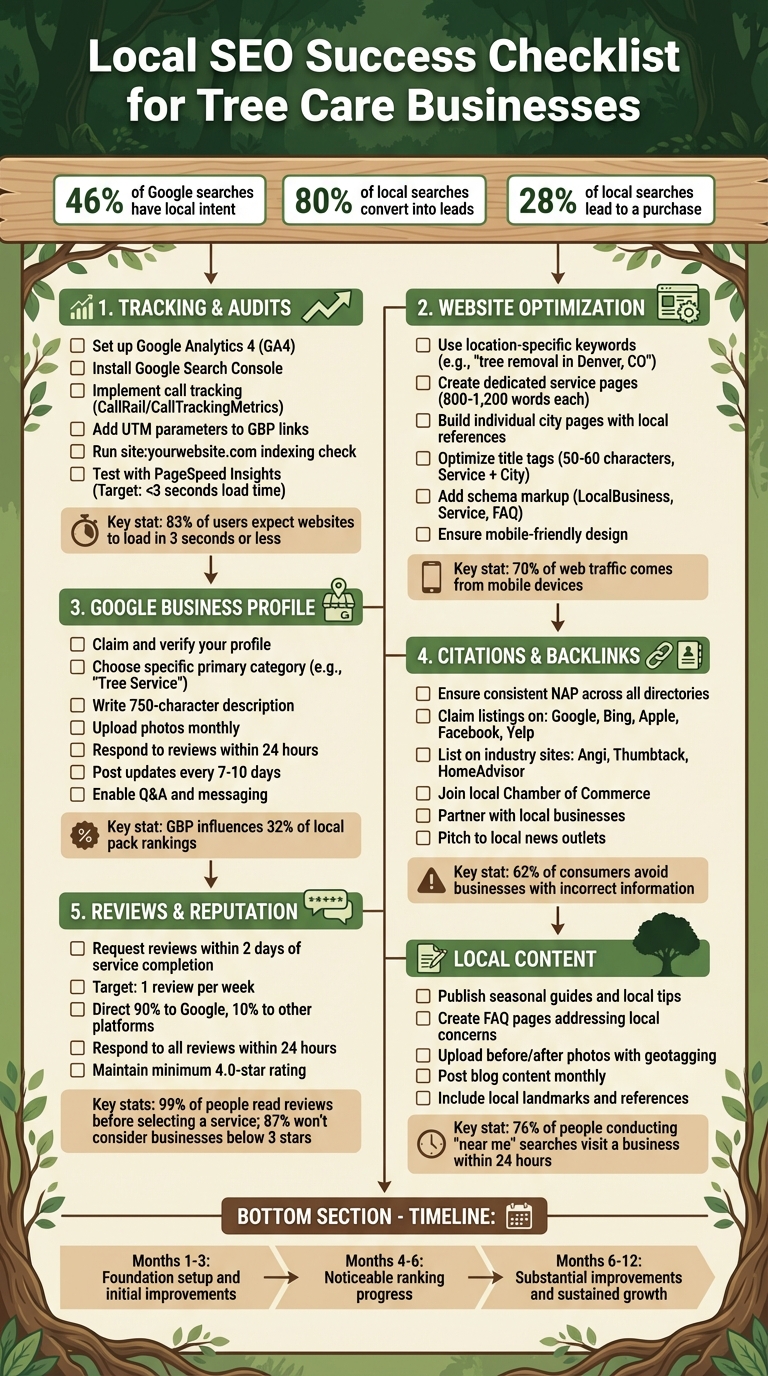
Local SEO Checklist for Tree Care Companies – Complete Implementation Guide
Mastering Tree Service SEO: Dominate Google & Grow Your Business!
Setting Up Tracking and Performance Audits
Before diving into strategies, it’s crucial to understand where you currently stand. Tracking tools not only give you a starting point but also help identify which efforts are bringing in paying customers.
Installing Analytics and Call Tracking
Start with Google Analytics 4 (GA4) to monitor website traffic and conversions. Set up the tracking code and define Goals for key actions like form submissions or emergency service calls. For example, a "Thank You" page after a form submission can act as a conversion trigger.
Integrate Google Search Console with GA4 to track keyword performance, fix crawl errors, and ensure proper indexing.
Since phone calls often lead to high-value customers, install a call tracking tool like CallRail or CallTrackingMetrics. These tools help identify whether calls come from organic search, your Google Business Profile, or paid ads. Dynamic Number Insertion (DNI) can display tracking numbers based on the source while keeping your primary business number intact.
"Proper tracking is the single most important element in your local business digital marketing stack." – Nick Pierno, Director of Custom Projects, Whitespark
Add UTM parameters to your Google Business Profile link (e.g., ?utm_source=google&utm_medium=organic&utm_campaign=gmb-listing) to distinguish profile clicks from regular organic traffic in GA4. This helps you see how many leads come from Google Maps versus standard search results.
Running a Local SEO Audit
Once tracking is in place, it’s time to audit your local SEO performance. Start by typing site:yourwebsite.com into Google to check if your pages are indexed correctly.
Next, review your Google Business Profile to ensure it’s claimed, verified, and set up with the right primary category (e.g., "Tree Service" or "Arborist"). Also, confirm that your business name, address, and phone number (NAP) match exactly across your website and directory listings.
Use Google PageSpeed Insights to test your site’s loading speed and mobile usability. Speed matters – 83% of users expect a website to load in 3 seconds or less. Slow-loading sites not only frustrate visitors but can also hurt your local rankings. Check for broken links, 404 errors, and ensure your NAP details are in text format, not embedded in images.
Search for your business on major directories like Yelp and Yellow Pages to identify duplicate or inconsistent listings that could harm your visibility. Look at your star ratings and total reviews. Negative feedback often reveals issues you might need to address.
Finally, compare your profile to top-ranking competitors in your area. How many reviews do they have? What categories are they using? What does their website offer? This analysis can highlight areas where you’re falling behind.
Creating a Reporting Schedule
After your audit, set up a schedule to review progress regularly. Monthly reviews should focus on metrics like website traffic, phone leads, and keyword rankings. Pay attention to signals of high-intent customers, such as direction requests from your Google Business Profile, clicks-to-call, and form submissions.
Plan quarterly audits to identify broader trends and seasonal patterns. For instance, you might notice an increase in storm damage inquiries during certain months. Regular reporting helps you see the bigger picture, avoiding overreactions to daily fluctuations, and ensures your SEO efforts are on track.
| Metric Category | Key Metrics to Track | Tool to Use |
|---|---|---|
| Conversions | Phone calls, form fills, quote requests | CallRail, GA4 |
| GBP Engagement | Direction requests, profile calls, photo views | GBP Insights |
| Visibility | Local Pack rankings, organic keyword position | Search Console, BrightLocal |
| Reputation | Star rating, review volume, response rate | GBP, Yelp |
| Technical | Page load speed, mobile usability, indexing errors | PageSpeed Insights, GSC |
Optimizing Your Website for Local Search
Using the data from your tracking and audits, it’s time to fine-tune your website to attract local tree care customers. By clearly emphasizing your location and services, you can turn local search traffic into paying customers.
Using Service and Location Keywords
To connect with local customers, incorporate specific keywords like "tree removal in Denver, CO" throughout your site. Add them to key areas such as homepage headlines, service page titles, meta descriptions, headings, image alt tags, and even your URL slugs. Make sure your title tags highlight the service and location upfront. For instance, "Tree Removal Denver, CO | Emergency Storm Cleanup" is more effective than "ABC Tree Company | Tree Removal Services in Denver".
Your URL structure should also reflect this approach. Use clean, descriptive paths like yourtreecompany.com/tree-removal-denver-co instead of vague URLs such as /services/page-12.
"If you want to rank well in each town, then yes [you need a separate page]. A page for each area helps Google understand where you operate." – Local Tree Service Marketing
Considering that 72.7% of users click organic or map results over paid ads, and 28% of local searches lead to a purchase, getting your keywords and structure right can have a direct impact on your business.
Building Service and City Pages
To capture more local traffic, create individual pages for each service and area you serve. Instead of cramming everything into a single "Services" page, build dedicated pages for offerings like tree removal, pruning, stump grinding, and emergency services. Then, add separate pages for each major city or town you cover, accessible via a footer link or an "Areas Served" menu.
Each page should feature 800–1,200 words of original content. Blend useful information – like the importance of tree trimming or common causes of storm damage – with details about your business. Avoid duplicating text across city pages. Instead, tailor each one with local references, such as landmarks, neighborhood names, weather challenges, and customer testimonials.
Add a Google Map to each city page to reinforce your geographic relevance. Make sure your NAP (Name, Address, Phone number) is in text format so search engines can read it. Since most local searches are done on mobile and 80% of smartphone users who search for local businesses make an offline purchase, include easy-to-use click-to-call buttons and quote request forms on every page.
| Page Element | Optimization Requirement |
|---|---|
| Title Tag | 50–60 characters; include "Service + City" at the start |
| Meta Description | 50–160 characters; include target keyword and a clear CTA |
| Word Count | 800–1,500 words for competitive markets |
| Schema Type | LocalBusiness, Service, and FAQ markup |
| Load Speed | Under 3 seconds |
Use high-quality, original photos of your team, equipment, and completed projects on your service pages. Avoid stock images – they don’t build trust. Instead, upload real visuals and add descriptive alt text with keywords, like "tree removal crew working in Denver backyard".
Fixing Technical SEO Issues
Even the best content won’t perform well if your site has technical problems. Start by ensuring your site is mobile-friendly. Google prioritizes mobile versions for ranking, and with 70% of all web traffic coming from mobile devices, your site must adapt seamlessly to different screen sizes.
Keep your site fast – 83% of users expect it to load in 3 seconds or less, and every extra second can reduce conversions by 7%. Tree care websites often feature large images, so compress them to avoid slowing down your site. Use tools like Google PageSpeed Insights or GTmetrix to identify other issues like slow server response times or unoptimized JavaScript.
Make sure your site is secure with HTTPS and an SSL certificate. Since 2014, Google has favored secure sites, and a "Not Secure" warning can drive visitors away. Check that all your pages are indexed by searching site:yourdomain.com on Google. If anything is missing, submit an XML sitemap through Google Search Console.
Add schema markup (like LocalBusiness, Service, and FAQ) to help search engines understand your site and improve your chances of earning rich snippets. If you remove any pages, set up 301 redirects to preserve link equity.
"Local and organic traffic makes up nearly 70% of all traffic to websites." – Stephanie Heitman, Associate Director of Content, LocaliQ
Finally, ensure your NAP details are in HTML text format, not embedded in images, so search engines can properly associate them with your location. By addressing these technical aspects, you’ll strengthen your local rankings and prepare for the next steps in managing reviews and creating local content.
Building Off-Site SEO for Local Rankings
Once your website is optimized, it’s time to strengthen your presence beyond your site. Tools like Google Business Profile, consistent citations, and local backlinks can help establish your business as a trusted part of the community.
Setting Up Google Business Profile
Your Google Business Profile (GBP) is one of the most powerful tools for improving local rankings. Start by searching for your business on Google Maps. If it’s already listed, click "Own this business?" to claim it. Verification in 2025 can be done through postcards, phone calls, texts, emails, or even video verification where you show your storefront and equipment.
Choose a specific primary category that reflects your main service, like "Tree Service", instead of a broad term like "Contractor." Add secondary categories such as "Stump Grinding" or "Arborist" to cover all your offerings. If you don’t have a physical storefront, hide your home address and define your service areas by listing specific cities, counties, or a radius.
Write a 750-character business description, focusing the first 250 characters on what sets you apart. Naturally include keywords like "tree removal" or "emergency tree service", but avoid stuffing them into your business name – this could lead to profile suspension. Upload high-quality photos of your projects, team, and branded equipment at least monthly. Businesses with active photo galleries tend to get more clicks and direction requests.
Respond to all reviews within 24 hours, whether they’re positive or negative, to build trust and show Google your business is active. Publish Google Posts every 7–10 days to keep your profile fresh. Use the Q&A section to post and answer common questions like "Do you offer free estimates?" Enable messaging for direct inquiries, but ensure you respond promptly, as response time can affect your ranking.
Creating Citations and Directory Listings
Citations – mentions of your business name, address, and phone number (NAP) – are essential for local SEO. Consistency is key. Even minor differences, like using "St." in one place and "Street" in another or listing a toll-free number instead of a local one, can confuse search engines and hurt your rankings.
Start by claiming your listings on major platforms like Bing Places, Apple Business Connect, Facebook, Yelp, YellowPages, and Foursquare. Then, focus on industry-specific directories such as Angi, Thumbtack, HomeAdvisor, and the Better Business Bureau. These directories are particularly effective for reaching customers actively searching for home services.
Use tools like BrightLocal’s Citation Tracker or Semrush to audit your listings, fix inconsistencies, and identify directories where your competitors appear. Duplicate listings can weaken your SEO, so remove or merge any duplicates.
| Directory Category | Examples for Tree Care | Purpose |
|---|---|---|
| Major Search/Maps | Google Business Profile, Bing Places | Visibility in search results and map packs |
| General Directories | Yelp, YellowPages, Facebook, Foursquare | Broad digital footprint and trust signals |
| Industry/Niche | Angi, Thumbtack, HomeAdvisor | Targeted reach for home service customers |
| Local/Community | Chamber of Commerce, local news sites | High-authority links and geographic relevance |
Incorrect information online can drive away 62% of consumers, so keep your listings accurate and up-to-date.
Once your citations are in order, shift your focus to building local backlinks to further enhance your online authority.
Getting Local Backlinks
After verifying your business listings and ensuring consistency, start building local backlinks to strengthen your rankings. Backlinks from local websites signal to Google that your business is trusted and well-established in the area.
Reach out to suppliers, distributors, and nearby businesses to request links on their "Partners" pages.
Join your local Chamber of Commerce or business associations for credible backlinks with consistent NAP details. You can also gain local authority by partnering with community organizations or contributing expert commentary to local news outlets.
"The main takeaway here is that the more involved you are in the communities you serve, the more reason you will be giving local people to talk about and link to your business." – Miriam Ellis, Local Search Scientist, Moz
Pitch seasonal tips or expert insights to local digital news sites. For example, offer advice on tree safety during storms or other local environmental issues to secure high-quality PR-based links. Additionally, create "best of" guides or community-focused blog posts that local organizations might link to as a resource.
SEO tools can also help you identify where competitors are getting backlinks. Target those same directories or organizations for your own business. Considering that local and organic traffic makes up nearly 70% of all website visits, and 76% of people conducting "near me" searches visit a business within 24 hours, building a strong local backlink profile can have a direct impact on your success.
sbb-itb-130a704
Managing Reviews and Creating Local Content
Online reviews and locally focused content are powerful tools for building trust and improving your search rankings. With 99% of people reading reviews before selecting a service provider and 85% trusting online reviews as much as personal recommendations, managing customer feedback is just as critical as website optimization.
Requesting and Responding to Reviews
Timing is everything when it comes to reviews. Ask for feedback right after completing a job – this is when customers are most likely to be happy with your service. Direct 90% of your review requests to Google and the remaining 10% to platforms like Yelp, BBB, or Angi. Make it easy for customers by sending review links through text, email, or even a QR code on the invoice within two days of service. Train your team to let customers know in person that they’ll receive a review link soon.
Consistency is key. Aim for one review per week to keep your feedback steady and relevant. With about 50% of customers choosing businesses with at least a 4.0-star rating, maintaining a solid reputation is more important than amassing a large number of reviews.
When responding to positive reviews, personalize your reply by thanking the customer by name and referencing the specific service provided: "We’re so glad we could assist with your emergency tree removal!". This not only shows appreciation but also helps with keyword relevance. For negative reviews, address concerns promptly, take responsibility, and offer a direct way to resolve the issue offline, like a phone number or email.
"In the customer’s mind the clock starts when he or she posts a negative review, and your reputation drops with every hour you delay providing a response. Bad reviews that remain unanswered signal to other customers you are disinterested." – Chip Bell, customer service expert
Here’s a quick guide on how to handle different types of reviews:
| Review Type | Response Goal | Key Element to Include |
|---|---|---|
| Positive | Build Loyalty & SEO | Thank the customer; mention the specific service provided. |
| Neutral | Clarification | Thank them for the feedback; ask for details on how to improve. |
| Negative | Damage Control | Apologize; take responsibility; provide direct contact info. |
While managing reviews is essential, creating relevant local content can further strengthen your connection with the community.
Writing Content for Local Customers
Pair your review strategy with content that resonates with your local audience. Write about seasonal topics, common issues, and local concerns. For instance, create posts like "5 Signs Your Oak Tree is Diseased" or seasonal guides such as "Prep Your Trees for a Winter Storm" and "Best Time for Tree Trimming in Ohio". FAQ pages are another great way to address local search queries, with topics like "How Much Does Stump Grinding Cost in Cleveland?" or "Local Regulations for Tree Removal in [Your City]".
Add a visual touch by uploading before-and-after photos of recent projects to your website and Google Business Profile, and use geotagging to emphasize your local presence. Keep your Google Business Profile active by posting updates every 7 to 10 days, sharing project highlights or seasonal tips. Since nearly 70% of all website visits come from local and organic traffic, content tailored to your community can lead to meaningful results.
How Tree Company Leads Can Support Your Local SEO
Managing local SEO can be a challenge, especially for tree care businesses that already have their hands full. That’s where Tree Company Leads steps in. They handle the technical side of things, letting you focus on running your business. Here’s how they simplify local SEO, from personalized ad strategies to smart review management.
Custom SEO and Marketing Services
Tree Company Leads offers a specialized Maps SEO system that takes care of everything – keyword targeting, local optimization, content creation, and ranking strategies. The result? Google Maps becomes a powerful tool for attracting leads. They also provide professional web design services, creating dedicated service pages and localized landing pages to boost your online presence.
When it comes to advertising, they manage Google Ads and Local Service Ads with budgets ranging from $600 to $2,000 and $1,000 to $2,000, respectively. Their strategy not only improves your immediate visibility through paid ads but also strengthens your long-term search rankings. On top of that, they offer an exclusive pay-per-lead model, ensuring a steady flow of high-quality prospects.
Implementing the Checklist for You
Tree Company Leads aligns their services with a detailed local SEO checklist to cover all the bases. They use tools like Google Analytics and Search Console to track keyword performance and monitor your local reach across neighborhoods . To optimize your Google Business Profile, they focus on accurate categorization and consistently upload geo-tagged photos.
Their efforts don’t stop there. They integrate your CRM with automated email and text systems to request customer reviews immediately after a job is done. Plus, they publish monthly blog posts and video content to position your business as a trusted local expert. While it may take 3 to 6 months to secure top-page rankings for competitive keywords like "tree removal", Tree Company Leads takes care of the entire process. That way, you can stay focused on what you do best – caring for trees.
Conclusion
Succeeding in local SEO for tree care comes down to four key areas: tracking, on-site optimization, off-site authority, and reputation management. These elements work together to ensure your business shows up when potential customers search for terms like "tree removal near me" or "emergency arborist in [City]." With about 80% of local searches turning into leads, having a well-thought-out strategy is essential .
Start with reliable tracking data and a polished Google Business Profile, which influences approximately 32% of local pack rankings. Pair that with a fast, mobile-friendly website (loading in under three seconds), consistent NAP (Name, Address, Phone) details across directories, and a steady flow of customer reviews, and you’re setting yourself up for success. Keep in mind, 87% of consumers won’t consider a business unless it has a rating of 3 to 5 stars, making review management a must.
While results take time, patience pays off. You can expect to see noticeable progress within 4–6 months, with more substantial improvements in 6–12 months. This process requires ongoing effort – monitoring keyword rankings, ensuring citations are accurate, and consistently producing quality content.
"Local SEO isn’t rocket science. But it does take consistency, clarity, and a little creativity." – Matt Sullivan, CEO of Torro Media
The foundation is clear, so the next step is action. Whether you take on these tasks yourself or work with specialists like Tree Company Leads, the key is to start now. Focus on the essentials: claim your Google Business Profile, fix technical issues, and actively collect customer reviews. Each step you take boosts your visibility and strengthens your position in the local market.
FAQs
What are the best ways to optimize my Google Business Profile for local SEO?
To get the most out of your Google Business Profile for local SEO, start by claiming and verifying your profile. Double-check that your business name, address, and phone number (NAP) are correct and match across all platforms. Choose the service categories that best describe your tree care business, and add high-quality photos and videos to highlight your work.
Keep your profile up to date by regularly reviewing your hours, services, and other details. Aim to post new content, like updates or promotions, at least twice a month to keep your profile active. Encourage happy customers to leave reviews, and make sure to respond to them – whether they’re positive or not – in a professional and timely manner. Following these steps can boost your local visibility and help you connect with more potential clients.
What should be included on service and city pages to improve local SEO for tree care businesses?
To improve service and city pages for local SEO, make sure to include the city-plus-service keyword in the title tag, H1, and meta description. Keep your Name, Address, and Phone number (NAP) consistent throughout the page, and embed a Google Map to boost local relevance. Incorporate local schema markup, like LocalBusiness, FAQ, or Reviews, to help search engines better understand your content.
Enhance the page with high-quality photos, customer testimonials, and a clear call-to-action to keep visitors engaged. Additionally, use internal links with location-specific anchor text to make navigation easier and strengthen your SEO efforts.
Why is it important to keep your business’s name, address, and phone number (NAP) consistent online?
Keeping your NAP information (Name, Address, Phone Number) consistent across all online platforms is a key factor in local SEO. Search engines rely on this information to confirm your business’s authenticity, and any inconsistencies can hurt your local rankings. Plus, errors or mismatched details might confuse potential customers, causing them to look elsewhere.
To avoid this, make sure your business name, address, and phone number are accurate and match across platforms like your Google Business Profile, online directories, and your website. This not only strengthens trust but also boosts visibility and ensures customers can easily reach you.
Related Blog Posts
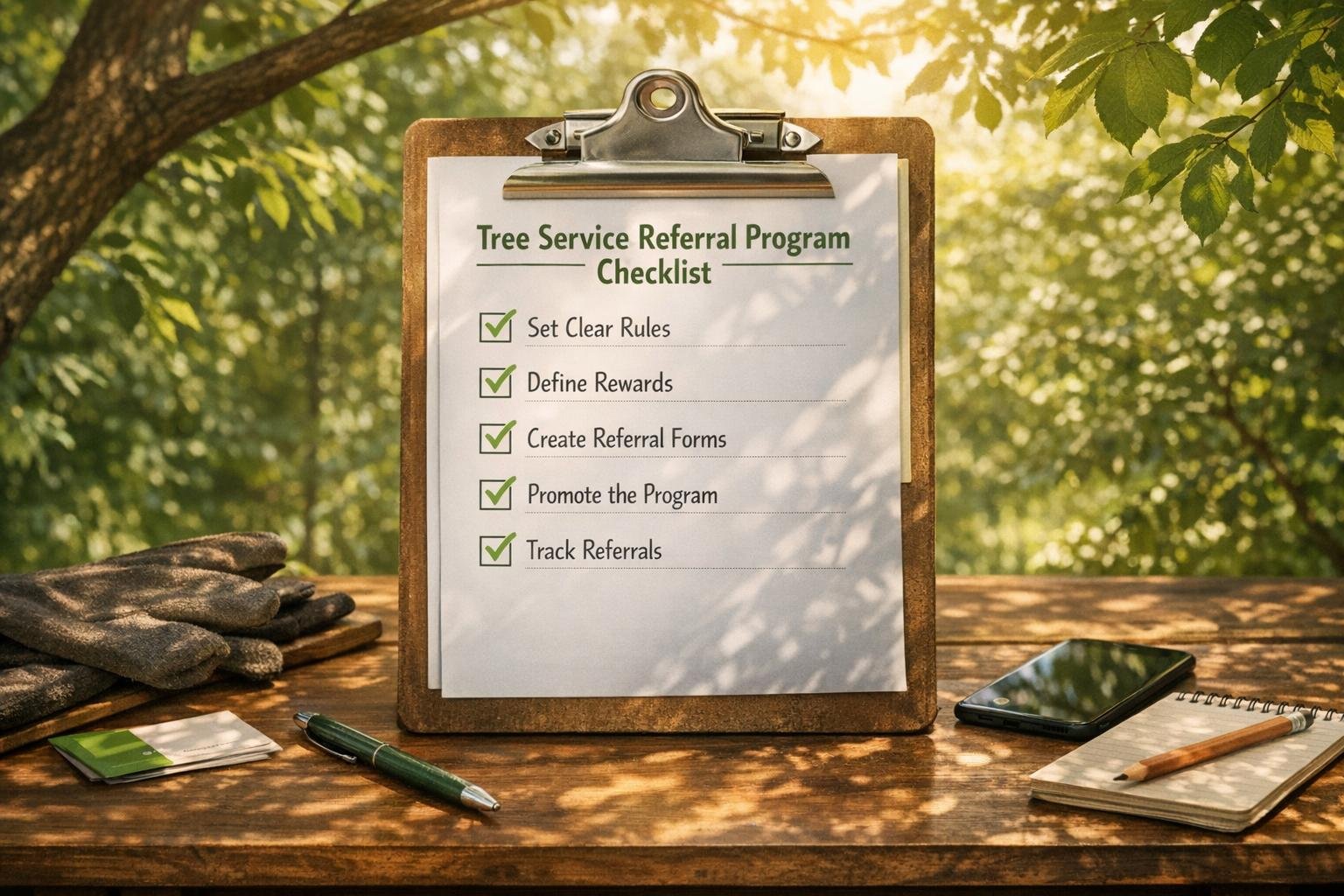
Want more customers without spending big on ads? A referral program can help. It rewards your happy customers for bringing in new business while boosting trust and sales. Here’s what to know:
- Why referrals work: 92% of people trust recommendations from friends and family. Referral leads also close 75–85% of the time and cost less than traditional marketing.
- Before starting: Make sure your customers are satisfied, your team can handle more leads, and you have a system to track referrals.
- Key steps:
- Offer rewards like cash, service credits, or gift cards.
- Set clear rules (e.g., when rewards are paid).
- Make it easy for customers to share referrals (e.g., forms, QR codes).
- Promote it: Add referral links to your website, invoices, and social media. Train your team to mention it after positive interactions.
- Track success: Use CRM software to manage leads and measure metrics like conversions and ROI.
- Deliver rewards fast: Pay out rewards quickly to keep customers engaged.
Referrals bring in loyal, high-value clients and save on marketing costs. Start small, promote consistently, and refine as you go.
Planning Your Referral Program
Selecting Rewards That Work
Choosing the right reward can make or break your referral program. Dual-sided rewards – where both the referrer and the new customer benefit – are especially effective at encouraging participation from both sides. For tree service businesses, it’s smart to match the reward to the type of customer. For example:
- Recurring maintenance clients often appreciate service credits, typically ranging from $25 to $75 off future services.
- One-time customers, like those needing tree removal, might prefer cash or Visa gift cards, often around $50.
As Chad Diller, CEO of Landscape Leadership, puts it:
"$50 cash can be a tipping point for referrals generating $400-$1,000 in business." – Chad Diller, CEO, Landscape Leadership
For higher-value jobs, consider using tiered rewards. One residential design/build firm, for instance, offers $200 for the first referral that leads to a $25,000+ project, $500 for the second, and a choice of $1,500 or a weekend getaway for the third referral within a year. Offering a charitable donation in the customer’s name can also be a meaningful option for those less motivated by monetary rewards.
Whatever you choose, make sure the reward cost aligns with the revenue generated by the new business.
Setting Program Rules and Conditions
Clear rules are essential to avoid confusion. Define exactly when rewards will be triggered – common options include after the final invoice is paid, at contract signing, or upon project completion. Be transparent about timelines and ensure customers know what to expect.
It’s also a good idea to acknowledge referrals even if they only result in a consultation. For dual-sided programs, clearly outline what both parties will receive. For example, a residential lawn and tree care company offers a $25 credit to the referrer and a $25 coupon to the new customer.
To keep things running smoothly, consider automating the reward process using CRM software. This ensures rewards are issued quickly, avoiding unnecessary delays that could frustrate participants.
Making Referrals Easy to Submit
A simple referral process will encourage more customers to participate. Keep forms short – collecting just the basics like the referrer’s name, the new customer’s name, phone number, and email – and provide multiple ways to share referrals. Options like unique links, social media buttons, email templates, and QR codes make it easy for customers to spread the word.
Take a page from Oasis Turf & Tree, which created a dedicated referral landing page on their website. By making the process straightforward and requiring minimal effort, you can significantly boost participation. The fewer steps involved, the more likely customers are to refer their friends and family.
Promoting Your Referral Program
Adding Referral Links to Your Marketing
Make your referral links impossible to miss. Place them prominently in your website’s main navigation, footer, and on a dedicated landing page. A hero banner on your homepage can also draw immediate attention.
Think beyond the digital space – include referral program details on invoices, proposals, and renewal notices. This way, customers encounter the program while actively engaged with your services. You can also add a call-to-action, like "Ask me about discounts for referrals," in every employee’s email signature. For an extra touch, consider including QR codes on physical invoices, making it a breeze for customers to access your referral page using their phones.
Don’t overlook the power of social media. Add your referral link to profile bios and share regular updates to keep the program visible. Highlight customer success stories and testimonials – this builds trust and encourages others to participate.
Lastly, prepare your team to promote the program naturally during customer interactions. A well-informed team can make all the difference.
Getting Your Team to Mention the Program
Your office staff and field crews are your biggest advocates. Train them to bring up the referral program during calls and on-site visits – especially at the right moment, like after completing a job or receiving positive feedback.
"If your company has a great customer referral program, your team and your customers will know about it." – Chad Diller, CEO, Landscape Leadership
Provide your team with physical referral cards they can hand out during home visits or community events. Regularly review the program details with them so they feel confident answering questions and promoting it enthusiastically.
When your team is fully engaged, it paves the way for a successful public launch.
Announcing Your Program Launch
Spread the word about your referral program across every channel. Send an email to your customer list with a clear overview of the program, and consider personalizing messages for your most loyal clients.
Leverage social media to drum up excitement with launch posts, and follow up with periodic reminders to keep the program fresh in people’s minds. Timed post-purchase texts are another great way to capitalize on the positive energy customers feel after a great experience.
"Timing is critical when asking for referrals, and there’s no better time than when the excitement of buying from you is fresh." – Rob Glover, Senior Copywriter at LocaliQ [6]
Scooter’s Lawn Care Client Referral Program
sbb-itb-130a704
Tracking and Managing Referrals
Once your referral program is up and running, keeping track of its performance and managing the details effectively is key to maintaining its success.
Using CRM Software for Referral Tracking
A CRM system acts as the hub for your referral program, helping you keep everything organized. It stores information about who referred whom, tracks leads as they move through your sales pipeline, and automates follow-up messages to ensure no referral slips through the cracks. To make the most of your CRM, use lifecycle stage tags to pinpoint your most dedicated customers – those who’ve left glowing reviews or have a strong purchase history – and focus your referral requests on them.
For a seamless process, your CRM should integrate with your referral software. When a new lead comes in through a referral link, the system can automatically log the source, assign the lead to a team member, and send out a welcome message right away. This ensures your team can follow up within 24 hours, keeping the momentum going.
Measuring Your Program Results
To evaluate your referral program’s performance, keep an eye on these four metrics:
- Joined Members: The total number of people who’ve signed up for the program.
- Engaged Members: Those actively sharing their referral links.
- Brand Visits: The traffic generated from those links.
- Referrals Added: The number of conversions from referrals.
If you notice sharing rates dropping below 10–15%, it may be time to tweak your incentives.
To calculate your ROI, compare the revenue generated from referred customers to the total program costs. These costs typically include rewards, software subscriptions (which often run about $100/month), and staff time. Keep in mind that 54% of marketers say referral programs significantly cut down their cost-per-lead. Also, track conversion rates and Customer Lifetime Value (CLV) to determine if offering higher rewards for long-term commitments makes sense.
Automating Reminders and Follow-Ups
Automation is your best friend for keeping your referral program on track without requiring constant manual oversight. Set up automated email sequences to handle key tasks, such as welcoming new participants, providing updates on their progress, notifying them of earned rewards, and alerting your team to follow up on referrals. Make at least three contact attempts to maximize conversions. If someone hasn’t shared their referral link within a week or two of signing up, send a gentle reminder.
"Nothing will suck the wind out of your brand evangelists’ sails more quickly, than crappy follow-up and lousy tracking." – Chad Diller, CEO, Landscape Leadership
Lastly, always send an automated thank-you message to show appreciation for your referrers’ efforts. A little acknowledgment can go a long way in keeping them engaged.
Rewarding Referrals and Keeping Customers Happy
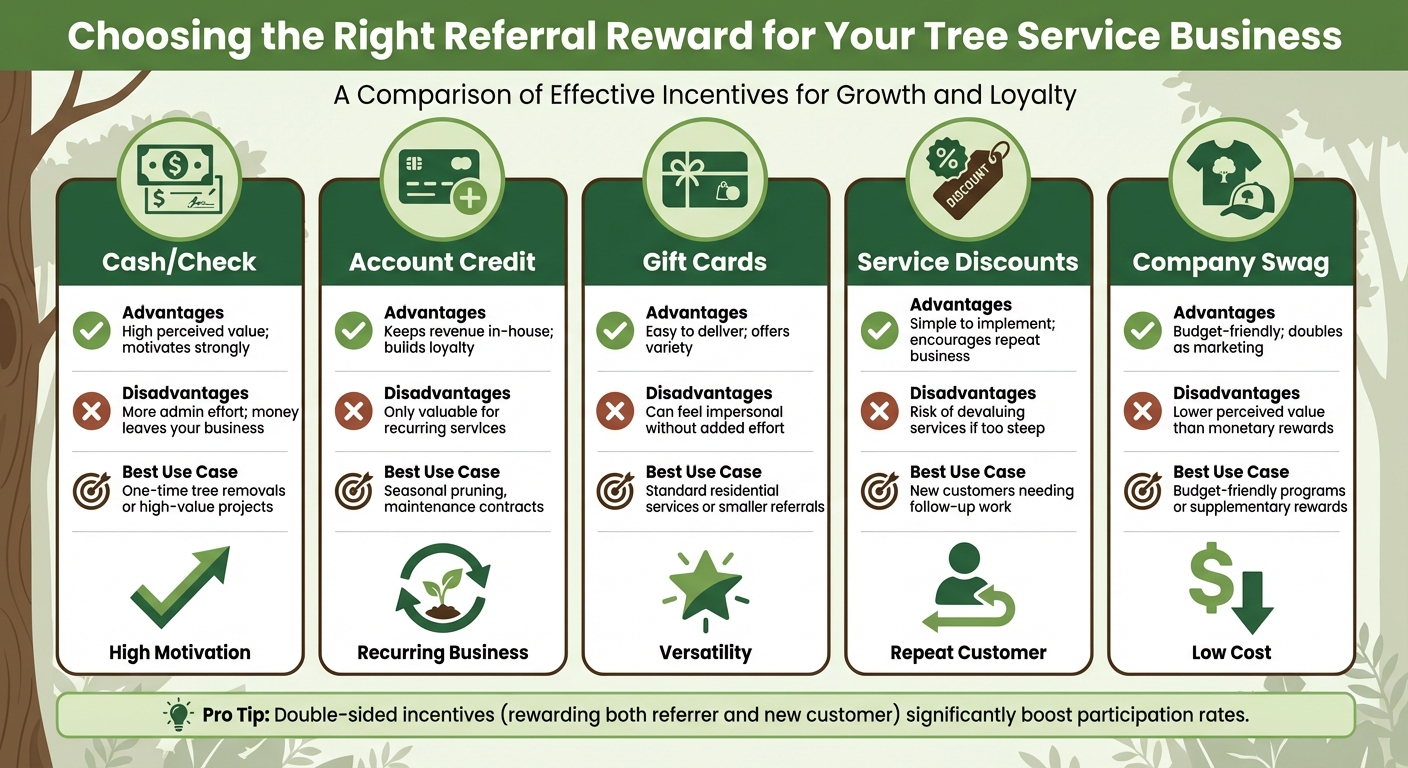
Tree Service Referral Program Reward Types Comparison Chart
Delivering Rewards Quickly
Getting rewards to your customers fast – ideally within 24 hours of a successful conversion – can make all the difference in building trust and keeping them engaged. To streamline this, configure your referral software to automatically track attributions and issue rewards as soon as a conversion is confirmed. For standard residential services, you can trigger the reward right after the first payment clears. However, for larger projects, like a major tree removal, you might want to add a manual approval step. This ensures the job is completed and fully paid before releasing high-value rewards.
Be upfront about your reward triggers. Whether it’s 31 days after the first payment or immediately after project completion, clarity helps customers know exactly what to expect.
Your CRM integration is key here. By syncing referral data, it allows you to monitor every lead from start to finish, ensuring no referrer gets overlooked. Plus, it keeps customers informed about their reward status, which is a great way to maintain transparency and trust. Once the reward is delivered, a personal acknowledgment can go a long way in solidifying loyalty.
Thanking Your Referrers
A simple but meaningful gesture, like a handwritten thank-you card signed by the owner, can leave a lasting impression. If your business has grown and you need help drafting these notes, have a receptionist write them, but make sure the owner still signs them for that personal touch.
For high-value referrals – or even referrals that don’t convert – consider going the extra mile. A $100 donation to a charity they care about or a gift card to their favorite local restaurant can leave a strong impression. As Michelle Farnsworth from Calldrip puts it:
"A little appreciation can go a long way!"
Comparing Different Reward Options
Different rewards resonate in different situations, and choosing the right one can make your referral program more effective. Here’s a quick breakdown:
| Reward Type | Advantages | Disadvantages | Best Use Case |
|---|---|---|---|
| Cash/Check | High perceived value; motivates strongly | More admin effort; money leaves your business | One-time tree removals or high-value projects |
| Account Credit | Keeps revenue in-house; builds loyalty | Only valuable for recurring services | Seasonal pruning, maintenance contracts |
| Gift Cards | Easy to deliver; offers variety | Can feel impersonal without added effort | Standard residential services or smaller referrals |
| Service Discounts | Simple to implement; encourages repeat business | Risk of devaluing services if too steep | New customers needing follow-up work |
| Company Swag | Budget-friendly; doubles as marketing | Lower perceived value than monetary rewards | Budget-friendly programs or supplementary rewards |
For customers on recurring maintenance plans, account credits are a smart choice since they keep funds within your business. On the other hand, for one-time projects, cash or gift cards tend to be more appealing and flexible. Also, offering double-sided incentives – where both the referrer and the new customer receive rewards – can significantly boost participation rates.
Conclusion: Building Long-Term Success
Key Takeaways
Creating a successful referral program takes thoughtful planning, consistent promotion, and effective reward management. Start by establishing SMART goals and identifying the best moments to ask for referrals – like right after completing a tree removal job or when a customer leaves a glowing review. Make your program easy to find by showcasing it on your website, invoices, email signatures, and social media. Also, train both your field crews and office staff to mention it naturally during customer interactions.
Referrals in the tree care industry boast an impressive close rate of 75% to 85%, making them one of the most effective tools for growing your business. As Chad Diller, CEO of Landscape Leadership, explains:
"Customer referrals close at a higher rate than most other marketing mediums and the customers that result also are more easy to retain."
To streamline the process, use CRM or referral software to track referrals, ensure rewards are delivered promptly, and measure your program’s ROI. Offering rewards for both the referrer and the new customer can significantly increase participation.
By applying these strategies, you can fine-tune your referral program and set the stage for sustainable growth.
Next Steps for Your Tree Service Business
With these takeaways in mind, it’s time to take action. Launch your referral program and test it with your most loyal customers first. Gather their feedback to make improvements. Review your program’s performance every quarter to identify trends and areas that need adjustment. Keep promoting it consistently, and try out different reward options or seasonal contests to keep customers engaged.
For even better results, pair your referral program with professional marketing. Tree Company Leads offers services like web design, Google Ads management, and lead generation tailored specifically for tree service businesses. They can help you attract high-quality leads while improving your local SEO and online visibility. Combining trusted referrals with targeted lead generation creates a solid foundation for long-term growth and success.
FAQs
What’s the best way to choose rewards for a tree service referral program?
Selecting the right rewards can make or break your tree service referral program. The incentive needs to strike a balance: valuable enough to motivate your customers but still cost-effective for your business. Start by defining your main goal – whether that’s encouraging repeat customers, bringing in new clients, or building loyalty – and tailor your rewards to fit. For example, offering a 10% discount on future services can inspire repeat business, while a $100 gift card to a home improvement store might attract new customers.
Think about what your customers truly value. Practical rewards tend to work best – things like service discounts, free tree health inspections, or branded safety gear (like gloves or hard hats). Giving your customers options can also boost participation. For instance, let them choose between a $50 gift card, a free service, or company-branded merchandise. When people feel they have a say, they’re more likely to engage.
Keep the reward system straightforward and easy to follow. A tiered structure can work wonders: “Refer one client → 5% off; refer three → free stump grinding.” Clear rules and quick delivery of rewards build trust and keep participants excited. By aligning your incentives with what your customers value and your business needs, you’ll create a referral program that not only drives growth but also strengthens your relationship with your customers.
How can I effectively promote my tree service referral program to increase participation?
To get the most out of your referral program, make it impossible to miss and simple to join. Start by designing a dedicated landing page that lays out the rewards clearly, uses eye-catching visuals, and includes a straightforward call-to-action. Make sure the page is mobile-friendly and easy to navigate so potential participants can sign up in just a few clicks. Real-time referral tracking is another must-have – it lets you monitor performance and tweak rewards as needed.
Get the word out through the platforms your customers already know and love. Share program details face-to-face, on invoices, or through email newsletters and postcards. Social media is another great tool – use it to showcase rewards like gift cards, discounts, or branded swag. Want even more engagement? Offer incentives for both the person making the referral and the new customer. A win-win is hard to resist.
If you’re looking to elevate your program, teaming up with Tree Company Leads could be the way to go. They specialize in creating professional landing pages, running targeted Google Ads, and fine-tuning local SEO to ensure your referral program hits the right audience and brings in top-notch leads.
What’s the best way to track and manage referrals for my tree service business using CRM software?
To keep track of and manage referrals for your tree service business effectively, start by setting up a dedicated referral pipeline or tagging system within your CRM. Use custom fields to log details like referral sources and unique codes, making it easy to attribute referrals accurately. Take it a step further by automating data capture – integrate your website or email forms with your CRM so referral submissions are recorded automatically, eliminating the need for manual entry.
Next, streamline your rewards process with automated workflows. For instance, when a referral job is completed (like a $500 tree removal on December 15, 2025), your CRM can handle multiple tasks: logging the reward amount, notifying your team, and even sending a thank-you email to the person who referred the job. Regularly analyze metrics such as total referrals, conversion rates, and ROI to pinpoint your most active advocates and fine-tune your referral program as needed.
If you need help integrating these workflows, Tree Company Leads offers services to seamlessly set up these processes in your CRM. They can also enhance your lead generation and local SEO efforts, helping you attract quality referrals with ease.
Related Blog Posts
Want more leads for your tree service business? Start with digital marketing.
Tree services are booming, with the industry projected to reach $35.6 billion by 2025. But if your business isn’t visible online, you’re losing customers to competitors. Over 87% of people research tree services online before calling. That means showing up in search results, Google Maps, and ads is non-negotiable.
Here’s what works:
- Local SEO: Get your business listed in the "Local Pack" on Google Maps for high-intent searches like "tree removal near me."
- Google Ads: Capture urgent leads with targeted campaigns for keywords like "emergency tree removal."
- Social Media Ads: Use platforms like Facebook to connect with local homeowners using before-and-after photos and seasonal campaigns.
- Mobile-Friendly Websites: Make it easy for customers to contact you with fast-loading pages, click-to-call buttons, and service-specific landing pages.
Digital marketing works for businesses of all sizes. Whether you’re spending $750 in a rural area or $6,000+ in a competitive city, these strategies can keep your schedule full year-round.
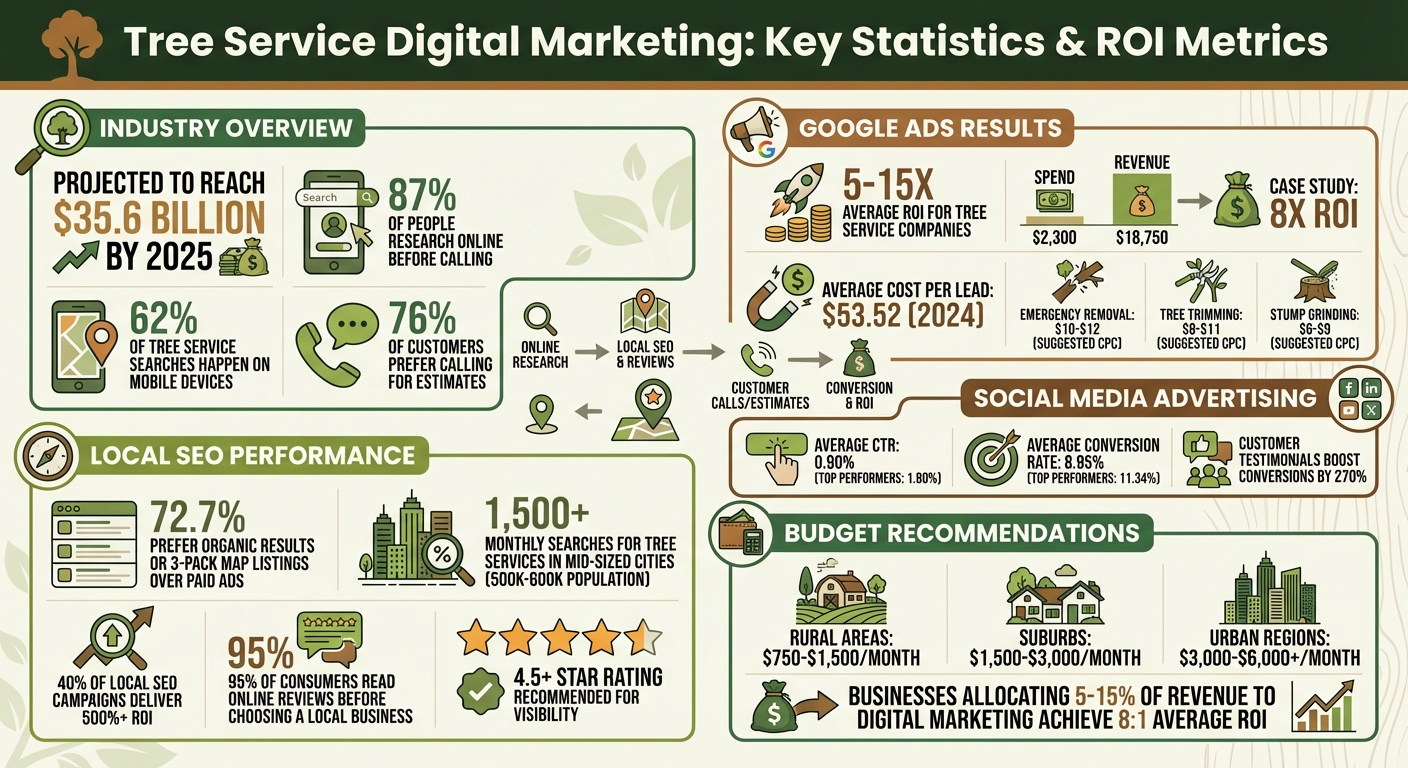
Tree Service Digital Marketing ROI Statistics and Key Metrics
The 10 Best Tree Service Marketing Ideas
Local SEO for Tree Service Businesses
Nearly half of all Google searches are local in nature. When someone searches for "tree removal near me" or "arborist in [City]", they’re often ready to hire. Local SEO ensures your tree service appears in front of these high-intent customers at just the right moment. Unlike paid ads that stop generating leads as soon as the budget runs out, local SEO builds long-term visibility, driving consistent calls month after month.
Here’s the kicker: 72.7% of searchers prefer clicking on organic results or the 3-pack map listing over paid ads. In mid-sized cities with populations of 500,000 to 600,000, there are typically over 1,500 monthly searches for tree services. And with 40% of local SEO campaigns delivering an ROI of 500% or more, it’s one of the most cost-efficient marketing strategies for tree service companies. While professional SEO management can cost between $2,000 and $5,000 per month, the steady stream of leads often makes it well worth the investment.
Google Business Profile Setup
Your Google Business Profile (GBP) is the backbone of your local SEO strategy. When people search for tree services in your area, your GBP determines whether you appear in the "Local Pack" – the top three businesses displayed alongside a map in search results. Securing this spot can dramatically increase your lead flow.
Start by claiming and verifying your profile as soon as possible. The verification process can take 2–4 weeks, so don’t wait until you’re desperate for leads. Once verified, you’ll have full control over your business details and can respond directly to customer reviews.
NAP consistency – your Name, Address, and Phone number – must match exactly across your GBP, website, and other online directories. Even small inconsistencies can confuse search engines and hurt your rankings.
Selecting the right categories is another crucial step. Set "Tree Service" as your primary category, and add secondary categories like "Arborist" or "Stump Grinding Service" to reflect your offerings. If you’re a service-area business without a physical storefront, clearly define your service area by listing all the cities and neighborhoods you cover.
Your business description is a prime spot for integrating keywords. Use terms like "tree removal", "stump grinding", and "emergency tree service" naturally. Write for people first, but make sure to include the phrases potential customers are searching for.
Photos are surprisingly impactful. Businesses with 10 or more high-quality photos tend to see higher engagement and improved rankings. Include images of your team at work, branded trucks, before-and-after shots, and your equipment. Regularly updating these photos – ideally weekly – signals to Google that your business is active.
Reviews can make or break your local rankings. With 95% of consumers reading online reviews before choosing a local business, it’s vital to request feedback from happy customers and respond to all reviews professionally. Aim for a 4.5+ star rating with recent reviews to boost your visibility.
Don’t overlook Google Posts. Posting weekly updates about completed projects, seasonal tips, special offers, or storm alerts keeps your profile fresh and engaging.
| Feature | Optimization Action | Impact on Ranking |
|---|---|---|
| Business Name | Use exact legal name; avoid keyword stuffing | High (Trust/Compliance) |
| Categories | Select "Tree Service" as primary | Critical (Relevance) |
| Photos | Upload 10+ high-quality project photos | Medium (Engagement) |
| Reviews | Maintain 4.5+ star rating with recent entries | High (Authority) |
| Posts | Update weekly with offers or tips | Medium (Activity Signal) |
Use GBP insights to track how many customers call directly from your map listing versus visiting your website. This data can help you fine-tune your strategy for even better results.
Once your GBP is optimized, shift your focus to identifying high-intent keywords your local customers are using.
Keyword Research for Tree Services
To connect with local customers, you need to target the keywords they’re searching for. Effective keyword research ensures you show up at every stage of their decision-making process.
Commercial intent keywords are essential. Focus on high-volume phrases like "tree services + [city]", "tree removal + [city]", and "arborist in [city]". For example, if you’re based in Austin, target "tree removal Austin" or "arborist in Austin."
Service-specific keywords let you reach customers with more specific needs. Terms like "stump grinding", "tree trimming", "land clearing", and "emergency tree removal" are great examples. Creating individual pages for each service not only improves rankings but also enhances the user experience.
Emergency keywords are key for capturing urgent leads. After storms or accidents, people often search for terms like "emergency tree removal", "storm damage cleanup", or "24/7 tree service". These searches tend to convert quickly due to their urgency.
With mobile usage accounting for over 60% of web traffic, optimizing for "near me" searches is a must. Queries like "tree removal near me" or "arborist near me" are common. Ensure your GBP and website content are tailored to these location-based searches.
Voice search is also on the rise. Customers using Siri, Alexa, or Google Assistant might ask, "Who offers the best tree removal near me?" or "Where can I find a certified arborist?". To capture these queries, use conversational, long-tail keywords in your FAQ sections and blog posts.
Don’t forget informational keywords to attract customers in the research phase. Queries like "when to prune apple trees", "how to tell if a tree is dying", or "best time of year for tree trimming" may not convert immediately, but they establish your expertise and keep your business top-of-mind.
"Tree Service SEO… is typically trying to show up higher for the main keywords and search intent that drive the most volume, which include ‘tree services + city’ and ‘tree removal + city’." – SEO Brothers
Use tools like Google Keyword Planner or Semrush to uncover search volumes specific to your area. In mid-sized cities, tree-related searches can exceed 1,500 per month, offering plenty of opportunities to capture traffic.
| Keyword Category | Examples | Intent Level |
|---|---|---|
| Core Services | Tree removal, tree trimming, arborist | High (Commercial) |
| Location-Based | Tree service [City], tree removal near me | High (Local) |
| Urgent/Emergency | Emergency tree removal, storm damage | Critical (Immediate) |
| Specialized | Stump grinding, land clearing, cabling | Medium (Niche) |
| Informational | When to prune trees, signs of tree disease | Low (Educational) |
Make sure to optimize your website with these keywords, especially on dedicated service pages, to strengthen your local SEO efforts.
On-Page SEO and Content
Once you’ve nailed down your keywords, it’s time to optimize your website. On-page SEO ensures search engines understand what each page is about and why it deserves to rank for specific searches.
Instead of grouping everything on one "Services" page, create separate pages for each offering – like "Tree Removal", "Stump Grinding", "Tree Trimming", and "Emergency Services". This approach improves rankings and makes it easier for visitors to find exactly what they need.
Location-based content is just as important. Develop landing pages for each city or neighborhood you serve. For example, if you cover multiple areas, create pages like "Tree Removal in [City A]" and "Tree Removal in [City B]" with localized content and meta descriptions.
Incorporate location modifiers naturally throughout your site by mentioning specific cities and neighborhoods. This helps boost your relevance for local searches and improves your visibility.
Google Ads for Tree Services

While local SEO helps build your long-term online presence, Google Ads offers immediate visibility. Launch a campaign, and your tree service can appear at the top of search results almost instantly. As SEO consultant Joel Casarez puts it, "Google Ads is your shortcut to the top of search results (like, in hours, not months)".
The numbers back this up. Tree service companies running Google Ads often report a 5–15X return on investment (ROI). For instance, in August 2025, a tree service operating in a market of 250,000 people spent $2,300 on Google Ads in one month. This generated 37 leads, resulting in 15 booked jobs and $18,750 in revenue – an impressive 8X ROI.
When someone searches for "emergency tree removal", they’re not just browsing – they’re ready to act. With 62% of tree service searches happening on mobile devices and 76% of customers preferring to call for estimates, your ads need to make it easy for potential clients to contact you.
Campaign Setup and Keyword Targeting
Setting up a Google Ads campaign correctly is critical to getting quality leads without wasting money. First, use Expert Mode instead of Smart Campaigns. Expert Mode gives you full control over keywords, bidding strategies, and location targeting.
Focus on high-intent keywords that reflect what potential customers are searching for. Examples include:
- "Emergency tree removal"
- "Tree cutting service near me"
- "Stump grinding cost"
- "Licensed arborist near me"
Organize these keywords into specific ad groups, such as Tree Removal, Emergency Services, Tree Trimming, and Stump Services. This structure improves your campaign’s Quality Score, which can lower costs over time.
To avoid wasting money on irrelevant clicks, use negative keywords. Add terms like "DIY", "jobs", "free", "how to", and "Dollar Tree" to your negative keyword list.
Start with a manual bidding strategy and set an initial daily budget of $50–$100 per campaign. This allows you to gather enough data without overspending. Spending less than $50 daily can slow down data collection. Once you’ve logged 30 or more conversions, switch to "Target CPA" bidding to let Google optimize for your preferred cost per lead.
| Service Type | Suggested Max CPC | Daily Budget Range |
|---|---|---|
| Emergency Tree Removal | $10–$12 | $75–$150 |
| Tree Trimming | $8–$11 | $50–$100 |
| Stump Grinding | $6–$9 | $40–$80 |
Ad scheduling can further boost results. Run your ads during peak search times – typically 7–9 AM, 12–1 PM, and 5–7 PM. During storm seasons, when emergency searches spike, increase your bids by 15–25% to capture the surge.
Your ads should direct users to dedicated landing pages that match the ad copy. For example, an ad about "Storm Damage" should link to a page focused on storm cleanup services. Include trust-building elements like your business license number, insurance details, and before-and-after photos to establish credibility.
Enhance your ads with extensions such as:
- Call extensions: Allow users to call directly from the ad.
- Location extensions: Showcase your service area.
- Sitelinks: Highlight specific services, like "Stump Grinding" or "Emergency Services".
Once your campaign is up and running, fine-tune your targeting to focus on local customers.
Geo-Targeting for Local Customers
Geo-targeting lets you zero in on the local audience most likely to need your services. One of Google Ads’ biggest strengths is its ability to target customers across your entire service area, not just those near your office. As Wesley Smith, founder of Tree Service Digital, explains, "Google Ads break those boundaries – you can appear across your entire service area, no matter where you’re based".
Set your location targeting to cover a 25–50 mile radius around your business or focus on specific high-value ZIP codes. This approach minimizes wasted clicks from users outside your service area. You can also use the "location in search" option to reach users searching for services in your area, even if they’re physically elsewhere. For example, someone in another city searching for "tree removal Atlanta" will still see your ad if you serve that area.
Optimize your ads for different devices. Mobile ads should include click-to-call features, while desktop ads can provide more detailed descriptions of your services. Make sure your landing pages are mobile-friendly and include prominent call buttons for easy contact.
Adjust your monthly budget based on your location’s competition:
- Rural areas: $750–$1,500 (CPC $10–$15)
- Suburbs: $1,500–$3,000 (CPC $20–$30)
- Urban regions: $3,000–$6,000+ (CPC $30–$50+)
To dominate search results, consider combining Google Ads with Local Services Ads (LSAs).
Combining Google Ads with Local Services Ads
Running both traditional Google Ads and Local Services Ads (LSAs) can maximize your visibility. LSAs appear at the very top of search results and operate on a pay-per-lead model – you only pay when a potential customer contacts you directly.
One major advantage of LSAs is the Google Guaranteed badge, which you earn after passing a background check. This badge builds trust with potential customers and often increases click-through rates. As Digital Drew SEM founder Drew Blumenthal explains, "LSAs operate on a pay-per-lead model, not pay-per-click. That means you’re only charged when a potential customer contacts you directly through the ad".
Using both ad types together ensures you dominate the top of the search results. For example, when someone searches for "tree removal near me", your LSA might appear first, followed by your traditional Google Ad and then your organic listing. This layered approach increases your chances of getting contacted.
Speed matters with LSAs. Use the Google LSA mobile app to respond to leads quickly – ideally within minutes. Slow responses can hurt your ranking. And since 76% of customers prefer calling for estimates, make sure someone is available to answer calls during business hours.
Finally, track your campaign performance. Monitor phone calls (using tracking numbers), form submissions, and your Cost Per Lead (CPL). In 2024, the average CPL for tree services was about $53.52, though this can vary by market. Use this data to refine your strategy and focus on the keywords and ad types delivering the best ROI.
Social Media Advertising for Tree Services
When it comes to reaching local property owners and building brand awareness, social media advertising is a powerful tool. Unlike Google Ads, which target people actively searching for tree services, platforms like Facebook and Instagram allow you to connect with potential customers based on location, interests, and demographics. This proactive approach helps establish trust with homeowners even before they face an emergency.
The stats back it up: tree service ads on Facebook average a click-through rate (CTR) of 0.90%, with top campaigns hitting 1.80%. Conversion rates are equally impressive, averaging 8.95% and climbing as high as 11.34% for the best-performing ads. For visually oriented businesses like tree services, these platforms are a natural fit. Showcasing before-and-after photos or videos of your work can highlight your expertise and drive engagement. These metrics underline the potential return on investment when social media campaigns are executed effectively.
Meta Ads for Homeowners
Facebook and Instagram ads now rely heavily on interest-based targeting to connect with homeowners. To reach this audience, focus on interests such as Home Improvement, Gardening, DIY projects, or even Home Insurance. Targeting shoppers at major home improvement stores is another effective strategy since these interests often align with homeownership.
Hyperlocal targeting is key to narrowing your audience. Use ZIP codes or set a 15–25 mile radius around specific neighborhoods. Including the neighborhood name in your ad copy – like "Serving homeowners in [Neighborhood Name] with expert tree care" – can make your ads feel more relevant and personal. For demographics, aim for users aged 35–65, as this group is most likely to own homes. Start with a daily budget of $20–$30 to gather enough data for optimization.
Next, let’s talk about how visual content can take your social media strategy to the next level.
Using Photos and Videos
Visual content is the backbone of social media success. Before-and-after photos showcasing tree removals or trimming transformations consistently outperform other types of posts [30, 35, 37]. Videos are equally effective at building trust. Whether you’re featuring your team using professional safety equipment, sharing drone footage of complex projects, or posting "day in the life" clips, video content humanizes your business and builds credibility.
Customer testimonials are another game-changer, boosting conversions by up to 270%. You can also connect with your audience by sharing "Meet the Crew" posts or introducing the business owner, which adds a personal touch to your brand.
For the best results, use high-resolution images (at least 1080×1080 pixels) and limit text overlays. While Facebook no longer bans ads with too much text, overly text-heavy visuals tend to have reduced reach. As Afsheen Ali, Product Marketing Manager at Facebook, explains:
"Our research has shown that people demonstrate a preference for ads with less text".
| Performance Metric | Industry Average | Top Performers |
|---|---|---|
| Click-Through Rate (CTR) | 0.90% | 1.80% |
| Conversion Rate | 8.95% | 11.34% |
| Engagement Rate | 1.57% | 3.14% |
Seasonal Campaigns and Retargeting
Once you’ve nailed your visuals and budget, it’s time to explore seasonal campaigns and retargeting to drive bookings. Seasonal ads create urgency and position your business as an expert. For example, you can promote spring pruning services in late February or early March, storm preparation in the summer and fall, and winter damage prevention in November and December. Launching these campaigns 2–3 weeks before the season begins ensures you’re ahead of the curve.
Here’s an example: in October 2025, a tree service company ran a Facebook campaign targeting homeowners in storm-prone areas, promoting emergency tree removal services. The result? A 25% boost in service bookings during storm season. For emergency-focused ads, use "Click-to-Call" buttons and highlight 24/7 availability to encourage immediate action.
Retargeting ads are another effective tactic. One tree service business used them to reconnect with website visitors, achieving a 30% increase in conversions over two months. You can also offer educational resources like a "Seasonal Tree Care Calendar" or "Emergency Prep Guide." These lead magnets capture contact information from potential customers who aren’t ready to book yet while positioning your business as a trusted resource.
sbb-itb-130a704
Building a Tree Service Website That Converts
Your website is your strongest tool for generating leads. With the tree care industry pulling in over $20 billion annually in the U.S., businesses with complete digital profiles see 70% more location visits than those with incomplete ones. Every aspect of your website should be geared toward turning visitors into customers.
Website Features That Generate Leads
If your phone number isn’t easy to find, you’re missing out on potential clients. Make sure click-to-call buttons are clearly visible on every page.
Create dedicated pages for each service – tree removal, pruning, stump grinding, and emergency services. Use location-specific keywords like "tree removal in [City Name]" to attract local search traffic. These pages should highlight trust signals like insurance certificates, ISA certifications, and professional association logos to establish credibility.
Visual proof of your work, like before-and-after photos or videos, can make a big difference. A service area map or location-specific pages helps reassure visitors that you operate in their neighborhood. Adding educational content, such as seasonal tree care tips, positions you as a trusted local expert.
Modern lead forms should go beyond collecting basic information. Include fields for urgency, tree details, and even photo uploads to streamline remote quoting and prequalify leads. Guillaume Heintz, a Lead Generation Strategist, emphasizes:
"Don’t just collect names – qualify for intent, location, and urgency. Your estimators’ close rate will climb instantly."
Quick responses matter: contacting a lead within five minutes can double your chances of closing the deal compared to slower follow-ups. Many tree service companies now use live chat to provide instant support. Monica Hemingway from Tree Care Marketing Solutions explains:
"The fastest responder often wins the job, even if they’re not the cheapest."
Mobile-Friendly Design
Most tree service searches happen on mobile devices. In fact, 72% of consumers turn to Google Search first when looking for local businesses, with most searches coming from smartphones. During emergencies like storm damage, homeowners need quick help. If your site is slow to load or hard to navigate on a phone, they’ll move on to the next option.
To optimize for mobile, focus on fast loading times with compressed images, simple navigation, and prominently placed click-to-call buttons. Include clear CTAs like "Request a Free Estimate" tailored for mobile users. As Jobber explains:
"Many people search for help while on their phone, so your site should be easy to use on those devices. They might even be standing in their yard, looking at a fallen tree, when they land on your site."
A mobile-friendly design is also critical for local SEO, directly affecting how your site ranks in search results. Arul Selvan, a digital marketing specialist at TechAffinity, points out:
"Technical SEO is usually carried out to provide a great user experience. It is generally done by focusing on your site speed, mobile-friendliness, crawlability, site structure, and indexation."
Customizing your website design takes these features to the next level, making it a true lead-generation powerhouse.
Custom Web Design with Tree Company Leads
While generic website templates might save you money upfront, they rarely deliver the results you need to grow your business. Custom web design combines technical expertise with elements specifically designed to convert visitors into leads.
Tree Company Leads offers custom web design services tailored to tree service businesses. Their designs include features like seasonal messaging, fast-loading forms, and branding that reflects your company’s voice. These designs also focus on essentials like showcasing certifications, integrating service area maps, and ensuring a mobile-first experience.
Tom Sudik of Oasis Tree Care saw $17,000 in revenue from five jobs within six weeks of launching a specialized digital marketing program with Tree Company Leads. Similarly, Jack Leake of Affordable Tree & Landscape received 20 estimate requests in just two days after revamping his online presence, keeping his business busy even during slower times.
Justin Williamson from East Coast Arbor Pro sums it up:
"What it boils down to is that our phones haven’t stopped ringing since we switched to Tree Company Leads."
Custom web design isn’t just about making your site look good – it’s about creating a lead-generating system that works 24/7.
Tracking and Improving Marketing Results
Once your digital strategies are in motion, the next step is tracking their performance and fine-tuning them to get the most bang for your buck. Monitoring your efforts helps you pinpoint which channels are bringing in customers and which ones might just be draining your budget.
Measuring Performance Metrics
After launching local SEO, paid ads, and social media campaigns, keeping an eye on their performance is crucial. Focus on key metrics like website traffic, conversion rate, and cost per lead (CPL). For instance, a conversion rate above 3% is considered strong, while CPL is calculated by dividing your total spend by the number of leads generated.
Another key indicator is Return on Ad Spend (ROAS), which measures campaign profitability. For example, if you invest $2,000 in Google Ads and generate $8,000 in revenue, your ROAS is 4x. Ryan Warner, who runs a tree service business, highlights the importance of tracking:
"What we’ve realized through working with you and your team is that you can quantify marketing returns. I can look and see I’m spending this dollar and I’m getting this in return for it".
To dig deeper, use tools like call tracking. Platforms such as CallRail assign unique phone numbers to your campaigns, so you can tell whether a lead came from Google Ads, your website, or social media. Also, calculate your Customer Acquisition Cost (CAC) by dividing all marketing and sales expenses by the number of new customers acquired.
Here’s a quick overview of key metrics:
| Metric | Calculation Method | Why It Matters |
|---|---|---|
| Cost Per Lead (CPL) | Total Spend ÷ Total Leads | Measures ad efficiency |
| Conversion Rate | (Actions ÷ Total Visitors) × 100 | Shows how well your website converts traffic |
| ROAS | Total Revenue ÷ Total Ad Spend | Tracks campaign profitability |
| CAC | Total Marketing + Sales Costs ÷ New Customers | Reveals the cost of acquiring each customer |
Additionally, tools like Google Search Console can help you monitor your organic rankings and visibility over time.
Testing and Optimization
Before making any adjustments, gather performance data for at least 2–3 weeks. Regular reviews allow you to identify which keywords are driving results and which are just wasting money. Pause keywords that aren’t converting, and consider increasing bids on high-performing ones like “emergency tree removal”. Experiment with different ad elements – headlines, visuals (like before-and-after photos), and call-to-action buttons – to see what resonates most with your audience.
Fine-tune your geo-targeting by analyzing performance trends across ZIP codes. Shift your budget toward areas with high conversion rates and scale back in regions with lower-quality leads. For more control over campaigns, use Google Ads’ "Expert Mode" instead of automated Smart Campaigns. This gives you the flexibility to manage keyword bidding and location targeting.
Don’t overlook the technical side. Regular audits can ensure your website loads in under three seconds and is free of broken links . Encourage happy customers to leave reviews that include specific keywords, such as “stump grinding” and the name of their city. These reviews can boost your Local Map Pack visibility.
Combining Multiple Marketing Channels
To tie it all together, consider using a unified dashboard that tracks SEO, paid ads, and social media performance. Combining these channels creates a well-rounded marketing strategy. SEO works to build long-term visibility, while Google Ads deliver immediate leads. Running both Google Search Ads and Local Services Ads ensures you dominate the top of search results.
Each channel serves a unique purpose. Google Ads target high-intent customers actively searching for tree services, while social media ads on platforms like Meta help build awareness among homeowners who may not have an immediate need. Meanwhile, email and SMS marketing keep you on their radar for seasonal services like pruning or storm preparation.
Tools like Google Analytics and call tracking can help you follow the entire customer journey. A unified dashboard that captures calls, forms, chats, and texts ensures no leads are missed and allows for quicker follow-ups. Keep in mind that about 70% of tree service customers do their research before ever reaching out to a company.
Digital marketing is like a puzzle – every piece needs to fit together to get the best results. Businesses that use multiple channels often experience a steady flow of leads, even if one channel sees a dip.
Conclusion
If you want your tree service business to thrive in 2025, it’s essential to connect with customers across all digital platforms. The strategies outlined here work hand-in-hand to create a reliable stream of leads. Investing in local SEO helps build trust and organic visibility over time, while Google Ads and Local Services Ads provide quick results for urgent needs like emergency tree removal. Social media ads keep your services in front of potential customers during key seasons, and a fast, mobile-friendly website ensures those visitors turn into paying clients.
Businesses that allocate 5% to 15% of their revenue to digital marketing often achieve an average ROI of 8:1. Take T&T Tree Service as an example – effective digital marketing completely transformed their lead generation and revenue growth.
"Partnering with [an agency] has been a total game-changer for our tree service. We went from receiving 1-2 leads a day to consistently getting 15+ leads daily! Their expertise in website management, Google Ads, and SEO has driven a 200% revenue growth year over year." – Steve Tatalovich, Owner, T&T Tree Service
Consistency is key to staying visible online. Keep your Google Business Profile accurate and up-to-date, ensure your website is fast and optimized for conversions, and focus your ads on high-intent keywords like "emergency tree removal." Don’t forget to ask for reviews after each job – they’re invaluable for building trust and credibility.
Tree Company Leads takes the guesswork out of digital marketing by offering custom web design, targeted Google Ads, and SEO services. With these tools in place, you can focus on what you do best – running your business.
FAQs
What are the best ways to increase my tree service business’s online visibility?
To improve your tree service business’s online visibility, start by focusing on local SEO. Make sure to claim and optimize your Google Business Profile by providing accurate details like service areas, business hours, and contact information. Add high-quality photos and craft a detailed description that includes location-specific keywords such as "tree trimming in [city]" or "stump removal near [zip code]." On your website, create separate pages for each service you offer, using geo-targeted keywords in titles and meta descriptions. Don’t underestimate the power of positive customer reviews – most people rely on them before making hiring decisions. Encourage happy clients to share their feedback online.
If you’re looking for faster results, consider investing in paid advertising. Google Ads can help you target high-intent searches like "tree service near me", while allowing you to set a geographic radius to focus on local customers. Meta platforms like Facebook and Instagram are excellent for running ads that showcase before-and-after photos or seasonal tips, helping you connect with your audience. Additionally, Google Local Services Ads, if available in your area, can give your business an edge with the "Google Guaranteed" badge, which builds trust and attracts more clicks.
Don’t forget to stay active on social media and list your business in well-known directories like Yelp and Angi. Regularly post updates about recent projects, certifications, or seasonal advice to engage your audience and keep your brand visible. By combining local SEO, paid ads, and consistent social media activity, you can drive more leads and grow your tree service business effectively.
What are the best digital marketing strategies for tree service businesses?
The best digital marketing strategies for tree service businesses focus on increasing local visibility, running targeted ads, and building a website that turns visitors into paying customers.
Start with local SEO by claiming and optimizing your Google Business Profile. Make sure to use location-specific keywords like "tree trimming in Austin" and build local citations to improve your online presence. Creating helpful, service-focused content can also improve your chances of appearing in top Google Maps results, which is where many homeowners begin their search for tree services.
Next, invest in pay-per-click (PPC) advertising through platforms like Google Ads and Meta (Facebook/Instagram). PPC ads can target high-intent searches such as "tree removal near me", helping you connect with homeowners ready to book services. These ads can also be tailored by location, interests, and seasonal needs, driving immediate inquiries and bookings.
Lastly, make sure your website is built to convert visitors into leads. Your site should load quickly, be mobile-friendly, and include trust-building elements like customer reviews, certifications, and project photos. Keep your audience engaged by sharing tree care tips, before-and-after photos, and videos on your blog and social media. This not only attracts new leads but also encourages reviews, helping you grow your business while keeping marketing costs under control.
How can I optimize my Google Business Profile to improve local SEO for my tree service business?
To get the most out of your Google Business Profile (GBP) and boost your local SEO, start by making sure all your business details are accurate and up-to-date. This includes your business name, address, phone number (NAP), website, and hours of operation. Select a primary category that best represents your business, like Tree Service or Tree Removal Service, and add secondary categories for specific offerings, such as pruning or stump grinding. Make sure to list the cities or neighborhoods you serve so Google can better connect you with local searchers. Craft a short, keyword-focused description that highlights your expertise and what makes your services stand out.
Keep your profile fresh by regularly uploading high-quality photos and videos of your team, equipment, and completed projects. Ask your customers for reviews, and make it a habit to respond to all feedback – whether it’s glowing praise or constructive criticism – with professionalism and promptness. Take advantage of Google Posts to share updates like seasonal advice, special promotions, or recent projects. Don’t forget to keep an eye on the Q&A section, addressing common inquiries and fixing any incorrect information. Following these steps can help your tree service business gain more visibility in local search results and attract new customers.
Related Blog Posts
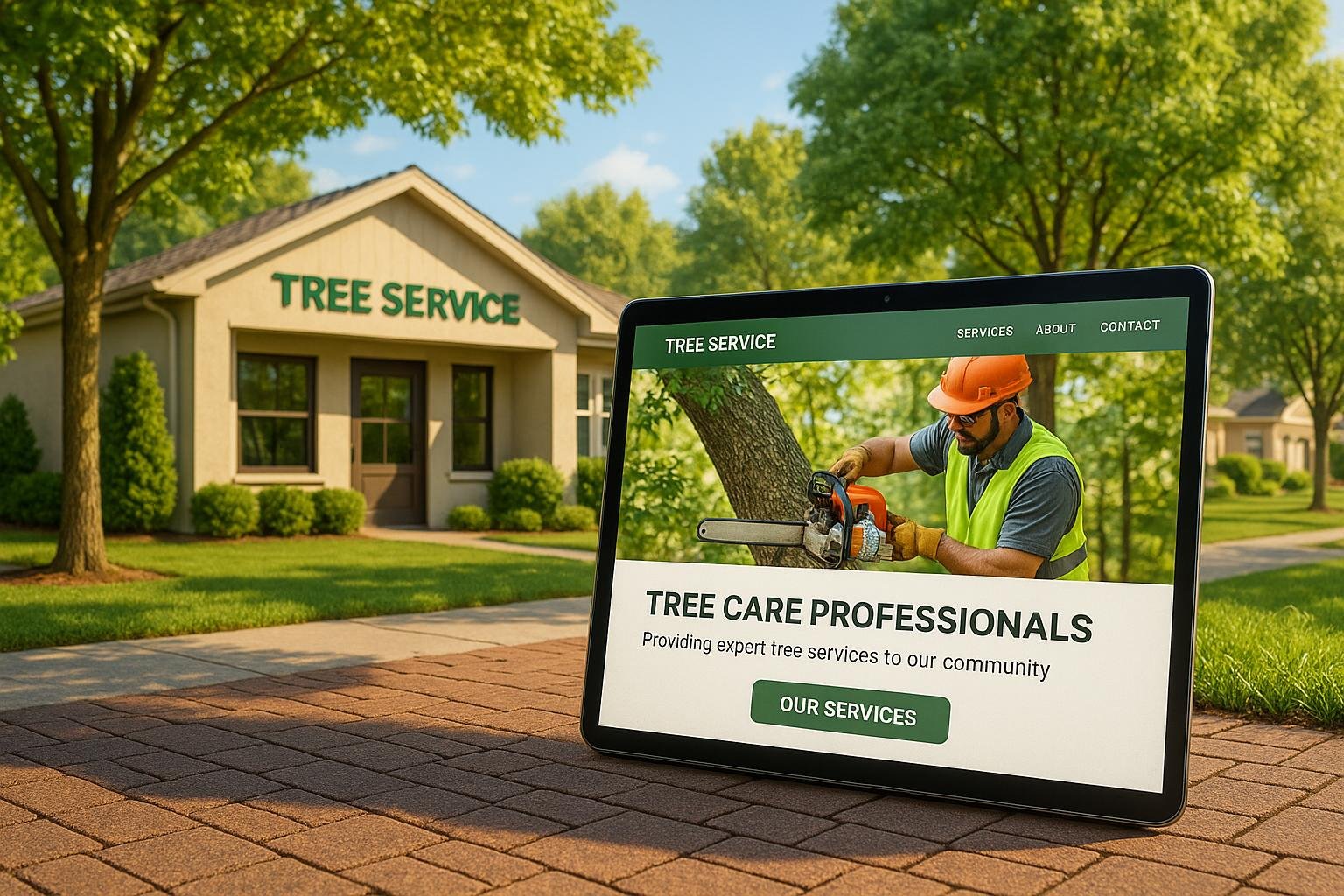
If your tree service website isn’t bringing in leads, it’s time to fix it. Low traffic often means fewer inquiries and lost revenue. The good news? You don’t need advanced skills or a big budget to solve this problem. This guide covers eight practical strategies to boost your site’s visibility and attract local customers:
- Local SEO: Claim and optimize your Google Business Profile. Use city-specific keywords like "tree removal in [Your City]" to rank higher in local searches.
- Website Design: Ensure your site is mobile-friendly, fast, and easy to navigate. Display contact info prominently and include clear calls-to-action.
- Online Ads: Use Google Ads to target high-intent keywords like "emergency tree service near me" and focus on location-based targeting.
- Backlinks: Partner with local businesses, write guest posts, and get listed in niche directories to improve your search rankings.
- Content Creation: Publish helpful blogs, showcase before-and-after projects, and write geo-targeted pages to engage visitors and build trust.
- Social Media: Share project photos, promote seasonal offers, and engage with local audiences on platforms like Facebook and Instagram.
- Track Performance: Use tools like Google Analytics to measure traffic, conversions, and ROI. Refine campaigns based on data.
- Professional Help: Consider partnering with services like Tree Company Leads for web design, ads, and exclusive leads.
Start small – focus on one or two strategies and build from there. Whether you DIY or hire experts, consistent effort will help you get more traffic and clients.
The 10 Best Tree Service Marketing Ideas
Solution 1: Optimize Local SEO
Local SEO is all about making sure your tree service business shows up when people in your area search for help. Think about it – when someone types "tree removal near me" or "emergency tree service in Springfield" into Google, you want your name to pop up first. This strategy connects you with local customers who are actively searching for services like yours, focusing on people who are within a reasonable distance and ready to hire.
For tree care businesses, local SEO is especially effective because your services are tied to specific locations. Done right, it can land your business in Google’s "map pack" – those three highlighted businesses with map pins at the top of search results. This spot can significantly boost your website traffic and phone calls. Here’s how to make it happen.
Claim and Optimize Your Google Business Profile
Your Google Business Profile (previously Google My Business) is essential for local visibility. It’s free and directly influences the map results people see when searching for tree services. If you haven’t claimed your profile yet, visit google.com/business and follow the verification process. Google typically sends a postcard with a code to verify your business, which can take about 5–7 days to arrive.
Make sure to fill out every detail on your profile. Include your business name, address, phone number, website, and hours of operation. Specify all the cities and towns you serve. Upload high-quality photos of your team, equipment, and completed projects to give potential customers a sense of your work.
Select the right business categories. Your primary category should be "Tree Service" or "Arborist", and you can add secondary categories like "Stump Grinding Service" or "Tree Removal Service" if they apply. Write a clear, engaging business description that highlights your services and service areas. For example: “Family-owned tree service offering emergency tree removal, trimming, and stump grinding across Fairfax County since 2010.”
Keep your profile active by posting updates about seasonal services, promotions, or recent projects. Google prioritizes active profiles, and these updates appear in search results, giving potential customers more reasons to choose you. Once your profile is polished, it’s time to focus on keywords.
Target Location-Specific Keywords
Location-specific keywords are key to attracting the right customers. Someone searching for "tree removal" without a location might not be ready to hire, but a search like "tree removal in Austin" or "emergency tree service near Round Rock" often signals immediate intent.
Combine your core services – tree removal, tree trimming, stump grinding, emergency tree service, land clearing, and arborist consultations – with your service areas. Use phrases like "tree removal in Denver", "tree trimming in Boulder", or "stump grinding in Lakewood."
Incorporate these keywords naturally throughout your website, including in page titles, headers, and body text. Instead of a generic homepage title like "Professional Tree Services", try "Professional Tree Removal & Trimming in Portland, OR." Create dedicated pages for each service area, such as "Tree Services in Arlington, VA", and include local details like landmarks, neighborhoods, or common tree-related challenges.
Don’t overlook long-tail keywords – specific phrases like "affordable tree removal for storm damage" or "certified arborist for oak tree disease." These may get fewer searches, but they often attract people closer to making a decision. Once you’ve nailed your keyword strategy, use customer reviews to further boost your local SEO.
Use Customer Reviews
Reviews are a cornerstone of local SEO. When potential customers see three tree service companies on Google, they’re more likely to choose the one with 45 glowing reviews. Reviews not only build trust but also influence Google’s algorithm, which considers the number, quality, and recency of reviews when ranking businesses – especially in the map pack.
Consistent, positive reviews signal to Google that your business is active, reliable, and well-regarded. They also often include keywords naturally, as customers describe the services they received, which can further improve your local SEO.
Make it a habit to ask for reviews after every job. Timing is everything – ask while the experience is still fresh. Send a text or email with a direct link to your Google Business Profile review page to make the process as easy as possible. Some tree service companies even include QR codes on invoices that take customers straight to the review page.
Respond to every review, whether it’s positive or negative. Thank satisfied customers for their feedback, and address any issues raised in critical reviews. This shows you care about your clients and are committed to quality service. Plus, responding to reviews signals to Google that you’re an engaged business owner, which can positively impact your rankings.
Don’t worry about the occasional negative review. What matters most is your overall rating and how you handle feedback. A professional, thoughtful response to criticism can often build more trust than a perfect score with no engagement.
Solution 2: Improve Website Design and User Experience
Your website is often the first impression potential customers get of your tree service business. If it feels outdated, takes forever to load, or is hard to navigate, visitors might leave before they even learn what you offer. A well-designed website does more than just look good – it keeps people engaged, builds trust, and turns casual visitors into paying customers.
The key is simple: make it easy for visitors to find what they need and take action. Whether they’re searching for emergency tree removal, stump grinding, or a free estimate, your site should guide them seamlessly from the landing page to contacting you. Poor design, slow loading speeds, or a site that doesn’t work well on mobile devices can quickly drive people away. Start with a mobile-friendly foundation, then focus on refining other design elements.
Mobile Optimization Is Non-Negotiable
Most people search for services on their smartphones, and many of your potential customers will visit your website from their mobile devices. If your site doesn’t load quickly or function well on every screen size, you’re losing a big chunk of your audience. As Hillary Walters puts it:
"Remember – you might miss out on potential customers if your website doesn’t load quickly or work well on every kind of device."
A responsive design ensures your site adjusts seamlessly across desktops, laptops, smartphones, and tablets. Not only does this improve user experience, but it can also boost your search rankings. Mobile optimization is critical – ignoring it is one of the most common SEO mistakes tree care businesses make, often resulting in lower page rankings.
Fast-loading pages are another must. If your site takes too long to load, visitors are likely to leave before exploring. Compress images, streamline your code, and test your site’s speed to ensure quick loading times.
Make Navigation Simple and Clear
Your website’s navigation should feel effortless. Visitors need to find your services, service areas, and contact details without hunting around. Use clear and straightforward menu labels like "Services", "Service Areas", "About Us", and "Contact."
Place a prominent call-to-action (CTA) on every page. Whether it’s "Get a Free Estimate", "Call Now for Emergency Service", or "Schedule a Consultation", make it crystal clear what you want visitors to do next. Buttons with clear CTAs on key pages guide visitors toward taking action, boosting conversions.
Visibility of Contact Information
Your contact details should be easy to find on every page – ideally in the header or footer. Display your phone number in a large, clickable format so mobile users can call you with one tap. Also, make sure to list your service areas clearly, so visitors know if you cover their location.
Build Trust Through Visuals and Content
High-quality photos of your team and completed projects can immediately establish credibility. Real photos are far more effective than generic stock images. Showcasing notable projects or your team in action helps visitors feel confident about your services.
A great user experience (UX) isn’t just good for visitors – it sends positive signals to search engines. When people spend time on your site, browse multiple pages, and engage with your content, search engines take it as a sign that your website is valuable, potentially improving your rankings.
Keep It Clean and Professional
Test your website on multiple devices and browsers to catch any issues. Sometimes, a fresh perspective can reveal problems you’ve overlooked.
Maintain a clean design by avoiding clutter, excessive pop-ups, and auto-playing videos. Use plenty of white space to make your content easier to read, and stick to a consistent color scheme that reflects your brand. Your site should feel polished and professional – not like it was thrown together in a hurry.
Finally, highlight your unique selling points – whether it’s 24/7 service, certified arborists, or full insurance coverage. These details build trust and help you stand out from competitors.
Solution 3: Use Targeted Online Advertising
When organic strategies take time to gain traction, targeted online ads can provide immediate visibility – especially important for tree service professionals dealing with seasonal demand. Paid ads allow you to connect with local customers actively searching for services. Unlike traditional options like newspaper ads or billboards, online advertising gives you control over who sees your ads, when they see them, and how much you spend. You can start small, experiment to see what works, and scale up as you gather results. The trick is to be strategic – choose the right keywords, focus on the right locations, and keep a close eye on your campaigns to get the most out of your investment.
Let’s break down how to select and optimize keywords to attract the right local audience.
Focus on High-Intent Keywords
Not all keywords are equally valuable. For instance, someone searching “what is tree pruning” is likely gathering information, while someone typing “emergency tree removal near me” is ready to hire. These high-intent keywords indicate an immediate need and a customer actively looking for help.
For tree service businesses, high-intent keywords often include terms like “tree removal service,” “emergency tree service,” “stump grinding near me,” or “tree trimming cost.” These searches show clear commercial intent and are more likely to lead to bookings.
When setting up Google Ads campaigns, prioritize these action-oriented keywords. While these terms might cost more per click than general informational phrases, they’re much more likely to convert into paying customers. Similar to location-based SEO, targeting high-intent keywords ensures your ads appear when potential customers are ready to act.
Don’t forget to include location-specific modifiers in your keywords. Phrases like “tree removal in [your city]” or “arborist near [neighborhood name]” can help you capture local searches. These geo-specific keywords often face less competition and attract customers actively seeking services in your area.
Set Up Location-Based Targeting
Location-based targeting ensures your ads are shown to people within your service area, saving you from wasting money on clicks from outside your reach. For tree service businesses, this is especially important since your work is geographically limited.
You can target specific cities, ZIP codes, or even a custom radius around your location. Platforms like Facebook and Instagram also offer location-based targeting, allowing you to refine your audience further. For example, you can focus on homeowners, people within certain age groups, or those interested in home improvement. This layered targeting helps you zero in on the most likely customers.
Adjust your bids based on location performance. If you notice that certain neighborhoods or towns generate more business or higher-value projects, increase your bids in those areas to capture more opportunities. On the flip side, if certain locations consistently underperform, reduce spending there and reallocate that budget to more profitable areas.
Once you’ve fine-tuned your targeting, it’s essential to track performance and make data-driven adjustments.
Monitor Campaign Performance
Tracking and optimizing your campaigns is key to ensuring your advertising dollars are well spent. It’s not just about clicks – it’s about results. You need to understand which ads are converting into phone calls or estimate requests and which ones are eating up your budget without delivering leads.
The most important metric for Google Ads campaigns is ROI – not just cost per click. A low cost per click is meaningless if those clicks don’t turn into paying customers. Focus on tracking the entire customer journey, from the moment they click on your ad to when they book your services.
Set up conversion tracking to measure actions like form submissions, phone calls, or clicks on your phone number. This data will reveal which keywords and ads are driving leads, not just traffic. Many businesses make the mistake of focusing solely on clicks when they should be measuring cost per lead and revenue per customer.
A good benchmark for an effective campaign is achieving a cost ratio of 5:1 – generating $5 in revenue for every $1 spent. For example, if you’re spending $500 per month on ads, aim to generate at least $2,500 in revenue. Keep track of this monthly to ensure your campaigns remain profitable.
Optimization is an ongoing process. Regularly tweak your ad copy, keywords, ad extensions, landing pages, and even your customer service processes. Review campaign performance weekly, especially in the early stages. Look for trends: which days and times bring in the most calls? Which ad copy gets the best engagement? Which keywords are too expensive without delivering results?
If clicks lead to quick exits, take a closer look at your landing page. Make sure it aligns with the promises in your ad and makes it easy for visitors to contact you. The goal is to create a seamless experience from the ad to the booking process.
Solution 4: Build High-Quality Backlinks
Backlinks from reputable websites can elevate your tree service business by improving search rankings and driving referral traffic. Search engines see links from trusted sources as endorsements of your site’s value and reliability.
But here’s the catch: quality matters more than quantity. A single link from a respected local business association or a well-known industry publication can carry more weight than dozens of links from low-quality directories. Search engines are smart enough to detect manipulative tactics, so the goal should always be earning authentic links from credible sources.
For tree care professionals, building meaningful connections and creating content that naturally attracts links is a long-term game. While it takes more effort than quick fixes, the payoff includes better rankings, increased visibility, and steady referral traffic from trusted sites. Let’s dig into some practical ways to secure those high-quality links.
Partner with Local Businesses
Teaming up with local businesses that complement your services is a smart way to earn backlinks. Think about businesses that share your customer base but don’t compete with you directly – like landscaping companies, garden centers, real estate agents, property managers, or home improvement contractors.
One simple approach is to exchange links by featuring each other on a "trusted partners" or "recommended services" page on your websites. Many local businesses appreciate these partnerships because they benefit both parties by offering added value to customers while strengthening local visibility.
Beyond backlinks, these collaborations can lead to client referrals and joint promotions. You can also explore opportunities with local chambers of commerce, business improvement districts, or professional associations. Many of these organizations offer member directories that link back to your site. While some require a membership fee, the networking opportunities and increased local credibility often make it worth the investment.
Write Guest Posts for Industry Websites
Guest blogging is another effective way to showcase your expertise while earning valuable backlinks. By contributing well-researched, informative posts to reputable websites, you can establish yourself as an authority and attract trusted traffic.
Look for opportunities with industry publications, local news outlets, home improvement blogs, or regional business websites that align with your target audience. For instance, topics like "How to Spot Tree Diseases Early", "Seasonal Tree Care Tips for Homeowners", or "Storm Damage Prevention for Your Trees" provide practical advice that resonates with readers.
Most guest blogging platforms allow you to include an author bio with a link to your site, and some even permit links within the content itself. Both options can strengthen your online presence. Just make sure to research the host site’s audience and craft a pitch that offers clear, actionable value.
Get Listed in Niche Directories
While general business directories often provide limited value, niche directories focused on tree care and home services can be a goldmine for backlinks and targeted leads. These specialized listings help you connect with people actively searching for tree services, while also signaling search engines that your business is legitimate.
Start by identifying directories tailored to arborists and tree care professionals. Many industry associations maintain lists of certified experts, which often carry significant weight. Additionally, local directories tied to your city or region can boost your local SEO. For example, municipalities often have directories of licensed contractors, and local news websites may feature business listings to help consumers find trusted services.
When creating directory profiles, consistency is key. Make sure your business name, address, and phone number match across all platforms. Write a compelling description of your services, highlight your service area, and include photos of your work to make your listing stand out. A well-crafted profile can do more than just improve your SEO – it can also turn directory visitors into paying customers.
On the flip side, steer clear of low-quality directories or link farms that can harm your SEO. Focus on platforms where real potential customers are likely to find you, ensuring the value goes beyond just earning a backlink.
sbb-itb-130a704
Solution 5: Create and Share Content
Sharing helpful content is one of the best ways to attract potential customers and boost your website’s visibility in search results. By publishing useful information, you not only draw traffic but also build trust with your audience.
Search engines reward websites that consistently publish fresh and relevant content. Every blog post or project showcase you share gives search engines another reason to rank your site for keywords related to tree care. But the real win happens when your content solves a specific problem – turning casual visitors into paying customers.
As a tree service expert, you already have the knowledge to create impactful content. You understand the questions homeowners ask, the mistakes they make, and the worries they face. Your task is to present this expertise in a way that’s easy to understand and accessible. Here’s how you can create content that converts browsers into clients.
Write Informative Blog Posts
Blog posts are a great way to show your expertise while targeting the keywords your potential customers are searching for. Focus on topics that matter to homeowners.
For example, write about common concerns like when to trim trees, how to spot signs of disease, or what to do after a storm. Each of these questions can become a blog post that attracts people actively seeking solutions.
Keep your posts clear and include relevant photos to make them more engaging. Use subheadings to break up the text for easier reading. Wrap up each post with a straightforward call to action, such as encouraging readers to contact you for professional help.
Develop Geo-Targeted Content
While general tree care advice is helpful, targeting content to specific locations can significantly boost your local search rankings. By creating pages or blog posts tailored to particular neighborhoods, cities, or regions, you let search engines – and potential customers – know exactly where you operate.
For instance, instead of having one broad "Tree Removal Services" page, create location-specific pages like "Tree Removal in [City Name]", "Storm Damage Cleanup in [County]", or "Emergency Tree Services in [Neighborhood]." On these pages, include details relevant to the area, such as local tree species, weather challenges, or tree care regulations.
You can also create geo-targeted blog posts. Write about topics like "Best Trees to Plant in [City]’s Climate", "How [Local Weather Event] Impacts Tree Health", or "Understanding [City Name]’s Tree Removal Permits." These posts naturally include local keywords while providing valuable information to your audience.
Just make sure each piece of content is unique. Avoid duplicating content with only minor changes for different locations, as this can hurt your search rankings.
Showcase Before-and-After Projects
Before-and-after photos are a powerful way to build credibility. They visually demonstrate your expertise and show potential customers the kind of transformations your services can achieve.
Research shows that 89% of people are influenced by videos when deciding to purchase a product or service. While video is effective, simple photo comparisons can also make a big impact. They’re engaging, easy to understand, and quickly highlight the value of your work.
Post these photos on your Google Business Profile to improve your local search presence. Make sure the "before" shot clearly shows the problem – like an overgrown tree blocking a view or a hazardous hanging branch – and the "after" shot showcases the clean, professional result.
Social media platforms like Instagram are perfect for sharing these transformations. Post photos of a major tree removal, a beautifully pruned tree, or a lot cleared after storm damage. Add short descriptions explaining what you did and why. For especially striking projects, consider boosting posts to reach a larger audience.
On your website, create a portfolio or gallery page where visitors can browse your work. Organize photos by service type – such as pruning, tree removal, or emergency cleanup – so users can easily find examples relevant to their needs. Add captions explaining the problem, your solution, and the outcome to show your expertise and build trust.
"Underutilizing photos and testimonials: Real results build trust. Share them!" – GorillaDesk Staff
Combining visual proof with clear explanations makes before-and-after content a powerful marketing tool. It only takes a few extra minutes to document your work, but the impact on your credibility and customer confidence is huge. By using these content strategies, you can not only improve your online presence but also attract quality leads to your tree service business.
Solution 6: Use Social Media
Social media is a powerful tool for boosting local visibility and driving traffic to your website, especially for tree service companies. Every share, comment, and interaction can bring potential customers right to your digital doorstep. These platforms allow you to connect with local homeowners, showcase your expertise, and turn followers into paying clients.
The trick is to focus on platforms where your audience spends their time. Homeowners searching for tree services are often active on Facebook, Instagram, and neighborhood-specific platforms like Nextdoor. Each platform serves a unique purpose, but they all share a common benefit: they keep your business top-of-mind when someone needs tree care.
When used regularly, social media does more than just showcase your work – it positions your business as a trusted local expert. Engaging with your audience builds trust, and the visual nature of tree care makes it a perfect fit for social platforms. From dramatic transformations to intricate craftsmanship, your work naturally grabs attention online.
Share Visual Content
Tree care is highly visual, and social media thrives on eye-catching photos and videos. Your completed projects can tell a story that words alone can’t. Share images of challenging tree removals, beautifully pruned landscapes, or emergency storm cleanups to highlight your skills.
- Facebook: Ideal for connecting with local homeowners and running targeted ads. Post project photos, team highlights, and tree care tips. The platform’s community focus makes it perfect for building relationships in your area.
- Instagram: A great place to showcase your most visually striking work. Share before-and-after shots of overgrown trees turned into well-maintained landscapes. Use local hashtags like #TreeCare, #[YourCity]Trees, or #TreeRemoval to expand your reach.
- YouTube: Create short, educational videos to prove your expertise. Share tips on storm prep, identify signs of diseased trees, or demonstrate proper pruning techniques. These videos not only help viewers but also boost your brand and drive traffic to your site.
Did you know 89% of people say watching a video influenced their decision to buy a product or service? Even simple smartphone videos of your crew removing a hazardous tree or cleaning up after a storm can be incredibly effective. The scale, movement, and skill involved in tree work translate beautifully to video.
Don’t just focus on finished projects. Share behind-the-scenes content, introduce your team members, or show off the specialized equipment you use. These glimpses into your daily operations help build a personal connection with your audience.
Encourage Interaction
Social media isn’t just about posting visuals – it’s about creating a dialogue. How you engage with comments, messages, and reviews can make or break someone’s decision to contact you.
- Respond quickly to comments and messages. If someone asks about your services or pricing, provide clear and thorough answers.
- Reply to reviews on platforms like Facebook and Google Business Profile. Thank happy customers for their feedback, and address any concerns from negative reviews in a professional manner. Thoughtful responses show potential clients that you value feedback and care about your reputation.
- Ask questions in your posts to spark engagement. For example, after sharing a project photo, ask followers if they’ve faced similar tree issues. Or post a picture of an unusual tree species and ask if anyone can name it. These small interactions boost your visibility and keep your business memorable.
Another tip: join local community groups on Facebook. Homeowners often discuss neighborhood issues and ask for service recommendations in these groups. By actively participating and sharing helpful advice, you’ll establish your name as a trusted resource. Just be sure to follow the group’s rules on self-promotion.
Promote Seasonal Offers
Social media offers a direct way to reach customers when they’re most likely to need your services. Tree care has seasonal peaks, and timely promotions can drive significant traffic to your website.
- In late winter and early spring, promote pruning services and spring cleanup packages.
- As storm season approaches, advertise emergency tree removal and preventive trimming services.
- In the fall, highlight leaf removal and pre-winter tree health assessments.
You can also announce limited-time deals, like 10% off tree health inspections or discounted storm damage assessments. Paid ads on Facebook and Instagram can amplify these promotions, targeting homeowners in specific neighborhoods or demographics. Even a small budget of $5–10 per day can expand your reach significantly.
Nextdoor is especially effective for seasonal offers. This hyperlocal platform connects you directly with homeowners in your area. Posts about seasonal services or special deals are likely to reach people who need your help the most. Plus, recommendations on Nextdoor carry weight because they come from trusted neighbors.
Timing is everything. Post storm preparation tips ahead of severe weather or remind people of the importance of removing dead trees before high winds hit. This kind of timely, helpful content not only positions you as an expert but also encourages people to visit your website when they need assistance.
Solution 7: Monitor and Adjust Marketing Strategies
Unfocused marketing is like throwing money into the wind – you don’t know where it’s going or if it’s doing anything worthwhile. To avoid wasting your budget, you need to understand what’s working, what isn’t, and where your next customer is coming from. Without tracking your efforts, you’re essentially making decisions in the dark, spending resources on tactics that might not deliver.
Once you’ve implemented strategies like SEO, design improvements, and advertising campaigns, the next step is crucial: monitor and adjust your marketing efforts to ensure sustained growth. The difference between a tree care business that’s barely getting by and one that’s thriving often lies in how well those efforts are tracked and fine-tuned. It’s not enough to launch a Google Ads campaign or post sporadically on social media – you need to dig into the data, understand what it’s telling you, and make informed adjustments.
Think of it like diagnosing a sick tree: you inspect the symptoms, identify the issues, and apply targeted solutions. Regular monitoring allows you to catch problems early, seize opportunities, and keep your marketing budget working efficiently. One of the best tools for this is your website’s analytics, which can reveal what’s working and where changes are needed.
Track Website Analytics
Your website generates a treasure trove of data every day, and ignoring it means missing out on insights that could transform your business. For tree care companies, one of the most critical metrics is the conversion rate – the percentage of visitors who take an action, such as calling your business, filling out a contact form, or requesting an estimate.
Traffic alone doesn’t mean much if it doesn’t lead to action. For instance, you might see 1,000 visitors a month, but if none of them contact you, that traffic isn’t helping your business. The key is to understand how visitors interact with your site and whether they’re completing the actions you want them to take.
Google Analytics is an indispensable tool for tracking your website’s performance. It can show you where your traffic is coming from – whether it’s organic search, paid ads, social media, or direct visits. You’ll also see which pages are most popular, how long visitors stay, and where they leave. A critical metric to watch is your bounce rate, which measures the percentage of visitors who leave after viewing just one page. A bounce rate between 25% and 40% is generally excellent. If yours is higher, it could indicate issues like slow loading times, poor design, or irrelevant content.
Breaking down conversion rates by traffic source can also help you optimize your marketing budget. This data confirms which channels – like SEO or paid ads – are delivering the best results.
Geographic data is another useful insight. If your business serves multiple cities or counties, tracking which areas generate the most conversions can guide your local SEO and advertising strategies. For example, you might find that one town consistently brings in high-quality leads, while another barely converts. Use this information to allocate your resources more effectively.
Google Search Console is another valuable tool that complements Analytics. It provides insights into how your site performs in search results, including which keywords drive traffic, click-through rates (CTR) for various search terms, and any technical issues that could hurt your rankings. A good CTR typically falls between 2% and 5%, according to Campaign Monitor. If your CTR is lower, consider revising your page titles and meta descriptions to make them more engaging.
Don’t forget to monitor mobile-specific metrics like bounce rates and conversion rates. If your mobile performance lags behind desktop, it’s a clear sign that your site’s mobile experience needs improvement.
Once you’ve gathered insights from your analytics, use them to refine your campaigns and make data-driven decisions.
Test and Refine Campaigns
The most successful tree care businesses are constantly testing, measuring, and tweaking their marketing campaigns. This ongoing process of refinement is what separates average results from outstanding ones.
Start with your paid advertising efforts. If you’re running Google Ads, experiment with different ad headlines and descriptions to see which versions generate more clicks and conversions. Test variations of your landing pages – adjust the headline, change the color of your call-to-action button, or try a different form layout. Even small changes can lead to noticeable improvements.
Your keyword strategy also needs regular attention. Some keywords may cost more per click but attract higher-quality leads, while others might drive traffic that never converts. Regularly review your keyword performance, pausing the ones that waste your budget and focusing on those that bring in customers.
Email marketing is another area ripe for testing. With an average ROI of $42 for every $1 spent and a 6.5% conversion rate, email remains one of the most effective digital marketing channels. Experiment with different subject lines, sending times, and content formats to see what resonates most with your audience. The average email open rate is 21.33%, so there’s plenty of room to optimize.
Call tracking is another powerful tool for refining your marketing efforts. Many tree service customers prefer to call rather than fill out an online form, so if you’re only tracking digital conversions, you could be missing valuable leads. Assign unique phone numbers to different marketing channels – one for your website, one for Google Ads, and another for direct mail – so you can identify exactly where each call is coming from.
When testing, focus on one variable at a time. For example, if you’re experimenting with ad copy, don’t simultaneously change your landing page design and keyword strategy. This way, you’ll know exactly which change led to the improvement. Test methodically, keep what works, and discard what doesn’t.
Stay Updated on Industry Trends
Digital marketing is always evolving, and what worked last year might not be as effective today. Staying informed about new trends and tools can give your tree care business a competitive edge.
For example, Google updates its search algorithm hundreds of times each year. While most changes are minor, major updates can significantly impact your website’s rankings. Following reputable SEO news sources can help you understand these updates and adjust your strategies accordingly. Social media platforms like Instagram, Facebook, and YouTube also roll out new features regularly – short-form video content, for instance, offers fresh ways to engage potential customers.
Consumer behavior is also shifting. A staggering 95% of consumers now read online reviews before choosing a local business. In the past, simply having an online presence might have been enough, but today, detailed and positive reviews play a crucial role in converting prospects into customers.
Emerging technologies like AI-powered chatbots and advanced analytics platforms can also help you work more efficiently and effectively.
Engage with online communities where tree care professionals share marketing tips and strategies. Whether through Facebook groups, industry forums, or professional associations, these platforms can offer valuable insights. Subscribing to newsletters and blogs focused on local service businesses is another great way to stay informed.
Attending industry conferences and workshops can also be incredibly beneficial. These events provide concentrated learning opportunities and the chance to network with peers facing similar challenges. Sometimes, a single conversation at an event can spark ideas that transform your marketing approach.
Solution 8: Partner with Tree Company Leads
Managing SEO, ads, content, and website updates can quickly become overwhelming. Digital marketing requires ongoing attention, expertise, and consistent effort to deliver results. For many tree care professionals, trying to juggle these responsibilities often means important tasks get overlooked.
That’s where partnering with a specialized service can simplify your marketing efforts. Instead of managing multiple contractors for web design, advertising, and lead generation, you can turn to a one-stop solution. Tree Company Leads focuses exclusively on helping tree care businesses grow by driving more website traffic and delivering qualified leads. Their services include custom web design, targeted Google Ads management, and exclusive lead generation – all tailored specifically for the tree care industry.
This integrated approach ensures your website, advertising, and lead generation work seamlessly together. It allows you to concentrate on what you do best: providing top-notch tree care services. If your digital marketing feels like it’s falling short, this partnership could be the missing piece.
Get Custom Web Design
Your website is the cornerstone of your online presence. A slow or outdated site can drive potential customers away in seconds.
Tree Company Leads creates custom websites designed specifically for tree service businesses. These aren’t cookie-cutter templates – they’re built with your customers in mind. Features like clear service descriptions, easy-to-use contact forms, mobile-friendly click-to-call buttons, and professional images showcasing your work are all included to boost conversions.
Whether a customer is looking for emergency storm cleanup or routine tree trimming, your website will make it easy for them to find the information they need. Beyond just looking great, these sites are optimized for speed, mobile usability, and search engines – ensuring they perform well across the board.
Tree Company Leads handles the technical side of things so your site reflects your brand and speaks directly to your audience. The result? A professional online presence that builds trust and turns visitors into paying customers.
Access Targeted Google Ads Campaigns

Running Google Ads effectively takes time and expertise. From researching keywords to fine-tuning ad copy, even small missteps can waste your budget. Many tree service owners simply don’t have the bandwidth to manage these details.
Tree Company Leads takes the guesswork out of Google Ads. They create and manage campaigns tailored specifically for tree care businesses. Using high-intent keywords and location-based targeting, they ensure your ads reach the right audience in your service area.
Their ongoing management includes refining ad copy, adjusting keyword bids for better ROI, and monitoring landing pages to improve conversions. This hands-on approach ensures your advertising dollars are spent wisely, giving you more time to focus on growing your business.
Receive Exclusive Leads
A common frustration with lead generation services is shared leads – where multiple businesses compete for the same customer. This often leads to bidding wars or missed opportunities if you’re not the first to respond.
Tree Company Leads eliminates this issue by providing exclusive leads. When a potential customer contacts you through their system, that lead is yours alone. This direct connection improves conversion rates and allows for more effective communication with prospects.
Additionally, leads come with real-time tracking, so you’re notified immediately when someone requests a quote or reaches out. Quick response times are essential in the tree care industry, especially for emergency services. By focusing on high-quality leads and filtering out less serious inquiries, Tree Company Leads ensures your marketing efforts translate into real business opportunities.
Conclusion
Struggling with low website traffic doesn’t have to be a permanent hurdle for your tree care business. With the right approach, you can attract more visitors and turn them into loyal clients. Let’s quickly revisit the key strategies that can set you up for success.
Start with local SEO by claiming your Google Business Profile and focusing on location-specific keywords. Make sure your website leaves a great first impression with fast loading speeds and mobile-friendly navigation. Use targeted online ads to connect with people actively searching for tree services in your area. Build credibility with high-quality local backlinks, and create engaging content like blog posts answering common tree care questions or before-and-after project galleries to showcase your expertise. Social media is another powerful tool – use it to highlight your work and connect with your community.
As you implement these strategies, keep an eye on your progress using website analytics. Adjust your tactics based on what’s working because the tree care industry – and marketing itself – is always evolving.
If juggling all of this feels overwhelming, you don’t have to go it alone. Partnering with experts like Tree Company Leads can make a world of difference. They offer custom web design, managed Google Ads, and exclusive leads to help you grow your business without the hassle.
The most important step? Take action. Start with one or two of these strategies and put them into practice today. Whether you handle it yourself or bring in professional help, consistent effort will lead to increased traffic and, ultimately, more customers.
FAQs
How can I track if my local SEO strategies are working for my tree service business?
To measure how well your local SEO efforts are paying off, tools like Google Analytics and Google Search Console are essential. These platforms help you keep an eye on key metrics such as organic traffic, keyword rankings, and bounce rate – all of which can reveal what’s performing well and where there’s room for improvement.
It’s also important to evaluate how visible your business is in local search results and map listings. Keep track of customer reviews, click-through rates, and the number of inquiries coming from online searches. These indicators provide valuable insights into how effectively your local SEO strategies are driving engagement and bringing in leads.
What are some common mistakes to avoid when running online ads for tree care services?
When running online ads for tree care services, there are a few common mistakes you’ll want to steer clear of to avoid wasting your budget or limiting your success.
First, don’t cast too wide a net when targeting your audience. Tree care services are typically local, so it’s crucial to focus on specific geographic areas where your services are actually needed. Narrowing your audience ensures your ads reach the right people.
Second, make sure your ads are clear and to the point. Misleading or overly vague messaging can confuse potential customers, making them less likely to trust your business. Be direct about what you offer and how you can help.
Third, always track your ad performance. Metrics like click-through rates and cost per lead give you valuable insights into what’s working and what needs tweaking. Without this information, you’re essentially flying blind.
By avoiding these common pitfalls and keeping your focus on a local audience, you’ll be better positioned to create ad campaigns that truly deliver results for your tree care business.
What are the best ways to attract more visitors to my tree care website and turn them into customers?
To bring in more visitors and turn them into customers, start by focusing on local SEO. This means tailoring your website to show up in local search results. Use keywords that highlight both your tree care services and the specific areas you serve.
Next, make sure your website is user-friendly. A simple, professional design with easy navigation can make a big difference. Add clear calls-to-action, like buttons for requesting a quote or contacting you, to guide visitors toward taking the next step.
If you want to boost visibility even further, think about running targeted online ads, such as pay-per-click (PPC) campaigns. These ads can connect you with people who are already looking for tree care services nearby, helping you attract more qualified leads.
Related Blog Posts

When choosing between HomeAdvisor and Angie’s List (now Angi Ads) for tree service businesses, the decision comes down to your business goals and customer focus:
- HomeAdvisor: Ideal for quick access to leads, especially for emergency services like storm damage cleanup or hazardous tree removal. You pay per lead, with costs ranging from $15–$100, plus an annual fee of $300–$350. Leads are competitive, and fast follow-up is crucial to secure jobs.
- Angie’s List (Angi Ads): Better for building long-term client relationships and showcasing your reputation. Free to list, but paid ads ($300/month on average) increase visibility. Customers here value reviews and take more time to decide, making it great for planned services like pruning or routine maintenance.
Quick Comparison
| Feature | HomeAdvisor | Angie’s List (Angi Ads) |
|---|---|---|
| Cost Structure | Pay-per-lead ($15–$100 + $300 annual fee) | Free listing, ads cost ~$300/month |
| Lead Type | Emergency, high-demand jobs | Routine, planned services |
| Customer Focus | Immediate response | Reputation and reviews |
| Competition | High | Moderate |
| Best For | Urgent, large-scale projects | Long-term relationships |
If you’re focused on urgent, high-value jobs, HomeAdvisor is the better fit. For businesses prioritizing trust and repeat clients, Angie’s List is the way to go. Tracking ROI from each platform is key to optimizing your marketing spend.
Homeadvisor vs Angie’s List vs Your Own Marketing
HomeAdvisor vs Angie’s List: Platform Overview
HomeAdvisor and Angie’s List may share the same parent company, but they operate using very different approaches to support tree service professionals. HomeAdvisor is all about generating quick leads through a pay-per-lead system, while Angie’s List focuses on helping businesses build long-term reputations through detailed profiles and verified customer reviews.
Knowing how each platform functions can help tree service businesses decide which one aligns better with their size, budget, and approach to gaining new customers. Let’s break down how each works so you can make the best choice for your business.
How HomeAdvisor Works for Tree Services
HomeAdvisor uses a straightforward lead-generation model. Tree service companies pay for each lead, which gives them direct access to potential customers. When a homeowner submits a request for tree services, HomeAdvisor matches them with local contractors who fit the job’s requirements. Customers provide details like the type of work they need and their timeline, and HomeAdvisor connects them with professionals based on service areas and availability.
Once you receive a lead, you can contact the customer directly to discuss the project. Lead costs vary depending on factors like the project size and your location. To ensure customer trust, HomeAdvisor requires all service providers to complete background checks before joining the platform.
How Angie’s List Works for Tree Services
Angie’s List takes a different route, emphasizing reputation-building rather than instant lead generation. Instead of paying for individual leads, businesses create detailed profiles that highlight their services – such as stump grinding or emergency cleanup – and showcase customer reviews. Homeowners can browse these profiles, compare businesses, and request quotes at their own pace, without the added cost of per-lead fees.
Most businesses pay a subscription fee to maintain their profiles and access premium features. One standout feature of Angie’s List is its review system, which only accepts feedback from verified customers after a project is completed. This setup encourages businesses to consistently deliver quality work and build trust over time.
For those looking for extra visibility, Angie’s List also offers paid advertising options. These promotions can help your profile appear higher in search results, giving you an edge while still allowing you to choose which projects to take on. Additionally, the platform includes tools for project management, making it easy to track communications, send estimates, and handle follow-ups – all within the same system. This makes Angie’s List a more relationship-focused option compared to HomeAdvisor’s transactional model.
Cost Comparison: HomeAdvisor vs Angie’s List
When it comes to marketing your tree service business, understanding the cost structures of HomeAdvisor and Angie’s List is crucial. Each platform operates differently, and these differences can directly influence your monthly budget and overall profitability. Here’s a breakdown of how their pricing models stack up.
HomeAdvisor follows a pay-per-lead model paired with an annual membership fee. Businesses typically pay between $300 and $350 annually for access to the platform, with additional lead fees ranging from $15 to $100 per lead. The exact cost per lead depends on factors like your location, competition, and the type of project. For example, leads for larger jobs, such as tree removal, often cost more than smaller tasks like pruning.
Angie’s List, on the other hand, offers a free business listing but relies on a pay-per-click advertising system for increased visibility. While creating a profile costs nothing, promoting your business requires an ad budget. Companies generally spend around $300 per month on ads, with each click costing between $4 and $8.
Here’s a side-by-side comparison of the two platforms:
| Feature | HomeAdvisor | Angie’s List |
|---|---|---|
| Annual Membership | $300–$350 | Free listing (ads require payment) |
| Lead Costs | $15–$100 per lead | Not directly charged per lead |
| Monthly Ad Spend | N/A | Approximately $300 |
| Cost Per Click | N/A | $4–$8 |
| Payment Model | Pay for every lead received | Pay only for ad clicks |
| Contract Length | Annual membership | Typically a one-year contract |
The biggest difference lies in when you pay: HomeAdvisor charges for every lead you receive, whether or not the lead turns into a job. In contrast, Angie’s List charges only when someone clicks on your ad or profile, giving you more control over your spending.
Pricing Examples for Tree Service Providers
Let’s look at some real-world examples to highlight how these costs play out.
For smaller tree service businesses, Angie’s List can be a more affordable starting point. With its free listing, you can establish an online presence and gradually scale your advertising. For instance, a business spending $200 per month on ads, with clicks priced at $4–$8, might generate 25–50 clicks depending on local competition.
Larger companies, however, might prefer HomeAdvisor’s model for its more predictable lead generation. If a business receives 20 leads per month at an average cost of $40 per lead, it would spend $800 monthly on leads, plus the annual membership fee. These leads often involve higher-value jobs, such as emergency tree removals or extensive pruning, which can justify the upfront costs.
For a mid-sized company using HomeAdvisor, the numbers might look like this: with a $350 annual fee and 24 leads per month at $40 each, the total annual cost would be about $11,870. Meanwhile, the same company using Angie’s List with a $300 monthly ad budget would spend roughly $3,600 annually. However, keep in mind that converting clicks into paying customers often requires additional effort and follow-up.
Both platforms typically require a one-year commitment for their paid services. HomeAdvisor may offer refunds for leads that don’t result in contact, while Angie’s List contracts could include early termination fees.
Lead Quality and Project Types
After analyzing platform costs and features, it’s equally important to evaluate lead quality and the types of projects each platform tends to attract. These factors directly influence your revenue potential and workload. Different platforms cater to varying customer needs – some focus on urgent, high-priority issues, while others emphasize planned, routine services.
Understanding these distinctions allows you to fine-tune your marketing approach to align with the kind of work that suits your expertise. Let’s break down the types of tree service projects these platforms typically generate.
Types of Tree Service Projects Each Platform Attracts
HomeAdvisor is a go-to platform for homeowners dealing with immediate, high-stakes situations. Its instant-match system often connects you with leads for emergency tree removal, storm damage cleanup, or addressing hazardous tree conditions. These projects demand quick action, but they also come with intense competition due to the urgency.
On the other hand, Angie’s List appeals to clients who prefer to plan ahead. Leads from this platform often involve routine services such as annual pruning, preventive maintenance, or landscape improvement projects. While these jobs may not be as urgent, they often attract clients who value detailed proposals and customer reviews. This can lead to more meaningful, long-term relationships and repeat business opportunities.
Seasonal trends also play a role. HomeAdvisor typically sees a surge in activity after storms, while Angie’s List maintains a steadier flow of inquiries throughout the year.
Lead Accuracy and Competition Levels
The quality and detail of leads are just as critical as the types of projects they represent. The information provided in leads can vary significantly between platforms, influencing how efficiently you can convert inquiries into paying jobs.
HomeAdvisor leads often include only basic contact information and brief project descriptions. This means you’ll likely need to conduct additional consultations to gather the full scope of the job. Acting quickly is essential here, as competition for these leads tends to be fierce.
In contrast, leads from Angie’s List are usually more detailed. Customers on this platform often take the time to outline their specific needs, which can help you provide accurate estimates right from the start. While there may be less immediate competition for each lead, the decision-making process is typically more drawn out. Customers here tend to compare multiple proposals and reviews before making a choice, so your presentation and reputation carry significant weight.
sbb-itb-130a704
HomeAdvisor vs Angi Ads: Pros and Cons
Choosing the right platform for your tree service business can make a big difference in how effectively you spend your marketing budget. Both HomeAdvisor and Angi Ads come with their own set of strengths and challenges, and understanding these can help you make a more informed decision.
Since 2021, HomeAdvisor has been operating as Angi Leads, while Angie’s List was rebranded to Angi Ads. Both platforms are owned by Angi Homeservices Inc., which adds a unique dynamic for tree care professionals to consider.
Here’s a closer look at the pros and cons of each platform.
HomeAdvisor: Pros and Cons
HomeAdvisor is known for its extensive reach and the volume of leads it generates, but this comes with some trade-offs.
| Advantages | Disadvantages |
|---|---|
| Massive user base: 45 million lifetime users and 37 million annual visits | Intense competition: Multiple contractors often vie for the same lead |
| High lead volume: Reliable flow of inquiries, especially during storm seasons | Shared lead system: Leads can be duplicated on both HomeAdvisor and Angi platforms |
| Emergency focus: Attracts urgent, high-value jobs like storm cleanup and tree removal | First-call advantage: Roughly 35–50% of sales go to the contractor who contacts the lead first |
| Broad geographic reach: Available in most areas across the U.S. |
HomeAdvisor’s ability to generate high-value leads makes it well-suited for businesses specializing in large-scale or emergency tree services. However, its competitive environment means quick follow-ups are essential to secure jobs.
Angi Ads: Pros and Cons
Angi Ads, on the other hand, focuses more on building trust through customer reviews, which can influence the quality of leads you receive.
| Advantages | Disadvantages |
|---|---|
| Review-driven visibility: Over 10 million reviews help businesses establish trust | Focus on smaller projects: Attracts niche jobs rather than large-scale services |
| Quality-focused customers: 54% of users read at least four reviews before hiring | Slower lead flow: Fewer immediate inquiries compared to HomeAdvisor |
| Year-round traffic: Steady site visits, totaling about 19 million annually |
Angi Ads is ideal for businesses that prioritize building long-term relationships and maintaining a strong reputation. Its review-based model helps attract customers who value quality and trust.
Key Considerations
One important factor to keep in mind is that both platforms are owned by the same parent company. Using both simultaneously can sometimes lead to duplicate charges for the same leads. For many tree service businesses, focusing on just one platform can be a more cost-effective strategy.
- If your business thrives on emergency services and you have systems in place for rapid response, HomeAdvisor’s high lead volume and urgency-driven model may work better for you.
- On the other hand, if your focus is on cultivating strong customer relationships backed by positive reviews, Angi Ads could be the better fit.
Ultimately, the choice between these platforms comes down to your business model and priorities. Whether it’s speed and volume or trust and reputation, aligning your marketing efforts with the right platform can help you get the most out of your investment.
Which Platform Should Your Tree Service Business Choose?
Deciding between HomeAdvisor and Angi Ads comes down to your business model, growth goals, and the type of tree service projects you want to focus on. Here’s a breakdown to help you make the right choice.
For Emergency and Large-Scale Tree Services
If your business specializes in emergency services or large-scale projects, HomeAdvisor might be your best bet. With 37 million visits annually, the platform thrives on high-demand, urgent leads – especially during storm seasons. Quick response times are essential to make the most of these opportunities.
For Building Relationships and Offering Specialized Services
Angi Ads is ideal for businesses that emphasize long-term relationships and specialized services. Their platform, backed by over 10 million verified reviews, is geared toward customers who value quality and reputation – 54% of users read at least four reviews before deciding. Services like tree health assessments, pruning, or ongoing maintenance benefit from this trust-driven environment.
Considering Budget and Business Stage
Your budget and stage of business play a big role in choosing the right platform.
- Smaller or newer businesses might find Angi Ads’ pay-per-click model more manageable. It allows for flexibility while building a client base.
- Established businesses, on the other hand, may prefer HomeAdvisor’s steady lead flow. Though newer businesses can also benefit from HomeAdvisor’s immediate leads, the competitive nature might result in thinner margins at the start.
If you’re already established with a strong reputation, leveraging Angi Ads’ review system can help attract more qualified leads.
Geographic and Seasonal Dynamics
Your location and seasonal trends matter, too. In areas prone to severe weather, HomeAdvisor can be a goldmine, offering year-round opportunities for emergency services. Meanwhile, in regions with predictable seasons, Angi Ads’ consistent 19 million annual visits can provide a steady stream of leads.
A Diversified Approach
Why choose just one? Many businesses find success by diversifying their lead-generation strategies. According to research by Housecall Pro, HomeAdvisor often outperforms Angi in terms of average cost per lead and monthly revenue across various home service categories. Tracking your ROI from each platform can help you adjust your budget and strategy effectively.
Avoiding Common Mistakes
Managing multiple platforms can get overwhelming, especially when it comes to budgeting and tracking results. Many tree service businesses find it easier to start with one platform, master it, and then expand strategically. This approach prevents spreading resources too thin while ensuring steady growth.
Whether you prioritize high-volume, fast-turnaround projects or focus on building lasting relationships with clients, aligning your platform choice with your business goals is key to optimizing your lead-generation efforts.
Conclusion
The comparison between HomeAdvisor and Angi Ads highlights how each platform caters to different needs for tree service businesses. HomeAdvisor stands out for delivering a high volume of leads, making it a great option for businesses tackling urgent, high-demand projects. This is particularly valuable during peak times, like storm seasons, when quick connections with customers are essential.
On the other hand, Angi Ads focuses on building trust through verified customer reviews. This approach works well for businesses offering specialized services, such as tree health evaluations, ongoing maintenance, or detailed pruning. For providers aiming to build long-term relationships, Angi Ads offers a platform that emphasizes quality and reputation.
HomeAdvisor’s pay-per-lead model can produce fast results but requires careful budget management, especially for newer businesses. Meanwhile, Angi Ads’ pay-per-click system allows for more controlled spending, making it a good choice for smaller businesses or those testing their marketing strategies with lower upfront costs.
Deciding between the two comes down to your business’s goals, service offerings, and growth strategy. If your focus is on handling emergency projects with speed, HomeAdvisor might be the better fit. For businesses prioritizing craftsmanship and trust, Angi Ads could yield stronger results.
Regardless of the platform, tracking your return on investment is crucial. By aligning your choice with your strengths and goals, you can make the most of your marketing efforts and grow strategically.
FAQs
How do HomeAdvisor and Angi’s pricing models affect the profitability of my tree service business?
HomeAdvisor and Angi take different approaches when it comes to pricing, and these differences can directly affect your tree service business’s earnings.
HomeAdvisor charges an annual membership fee of $350. On top of that, you’ll pay for each lead, with prices typically falling between $15 and $100. The exact cost depends on factors like the type of job and your location.
Angi, in contrast, allows you to create a basic listing for free. However, if you want better visibility, you’ll need to invest in paid advertising. Lead costs on Angi usually range from $15 to $85.
How well each platform works for your business will largely depend on two things: how effectively you can turn these leads into customers and the overall quality and quantity of leads you receive.
Which tree service projects are better suited for HomeAdvisor versus Angie’s List?
HomeAdvisor is typically more effective for bigger, high-budget tree service projects like full tree removals or large-scale landscaping work. On the other hand, Angi Ads (formerly known as Angie’s List) often caters better to smaller, specialized tasks such as pruning, trimming, or stump grinding.
The best platform for your business depends on the services you provide and the type of projects you want to focus on. Each platform shines in different areas, so matching your business goals with the right audience can greatly impact your success.
How can I track my ROI when using HomeAdvisor or Angie’s List for tree service leads?
To get a clear picture of your return on investment (ROI) when using platforms like HomeAdvisor or Angie’s List, start by figuring out your total cost per lead. On HomeAdvisor, for instance, this cost can vary widely – anywhere from $15 to over $100 per lead, depending on factors like your location and the level of competition. The next step is to compare that cost to the revenue you earn from each lead that turns into a paying customer. This will help you gauge whether the platform is profitable for your business.
It’s essential to keep thorough records of your expenses and track how many leads actually convert into paying clients. Key metrics to monitor include your conversion rate, the average value per job, and the lifetime value of a customer. By regularly analyzing this data, you can determine if these platforms are worth the investment and tweak your approach to get the best possible results.
Related Blog Posts
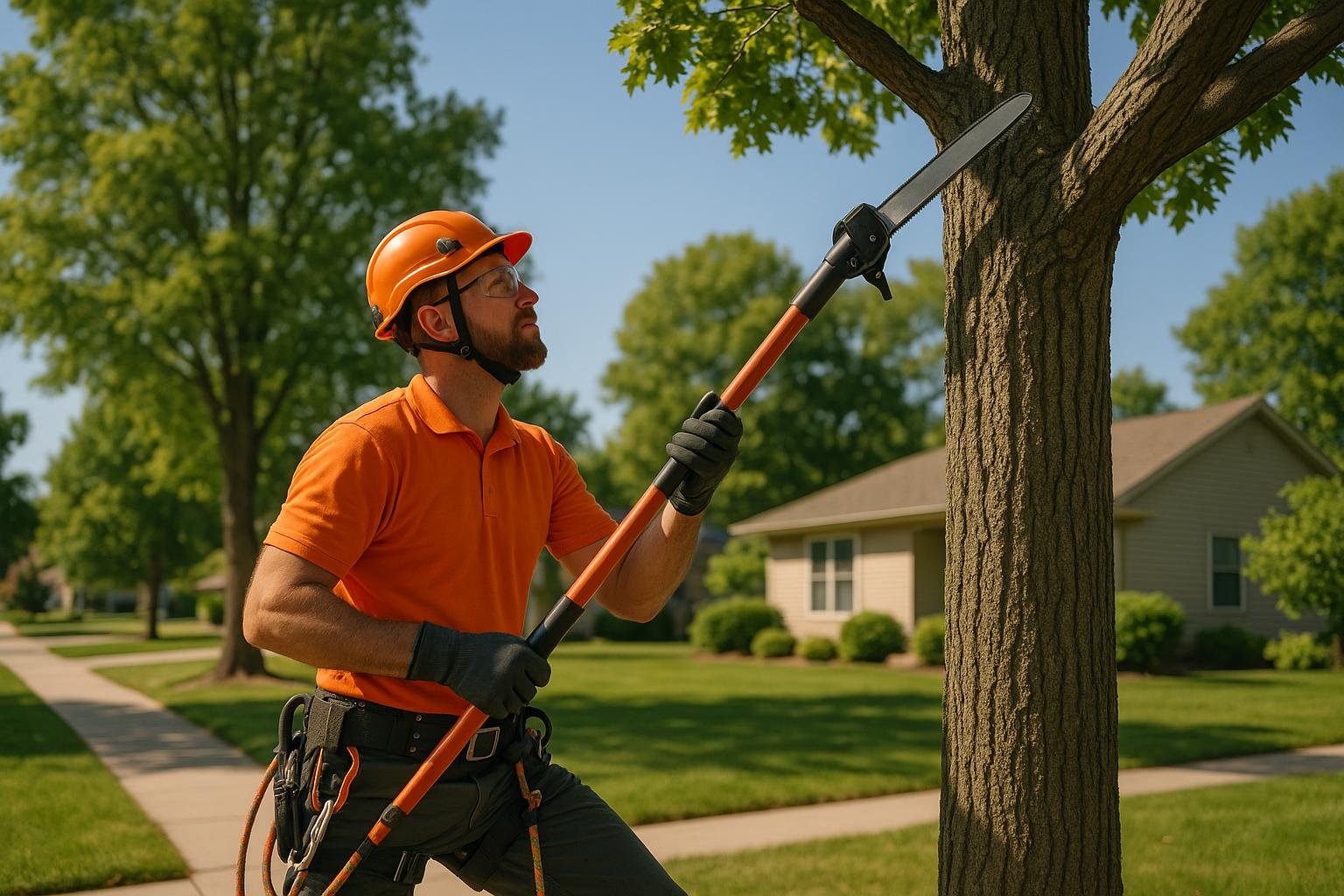
When homeowners need tree services – especially in emergencies – they turn to Google. Ranking high in search results can mean more calls, more jobs, and a stronger reputation. Here’s how to make it happen:
- Focus on Local SEO: Ensure your business name, address, and phone number (NAP) are consistent across all platforms. This helps Google trust your business.
- Optimize Your Google Business Profile: Claim and verify your profile, fill in all details, and update it regularly with posts, photos, and reviews.
- Create Localized Content: Build service pages and blogs tailored to your area, answering common questions like "How much does tree removal cost in [City]?"
- Leverage Reviews and Backlinks: Encourage customer reviews and get listed in local directories and industry associations for credibility and better rankings.
- Adapt for Mobile: Many searches happen on smartphones, so ensure your website loads quickly and has clickable phone numbers.
Want to grow your tree service business? Start with these steps to boost your visibility and attract more local customers.
Mastering Tree Service SEO: Dominate Google & Grow Your Business!
Local SEO Basics for Tree Services
If you’re aiming to attract nearby customers, mastering local SEO is a must. Unlike traditional SEO, which focuses on broad keywords, local SEO zeroes in on geographic signals to connect with local customers. For tree service companies, this is especially important because your clientele is always local.
When someone types in "tree removal near me" or "arborist in Dallas", Google evaluates several factors like your business details, customer reviews, and how relevant you are to the searcher’s location. These local searchers often have immediate needs – emergency tree removal or routine care – and are more likely to convert into paying customers than general website visitors.
Google’s local algorithm considers three main factors: relevance, distance, and prominence. Fine-tuning these elements can boost your local rankings. But before diving deeper into local SEO strategies, it’s essential to focus on one foundational aspect: consistent business information.
NAP Consistency Requirements
Your business’s Name, Address, and Phone number – commonly known as NAP – must be consistent across all online platforms. Why? Because Google relies on this consistency to determine your business’s legitimacy. Even minor inconsistencies can confuse search engines and hurt your rankings.
Exact matches are non-negotiable. If your website lists your business as "Smith’s Tree Service LLC", that exact name should appear on Google My Business, Yelp, and every other directory. Avoid variations like "Smith Tree Service" or "Smith’s Tree Services" on different platforms.
The same rule applies to your address and phone number. For example, if your website lists your address as "123 Main Street", don’t abbreviate it as "123 Main St." elsewhere. Similarly, choose one phone number format – like (555) 123-4567 – and use it consistently.
Common NAP errors include using different phone numbers for various locations without proper tracking, inconsistent street name abbreviations, or leaving out suite numbers on certain listings. These inconsistencies lead to what SEO experts call "citation confusion", which can prevent your business from showing up in local search results.
Regular audits are crucial. Platforms like Yelp or Google My Business allow users to suggest edits to your business information, which can result in unintentional changes. Make it a habit to review your NAP details across all directories to avoid citation confusion. Once your information is aligned, you’ll be in a stronger position to attract local leads.
How Local Searches Generate Leads
Local searches often follow a predictable pattern, and understanding it can give tree service companies a big advantage. Customers usually start with broad searches like "tree service near me" to explore options. As they get closer to making a decision, their searches become more specific, such as "emergency tree removal [city name]."
Searches that include terms like your city, neighborhood, or "near me" often indicate a strong intent to hire. For instance, someone searching "tree trimming Austin TX" is much more likely to call than someone casually looking up "tree care tips."
Timing also plays a big role in local searches for tree services. Emergency-related searches tend to spike during storm seasons or right after severe weather events. On the other hand, routine maintenance searches typically increase in late winter and early spring as homeowners prepare for the growing season.
Mobile devices dominate local searches. Many customers search for tree services on their phones, especially during emergencies. This makes having a fast-loading website with clickable phone numbers absolutely essential.
Google My Business provides valuable insights into how people find your business. Whether they’re searching directly for your company name, browsing categories like "arborist", or discovering you through related service searches, this data can highlight which local SEO strategies are paying off and where you should focus more attention.
Seasonal search patterns are a goldmine for lead generation. For example, tree removal searches peak in late fall and winter when trees are dormant, making it easier for homeowners to assess which ones need attention. Pruning and trimming searches, on the other hand, rise in late winter as people prepare for spring growth. By understanding these trends, you can fine-tune your content and advertising to make the most of these opportunities.
Setting Up Your Google Business Profile
Think of your Google Business Profile as your digital storefront – it’s a powerful tool to boost your visibility in local searches and attract qualified leads. When someone searches for tree services in your area, an optimized profile can make all the difference in helping you stand out.
Your profile provides key details like business hours, contact info, customer reviews, and photos, all of which help potential clients decide whether to reach out. Google also uses the completeness and accuracy of your profile as a factor in determining local search rankings.
Once your profile is set up, the next steps are to claim, verify, and fill in all your business details.
Claiming and Verifying Your Profile
Start by visiting business.google.com, where you can search for your business listing to claim it or create a new profile if one doesn’t exist.
Verification is a must – it establishes your credibility. Most businesses verify through a postcard, which arrives within 5–7 business days and includes a code to complete the process. Other methods, like phone or Search Console verification, may be available but are less common, especially for service-based businesses.
If you run your tree service from a home office, you can still verify your business without displaying your home address. Set it up as a service area business, which allows you to list the areas you serve instead.
Avoid common pitfalls during verification. For example, don’t create multiple profiles for the same location, and make sure the name on your profile matches your official business registration.
Adding Complete Business Information
A fully completed profile often ranks higher in local searches. Start by choosing the most accurate primary category – “Tree Service” is usually the best fit for tree care companies.
You can also add secondary categories to reflect your services. Options like “Arborist and Tree Surgeon,” “Emergency Tree Service,” or “Stump Grinding Service” can help you appear in more specific searches.
Your business description should be clear and straightforward, detailing your services and the areas you serve. For instance: “We provide tree removal, pruning, and stump grinding services in Dallas and surrounding areas, with 24/7 emergency availability.”
Don’t forget to upload high-quality photos. Include shots of your team at work, before-and-after project examples, and your equipment. Highlighting services like tree removal and pruning with visuals can showcase your expertise and professionalism.
Keep your hours accurate, including updates for holidays. If you offer 24/7 emergency services, make sure your profile reflects that. When setting your service areas, list the cities and neighborhoods you cover without exaggerating your reach.
Using Posts and Updates for Customer Engagement
Google Business Profile posts are a great way to stay active and engage with potential customers. Regular updates signal to Google that your business is active, which can improve your local search rankings.
Use these posts to share seasonal tips, customer testimonials, or highlight specific services. For example, create posts about spring pruning schedules, fall cleanup services, or winter tree protection. Add clear calls to action like “Book your spring pruning consultation” or “Call now for emergency storm cleanup.”
Sharing customer testimonials is another way to build trust. Post positive reviews along with before-and-after photos (with permission) to showcase your expertise.
Track the performance of your posts through Google’s insights. Metrics like views, website clicks, and phone calls can help you understand what resonates with your audience and refine your approach.
Keep your posts short and informative, and include high-quality images or videos. Since many people search on mobile devices, make sure your visuals look good on smaller screens. Posting regularly – about once a week – keeps your business fresh in people’s minds and helps turn local searches into service calls.
This consistent engagement lays the groundwork for converting potential customers into loyal clients.
Creating Content for Tree Services
When building your local profile, crafting high-quality content does more than boost your rankings – it also builds trust with potential customers. By creating informative content that answers the questions people are searching for, you position your site as a go-to resource. As a result, Google is more likely to rank your site higher in search results.
Focus on addressing customer questions and highlighting local areas to establish your business as an authority and attract local leads. This approach lays the groundwork for more targeted pages and keyword-rich posts.
Building Location-Based Service Pages
Local relevance and clear messaging are essential. Instead of a single generic "tree removal" page, create dedicated pages for each location you serve, such as "Tree Removal in Dallas."
Each page should include specific details about your services in that area. For instance, if you’re targeting Austin, mention how the city’s clay soil impacts tree root systems or highlight projects completed near well-known spots like Lake Travis or downtown Austin. Including local references adds authenticity and shows you understand the unique needs of the community.
To enhance credibility, include customer testimonials and before-and-after project photos. This local context not only helps Google pinpoint where you operate but also improves your chances of appearing in location-specific searches.
Make sure each page offers real value. Go beyond simply swapping out city names – explain your process, highlight what sets you apart, and, if possible, include pricing details. Pages that recycle the same content for different locations without adding meaningful information can hurt your rankings.
Writing About Common Tree Care Questions
Answering common customer questions through blog posts or detailed service pages can attract search traffic while showcasing your expertise.
Write about challenges your customers face, such as "When Should I Prune My Oak Trees?" or "How to Spot a Tree That Needs Emergency Removal." Seasonal topics are also effective – cover issues like storm prep in spring, drought stress in summer, or winter tree care.
Tailor your content to the types of trees common in your area. For example, if you’re in the Southeast, write about caring for live oaks, magnolias, or pine trees, and include tips on dealing with local pests, diseases, or weather conditions.
Be transparent about costs. Many potential customers search for pricing information before reaching out, so consider creating posts like "How Much Does Tree Removal Cost in [Your City]?" You don’t need to list exact prices – just explain the factors that influence costs. This builds trust, especially with budget-conscious readers.
Don’t forget emergency situations. Develop content covering topics like emergency tree removal, storm cleanup, and immediate safety measures. Pairing this with strategic keyword use can further improve your online visibility.
Using Keywords and Customer Reviews
Keyword research is critical for targeting local terms. Use tools like Google Keyword Planner, SEMrush, or Ahrefs to identify the phrases your audience uses, particularly those with high purchase intent, such as "tree removal in [city]" or "emergency tree services near me".
Incorporate these keywords naturally into your content, including meta titles, descriptions, headers, body text, URLs, and image alt text. Avoid keyword stuffing – it’s more effective to write naturally while keeping your target phrases relevant to the context.
For local businesses, integrating location-specific keywords is especially important. Phrases like "tree trimming Dallas" or "arborist near me" often signal that the user is ready to hire, so include them where appropriate.
Customer reviews and testimonials not only provide social proof but also help incorporate local keywords. Create pages or blog posts featuring testimonials that address common customer concerns. This can enhance your credibility while improving your SEO.
Use tools like Google Analytics and Search Console to track your content’s performance. If certain pages attract visitors but don’t convert them into leads, consider revising them with clearer calls to action or more engaging service descriptions. Regularly updating your content with fresh examples or customer stories also signals to Google that your site is active and relevant, which can help maintain or improve rankings.
sbb-itb-130a704
Building Backlinks and Citations
Strong backlinks and consistent citations can significantly enhance your domain authority and improve your local search rankings. Quality content draws visitors to your site, while accurate and consistent business listings signal to Google that your tree service is reliable and trustworthy.
"Consistency is the golden rule – if your NAP details vary across platforms, it can confuse search engines and hurt your local SEO efforts." – LinkNow Media
When securing directory listings or endorsements, always refer to your verified NAP (Name, Address, Phone Number) details. Even small discrepancies can confuse Google and negatively impact your rankings. To avoid this, maintain a master document with your approved business details. This ensures consistency across all platforms, including your Google Business Profile.
Getting Listed in Local Directories
Local directories act as digital proof of your business’s presence, helping validate its legitimacy. Start with widely recognized platforms like Yelp, Angi, and the Better Business Bureau (BBB). Don’t overlook your local Chamber of Commerce, which can further reinforce your NAP consistency. Accurate and consistent listings in these directories improve your visibility when potential customers search for tree services in your area.
Always double-check that the NAP information you submit to directories matches exactly what’s on your Google Business Profile and website. This attention to detail ensures search engines – and potential customers – can trust your business information.
Working with Industry Organizations
Professional associations and industry organizations offer more than just credibility – they provide high-quality backlinks that can strengthen your SEO efforts. For example, the International Society of Arboriculture (ISA) hosts a "Find an Arborist" directory that many customers rely on. If you’re ISA certified, claiming your spot in this directory not only enhances your credibility but also provides a valuable backlink to your website.
Another option is membership with the Tree Care Industry Association (TCIA). Their member directory frequently appears in search results for professional tree services, and the association’s reputation adds an extra layer of trust to your profile.
Combining these strategies – starting with high-authority local directories and reputable industry organizations – creates a solid foundation for your tree service’s online presence. This approach not only boosts your visibility but also reinforces your credibility in the eyes of both search engines and potential customers.
Tree Company Leads‘ Digital Marketing Services
Handling SEO on your own can be effective, but for many tree service businesses, partnering with experts makes a noticeable difference. Tree Company Leads offers a range of digital marketing services specifically tailored to tree care professionals who want to stand out in their local markets. These services are designed to go beyond basic SEO, creating complete marketing systems that drive real business growth.
Instead of relying on generic strategies, Tree Company Leads customizes its approach to address the unique challenges of tree service businesses. By building on the foundational SEO tactics you may already be using, their services provide the extra push needed to achieve long-term success in competitive local markets.
Custom Web Design and Local SEO Services
Tree Company Leads doesn’t just create websites that look good – they design sites that perform. Their custom-built websites are tailored to represent your service area and are optimized to boost your local SEO rankings.
The local SEO strategy includes targeted keyword optimization and precise location-based tactics. They also handle technical details, such as ensuring your online listings are accurate and up-to-date. Many tree service owners struggle with these aspects, but Tree Company Leads takes care of them seamlessly.
Their audit and setup process evaluates your current online presence thoroughly. This includes verifying ownership of your Google Business Profile, selecting the most relevant business categories, and refining service areas to align with how potential customers search for tree services.
Lead Generation and Real-Time Tracking
Tree Company Leads doesn’t stop at improving your rankings – they ensure your visibility translates into real business. Their lead generation system connects you with exclusive, high-quality leads, eliminating the need to share prospects with competitors.
What sets them apart is their real-time tracking system. Using tools like call tracking, heatmaps, and performance reports, they monitor which strategies are driving results and adjust accordingly. This data-driven approach ensures you can see exactly which efforts are bringing in phone calls and new customers.
By combining optimized content with local listings, their tracking system pinpoints the keywords, locations, and messages that work best for your business. This allows for continuous improvement, replacing guesswork with clear, actionable insights.
Google Business Profile Management
Keeping your Google Business Profile active and accurate is crucial, and Tree Company Leads takes care of this for you. They manage all ongoing updates, geo-tagged photos, and review responses, ensuring your profile stays fresh and trustworthy in Google’s eyes.
Their consistent updates and weekly activity signals help your business remain visible to the right audience. By maintaining a professional and engaging presence, they ensure that searches turn into phone calls and qualified leads.
With their step-by-step approach, Tree Company Leads goes far beyond just setting up your profile. They create a dynamic online presence that attracts the right customers in the right locations, helping you convert visibility into measurable growth.
Conclusion: Steps to Improve Your Google Rankings
Boosting your Google rankings starts with focusing on the essentials. Begin with local SEO basics – make sure your NAP (Name, Address, Phone) details are consistent across all platforms. This consistency helps Google connect you with local, qualified leads and lays the groundwork for more advanced optimization efforts.
Your Google Business Profile is a cornerstone of your online presence. Claim and verify your profile, then keep it up to date with accurate information. Regular updates, engaging posts, and responding to customer reviews signal to Google that your business is active and reliable, which can positively impact your rankings.
Content creation is another key element for building long-term authority. Develop location-specific service pages to attract local interest, and address common tree care questions to position yourself as a knowledgeable resource. By pairing targeted keywords with authentic customer reviews, you create content that resonates with both search engines and potential customers.
Don’t overlook backlink building and citations. Getting your business listed in local directories and collaborating with industry groups adds credibility and strengthens your online presence through reputable references.
The real key to success is consistency. Start with one area – like optimizing your Google Business Profile – and gradually expand your efforts. Many tree service business owners see improvements over time by staying persistent and focused.
If managing SEO feels overwhelming or you’re looking to fast-track your results, Tree Company Leads offers tailored digital marketing services specifically for tree care professionals. Their expertise can help turn your online presence into tangible business growth.
Whether you decide to handle SEO on your own or work with experts, the most important thing is to take action. Use your local knowledge to connect with customers searching for tree services in your area. Every step you take brings you closer to reaching more potential clients.
FAQs
How can I make my Google Business Profile more appealing to attract local customers for my tree service business?
To make your Google Business Profile shine and draw in local customers, start by ensuring that all your details are accurate and current. This includes your business name, address, phone number, and operating hours – the basics that help people find and trust your services.
Add high-quality photos to your profile that highlight your tree services. Think "before-and-after" shots of completed jobs or pictures of your team hard at work. These visuals not only grab attention but also give potential customers a clear idea of what you can do.
Encourage happy customers to leave positive reviews. Reviews are a powerful way to build trust and improve your visibility in local searches. Additionally, keep your profile fresh by posting updates like seasonal promotions, special offers, or relevant news. A regularly updated profile not only boosts your search ranking but also makes your business more inviting to potential customers.
What are the best ways to build backlinks and citations to improve local SEO for my tree service business?
To improve your tree service business’s local SEO, start by building quality backlinks. Partner with local businesses, contribute guest posts to relevant blogs, or get involved in community events through sponsorships or participation. These efforts not only boost your authority but also link your business to reliable local sources.
Another key step is creating local citations. List your business on trusted directories like Yelp, Angi, and other industry-specific platforms. Make sure your business name, address, and phone number (NAP) are consistent across all listings. Accurate citations and strong backlinks can greatly boost your local search rankings and help bring in more nearby customers.
How can tracking seasonal trends improve my tree service marketing strategy?
Tracking seasonal trends lets you tailor your marketing to meet your customers’ needs at just the right times. For instance, late winter and early spring are perfect for promoting tree pruning services, as homeowners gear up to prepare their yards for fresh growth. Similarly, highlighting storm damage cleanup services during peak storm seasons ensures you’re addressing timely concerns.
By recognizing these seasonal patterns, you can craft focused campaigns, fine-tune your website with seasonal keywords, and position your services where they’ll be most visible during high-demand periods. This strategy not only increases your online presence but also helps you capture more leads when your audience is actively searching for solutions.
Related Blog Posts
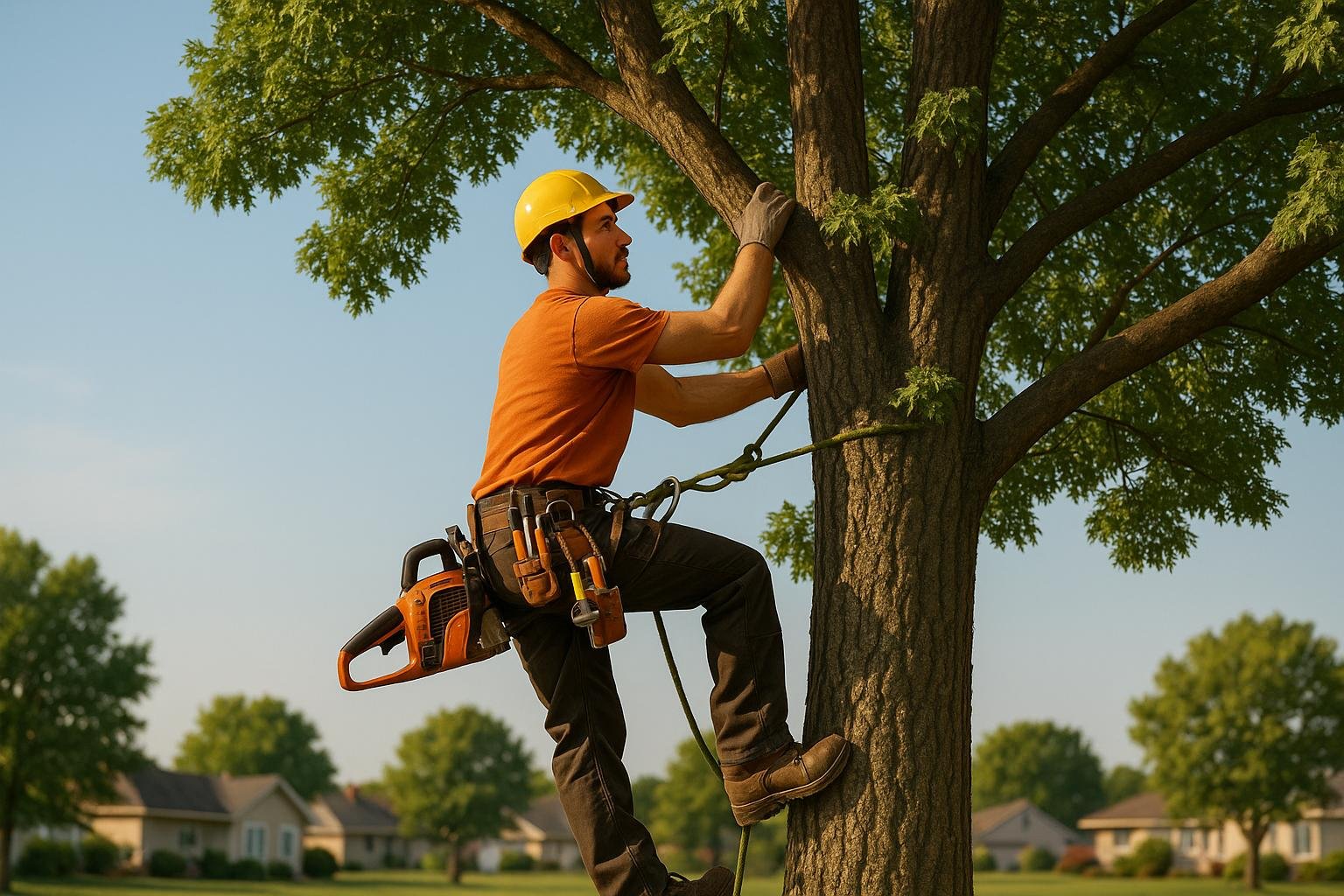
Generating leads for tree service companies is all about being visible when customers need your services most. Whether it’s during emergencies or for routine maintenance, the right tools can help you connect with local homeowners effectively. Here’s a quick overview of the top five lead generation tools tailored for tree care businesses:
- Tree Company Leads: A specialized platform that delivers exclusive, pre-screened leads directly to your business.
- Google Business Profile: A free tool to boost local visibility and attract customers searching for tree services near them.
- Google Ads: Paid search ads that put your business in front of customers actively searching for services like tree removal or storm cleanup.
- Lead Generation Chatbots: Automated chat tools for your website that engage visitors and collect their contact details 24/7.
- Thumbtack: A pay-per-quote platform connecting tree service providers with homeowners actively seeking project estimates.
These tools cater to different needs, from free options to paid campaigns, and help target local customers effectively. Below is a comparison to help you decide which one fits your business goals best.
Quick Comparison
| Tool | Pricing Model | Best For | Key Advantage | Time Investment | Lead Quality |
|---|---|---|---|---|---|
| Tree Company Leads | Subscription-based | High-quality, exclusive leads | Pre-screened leads delivered | Low | High |
| Google Business Profile | Free | Boosting local visibility | Free local exposure | Moderate (regular updates) | Varies by search intent |
| Google Ads | Pay-per-click | Paid campaigns targeting active searches | Instant visibility | High (requires optimization) | High |
| Lead Generation Chatbots | Subscription-based | 24/7 lead collection | Automated engagement | Moderate (setup needed) | Varies with setup |
| Thumbtack | Pay-per-quote | Connecting with ready-to-hire customers | Cost-effective for quick quotes | High (fast responses needed) | Variable |
Each tool serves a specific purpose, so consider your budget, time, and response capability when choosing the right fit for your tree service business.
Tree Service Lead Generation – How to Get More Leads Fast
1. Tree Company Leads
Tree Company Leads is a dedicated platform designed to handle your lead generation needs from start to finish.
Using AI-driven targeting technology tailored specifically for tree service searches, the platform identifies homeowners actively searching for services like tree removal, trimming, stump grinding, storm cleanup, and lot clearing. It filters leads based on key factors like your service area ZIP codes, job types, urgency, and budget preferences.
How It Works
Forget the hassle of managing Google Ads yourself – Tree Company Leads takes care of everything. They handle ad campaigns, design landing pages, and track conversions. These customized landing pages include trust-building elements such as ISA arborist certifications, proof of insurance, emergency response capabilities, and detailed estimates. This pre-selling strategy ensures more visitors turn into serious leads before they even reach out to you. It’s a hands-off system that lets you focus on what you do best: delivering excellent service.
Lead Quality and Delivery
The platform provides verified leads in real-time, delivered straight to your preferred channel – whether that’s your CRM, SMS alerts, or direct phone calls. Each lead is pre-screened to ensure you’re only dealing with qualified prospects. By targeting property owners with both the authority and budget to hire professional tree services, the system saves you time and effort.
Every lead includes detailed information about the job, timeline, and homeowner preferences, giving you the context you need to respond effectively. This ensures a smoother communication process and a higher likelihood of turning leads into confirmed jobs.
Reporting and Optimization
Tree Company Leads offers monthly reports that break down your campaign performance, including cost per lead and cost per booked job. The platform continually fine-tunes your campaigns to reduce acquisition costs over time.
2. Google Business Profile
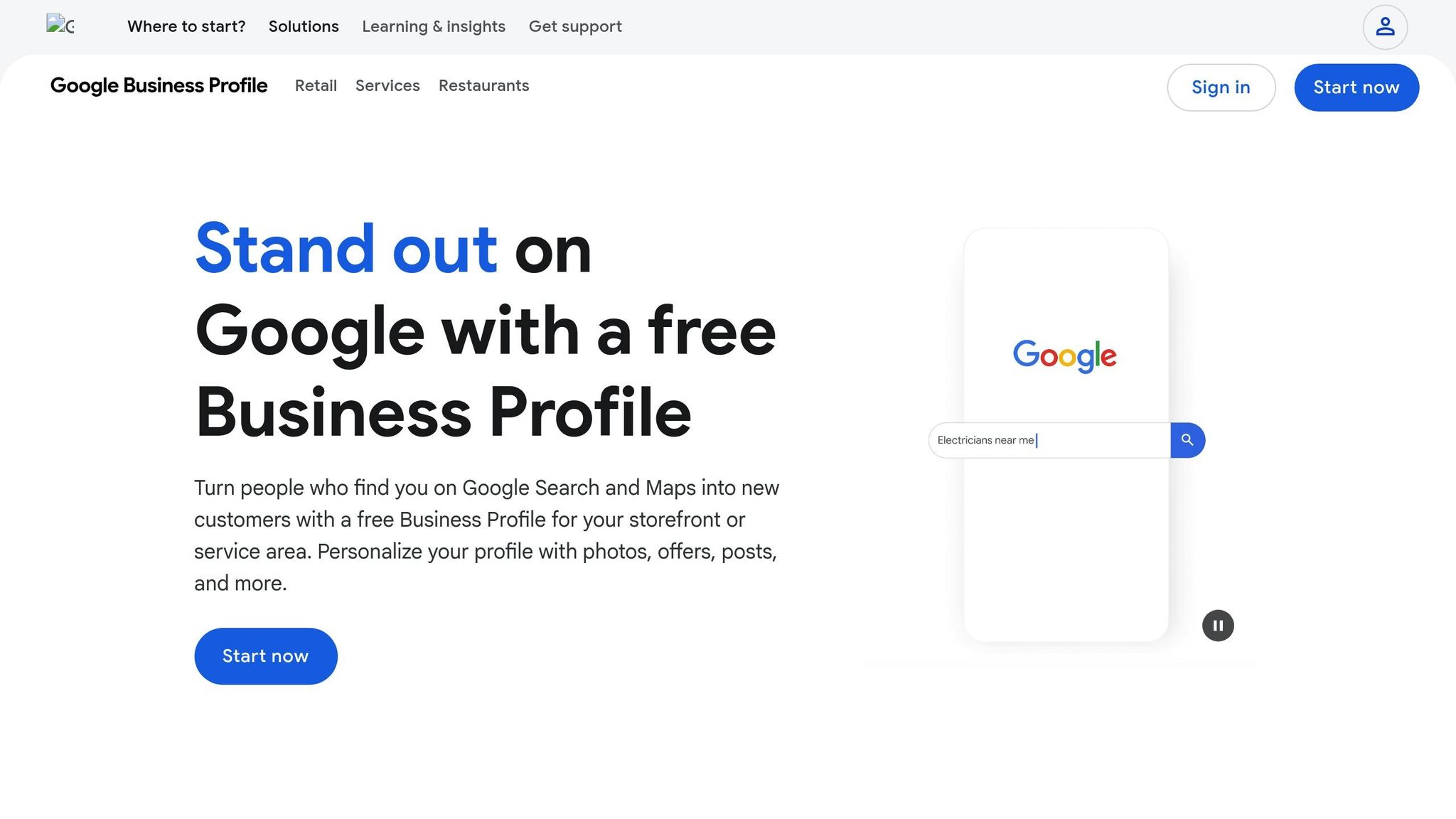
Google Business Profile is a free and effective tool for generating local leads in the tree service industry. When homeowners search for tree services, your profile often takes center stage, appearing prominently in the local map results at the top of the search page. In many cases, this profile becomes the first impression potential customers have of your business. The key to turning profile visits into leads lies in how well you optimize it.
Think of your profile as a virtual storefront. Customers will judge your business based on the photos you share, the reviews you’ve received, and how complete and professional your information appears. In fact, businesses with fully completed profiles can see up to 70% more visits, making optimization a must for boosting your lead generation efforts.
Setting Up Your Profile for Maximum Effectiveness
Start by filling out every section of your profile with accurate and detailed information. Include your business name, address, phone number, website, operating hours, and a thorough description of your services. For the primary category, choose either "Tree Service" or "Arborist", depending on your focus, as this helps Google connect your business with the right searches.
Be specific about your services. List offerings like tree removal, pruning, stump grinding, storm cleanup, or lot clearing. This not only improves your chances of showing up in targeted searches but also gives potential customers a clear picture of what you can do for them.
Using Visual Content to Drive Leads
High-quality visuals can make all the difference in converting profile visitors into customers. Regularly upload photos that highlight your work – before-and-after shots of tree removals, images of your team in action with professional equipment, and completed projects that showcase your expertise. These visuals build trust and can lead to immediate service bookings.
Photos of your equipment are especially effective. Show off your bucket trucks, chippers, and climbing gear to emphasize that you’re equipped to handle jobs of any size, which reassures potential customers about your capabilities.
Engaging with Reviews and Customers
Reviews are a critical part of your profile, and responding to them shows that you value customer feedback. Reply to every review – whether it’s positive or negative. For positive reviews, thank the customer and mention the specific service you provided. For negative reviews, address their concerns professionally and concisely to demonstrate your commitment to resolving issues.
Encourage happy customers to leave reviews by following up with a friendly text or email 2-3 days after the job is done. This timing ensures the experience is still fresh in their minds, and they’ve had a chance to appreciate the results of your work.
Keeping Your Profile Active to Rank Higher Locally
Activity on your profile plays a big role in how visible your business is in local search results. Google prioritizes businesses that actively update their profiles, so post weekly updates. Share seasonal tree care tips, showcase recent projects, or promote special offers like discounts on winter pruning or storm damage cleanup. Regular updates signal to Google that your business is active and relevant, improving your chances of ranking higher.
Take advantage of the Questions & Answers section to address common homeowner concerns. Answer queries about insurance, permits, cleanup procedures, or pricing estimates. This proactive approach not only builds trust but also helps capture leads from those still researching their options.
3. Google Ads

Google Ads put your tree service business front and center for people actively searching for services like "tree removal near me" or "emergency tree service." This immediate visibility makes it a powerful tool to complement other marketing efforts.
With a pay-per-click model, you only pay when someone clicks on your ad. This ensures your budget is spent on reaching people who are genuinely interested in your services.
Targeting the Right Keywords for Tree Services
To make the most of Google Ads, focus on keywords that reflect both routine maintenance and urgent needs. For regular services, terms like "tree pruning", "stump removal", or "arborist consultation" are effective. For emergencies, phrases such as "storm damage cleanup", "fallen tree removal", or "dangerous tree removal" are more relevant.
Since tree services are typically local, prioritize location-based keywords like "tree service in [your city]" or "tree removal in [your neighborhood]." Long-tail keywords – those with more specific phrases – can also attract customers closer to making a decision, such as "affordable tree pruning in [city]."
Don’t forget the seasonal nature of tree care. Spring often sees a spike in pruning requests, summer brings maintenance and removal needs, fall focuses on cleanup, and winter can lead to emergency storm-related calls. Adjust your keyword strategy and ad spend to match these seasonal trends for better results.
Creating Compelling Ad Copy That Converts
Your ad copy should directly address what tree service customers care about most: safety, expertise, and reliability. Highlight qualifications like certified arborists, proper insurance, and years of experience. Use clear and direct headlines like "Tree Removal Experts" or "24/7 Emergency Storm Cleanup."
Incorporate action-oriented phrases that encourage immediate contact. Promises like "Free Estimate Today", "Licensed & Insured", or "Same-Day Service Available" can resonate with customers without coming across as too aggressive. Including your phone number in the ad makes it easier for those in urgent situations to get in touch quickly.
Adding local touches – like mentioning your city, service area, or nearby landmarks – helps establish trust and reinforces your position as a reliable, local provider.
Managing Budgets and Measuring ROI
Once you’ve nailed down your keywords and ad copy, set a daily budget to maintain consistent visibility. Keep an eye on your cost-per-click (CPC), as it can vary depending on competition in your area. Even if CPC is on the higher side, the revenue from just one quality job can easily offset the cost.
It’s not just about clicks, though. Track meaningful conversions like phone calls, form submissions, and estimate requests. Since many tree service jobs begin with a phone consultation, monitoring call activity can give you a clearer picture of your campaign’s performance.
Use geographic targeting to focus on areas you serve and schedule your ads during times when customers are most likely to respond.
Leveraging Ad Extensions for Better Performance
Ad extensions can significantly improve your campaign’s effectiveness. For example:
- Call extensions prominently display your phone number, making it easy for mobile users to call you with one tap – especially crucial during emergencies.
- Location extensions show your business address, reinforcing your local presence and credibility.
- Sitelink extensions let you highlight specific services like "Emergency Tree Removal", "Stump Grinding", or "Tree Health Assessment", helping customers find exactly what they need.
- Review extensions showcase your Google ratings directly in the ad, building trust by sharing positive feedback from past customers.
These features not only enhance your ad’s visibility but also make it easier for potential customers to connect with you quickly and confidently.
sbb-itb-130a704
4. Lead Generation Chatbots
Adding a chatbot to your tree service website gives visitors a way to connect with your business instantly. This handy tool works around the clock, gathering lead information through automated pre-screening and capturing contact details from potential customers. It keeps your lead generation efforts active, even when your team isn’t available, ensuring you don’t miss out on opportunities.
5. Thumbtack
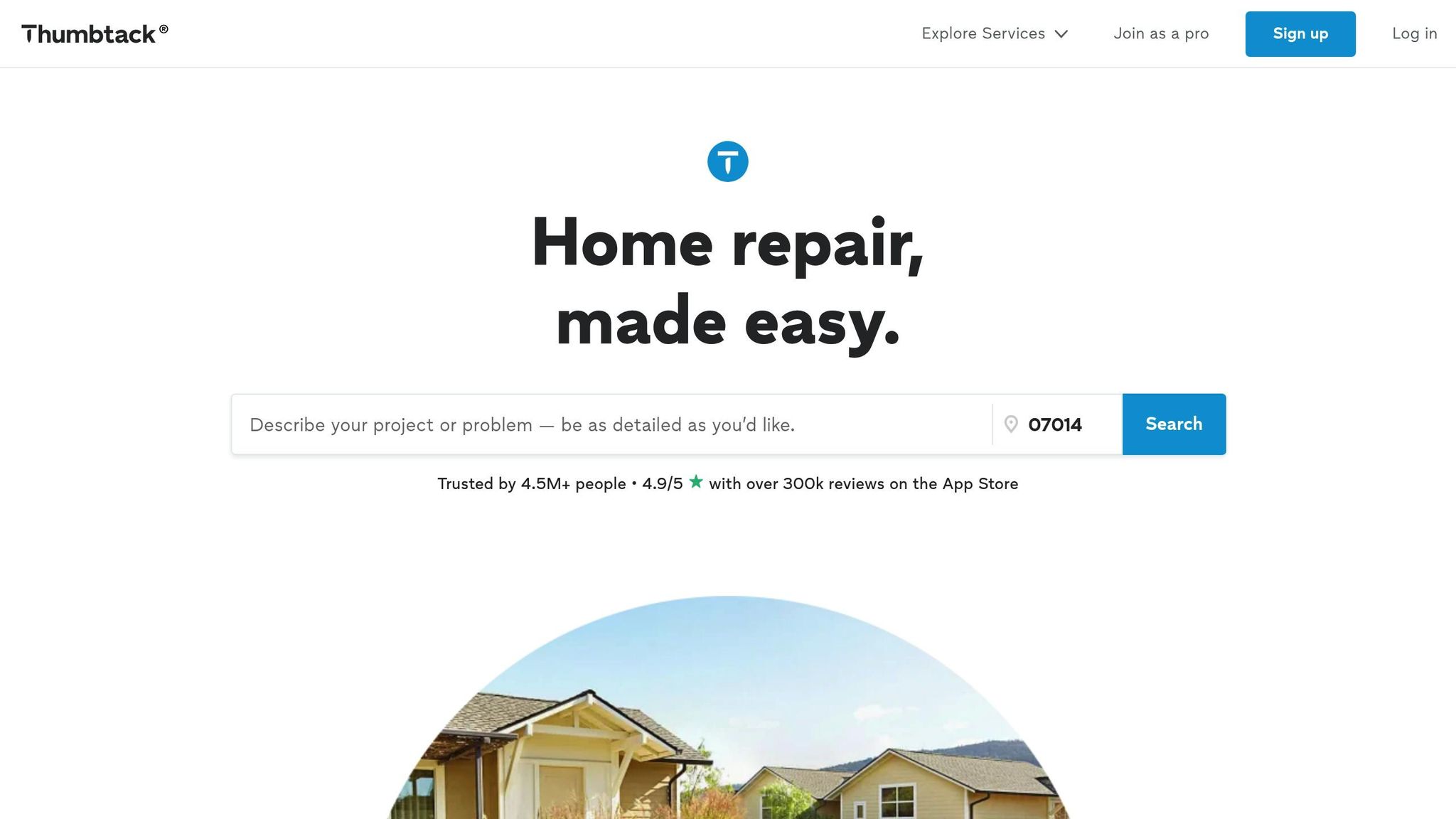
Thumbtack is a platform that links tree service providers with homeowners seeking project quotes. It’s a great tool for newer businesses aiming to gain reviews and establish a solid reputation in their local area.
The platform uses a pay-per-quote model, meaning you’re only charged for the proposals you send. This setup helps you keep your marketing budget in check. Thumbtack attracts an estimated 1,150+ monthly organic visitors searching for tree service-related keywords and holds a 31.2% impression share among leading paid search platforms.
Getting the Most Out of Thumbtack
Thumbtack’s cost-effective structure can deliver excellent results – if you act quickly and strategically. Speed is crucial here. Responding to inquiries within minutes can significantly improve your chances of securing a job. Since multiple professionals often compete for the same project, a fast response can make all the difference.
To stand out, optimize your Thumbtack profile. Showcase certifications like ISA accreditation, highlight specialized services such as hazardous tree removal, and include high-quality photos of your past work. These details can help position your business as the clear choice for potential clients.
Smart Pricing and Performance Tracking
Quick responses are essential, but so is a well-thought-out pricing strategy. Thumbtack connects you with homeowners who are ready to hire, so pricing competitively while emphasizing the value and expertise you bring is critical. Keep an eye on your performance metrics to fine-tune your bidding approach and make the most of your marketing dollars.
Thumbtack is especially effective for businesses that can respond promptly during working hours and handle competitive bidding. Like other tools mentioned, it’s a practical, budget-friendly option to strengthen your tree service lead generation efforts.
Tool Comparison Chart
When deciding on the right tool for your tree service business, think about your budget, goals, and how much time you can dedicate. The chart below summarizes key options to help you make an informed choice.
| Tool | Pricing Model | Best For | Key Advantage | Time Investment | Lead Quality |
|---|---|---|---|---|---|
| Tree Company Leads | Subscription-based (pricing varies by plan) | Businesses seeking exclusive, high-quality leads | Exclusive leads delivered directly | Low – minimal effort required | High – pre-screened prospects |
| Google Business Profile | Free | Improving local visibility | Boosts reputation at no cost | Moderate – requires regular updates | Varies with customer search intent |
| Google Ads | Pay-per-click | Businesses with an advertising budget | Instant visibility in targeted searches | High – needs ongoing optimization | High – targets actively searching customers |
| Lead Generation Chatbots | Subscription-based (pricing varies by features) | Engaging customers 24/7 | Captures leads even outside business hours | Moderate – setup and maintenance required | Varies – depends on configuration |
| Thumbtack | Pay-per-quote | Businesses building a local reputation | Pay only for real quote opportunities | High – quick responses needed | Variable |
Key Factors to Consider
- Budget: If you’re starting out, free tools like Google Business Profile can help you build visibility without spending money. For businesses with a marketing budget, Google Ads offers a faster way to attract leads.
- Response Time: Tools like chatbots provide instant engagement, while platforms like Thumbtack demand quick responses to customer inquiries. Tree Company Leads offers flexibility by delivering pre-screened leads directly to you.
- Ease of Use: Google Business Profile is easy to maintain, but Google Ads requires knowledge of digital advertising for effective results. Chatbots can automate lead capture with minimal learning curve.
- Geographic Precision: For local tree service companies, targeting specific areas is crucial. Google Ads excels in this area with advanced targeting options, while other tools work to connect you with a broader audience.
Conclusion
Running a successful tree service business takes more than just skilled arborists and top-notch equipment. It also requires a smart approach to generating leads. By spreading your efforts across multiple platforms, you can protect your business from market changes and rising competition.
The five tools discussed in this guide each play a unique role in your marketing efforts. Google Business Profile is a must-have for boosting local visibility without spending a dime, while Google Ads works well for those ready to invest in paid campaigns. Tree Company Leads provides exclusive, time-efficient leads, chatbots ensure you’re capturing inquiries 24/7, and Thumbtack connects you directly with homeowners actively looking for tree services.
To get the most out of these tools, combine free and paid channels into a well-rounded strategy. This not only increases your reach but also helps balance out the seasonal ups and downs common in the tree care industry. Start with the basics, like optimizing your Google Business Profile, and gradually expand into paid advertising or specialized platforms. Keep an eye on metrics such as lead volume, cost per lead, and conversion rates to figure out which tools are delivering the best results. Regularly reviewing these metrics allows you to fine-tune your approach as your business grows.
Your choice of tools will depend on your budget, response capacity, and overall goals. For instance, a new tree service might stick to free options like Google Business Profile, while established companies can explore premium services like exclusive leads or robust Google Ads campaigns. The key is to match your tools with your resources and growth plans, scaling up as your business evolves.
FAQs
What’s the best way to choose a lead generation tool for my tree service business?
To choose the best lead generation tool for your tree service business, focus on options that match your goals and connect with your target audience. Start with platforms like Google Business Profile to enhance your local presence. Pair this with local SEO efforts to improve how your website ranks in search results. You can also consider paid advertising options such as Google Ads, Facebook Ads, or Local Services Ads to reach potential customers directly.
For industry-specific solutions, look into lead generation services designed for tree care businesses. These often include features like job scheduling and customer management, which can streamline your operations. Make sure the tools you choose align with your budget and the scale of your business. Experimenting with a mix of strategies can help you discover the most effective methods to attract new clients.
How can I optimize my Google Business Profile to attract more local customers?
Making the most of your Google Business Profile is an effective way to draw in more local customers. To start, make sure every detail on your profile is accurate and up to date. This includes your business name, address, phone number, and hours of operation. Choose the primary category that best describes your business, and don’t forget to upload high-quality photos regularly to highlight your services or products.
Stay connected with your audience by responding to reviews quickly. Thank customers for their positive comments and handle any concerns with professionalism. Keep your profile active by posting updates every week, and encourage happy customers to leave reviews. These simple actions can go a long way in improving your local visibility and bringing in more clients.
What’s the best way to manage and track the performance of my Google Ads campaigns for tree services?
To get the most out of your Google Ads campaigns for tree services, start by defining clear objectives. Are you aiming to drive more visitors to your website, generate leads, or increase phone inquiries? Whatever your goal, make sure it’s specific and measurable. Setting up conversion tracking is crucial – it allows you to track actions like form submissions or calls that come directly from your ads.
Keep a close eye on key metrics such as click-through rate (CTR), cost per click (CPC), and conversion rate. These numbers will give you valuable insights into how well your ads are performing. Use this data to tweak your targeting, refine your ad copy, and adjust your keywords for better results. Take advantage of tools like Google Ads’ built-in reporting and analytics to monitor performance and make informed decisions that can help you get the best return on your investment.
Related Blog Posts

In 2025, tree service leads cost between $45 and $100 on average, with a national average of $58 per lead. Costs vary based on factors like location, lead exclusivity, and the platform used. For instance, leads in California average $68, while Los Angeles leads are around $71. Exclusive leads and higher-quality sources tend to cost more but often result in better conversions. Seasonal demand and competition also influence pricing.
Key points:
- Average Lead Cost: $45–$100
- National Average: $58
- Location Impact: Urban areas see higher costs (e.g., $68 in California).
- Lead Types: Pay-per-lead and pay-per-call models differ in cost and conversion rates.
- Platforms: Google Ads and Local Services Ads typically offer measurable results.
To maximize ROI, focus on high-quality leads, track performance metrics, and adjust budgets based on conversion data. Testing different channels with smaller budgets can help identify the most effective strategies before scaling.
Tree Service Leads ➡️ Tree Service Marketing (Peak Inside a LIVE Campaign)
Average Cost of Tree Service Leads in 2025
In 2025, the cost of tree service leads ranges between $45 and $100. This is an essential figure to keep in mind when planning your marketing budget. Understanding these costs allows you to allocate resources wisely and make smarter decisions about your advertising strategies.
Current Average Cost Ranges
Recent data shows that the national average cost per lead is about $58. However, this number varies depending on the location. For example, in California, leads average around $68, while in Los Angeles, they climb to approximately $71.
Interestingly, phone leads tend to cost more than form leads. While form leads are slightly cheaper, they often come with lower conversion rates.
So, what causes these price differences? Let’s break it down.
Factors That Affect Lead Costs
Several factors influence the cost of tree service leads, including:
- Location: Where your business operates has a big impact on lead pricing. Urban areas with intense competition and higher living costs typically see more expensive leads. On the flip side, rural areas tend to have lower prices.
- Exclusivity of Leads: Exclusive leads – those shared only with your business – are priced higher than shared leads, as they offer a better chance of converting into customers.
- Bidding Systems: Many platforms use a bidding system for lead generation. Offering a higher cost per lead often increases the number of leads you receive.
- Lead Quality and Source: Leads generated through targeted local SEO or well-planned ad campaigns may cost more upfront. However, they frequently deliver higher conversion rates, especially when paired with strong lead-to-sale metrics and solid customer revenue.
- Seasonal Demand: Certain times of the year, like after storms or during spring cleanups, see a spike in lead prices due to increased demand for tree services.
Lead Sources and Pricing Models
Understanding pricing models can fine-tune how you allocate your lead generation budget. Each model comes with its own cost structure and advantages, which can directly influence your overall marketing strategy. Let’s break down the differences between pay-per-lead, pay-per-call, and the nuances of traditional versus digital lead sources.
Pay-Per-Lead vs. Pay-Per-Call
With pay-per-lead, you’re charged every time a potential customer’s contact information is collected. This typically includes details like their name, phone number, and the type of service they’re interested in. The upfront payment gives you control over when and how you choose to follow up with these prospects.
On the other hand, pay-per-call charges only when a customer places a direct call to your business. These calls often come from people actively looking for tree services, which means they tend to convert at a higher rate. That said, this model works best if you have staff ready to handle incoming calls during business hours – missed calls could mean missed opportunities.
Platform-Specific Lead Pricing
The cost of generating leads varies depending on the platform and strategy you use:
- Google Ads: Pricing depends on factors like ad quality, competition, and the keywords you target. These variables play a big role in how you allocate your advertising budget.
- Google Local Services Ads: These ads charge only for verified inquiries and prominently display your business with a Google-backed badge, building trust with potential customers.
- Social Media Ads: While these platforms often offer lower cost-per-click rates, they may generate fewer immediate service requests. Social media tends to work best for increasing brand awareness and showcasing your work visually.
For tree service businesses, companies like Tree Company Leads specialize in crafting targeted Google Ads campaigns. By combining local SEO strategies with exclusive lead generation techniques, they help businesses maximize their marketing dollars through custom web design and advanced advertising methods.
Traditional vs. Digital Lead Sources
Traditional methods like directory listings and direct mail often come with higher, less predictable costs and offer limited tracking capabilities. This makes it harder to measure their impact on your bottom line.
Digital lead sources, on the other hand, provide detailed analytics that allow for precise spending. For example, contact forms on your website – driven by strong organic search visibility – can convert effectively. However, building up that organic presence usually takes time and consistent effort.
Referral programs also remain a solid option for tree service businesses. These programs often yield higher conversion rates since they come from trusted recommendations. The cost of setting up and maintaining a referral system will depend on the incentives you offer, but the returns can be well worth it.
Digital platforms excel in delivering measurable results. They allow you to track which keywords, ad placements, or landing pages drive the most valuable leads. Armed with this data, you can fine-tune your marketing efforts to focus on strategies that generate the best returns for your business.
sbb-itb-130a704
Maximizing ROI from Tree Service Leads
Getting the most out of your investment in lead generation isn’t just about counting how many leads you get. The real key is understanding the entire customer journey – from the moment they first reach out to when the job is completed.
Tracking and Measuring Lead ROI
To measure ROI effectively, you need to track how your leads are performing. Pay attention to metrics like lead volume, cost per lead, conversion rates, and customer lifetime value. These numbers help fine-tune your marketing strategy.
When assessing your marketing returns, think beyond the immediate income from a single job. Consider the potential for repeat business. Tools like Tree Company Leads’ real-time lead tracking make it easier to collect and analyze data, giving you a clear picture of how your leads perform across different channels. This insight helps you make smarter budget decisions. Plus, understanding ROI ties back to the pricing trends we’ve mentioned earlier, showing why it’s worth investing strategically in high-quality leads.
Balancing Lead Quality and Cost
Once you have performance data, the next step is finding the right balance between lead quality and cost. Sure, higher-quality leads might cost more upfront, but they often pay off with better conversion rates and long-term customer relationships. By focusing on the value of the leads – not just their price – you can align your marketing budget with your business goals.
Conversion Rate Benchmarks for Tree Services
Tracking conversion rates is another crucial step in understanding the true value of your leads. While benchmarks will vary depending on your market and the type of service inquiries you receive, keeping a close eye on these rates helps you set realistic goals. Over time, this allows you to adjust your strategies to make your lead generation efforts as profitable as possible.
Budgeting for Lead Generation in 2025
Creating a lead generation budget that works starts with understanding your business’s size, growth ambitions, and financial boundaries. A good starting point is a testing phase – dedicating a small, manageable budget to try out various lead sources. This helps you figure out which channels work best without stretching your resources too thin. Once you’ve gathered insights, you can make smarter decisions about where to allocate more funds for maximum impact.
Recommended Budget Allocations
For tree service businesses, it’s wise to set aside a percentage of your revenue for marketing. Begin with a cautious monthly testing budget, and as you gather data on what’s working, adjust your spending to focus on channels that deliver the best results. This ensures your investments are guided by actual performance rather than guesswork.
Scaling Lead Generation Efforts
After identifying your most effective lead sources during the testing phase, scaling becomes the next step. A gradual approach works best – reinvesting profits from successful campaigns into the channels that consistently bring in high-quality leads. By concentrating on one or two standout channels at first, you’ll maintain control over your strategy and expand in a deliberate, manageable way.
Monitoring Lead Costs Over Time
Lead generation costs are rarely static. They can shift due to market trends, competition, and even seasonal fluctuations. Keeping a close eye on costs – whether weekly or monthly – helps you spot increases early and adjust your strategy as needed. Regular performance reviews allow you to identify campaigns that are no longer cost-effective, so you can redirect your budget to more efficient options. Using real-time tracking tools makes this process even smoother, giving you immediate insights to pause or tweak underperforming efforts and keep your overall costs in check.
Conclusion: Key Takeaways on Tree Service Lead Costs in 2025
Navigating lead costs is all about making smart decisions that push your business in the right direction. As lead generation continues to change, staying on top of pricing trends can keep you competitive and safeguard your profits. With the right insights, you can fine-tune your strategy to maximize your return on investment (ROI).
Recap of Lead Cost Insights
Here’s a quick rundown of what we’ve covered about lead costs in 2025. The price you’ll pay for tree service leads can vary a lot depending on factors like pricing models, local market conditions, the complexity of services offered, and how competitive your area is. Digital platforms tend to offer clearer pricing compared to traditional advertising, making them an appealing choice for many businesses. Additionally, lead costs are influenced by seasonal demand and market-specific trends, which can cause fluctuations throughout the year.
Practical Tips for Tree Service Businesses
To make the most of your lead generation efforts, consider these strategies:
- Start small: Test different lead sources with smaller budgets before committing heavily. This approach minimizes risk while helping you identify the most effective channels.
- Measure ROI: Keep a close eye on your spending and compare it to the revenue generated from new leads. This will help you understand which investments are paying off.
- Prioritize quality over quantity: A single high-quality lead is often more valuable than several unqualified ones. Focus on attracting prospects that are more likely to convert.
- Diversify your methods: Relying on one source for leads can be risky. Explore multiple avenues to ensure stability, even when market conditions shift.
- Monitor costs regularly: Review your lead generation expenses on a weekly basis to stay agile and adapt quickly to changes in the market.
FAQs
Are exclusive leads worth the higher cost for my tree service business?
Exclusive leads might come with a higher price tag, but they often deliver a stronger opportunity to turn prospects into paying customers. Since these leads are reserved solely for your business, there’s no need to battle it out with competitors, which can boost your booking rates and improve your overall return on investment.
To decide if exclusive leads are a good fit, think about a few key factors: the average value of a customer for your business, your current conversion rate from lead to customer, and the time and effort saved by avoiding the competition that comes with shared leads. If the numbers point to a positive return, investing in exclusive leads could be a smart move for your tree service business.
What are the best ways to track and boost conversion rates for tree service leads?
To boost the conversion rates of your tree service leads, start by incorporating tools that gather essential customer information – like interactive pricing estimators. These tools not only engage visitors but also encourage them to share their contact details, turning casual browsers into actionable leads.
Keep a close eye on your cost per lead (CPL) and overall lead performance. To pinpoint what’s working, track your lead-to-sale conversion rate and calculate the average revenue each customer brings in. This analysis will highlight effective strategies and reveal areas that might need tweaking.
Make sure your website is optimized with location-specific keywords and detailed descriptions of your services to attract the right audience. For quicker results, consider running paid ad campaigns on platforms like Google Ads or Facebook, especially during busy seasons. Just be sure to monitor your CPL closely to ensure you’re getting the best return on your investment.
How can I adjust my lead generation budget to account for seasonal changes and market trends?
To fine-tune your lead generation budget, it’s crucial to monitor two key metrics: cost per lead (CPL) and return on investment (ROI). These numbers reveal which campaigns are giving you the most bang for your buck and help you focus on what’s working.
Pay attention to seasonal demand shifts as well. For instance, tree care services often experience a surge in demand during storm seasons or when homeowners prepare for spring and fall. By increasing your budget during these peak times, you can attract more leads when potential customers are actively searching for your services.
Don’t forget to stay informed about market trends and keep tabs on your local competition. If lead costs spike due to higher demand or increased ad competition, you might need to adjust your strategy. Shift your budget toward channels that are performing well or tweak your campaigns to make them more efficient.