Category: Uncategorized
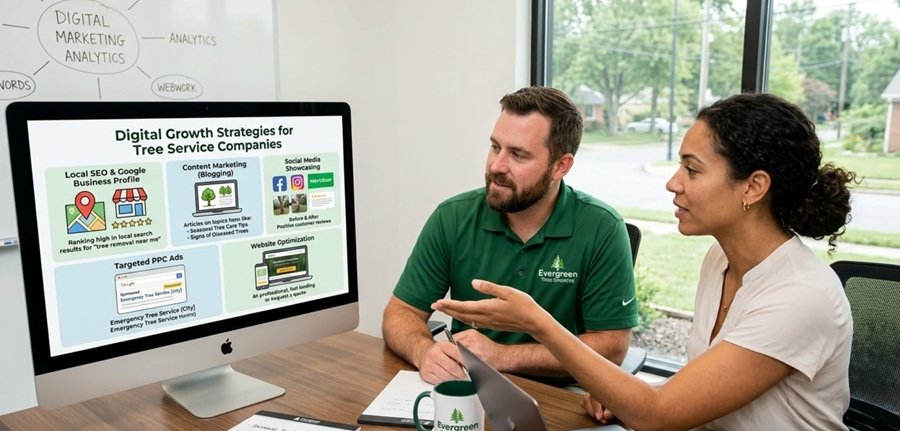
Tree service is a hyper-local, high-intent business. When a homeowner has a storm-damaged oak hanging over their roof or a dead tree threatening their fence line, they’re not browsing — they’re searching. That urgency is an enormous opportunity for tree companies that show up in the right place at the right time with the right message.
Here are the most effective digital marketing strategies for tree service companies in today’s competitive landscape.
1. Google Ads: The Fastest Path to New Customers
No other channel generates qualified tree service leads faster than Google Ads. When someone types “emergency tree removal near me” or “tree trimming [city name],” they’re ready to hire — today. Google Ads puts your company in front of that searcher before they ever scroll down to the organic results.
What works for tree service Google Ads:
- Separate campaigns by service. Tree removal, stump grinding, trimming/pruning, and emergency services all have different margins, seasonality, and conversion rates. Grouping them together makes it impossible to allocate budget intelligently.
- Use call-only and call extension campaigns. Most tree customers want to talk to someone, not fill out a form. Prioritize phone call conversions and track every call to understand which keywords are actually generating real jobs — not just clicks.
- Build a strong negative keyword list from day one. Tree service campaigns bleed budget on irrelevant searches like “tree identification,” “tree care tips,” “how to plant a tree,” and “palm tree removal” (if you’re in the Midwest). A clean negative keyword list is the difference between a campaign that loses money and one that delivers a consistent cost per lead.
- Target by zip code and radius strategically. Don’t just target your whole metro area equally. Focus budget on the zip codes and neighborhoods that convert best and have the job values you want. Large-lot suburban areas and neighborhoods with older, mature trees are often your highest-value targets.
2. Local SEO: Build Long-Term Visibility Without Paying Per Click
Google Ads drives immediate leads, but local SEO builds an asset that pays dividends for years. For tree service companies, ranking in the Google Local Pack (the map results) can generate a steady, consistent stream of calls at zero cost per click.
Key local SEO priorities:
- Optimize your Google Business Profile. This is non-negotiable. Ensure your service categories are correct, add photos of your crew and completed jobs, respond to every review, and post updates regularly. A complete, active GBP ranks higher and converts better.
- Build city and service landing pages. If you serve 15 cities, you should have a dedicated page for tree removal, tree trimming, and stump grinding in each of those cities — each page with unique, locally relevant content. Generic pages that say “we serve the greater metro area” won’t rank. Specific pages targeting “tree removal in [city name]” will.
- Earn local citations. Consistent NAP (name, address, phone number) listings across directories like Yelp, Angi, HomeAdvisor, Better Business Bureau, and industry directories reinforce your local relevance to Google.
- Generate reviews systematically. Reviews are one of the top ranking factors for local search. After every completed job, follow up with a direct link to your Google review page. Even a simple text or email asking for an honest review — sent within 24 hours of service — can dramatically increase your review velocity.
3. A Website That Converts, Not Just Informs
Your website is your 24/7 sales rep. For tree service companies, a high-converting site needs to do a few things exceptionally well:
- Make it effortless to call or request a quote. Your phone number should be click-to-call on mobile and visible in the header on every page. A prominent “Get a Free Estimate” button should follow users as they scroll.
- Show your work. Before-and-after photos of real jobs — large removals, technical climbs, stump grinding — build trust and credibility faster than any amount of marketing copy.
- Highlight what makes you different. Are you ISA Certified? Fully insured? Do you offer same-day emergency service? Do you own your own equipment? These trust signals matter to homeowners evaluating multiple companies.
- Keep load speed fast. Most tree service customers are searching on a mobile phone, often standing in their yard looking at a problem. A slow-loading site loses them immediately. Compress images, minimize plugins, and choose quality hosting.
4. Local Service Ads (Google Guaranteed)
If you haven’t set up Google Local Service Ads, it should be on your short-term to-do list. LSAs appear above traditional Google Ads and organic results and carry the “Google Guaranteed” badge — a trust signal that meaningfully improves click-through rates.
Unlike traditional PPC where you pay per click, LSAs charge per lead. You dispute fraudulent or irrelevant leads to get credits back. The Google Guaranteed badge requires a background check and license/insurance verification, which filters out some competitors and gives you an edge with customers who are price-comparing.
For tree service companies in competitive markets, running both LSAs and traditional Google Ads together maximizes coverage at the top of the search results page.
5. Seasonal and Storm Campaign Strategy
Tree service demand is highly seasonal and weather-driven. Smart operators build their campaigns around this reality:
- Ramp up budget in spring and fall. Spring is when homeowners emerge from winter and notice damage, dead limbs, and overgrowth. Fall brings pre-winter cleanup demand. These are your highest-volume seasons.
- Have a storm response playbook. When a significant storm hits your service area, search volume for emergency tree removal can spike 5–10x overnight. Have a campaign ready to activate immediately — with emergency-specific ad copy, a budget increase plan, and a landing page that leads with your rapid response capability.
- Promote stump grinding in slower periods. Stump grinding is often a lower-urgency service that customers delay. Running targeted promotions or discounted bundled pricing in your slower months can fill the schedule and keep crews busy.
6. Reputation Management and Review Strategy
For a service business built on trust and access to someone’s property, your online reputation is one of your most powerful marketing assets — or your biggest liability.
- Respond to every review, positive and negative. A professional, empathetic response to a negative review often impresses potential customers more than the review itself damages you. It shows you care and you’re accountable.
- Never pay for fake reviews. Beyond the ethical issues, Google actively detects and removes suspicious review patterns, and getting penalized can wipe out years of legitimate review equity.
- Leverage reviews in your ads. Positive reviews and high ratings can be highlighted in Google Ads via seller ratings extensions, and on your website as social proof near your quote request forms.
7. Retargeting: Stay in Front of People Who Didn’t Call Yet
The majority of people who visit a tree service website don’t convert on the first visit. They might be comparing prices, waiting to discuss it with a spouse, or just not ready yet. Retargeting ads — which show banner or social ads to people who have already visited your site — keep your company top of mind until they’re ready to book.
Even a modest retargeting budget of $5–10/day can meaningfully improve your overall conversion rate from website traffic you’re already paying for through Google Ads and SEO.
8. Social Media for Brand Awareness and Community Trust
Tree service isn’t typically a social-first business, but platforms like Facebook and Nextdoor can be surprisingly effective for building local awareness.
- Before-and-after posts perform extremely well — dramatic tree removals, large stump grindings, and hazardous tree work are genuinely interesting content that gets shared locally.
- Nextdoor is underutilized. Many homeowners ask their neighbors for service recommendations directly on Nextdoor. Having an active business presence and encouraging happy customers to recommend you there can generate referrals at near-zero cost.
- Facebook ads work well for homeowners with larger lots. If you can target by homeownership, home value, and geography, Facebook can be a cost-effective way to reach the homeowner demographic that has the jobs you want.
Putting It Together: The Right Mix for Your Budget
If you’re just starting out, prioritize Google Ads and Google Business Profile optimization first. They’ll generate leads the fastest and help you understand which services and geographies perform best. As your budget grows, invest in your website and city-specific SEO pages to reduce your long-term reliance on paid traffic.
The tree service companies that consistently win in their markets are doing all of these things — not perfectly, but systematically. They’re tracking calls, refining their ad campaigns monthly, generating reviews after every job, and building a web presence that compounds in value over time.
That’s how you turn a good tree company into the most visible and trusted one in your market.
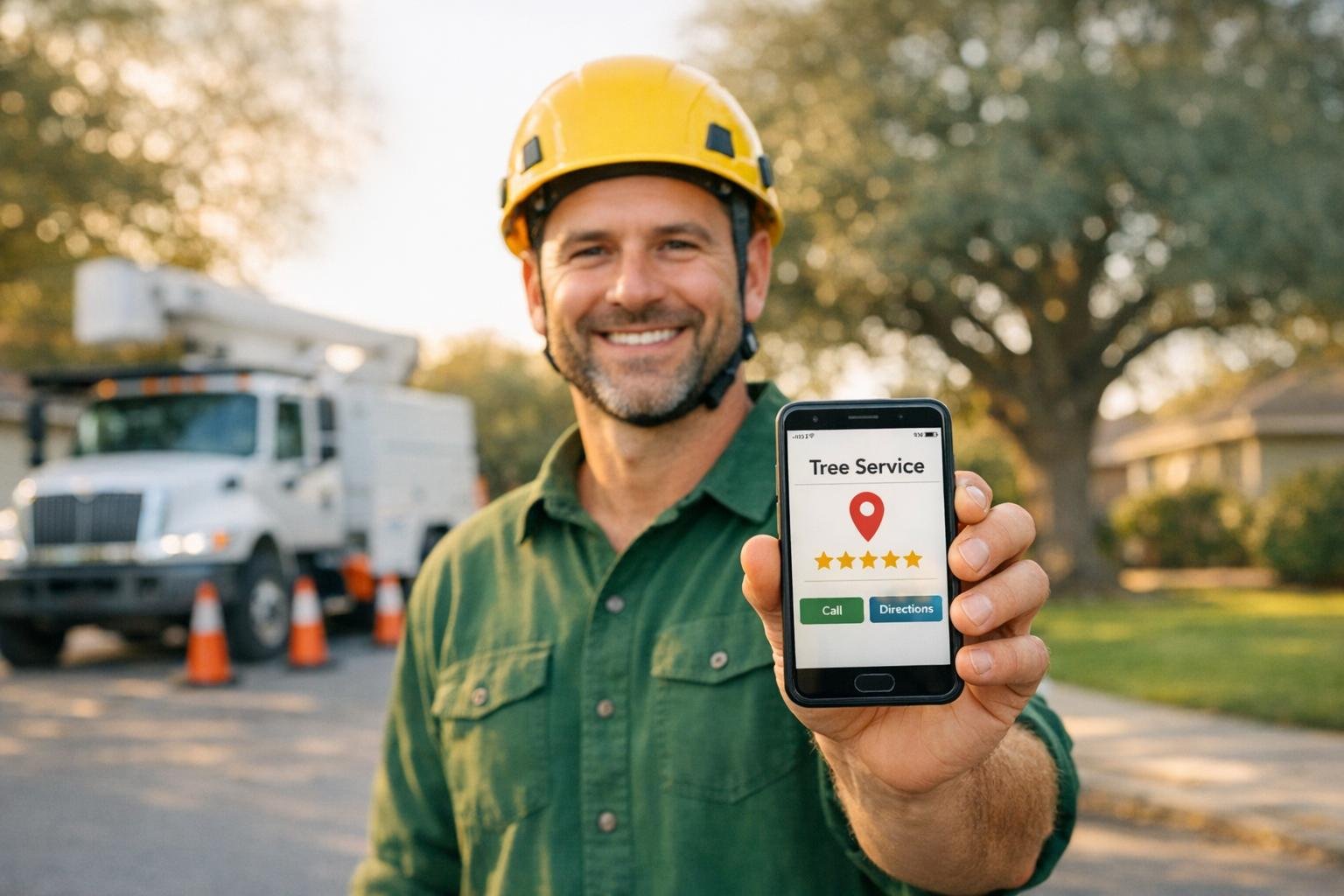
If you’re running a tree service business, showing up in local search results is essential. Why? 96% of consumers search online for local services, and 76% of smartphone users visit a business within 24 hours of searching. If your company isn’t visible on Google – especially in the local Map Pack – you’re losing potential customers daily.
Here’s what you need to do:
- Target local keywords: Focus on terms like "tree removal [City]" or "stump grinding near me" to attract high-intent local searches.
- Optimize your Google Business Profile (GBP): Accurate info, photos, and reviews can boost visibility and drive leads.
- Build service-specific landing pages: Create pages for each service (e.g., tree removal, stump grinding) with location-based keywords.
- Ensure your website is mobile-friendly and fast: With 78% of emergency searches happening on mobile, a slow or hard-to-navigate site can cost you leads.
- Maintain NAP consistency: Your business name, address, and phone number must match across all directories to improve rankings.
SEO is a long-term effort, but the payoff is steady leads without the ongoing costs of ads. If you need immediate leads while your SEO builds, you can also set up Google Ads for tree companies to capture urgent calls. Start with GBP optimization and keyword research to get results faster.
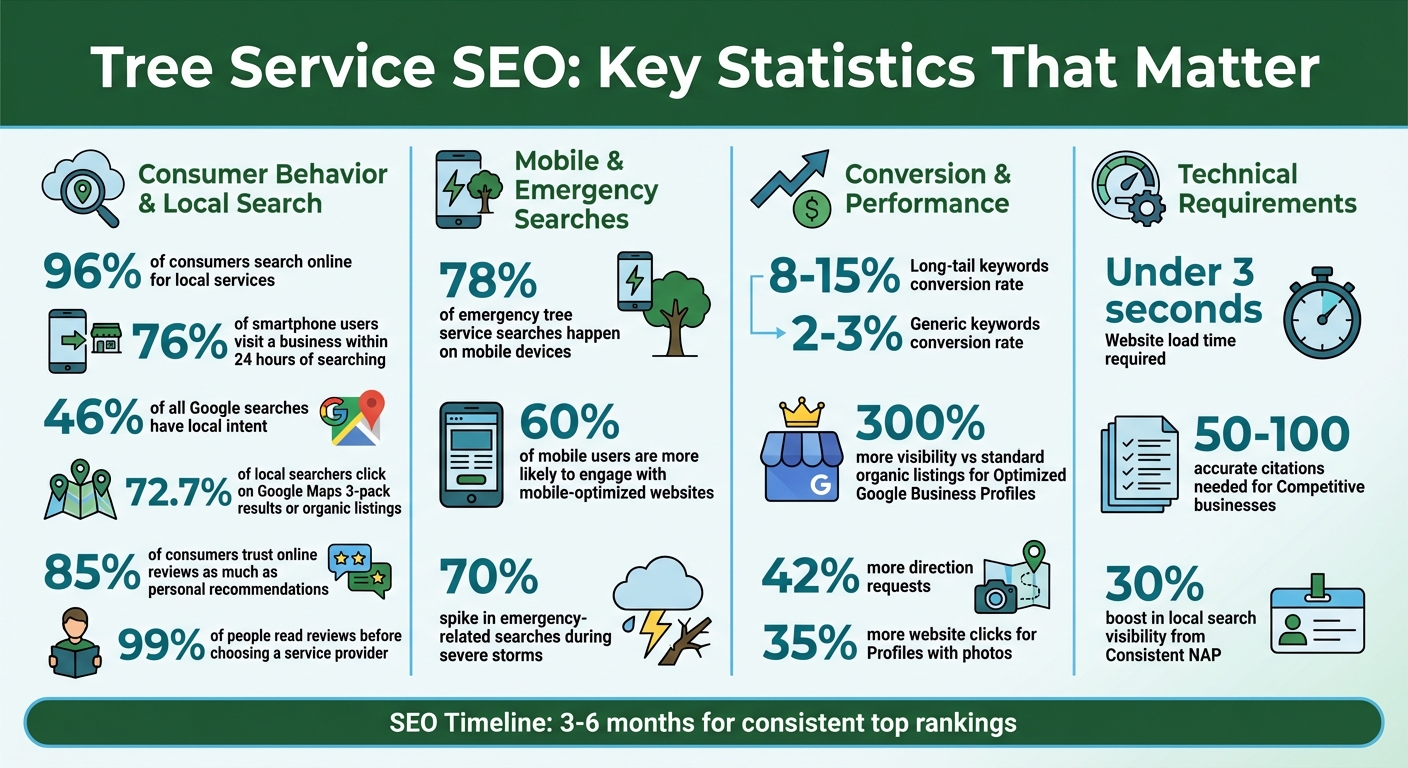
Tree Service SEO Statistics: Local Search, Mobile Usage, and Conversion Rates
Mastering Tree Service SEO: Dominate Google & Grow Your Business!
sbb-itb-130a704
Finding the Right Keywords for Tree Services
Targeting the right keywords connects you with local homeowners actively searching for tree services. Did you know that 46% of all Google searches have local intent? That means nearly half of your potential customers are using location-specific phrases to find services like yours. By identifying the exact search terms local customers use, you can ensure you rank higher on Google for tree services when they need help.
Start by focusing on your core services – tree removal, tree trimming, stump grinding, and emergency tree care – and pair them with your city or neighborhood name. For example, searches like "tree removal Denver" or "stump grinding near me" often signal someone ready to hire. These location-specific searches tend to convert well because they reflect both urgency and intent. Let’s dive into how local keywords can make all the difference.
Local Keywords That Drive Traffic
When it comes to tree service SEO, location is everything. Homeowners searching for help aren’t looking across the state – they want nearby providers. Keywords like "tree trimming near me" or "tree removal [City Name]" are magnets for local customers ready to book. In fact, 72.7% of local searchers click on Google Maps 3-pack results or organic listings. By combining your services with geographic terms – like your city, surrounding neighborhoods, or even local landmarks – you can capture these high-intent searches. For example:
- "Tree service in West Austin"
- "Emergency tree removal downtown Portland"
These types of phrases resonate with people searching for services in those specific areas.
Also, consider this: 78% of emergency tree service searches happen on mobile devices. Many of these searches occur when customers are onsite assessing damage, making "near me" keywords even more critical.
Keyword Research Tools
If you’re wondering how to find the right keywords for your business, tools like Google Keyword Planner and Ubersuggest are excellent starting points. Enter your main services as "seed" keywords, and these tools will suggest variations while showing you how often they’re searched in your area. Ubersuggest can even reveal which keywords drive traffic to your competitors’ websites.
Don’t overlook Google’s built-in tools like Autocomplete, "People Also Ask", and "Related Searches." They provide real-time keyword ideas such as "how much does tree removal cost in [City]" or "do I need a permit to remove a tree." These tools not only help you identify popular terms but also uncover precise long-tail phrases tailored to your services.
Long-Tail Keywords for Specific Services
Once you’ve nailed down your core and local keywords, refining your strategy with long-tail phrases can help you capture even more high-intent searches. Long-tail keywords are longer, highly specific phrases that attract customers who know exactly what they need. Instead of competing for a broad term like "tree service", you can target phrases such as:
- "Emergency oak tree removal in west Denver"
- "24/7 storm damage tree service [City Name]"
Why focus on these longer phrases? They tend to convert better because they match a customer’s precise needs. As Tree Service Marketing Solutions explains:
"The generic short keywords get searched more but convert worse. The longer specific ones bring in customers who are actually ready to book work."
The numbers back this up: long-tail keywords achieve conversion rates of 8-15%, compared to just 2-3% for generic terms. To make the most of this, create dedicated pages for niche services like "crane-assisted tree removal", "stump grinding", or "tree pruning for storm preparation." Each page should focus on its own long-tail keyword combination, helping you rank for multiple specific searches instead of competing for one broad term.
| Keyword Type | Example | Intent Level |
|---|---|---|
| Local Service | tree removal [City], tree trimming near me | High |
| Emergency | 24/7 tree service, storm damage removal | Very High |
| Service-Specific | stump grinding [City], deep root fertilization | Medium-High |
| Long-Tail | emergency oak tree removal in west Denver | High |
Emergency-related terms like "fallen tree removal" or "tree fell on house" see a 70% spike during severe storms. By optimizing for these urgent phrases, you can capture customers who need immediate assistance.
Setting Up Your Google Business Profile
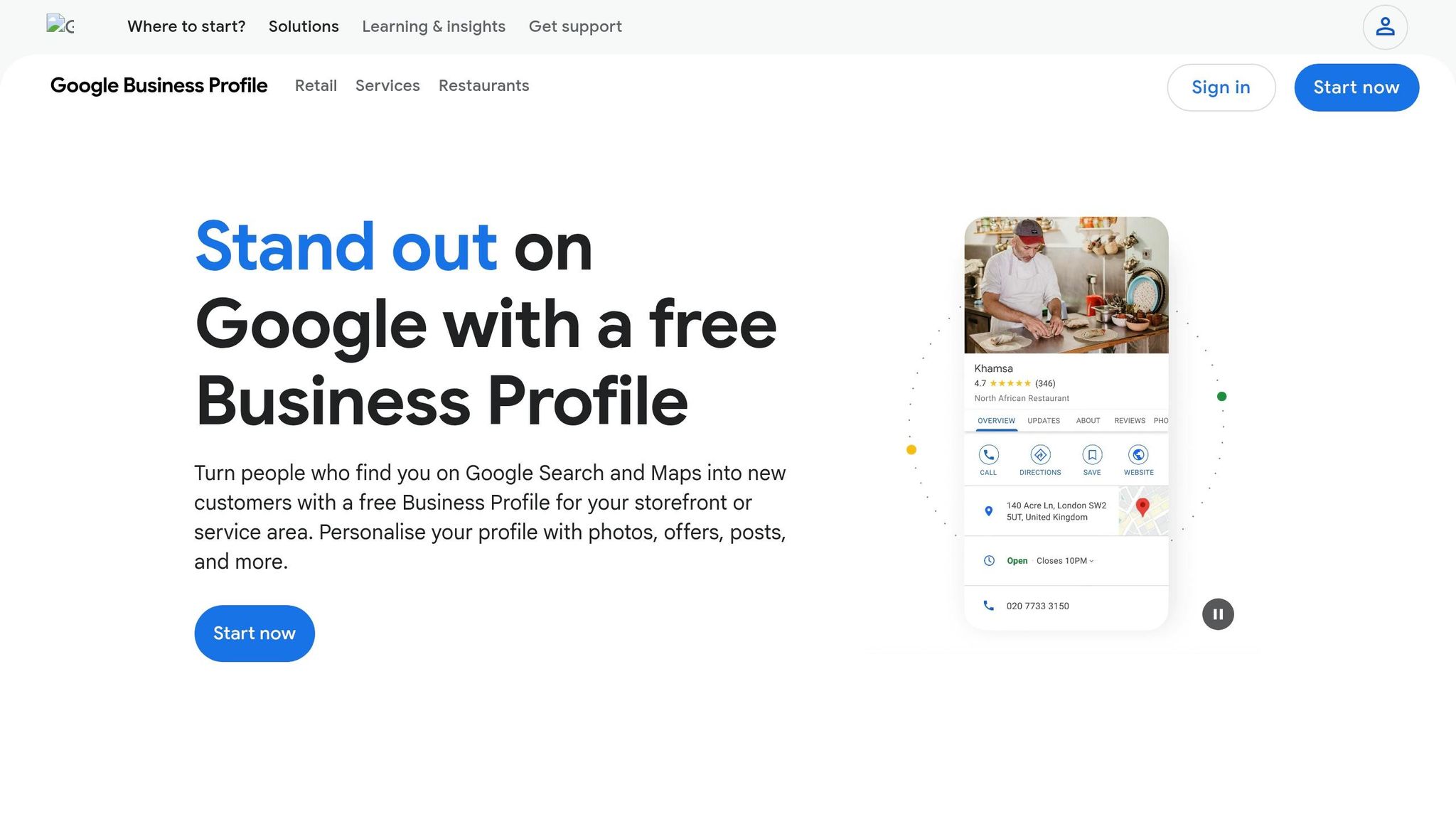
Your Google Business Profile (GBP) acts like a mini-website that can significantly boost your local tree service marketing visibility. It’s the key to landing in the coveted Google Map Pack – the top three local businesses that show up prominently in search results. In fact, optimized profiles can achieve 300% more visibility compared to standard organic listings.
Take HLI Tree Experts in Riverside, CA, as an example. Between 2022 and 2023, Leonard A. led the company through a local SEO overhaul, turning a modest 2-truck operation into a 5-truck fleet in just six months. This strategy brought in 10+ leads daily and added about $50,000 in weekly job revenue. Here’s how you can set up your GBP to become a high-performing local lead machine.
Keep Your Business Information Accurate
Your business name, address, and phone number (NAP) must match exactly across your GBP, website, and all online directories. Even small inconsistencies – like using "St." in one place and "Street" in another – can confuse Google.
Make sure to:
- Set "Tree Service" as your primary category to clearly define your business.
- Add secondary categories such as "Arborist", "Tree Removal Service", and "Stump Removal Service" to attract a broader range of search queries.
- Use the 750-character business description wisely – place your most important keywords in the first 250 characters to grab attention.
If you don’t have a physical office for customer visits, hide your address and specify your service areas instead. This helps Google identify the neighborhoods you cover. You can also add attributes like "On-site Services" or "Free Estimates" to provide quick, useful details to potential customers.
Accurate and consistent NAP details are the foundation of a strong local presence. Once that’s in place, it’s time to make your profile visually appealing.
Add Photos and Service Descriptions
Photos make a huge difference – profiles with images see 42% more direction requests and 35% more website clicks. Upload 3–5 new photos every week, showcasing your crew in action, your equipment, and before-and-after shots of completed jobs.
Here’s a pro tip: Rename your image files before uploading. Instead of generic names like IMG_123.jpg, use descriptive, localized names like oak-tree-trimming-west-chester-pa.jpg. Tools like GeoImgr can embed location data into your photos, helping Google associate your work with specific areas.
As Local Tree Service Marketing explains:
"Your tree care photos do more than show off your work. They help Google understand your business and where you serve."
In the "Services" section, list your offerings in detail. Include services like "Emergency Storm Damage Cleanup", "Stump Grinding", or "Cabling and Bracing", and add pricing where possible to stand out. Posting weekly updates – such as recent project photos, seasonal tips, or discounts like "10% off stump grinding" – signals activity to Google and keeps your profile fresh.
Finally, building trust through customer reviews can take your profile to the next level.
Collect and Reply to Customer Reviews
Reviews are essential – 85% of consumers trust online feedback as much as personal recommendations. After completing a job, ask customers for reviews through a short, text-based request.
Always respond to reviews, whether they’re glowing or critical, and aim to reply within 24 hours. For negative reviews, remain calm and professional. Acknowledge the customer’s concerns and provide a direct contact number to resolve the issue offline. As Clicks Geek points out:
"A professional, calm, and helpful response to a bad review can actually win you more business than a dozen five-star ratings. It proves you have integrity."
For example, in 2024, a tree service provider named Tucker optimized his GBP and saw 30 to 40 new leads in just 3 to 4 weeks, resulting in his best-ever revenue month of $90,000. By combining accurate information, engaging visuals, and active review management, you can create a profile that not only attracts attention but also converts searchers into loyal customers.
On-Page SEO for Your Tree Service Website
Your website needs to turn traffic from your Google Business Profile (GBP) into paying customers. On-page SEO helps optimize each page to rank higher in search results while giving visitors the information they need to take action. Let’s break down how to design effective service pages, write compelling meta tags, and structure internal links to maximize your website’s performance.
Create Landing Pages for Each Service
Build individual landing pages for each of your core services – like tree removal, pruning, stump grinding, and emergency storm cleanup. Aim for 500–800 words per page, detailing the process, safety practices, equipment used, and benefits for customers. These focused pages ensure that visitors from your GBP find the exact service they’re searching for right away.
Incorporate location-based keywords throughout the page. For example, if your business operates in Dallas, use phrases like "tree trimming in Dallas" in the H1 header, subheadings, and naturally within the content. This helps Google understand both your service offering and your service area. Adding an FAQ section is also a smart move – cover common queries about pricing, permits, or timelines.
Include trust-building elements to make your pages more effective. Highlight your insurance and licensing, show real photos of your team in action, and feature customer testimonials. These details transform a basic service page into what marketers call a "money page" – a page designed to generate revenue. Considering that 96% of consumers search online for local services, these pages are often the first impression potential customers get of your business.
Write Better Meta Tags
Your meta title and description are critical because they’re the first things users see in search results. Use this proven formula for meta titles: [Service] in [City, State] | [Company Name]. For example: "Tree Removal Services in Springfield, IL | Green Tree Experts."
For the meta description, include a secondary keyword and a clear call-to-action. A good example might be: "Licensed arborists serving Springfield. Fast response, free estimates. Call today for reliable tree removal". Keep it concise – around 150 to 160 characters – and prioritize the most important details, like your service and location, as mobile users might see a shortened version.
Highlight your unique selling points in the description. Phrases like "Certified Arborists", "Licensed & Insured", or "24/7 Emergency Service" can build trust and improve click-through rates. Tree Services Marketing emphasizes:
"Title tags and meta descriptions should include the city and service (e.g., ‘Tree Removal Services in Springfield – Fast, Reliable Help’)."
Each service page needs its own unique meta tags to avoid duplication and maintain consistency across your site.
Link Between Your Pages
Internal linking is key for both user navigation and SEO. Linking from your homepage to your main service pages helps direct authority and ensures that visitors (and Google) can easily find your most important content.
Use descriptive anchor text instead of generic phrases like "click here." For example, write "emergency tree removal" or "stump grinding services" to give both search engines and users a clear idea of the linked page’s content.
Consider using a hub-and-spoke structure: create a central "pillar" page, like a Tree Care Guide, that links to more specific "cluster" pages on topics like pruning techniques or tree disease identification. You can also link educational blog posts – like "How to Prepare for Storms" – to commercial pages such as "Emergency Services" to guide readers toward booking. As Google’s John Mueller puts it:
"It guides both Google and visitors to priority pages."
Keep your most important pages within a few clicks of the homepage, and make sure every page has at least one internal link pointing to it. This ensures no page gets overlooked.
Building Local Citations and NAP Consistency
Once your service pages are optimized, the next step is building your online authority through local citations. These citations – mentions of your business name, address, and phone number (NAP) – serve as a digital trail that helps Google confirm your business’s legitimacy and exact location. Keeping these listings consistent across platforms strengthens your credibility with search engines.
What Local Citations Are
Local citations refer to any online mention of your NAP on directories, websites, or social media platforms. They play a key role in what Google refers to as "Prominence", one of the three main factors (along with Relevance and Distance) that determine which businesses appear in the local Map Pack. Besides improving rankings, citations can also drive direct traffic from users searching for arborists on platforms like Yelp or Angi, rather than relying solely on Google. With 96% of consumers turning to the internet to find local services, these listings often provide their first impression of your business.
Where to List Your Tree Service Business
Start by listing your business on high-authority platforms like Google Business Profile, Yelp, Bing Places, Facebook, Apple Maps, and the Better Business Bureau. Then, target home service marketplaces such as Angi, HomeAdvisor, Thumbtack, and Nextdoor, where homeowners frequently search for contractors. Additionally, industry-specific directories like TreeCareHQ, the Tree Care Industry Association (TCIA), and the International Society of Arboriculture (ISA) can further establish your expertise with search engines. A competitive local business typically needs 50–100 accurate citations on trusted platforms to stand out.
Once your listings are live, maintaining consistency across all platforms is critical to improving your search engine rankings.
Keep Your NAP Information Consistent
Your business name, address, and phone number must match exactly across every listing. Even small discrepancies – like using "St." on one site and "Street" on another, or including "LLC" inconsistently – can confuse search engines and harm your rankings.
Tree Service Marketing Solutions explains:
"If your website says ‘Bob’s Tree Service LLC’ but your Google profile says ‘Bob’s Tree Service’… Google gets confused. Confused Google doesn’t rank you well."
To avoid these pitfalls, use tools like Moz Local, BrightLocal, or Whitespark to audit your listings and fix any inconsistencies. Regularly review your citations – ideally every 6–12 months – especially after changes like moving offices or updating phone numbers. When done correctly, consistent citations can boost your local search visibility by up to 30%.
Technical SEO: Mobile and Website Speed
After establishing consistent citations to build local credibility, the next step is ensuring your website runs efficiently – especially on mobile devices. Why? Because 78% of all emergency tree service searches are conducted on mobile devices. When homeowners are dealing with tree damage, they’re likely to contact the first company whose website is fast and easy to use on their phone.
Make Your Site Mobile-Friendly
Google now uses mobile-first indexing, which means it evaluates your site based on its performance on smartphones and tablets. If your site isn’t mobile-friendly, you’re losing out on potential customers. In fact, 60% of mobile users are more likely to engage with businesses that have mobile-optimized websites. On the flip side, users will quickly leave a site that’s hard to navigate on their device.
Test your website on a smartphone to ensure it’s easy to use. Key features to focus on include:
- Large, tap-friendly buttons (a click-to-call button is a must).
- Readable text that doesn’t require zooming.
- Simple, intuitive navigation.
A mobile-friendly design not only improves your search rankings but also converts emergency leads quickly.
Once your mobile setup is solid, the next priority is speeding up your site.
Speed Up Your Website
A fast website is critical for capturing leads during emergencies. Homeowners dealing with storm damage or fallen trees won’t wait for a slow-loading page – they’ll move on to the next company. Aim for your website to load in under 3 seconds, which is the standard for maintaining strong search rankings and keeping visitors engaged.
Use free tools like Google PageSpeed Insights or GTmetrix to identify performance issues. One common problem is oversized images, which can significantly slow down your site. To fix this:
- Compress and resize images before uploading them.
- Enable caching to reduce load times for repeat visitors.
- If your website runs on WordPress, consider using a caching plugin or a content delivery network (CDN) to deliver images more quickly.
As one tree service marketing expert explains:
"A slow and cumbersome website kills leads".
Secure Your Site with HTTPS
Enabling HTTPS by installing an SSL certificate is essential. This protocol encrypts data between a visitor’s browser and your server, protecting sensitive information like contact forms and quote requests. Google even uses HTTPS as a ranking factor, giving secure sites an edge over those still using HTTP.
Alex Gambashidze from ResultCalls highlights:
"Your site must use HTTPS, not HTTP. This encrypts data and builds trust with visitors and search engines".
Most web hosting providers now include SSL certificates for free, so there’s no reason to delay. Without HTTPS, your site may display “Not Secure” warnings, which can scare off potential customers before they’ve even learned about your services. For tree service businesses handling urgent and high-value jobs, building trust immediately is key to turning visitors into paying clients.
Key Takeaways
SEO for tree service companies doesn’t have to be complicated, but it does demand steady, focused effort. Your Google Business Profile is the backbone of your local SEO strategy and often drives the majority of calls. Make sure to fill out every section, post updates regularly, and keep your business details consistent across all platforms. As Alex Gambashidze aptly says:
"Not having a good Google Business Profile is like running a business without a sign".
This step sets the stage for all your other SEO efforts.
To boost your local relevance, create dedicated landing pages for each service you offer – like tree removal, stump grinding, or emergency storm cleanup – as well as for every city or neighborhood you serve, such as Charleston, South Carolina. These pages signal to search engines that you’re the go-to expert in your area. Pair them with ongoing customer reviews. With 99% of people reading reviews before choosing a service provider, these testimonials help build the trust you need to land those high-value jobs. Together, these efforts, alongside on-page and technical SEO, form a comprehensive local strategy.
Your website also needs to perform flawlessly. Make sure it loads in under 3 seconds, works seamlessly on mobile devices, and uses HTTPS for security and trustworthiness.
SEO is a long-term game. While optimizing your Google Business Profile can deliver quick results, consistently ranking at the top of search results usually takes 3 to 6 months of effort. Unlike paid ads that disappear when the budget runs dry, SEO creates a lasting foundation that attracts high-intent leads 24/7. By optimizing your Google Business Profile, ensuring NAP (Name, Address, Phone) consistency, and building service-specific pages, you’ll stand out in local searches and secure a steady stream of inquiries.
FAQs
How long does SEO take to bring in calls?
SEO typically requires 4 to 6 months to show results, as organic rankings improve gradually. If you’re looking for quicker outcomes, consider using strategies like Google Ads to generate immediate leads while your SEO efforts build momentum.
What should I do first on my Google Business Profile?
To start, make sure to fill out and fine-tune your business details. Double-check that your business name, address, phone number (NAP), and website link are correct and consistent across platforms. Select specific categories such as "Tree Service" or "Tree Removal Service" to help define your offerings. Also, upload clear, high-quality photos showcasing your team, equipment, and completed projects. Doing this boosts your profile’s visibility in local searches and on Google Maps, making it easier for potential customers to find you.
Do I need separate pages for each service area?
Creating separate pages for each service area is a smart move when it comes to local SEO. These dedicated pages allow you to focus on location-specific keywords, which can help improve your rankings in local search results. Plus, they let you offer tailored content that speaks directly to potential customers in specific areas. For instance, having pages optimized for searches like "tree removal near [city]" or "arborist in [neighborhood]" can make your business appear more relevant to those looking for services in those locations.
Related Blog Posts
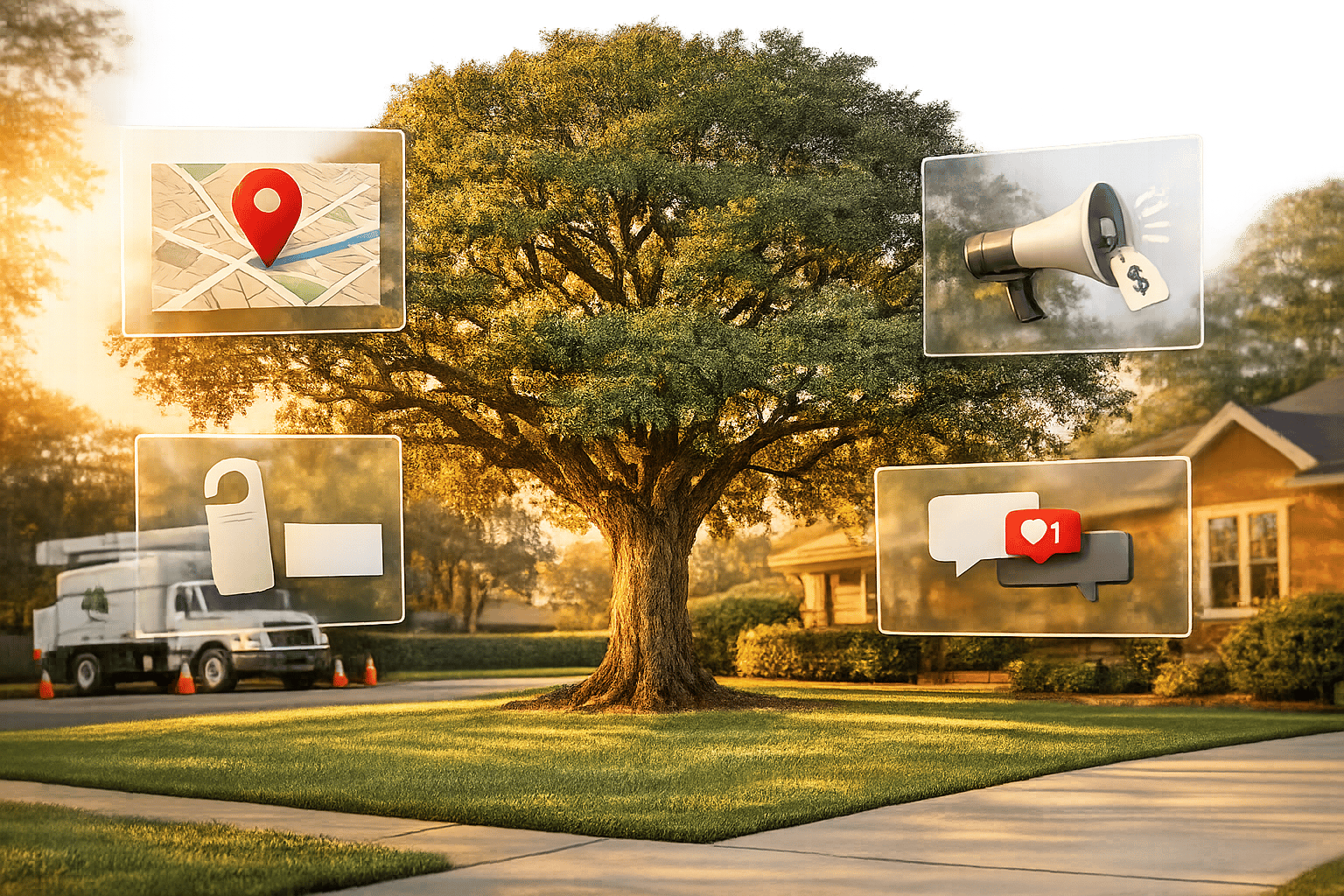
If you’re running a tree service business, standing out is no longer just about word-of-mouth or a logo on your truck. With 97% of consumers searching online for local services, your business needs a strong online and offline marketing strategy to thrive. Here’s how to grow your leads and revenue:
- Local SEO: Optimize your Google Business Profile, use location-specific keywords, and build local backlinks to rank higher in search results.
- Paid Ads: Use Google Local Service Ads and PPC campaigns for tree services to attract high-intent customers actively searching for tree services. If you’re just starting, follow a guide on how to set up Google Ads to ensure your budget is spent effectively.
- Social Media: Post time-lapse videos, before-and-after photos, and educational content to engage homeowners and build trust.
- Offline Tactics: Use vehicle wraps, yard signs, and sponsor local events to boost visibility in your community.
Businesses implementing these strategies often see a 50–75% increase in leads within six months, with annual revenue gains of $60,000 to $120,000 or more. Whether it’s dominating search results or leaving a lasting impression in your neighborhood, these methods help create steady growth for your tree service business.
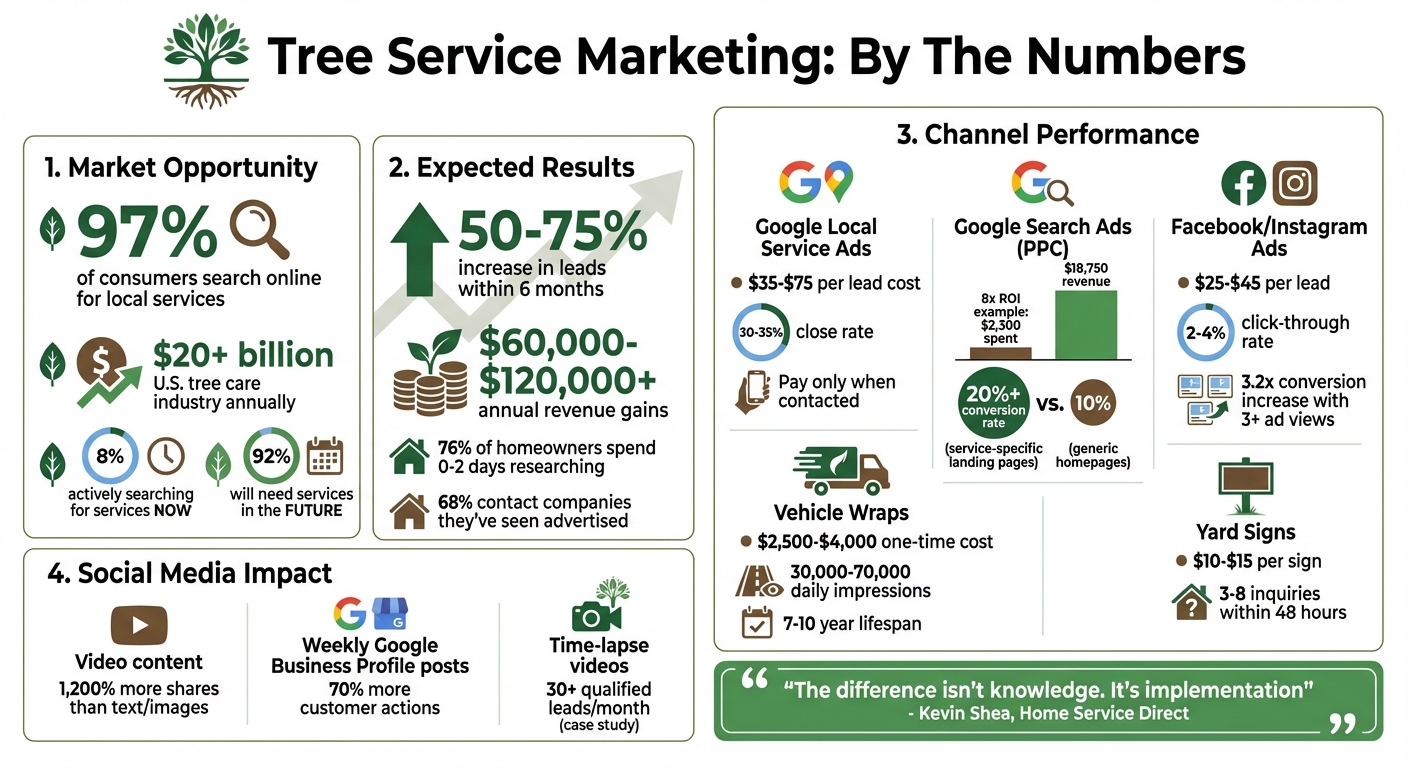
Tree Service Marketing Strategy ROI and Lead Generation Statistics
1. Local SEO Optimization
Claim and Optimize Your Google Business Profile
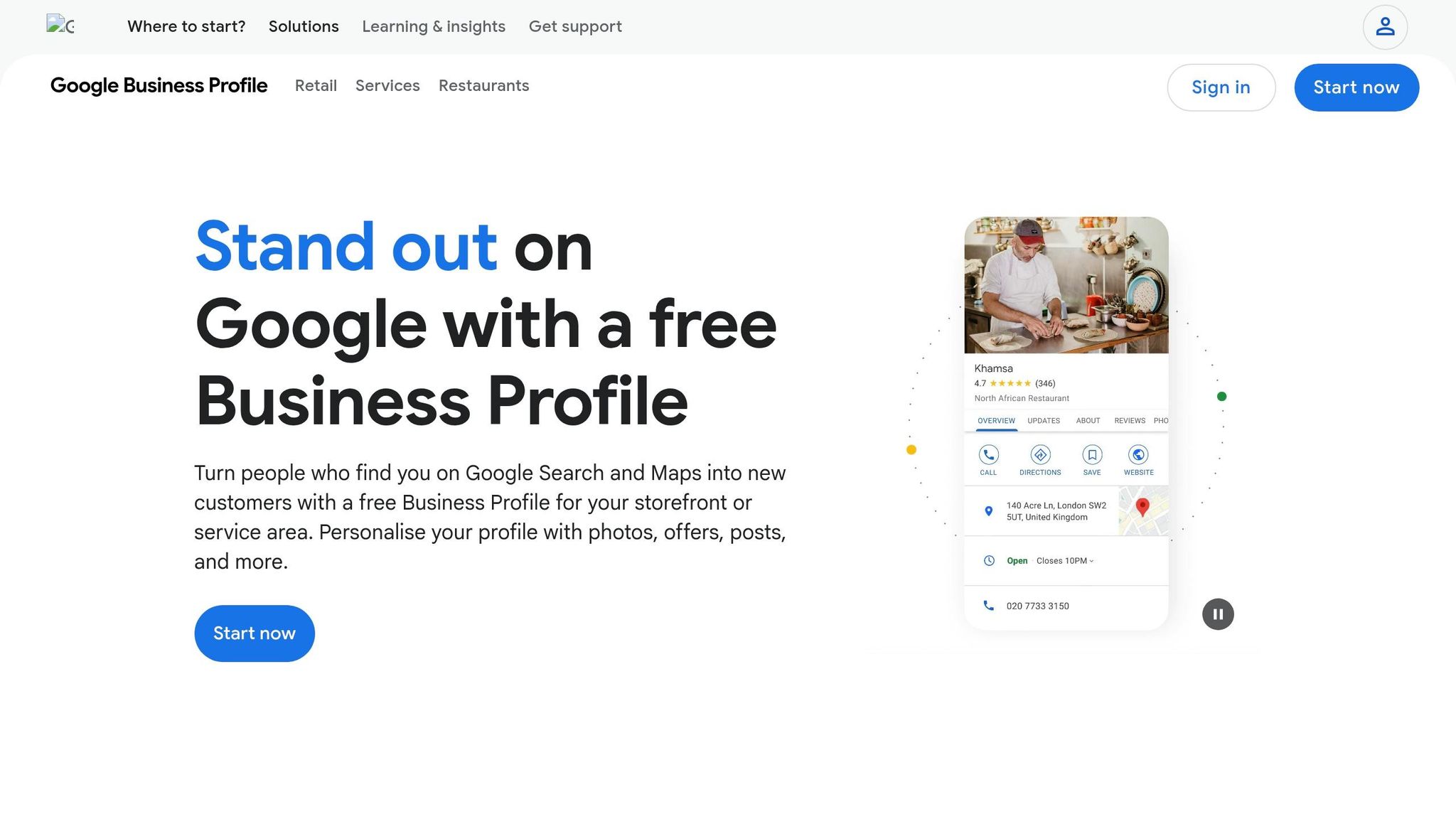
Your Google Business Profile (GBP) is often the first thing potential customers see when they search for tree services in your area. A well-maintained GBP is the cornerstone of your local SEO efforts. Start by ensuring your business Name, Address, and Phone number (NAP) are consistent across your GBP, website, and directory listings. Set "Tree Service" as your primary category, and add secondary ones like "Arborist" or "Stump Removal" to expand your visibility for different search terms.
Add geotagged photos of your branded trucks, work crews in action, and before-and-after shots of completed projects. These photos embed location data, making it clear to Google where you operate. Use the Services section to showcase offerings like emergency storm damage cleanup or tree pruning, and include standard pricing if applicable. In the Q&A section, address common questions, such as, "Do you offer 24/7 emergency storm service?" with clear, helpful answers.
"Businesses that post weekly on their Google Business Profile see 70% more customer actions (calls, website visits, direction requests) than those who don’t post regularly." – Tactical SEO Consulting
Stay active by posting weekly updates. Share special offers (e.g., "10% off stump grinding") or seasonal safety tips. Since posts expire after seven days, consistent updates keep your profile fresh. Encourage five-star reviews and respond promptly – ideally within 24 hours. For negative feedback, address concerns respectfully, take responsibility, and provide a direct contact number to resolve the issue.
These steps lay the groundwork for targeting hyper-local keywords and reaching customers ready to take action.
Target Location-Based Keywords
Instead of going after broad terms like "tree removal", focus on location-specific keywords such as "tree removal in Pensacola" or "emergency oak trimming in Oakwood District." These localized phrases face less competition and attract customers who are ready to hire. Create unique landing pages for each area you serve, incorporating local landmarks and targeted keywords into meta titles, H1 headings, and image alt text.
Once your pages are optimized, your next step is building trust and authority through local backlinks.
Build Local Backlinks
After optimizing your profiles and pages, strengthen your online presence with local backlinks. Links from local and industry-specific websites help improve your search rankings. Start by listing your business on major directories like Google Business Profile, Yelp, Angi, and the Better Business Bureau, along with niche platforms like TreeCareHQ and the International Society of Arboriculture (ISA).
Collaborate with non-competing local businesses – such as landscapers, realtors, or home improvement contractors – for reciprocal links or guest blog opportunities. Sponsoring community events, like youth sports teams or charity fundraisers, can also earn backlinks from organization websites and local news outlets. Keep in mind, websites that rank at the top of search results typically have 3.8 times more backlinks than lower-ranking ones.
sbb-itb-130a704
13 Ways To Market Your Tree Service Business in 2026
2. Paid Advertising
Paid advertising can supercharge your local SEO efforts by ensuring your business shows up when potential customers are ready to take action.
Google Local Service Ads (LSA)
Google Local Service Ads stand out in search results with their green "Google Guaranteed" badge. The best part? You only pay when a customer contacts you, with costs ranging from $35 to $75 per lead. These ads are highly effective, boasting close rates of 30–35%, compared to 12–15% for standard Google Search Ads.
Take HLI Tree Experts in Riverside, CA, for example. Between late 2025 and March 2026, they used LSAs to generate over 10 leads daily, adding approximately $50,000 in weekly jobs. This growth allowed them to expand from two to five trucks in just six months.
"Home Service Direct completely transformed our business. We’re getting 10+ leads daily and adding $50,000 worth of jobs to our pipeline every week." – Leonard A., owner
Pair LSAs with targeted Google Search Ads to maximize your reach and attract customers actively searching for your services.
Google Search Ads (PPC)
Google Search Ads are perfect for targeting homeowners who need services right away. These ads focus on urgent search terms like "emergency tree removal near me" or "tree removal emergency [City]". They target the 8–12% of the market actively looking to hire.
For the best results, create separate campaigns for each service – tree removal, pruning, stump grinding, and emergency work. This ensures your ad copy and landing pages align precisely with what potential customers are searching for.
Here’s a real-world example: In August 2025, a tree service client of Tree Service Digital in a market of 250,000 people spent $2,300 on Google Ads. The campaign generated 37 leads and 15 booked jobs, resulting in $18,750 in revenue – an 8x return on investment. To avoid wasting money, use negative keywords to filter out irrelevant searches like "jobs", "equipment", or "DIY". Always direct traffic to service-specific landing pages, which usually convert at 20% or higher, compared to just 10% for generic homepages.
Facebook & Instagram Ads (Meta Ads)
Facebook and Instagram Ads are fantastic for building brand awareness among the 88–92% of homeowners who might need tree services in the future. These platforms help generate demand before customers have an urgent need. To grab attention, use real before-and-after photos from actual jobs instead of stock images. High-quality visuals can deliver click-through rates of 2–4%, with leads typically costing $25 to $45.
There’s also a major advantage to repeated exposure. Ads seen three or more times can increase conversion rates by 3.2 times.
"Facebook advertising isn’t about capturing intent – it’s about creating it." – Kevin Shea, Sales Manager at Home Service Direct
To make the most of your efforts, set up retargeting campaigns using tracking pixels. This allows you to show ads to people who’ve already visited your website. A smart budget allocation could look like this: 40% for cold awareness, 30% for warm consideration, and 30% for hot conversion and retargeting.
3. Social Media Marketing
Post Time-Lapse Videos and Before-and-After Transformations
When it comes to social media, visual content is king – especially for tree service companies. Time-lapse videos are a fantastic way to condense hours of tree removal into a quick, eye-catching 30–60 second clip. These videos not only highlight your expertise but also demonstrate your commitment to safety. Similarly, before-and-after images taken from the same angle can showcase the dramatic improvements your services bring to a property.
Here’s a real-world example: In 2025, a tree service client of Tactical SEO Consulting started posting weekly time-lapse videos on Instagram and TikTok. Over just six months, they gained 15,000 followers and started generating more than 30 qualified leads each month. And it’s not surprising – video content drives engagement, generating 1,200% more shares than text and images combined. Even for ads, videos outperform static images by a 2:1 ratio.
"In a visually-driven industry like tree care, a smart social media marketing strategy is your most powerful tool for turning skeptical homeowners into confident clients." – Marketing 360
These videos don’t just grab attention – they build a sense of connection and trust with your local audience.
Build Trust Through Nextdoor and Local Community Engagement
Once you’ve captured attention with engaging visuals, platforms like Nextdoor can help you build trust within your community. Nextdoor is especially effective for tree services because it thrives on neighbor-to-neighbor recommendations [6,28]. Positive reviews from satisfied customers can go a long way in establishing credibility. Encourage your clients to share their experiences on their neighborhood feeds – it’s a simple yet impactful way to grow your reputation locally.
If you’re looking to go a step further, consider investing in promoted placements on Nextdoor. These typically cost between $300 and $600 per month, making it an affordable option for targeting homeowners in specific ZIP codes.
Create Educational Content That Builds Awareness
Not every homeowner is actively searching for tree services – 92% aren’t, in fact – but they will need them eventually. That’s where educational content comes in. By sharing tips on hazard signs, seasonal pruning, or when to call a professional, you can keep your business top-of-mind for future needs [8,4].
This strategy works because most homeowners – 76% – spend just 0–2 days researching before booking a service. Of these, 68% contact the company they’ve seen advertised or remember hearing about. Posting regular updates on platforms like your Google Business Profile can also make a big difference. Businesses that update weekly see 70% more customer actions, like calls or website visits, compared to those that don’t.
Educational content not only positions you as an expert but also ensures your business is the first one homeowners think of when the need arises.
4. Offline and Community Engagement
Sponsor Local Events and Use Your Trucks as Mobile Billboards
While digital marketing grabs attention online, offline efforts play a crucial role in establishing your company as a trusted name in the community. Sponsoring local activities, like youth sports teams, school events, or holiday festivals, not only boosts goodwill but also keeps your brand top-of-mind with residents. These sponsorships usually cost between $500 and $2,000 for banners and logo placement, making them a budget-friendly way to strengthen your local reputation.
Your service trucks are another powerful tool for offline marketing. A single vehicle wrap, priced between $2,500 and $4,000, can generate an impressive 30,000 to 70,000 impressions daily, with your branding visible from up to 50 feet away. Chad Diller, CEO of Landscape Leadership, highlights their value:
"Vehicle graphics are a very cost-effective means to advertise. They last for 7-10 years and you only pay once for them."
In addition to mobile advertising, on-site promotions can further amplify your visibility. For instance, placing yard signs at job sites is a simple but effective strategy. Bulk-ordered 18" x 24" signs cost just $10 to $15 each and can generate 3 to 8 inquiries within 48 hours. These signs act as proof of your quality work, sparking interest from neighbors who see your team in action. To take it a step further, distribute door hangers in a 2–3 block radius around completed projects. Adding a "neighbor discount" offer can encourage even more inquiries and build trust within the area.
When combined with your online efforts, these offline strategies create a strong foundation for local engagement and community trust.
Conclusion
Expanding a tree service business today goes beyond delivering exceptional work – it demands a mix of digital and offline strategies working together. The most successful companies use multiple channels to connect with homeowners at every stage of their decision-making process. For instance, Google Local Service Ads and PPC campaigns are great for reaching the 8% of homeowners actively searching for immediate help. On the other hand, tools like vehicle wraps, yard signs, and community sponsorships focus on the remaining 92%, building awareness long before they need your services.
This combination doesn’t just generate short-term results – it builds trust over time. The magic lies in how these channels support each other. Imagine a homeowner spotting your branded truck in their neighborhood, then later checking your glowing reviews on your Google Business Profile. That offline visibility reinforces your online credibility, making it easier to convert them into a customer. Companies that adopt this approach often see a noticeable boost in qualified leads within just six months. As Kevin Shea from Home Service Direct wisely says:
"The difference isn’t knowledge. It’s implementation".
Start with the basics: optimize your Google Business Profile, wrap at least one vehicle with your branding, and leave yard signs at every job site. These cost-effective steps create immediate visibility while laying the groundwork for long-term growth through strategies like SEO and referral partnerships. You can also find commercial contacts to diversify your revenue streams. Be diligent about tracking your leads – ask every customer, "How did you hear about us?". Then, review your results quarterly to drop any channels where the return on investment is less than three times the cost.
With the U.S. tree care industry pulling in over $20 billion annually, homeowners are actively looking for dependable providers. Following these strategies ensures a steady stream of leads, protecting your business from sudden changes in ad costs or search algorithms. Focus on perfecting a few key channels before spreading your efforts too thin, and you’ll create a resilient foundation for growth.
FAQs
Which marketing channel should I start with first?
If you’re looking to grow your tree service business, local SEO is the way to go. Specifically, focusing on your Google Business Profile can make a big difference. By optimizing this profile, your business becomes more visible in local search results – especially on Google Maps. This means nearby customers can find you more easily when searching for tree services.
Since most people start their hunt for tree services online, having a strong local SEO presence isn’t just helpful – it’s necessary.
How much should I budget for ads each month?
When running Google Ads campaigns for your tree service business, you should plan to allocate around $32–$50 per lead. To maintain a steady flow of leads, this generally translates to a monthly budget of $1,000–$2,000, though the exact amount may vary depending on factors like your target area and the level of competition.
How do I track which marketing is actually working?
To understand which marketing efforts are driving results, consider using marketing attribution tools. These tools help pinpoint the channels that lead to conversions, such as phone calls, form submissions, or scheduled jobs. With multi-touch attribution, you can get a clearer picture of the entire customer journey. It reveals which strategies are bringing in the most leads and sales, enabling you to allocate your budget wisely and concentrate on the channels that deliver real, measurable outcomes.
Related Blog Posts

Generating leads for tree service businesses in 2026 requires a strong online presence, effective marketing strategies, and leveraging multiple platforms to attract homeowners. Here’s a quick breakdown of how to stand out in a competitive market:
- Optimize Your Google Business Profile (GBP): Claim and verify your profile, use local keywords, upload high-quality photos, and respond to reviews promptly. A polished GBP helps you rank higher and attract more customers.
- Focus on Local SEO: Create dedicated service and location pages on your website. Highlight certifications, ensure mobile-friendliness, and improve load times to convert visitors into customers.
- Run Google Ads and Local Services Ads (LSAs): Target high-intent keywords like “emergency tree removal.” LSAs, with their pay-per-lead model, can boost visibility while keeping costs manageable.
- Use Meta Ads: Advertise on Facebook and Instagram to reach local homeowners early. Showcase services with engaging visuals and use lead forms to simplify the booking process.
- Build Referral Programs: Offer cash or discounts for referrals. Partner with landscapers, roofers, and real estate agents to expand your network.
- Collect Reviews: Request reviews after every job. Positive reviews increase trust and improve rankings on Google.
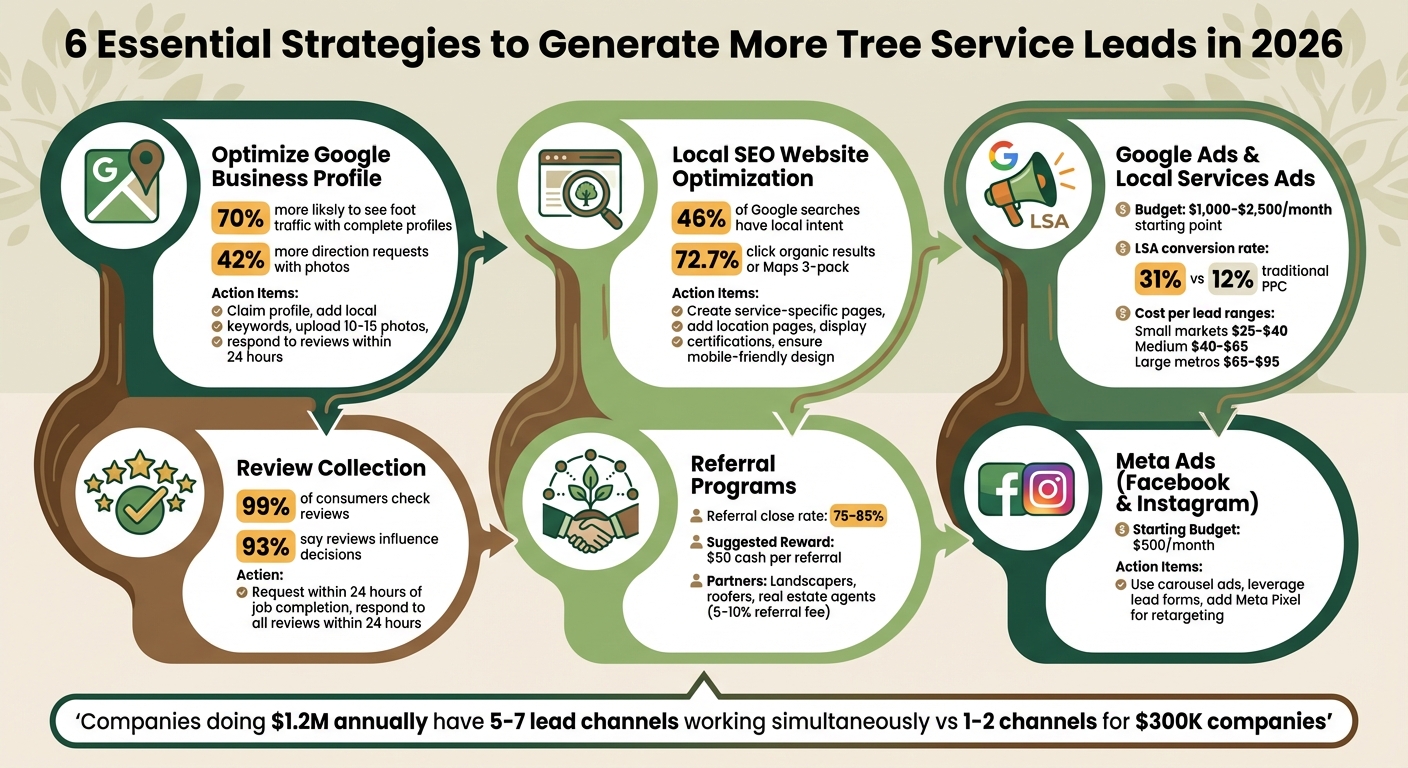
6 Essential Strategies to Generate More Tree Service Leads in 2026
Tree Service Lead Generation – How to Get More Leads Fast
sbb-itb-130a704
Set Up and Optimize Your Google Business Profile
A polished Google Business Profile is a game-changer for pulling in local leads, especially in the highly competitive tree service industry. Businesses with complete profiles are 70% more likely to see foot traffic, and profiles featuring photos can generate 42% more direction requests and 35% more website clicks. It’s a key tool for increasing visibility and engagement.
"Your Google Business Profile is the most important piece of digital real estate your local business owns." – ReviewScout AI
Claim and Verify Your Profile
To get started, claim your profile through business.google.com or Google Maps. Google offers several ways to verify your business:
- Phone or SMS Verification: Receive a code via phone or text for quick confirmation.
- Email Verification: A code is sent to your business-domain email address.
- Service-Area Business (SAB): If you operate without a physical storefront, set up a SAB profile. This allows you to list up to 20 service areas while keeping your home address private.
- Video Verification: Record a video showcasing your business exterior, interior, and official documents.
- Instant Verification: Available if your website is already verified in Google Search Console.
- Postcard Verification: A code is mailed to your physical address, typically arriving within 5–14 days.
Make sure your NAP (Name, Address, Phone number) is consistent across your profile, website, and any other online directories. Inconsistencies can hurt your ranking, and Google explicitly prohibits the use of PO boxes.
Once verified, take your profile to the next level by adding local keywords and engaging visuals.
Add Local Keywords and Professional Photos
Set "Tree Service" as your primary category to ensure accuracy and relevance. Add secondary categories like "Arborist", "Stump Removal Service", or "Emergency Tree Service" to expand your reach. Use your 750-character business description wisely – place important keywords like "emergency tree removal", "tree trimming", and "stump grinding" within the first 250 characters, and mention your city or service area to boost local relevance.
Visuals are another powerful driver of engagement. Upload 10–15 high-quality photos showcasing before-and-after projects, your team in action, and branded vehicles. Geo-tag these images and aim to add 1–2 new photos weekly. Short video clips of tree removals or other services can also grab attention and increase interaction.
"Think of verification as Google’s handshake. No handshake, no trust." – Aniruddha Chakraborty, Marketing for Tree Service
Request and Respond to Customer Reviews
Reviews are critical. Ninety-nine percent of consumers check reviews before choosing a local service, and 93% say reviews influence their decisions. Businesses that respond to reviews are 45% more likely to attract visits.
Ask for reviews within 24 hours of completing a job. Use the "Ask for Reviews" link from your Google Business Profile dashboard and include it in follow-up emails or invoices – QR codes work great for this. Encourage customers to mention the specific service they received and your city, as this boosts keyword relevance.
Responding to reviews is just as important. Reply to all reviews – positive, neutral, or negative – within 24 hours. Use the customer’s name and reference details about their project to make your responses personal. For negative feedback, remain professional, apologize for the experience, and offer to resolve the issue privately. Keep in mind, offering incentives for positive reviews is against Google’s guidelines.
"A tree company with two reviews loses every time to one with 50+ five-star reviews. Even if they’re better at the work." – Alex Gambashidze, ResultCalls
Finally, make use of the Q&A section. Post and answer common questions like "Do you offer free estimates?" or "Are you insured?" This not only provides helpful information but also creates more opportunities to include relevant keywords, building trust with potential customers.
Use Local SEO to Improve Your Website
Your Google Business Profile might grab people’s attention initially, but it’s your website that turns those visitors into customers. With 46% of all Google searches having local intent and 72.7% of searchers clicking on organic results or the Google Maps 3-pack, ignoring local SEO could mean missing out on valuable leads.
"A great GBP drives the traffic. A great website closes the deal." – Clicks Geek
Your website should highlight the services you provide, the areas you serve, and your credibility while being easy to navigate on mobile devices. Here’s how to make sure every page works to attract local customers.
Build Pages for Specific Services and Locations
Google rewards specificity. That means creating dedicated pages for each of your main services and the locations you cover. For instance, a page focused solely on "tree trimming" will rank higher than a general "services" page. So, if you offer services like tree removal, stump grinding, or emergency storm cleanup, each should have its own landing page. Use the service name as the H1 heading and write 500–800 words that explain the service, why it’s important, and what makes your approach stand out.
Similarly, create individual pages for each city or neighborhood you serve. Use a title tag formula like "Service + City + State | Company Name", keeping it under 60 characters. For example: "Tree Removal Austin TX | [Your Company Name]. In your meta descriptions, add your phone number and a call-to-action, such as "Call Now" or "Free Estimate".
Avoid duplicating content across city pages – Google penalizes "doorway pages" that don’t provide unique value. Instead, customize each page with details like local landmarks, tree species common to the area, or weather-specific concerns.
For images, name files using service and location keywords (e.g., oak-tree-trimming-austin.jpg). Also, include Local Business Schema markup to help search engines understand your business details, such as hours, location, and services. This can boost your local search visibility by up to 30% and rank higher on Google. Once these pages are optimized, focus on building trust and making it easy for visitors to reach you.
Display Certifications and Make Contact Easy
Trust is key. Highlight your ISA certifications, state licenses, and insurance details on every service page. Include before-and-after photos from real jobs in your area – avoid stock images. Customer testimonials that mention specific services and locations can also go a long way in building credibility.
Make contacting you as simple as possible. Add a click-to-call button above the fold and include your phone number in the header of every page. For mobile users, this makes reaching out instant. In your meta descriptions, include your phone number and a clear call-to-action.
A contact form should be user-friendly, asking for basic details like name, phone number, service needed, and zip code. Let visitors know what to expect next – for example, "We’ll call you within 15 minutes during business hours to schedule your free estimate." Lastly, ensure your NAP (Name, Address, Phone number) is consistent across your website, Google Business Profile, and any online directories.
Make Your Site Mobile-Friendly and Fast
Seventy-six percent of people who conduct a local search on their smartphone visit a related business within 24 hours. Many tree service searches happen on mobile devices, especially during emergencies. A slow or clunky site could cost you leads.
Run your site through Google PageSpeed Insights and aim for a load time of under three seconds. Compress images, enable browser caching, and use a mobile-responsive design that adapts to any screen size. Test your site on an actual phone – click buttons, fill out the contact form, and make sure everything works smoothly.
After severe weather, emergency searches spike. A fast, mobile-friendly site ensures you’re ready to capture those leads. By combining optimized service pages with a responsive design, you’ll position your business to thrive in local search results.
Run Google Ads Campaigns

While local SEO vs. paid ads is a common debate, using both helps you set the groundwork while reaching customers ready to hire immediately. Organic rankings take time to build, but a well-structured ad campaign can start delivering leads in just hours. This strategy complements your optimized online presence, ensuring you capture interest at the moment it matters most. To succeed, prioritize high-intent keywords, set a realistic budget, and track conversions carefully.
Find Keywords That Show Purchase Intent
Not all searches are created equal. For example, a search like "how to remove a tree" suggests someone looking for DIY advice, not professional help. On the other hand, terms like "emergency tree removal" or "tree service near me" show clear intent to hire. These high-intent keywords are the ones that drive real results.
"Someone typing ’emergency tree removal’ isn’t browsing – they’re buying, and they need you today." – Joel Casarez, SEO Consultant
To maximize your results, create tightly focused ad groups for specific services like Tree Removal, Tree Trimming, Stump Grinding, and Emergency Services. Within these groups, target long-tail keywords such as "dead tree removal cost" or "certified arborist tree pruning." While these phrases may attract fewer searches, they often lead to higher conversions at a lower cost. Adding location-based keywords – like "tree service Austin" – can further refine your audience and improve relevance.
Use Phrase Match and Exact Match settings to avoid irrelevant clicks from searches like "Christmas tree delivery" or "forest service jobs". Start building a negative keyword list early, filtering out terms like "DIY", "jobs", "equipment", "supplies", "free", and "how to". Regularly review your Search Terms Report to catch and block any irrelevant terms that trigger your ads. Also, make sure your landing pages align with the keywords you’re targeting. For example, if your ad focuses on "stump grinding", the corresponding landing page should highlight that specific service, not general tree care.
Start with $1,000-$2,500 per Month and Monitor Results
For most tree service businesses, a monthly budget of $1,000 to $2,500 is a good starting point to gather meaningful data and generate steady leads. If you’re in a rural or low-competition area, you might start with $750 to $1,500. Suburban markets often require $1,500 to $3,000, while urban areas with high competition may need $3,000 to $6,000 or more. A daily budget of $50 to $100 per campaign strikes a balance between gathering enough data and avoiding overspending during the initial phase.
"If you spend less than $50 per day, it will literally take you forever to start to get the data to make educated decisions." – Joel Casarez, SEO Consultant
Track key performance metrics like Click-Through Rate (CTR), Conversion Rate, Cost Per Lead (CPL), and Return on Ad Spend (ROAS). Since about 80% of tree service leads come from phone calls, tools like CallRail can help you identify which keywords are driving inquiries. Review your campaign every two weeks to pause underperforming keywords and adjust bids based on seasonal trends. For instance, during storm seasons, you might increase bids by 15% to 25% to capture the surge in emergency searches.
Here’s a quick guide to suggested max CPC and daily budget ranges:
| Service Type | Suggested Max CPC | Daily Budget Range |
|---|---|---|
| Emergency Tree Removal | $10–$12 | $75–$150 |
| Tree Trimming | $8–$11 | $50–$100 |
| Stump Grinding | $6–$9 | $40–$80 |
(Source: Kaanen Group)
Once your campaign is running smoothly, consider bringing in professionals to take it to the next level.
Work with Tree Company Leads for Google Ads Management
Running Google Ads effectively requires ongoing attention – constant keyword research, bid adjustments, and landing page updates. Tree Company Leads specializes in managing Google Ads campaigns specifically for tree service businesses. Their team understands the unique challenges of the industry, from seasonal demand spikes to local competition, and they focus on delivering high-quality, exclusive leads. By partnering with experts, you can concentrate on running your business while they ensure your ads are performing at their best.
Use Meta Ads and Google Local Services Ads
Google Ads for tree services are great for capturing people actively searching for help, but what about those who don’t realize they need help until a problem arises? That’s where Meta Ads on platforms like Facebook and Instagram come in. They allow you to build awareness and stay top-of-mind for homeowners, even before they start searching. Meanwhile, Google Local Services Ads (LSAs) use a pay-per-lead model to connect you with highly qualified prospects. By combining these tools, you can target potential customers at every stage of their decision-making process. Let’s take a closer look at how Meta Ads can expand your reach.
Target Local Customers with Facebook and Instagram Ads
Meta Ads are a powerful way for tree service businesses to connect with local homeowners early on. These ads let you target specific audiences based on location, interests, and online behavior. For example, carousel ads can showcase your services – like tree removal, trimming, or stump grinding – using compelling before-and-after photos.
Facebook’s built-in lead forms make it easy for potential clients to request quotes without leaving the app, reducing barriers and increasing conversions. Start small with a $500 monthly budget to test different audiences and creative ideas. Since most users browse on mobile, ensure your call-to-action buttons are easy to tap and that your landing pages load quickly. Adding the Meta Pixel to your website allows you to retarget visitors who didn’t immediately book, keeping your business fresh in their minds.
Using urgency-driven headlines, such as “Storm Damage? Get 24/7 Emergency Tree Service – Free Estimates!”, can grab attention. Including customer testimonials or 5-star reviews in your ads also helps establish trust and credibility.
Set Up Google Local Services Ads for Pay-Per-Lead
Google Local Services Ads (LSAs) are a game-changer for visibility. They appear at the very top of search results – above traditional Google Ads and organic listings – making them hard to miss. LSAs operate on a pay-per-lead basis, meaning you only pay when a customer directly calls or messages you, which can be a cost-effective option in competitive markets.
To get started, you’ll need to complete Google’s background check to earn the “Google Guaranteed” badge. This certification can increase click-through rates by up to 210%. LSAs also boast an impressive conversion rate of around 31%, compared to about 12% for standard pay-per-click ads.
"LSAs appear above regular Google Ads and organic search results, ensuring maximum visibility." – Dipa Gandhi, 99 Calls
Several factors influence your LSA ranking, including proximity to the searcher, the number of positive reviews (aim for 50–100+), and your responsiveness to inquiries. Quick responses are crucial – replying within three minutes can make a lead four times more likely to convert compared to waiting two hours. Be sure to dispute any out-of-area inquiries to avoid unnecessary charges.
Here’s a breakdown of what you might pay per lead, depending on your market size:
| Market Type | LSA Cost Per Lead |
|---|---|
| Small markets | $25–$40 |
| Medium markets | $40–$65 |
| Large metros | $65–$95 |
(Source: Home Service Direct)
Take Jake’s Tree Solutions in Florida, for example. In 2025, they started using LSAs to complement their word-of-mouth referrals. By targeting high-intent searches like “emergency tree removal near me” and leveraging the “Message Leads” feature, they saw a 40% increase in leads within three months, all while keeping their average cost per lead at $25.
Combine Ad Platforms with Tree Company Leads
Running campaigns on both Meta Ads and Google LSAs creates a unified strategy that keeps your business visible across multiple channels. This consistent presence builds trust and familiarity, crucial for landing high-value tree service jobs. When potential customers see your company on Google search results and their Facebook feed, it reinforces your credibility.
Tree Company Leads can manage the technical aspects for you, from installing the Meta Pixel to handling Google’s background checks for LSAs. Their integrated tracking tools ensure you’re investing in the platforms that deliver the best results, creating multiple touchpoints that guide customers toward booking your services.
Create Referral Programs and Get More Reviews
To round out your lead-generation strategy, a well-thought-out referral and review system is essential. Happy customers are your most effective advocates, and referrals tend to close at an impressive rate of 75–85%. By combining a smart referral program with regular review collection, you can create a system that keeps new leads coming in consistently. The trick? Make it simple and rewarding for customers to recommend your tree service to others. Let’s dive into how to set up effective referral incentives and gather reviews that build trust.
Give Customers Incentives to Refer Others
For a referral program to work, the reward has to feel worthwhile. Studies suggest that $50 cash is a sweet spot for motivating referrals in the tree service industry – enough to inspire action without eating into your profit margins on jobs that typically cost $400–$1,000. Alternatively, you could offer $50–$100 in account credits, which customers can use toward future services like trimming or maintenance. This approach not only rewards referrals but also encourages repeat business.
"Personally, I think $50 cash is a tipping point for a referral that leads to $400-$1,000 in business for your company." – Chad Diller, CEO, Landscape Leadership
For larger projects, consider tiered rewards. For example, offer $200 for the first referral, $500 for the second, and up to $1,500 for multiple referrals. Dual-sided incentives can also be effective – give both the referrer and the new customer a $25 discount. This approach makes participation appealing for everyone.
Don’t forget about partnerships. Collaborate with landscapers, roofers, and real estate agents who can spot when your services are needed. Landscapers may notice tree root issues during routine work, roofers often see overhanging branches causing damage, and real estate agents know when quick tree services are essential to close a sale. Offering these partners a 5–10% referral fee or priority service can ensure a steady flow of high-quality leads.
Promote your referral program everywhere: on invoices, email signatures, your website, and even through physical materials like door hangers at job sites. Track referrals in your CRM and pay rewards promptly after the job is completed to maintain trust and goodwill with your advocates.
While referrals bring in new leads, gathering positive reviews helps solidify your credibility.
Send Automated Review Requests After Each Job
Timing is everything when asking for reviews. Sending review requests 2–3 days after completing a job ensures you capture fresh, positive impressions. Automation tools can help streamline this process – personalize messages based on the service provided and schedule them for optimal timing.
A strong collection of positive reviews can significantly boost your visibility. For instance, businesses with complete Google Business Profiles see 70% more location visits compared to those with incomplete profiles. Use multiple channels for review requests; text messages often get quicker responses than emails.
Be sure to respond to every review within 24 hours. Thank customers for positive feedback and address any concerns professionally. This shows that you take customer satisfaction seriously and are committed to delivering quality service.
Get Involved in Your Local Community
Building trust within your community is another way to drive referrals. Sponsor local sports teams, set up booths at community events, or host free "Ask an Arborist" clinics. These efforts establish your business as a trusted local expert while keeping your name top-of-mind.
Placing professional yard signs at active job sites is another simple but effective tactic. These signs act like mini billboards, showcasing your work to the surrounding neighborhood. Joining your local Chamber of Commerce is also a smart move. It can connect you with property managers, developers, and architects who may provide steady commercial leads.
Engaging with your community not only generates referrals but also boosts your local search visibility, amplifying the impact of all your marketing efforts.
Conclusion
Growing a tree service business in 2026 requires tapping into multiple lead sources to stay competitive. With the tree care industry generating around $24.8 billion in 2025 and customer acquisition costs rising by 34% between 2023 and 2026, it’s clear that a well-rounded marketing strategy is no longer optional – it’s essential.
Start by focusing on Local SEO and your Google Business Profile. These tools are key for building trust and driving organic traffic without continuous ad spend. For immediate visibility, integrate Google Ads and Local Services Ads (LSAs) into your strategy – LSAs boast a conversion rate of 31%, nearly three times higher than traditional PPC. To maintain a strong presence on social media, consider running Meta Ads, and don’t underestimate the value of a referral program for attracting high-quality leads.
"The difference between a tree service doing $300K annually and one doing $1.2M isn’t capability – it’s customer flow. Companies stuck at lower revenue levels have 1-2 lead sources. Growing companies have 5-7 channels working simultaneously." – Kevin Shea, Sales Manager, Home Service Direct
This insight highlights the importance of a diversified approach. By leveraging multiple channels, you can reduce the impact of seasonal demand shifts while strengthening your visibility across platforms like Google Maps, search engines, and Facebook. When homeowners see your business consistently across these spaces, it builds trust and makes them more likely to reach out.
For those looking to streamline their efforts, companies like Tree Company Leads can help manage your Google Ads campaigns and optimize your overall lead generation strategy. This allows you to focus on what you do best – providing excellent tree care services.
Make it a priority to monitor your results monthly, respond to inquiries within five minutes, and fine-tune your approach as needed.
FAQs
Which lead source should I start with first?
One of the fastest ways to attract free, high-quality leads is by optimizing your Google My Business (GMB) profile. A well-maintained GMB profile ensures your business shows up in local map results, putting you directly in front of nearby customers.
Here’s how to make the most of it:
- Complete every section: Fill out all the details, like your business name, address, phone number, and hours of operation.
- Add quality photos: Upload clear, professional images of your business, products, or services to make a strong impression.
- Encourage reviews: Positive reviews can boost your credibility and improve your visibility in search results.
- Use location-specific keywords: Incorporate terms that highlight your local area to connect with nearby customers.
- Post regular updates: Share news, offers, or events to keep your profile active and engaging.
While methods like SEO and PPC are effective, focusing on your GMB profile can deliver faster results when it comes to attracting local customers.
How do I track calls and form leads by channel?
To figure out where your leads are coming from, consider using call tracking tools. Assign dedicated phone numbers to each marketing channel – like Google Ads or social media – so you can pinpoint which platforms are generating calls.
For form submissions, you can add tracking pixels or UTM parameters to your website and landing pages. These tools let you trace submissions back to specific campaigns.
By combining call tracking and form tracking, you’ll get a clear picture of which channels are driving the most leads, helping you refine your marketing efforts.
What should I do when ads bring low-quality leads?
If your ads are pulling in low-quality leads, it’s time to take a closer look at your strategy. Start by fine-tuning your keyword targeting. Focus on terms that reflect high intent, are specific to your service, and include location-based phrases. This helps attract people who are more likely to convert.
Next, conduct a campaign audit. Look for problems like overly broad targeting or offers that might be unclear or unappealing. Make adjustments where necessary.
Don’t forget about your ad copy and landing pages. They should align closely with what your audience is searching for. Make sure the messaging speaks directly to their needs and expectations.
Finally, keep an eye on your performance data. Regular reviews can help you weed out unqualified leads and zero in on prospects who are genuinely interested in what you offer.
Related Blog Posts

When homeowners need tree services, they act fast – 76% of local smartphone searches lead to a business visit within 24 hours. If your tree service company isn’t visible in these moments, you’re losing potential customers. Geographic Optimization (GEO) ensures your business ranks for searches like “emergency tree removal near me” and appears in Google’s Local Pack, which captures 44% of local search clicks.
Here’s how GEO helps tree service companies grow:
- Google Business Profile (GBP): Optimize your profile with accurate details, geotagged images, and regular updates to rank higher on Google locally.
- Local Keywords: Use location-based phrases like “tree trimming in Springfield” across your website and create dedicated pages for each service area.
- Citations: Ensure consistent business listings on directories like Google, Yelp, and industry-specific platforms to strengthen your local presence.
- Schema Markup: Add structured data to your website to help search engines display your business in rich search results.
With 78% of location-based mobile searches leading to offline purchases, a strong GEO strategy positions your company as the go-to local expert. By combining these tactics with tools like call tracking and review management, you can attract high-intent leads and grow your business effectively.
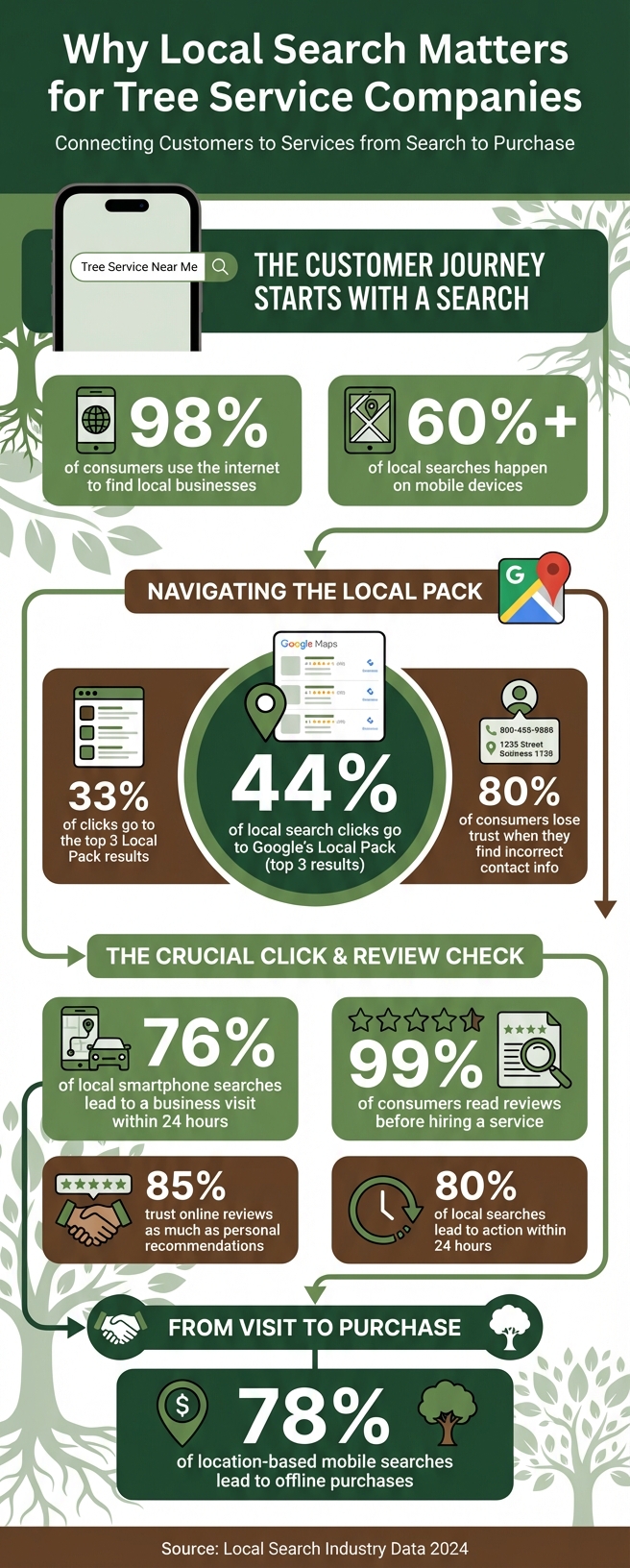
Local Search Statistics for Tree Service Companies
What is Geographic Optimization (GEO)?
GEO Basics
Geographic Optimization, or GEO, is all about making sure your tree service business shows up when people search for help in specific neighborhoods, towns, or areas within your service zone. Essentially, it focuses on the 15 to 30 miles where you actually operate.
When someone searches for terms like "tree removal near me" or "arborist in Pensacola", search engines rely on key tools like your Google Business Profile, localized web pages, and consistent business listings to confirm your service area. GEO works by aligning your online presence with your physical operating zone, using tools like structured data, local keywords, and verified listings.
Unlike traditional SEO, which casts a wider net, GEO zeroes in on the Map Pack – the top three local listings that grab 44% of local search clicks. With AI-driven local search features becoming more prominent by 2026, this strategy will only grow in importance. For businesses tied to a specific location, like tree service companies, this localized approach is a game-changer.
Why Tree Service Companies Need GEO
Once you understand how GEO works, it becomes clear why it’s essential for tree service providers. Tree services are inherently local – you can’t realistically serve customers far outside your area. This makes being visible in local searches absolutely critical. In fact, over 98% of consumers use the internet to find local businesses. When someone searches for emergency tree removal or routine tree trimming, they’re likely to call the first professional that pops up on their phone.
These aren’t casual browsers – they’re homeowners with immediate needs, ready to act fast.
"GEO ensures your business shows up in those high-intent searches… When someone’s air conditioner breaks in July or a pipe bursts in January, they’re not scrolling through page five of Google." – Optic Marketing Group
Without a solid GEO strategy, you risk losing potential customers to competitors who may not even provide better service but simply rank higher locally. For example, a newer company with 50 reviews and a 4.7-star rating can easily outrank a long-established business with only 8 reviews and a perfect 5.0-star rating. GEO helps level the playing field, positioning your company as the go-to expert in specific cities, neighborhoods, and even near local landmarks in your service area.
sbb-itb-130a704
Core GEO Strategies for Tree Service Companies
How to Optimize Your Google My Business Profile
Optimizing your Google Business Profile (GBP) is a critical first step in building a strong local presence. Start by ensuring your Business Name, Address, and Phone number (NAP) are consistent across your website and all directories. This consistency helps Google – and potential customers – trust your business. Use a local phone number with your area code instead of a toll-free number to emphasize your connection to the community.
Selecting the right primary category for your business is also key. Wesley Smith from Tree Service Digital advises:
"Your primary category on your Google Business Profile (GBP) should be hyper‑specific. For example, if you’re a tree service business, don’t just choose ‘Landscaper’ or ‘Contractor.’ Choose ‘Tree Service’".
This specificity ensures Google knows exactly what services you offer, which helps you show up in the right searches.
In the Services section, list detailed offerings like "Emergency Storm Damage Cleanup", "Stump Grinding", and "Cabling and Bracing". For your business description, focus on the first 250 characters, as this snippet appears before users click "read more".
To reinforce your local presence, upload 1–2 geotagged images every week. These could include before-and-after shots or equipment photos, embedding location data that signals your service area to Google. Keep your profile active with weekly updates – Google Posts expire after seven days, so regular posting shows you’re engaged.
Reviews are another powerful tool. With 99% of consumers reading reviews before hiring a service and 85% trusting them as much as personal recommendations, they can make or break your business. Encourage customers to mention specific services and their city in reviews (e.g., "Great tree removal in Charlotte"). Always respond to reviews, even negative ones:
"A professional, calm, and helpful response to a bad review can actually win you more business than a dozen five‑star ratings. It proves you have integrity".
These steps not only enhance your GBP but also strengthen your overall local SEO strategy.
Finding and Using Location‑Based Keywords
Once your GBP is optimized, the next step is to focus on location-based keywords. Combine your core services – like tree removal, trimming, and stump grinding – with geographic markers such as city names, neighborhoods, counties, or "near me" phrases. For example, targeting long-tail phrases like "affordable oak tree removal in West Denver" can help you attract customers who are ready to hire.
Strategically place these keywords throughout your website. Use them in headlines, H1 and H2 tags, meta descriptions, image alt tags, and URL slugs (e.g., /tree-removal-charlotte-nc). Rename image files with descriptive, location-specific names like oak-tree-removal-charlotte-before.jpg and add matching alt text. Aim for a keyword density of 1–2% to keep your content natural while still signaling relevance.
Creating unique landing pages for each major city or area you serve is another effective tactic. Avoid simply swapping out city names in the same template, as Google penalizes this "doorway page" approach. Instead, write original content that reflects local landmarks, regional tree species, or area-specific challenges like weather patterns or pests. Use your blog to answer local questions, such as "How much does stump grinding cost in Florida?" or "Do I need a permit to remove a tree in Raleigh?". Since 76% of local searches on smartphones result in a business visit within 24 hours, this targeted content can directly drive new leads.
Building Local Citations and Directory Listings
To further solidify your local presence, ensure your business details are listed consistently across reputable directories. Citations – mentions of your NAP on other websites – play a big role in Google’s local ranking algorithm. Consistency is key, as 80% of consumers lose trust in businesses when they find incorrect contact info online.
Start with the "Big Five" directories: Google Business Profile, Yelp, Facebook, Apple Maps, and Bing Places. Expand to industry-specific directories like the Tree Care Industry Association (TCIA), International Society of Arboriculture (ISA), and TreeCareHQ. Don’t forget local organizations like your Chamber of Commerce or community websites, which provide strong geographic signals.
Consistency matters. As Clicks Geek explains:
"If your business name is ‘Joe’s Tree Service LLC’ on one site and ‘Joe’s Tree Service’ on another, it creates confusion for search engines".
Stick to one format for your business name and address across all platforms. Audit your listings every six months using tools like BrightLocal, Whitespark, or Moz Local to catch and fix inconsistencies. Consider using data aggregators like Yext or BrightLocal to distribute your information across smaller directories efficiently. These efforts complement your GBP and location-based keywords, reinforcing your geographic accuracy.
| Directory Type | Examples | Primary Benefit |
|---|---|---|
| Major Search/Maps | Google Business Profile, Apple Maps, Bing Places | Direct visibility in Map Packs and navigation apps |
| General Directories | Yelp, Yellow Pages, BBB, Nextdoor | High domain authority and secondary lead generation |
| Home Service Sites | Angi, HomeAdvisor, Thumbtack | Connects with users specifically looking for contractors |
| Industry-Specific | ISA, TCIA, TreeCareHQ | Builds authority within the tree care industry |
| Local/Community | Chamber of Commerce, Local News, Sponsorships | Provides strong geographic relevance signals |
How to Structure Local Service Area Pages for Stronger SEO Performance
Advanced GEO Techniques for Tree Services
These advanced strategies build on basic GEO methods to help tree service companies dominate their local markets.
Creating Service Area Pages for Each Location
After optimizing your Google Business Profile (GBP) and building citations, the next step is to create Service Area Pages (SAPs) for each location you serve. Unlike location pages for physical businesses, SAPs focus on "service in city" keywords and don’t require a physical office in every area. To avoid penalties, steer clear of generic templates. Instead, make each page unique by incorporating local details like common tree species, neighborhood characteristics, weather challenges, and local permit requirements.
For instance:
- A page for Raleigh could highlight concerns like oak wilt and local tree ordinances.
- A page for Charleston might focus on storm damage from summer thunderstorms.
Use a clean, descriptive URL structure such as: yoursite.com/tree-removal-springfield. Your H1 header should include the city name and a clear benefit (e.g., "Fast Emergency Tree Removal in Springfield – 24/7 Response"). Adding a Google Map showing your service radius or specific neighborhoods reinforces your local presence. A localized FAQ section can answer questions like, "Do I need a permit for tree removal in Springfield?" or "How quickly can you respond to downtown storm damage?"
Boost trust by featuring customer reviews and photos of your team working at recognizable local landmarks. As Arborgold explains:
"Service area pages give search engines (and potential customers) a clear signal that you’re not only active in the area, but that you’re the trusted local expert for every type of tree care need."
Interlink your core service pages (e.g., "Tree Removal") with the relevant SAPs to improve authority and site crawlability. Since many searches for emergency tree services happen on mobile, ensure these pages load quickly and include prominent click-to-call buttons.
Once your SAPs are set, take your local SEO a step further with structured data.
Using Schema Markup for Local SEO
Schema markup helps search engines understand your business details – such as location, services, hours, and reputation. The most common format is JSON-LD, which can be added to your website’s header or footer. For tree service businesses, start with the LocalBusiness schema. Include basics like your name, address, phone number (matching your Google Business Profile), opening hours, and logo.
To go further, add:
- Service schema for offerings like "stump grinding", "tree pruning", or "emergency tree removal."
- GeoCoordinates to define your service area with latitude and longitude.
Using AggregateRating schema can display star ratings in search results, which builds trust and encourages clicks. Adding FAQ schema can help your page appear in "People Also Ask" sections, especially in voice search results. As Clicks Geek notes:
"When you spoon-feed Google this information, you make its job easy. In return, Google is more likely to feature your business in rich search results."
Before publishing, validate your schema markup using tools like Google’s Rich Results Test or the Schema.org Structured Data Validator to ensure accuracy.
| Schema Type | Purpose | Key Properties |
|---|---|---|
| LocalBusiness | Identifies your business and contact info | name, address, telephone, openingHours, logo |
| Service | Highlights specific services | serviceType, description, areaServed, provider |
| AggregateRating | Displays star ratings in search results | ratingValue, reviewCount, bestRating |
| FAQPage | Shows questions and answers in results | mainEntity (Question and Answer) |
| GeoCoordinates | Pinpoints exact location for map results | latitude, longitude, postalCode |
How Tree Company Leads Supports Your GEO Strategy
Creating a solid GEO strategy requires both time and specialized knowledge. Tree Company Leads streamlines this process by blending technical SEO with a steady stream of exclusive leads. Designed specifically for tree service companies, their approach ensures geo-targeted leads flow to your business 24/7, with you as the only responder to each inquiry. Here’s how their tailored plans complement your GEO strategy.
Tree Company Leads Plans and Features
Tree Company Leads provides two main plans, each tailored to different growth stages.
- Professional Plan: This plan focuses on local SEO and exclusive lead generation, perfect for businesses looking to maintain a steady customer base while improving their organic search visibility.
- Enterprise Plan: This option offers a more comprehensive package, including advanced web design, multi-channel campaigns across platforms like Google Ads, Meta, and YouTube, and AI chatbots to capture leads around the clock.
Since organic SEO can take 3–6 months to deliver results, these plans ensure your cash flow remains steady by leveraging paid channels while your GEO strategy gains traction.
Take it from Sarah R., a tree service owner:
"I’ve seen fantastic growth in my business since using their tree service marketing and lead generation. Their strategies are effective and tailored for the North Carolina market!"
The platform also features a lead management dashboard that provides real-time updates, call tracking, and a centralized system for managing contacts from forms, texts, and calls. These tools work seamlessly with your ongoing GEO efforts.
Combining Tree Company Leads with GEO Methods
The best results come from combining your GEO strategy with Tree Company Leads’ multi-channel approach. While you focus on building service area pages and adding schema markup, Tree Company Leads enhances your efforts through Google Local Service Ads, PPC campaigns, and conversion-focused web design. This ensures your business appears in the Map Pack, organic search results, and sponsored sections all at once.
Mike D., another satisfied customer, shared:
"Thanks to their Google Ads for tree services, my call volume has doubled in just a few weeks! The team really knows how to reach the right audience."
Additionally, the platform’s AI chatbots ensure no lead slips through the cracks, even after business hours. This integration allows your service area pages and schema markup to work hand-in-hand with paid advertising, giving your business a stronghold in local search results. By aligning these strategies, you can effectively dominate your target market.
Tracking and Improving Your GEO Results
Focus on tracking the metrics that influence your business outcomes. Nearly half of all local business interactions occur through Google Maps and the Local Pack, making visibility in these areas essential. The challenge lies in distinguishing between tactics that yield quick wins and those that drive ongoing growth.
Key Metrics to Track for GEO
Start with Google Business Profile (GBP) Insights. This tool helps you monitor customer actions like views, clicks, and calls – key indicators of high-intent leads, especially for time-sensitive services. Additionally, keep an eye on your Local Pack rankings for targeted keywords such as "tree removal [city]." Why? Because the top three results in the Local Pack attract about 33% of all clicks.
To get a broader view of your GEO success, connect local performance metrics to your website data. Use Google Search Console to identify location-specific keywords driving traffic. In Google Analytics 4 (GA4), set up conversion tracking to measure actions like phone calls, form submissions, and quote requests from particular service areas. Also, don’t overlook your review performance – the number of reviews and your average rating significantly impact your local rankings.
Here’s a quick breakdown of essential metrics and tools:
| Metric Category | What to Track | Tool to Use |
|---|---|---|
| Visibility | Local Pack ranking (top 3 spots) | BrightLocal, Google Search Console |
| Engagement | Direction requests, profile clicks | Google Business Profile Insights |
| Conversion | Phone calls, form submissions | GA4, call tracking software |
| Reputation | Review count, average rating | Google Business Profile |
Once you’ve gathered your data, the next step is to use it to make meaningful adjustments.
Adjusting Your GEO Strategy Based on Data
Using your optimized GBP and the insights you’ve collected, refine your GEO strategies regularly. Conduct weekly reviews of your GBP engagement and Local Pack rankings to spot any sudden changes or market trends. For instance, tree service demand often fluctuates with the seasons, so adjust your keywords accordingly. Experiment monthly with updates like new GBP categories, refreshed photos, or tweaks to your review request timing to see what boosts engagement.
To maintain local visibility, ensure your foundational tactics – like schema markup and service area pages – stay effective by making timely updates. Audit your citations every 6–12 months using tools like BrightLocal or Whitespark to ensure consistent NAP (Name, Address, Phone) data. Even small discrepancies, like "St." versus "Street", can confuse search engines and hurt your rankings. And remember, 80% of local searches lead to action within 24 hours, so addressing any data issues quickly is critical.
Kevin Fincel from Geol.ai emphasizes this point:
"If you only fix three things, fix data accuracy, reviews, and measurement. Everything else compounds after that".
Conclusion
For tree service companies, geographic optimization has become a necessity, not a choice. As Tree Service Marketing Agency puts it, "If your tree service does not practice local optimization, then you are losing a customer to those who do."
Local search behavior highlights the importance of this approach. Over 60% of local searches happen on mobile devices, making mobile-friendly design – complete with click-to-call buttons – essential for capturing leads. Online reviews also play a pivotal role, heavily influencing consumer decisions.
To stay ahead, ensure your Google Business Profile is claimed and verified, audit your citations for accuracy, and create city-specific landing pages. Adding schema markup can increase your local search visibility by up to 30%. Don’t overlook the value of managing your online reputation – responding to reviews professionally shows accountability and can set you apart from competitors. For an added edge, focus on generating exclusive, geo-targeted leads.
Partnering with services like Tree Company Leads can take these efforts further by delivering geo-targeted leads straight to your service areas. They also provide centralized tracking for calls, forms, and messages, helping you monitor and refine your strategy.
The tree care market is projected to hit $1.49 billion by 2025, with an annual growth rate of 7.5% through 2031. These numbers highlight the immense potential in this industry. By implementing and refining your GEO strategies, you can position your business not just to compete locally but to dominate your market.
FAQs
How long does GEO take to get my tree service ranking locally?
GEO efforts usually require 3 to 6 months of consistent work to boost your tree service’s local rankings. The exact timeline can vary based on factors like the level of competition in your area and the effort invested in tactics such as refining your Google My Business profile and incorporating location-specific keywords. Success takes time, so staying patient and committed is essential for meaningful results.
What’s the best way to pick the right cities for service area pages?
To create effective service area pages, start by targeting cities with a high search volume for keywords such as "tree removal" or "emergency tree services." Dig into your customer data and service requests to pinpoint locations where demand is strongest.
It’s also smart to look at areas where competitors are active or where the local SEO landscape is less competitive – this can help you carve out opportunities. Finally, make sure your team is equipped to provide services in the chosen areas to ensure you can meet customer needs efficiently.
Which GEO metrics actually predict more calls and booked jobs?
To attract more calls and secure more booked jobs, focus on key GEO metrics. Start by optimizing your Google Business Profile – ensure your business information is complete and accurate, including your address, phone number, and hours of operation.
Incorporate location-based keywords into your website and content. For example, if you offer tree services in Austin, Texas, use phrases like "tree trimming in Austin" or "Austin tree removal services" to capture local searches.
Encourage satisfied customers to leave positive reviews on platforms like Google. These reviews not only build trust but also boost your visibility in local search results.
Finally, aim to rank higher in the local map pack. This is the group of businesses that appear at the top of Google search results under a map. By focusing on these strategies, you’ll make it easier for potential customers to find and contact your tree service business.
Related Blog Posts

Want to grow your tree service business? AI can help you generate leads, respond faster, and increase revenue.
Here’s what you need to know:
- 78% of customers choose the first business to respond. AI tools like chatbots and automated text-back systems ensure you never miss a lead, even after hours.
- Speed matters. Leads contacted within 5 minutes are 21x more likely to convert. AI-powered systems handle inquiries instantly, schedule appointments, and filter out low-quality leads.
- Real results: Ronnie from Tree Rangers boosted monthly sales to $182,000 using AI, while Brandyn in Indiana increased revenue from $15,000 to $60,000 in just two weeks.
AI doesn’t replace your expertise – it makes your marketing and customer service faster and more efficient. From predictive analytics to Google Ads optimization, these tools save time and money while targeting the right customers at the right time.
If you’re ready to stand out in the competitive tree care market, AI marketing is the way forward.
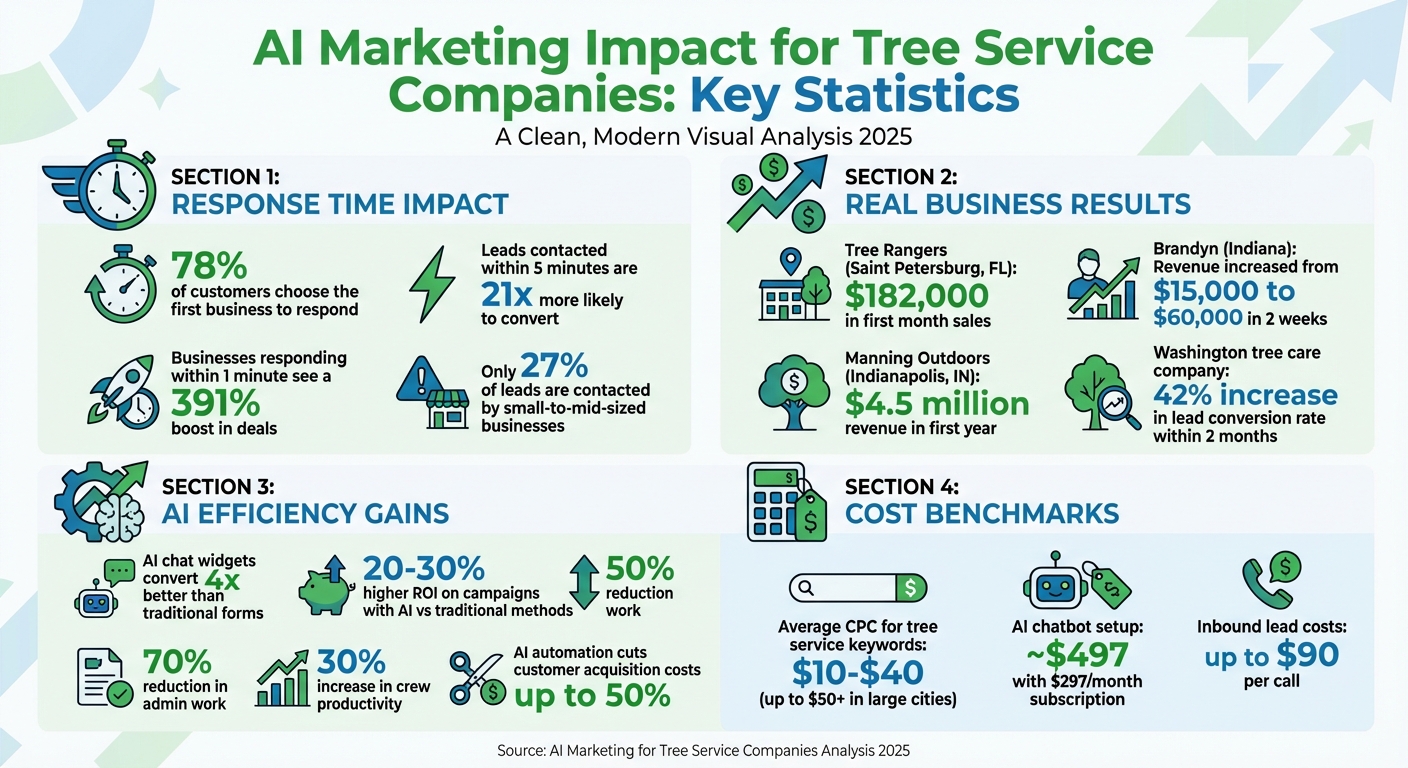
AI Marketing Impact Statistics for Tree Service Companies
Top 3 Ways to Use AI in Your Tree Service Business
sbb-itb-130a704
AI Chatbots for Lead Capture and Customer Support
Picture this: a homeowner notices a damaged oak tree late at night. They’re not waiting until morning to find help – they’re already online, submitting forms, and sending messages, expecting quick responses. If your tree service isn’t replying immediately, chances are they’ll move on to someone else. That’s where AI chatbots step in. These bots engage visitors instantly, whether they’re reaching out through your website, Facebook Messenger, Instagram, Google Business Profile, or even SMS.
How Chatbots Improve Lead Generation
Speed matters. Leads contacted within 5 minutes are 21 times more likely to be qualified compared to those contacted after 30 minutes. AI chatbots make this possible by responding instantly. They don’t just collect contact details – they also ask qualifying questions, like the type of service needed (removal, pruning, or emergency work) and whether the inquiry falls within your service area. Plus, they filter out irrelevant leads, saving you time.
Here’s a real-world example: in early 2024, a tree care company in Washington adopted an AI chatbot. Within two months, their lead conversion rate jumped by 42%. Advanced bots can even sync with tools like Google Calendar to suggest appointments and book estimates without endless back-and-forth. Once a qualified lead is identified, the system sends an alert straight to your phone so you can step in at the right moment. Miss a call? No problem – the AI can automatically send a text to keep the conversation going, making sure no lead slips through the cracks.
But chatbots aren’t just about capturing leads – they’re game-changers for ongoing customer support too.
Automating Customer Support with AI
AI chatbots go beyond lead generation by tackling routine customer inquiries 24/7. They can provide pricing ranges, confirm service areas, and even share advice tailored to specific tree species. This means you can focus on estimates and fieldwork instead of answering the same questions over and over.
"Today’s AI chatbots aren’t the clunky, frustrating ‘customer-service’ bots of just a few years ago. Instead, they provide genuine 24/7 customer support by having natural conversations via chat or text message." – Monica Hemingway, Ph.D., Licensed Arborist and Marketing Strategist
Customization is key. You can train your bot to reflect your company’s service offerings, working hours, and preferred communication style, ensuring every response feels on-brand. With multi-channel integration, messages from platforms like Facebook, Instagram, Google, and SMS are consolidated into a single dashboard. This makes it easy to monitor conversations and jump in when necessary. Setup costs are typically around $497, with monthly subscriptions running about $297.
Predictive Analytics for Targeted Marketing
You’ve got a database full of past customers, website visitors, and leads. But here’s the challenge: how do you figure out which ones are worth your time and effort? That’s where predictive analytics steps in. By analyzing your historical data, it helps pinpoint the prospects most likely to convert. This means you can focus your resources on the opportunities with the highest payoff.
Understanding Customer Behavior with Data Analysis
AI excels at uncovering patterns in customer data. For instance, it can analyze details like the types of trees on a property, local conditions, and previous service dates. Let’s say a homeowner had their oak tree trimmed 18 months ago, and oaks generally need pruning every two years. Predictive systems can flag this customer for a follow-up, ensuring you’re reaching out at the right time.
"Predictive analytics, an application of AI, allows marketers to predict future customer behavior based on past data. This can be particularly useful for tree service companies in identifying potential customers and forecasting market trends." – Chris Sams, Jemsu
Search intent data is another powerful tool. If someone searches for "emergency tree removal", they’re signaling urgency, while a search for "tree trimming estimate" might reflect a more budget-conscious mindset. AI tools can track these search patterns, enabling you to create targeted campaigns around high-value keywords. Considering that tree service jobs typically range from $1,200 to $4,500, knowing who’s searching for premium services like hazardous tree removal versus routine maintenance can have a huge impact on your bottom line.
These insights allow you to maximize your marketing spend by targeting the right audience at the right time.
Improving Campaign Performance with Data
By leveraging these behavioral insights, predictive analytics helps fine-tune your campaigns to get the best return on investment. It answers critical questions like: Which ZIP codes bring in the highest-paying jobs? When do emergency calls peak during the year? Which marketing channels attract leads that actually convert? Metrics like cost per lead, conversion rates, and customer lifetime value guide your decisions, so you can double down on what works and cut what doesn’t.
Here’s how it works in practice: AI can screen out "tire-kickers" or renters, ensuring your ads reach verified homeowners. During storm season, it can prioritize leads for emergency tree removal, while slower months can focus on routine maintenance. Tools like Looker, Akkio, or Polymer integrate with your customer database to spot trends you might otherwise miss. This strategy not only brings in better leads but can also push your close rate on qualified estimates from 25% to 45%.
With predictive analytics, you’re not just marketing smarter – you’re making every dollar count.
AI-Powered Google Ads Optimization
AI has transformed the way businesses approach Google Ads, allowing campaigns to be more efficient and effective. Without proper optimization, running Google Ads can quickly drain your budget. For example, the average cost per click for tree service keywords ranges from $10 to $40, and in larger cities, it can climb above $50. This makes AI-powered tools a necessity to ensure every dollar is spent wisely.
Google’s AI tools take over many time-consuming tasks, such as manual bid adjustments. Smart Bidding, for instance, uses machine learning to tweak bids in real-time, factoring in elements like the searcher’s device, location, time of day, and even competitor activity. Another example is Performance Max campaigns, which expand your reach across Search, Display, and YouTube by analyzing user intent beyond basic keyword matches.
"AI tools for Google Ads handle tasks like keyword optimization and bid adjustments, giving you more time to focus on growing your business." – Avram Gonzales, Chief Strategist, Digital Harvest
The results speak for themselves. In August 2025, a tree service company operating in a market of 250,000 people spent $2,300 on a well-structured Google Ads campaign. They generated 37 leads, booked 15 jobs, and earned $18,750 in revenue – an impressive 8x return on investment. These kinds of results are possible because AI continually learns which searches drive conversions and which ones don’t.
Automated Ad Targeting for Local Areas
AI shines when it comes to targeting the right audience at the right time. Instead of casting a wide net, AI ensures your ads reach homeowners actively searching for services like "tree removal near me" within a specific 10-mile radius of your business.
This level of precision is essential for tree services, which are inherently local. Paying for clicks from users who live 50 miles outside your service area is a waste. AI lets you narrow your targeting down to specific ZIP codes, improving lead quality. You can even apply bid modifiers to increase bids by 20–30% in high-value neighborhoods where jobs typically pay more.
Google’s AI also prioritizes intent-based targeting. For instance, someone searching for "emergency tree removal" at 2:00 AM after a storm likely has an urgent need, while someone browsing "tree trimming tips" on a Sunday afternoon does not. AI identifies these differences and adjusts bids to ensure your ads are competitive when it matters most.
One critical adjustment: set your location targeting to "Presence only" instead of "Presence or interest." The default setting can waste money by showing ads to people who are merely interested in your area but don’t actually live there. For tree services, where proximity is key, this simple change can make a big difference.
Reducing Wasted Ad Spend with AI
Once your targeting is dialed in, the next step is minimizing wasted ad spend. This is where AI truly excels. For example, without proper filtering, you could end up paying for clicks from searches like "tree service jobs", "DIY tree removal", or "tree trimming equipment" – none of which lead to paying customers. AI identifies and filters out these non-buyer searches automatically.
AI also monitors performance in real-time, reallocating your budget to campaigns that convert while pausing underperforming ads before they drain your funds. Additionally, AI-generated scripts can further enhance efficiency. For example, you can use tools like ChatGPT to create scripts that automatically add exact match keywords as negatives in broad match campaigns, preventing your own ad groups from competing with each other. Other scripts can track your Quality Score daily, a feature not natively available in Google Ads, helping you identify and address costly low-relevance keywords.
| Market Type | Average CPC | Recommended Monthly Budget |
|---|---|---|
| Rural / Low-Competition | $10 – $15 | $750 – $1,500 |
| Suburban / Mid-Sized | $20 – $30 | $1,500 – $3,000 |
| Urban / High-Competition | $30 – $50+ | $3,000 – $6,000+ |
(Source:)
While AI automation is powerful, it’s not perfect. Google often recommends "auto-apply" changes, such as adding broad match keywords or increasing budgets – adjustments that could hurt your ROI if applied without review. To avoid this, review AI suggestions manually every two weeks. This allows the system to learn effectively without making impulsive changes based on short-term trends.
"AI won’t write your strategy for you, but it can help turn good ideas into great outcomes – if you know your audience and guide it with the right inputs." – Avram Gonzales, Chief Strategist, Digital Harvest
AI tools like Jasper and Copy.ai can also help with creating multiple ad copy variations for A/B testing. This lets you identify which messaging resonates most with your audience. Pairing these ads with specialized landing pages – such as one for emergency tree removal and another for routine pruning – can boost conversion rates from the typical 10% to 20% or more.
Personalized Customer Experiences with AI
AI has gone beyond simply optimizing lead capture and campaigns – it’s now reshaping customer engagement by making interactions more personal. By analyzing customer data like the tree species on their property, previous service history, and even local environmental factors, AI turns generic messages into tailored conversations. These personalized interactions don’t just grab attention; they build trust and position your business as a reliable partner rather than just another contractor.
The numbers back this up: personalized AI-driven interactions significantly boost customer engagement, with tailored recommendations leading to higher conversion rates compared to generic approaches. And when 78% of customers choose the business that responds first to their inquiry, delivering personalized responses quickly gives you a major edge.
Customizing Marketing Campaigns with AI
AI-powered CRMs make it easier to tailor marketing efforts. They can automatically tag leads based on factors like service type, urgency, and how the lead was generated. For instance, someone requesting emergency storm damage help will receive a different follow-up than someone casually exploring pruning tips. AI ensures that each message is not only relevant but also delivered at the best possible time based on customer behavior and purchasing patterns.
"By using AI, you can easily analyze data already in your system to understand individuals’ preferences, behaviors, and purchase patterns. From this data, you can create experiences tailored directly to your consumers." – Katie Petersen, ArboRisk
Tools like ChatGPT and Claude can even help with content creation. By feeding these tools your brand voice and service details, you can quickly generate newsletters, social media updates, and blog posts that sound authentic and align with your messaging. This is especially useful for batching content – imagine creating a month’s worth of posts about seasonal tree care trends in one sitting.
AI also enhances lead capture. Multi-step quote forms powered by AI convert 35% better than basic forms. These forms ask targeted questions like “How many trees need service?” or “Is this an emergency?” and even allow photo uploads. This makes customers feel like their needs are understood while providing your team with the details needed to deliver accurate quotes.
By combining personalized messaging with smart automation, AI doesn’t just improve engagement – it builds lasting customer loyalty.
Improving Customer Engagement with AI Data
AI keeps customers engaged over time by automating reminders for seasonal maintenance, such as dormant pruning in winter or storm preparation in summer, based on their service history. These timely nudges encourage repeat business without requiring manual follow-up.
Using predictive analytics, AI can even anticipate customer needs. For example, if your data shows that a neighborhood faced pest problems last spring, AI can trigger content about preventive treatments before the issue arises again. Proactive efforts like this show customers you’re always one step ahead, strengthening their trust in your expertise.
AI also ensures customers stay connected through tools like voice assistants and chatbots. These can provide 24/7 support, handling routine questions or booking appointments directly into your calendar – even when your team is in the field. This kind of instant engagement is crucial, especially when leads are 10 times less likely to respond if they don’t hear back within 5 minutes. Quick responses can mean the difference between securing a job or losing it to a competitor.
| AI Personalization Feature | Benefit to Tree Service Company |
|---|---|
| Species-Specific Tips | Establishes your company as an expert in local tree care. |
| Seasonal Reminders | Drives repeat business and boosts customer lifetime value. |
| Automated Follow-ups | Ensures around-the-clock engagement, improving lead qualification rates. |
| Predictive Analytics | Anticipates service needs like pruning or pest control. |
Think of AI as an essential part of your team. The more context you provide – like your specific tools, service area, and company values – the more natural and effective its messaging will be.
Combining AI with Tree Company Leads Services
AI is transforming how businesses handle marketing, and when paired with Tree Company Leads, it creates a system that works tirelessly to generate leads and improve customer interactions. Instead of replacing your existing strategies, AI enhances them. By integrating AI-powered tools with Tree Company Leads’ services – like custom web design, Google Ads management, and lead tracking – you can achieve round-the-clock lead generation.
How AI Works with Tree Company Leads Features
Tree Company Leads designs custom websites that focus on driving conversions. Adding AI chat widgets to these sites can multiply visitor conversions by four compared to traditional long-form estimate requests. These chat widgets ask targeted questions like, "How many trees need service?" or "Is this an emergency?" They can even prompt homeowners to upload photos for quicker quotes.
Speed matters. When a homeowner submits a form on your Tree Company Leads website or clicks on a Google Ad, AI can send an SMS or email reply within 15 seconds. This is crucial since 78% of customers go with the first business to respond. Waiting even five minutes can reduce your chances of qualifying a lead by 400%.
AI also integrates seamlessly with industry-specific CRMs like ArborGold or Jobber, automatically syncing lead data and eliminating manual data entry. Since about 28% of calls go unanswered due to on-site work, an AI voice assistant can step in to handle missed calls. It can screen callers for service areas and urgency, and even schedule estimates directly into your Google Calendar – whether it’s during business hours or a midnight storm emergency.
| Feature | Without AI | With AI Integration |
|---|---|---|
| Response Time | Minutes to hours (manual) | 15 seconds (automated) |
| Lead Availability | Business hours only | 24/7 autopilot |
| Data Entry | Manual into CRM | Auto-sync to ArborGold/Jobber |
| Conversion Rate | Standard web forms | 4x higher with AI chat widgets |
AI doesn’t just improve lead capture – it streamlines your entire marketing process, as we’ll explore next.
Simplifying Marketing with AI Integration
AI simplifies your workflow by removing inefficiencies. Instead of managing multiple communication channels across various platforms, AI consolidates everything into one dashboard. Automated lead scoring filters out low-value inquiries by analyzing intent, saving your team from wasting time on unqualified leads. This allows your estimators to focus on high-priority leads, like emergency removal or storm cleanup requests, cutting admin work by 70% and increasing crew productivity by 30%.
With Tree Company Leads, AI reduces response times to just 15 seconds, a drastic improvement over manual processes. Google Ads campaigns managed by Tree Company Leads become even more effective when combined with AI targeting. AI analyzes search data to connect you with property owners in specific ZIP codes actively looking for your services. If you’re working on local SEO, AI can also generate thousands of hyperlocal landing pages to capture organic traffic without the need for ongoing ad expenses.
"AI chatbots do more than just provide 24/7 support – they help sort out leads instantly." – ArboStar
Implementing AI is straightforward. Replace your current website call-to-action with "Text an Arborist Now" to increase click-through rates. Update your Google Business Profile hours to 24/7 if you’re using an AI receptionist to handle after-hours storm calls. From there, let AI handle routine questions, allowing your team to concentrate on estimates and fieldwork. By combining Tree Company Leads’ expertise with AI automation, you’ll have a marketing system that operates around the clock – even when you’re not.
Measuring ROI of AI Marketing
Once you’ve implemented AI tools, the next critical step is figuring out if they’re actually boosting your revenue. Tracking the right metrics is what separates a successful AI investment from a wasted one. Companies leveraging AI in marketing report 20-30% higher ROI on campaigns compared to traditional methods. However, a staggering 74% of companies still struggle to demonstrate measurable ROI from these investments.
Key Metrics for AI Marketing Success
To determine the success of your AI marketing efforts, focus on metrics that directly tie back to your business goals.
1. Financial Metrics
Start with numbers that impact your bottom line. Compare pre- and post-AI implementation sales to measure incremental revenue. Calculate Cost Per Acquisition (CPA) by dividing total marketing costs by new customer acquisitions. Use Return on Ad Spend (ROAS) to see how much revenue you generate for every dollar spent on advertising.
2. Lead Conversion Metrics
These metrics help you understand how well AI converts leads into paying customers. For example, track the lead-to-customer conversion rate, which measures the percentage of initial inquiries that result in sales. In one case, a tree care company in Washington implemented an AI chatbot in 2025 and saw a 42% increase in lead conversion rates within just two months.
3. Operational Efficiency
AI often shines in reducing manual tasks and speeding up processes. Track hours saved on repetitive tasks like scheduling, data entry, and report generation. For instance, AI-powered automation can cut customer acquisition costs by up to 50%. It also significantly reduces campaign setup time, shrinking it from 5-7 days to just 1-2 days.
4. Customer Experience Metrics
Finally, assess how AI impacts customer interactions. Metrics like email open rates, click-through rates, and engagement levels across channels provide insights into how well your campaigns resonate with your audience.
| Metric Category | What to Track | Why It Matters |
|---|---|---|
| Financial | Revenue gains, CPA, ROAS | Measures direct profit impact |
| Lead Conversion | Lead-to-customer rate, SQLs | Evaluates sales effectiveness |
| Operational | Time saved, campaign speed | Highlights efficiency improvements |
| Customer Experience | Response time, engagement rates | Tracks service quality and resonance |
These metrics are the building blocks for aligning AI investments with your broader business objectives.
Aligning AI Investment with Business Goals
Armed with these metrics, set SMART goals to ensure your AI tools deliver measurable results. For example, instead of saying, "We want more leads", aim for something specific like: "Increase website conversions for emergency tree removals by 20% within four months". Specific goals like this provide clear benchmarks for success.
Before launching AI tools, document your baseline performance. Record your current sales figures, lead quality, response times, and efficiency levels. Without this data, it’s impossible to know whether improvements stem from AI implementation.
When calculating ROI, make sure to include all costs. This means factoring in software subscriptions, setup fees (which for tree-specific AI tools can range from $1,000 to $3,000), employee training, and ongoing maintenance. Use this formula to calculate ROI:
ROI = [(Revenue Gains + Cost Savings + Productivity Gains) – (AI Investment + Implementation Costs + Ongoing Costs)] / Total AI Investment × 100.
"Running a home service business without measuring AI marketing results is like driving blindfolded." – CI Web Group
Take a phased approach to measuring ROI. Track implementation metrics during the first 1-3 months. Focus on operational efficiency improvements from months 4-12. Finally, assess comprehensive financial ROI after 13-24 months. While AI-driven personalization can deliver 5-8 times the ROI on marketing spend, these benefits often take time to fully materialize. Companies that establish detailed ROI measurement frameworks are 2.5 times more likely to scale their AI initiatives successfully.
To maximize AI’s impact, consider running A/B tests. Compare AI-powered campaigns against traditional ones to isolate results. Also, evaluate the cost of your AI system against alternatives. For example, in the tree service industry, inbound lead costs can reach $90 per call. Investing in AI infrastructure may be more cost-effective than buying leads in the long run. Measuring ROI in these areas ensures your AI tools are driving profitable campaigns while improving lead conversion rates.
Conclusion
AI marketing is reshaping how tree service companies attract leads, streamline campaigns, and connect with customers. Did you know that businesses responding within the first minute see a 391% boost in deals, and 78% of customers choose the first company to respond?. Tools like missed call text-back systems and web chatbots make it possible to capture leads instantly, addressing a common issue: only 27% of leads are contacted by small-to-mid-sized businesses. From there, AI can take things further – predictive analytics help pinpoint high-intent prospects, AI-driven Google Ads reduce wasted spending, and personalized follow-ups encourage customer loyalty.
Consider these results: Tree Rangers in Saint Petersburg, FL, closed $182,000 in their first month using AI-powered marketing. Manning Outdoors in Indianapolis, IN, achieved $4.5 million in revenue within their first year. These success stories highlight the potential of integrating AI into your marketing strategy.
As Monica Hemingway, Ph.D., a licensed arborist and marketing strategist, puts it:
"AI won’t replace us, but will free us up to focus on what we do best – provide exceptional tree care services to our communities."
By pairing AI tools with Tree Company Leads services, tree care businesses can take advantage of a system that automates lead qualification and scheduling. This means every high-quality lead is nurtured and booked without the need for manual effort. AI-driven marketing ensures seamless integration of chatbots, predictive analytics, and ad optimization, simplifying every step of lead generation and customer engagement.
The key is to act quickly. Whether it’s a $20/month tool like ChatGPT for content creation or a $297/month chatbot system, the return on investment can be transformative. Focus on tools that deliver measurable results, align them with your business goals, and let AI elevate your marketing game.
FAQs
Which AI tool should I start with first?
An excellent starting point for incorporating AI into your tree service business is using an AI-powered chatbot or a lead qualification system. These tools are designed to streamline customer interactions, qualify leads, and even schedule appointments around the clock. By automating these tasks, you can ensure faster responses to customer inquiries, which can lead to higher conversion rates.
Chatbots stand out because they’re efficient, easy to scale, and operate tirelessly – no breaks, no downtime. This makes them a practical and effective way to begin integrating AI into your marketing strategy.
How do I set up AI to book estimates automatically?
Streamline your estimate booking process by using AI-powered chatbots and scheduling tools tailored for tree service businesses. These tools can manage inquiries, qualify potential customers, and schedule appointments around the clock.
By setting up your chatbot to identify urgent requests – like storm damage – you can ensure high-priority cases are addressed promptly. Integrating the system into your existing workflow is key to keeping operations smooth. Be sure to thoroughly test the setup to guarantee accurate bookings and provide a hassle-free experience for your customers. This approach not only reduces manual work but also helps you capture more leads efficiently.
How can I prove AI marketing is worth the money?
AI marketing proves its worth when it delivers measurable outcomes like more leads, boosted sales, better ROI, and streamlined operations. Take Ronnie’s Tree Rangers, for example – they brought in $182,000 in just one month with the help of AI systems. Real-world case studies like this showcase how AI tools can provide clear advantages for tree service companies.
Related Blog Posts
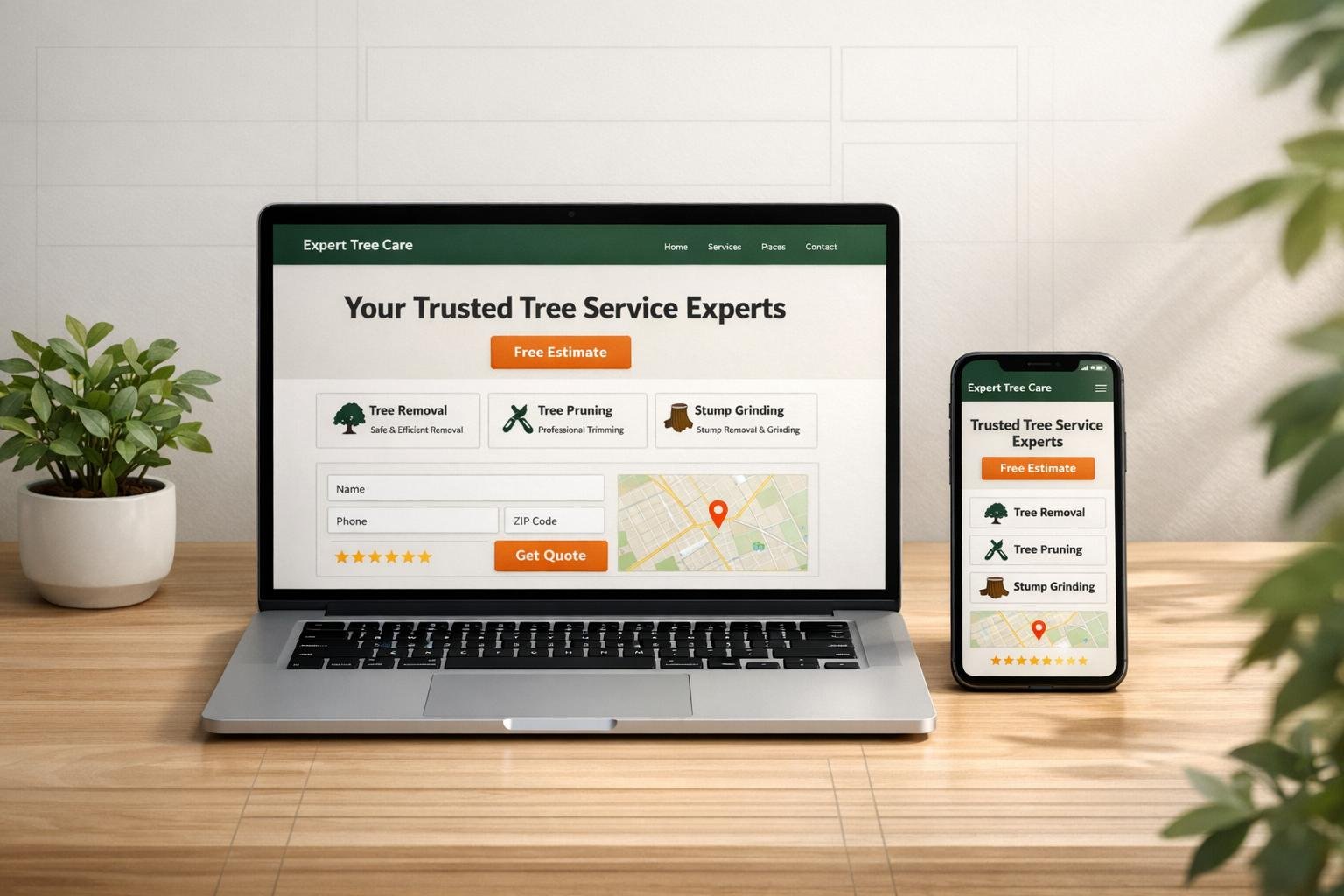
Want your tree service business to stand out online? Your website is more than just a digital business card – it’s your 24/7 salesperson. Homeowners are searching online for tree services, and a well-designed, fast, and mobile-friendly website can make all the difference. Here’s what you need to know:
- 89% of homeowners search online before hiring tree care services.
- 75% of users judge your credibility based on your website design.
- Mobile users dominate: 79% of searches for tree services happen on phones.
- A slow site hurts conversions – 53% leave if it takes more than 3 seconds to load.
To build a website that works for your business, focus on these key areas:
- Choose the right platform: Look for fast load times, mobile responsiveness, and lead tools.
- Design for mobile: Responsive layouts, click-to-call buttons, and easy navigation are essential.
- Create detailed service pages: Highlight your services, credentials, and local expertise.
- Optimize for local SEO: Ensure your business shows up in local searches with tools like Google Business Profile.
- Add lead capture tools: Use live chat, simple forms, and call tracking to turn visitors into customers.
- Keep it fast and secure: Compress images, enable SSL, and use reliable hosting to maintain trust and performance.
Your website should not only look professional but also drive leads and grow your business. Let’s dive into how to make it happen.
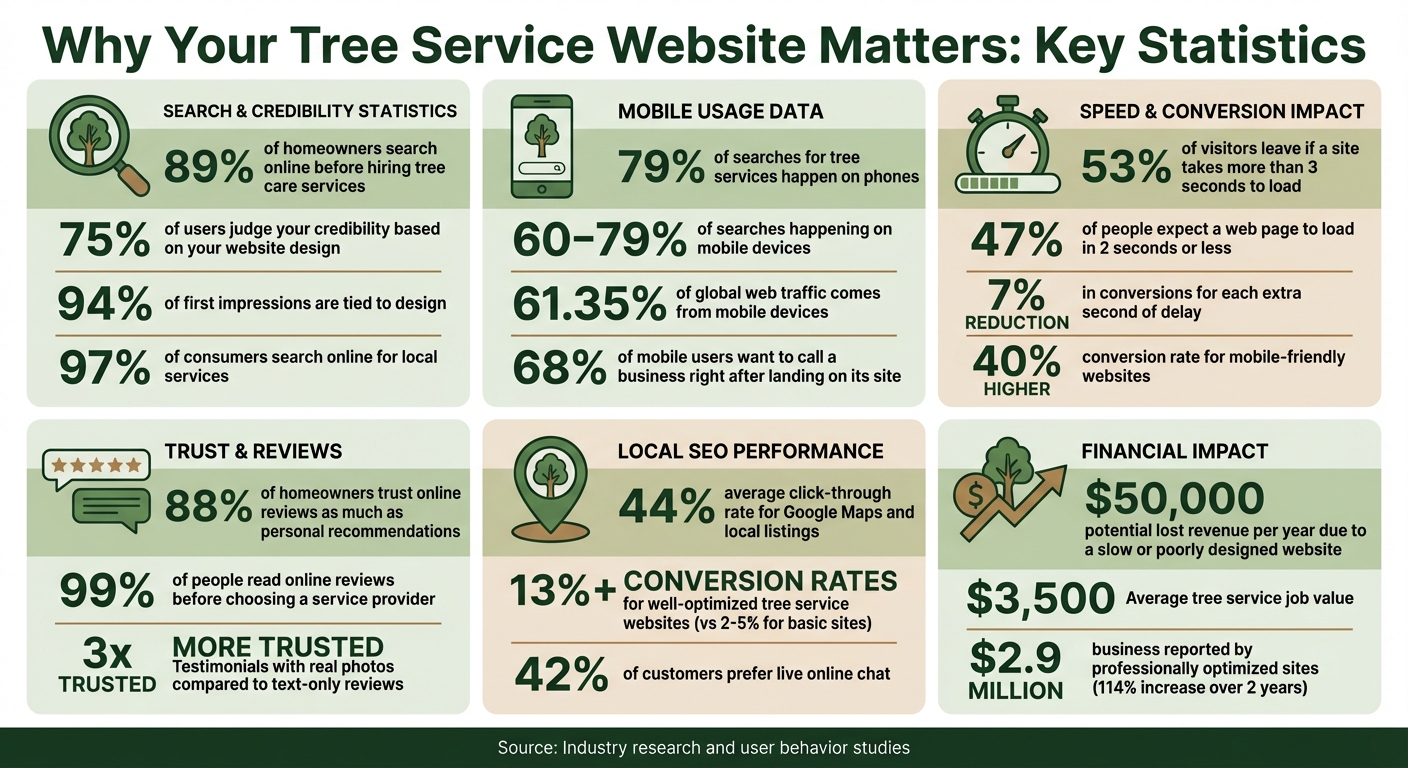
Tree Service Website Statistics: Mobile Usage, Conversion Rates & User Behavior
How to Build Your Tree Service Website for Maximum Conversion & Lead Flow
sbb-itb-130a704
Select Your Website Platform
The platform you choose for your website plays a huge role in how easily you can update content, attract leads, and rank well in local searches. It’s all about finding the right balance between user-friendliness and the technical features your tree service business needs to thrive online.
What to Look for in a Website Platform
Your platform should check several key boxes: mobile responsiveness, lead capture capabilities, fast load speeds, and strong security. With most searches happening on mobile devices, your site must adjust seamlessly to different screen sizes. Features like tap-to-call buttons that stay visible as users scroll are a must – 68% of mobile users want to call a business right after landing on its site.
Lead generation tools are just as critical. Look for platforms that integrate with chatbots, live chat, and easy-to-use contact forms. Short, straightforward forms can make a big difference in turning visitors into customers. Plus, make sure the platform supports dedicated service pages for offerings like stump grinding or emergency tree removal, as well as location-specific pages for each city you serve. These pages are essential for boosting your local SEO rankings.
Quick load times and strong security features are non-negotiable. An SSL certificate (HTTPS) is a must-have – browsers flag sites without one, which can hurt your credibility with potential customers researching your services.
Best Platforms for Tree Service Websites
Tree Company Leads custom web design is built specifically for the tree care industry. It offers layouts tailored to your business, complete with industry-specific SEO and lead generation tools designed to match how tree service customers search and make decisions. The platform also handles all the technical upkeep, letting you focus on your business while your site works to bring in leads 24/7.
"I am thrilled with the new website Tree Company Leads designed for my tree service business! The layout is clean and user-friendly, which has definitely increased my online inquiries."
- Mark Thompson, Tree Service Business Owner
Tree Company Leads takes the guesswork out of adapting generic platforms to fit your industry. It comes preloaded with mobile-responsive designs, built-in lead capture tools, fast page speeds, and strong security features. Everything is designed specifically with tree care businesses in mind, ensuring your website connects with homeowners searching for services and converts them into customers.
Once you’ve chosen your platform, the next step is designing a mobile-friendly site that leverages these built-in features.
Design a Mobile-Responsive Website
With 60%-79% of searches happening on mobile devices, your website needs to work seamlessly across all screen sizes. Mobile-friendly websites enjoy a 40% higher conversion rate compared to non-responsive ones. Plus, speed is critical – 53% of visitors will leave if a site takes longer than 3 seconds to load, and each extra second reduces conversions by 7%.
A responsive design ensures your site automatically adjusts to different devices. This means images resize, text flows properly, and buttons remain easy to tap. Visual appeal is just as important – 75% of users judge a company’s credibility based solely on its website design, and 94% of first impressions are tied to design.
"Your website isn’t competing against other tree service websites – it’s competing against Amazon, Netflix, and every modern website your customers use daily." – Home Service Direct
To keep visitors engaged, make navigation simple and guide them to the most important service information.
Navigation Structure and Core Pages
Your navigation should be straightforward and touch-friendly. The main menu should include key sections like Services (with a dropdown for specific offerings such as tree removal, stump grinding, and pruning), About, Gallery, and Contact. Each service should have its own dedicated page to make it easier for both customers and search engines to understand your expertise.
Showcase high-quality visuals, including before-and-after photos, branded trucks, and crew members in safety gear, to highlight the professionalism of your work. Add an FAQ section to address common concerns about pricing, insurance, and safety – this not only helps potential customers but also improves your search rankings for specific queries.
Once your navigation is set, focus on optimizing interactive features for mobile users.
Mobile Design Best Practices
Click-to-call functionality is a must – 68% of mobile visitors want to call a business immediately after visiting its site. Make your phone number large, clickable, and place it in a sticky header that stays visible as users scroll. For urgent needs, include a prominent "Emergency Service" button in a high-contrast color to capture leads during storms or emergencies.
Ensure all interactive elements are easy to use. Tap targets should be at least 44×44 pixels or a minimum height of 50px to make them finger-friendly. Use short contact forms (just name, phone, and service type), keep font sizes at least 16px, and limit paragraphs to 3-4 lines for better readability on small screens.
To keep your site fast and visually appealing, compress images with tools like TinyPNG or use modern formats like WebP. Aim for load times under 3 seconds. Adding a floating contact bar with options like "Call", "Quote", or "Text" keeps your contact details accessible as users browse. For those who prefer messaging, consider live chat or chatbots to capture leads 24/7.
Write Service-Focused Content
After ensuring your website is mobile-friendly, the next step is creating service-focused content that turns visitors into customers. Your content shouldn’t just list your services – it needs to showcase your expertise and answer the key questions homeowners might have. Well-written, optimized content not only builds trust but also attracts qualified leads through SEO or ads. The goal is to speak directly to your customers’ needs while demonstrating your technical knowledge of tree care.
Most homeowners don’t have a deep understanding of tree care and often value reliability over finding the lowest price. Your content should highlight your licensing, insurance, and years of experience. Use clear, straightforward language to explain the "why" and "how" of your services. For instance, describe the property protection measures you take during complex tree removals. This kind of transparency fosters trust even before they pick up the phone.
"My personal advice is to write about what you’re passionate about, trees! … Write about what your customers ask you frequently about. Your area of expertise isn’t represented enough online." – Gravity Web Designs
Tackle specific concerns like pricing, permits, and cleanup processes to answer questions before they’re even asked. This approach not only simplifies the sales process but also helps search engines connect your site with highly specific queries. Keep your tone authoritative yet approachable – you’re the expert, but you’re also someone who genuinely wants to help homeowners with their tree care challenges.
Write Detailed Service Pages
Create a dedicated page for each of your primary services – tree removal, stump grinding, pruning, and emergency cleanup. These pages should target location-based searches by incorporating city names into headlines, such as "Tree Removal in [City]", and referencing local landmarks or common tree species.
On each service page, prominently display your credentials. Mention your $2 million+ liability insurance and ISA (International Society of Arboriculture) certifications. Include high-resolution before-and-after photos to demonstrate your quality of work, along with images of your team in safety gear and operating professional equipment. These visuals reassure potential customers that you’re a legitimate, professional operation.
Define your service area clearly. Use interactive maps or list specific neighborhoods to avoid receiving inquiries from outside your coverage zone. Add bold, easy-to-spot "Get a Free Quote" or "Emergency Service" buttons at the top of the page and repeat them throughout. For emergency services, use high-contrast buttons like "24/7 Emergency Service" to capture urgent leads during storms or other crises. Enhance these pages further by incorporating authentic visuals and testimonials from satisfied clients.
Use Photos and Testimonials to Build Trust
Once your service pages are detailed and informative, strengthen them with real photos and testimonials to establish credibility. Authentic images of your crew and equipment perform far better than generic stock photos. In fact, 88% of homeowners trust online reviews as much as personal recommendations, and testimonials with real photos are trusted three times more than text-only reviews.
On your "About Us" page, include photos of the owner and team members, along with their names and specialties, to add a personal touch. Encourage your crews to take "before", "during", and "after" photos from the same angle to showcase transformations. These galleries help homeowners visualize how their own property could look after your services. Use modern image formats like WebP and enable "lazy loading" to ensure high-resolution photos don’t slow down your site.
Place testimonials on the relevant service pages. For example, a stump grinding review belongs on the stump grinding page, not buried on a general "Reviews" page. Video testimonials, even if they’re just 30 seconds long, can significantly boost credibility. Embed a live widget showing your current Google star rating (e.g., 4.9/5) to provide third-party validation.
To maintain a steady flow of reviews, send automated text or email requests within 24–48 hours of completing a job. Respond to all reviews promptly – within 24–48 hours. For negative reviews, reply with empathy and offer to resolve the issue privately. This shows potential clients that you’re accountable and committed to customer satisfaction.
Add Lead Generation and Local SEO Features
After perfecting your content and ensuring it builds trust, the next step is making sure local customers can actually find your website. Here’s the reality: 97% of consumers search online for local services. If your business doesn’t appear on the first page for searches like "tree removal [your city]", you’re essentially handing jobs over to your competitors. Local SEO ensures your business shows up when people in your area need help, while lead capture tools turn those visitors into calls and quote requests. Together, these strategies can turn local searches into actual business opportunities.
Local SEO doesn’t just increase visibility – it drives results. For instance, Google Maps and local listings boast a 44% average click-through rate, and well-optimized tree service websites can achieve conversion rates of 13% or higher, compared to the typical 2–5% for basic sites. But simply having a website isn’t enough. You need to signal to Google that your business is active and make it easy for potential customers to reach you.
"If you’re not on page one for ‘tree removal [your city],’ you’re losing money. Competitors who rank higher take those jobs." – Alex Gambashidze, ResultCalls
Here’s how to focus on two key areas: optimizing for local search and implementing lead capture tools that work even while you’re busy.
Local SEO Optimization Techniques
Start by claiming and verifying your Google Business Profile (GBP). Set "Tree Service" as your primary category and consider adding secondary ones like "Arborist" or "Stump Removal Service". Upload high-quality photos of your team, equipment, and completed projects – posts with photos get 42% more engagement. Before uploading, geotag your images to add location data, which boosts local relevance.
Use Google Posts to share updates like completed jobs, seasonal tips, or special offers. These posts expire after seven days, so posting weekly signals to Google that your business is active. Also, encourage customer reviews and respond promptly – preferably within 24–48 hours. Why? 99% of people read online reviews before choosing a service provider, and a thoughtful response to a negative review can sometimes win over more customers than a perfect five-star rating.
Keep your Name, Address, and Phone number (NAP) consistent across platforms like your website, GBP, Yelp, Facebook, Angi, and the Better Business Bureau. Use tools like BrightLocal or Whitespark to audit and fix any inconsistencies.
Create service area pages for every city or neighborhood you serve. These pages should include unique content, mention local landmarks, and address regional tree issues, such as storm damage in coastal towns or oak wilt in Texas. Incorporate long-tail keywords like "emergency tree removal in Dallas" into your title tags, headings, and image alt text to reinforce your local relevance.
Add Local Business Schema Markup using JSON-LD to help search engines understand your business type, service area, operating hours, and reviews. This can improve your local search visibility by up to 30%. Embedding a Google Map on your contact page also strengthens your local presence.
While GBP optimization can produce quick wins, consistent effort over three to six months is typically required to achieve top rankings. If managing SEO feels overwhelming, professional services tailored to tree companies – costing around $1,500 per month – can be a worthwhile investment, given the potential revenue from new customers.
Install Lead Capture Tools
Once your local SEO is in place, focus on capturing leads effectively. Make it simple for visitors to contact you, especially on mobile devices. Add large, clickable call-to-action buttons in your site’s header and as a sticky footer.
Integrate live chat or chatbots to collect lead details 24/7, even when you’re unavailable. With 42% of customers preferring live online chat, an automated greeting like “Need help with a tree service? Let me take your info for a free estimate” can encourage immediate engagement.
Use tools like online booking systems and call tracking to streamline scheduling and measure marketing ROI. For example, platforms like Jobber make appointment booking easier, while services like CallRail help track which pages or campaigns generate the most calls.
By combining local SEO with effective lead capture tools, you ensure that visitors not only find your website but also take action.
| Category | Recommended Software | Primary Benefit |
|---|---|---|
| Live Chat / Chatbots | Tidio, ManyChat, HubSpot Chat, LiveChat, Intercom | 24/7 engagement and instant response |
| Call Tracking | CallRail, CallTrackingMetrics | Tracks ROI and attributes calls to specific pages |
| Online Booking | Jobber | Simplifies scheduling and reduces booking friction |
| Contact Forms | WPForms, Gravity Forms | Makes mobile-friendly quote requests easy |
| Review Management | EmbedSocial, Elfsight, BrightLocal | Displays real-time reviews to build trust |
Ensure your site is secure with an SSL certificate (HTTPS), as browsers often flag non-secure websites, which can deter potential leads. Use tools like Google Analytics and Google Tag Manager to track clicks, form submissions, and conversions, so you can continuously refine your strategy.
"Your website isn’t competing against other tree service websites – it’s competing against Amazon, Netflix, and every modern website your customers use daily." – Home Service Direct
Optimize Website Performance and Security
Your website’s performance and security play a huge role in turning visitors into customers. Did you know that 47% of people expect a web page to load in 2 seconds or less? And every extra second of delay can decrease conversion rates by 7%. For tree service companies, this means a slow or insecure website could cost you potential clients – especially during emergencies when homeowners need help fast. A quick, secure site not only builds trust but also keeps visitors engaged.
Improve Website Speed
Speed matters. Start by compressing images using modern formats like WebP to reduce file sizes while maintaining quality. Tools like Google PageSpeed Insights can help pinpoint issues like oversized images or slow server response times.
Here are some ways to improve your site’s speed:
- Enable browser caching to make return visits faster.
- Use a Content Delivery Network (CDN) like Cloudflare to deliver content more quickly.
- Minify CSS and JavaScript files to simplify browser processing.
- If your site uses a heavy theme, consider rebuilding it with a lighter framework like Next.js or streamlined HTML/CSS.
Also, invest in reliable hosting. Cheap shared hosting often slows down your site. With mobile devices making up about 61.35% of global web traffic, ensure critical elements – like your phone number and call-to-action button – load first, so visitors can act without delay.
Once your site is running smoothly, it’s time to focus on security measures to protect both your business and your users.
Implement Security Measures
Speed is crucial, but so is security. Start by installing an SSL certificate to encrypt data between users and your server. Without SSL, browsers like Chrome display a "Not Secure" warning, which can erode trust instantly. Free SSL certificates are available through Let’s Encrypt, or you can opt for paid versions with added warranties, like Network Solutions’ $10,000 security warranty. Plus, switching to HTTPS can even improve your search rankings.
Other essential security steps include:
- Automated Backups: Use tools like UpdraftPlus or BlogVault to schedule daily backups to remote locations like Dropbox or Amazon S3. This is crucial because hiring professionals to fix a hacked site can cost over $250 per hour.
- Strong Passwords and 2FA: Use unique passwords managed by tools like LastPass, and enable Two-Factor Authentication (2FA) with apps like Authy or Google Authenticator.
- Web Application Firewall (WAF): Install a WAF like Sucuri or Cloudflare to block malicious traffic. Sucuri offers a full security package – including malware scanning and cleanup – for about $199 per year.
- CAPTCHA Protection: Add CAPTCHA to forms to block spam and bots.
- Regular Updates: Keep your site’s core software, themes, and plugins updated to fix vulnerabilities. Over 40% of websites have security flaws that hackers can exploit.
"Backups are your first defense against any WordPress attack. Remember, nothing is 100% secure." – Editorial Staff, WPBeginner
Conclusion
Creating a website that works as your 24/7 digital sales agent starts with a mobile-responsive design, service-focused content, local SEO, and effective lead capture tools. When these elements come together, your site transforms into a revenue-generating machine. Considering that many homeowners begin their search online, your website often serves as their first – and sometimes only – impression. Every aspect of your digital presence should be geared toward turning visitors into paying customers.
Effective SEO strategies ensure potential clients can find you by targeting searches like "tree removal near me." Once they land on your site, clear and concise content, along with authentic before-and-after photos, builds trust and keeps them engaged. From there, features like simple contact forms, tap-to-call buttons, and fast load times eliminate any barriers that might prevent them from reaching out. As one expert wisely noted: "Traffic means nothing if it doesn’t turn into leads. Conversion optimization ensures your website generates real business".
"A website shouldn’t just ‘look good’, it should work hard for your business. For tree service companies, that means being clear, fast, mobile-friendly, and built to turn clicks into calls." – Local Tree Service Marketing
The stakes are high. A slow or poorly designed website can cost a tree service company as much as $50,000 in lost revenue each year. On the other hand, businesses with professionally optimized sites and robust digital marketing strategies have reported closing $2.9 million in business, reflecting a 114% increase in estimates over two years. With the average tree service job valued at around $3,500, every visitor who leaves without converting represents a missed opportunity.
The key is to integrate all these elements into a seamless, conversion-focused experience. Start with a solid platform, prioritize mobile optimization, build out detailed service pages, and implement effective lead capture tools. Ensure your site is fast, secure, and answers the questions homeowners are asking. By doing so, you’ll position your business as the go-to option for tree services, no matter what device your potential customers are using.
FAQs
How much should a tree company website cost?
The price of a tree company website depends on factors like design, features, and the level of customization. A simple website typically starts at around $2,000, while a more advanced, fully tailored site focused on generating leads can cost anywhere from $10,000 to $15,000 or more. Additionally, ongoing maintenance fees often range between $500 and $2,000 per month. Overall, you should plan for a budget of $2,000 to $20,000, depending on what you’re looking for and how customized the site needs to be.
How long does local SEO take to get more calls?
Local SEO for tree service companies can start driving more calls in just a few weeks. That said, seeing noticeable improvements often takes 3 to 6 months of steady optimization. The key to sustained growth? Consistently updating your strategy and targeting the right local keywords.
What should I track to know my website is working?
To get the most out of your website, keep an eye on essential metrics like the number of visitors, bounce rate, and actions such as contact form submissions or bookings. Make sure your site loads fast – ideally within 2-3 seconds – and works well on mobile devices. These elements play a big role in user experience and lead generation, letting you gauge how effectively your site draws in visitors and turns them into potential customers.
Related Blog Posts
In 2026, the tree service industry is highly competitive, with over 150,000 companies in the U.S. – a significant increase from 91,949 in 2015. To stand out, you need to analyze your competitors effectively. This guide outlines 10 practical steps to help you identify opportunities, improve your strategies, and gain an edge in your local market. Key insights include:
- 68% of jobs go to the first business that responds to tree service leads. Speed and responsiveness are critical.
- Google’s "Get Competitive Quotes" feature allows customers to compare up to four providers, but these leads convert 15–25% less than standard ones.
- Tools like SEMrush, Ahrefs, and BrightLocal can help you track competitors’ SEO, keywords, and local rankings.
Here’s a quick summary of the steps:
- Find local competitors using search terms and tools like BrightLocal.
- Analyze their Google Business Profiles for categories, reviews, and engagement.
- Review their websites for speed, mobile usability, and lead generation features.
- Compare their SEO rankings and keyword strategies.
- Study their service offerings and pricing to identify gaps.
- Examine online reviews for patterns in strengths and weaknesses.
- Evaluate their lead generation methods, including ads and response times.
- Monitor their advertising campaigns using tools like Google Ads Transparency.
- Set up a tracking system to monitor changes and trends.
- Turn data into actionable improvements for your business.
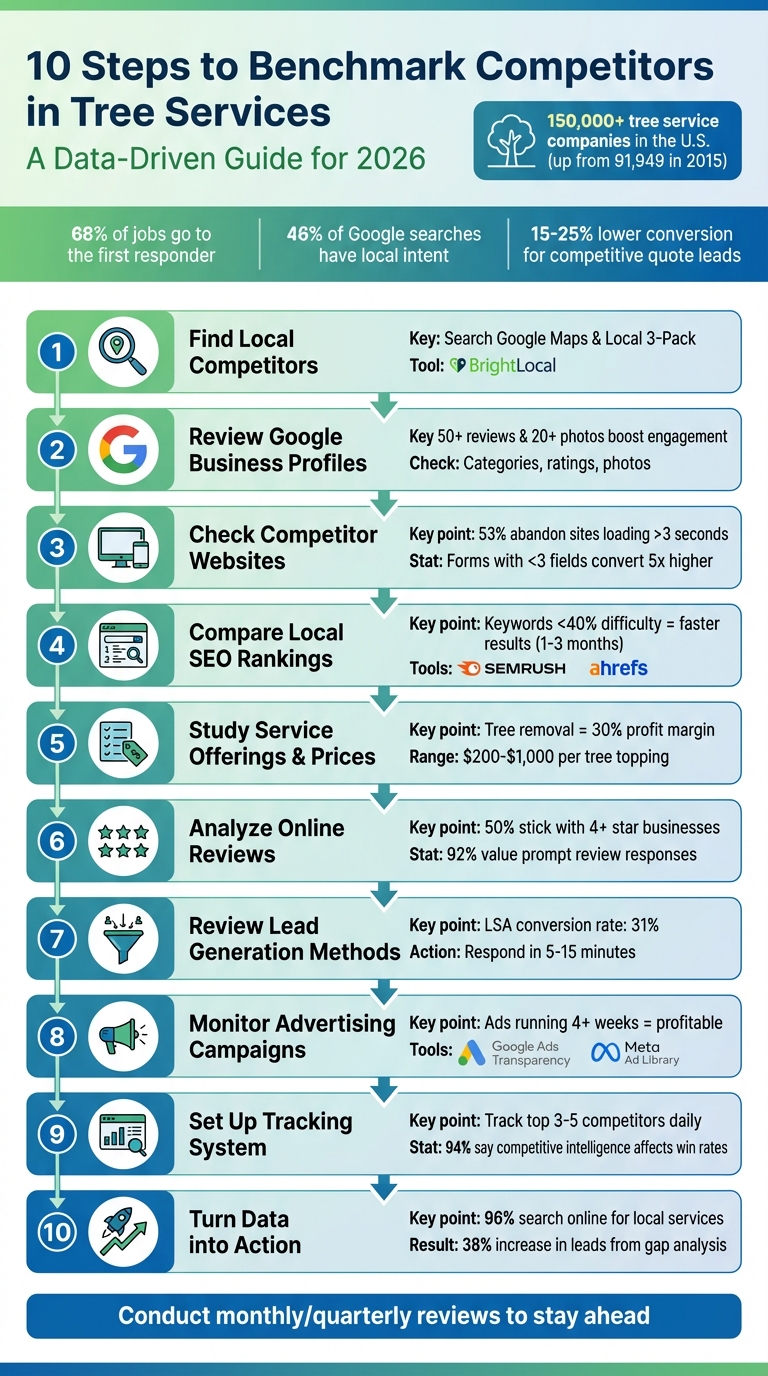
10-Step Competitor Benchmarking Process for Tree Service Companies
SEO Competitive Analysis: Steal Your Competitor’s SEO Keywords (DIY SEO)
sbb-itb-130a704
Step 1: Find Your Local Competitors
Your real competition isn’t just the local trucks you see driving around – it’s the companies showing up in Google search results.
Start by searching for your core services along with your city (e.g., "tree removal in Birmingham" or "stump grinding in Nashville"). Pay close attention to the Google Maps listings, the Local 3-Pack, and the organic results. The businesses appearing here are your main competitors in the digital space.
"If you’re not one of those three [in the Map Pack], you basically don’t exist." – Tree Service Marketing Solutions
Keep in mind that platforms like Yelp, Angi, and Houzz aren’t direct competitors – they’re additional marketing channels you can leverage. Instead, focus on tree service companies that consistently appear across multiple searches. If the same business shows up for terms like "tree trimming," "arborist services," and "tree removal," they’re a significant player you’ll want to keep an eye on.
Since proximity plays a big role in rankings, tools like BrightLocal’s Local Search Results Checker can help you see search results from different locations. Create a spreadsheet to track competitor names, URLs, Local Pack positions, and the keywords they’re ranking for. Once you’ve collected this data, you’ll be ready to analyze their Google Business Profile setups in Step 2.
Step 2: Review Google Business Profile Setup
Once you’ve identified your main competitors, it’s time to dive into their Google Business Profiles. Considering that nearly 46% of all Google searches have local intent, analyzing these profiles can reveal useful insights and guide you in refining your own, much like choosing between local SEO and paid ads for your growth strategy. This step lays the groundwork for improving specific profile elements.
Start by examining their business name and categories. Check if competitors are using their actual business names rather than stuffing them with keywords. Take note of their primary category – often "Tree Service" – and any additional ones, such as "Arborist", "Stump Removal Service", or "Emergency Tree Service". If a competitor sticks to just one category, you may have an edge by including relevant secondary categories on your profile.
Next, shift your focus to customer engagement and visual appeal. Look at the number of reviews they’ve received, their average ratings, and highlighted attributes like "professionalism" or "responsiveness." For example, a business with 50 reviews and a 4.7-star rating generally holds more weight than one with only 8 perfect reviews. Check how many photos they’ve uploaded – 20 or more high-quality images can significantly boost engagement. If a competitor has fewer than 10 photos, consider exceeding that number to stand out.
Also, review their service areas, business hours, and how often they post updates on Google. Pay attention to the towns or counties they list. Posting weekly can demonstrate activity and relevance. Finally, take a look at their Q&A section. This can highlight common customer concerns or areas where information might be lacking.
To stay organized, create a comparison table for your top three competitors. This will give you a clear benchmark and make it easier to spot opportunities to improve your own Google Business Profile.
Step 3: Check Competitor Websites
After reviewing Google Business Profiles, the next step is to dive into competitor websites. These sites can offer valuable insights into their conversion strategies and overall digital approach. A sleek, modern design often reflects a strong focus on marketing, while an outdated site might signal an opportunity for you to shine.
Start by assessing their load speed and mobile compatibility. Use tools like Google PageSpeed Insights to test your competitor’s URLs and compare performance scores. Remember, 53% of users abandon a website if it takes more than three seconds to load. If their site is slow or clunky on mobile, prioritize making your own site faster and more responsive. Test their website on multiple devices to see how user-friendly it is and ensure that important elements, like navigation and calls-to-action, remain accessible across platforms.
Next, take a closer look at their conversion pathways. Check for essential website features like "Click to Call" buttons that are easy to use on mobile. Evaluate their contact forms – how many fields do they require? Research shows that forms with fewer than three fields can convert up to five times higher than longer ones. If their forms or quote request process feel cumbersome, it’s a chance for you to simplify and improve your own.
Credibility is another critical factor. Look for trust signals on their site, such as ISA Certified Arborist badges, insurance information, customer testimonials, or professional memberships. These elements help build confidence with potential customers. Also, review their content strategy. Are they targeting high-value keywords like "Emergency Tree Removal" or "Stump Grinding"? Do they regularly publish blogs or guides that could drive organic traffic? These clues can reveal how they’re positioning themselves in the market.
Lastly, analyze their lead generation process. Fill out their contact form or sign up for their newsletter to experience their funnel firsthand. Do they send an automated email right away? How polished and professional is their follow-up? These details can highlight areas where you can refine your own approach, ensuring you turn more visitors into loyal customers.
Step 4: Compare Local SEO Rankings
Once you’ve reviewed competitor websites, the next step is to dive into local SEO rankings. This analysis uncovers which keywords are driving traffic to your competitors and highlights areas where you might be falling short. It’s a natural extension of the insights you gathered during your competitor website review.
Tools like SEMrush and Ahrefs are essential for this step. Start with SEMrush’s "Keyword Gap" tool to compare your website against up to five competitors. Focus on the "Missing" filter to pinpoint high-value keywords you’re not yet targeting. For example, phrases like "emergency tree removal [City]" or "stump grinding near [Landmark]" can bring in highly targeted, local traffic. Ahrefs offers a similar feature with its "Content Gap" tool, which also highlights keywords where competitors rank in the top 10 search positions.
"Competitor keywords represent terms that are already working for other businesses in your space." – Ana Camarena, Organic Content Lead, Semrush
Next, review competitors’ top-performing pages to identify what’s working for them. SEMrush and Ahrefs both provide "Top Pages" reports, showing which pages generate the most organic traffic. For instance, if a competitor’s "emergency tree removal" page is pulling in thousands of visits monthly, it’s a clear signal to optimize your content in that area. Additionally, explore their paid keywords using the "Advertising Research" tab in SEMrush or the "Paid Search" section in Ahrefs. High CPC keywords often indicate terms that convert well, making them worth your attention.
Pay close attention to keyword difficulty scores. Keywords with difficulty ratings above 70% are harder to rank for and may take six months or more to show results. On the other hand, low-competition keywords – those with difficulty scores under 40% – can deliver results faster, often within one to three months. For instance, if "tree removal" feels too competitive, use SEMrush’s Keyword Magic Tool to uncover long-tail alternatives like "affordable stump grinding near [Landmark]."
Finally, check whether competitors dominate Local 3-Pack results or Featured Snippets for terms like "tree trimming near me." These prominent search features capture a large share of clicks, providing a significant advantage in local SEO. By analyzing these elements, you can refine your strategy and improve your visibility in local search results.
Step 5: Study Service Offerings and Prices
Take a close look at your competitors’ service offerings and pricing. This step helps you pinpoint service gaps and evaluate whether your pricing is in line with the market or needs adjustment.
Start by listing the main services featured on competitors’ websites and Google Business Profiles. Most tree service companies highlight offerings like tree removal, trimming, pruning, stump grinding, and emergency storm response. Pay attention to what they don’t provide – if competitors in your area lack specialized arborist services or 24/7 emergency response, this could be your chance to stand out. Also, check their profile categories for niche services they might be overlooking. This analysis can uncover opportunities for you to fill unmet needs.
Next, focus on pricing. While exact prices are rarely listed, you can gather insights through mystery shopping. Call competitors for quotes and request brochures to understand their pricing strategies and sales process. Another option is to reach out to tree services in similarly sized cities in other states – they’re often more open about pricing since you’re not a direct competitor. For instance, tree topping typically costs between $200 and $1,000 per tree, while tree removal often generates a 30% profit margin.
"Pricing too low can hurt your credibility as being a business that provides high-quality service, but pricing too high may result in more business for your competition." – Lauren Spiers
Consider offering tiered service packages, such as Basic, Intermediate, and Premium. If your competitors stick to single-option pricing, tiered packages can attract both budget-conscious customers and those willing to pay for premium service. Also, check if competitors provide resources like pricing guides or FAQs. These tools not only build trust but can also help justify higher rates. Lastly, pay attention to how quickly competitors respond to quote requests – responding within 5–15 minutes can set you apart, especially when competing for urgent, high-intent leads.
Step 6: Analyze Online Reviews and Ratings
Online reviews are a goldmine when it comes to understanding your competition and refining your strategy. Start by examining the volume and recency of reviews for your top competitors. Did you know that 50% of customers stick with businesses that have at least a four-star rating? On top of that, 67% of people prioritize recent reviews when making decisions. For example, a competitor boasting 100 reviews from 2020 might not seem as appealing as one with 30 fresh reviews from just the past three months.
Pay attention to both the total number of reviews and what’s called review velocity – the number of reviews a business gets in the last 90 days. A steady flow of recent reviews signals an active and engaged business. But be cautious if you notice a sudden spike in reviews; it could hint at questionable tactics like review gating.
Next, dive into the sentiments and recurring themes in these reviews. Look for patterns in complaints or praise. Keywords like "left debris", "slow response", or "rude crew" can tell you a lot about where competitors fall short. In the tree service industry, for instance, customers often zero in on safety, crew professionalism, and whether the company provides proof of insurance. If you notice frequent complaints about missed estimates or messy job sites, this is your chance to highlight your own strengths in reliability and attention to detail. These insights naturally lead to evaluating how competitors handle customer feedback.
Don’t overlook response rates and reply times, either. A whopping 92% of customers say that businesses that respond promptly to reviews demonstrate good customer service. Even more, 82% of people are more likely to choose a company that actively engages with reviewers. Interestingly, nearly half (46%) of customers aged 45–60 expect a response within 24 hours.
"A 4.6‑star rating with 20 recent reviews and thoughtful responses will outperform a 5.0‑star rating with only five reviews from last year" – Monica Hemingway, Founder of Tree Care Marketing Solutions
Finally, widen your scope by assessing reviews across multiple platforms. While Google hosted 64% of professionally managed reviews in 2020, don’t ignore sites like Yelp, Facebook, and the Better Business Bureau. For instance, if your competitors dominate on Google but have little presence on Yelp, this could be an opportunity for you to carve out a niche and attract those customers.
Step 7: Review Lead Generation Methods
Take a close look at how competitors generate leads and respond to inquiries. This analysis complements the earlier website evaluation, helping you pinpoint gaps in your strategy. Start by checking if local competitors display the "Google Guaranteed" badge in their Local Services Ads (LSAs). These ads appear at the very top of search results and have a conversion rate of about 31%, nearly triple that of traditional Google Ads.
Another feature to examine is the "Get Competitive Quotes" option, which allows homeowners to contact up to four tree service providers with a single click. While this is convenient for potential customers, these shared leads tend to convert 15–25% lower than standard LSA leads because users are often shopping around for the best price. Factors like proximity, review quality, response speed, and profile completeness influence how these leads are distributed. Test this feature by submitting a quote and timing how quickly competitors respond.
Expand your evaluation to include additional lead generation channels. Beyond digital methods, traditional offline strategies still hold value. For instance, vehicle wraps, yard signs at active job sites, and direct mail campaigns remain effective. Direct mail postcards, which cost between $0.50 and $1.00 each, can generate consistent leads, especially in neighborhoods where your trucks are already visible. On the digital side, platforms like Facebook and Instagram are ideal for targeting homeowners in specific zip codes with before-and-after photos, helping to build brand recognition.
Competitors also rely on third-party platforms like Thumbtack and Angi, where leads cost between $15 and $60 and are shared among multiple companies. On Thumbtack, quick responses are crucial – 68% of jobs go to the first responder. Top-performing businesses aim to reply within 5–15 minutes, as delays significantly reduce conversion rates.
"The competitive quotes feature changes the game for LSA lead quality. We’re seeing these leads behave more like cold inquiries than the warm leads traditional LSAs generate." – Panajota Gushkova, Paid Search Lead
Finally, assess how efficiently leads are followed up. Monitor the entire process, from initial contact to scheduling, to ensure quick conversions. Focus on providing clear scheduling options rather than vague calls to action. This approach can raise exclusive lead closures to 60–75%, compared to the industry average of 25–30%.
Step 8: Monitor Advertising Campaigns
Once you’ve gathered insights from lead generation, the next step is to keep a close eye on your competitors’ advertising campaigns. This can sharpen your market strategy and help you stay ahead.
By analyzing where and how competitors advertise, you can uncover which channels are delivering the best results for them. Tools like the Google Ads Transparency Center (adstransparency.google.com) and Auction Insights allow you to see active competitor ads, evaluate their impression share, and determine whether their top ad placements are driven by quality or just higher bids. Similarly, the Meta Ad Library provides a clear view of all current Facebook and Instagram ads, making it easier to identify trending messages and strategies.
The duration of an ad can also be a strong indicator of its effectiveness. Ads that run for more than four weeks are often profitable, as businesses tend to sustain campaigns that deliver solid returns. If a competitor’s ad has been live for several months, it’s likely been tested and optimized for success.
You can also use manual search techniques to gather insights into competitor targeting. For example, opening an incognito browser and searching for high-intent keywords like "emergency tree removal near me" can reveal which competitors consistently appear in top ad spots. Additionally, visiting a competitor’s website and exploring their service or pricing pages can trigger retargeting ads. These ads can give you a glimpse into the display networks and offers they are using.
"When you analyze competitor ads, you’re essentially getting a free education on what’s working in your industry." – Austin LeClear, Grow My Ads
Tracking competitor ad patterns monthly can also help you spot seasonal trends. For example, competitors might increase bids on terms like "storm damage cleanup" in the spring or promote "tree pruning" services in late autumn. Automating competitive intelligence can save significant research time – up to 85–95% – while delivering results like a 31% boost in click-through rates and a 6:1 return on investment within just three months. These insights can help you fine-tune your ad spend and outperform the competition, paving the way for effective tracking in the next step.
Step 9: Set Up a Tracking System
To keep tabs on competitor performance without drowning in data, it’s essential to establish a focused tracking system that prioritizes what truly impacts your tree service business.
Start by categorizing competitors into tiers: monitor your top 3–5 competitors daily, the next 5–10 weekly, and broader industry players monthly. For daily tracking, zero in on high-value areas like emergency tree removal pricing, stump grinding rates, and updates to Google Business Profiles rather than attempting to monitor entire websites. This method builds on insights from website, SEO, and ad monitoring, creating a well-rounded view of your competitive landscape.
Leverage competitor campaigns to shape your tracking system. Tools like Ahrefs or Semrush can help you monitor keyword rankings for terms such as "tree removal near me". For local visibility, BrightLocal tracks citations and Google Business Profile metrics, while Local Falcon provides detailed map-ranking insights down to the block level. Additionally, Visualping can notify you when competitors update pricing or service pages. Setting keyword alerts for terms like "pricing", "emergency", and "discount" can further highlight strategic shifts.
Once you’ve gathered your data, centralize everything into a single dashboard, such as Google Sheets or Notion. This dashboard should log details like the date of the change, the type of signal, a brief summary, and an impact score. This streamlined view allows your team to quickly determine whether a competitor’s move warrants immediate action or continued observation. According to Klue’s 2024 State of Competitive Intelligence Report, 94% of businesses believe competitive intelligence directly influences their win rates.
"The goal is to surface the 5% of competitor activity that directly affects your business decisions and filter out everything else." – Visualping Team
Implement a "Detect, Score, Act, Log" workflow. High-impact changes should trigger immediate responses and automated alerts to your sales and marketing teams. By turning raw data into actionable insights, this system positions your business to make smarter decisions and stay ahead of the competition.
Step 10: Turn Data into Action
Once you’ve gathered all your competitor data, the next step is to turn those insights into meaningful actions that drive results. Data is only useful when it leads to strategies that improve key metrics – like increasing calls and conversions.
Start by optimizing your Google Business Profile. Considering that 96% of consumers search online for local services, this is a critical area. If competitors are dominating the Map Pack, ensure your profile is fully completed. Add 1–2 geotagged photos each week and regularly update it with job posts. Also, double-check that your primary category is set to "Tree Service" instead of "Landscaper", as this simple tweak can significantly improve your local visibility. Enable Google Messaging and aim for response times between 5–15 minutes. Why? Because quick responses are the top factor for winning competitive quote leads.
Address keyword gaps by creating focused service pages. Instead of cramming everything onto your homepage, write 500–800 word pages for high-intent keywords like "emergency tree service" or "stump grinding". For better local reach, build city- or neighborhood-specific landing pages, rather than just adding a list of locations in your footer.
When it comes to lead generation, use this formula to evaluate your efforts: Average Job Value × Close Rate = Lead Worth. For example, if you’re buying shared leads at $15–$45 each with a 12–22% close rate, compare that to exclusive leads priced at $50–$120 but with 60–85% close rates. The latter may offer a better return on investment. Keep in mind that competitive quote leads often convert 15–25% lower than standard leads due to price shopping, so track these separately.
"The ‘cost per lead’ number is meaningless without context. A $25 shared lead that closes at 15% is more expensive than a $75 exclusive lead that closes at 70%." – Kevin Shea, Sales Manager, Home Service Direct
Finally, create a 12-month roadmap to guide your efforts. Focus on lead generation during the first three months. From months 4–9, balance paid ads with SEO strategies. By month 10, shift toward organic growth and referrals. This phased approach ensures you’re not just reacting to competitors but building long-term advantages that grow over time. By following these steps, you can transform the insights from this guide into real, measurable results.
Conclusion
Competitor benchmarking goes beyond just keeping tabs on what others are doing – it’s about creating a focused, data-backed strategy that directs your efforts toward what truly works. As Ryan Warner, a tree service business owner, explains: "I can look and see I’m spending this dollar and I’m getting this in return for it. So again… you take that guesswork out of doing marketing!" In today’s crowded marketplace, success hinges on understanding where your competitors excel and where they fall short.
By following these steps, you can uncover market gaps, refine your online presence, and attract more customers. The proof is in the results: one dealer who increased visibility in areas where competitors were absent saw a 38% increase in leads. This shows how informed positioning, based on competitor analysis, can lead to tangible growth.
Keep in mind, benchmarking isn’t a one-time task. The local SEO landscape is always evolving, and strategies that work now might need tweaking in just a few months. Think of competitor analysis as a regular check-up – conduct monthly or quarterly reviews to stay ahead of shifts in the market and new trends. This approach allows you to move from reactive decisions to a forward-thinking, strategic game plan.
Take these insights and consider partnering with Tree Company Leads (https://treecompanyleads.com) to set the foundation for long-term growth.
FAQs
Which competitors should I track first?
Start by actively monitoring competitors who are leveraging digital marketing tools like local SEO, website design, and advertising. Pay close attention to local tree service businesses that stand out in your area, especially those utilizing Google My Business, running paid ads, or maintaining a strong presence on social media.
Focus on businesses that rank well in local search results or are clearly investing in marketing optimization tools. By analyzing their efforts, you can uncover gaps and find opportunities to improve your own marketing strategy.
What metrics matter most in local competitor benchmarking?
When evaluating how your tree service business stacks up against local competitors, focus on these key metrics:
- Google Business Profile performance: Check how complete their profiles are, the number and quality of reviews they have, and how well they’ve optimized for relevant keywords.
- Website engagement: Look at their website design, how mobile-friendly it is, and how quickly it loads. These factors directly impact user experience.
- Local SEO rankings: Pay attention to how they rank for local search terms that matter most to your audience.
- Advertising ROI: Consider metrics like cost per lead and the volume of leads they generate through paid campaigns.
- Customer reviews: Take note of the feedback they receive – both positive and negative – as it reflects customer satisfaction and areas where they excel (or fall short).
By keeping an eye on these areas, you can better understand your own position in the market and discover ways to grow.
How do I turn competitor data into a 90-day plan?
Start by diving into your competitors’ strategies. Identify the key players in your industry, explore their services, and study their marketing efforts. Tools like a SWOT analysis (Strengths, Weaknesses, Opportunities, and Threats) can help you break down what they’re doing well and where they might be falling short.
Once you’ve gathered this data, set specific, measurable goals based on your insights. For example, you might aim to increase your brand’s visibility or tap into a new customer segment. From there, outline actionable strategies to achieve these goals.
Make sure to check your progress every 30 days. Use these reviews to see what’s working, what’s not, and make any necessary adjustments to keep your plan on track and ahead of the competition.
Related Blog Posts

Tree service companies need marketing strategies tailored to their unique challenges. Generic marketing agencies often miss the mark when it comes to connecting arborists with homeowners who need services like emergency tree removal or pruning. This is where specialized arborist marketing agencies excel, focusing on:
- **Local SEO vs. PPC: Optimizing Google Business Profiles, service-area pages, and reviews to improve visibility in local search results.
- Custom Web Design: Creating fast, mobile-friendly websites with features like "Get a Quote" buttons, trust signals, and CRM integration.
- PPC Advertising: Running targeted ads for high-value keywords like "emergency tree removal", ensuring exclusive, high-quality leads.
With 97% of consumers searching online for local services, arborist marketing agencies help tree care businesses stand out by addressing industry-specific needs. From managing seasonal slowdowns to ensuring fast lead responses, these agencies provide tools and strategies to turn online searches into booked jobs. For tree service businesses, this focused approach means measurable growth and a competitive edge.
How to Build Your 2026 Tree Service Marketing Plan | Tree Care Marketing Solutions
sbb-itb-130a704
Main Services Provided by Arborist Marketing Agencies
Arborist marketing agencies specialize in turning online searches into paying customers. Their expertise centers on three primary areas: custom web design, local SEO, and PPC advertising to drive tree service lead generation.
Custom Web Design for Tree Service Companies
A well-designed website works as a 24/7 salesperson for tree care businesses. With most searches happening on mobile devices, these websites need to load in under three seconds. Agencies create designs focused on conversions, featuring standout elements like "Get a Quote" buttons, click-to-call functionality, and trust signals such as ISA certifications and BBB accreditation prominently displayed above the fold.
Additional features may include:
- Before-and-after photo galleries
- Automated review widgets
- Service-area landing pages
- High-definition drone footage as hero videos
Integrating CRMs like Jobber or ServiceTitan streamlines lead management, automatically routing inquiries into the company’s workflow. Considering that 70% of customer research happens before they even make contact, the website must answer key questions about insurance, pricing, and emergency services right away. While a polished website is vital, being visible in local search results is just as important.
Local SEO for Arborists
Local SEO helps tree service companies secure top spots in local search results, particularly in the Google Map Pack – the set of three businesses displayed when users search for terms like "tree removal near me." Agencies achieve this by optimizing Google Business Profiles, publishing regular posts, ensuring consistent NAP (Name, Address, Phone) details across directories like Yelp and Angi, and aiming for 3–5 new Google reviews monthly.
Key strategies also include:
- Creating service area pages with location-based keywords and references to local landmarks
- Using "LocalBusiness" schema markup
- Enhancing mobile speed to meet Core Web Vitals standards
These efforts can produce conversion rates of 12–18%, often outperforming certain paid channels. Agencies further boost results by building backlinks from local businesses and industry-specific platforms like the ISA’s "Find an Arborist" directory.
PPC Advertising and Lead Generation
To complement web design and SEO, PPC advertising offers immediate visibility and high-value leads. Paid campaigns, such as Google Search Ads, target high-intent keywords like "emergency tree removal", using precise match types to focus budgets on the most relevant prospects. Agencies also manage Google Local Services Ads, which feature the "Google Guaranteed" badge and operate on a pay-per-lead model.
Some agencies incorporate AI tools to score lead quality, prioritizing large-scale removal jobs over smaller trimming tasks. A fine-tuned PPC strategy can generate around 50 qualified leads per month, resulting in 15–25 booked jobs – a quick and effective way to boost revenue.
Tree Company Leads Service Plans Comparison
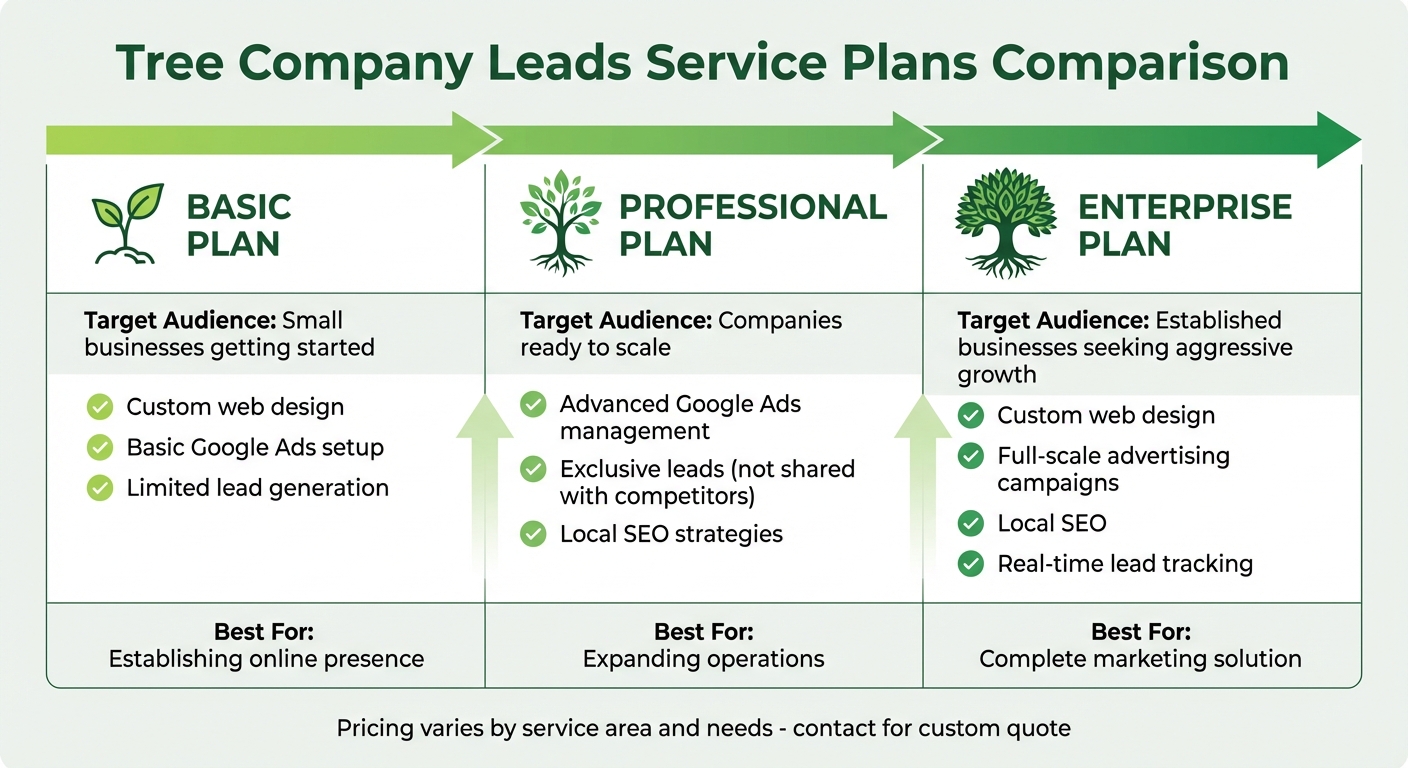
Tree Company Leads Service Plans: Basic vs Professional vs Enterprise Comparison
Basic, Professional, and Enterprise Plans Compared
Tree Company Leads offers three tailored service plans designed to meet the needs of tree service companies, no matter their size or stage of growth.
The Basic Plan focuses on establishing an online presence. It includes custom web design, a basic Google Ads setup, and limited lead generation – perfect for smaller businesses looking to get started without taking on too much.
For companies looking to expand, the Professional Plan steps things up with advanced marketing tools. This plan centers on advanced Google Ads management, exclusive leads (delivered only to your business, not shared with competitors), and local SEO strategies. It’s a great option for businesses ready to scale up their operations.
At the top tier, the Enterprise Plan offers a complete marketing solution. It combines custom web design, full-scale advertising campaigns, local SEO, and real-time lead tracking. This plan is aimed at established businesses seeking aggressive growth and a fully integrated marketing approach.
Pricing depends on your service area and specific needs, so it’s best to reach out to Tree Company Leads for a tailored quote. Each plan builds on the previous one, giving businesses the flexibility to start small and upgrade as they grow. These plans provide a solid foundation for improving your online presence – stay tuned for tips on taking your visibility even further.
How to Increase Visibility for Your Tree Service Business
If you’re looking to attract more qualified leads and increase your local presence, a simple website won’t cut it. Tree care businesses need a targeted strategy to connect with local homeowners right when they’re searching for help. The following approaches can help you stand out in local search results, on social media, and through customer reviews.
Local SEO: Ranking Higher in Local Searches
Your Google Business Profile is crucial for getting noticed locally. Ensure your business name, address, and phone number are consistent across all online platforms – small inconsistencies like "St." versus "Street" can negatively affect your rankings. Choose accurate categories such as "Tree Service" or "Arborist", and upload clear, high-quality photos of your team and equipment to engage potential customers.
For better reach, create separate landing pages for each area you serve. Use specific keywords like "emergency tree removal [City]" or "tree trimming near me", and include references to local landmarks or unique regional challenges. For instance, if you work in coastal areas, you could highlight storm preparation services tailored to that environment.
Customer reviews are a major factor in local rankings. Aim for a steady stream of 3–5 new reviews each month rather than sporadic bursts. Send review requests within 24–48 hours of completing a job, and make it a priority to respond to all feedback within 24 hours. This level of activity signals to Google that your business is active and reliable.
Your website’s mobile performance is another critical factor. A site that takes longer than three seconds to load can see a 32% increase in bounce rates. Tools like Google PageSpeed Insights can help you identify issues, such as oversized images, and fix them to improve loading times.
Once you’ve laid a solid SEO foundation, social media can help amplify your visibility even further.
Social Media Marketing for Tree Service Companies
Platforms like Facebook and Instagram are excellent for connecting with local homeowners in need of tree services. Visual content is incredibly powerful – it’s shared 40 times more often than text alone. Focus on content like "before-and-after" photos, time-lapse videos of tree removals, and drone footage of your completed projects to showcase your expertise.
Educate your audience with helpful tips to build trust. Share posts about spotting root rot, pruning schedules, or storm damage prevention. Align your content with seasonal changes, such as storm preparation in spring or pruning advice in the fall. This positions your business as the go-to expert when homeowners need help.
"Social media management is no longer a luxury, it’s the virtual front yard where you build the confidence that earns the call." – Marketing 360
Consistency is key – aim to post 4–5 times per week on your main platforms. Respond to messages quickly to enhance your visibility and show reliability. When sharing project photos, use the "Before/Action/After" method: take a "before" photo from a fixed angle, capture an "action" shot of your team working safely, and finish with an "after" photo from the same angle to highlight the transformation.
While social media generates interest, maintaining a strong online reputation is what seals the deal.
Creating a Strong Online Reputation
Online reviews play a huge role in local service decisions – 95% of customers rely on them. For tree care businesses, trust is everything. Homeowners value proof of insurance, real project photos, arborist certifications, and reviews that highlight safety practices more than just pricing. This is because tree work is often seen as risky.
The speed and consistency of new reviews – known as review velocity – affect your visibility in Google Local Services Ads. Regularly collecting fresh reviews can sometimes matter more for rankings than your ad budget. To encourage reviews, send follow-up texts with direct links within 24 hours of job completion.
Always respond to reviews professionally, whether they’re positive or negative. Thank customers for good feedback, and address any complaints publicly while offering to resolve issues privately. This shows potential customers that you’re committed to quality and willing to address concerns.
Keep in mind that 70% of customers research tree services before ever reaching out. Your online reputation acts as your digital storefront, building the trust homeowners need to feel confident about calling you.
These strategies, when combined, can help position your tree service business for long-term success and growth.
Conclusion: Why Tree Service Businesses Need Specialized Marketing
The tree care industry is expanding rapidly, with the market reaching $1.3 billion in 2024 and projected to grow to $2.51 billion by 2029. This kind of growth demands a well-thought-out marketing approach. With 97% of consumers now searching online for local services, relying solely on word-of-mouth isn’t enough anymore. Generic marketing often misses the mark because it doesn’t address the specific challenges of tree care businesses – like seasonal fluctuations or the technical details of ISA certifications and emergency storm services. These realities highlight the importance of using tailored strategies, such as custom websites and carefully targeted PPC campaigns, to stay competitive.
Specialized Georgia tree service marketing agencies simplify the process. They already understand the difference between structural pruning and hazardous tree removal, or how to craft ad copy for storm-related calls versus routine maintenance. These agencies know which keywords drive results, how to maximize Google Local Services Ads for the "Google Guaranteed" badge, and how to create campaigns that align with seasonal demand. The payoff? Tree care companies working with specialized agencies often experience up to 60% faster lead growth.
But it’s not just about the number of leads – it’s about quality. Specialized agencies focus on delivering exclusive leads tailored to your business, along with tools to measure exactly how much revenue each marketing dollar generates. As Ryan Warner from Above The Rest Tree Service explains:
"I can look and see I’m spending this dollar and I’m getting this in return for it. So… you take that guesswork out of doing marketing!"
Key Takeaways for Tree Service Businesses
Specialized marketing turns industry-specific challenges into consistent growth opportunities. By leveraging strategies like Local SEO, PPC, and reputation management, businesses can create predictable systems for lead generation and resource planning. For example, a system producing 50 qualified leads monthly often translates into 15–25 booked jobs. That kind of reliability transforms marketing from a risky expense into a dependable growth tool.
Speed, accuracy, and trust are the cornerstones of success. Specialized agencies focus on mobile-friendly websites, fast-loading pages, and automated follow-ups. They understand that homeowners care more about proof of insurance, arborist certifications, and real project photos than generic stock images. And with 83% of tree care businesses reporting better results from specialized agencies, it’s clear that partnering with marketers who understand the industry gives you a significant edge. In a field where trust and expertise drive decisions, working with professionals who "get it" can make all the difference.
FAQs
How long does it take to see results from local SEO?
Local SEO usually requires 3 to 6 months to deliver noticeable improvements in search rankings and lead generation. However, the timeline can differ based on factors such as the level of competition in your area and how well your strategies are executed.
What should my tree service website include to get more calls?
If you’re looking to get more calls for your tree service business, your website needs to work as hard as you do. Start by focusing on local SEO. Use keywords like “tree removal near me” on your service pages to attract nearby customers actively searching for your services.
Make sure your contact information is easy to find – display your phone number prominently at the top of the page. Add clear, eye-catching buttons like “Call Now” or “Get a Free Quote” to encourage visitors to take action immediately. And don’t forget about mobile users! A mobile-friendly design ensures potential customers can easily navigate your site and contact you while on the go.
Finally, integrate your Google My Business profile into your website. This can significantly boost your visibility in local search results, making it simpler for people in your area to find and connect with you.
How do I track which leads turn into real jobs?
To figure out which leads actually become jobs, you’ll need a system to track inquiries and their results. A lead tracking tool, like a CRM system or marketing software, can do the heavy lifting here. These tools let you monitor how ads are performing and how leads are converting.
Make sure you’re tracking all lead sources – whether they come from phone calls, form submissions, or clicks. Having this data gives you a clear view of your return on investment (ROI) and helps fine-tune your marketing strategies.
Related Blog Posts
Finding the right marketing agency for your tree service business can be the key to growing your customer base and staying competitive. Here’s what you need to know upfront:
- Specialized agencies deliver better results: Tree service marketing requires unique strategies like seasonal campaigns for storm emergencies or pruning services. General agencies often miss these nuances.
- Focus on local SEO and exclusive leads: With 70% of customers researching online, optimizing your Google Business Profile and securing exclusive leads can boost conversions by 30%.
- Set clear goals: Whether you want fast leads through PPC or long-term growth via SEO, define your objectives and budget (5%-10% of revenue is typical).
- Evaluate expertise and case studies: Look for agencies with proven results in the tree care industry – like increasing lead volumes or tripling revenue for similar businesses.
- Ask the right questions: Ensure they offer transparent reporting, account ownership, and strategies tailored to your local market.
Partnering with a specialized agency can help you stand out in a $2.51 billion industry projected to grow 14% annually. Keep reading for a step-by-step guide to choosing the best fit for your business.
🌳💵 Tree Service PPC Strategy That Literally Prints Cash – See How We Do It!
sbb-itb-130a704
Define Your Marketing Goals and Needs
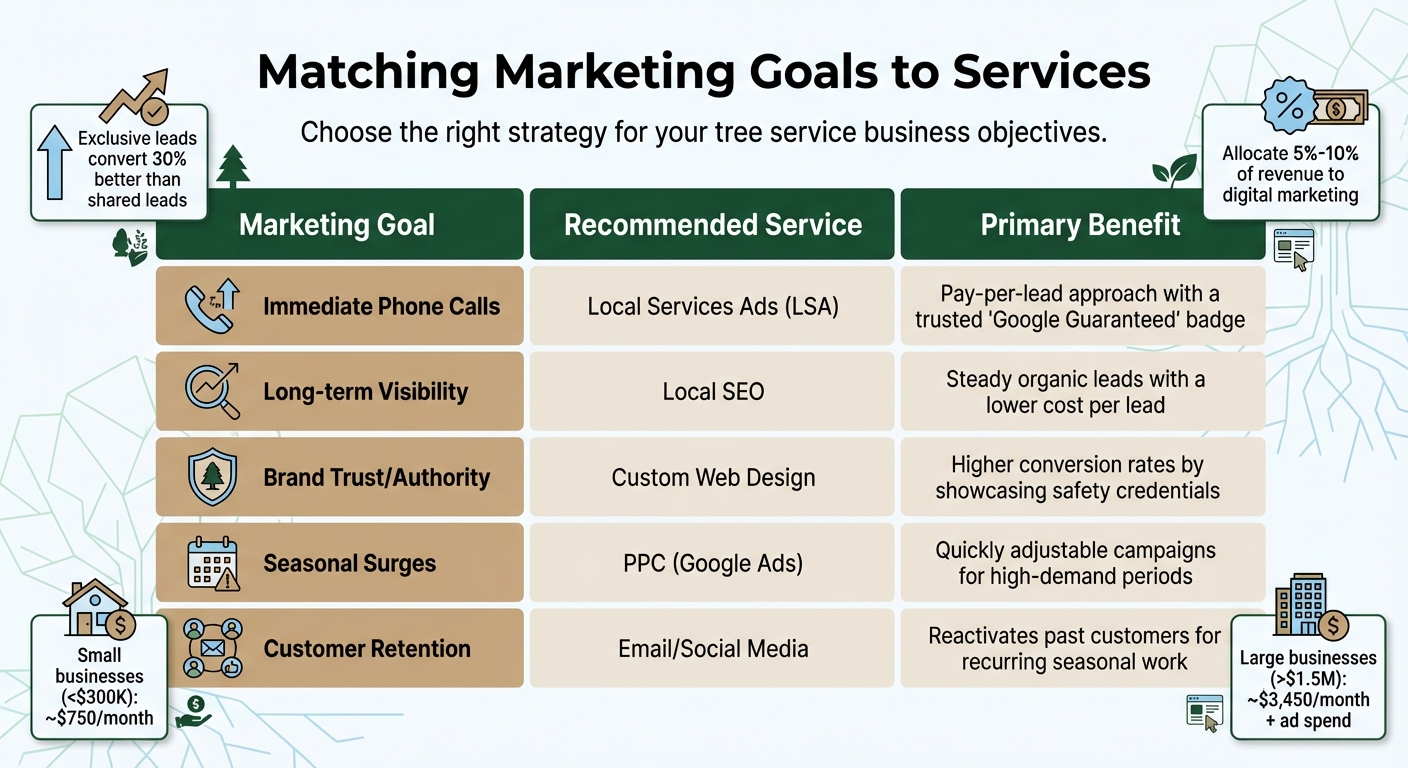
Tree Service Marketing Goals and Recommended Services Comparison
To create a successful marketing strategy, you need to start with clear, measurable goals. Vague objectives like "get more customers" won’t cut it. Instead, focus on revenue-driven targets that align with your business’s current stage and growth ambitions. For example, a tree service company earning under $300,000 annually will need a different approach than one generating $1.5 million or more. Smaller businesses often see great results by building a strong Google Business Profile and gathering reviews, while larger operations might prioritize regional expansion. On average, tree service businesses allocate 5% to 10% of their revenue to digital marketing to stay competitive.
Set Clear Objectives for Your Tree Service Business
Your first step is deciding whether your focus is immediate results or long-term growth. If you need leads fast – say, to fill gaps in your schedule next week – services like Google Ads for tree services or Local Services Ads (LSAs) are great options. On the other hand, Search Engine Optimization (SEO) builds organic authority, creating a steady stream of leads over time.
"A PPC campaign for emergency tree removal in storm season demands lightning-fast targeting… Meanwhile, a spring pruning campaign focuses on awareness, seasonal SEO, and nurturing leads over weeks."
- Tim Brown, Founder, Hook Agency
If exclusive leads are a priority, make that clear when choosing an agency. Exclusive leads often convert 30% better than shared ones. Another key objective should be focusing on conversion, not just website traffic. Thousands of visitors don’t mean much if they aren’t calling your business or filling out contact forms. Improving your website’s ability to turn visitors into paying customers should be a top priority.
Lastly, consider your business’s seasonality. During storm seasons, your marketing might focus on high-volume emergency leads, while quieter months could shift toward maintenance services.
Prioritize Services That Match Your Goals
Once your objectives are clear, choose services that align with them. For immediate results, look for agencies that specialize in PPC, LSAs, and lead automation. If you’re aiming for long-term growth, focus on strategies like SEO, content creation, and video marketing. High-ticket growth may require custom strategies, while businesses looking for all-in-one solutions often benefit from full-service agencies that handle everything from SEO to web design.
| Marketing Goal | Recommended Service | Primary Benefit |
|---|---|---|
| Immediate Phone Calls | Local Services Ads (LSA) | Pay-per-lead approach with a trusted "Google Guaranteed" badge |
| Long-term Visibility | Local SEO | Steady organic leads with a lower cost per lead |
| Brand Trust/Authority | Custom Web Design | Higher conversion rates by showcasing safety credentials |
| Seasonal Surges | PPC (Google Ads) | Quickly adjustable campaigns for high-demand periods |
| Customer Retention | Email/Social Media | Reactivates past customers for recurring seasonal work |
Budgeting is another important aspect. Smaller businesses (under $300K in revenue) may spend around $750/month, while larger companies (over $1.5M in revenue) might invest $3,450/month or more, plus ad spend. Before signing with any agency, track your current metrics – like lead volume, closing rates, and revenue – to establish a baseline. This will help you measure whether the agency is delivering a solid return on investment.
As Ryan Warner, a tree service business owner, put it:
"What we’ve realized through working with you and your team is that you can quantify marketing returns. I can look and see I’m spending this dollar and I’m getting this in return for it."
- Ryan Warner, Owner
Clear objectives not only help you choose the right agency but also set the foundation for measuring success.
Research and Shortlist Specialized Agencies
Once your objectives are set, it’s time to find agencies that genuinely understand the tree service industry.
Focus on Industry-Specific Experience
General marketing agencies often rely on broad strategies that overlook the unique needs of tree care businesses. But specialized agencies know the difference between promoting pruning services and hazardous tree removal. They also understand how critical it is to launch immediate-response campaigns for storm-related calls.
Consider agencies founded or staffed by licensed arborists. These teams already speak your language, cutting down on the time spent explaining industry specifics. As Monica Hemingway, Founder of Tree Care Marketing Solutions, says:
"Tired of wasting time and money explaining tree care to your marketing agency? Hire the agency staffed by arborists!"
This expertise allows these agencies to hit the ground running, using data-driven strategies tailored to the tree care market. They’re skilled at targeting seasonal demands, optimizing for high-value jobs like emergency removals, and incorporating industry-specific keywords for better results.
Evaluate Case Studies and Success Stories
Request case studies that highlight measurable outcomes like revenue growth, lead generation, and job bookings – not just metrics like website traffic or ad impressions. A solid agency will back their claims with numbers that matter.
Take Leads4Build, for example. Between June and October 2025, they partnered with a new tree service provider in Greater Boston that had no digital presence. By creating optimized landing pages and running Google and Facebook ads, the agency generated over 280 monthly leads at $40 per lead. This effort resulted in 65+ completed jobs and helped the solo arborist grow into a five-person crew. According to the business owner:
"I was genuinely worried we wouldn’t even get off the ground as a new business. Now my biggest challenge is hiring qualified arborists fast enough to keep up with demand."
Another example is Tree Service Digital, which worked with Eco Tree Experts in West Palm Beach, FL, over 32 months ending in January 2024. By combining SEO, Google Maps optimization, and Local Service Ads, they helped the client triple their annual revenue from $1 million to $3 million.
When reviewing case studies, ensure the agency provides exclusive leads to maintain strong conversion rates. Confirm that they allow you to own your advertising accounts and offer transparent, real-time dashboards to track ROI. These benchmarks can help you gauge whether an agency can deliver the results you’re aiming for.
Evaluate Agency Expertise and Capabilities
Once you’ve set clear goals and narrowed down your list of potential agencies, it’s time to dive into their expertise. Specifically, look at their skills in local SEO, paid advertising, and exclusive lead generation – three essential areas for driving tree service leads.
Examine Their Local SEO Strategies
For tree service businesses, local SEO is the foundation of steady growth. With 97% of consumers turning to online searches for local services, your agency must do more than just participate in local search – they need to dominate it.
Start by asking about their approach to optimizing your Google Business Profile. An experienced agency will prioritize selecting the right primary category (like "Tree Service" or "Arborist"), maintaining a steady flow of 3–5 new Google reviews each month, and publishing weekly posts with photos. Why photos? Posts with images see 42% more engagement than those without. The goal here is to secure a spot in Google’s "Local Pack", the map section that appears at the top of search results.
Next, check their strategy for NAP (Name, Address, Phone) consistency. Your business details should be accurate across 40–60 high-authority directories, including niche platforms like TreeBuzz or ISA’s "Find an Arborist" (common for a Virginia tree service marketing agency). Dedicated service area pages optimized for mobile are also critical – 73% of tree service searches happen on mobile devices. Make sure your website loads in under three seconds on 4G networks, as speed plays a big role in Google’s rankings.
A strong local SEO plan can yield 8–12% more organic leads each month, with conversion rates hovering between 12–18%. These aren’t just numbers – they directly translate to more booked jobs and revenue. Once local SEO is solid, it’s time to evaluate their PPC strategies.
Assess Their Google Ads and PPC Campaigns

Pay-per-click (PPC) advertising delivers instant visibility, but it requires precision to ensure your budget isn’t wasted. In the tree service industry, competition is fierce – clicks can cost over $40, and the average cost per lead often surpasses $100.
A specialized Florida tree service marketing agency will focus on high-intent keywords like "tree removal near me" or "emergency tree service", steering clear of broader terms such as "how to trim a tree". They should also segment campaigns by specific services – like stump grinding or pruning – to ensure ads are relevant. Ask how they use negative keyword lists to filter out irrelevant searches like "jobs", "equipment", or "DIY".
Robust call tracking and CRM integration are non-negotiable. These tools help connect your ad spend directly to booked jobs. On average, tree service PPC campaigns convert at around 5%.
Landing pages are another critical piece. While standard websites might convert about 10% of visitors, well-designed landing pages for tree services can achieve conversion rates of 20% or more. Chris Down from Downey Marketing puts it best:
"Every distraction on your website is another opportunity for someone to leave without converting into a lead."
Give PPC campaigns 2–3 months to fine-tune keywords and targeting. Insist on keyword-level tracking so you can pinpoint exactly which terms are driving calls and jobs.
Determine Their Lead Generation Approach
Once local SEO and PPC are in place, the focus shifts to converting visibility into exclusive leads. Quantity matters, but quality is just as important. Shared leads can reduce conversion rates by 30% or more, so confirm that the agency delivers exclusive leads – ones not sold to multiple contractors.
Look for agencies that combine Google Local Services Ads (LSAs) with traditional search ads. LSAs use a pay-per-lead model instead of pay-per-click, and they come with the "Google Guaranteed" badge, which helps build trust instantly. These ads appear at the very top of search results, capturing high-intent customers before they even consider competitors.
Exclusive, geo-targeted leads typically convert 30% better than shared ones. Make sure the agency offers real-time lead tracking and transparent dashboards so you can monitor your ROI at any time.
Finally, confirm account ownership. You should retain full ownership of your Google Ads, Analytics, and LSA accounts. This ensures that all your data and campaign history remain with you, even if you decide to switch agencies.
A well-executed lead generation system can completely transform your business pipeline. For example, generating 50 qualified leads a month could result in 15–25 booked jobs. That’s the kind of impact you want from the right agency.
Ask the Right Questions During Consultations
You’ve narrowed down your options, and now it’s time to dig deeper. The right questions can help uncover whether an agency truly understands your business and can deliver measurable results. This step ensures you’re partnering with a team that knows the tree service industry inside and out – and can account for every dollar spent.
Inquire About Customization for Local Markets
Kick things off by asking: "What specific strategies do you use to target local customers for tree service businesses in South Carolina, and how do you tailor these strategies to my market area?" This question helps you avoid cookie-cutter approaches and reveals the agency’s ability to craft campaigns that resonate with your specific audience.
A strong agency will dive into strategies like local optimization, emphasizing how they adapt campaigns to suit your service areas and account for seasonal changes. Tim Brown from Hook Agency puts it this way:
"A PPC campaign for emergency tree removal in storm season demands lightning-fast targeting, local ad tweaks, and urgency-driven copy. Meanwhile, a spring pruning campaign focuses on awareness, seasonal SEO, and nurturing leads."
If they can’t explain how they’d adjust campaigns for something like spring pruning versus fall storm prep, that’s a red flag. Additionally, confirm they create dedicated landing pages for each service and location. Sending paid traffic to a generic homepage is a major misstep.
Once you’ve covered local strategies, shift the conversation to how they measure and report campaign success.
Explore Their Performance Tracking Methods
To gauge how results-oriented an agency is, ask: "How do you track and report the performance of marketing campaigns, and what tools or metrics do you use to ensure transparency and accountability?" This will help you identify whether they focus on meaningful outcomes instead of vanity metrics like clicks or impressions.
The best agencies will mention tools like centralized dashboards that consolidate all leads – calls, contact forms, chats, texts, and messages – in one place. They should also use call tracking systems and keyword-level tracking to show which search terms are driving actual booked jobs.
Make sure they set baseline metrics at the beginning to measure progress accurately. Ask about their reporting schedule – monthly reports are a minimum, but real-time tracking is even better. Lastly, confirm that you own your accounts. This means retaining full ownership of your Google Ads, Analytics, and Local Services Ads accounts, which ensures transparency and control.
For example, Tree Company Leads offers real-time lead tracking with transparent dashboards, enabling you to monitor ROI and lead quality at any time. This kind of visibility empowers you to make smarter decisions about where to allocate your marketing budget.
Compare Agencies and Make an Informed Decision
You’ve done the research, asked the tough questions, and now it’s time to evaluate your options side-by-side. By comparing agencies thoroughly, you can identify the one that aligns best with your tree service business goals and budget. This step is key – 73% of businesses report dissatisfaction with their first marketing agency choice. A careful comparison now can save you from costly mistakes later.
Use a Comparison Table for Agency Evaluation
A comparison table is a simple yet effective way to organize and analyze your options. Focus on key factors that directly affect your business, such as industry expertise, lead quality, return on investment (ROI), and contract flexibility. This method ensures you’re weighing every detail, from pricing to performance, with clarity.
Here’s an example of how to structure your evaluation:
| Agency Name | Industry Focus | Lead Type | Core Services | Investment | Contract Terms | Reported ROI |
|---|---|---|---|---|---|---|
| Tree Company Leads | Tree service specialists | Exclusive leads | Local SEO, Google Ads, real-time tracking | Custom pricing | Flexible terms | High conversion rates |
| Agency B | General home services | Shared leads | SEO, PPC | $2,500–$5,000 | 12-month minimum | 2:1 average |
| Agency C | Multi-industry | Exclusive leads | Full marketing suite | $5,000–$10,000 | 6-month minimum | Varies by client |
This table gives you a clear snapshot of each agency’s strengths and weaknesses. Pay special attention to lead exclusivity – shared leads can reduce conversion rates by over 30%. Also, confirm you retain account ownership for assets like Google Ads, Analytics, and your website, ensuring control if you part ways. Agencies with a specialized focus often achieve 20–30% higher client retention and up to 60% faster lead growth, making this a critical factor to consider.
Budgeting and Trial Periods
As a general guideline, allocate 5%–10% of your revenue to digital marketing. For established tree service companies generating $2 million to $20 million annually, this translates to a marketing investment of $70,000 to $100,000 per year. If you’re hesitant to commit immediately, consider starting with a 3-month pilot project to test the agency’s performance and communication before signing a long-term agreement.
Check References and Performance Guarantees
Before finalizing your decision, ask for 2–3 client references. Focus on how the agency handles underperforming campaigns – this insight will give you a glimpse into how they’ll respond when challenges arise. By weighing these factors carefully, you’ll be well-positioned to choose an agency that delivers results and aligns with your business priorities.
Conclusion
Once you’ve set clear goals and completed a thorough evaluation, it’s time to make a well-informed decision. Select an agency that truly understands the specifics of tree care – whether it’s handling emergency storm leads or managing seasonal pruning schedules – and can deliver results in a highly competitive $2.51 billion industry. Specialized tree care marketing agencies can help businesses achieve up to 60% faster lead growth compared to working with generalist firms.
Make sure to verify the agency’s industry expertise, check references, and ensure you retain full ownership of your digital assets. Look for agencies that provide tools like real-time tracking dashboards and focus on driving booked jobs rather than vanity metrics like clicks or impressions. With nearly 90% of customers starting their search on Google, your agency must excel in areas like Google Business Profile optimization, Local Services Ads, and "near me" SEO.
The takeaway is clear: agencies specializing in tree care marketing deliver results through exclusive leads, accurate ROI tracking, and in-depth industry knowledge. These should be your guiding factors when making your final choice.
Want to take your Georgia tree service market by storm with exclusive, high-quality leads? Tree Company Leads offers the expertise and transparency you need to transform online searches into signed contracts. Contact us today to craft your personalized growth strategy!
FAQs
How long until a tree service marketing agency shows results?
A tree service marketing agency often produces noticeable results within 2 to 4 months. During this period, businesses can experience improvements such as higher Google rankings, more leads, and increased revenue. While some campaigns may yield quicker outcomes, the timeline largely depends on factors like the specific strategy employed, the level of competition, and the overall scope of the campaign. Typically, the first few months bring initial gains in visibility and lead generation.
What should I demand for lead tracking and ROI reporting?
When discussing lead tracking and ROI reporting, make sure to request tools and analytics that can clearly measure how your campaigns are performing. This includes tracking metrics like traffic, conversions, and leads. Insist on transparent reports that break down your ROI, highlighting key data such as cost per lead and conversion rates.
The agency should also utilize tools like Google Analytics or call tracking systems to monitor results accurately. Most importantly, these reports should align with your business objectives and showcase measurable outcomes that reflect your goals.
How do I know if the leads will be exclusive to my business?
To ensure exclusivity, find out if the marketing agency enforces a "one company per service area" rule. This policy guarantees they won’t represent multiple businesses in the same region, helping to avoid lead sharing and minimizing competition between clients.